CLAT 2027 Exam Syllabus: Your Complete Guide to Cracking India’s Premier Law Entrance Test
The journey to India’s top National Law Universities begins with understanding the CLAT 2027 exam syllabus inside out. Whether you’re a Class 12 student dreaming of a career in law or someone who’s been preparing for months, getting clarity on what exactly you’ll face on exam day can make the difference between success and disappointment.
Here’s the thing: CLAT isn’t just another entrance exam. It’s your gateway to prestigious institutions like NLSIU Bangalore, NALSAR Hyderabad, and 20 other premier NLUs across India. The competition is fierce, with over 60,000 students vying for roughly 2,300 seats. But here’s what most aspirants don’t realize – success isn’t about studying everything under the sun. It’s about strategic preparation based on the exact CLAT 2027 exam syllabus requirements.
Key Takeaways
• Five Core Sections: CLAT 2027 covers English Language, Current Affairs, Legal Reasoning, Logical Reasoning, and Quantitative Techniques with specific weightage for each
• Passage-Based Format: All sections follow a comprehension-based approach with 4-5 questions per passage, testing analytical skills over rote memorization
• Strategic Preparation: Success depends on understanding the syllabus structure and focusing on high-yield topics rather than broad, unfocused studying
• Time Management: With 120 questions in 2 hours, mastering the syllabus helps develop efficient solving strategies for maximum accuracy
• Current Affairs Emphasis: Nearly 35% weightage on current affairs makes staying updated with legal, political, and social developments crucial for CLAT 2027 success
Understanding the CLAT 2027 Exam Pattern and Structure
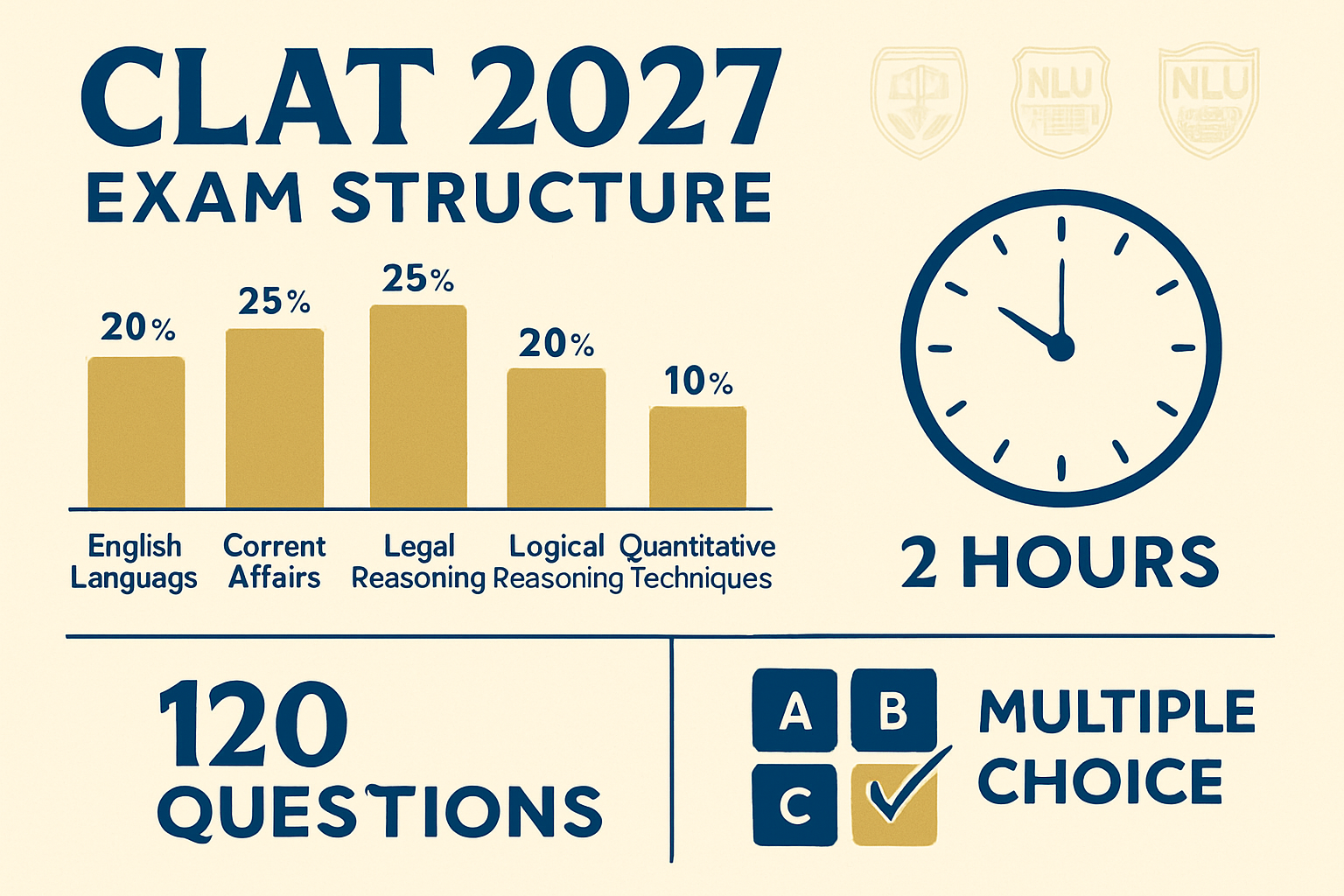
Before diving deep into the CLAT 2027 exam syllabus, let’s get crystal clear about what you’re actually preparing for. The Consortium of NLUs has maintained a consistent pattern that emphasizes analytical thinking over cramming.
Exam Overview:
- Duration: 2 hours (120 minutes)
- Questions: 120 multiple choice questions
- Marking Scheme: +1 for correct answers, -0.25 for incorrect ones
- Mode: Computer-based test (CBT)
- Language: English only
The beauty of understanding this structure is that it immediately tells you how to approach your preparation. With exactly one minute per question, speed and accuracy become your best friends.
Subject-Wise Question Distribution
| Subject | Number of Questions | Weightage | Time Allocation |
|---|---|---|---|
| English Language | 22-26 questions | ~20% | 20-25 minutes |
| Current Affairs & GK | 35-39 questions | ~32% | 35-40 minutes |
| Legal Reasoning | 22-26 questions | ~20% | 20-25 minutes |
| Logical Reasoning | 22-26 questions | ~20% | 20-25 minutes |
| Quantitative Techniques | 10-14 questions | ~10% | 10-15 minutes |
This distribution isn’t random. It reflects what law schools actually value in their students. Notice how Current Affairs gets the highest weightage? That’s because lawyers need to stay connected with the world around them.
Comprehensive CLAT 2027 Exam Syllabus Breakdown
Now let’s break down each section of the CLAT 2027 exam syllabus with the kind of detail that actually helps you prepare smarter, not harder.
English Language Section
The English section isn’t about fancy vocabulary or complex grammar rules. It’s designed to test your reading comprehension and language skills that you’ll actually use in law school.
What You’ll Face:
- 4-5 passages of 450 words each
- Fiction, non-fiction, and contemporary writing samples
- Questions on main ideas, inferences, and tone
Key Topics in CLAT 2027 Exam Syllabus:
- Reading Comprehension: Understanding explicit and implicit meanings
- Vocabulary in Context: Meaning of words as used in passages
- Grammar and Usage: Basic rules applied in context
- Critical Analysis: Author’s intent, tone, and perspective
Pro Tip: The passages often come from sources like The Hindu, Indian Express, or literary works. Start reading these publications regularly – it’s like getting a sneak peek into your exam material.
Current Affairs and General Knowledge
This section carries the maximum weightage in the CLAT 2027 exam syllabus, and for good reason. Law students need to understand the world they’ll be working to change.
Coverage Period: Typically 12 months preceding the exam
Major Areas:
- Political Developments: Government policies, elections, international relations
- Economic Updates: Budget highlights, major economic policies, business news
- Social Issues: Education, health, environment, human rights
- Legal Updates: Important judgments, new laws, constitutional amendments
- International Affairs: Global events affecting India, treaties, summits
- Science and Technology: Innovations, space missions, medical breakthroughs
- Sports and Culture: Major tournaments, awards, cultural events
The secret sauce? Focus on these high-yield GK topics that consistently appear in CLAT papers.
Legal Reasoning Section
Don’t worry if you’ve never studied law before. The Legal Reasoning section in the CLAT 2027 exam syllabus is designed for students with no prior legal background.
Format: Passages describing legal principles, followed by fact-based scenarios
Core Topics:
- Constitutional Law: Fundamental rights, directive principles, basic structure
- Contract Law: Agreement, consideration, breach, remedies
- Tort Law: Negligence, defamation, nuisance
- Criminal Law: Basic concepts of crime, punishment, defenses
- Family Law: Marriage, divorce, adoption, inheritance
- International Law: Basic principles, treaties, sovereignty
What Makes This Tricky: You’re not expected to memorize legal provisions. Instead, you need to apply given principles to new situations. It’s like solving puzzles with legal logic.
Logical Reasoning Section
This section tests your ability to think clearly and systematically – exactly what lawyers do every day.
Question Types in CLAT 2027 Exam Syllabus:
- Analytical Reasoning: Arrangements, groupings, sequences
- Critical Reasoning: Assumptions, conclusions, strengthen/weaken arguments
- Syllogisms: Logical deductions from given statements
- Blood Relations: Family tree problems
- Coding-Decoding: Pattern recognition
- Direction and Distance: Spatial reasoning
- Data Sufficiency: Determining if given information is adequate
The Real Challenge: These aren’t just puzzle-solving skills. They mirror the analytical thinking you’ll use when examining evidence, building arguments, or spotting logical fallacies in opposing counsel’s case.
Quantitative Techniques Section
The smallest section by weightage, but don’t underestimate it. These questions can be your quick score boosters if prepared well.
Topics Covered:
- Basic Mathematics: Ratios, percentages, profit and loss
- Algebra: Simple equations, inequalities
- Geometry: Areas, volumes, basic theorems
- Statistics: Averages, median, mode, basic probability
- Data Interpretation: Charts, graphs, tables
- Number Systems: LCM, HCF, prime numbers
Smart Strategy: Since this section has fewer questions, focus on accuracy over attempting everything. Master these quantitative techniques that give maximum returns.
Strategic Preparation Approach for CLAT 2027
Understanding the CLAT 2027 exam syllabus is just the beginning. The real game-changer is how you approach your preparation strategy.
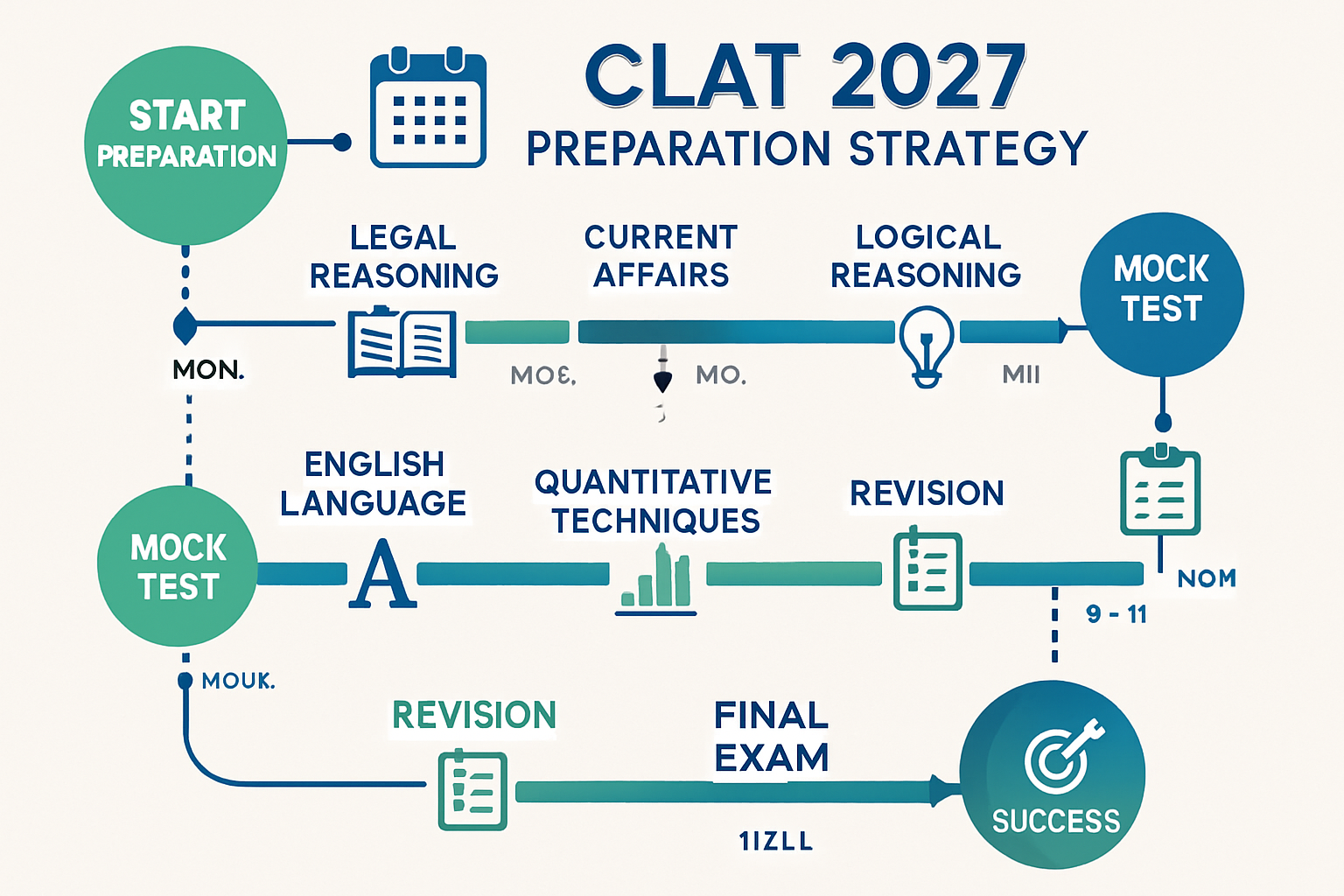
Phase-Wise Preparation Timeline
Foundation Phase (6-8 months before exam):
- Build reading habits with quality newspapers and magazines
- Strengthen basic concepts in all five sections
- Start maintaining current affairs notes
- Practice basic logical reasoning and quantitative problems
Intensive Phase (3-6 months before exam):
- Increase passage-based practice across all sections
- Take sectional tests to identify weak areas
- Deepen current affairs knowledge with legal focus
- Begin full-length mock tests
Revision Phase (Last 3 months):
- Focus on mock tests and previous year papers
- Quick revision of current affairs and legal principles
- Work on time management and exam strategy
- Address specific weaknesses identified through tests
Subject-Wise Preparation Strategies
English Language Mastery:
Start with newspapers like The Hindu or Indian Express. Don’t just read – analyze. What’s the author’s main argument? What evidence do they provide? This active reading builds the exact skills CLAT tests.
Current Affairs Excellence:
Create monthly compilations focusing on legal and constitutional developments. Avoid these common GK preparation mistakes that waste precious time.
Legal Reasoning Confidence:
Practice applying principles to new scenarios daily. Start with simple contract law problems, then gradually move to constitutional law applications.
Logical Reasoning Precision:
Dedicate 30 minutes daily to different question types. Rotate between analytical reasoning, critical reasoning, and puzzles to maintain variety.
Quantitative Techniques Efficiency:
Focus on speed and accuracy. Since this section has fewer questions, every mark counts. Practice mental math and shortcut techniques.
Expert Tips for CLAT 2027 Success
After helping thousands of students crack CLAT, here are the insights that actually make a difference:
Reading Strategy That Works
Most students read passively. Instead, read like a lawyer:
- Identify the main argument in the first paragraph
- Look for evidence and examples
- Note any counterarguments or opposing views
- Predict what questions might be asked
This approach works for every section because CLAT 2027 is fundamentally about comprehension and analysis.
Time Management Secrets
The 3-Pass Strategy:
- First Pass: Attempt questions you’re confident about (aim for 70-80 questions)
- Second Pass: Tackle moderate difficulty questions (15-20 more questions)
- Third Pass: Educated guesses on remaining questions
This strategy ensures you don’t get stuck on difficult questions while easier ones remain unattempted.
Mock Test Analysis Framework
Taking mocks isn’t enough – analyzing them properly is what separates toppers from the rest:
After Each Mock:
- Identify question types where you’re consistently making errors
- Note time spent per section versus optimal allocation
- Review incorrect answers to understand why you went wrong
- Track improvement trends over multiple tests
Weekly Analysis:
- Compare performance across different topics
- Adjust study plan based on mock test insights
- Focus extra time on consistently weak areas
Common Preparation Pitfalls to Avoid
Over-Studying Current Affairs: Yes, it has maximum weightage, but don’t neglect other sections. A balanced approach works better.
Ignoring Previous Year Papers: The CLAT 2027 exam syllabus might seem vast, but previous papers show you exactly how concepts are tested.
Perfectionist Trap: Don’t aim to master every topic completely. Strategic preparation with 80% mastery across all sections beats 100% mastery in three sections.
Mock Test Overload: Quality over quantity. Take 2-3 good mocks per week rather than attempting one daily without proper analysis.
Technology and Resources for CLAT 2027 Preparation
The right resources can accelerate your preparation significantly. Here’s what actually works:
Essential Study Materials
For Current Affairs:
- Monthly current affairs compilations focused on legal developments
- Quality newspapers with legal section emphasis
- Government websites for policy updates
For Legal Reasoning:
- Basic law textbooks for conceptual clarity
- Previous year CLAT papers for application practice
- Legal news websites for contemporary legal issues
For Other Sections:
- Standard reasoning books for logical reasoning
- Basic mathematics books for quantitative techniques
- English comprehension practice books
Digital Preparation Tools
Mock Test Platforms: Choose platforms that provide detailed analysis and adaptive learning features.
Current Affairs Apps: Use apps that categorize news by subjects and provide legal affairs separately.
Time Management Tools: Practice with online timers that simulate actual exam conditions.
Building a Support System
Study Groups: Form small groups with serious aspirants for regular discussions and doubt clearing.
Mentor Guidance: Connect with seniors who’ve cracked CLAT for practical insights and motivation.
Professional Coaching: Consider online CLAT coaching for structured preparation and expert guidance.
Success Stories and Insights from CLAT Toppers
Learning from those who’ve successfully navigated the CLAT 2027 exam syllabus can provide invaluable insights:
Topper Strategy #1: The Newspaper Method
“I treated newspaper reading like a daily exam. Every article became a comprehension passage, every editorial a legal reasoning exercise. This single habit improved my performance across multiple sections.” – Priya, NLSIU Bangalore
Topper Strategy #2: The Teaching Technique
“I explained legal principles to my study partner daily. If you can teach a concept, you truly understand it. This helped me tackle even complex legal reasoning questions confidently.” – Arjun, NALSAR Hyderabad
Topper Strategy #3: The Error Journal
“I maintained a detailed journal of every mistake in mock tests. Within two months, I could predict my likely error patterns and avoid them during the actual exam.” – Sneha, NUJS Kolkata
Psychological Preparation and Stress Management
The CLAT 2027 exam syllabus is comprehensive, and the pressure can be overwhelming. Here’s how to maintain peak mental performance:
Building Exam Day Confidence
Simulation Practice: Take mocks in exam-like conditions – same timing, similar environment, no distractions.
Positive Visualization: Spend 10 minutes daily visualizing yourself confidently solving questions and achieving your target score.
Stress Inoculation: Gradually increase practice intensity to build resilience for exam day pressure.
Maintaining Motivation During Long Preparation
Goal Setting: Break down your target score into section-wise goals, then into daily practice targets.
Progress Tracking: Maintain a preparation diary noting daily achievements and improvements.
Reward System: Set weekly rewards for meeting study targets – this maintains motivation over months of preparation.
Handling Pre-Exam Anxiety
Breathing Techniques: Practice deep breathing exercises that you can use during the actual exam.
Positive Self-Talk: Develop a set of encouraging phrases to counter negative thoughts during stressful moments.
Backup Planning: Have a clear plan for what you’ll do if things don’t go as expected – this reduces anxiety about the unknown.
Financial Planning and Scholarship Opportunities
Preparing for CLAT and subsequent law school education requires financial planning:
Cost-Effective Preparation Strategies
Free Resources: Utilize free mock tests, government websites for current affairs, and library resources for basic concepts.
Group Study: Share costs of study materials and coaching with serious study partners.
Budget-Friendly Coaching Options: Explore online coaching platforms that offer quality education without premium pricing.
Scholarship Opportunities
Merit-Based Scholarships: Most NLUs offer scholarships based on CLAT rank and academic performance.
Need-Based Financial Aid: Many institutions provide fee waivers and financial assistance for economically disadvantaged students.
External Scholarships: Research corporate and foundation scholarships specifically for law students.
Career Prospects After Clearing CLAT 2027
Understanding what lies ahead can fuel your motivation during challenging preparation phases:
Immediate Opportunities
Corporate Law: Join top law firms with starting packages ranging from ₹15-25 lakhs annually.
Litigation: Build a practice in areas like constitutional law, commercial disputes, or criminal defense.
Judicial Services: Prepare for judicial examinations to become a judge in lower courts.
Long-term Career Paths
Senior Advocate: Develop expertise in specific legal areas and appear before higher courts.
In-House Counsel: Work directly for corporations, handling their legal affairs.
Legal Academia: Pursue higher studies and teaching positions in law schools.
Public Service: Join government legal departments or regulatory bodies.
International Opportunities: Work with international law firms or organizations.
Final Preparation Checklist for CLAT 2027
As exam day approaches, ensure you’ve covered all bases:
Two Weeks Before Exam
- Complete revision of all current affairs notes
- Take final mock tests focusing on time management
- Review common error patterns and avoidance strategies
- Prepare exam day essentials (documents, stationery, etc.)
One Week Before Exam
- Light revision only – avoid learning new concepts
- Practice relaxation techniques daily
- Confirm exam center location and travel arrangements
- Maintain regular sleep schedule
Day Before Exam
- Quick review of important formulas and legal principles
- Prepare exam day kit with all required documents
- Get adequate sleep (7-8 hours)
- Avoid discussing exam strategies with anxious peers
Exam Day Strategy
- Reach exam center 30 minutes early
- Use the 3-pass strategy for question attempts
- Stay calm if you encounter difficult questions
- Trust your preparation and avoid second-guessing
Conclusion
The CLAT 2027 exam syllabus might seem comprehensive, but with the right approach, it becomes your roadmap to success rather than an overwhelming burden. Remember, thousands of students crack CLAT every year by following strategic preparation methods rather than trying to master everything perfectly.
Your success depends on three key factors: understanding the syllabus structure, consistent daily practice, and smart time management. The passage-based format rewards analytical thinking over rote memorization, which means you’re building skills that will serve you well throughout your legal career.
Start with a realistic assessment of your current preparation level, then create a study plan that aligns with the CLAT 2027 exam syllabus weightage. Focus extra attention on Current Affairs since it carries maximum marks, but don’t neglect other sections. Remember, even a 10% improvement in your weaker sections can significantly boost your overall score.
Most importantly, stay consistent with your preparation schedule. Small daily efforts compound over months to create remarkable results. Whether you’re starting your preparation now or fine-tuning your strategy, the comprehensive CLAT 2027 exam syllabus breakdown in this guide provides the foundation you need.
Ready to begin your CLAT 2027 journey? Join thousands of successful CLAT aspirants who’ve turned their law school dreams into reality with expert guidance and proven strategies. Your future at India’s premier National Law Universities starts with mastering this syllabus today.