How the Legal Profession is Going to Transform in the AI Era

The legal profession stands at the threshold of its most significant transformation in centuries. As artificial intelligence reshapes industries worldwide, the practice of law is experiencing unprecedented change that will redefine how legal professionals work, serve clients, and deliver justice. For aspiring lawyers and current practitioners alike, understanding these shifts isn’t just beneficial—it’s essential for career survival and success.
This transformation isn’t happening in some distant future. It’s unfolding right now, in 2025, as law firms, courts, and legal departments worldwide embrace AI technologies that promise to revolutionize everything from contract analysis to case prediction. The question isn’t whether the legal profession will change, but how quickly and dramatically these changes will reshape the industry.
Key Takeaways
• AI integration is accelerating rapidly across all areas of legal practice, from research and document review to client consultation and case strategy development
• Traditional legal roles are evolving rather than disappearing, with lawyers becoming AI-augmented professionals who combine human judgment with machine efficiency
• New skill requirements are emerging that blend legal expertise with technological literacy, data analysis capabilities, and AI collaboration techniques
• Client expectations are shifting dramatically toward faster, more cost-effective, and data-driven legal services powered by intelligent automation
• Career preparation strategies must adapt to include AI literacy, continuous learning, and hybrid skill development for long-term professional success
The Current State of AI Revolution in the Legal Profession

The legal profession has traditionally been resistant to change, but AI is breaking through centuries-old practices with remarkable speed. Today’s law firms are implementing sophisticated AI systems that can analyze thousands of documents in minutes, predict case outcomes with startling accuracy, and draft legal documents with minimal human intervention.
Generative AI is transforming legal research fundamentals. Modern AI platforms can process vast legal databases, identify relevant precedents, and synthesize complex legal arguments faster than teams of junior associates. This shift is particularly evident in large law firms, where AI-powered research tools have reduced research time by up to 70% while improving accuracy and comprehensiveness.
Contract analysis represents another area of dramatic change. AI systems now review commercial agreements, identify potential risks, and suggest modifications with precision that often exceeds human capabilities. These tools don’t just speed up the process—they’re changing how lawyers approach contract negotiation and risk assessment entirely.
The adoption rate is accelerating beyond predictions. According to recent industry surveys, over 85% of large law firms have implemented some form of AI technology in 2025, compared to just 25% in 2020. This rapid adoption reflects not just technological advancement but fundamental shifts in client expectations and competitive pressures.
Legal departments in corporations are leading this transformation. In-house counsel teams are using AI for compliance monitoring, regulatory analysis, and risk prediction. These applications demonstrate how AI isn’t replacing legal judgment but augmenting it with data-driven insights that were previously impossible to obtain.
For CLAT PG aspirants, understanding this current landscape is crucial. The legal profession you’re entering will be fundamentally different from the one that existed even five years ago. Success will require not just traditional legal skills but also comfort with AI tools and data-driven decision making.
Revolutionary Technologies Reshaping Legal Practice
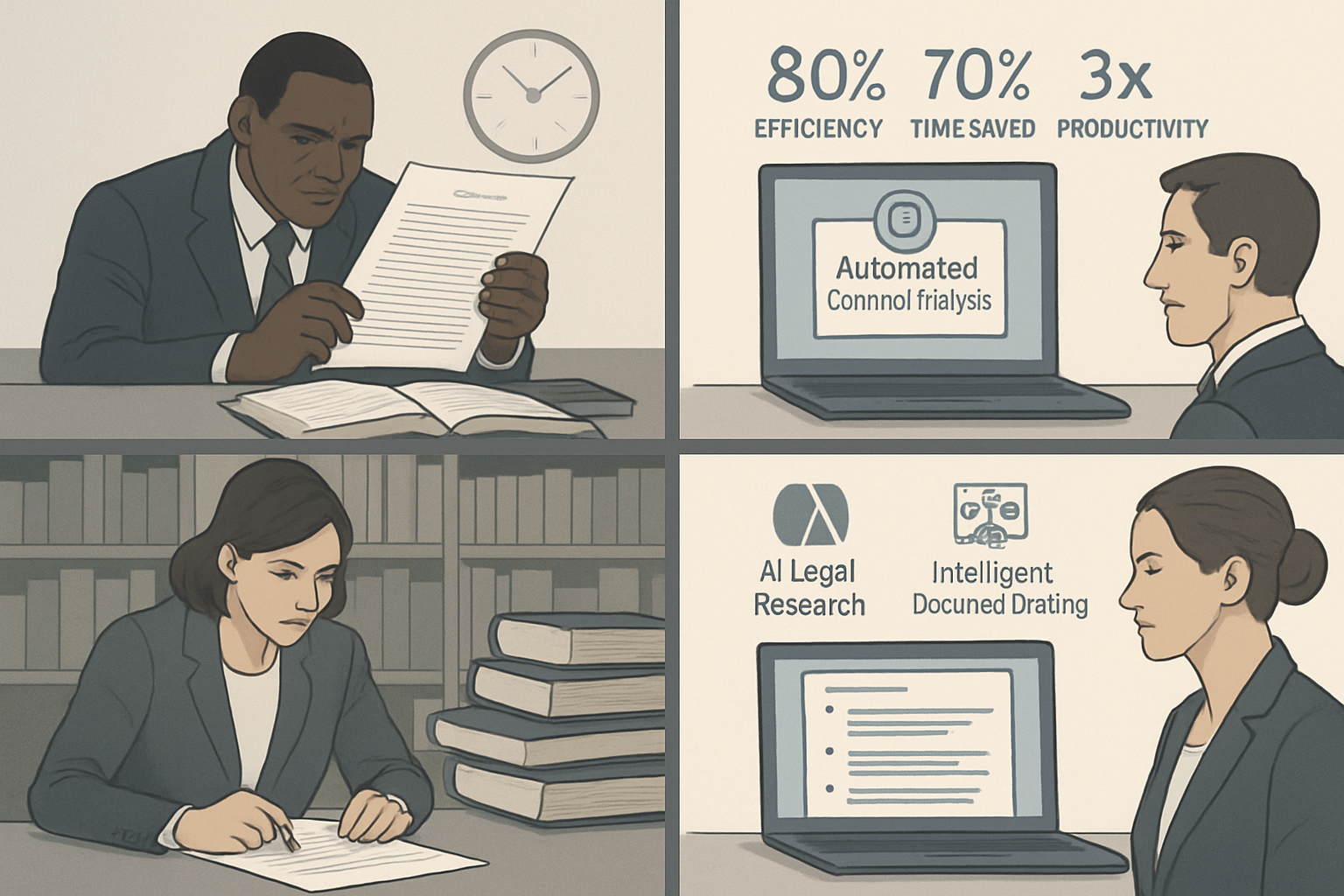
The technological transformation of the legal profession extends far beyond simple automation. Advanced AI technologies are creating entirely new ways of practicing law, fundamentally altering how legal professionals approach their work and serve clients.
Machine Learning and Predictive Analytics
Predictive legal modeling is revolutionizing case strategy. Advanced algorithms analyze historical case data, judge patterns, and legal precedents to predict outcomes with remarkable accuracy. Lawyers can now assess the likelihood of success in litigation before filing, helping clients make more informed decisions about pursuing legal action.
These systems examine factors that human analysis might miss—subtle patterns in judicial decisions, correlations between case characteristics and outcomes, and trends that emerge across thousands of similar cases. The result is strategic advice based on comprehensive data analysis rather than intuition alone.
Risk assessment has become data-driven. AI systems evaluate regulatory compliance, contract risks, and potential legal exposures with precision that manual review cannot match. This capability is particularly valuable in complex commercial transactions where multiple legal risks intersect.
Natural Language Processing in Legal Applications
Legal documents are becoming more accessible through AI-powered natural language processing. These systems can translate complex legal language into plain English, making legal services more transparent and client-friendly. They also enable automated document generation that maintains legal precision while reducing drafting time.
Contract intelligence platforms use NLP to extract key terms, identify unusual clauses, and flag potential issues across large document portfolios. This technology is transforming how law firms handle due diligence, merger and acquisition reviews, and ongoing contract management.
Automated Legal Research and Discovery
Traditional legal research, which once required hours of manual searching through case law and statutes, now happens in minutes. AI research platforms understand legal concepts, not just keywords, enabling more sophisticated and comprehensive research results.
E-discovery has been completely transformed. AI systems can process millions of documents, identify privileged communications, and locate relevant evidence with speed and accuracy that manual review cannot achieve. This transformation has made large-scale litigation more manageable and cost-effective.
The implications extend beyond efficiency gains. These technologies are enabling smaller firms to compete with larger ones by providing access to sophisticated analytical capabilities that were previously available only to well-resourced practices.
For law students preparing for their careers, familiarity with these technologies isn’t optional. The legal profession transformation requires practitioners who can effectively collaborate with AI systems while maintaining the critical thinking and ethical judgment that remain uniquely human.
Transformation of Traditional Legal Roles and Career Paths

The integration of AI into legal practice is fundamentally reshaping career trajectories and professional responsibilities across the legal profession. Rather than eliminating legal jobs, AI is creating new roles while transforming existing ones in ways that require fresh thinking about legal careers.
Evolution of Junior Associate Responsibilities
The traditional junior associate role is being redefined. Tasks that once occupied first and second-year associates—document review, basic research, and routine drafting—are increasingly handled by AI systems. This shift is forcing law firms to reconsider how they train new lawyers and what value junior associates provide.
Instead of spending months on document review, new associates are now expected to focus on client interaction, strategic analysis, and complex problem-solving from day one. This change accelerates professional development but also raises the bar for entry-level competency.
Billable hour models are under pressure. When AI can complete in minutes what previously took hours, traditional billing structures become unsustainable. Law firms are experimenting with value-based pricing, fixed fees, and hybrid models that reflect the efficiency gains from AI integration.
Emergence of New Legal Specializations
The legal profession is witnessing the birth of entirely new practice areas. AI governance and algorithmic compliance represent growing fields as organizations grapple with AI regulation and ethical AI implementation. Lawyers specializing in these areas combine traditional legal skills with deep technical understanding.
Legal technology consulting has become a distinct career path. These professionals help law firms and legal departments implement AI systems, ensuring compliance with ethical requirements while maximizing efficiency gains. They serve as bridges between legal practice and technological innovation.
Data privacy and cybersecurity law continue expanding as AI systems handle increasingly sensitive information. These specializations require lawyers who understand both legal frameworks and technical implementation details.
Impact on Partnership Tracks and Leadership
Partnership criteria are evolving to include technological literacy and innovation leadership. Law firms increasingly value partners who can guide AI implementation, develop new service delivery models, and help the firm adapt to technological change.
Senior lawyers who embrace AI augmentation are finding their expertise amplified rather than diminished. They can handle larger caseloads, provide more comprehensive analysis, and deliver faster results while maintaining the strategic thinking and client relationship skills that remain uniquely human.
Changing Skill Requirements
The legal profession now demands hybrid skills that combine traditional legal training with technological fluency. Data literacy has become as important as legal research skills. Lawyers must understand how AI systems work, their limitations, and how to effectively collaborate with them.
Project management and process optimization skills are increasingly valuable as law firms restructure workflows around AI capabilities. Lawyers who can design efficient processes and manage technology-enhanced teams are in high demand.
For those pursuing advanced legal education, understanding these career transformations is essential. The most successful legal professionals will be those who can adapt to these changes while maintaining the core competencies that make human lawyers irreplaceable.
Future Predictions: The Legal Profession in 2030 and Beyond

Looking ahead, the legal profession will continue evolving at an unprecedented pace. The changes we’re witnessing today represent just the beginning of a transformation that will reshape every aspect of legal practice over the next decade.
Autonomous Legal Systems and Their Implications
Fully autonomous legal research and analysis systems will become commonplace by 2030. These AI platforms will not only find relevant cases and statutes but also synthesize legal arguments, identify potential counterarguments, and suggest strategic approaches based on comprehensive analysis of similar cases.
The implications are profound. Legal research, which currently requires significant human oversight, will become largely automated for routine matters. This shift will free lawyers to focus on strategy, negotiation, and complex problem-solving while AI handles information gathering and initial analysis.
Smart contracts and automated compliance will transform transactional law. Self-executing contracts that automatically enforce terms and conditions will reduce the need for ongoing legal oversight in many commercial relationships. However, this automation will create new demands for lawyers who can design, implement, and troubleshoot these systems.
The Rise of Virtual Law Firms and Digital Courts
Fully digital law firms will become the norm rather than the exception. These practices will operate without traditional physical offices, using AI-powered platforms to manage cases, communicate with clients, and collaborate with colleagues. The overhead savings will enable more competitive pricing while maintaining service quality.
Virtual court proceedings, accelerated by the pandemic, will evolve into sophisticated digital justice systems. AI will assist judges with case management, legal research, and even preliminary decision-making in routine matters. This evolution will make justice more accessible while raising important questions about the role of human judgment in legal proceedings.
Global legal practice will become more feasible as AI translation and cross-jurisdictional analysis tools improve. Lawyers will be able to advise clients on international matters with AI assistance that can navigate different legal systems and identify relevant precedents across multiple jurisdictions.
Client Service Transformation
24/7 AI-powered legal consultation will become standard. Clients will interact with AI systems for initial legal advice, document preparation, and case updates, with human lawyers intervening for complex issues or strategic decisions. This model will make legal services more accessible and affordable for individual clients and small businesses.
Legal services will become increasingly predictive rather than reactive. AI systems will monitor regulatory changes, identify potential compliance issues, and alert clients to legal risks before they become problems. This shift from reactive to proactive legal services will fundamentally change the attorney-client relationship.
Personalized legal services will emerge as AI systems learn individual client preferences, risk tolerances, and business objectives. Legal advice will be tailored not just to the legal issue at hand but to the client’s specific circumstances and goals.
Regulatory and Ethical Evolution
New regulatory frameworks will emerge to govern AI use in legal practice. These regulations will address issues like AI bias in legal decision-making, accountability for AI-generated legal advice, and the unauthorized practice of law by AI systems.
The legal profession will need to develop new ethical guidelines for AI collaboration. Questions about client confidentiality when using AI systems, the duty of competence in an AI-augmented world, and the responsibility for AI-generated work will require careful consideration and clear professional standards.
For current law students and aspiring legal professionals, these future developments underscore the importance of building adaptable skills and maintaining technological literacy throughout their careers. The lawyers who thrive in 2030 will be those who embrace change while preserving the core values and competencies that make the legal profession essential to society.
Strategic Preparation for the AI-Enhanced Legal Career
As the legal profession undergoes this dramatic transformation, aspiring lawyers and current practitioners must develop strategic approaches to career preparation that account for AI integration while building on traditional legal strengths.
Essential Skill Development for Modern Legal Practice
Technology literacy has become non-negotiable. Future lawyers must understand how AI systems work, their capabilities and limitations, and how to effectively collaborate with them. This doesn’t require becoming a programmer, but it does mean developing comfort with technology and understanding basic AI concepts.
Critical thinking and analytical reasoning remain paramount, but they must be applied in new contexts. Lawyers will need to evaluate AI-generated analysis, identify potential biases in algorithmic decisions, and synthesize AI insights with human judgment. These skills require practice and intentional development.
Data interpretation and statistical literacy are increasingly important as legal practice becomes more data-driven. Understanding how to read and interpret statistical analyses, recognize patterns in large datasets, and draw meaningful conclusions from quantitative information will distinguish successful practitioners.
Communication skills are evolving beyond traditional legal writing and oral advocacy. Lawyers must be able to explain complex AI-assisted analyses to clients, collaborate effectively with technology teams, and translate between technical and legal concepts.
Educational Pathways and Continuous Learning
Law schools are adapting their curricula to include technology-focused courses, but students must also take initiative in developing relevant skills. Courses in data analysis, technology law, and AI ethics are becoming as important as traditional subjects like contracts and constitutional law.
Professional development will require continuous learning throughout legal careers. The rapid pace of technological change means that skills and knowledge must be constantly updated. Lawyers will need to embrace lifelong learning and stay current with technological developments that affect their practice areas.
Interdisciplinary education is becoming more valuable. Lawyers who understand business, technology, data science, or other fields in addition to law will be better positioned to navigate the AI-enhanced legal landscape. This might involve pursuing additional certifications, attending technology conferences, or collaborating with professionals from other disciplines.
Building Competitive Advantages
Specialization in AI-adjacent legal areas offers significant opportunities. Privacy law, cybersecurity, AI governance, and technology transactions are growth areas that combine legal expertise with technological understanding. These specializations position lawyers to serve clients navigating the digital transformation.
Developing expertise in specific AI tools and platforms can create competitive advantages. Lawyers who become proficient with particular AI research platforms, contract analysis tools, or case prediction systems can offer enhanced services to clients while working more efficiently.
Client relationship skills become even more important as routine tasks become automated. The ability to understand client needs, provide strategic counsel, and build trust will differentiate human lawyers from AI systems. These relationship skills cannot be automated and will remain central to legal practice.
Networking and Professional Development
Professional associations are evolving to address AI integration challenges. Joining technology-focused legal organizations, attending AI and law conferences, and participating in discussions about the future of legal practice provide valuable networking opportunities and keep practitioners current with developments.
Mentorship relationships should include guidance on technology adoption and AI integration. Young lawyers should seek mentors who are successfully navigating the technological transformation while maintaining traditional legal excellence.
Cross-industry collaboration is becoming more important as legal practice intersects with technology, data science, and other fields. Building relationships with professionals outside the legal industry can provide insights into technological trends and create opportunities for innovative service delivery.
For those preparing for legal careers through competitive exams, understanding these strategic considerations is crucial. The legal profession you’re entering will reward those who can combine traditional legal excellence with technological fluency and adaptability.
Success in the AI-enhanced legal profession requires embracing change while maintaining the core values and competencies that make lawyers essential. The most successful practitioners will be those who view AI as a powerful tool that enhances rather than replaces human legal expertise.
Challenges and Opportunities in the Evolving Legal Landscape
The transformation of the legal profession through AI integration presents both significant challenges and unprecedented opportunities. Understanding and preparing for these dynamics will be crucial for anyone entering or advancing in the legal field.
Addressing Implementation Challenges
Ethical considerations represent one of the most complex challenges facing the legal profession. AI systems can perpetuate biases present in their training data, potentially leading to discriminatory outcomes in legal analysis or decision-making. Lawyers must develop the ability to identify and mitigate these biases while ensuring that AI-assisted legal services meet ethical standards.
Client confidentiality becomes more complex when AI systems process sensitive legal information. Law firms must implement robust security measures and understand how different AI platforms handle confidential data. This requires new protocols and potentially new interpretations of professional responsibility rules.
The digital divide poses challenges for both legal practitioners and clients. Smaller firms may struggle to afford advanced AI tools, potentially creating competitive disadvantages. Similarly, clients without access to technology may be left behind as legal services become increasingly digital.
Quality control in AI-assisted legal work requires new approaches. While AI can process information quickly and identify patterns humans might miss, it can also make errors or miss nuances that experienced lawyers would catch. Developing effective oversight and quality assurance processes is essential.
Economic Disruption and Market Dynamics
Pricing pressures are intensifying as AI reduces the time required for many legal tasks. Clients increasingly question traditional hourly billing when they know AI can complete certain work in minutes. This pressure is forcing law firms to reconsider their business models and find new ways to demonstrate value.
The legal services market is becoming more competitive as technology lowers barriers to entry. Solo practitioners and small firms can now access sophisticated analytical tools that were previously available only to large firms. This democratization of legal technology is reshaping competitive dynamics across the profession.
Employment patterns are shifting as AI automates routine tasks. While this doesn’t necessarily mean fewer legal jobs overall, it does mean different types of jobs with different skill requirements. The profession must adapt training and career development programs to match these new realities.
Unprecedented Opportunities for Innovation
Access to justice could be dramatically improved through AI-powered legal services. Automated document preparation, AI-assisted legal research, and virtual consultation platforms can make legal services more affordable and accessible to underserved populations.
New practice areas are emerging around AI governance, algorithmic auditing, and technology compliance. These fields offer opportunities for lawyers to develop expertise at the intersection of law and technology, potentially commanding premium fees for specialized knowledge.
Global practice opportunities are expanding as AI translation and cross-jurisdictional analysis tools improve. Lawyers can serve clients across borders more effectively, opening new markets and practice possibilities.
Enhanced analytical capabilities allow lawyers to provide more strategic and valuable counsel. AI-powered insights into case outcomes, regulatory trends, and market dynamics enable lawyers to offer advice that goes beyond traditional legal analysis to include predictive and strategic elements.
Professional Development and Career Resilience
Continuous learning becomes essential as the pace of change accelerates. Lawyers must develop habits of lifelong learning and stay current with technological developments that affect their practice areas. This requires time management skills and a commitment to professional development that extends throughout entire careers.
Building resilience requires diversifying skills and maintaining adaptability. Lawyers who develop expertise in multiple areas and remain flexible about how they apply their skills will be better positioned to navigate ongoing changes in the profession.
Collaboration skills are becoming more important as legal work increasingly involves interdisciplinary teams. Lawyers must be able to work effectively with data scientists, technology specialists, and other professionals who bring different perspectives and expertise to legal challenges.
For aspiring legal professionals, these challenges and opportunities underscore the importance of developing both traditional legal skills and technological literacy. The most successful lawyers will be those who can navigate complexity, embrace innovation, and maintain ethical standards while delivering exceptional client service.
The transformation of the legal profession is not something happening to lawyers—it’s something lawyers can actively shape through thoughtful engagement with technology and commitment to professional excellence. Those who approach these changes strategically will find unprecedented opportunities for career growth and professional impact.
Conclusion
The legal profession stands at an unprecedented inflection point. The integration of artificial intelligence and advanced technologies is not just changing how lawyers work—it’s fundamentally redefining what it means to practice law in the 21st century. For CLAT PG aspirants and current legal professionals, understanding and preparing for these changes isn’t optional; it’s essential for career success and professional relevance.
The transformation we’re witnessing goes beyond simple automation. AI is creating new practice areas, reshaping traditional roles, and enabling lawyers to provide more strategic, data-driven counsel than ever before. While this evolution presents challenges—from ethical considerations to the need for continuous learning—it also offers unprecedented opportunities for those willing to adapt and grow.
Success in tomorrow’s legal profession will require a unique blend of traditional legal excellence and technological fluency. The lawyers who thrive will be those who can harness AI’s analytical power while maintaining the critical thinking, ethical judgment, and client relationship skills that remain uniquely human. They will view AI not as a threat to their profession but as a powerful tool that amplifies their capabilities and enables them to deliver greater value to clients.
For aspiring lawyers preparing through comprehensive CLAT preparation, the message is clear: embrace technology while building strong foundational legal skills. The legal profession of 2030 will reward those who can navigate complexity, think strategically, and adapt to continuous change while upholding the highest ethical standards.
The future belongs to lawyers who are curious, adaptable, and committed to lifelong learning. As the legal profession continues its transformation, those who prepare thoughtfully and embrace change strategically will find themselves at the forefront of a more efficient, accessible, and impactful legal system.
Your success is our mission at Lawgic Coaching, and we’re here to help you navigate not just your CLAT preparation but also your long-term career success in this evolving legal landscape. The legal profession is changing rapidly, but with the right preparation and mindset, these changes represent opportunities for unprecedented professional growth and impact.
Legal Career Readiness Assessment
Evaluate your preparedness for the AI-enhanced legal profession and discover personalized development recommendations