Starting your journey toward a career in law means understanding the intricate details of our legal system. And when it comes to criminal procedure, there’s a monumental shift on the horizon: the Bharatiya Nagarik Suraksha Sanhita (BNSS), 2023. This new legislation is set to replace the age-old Code of Criminal Procedure, 1973 (CrPC), and it brings with it several significant changes that every CLAT aspirant, and indeed every citizen, needs to grasp. One of the most impactful of these changes is the strengthened mandate of the Zero FIR under BNSS. This isn’t just a minor tweak; it’s a fundamental reimagining of how initial complaints are handled, designed to make justice more accessible and efficient for victims. Understanding this concept is crucial, not only for your CLAT exams but for comprehending the evolving landscape of Indian law.
Key Takeaways
- Expanded Scope: The BNSS, 2023, formally enshrines and expands the concept of the Zero FIR, making it a mandatory practice for all police stations, regardless of territorial jurisdiction.
- Victim-Centric Approach: This mandate aims to make the reporting of crimes more victim-friendly, ensuring that delay due to jurisdictional issues does not impede the initial registration of a complaint.
- Immediate Action: Police stations are now obligated to register a Zero FIR immediately upon receiving information about a cognizable offense, even if the incident occurred outside their designated area.
- Seamless Transfer: After registration, the Zero FIR must be promptly transferred to the police station with the appropriate jurisdiction for further investigation, preventing crucial time loss.
- Enhanced Accountability: The BNSS strengthens the accountability of police officers, with provisions for departmental action against those who fail to register a Zero FIR, emphasizing the seriousness of this mandate.
Let’s dive deeper into what this really means, exploring how the BNSS fundamentally alters the initial steps of criminal procedure and why this is such a vital development for anyone aspiring to legal excellence.
Understanding the Evolution: From CrPC to BNSS and the “Zero FIR” Mandate
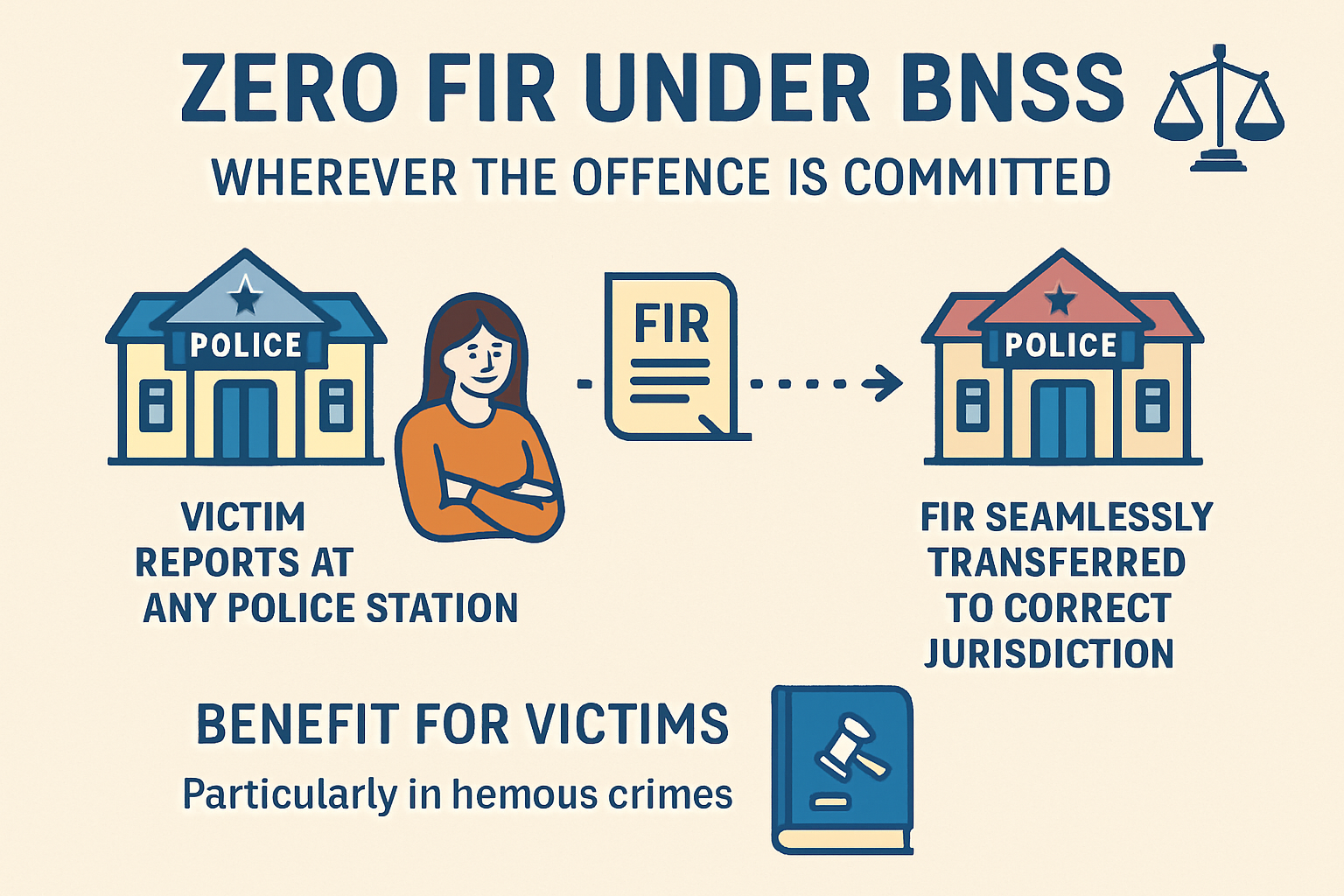
You know, the legal system isn’t static; it’s always evolving, adapting to societal needs and technological advancements. For decades, the Code of Criminal Procedure, 1973 (CrPC) was the backbone of how criminal cases were handled in India. But with the passage of the Bharatiya Nagarik Suraksha Sanhita (BNSS), 2023, we’re looking at a new chapter. This isn’t just about changing a few words; it’s a comprehensive overhaul that seeks to streamline justice delivery, embrace digital processes, and, significantly, empower victims. And right at the heart of these victim-centric reforms lies the strengthened concept of the Zero FIR under BNSS.
Now, what exactly was a First Information Report (FIR) under the old system? Simply put, it’s the document recorded by the police when they receive information about a cognizable offense [1]. A cognizable offense is one where the police can arrest a person without a warrant, like murder, robbery, or assault. The FIR is the very first step that sets the criminal justice machinery in motion. Without an FIR, an investigation into a cognizable offense generally can’t begin.
But here’s the thing about the old system, and where the concept of Zero FIR became crucial: jurisdiction. Imagine a situation where someone is assaulted while traveling from Mumbai to Pune. When they try to report the crime in Pune, the local police might tell them, “Sorry, this happened in Mumbai, you need to go file your complaint there.” Or worse, they might pass you around from one police station to another, citing territorial jurisdiction. This delay, this jurisdictional ping-pong, could be devastating for a victim. Evidence could be lost, crucial time wasted, and the victim’s faith in the system eroded.
That’s where the idea of a “Zero FIR” came in. Even before BNSS, the Supreme Court of India, in landmark judgments like Lalita Kumari v. Government of U.P. [2], had affirmed the principle that registration of an FIR is mandatory if the information discloses a cognizable offense, irrespective of territorial jurisdiction. The concept of a Zero FIR meant that any police station, upon receiving information about a cognizable offense, must register an FIR, even if the crime didn’t occur within their territorial limits. This FIR would be given a serial number “0” (hence “Zero FIR”) and then transferred to the appropriate police station. It was a judicial innovation designed to prevent victims from being turned away on jurisdictional grounds.
However, despite judicial pronouncements, the implementation of Zero FIR wasn’t always consistent. Some police stations would still hesitate, citing lack of resources or understanding. This is where the BNSS steps in, making this crucial concept a statutory mandate. Section 173 of the BNSS explicitly deals with information in cognizable cases and how it should be handled. It essentially codifies and strengthens the Zero FIR, making it a non-negotiable part of criminal procedure. This means that now, legally, a police officer cannot refuse to register your complaint on the grounds of jurisdiction if it pertains to a cognizable offense. This is a game-changer, especially for vulnerable victims, ensuring that their first point of contact with law enforcement is one of immediate support, not bureaucratic hurdle. It’s about ensuring that your pursuit of justice begins the moment you report the crime, not after you’ve navigated a labyrinth of police stations. This proactive approach is a cornerstone of the BNSS’s vision for a more responsive justice system.
Why is Zero FIR so important for victims?
Let’s be honest, reporting a crime can be incredibly daunting. Victims are often traumatized, disoriented, and seeking immediate help. The last thing they need is to be told to travel long distances or argue about which police station has the “right” to listen to their story. The Zero FIR concept addresses several critical issues:
- Prevents Delay: Time is often of the essence in criminal investigations. Delays can lead to the loss of crucial evidence, witnesses forgetting details, or even perpetrators escaping. A Zero FIR ensures that the investigative process can begin without geographical hindrances.
- Empowers Victims: It puts the victim’s needs first, providing a clear pathway for reporting regardless of where they are or where the crime occurred. This is particularly vital in cases of sexual assault, human trafficking, or crimes committed against migrant workers, where victims might be far from the actual crime scene.
- Enhances Accessibility: It makes police stations truly accessible as points of first contact for any cognizable offense, fostering greater trust between the public and law enforcement.
- Increases Accountability: By making it a statutory duty, the BNSS places a clear obligation on police officers to register the complaint, reducing instances of refusal and ensuring accountability.
Understanding the transition from CrPC to BNSS, and especially the enhanced role of the Zero FIR, is fundamental for CLAT aspirants. It showcases not just legal changes but the underlying principles of justice, equity, and victim protection that drive these reforms. For more on how to approach complex legal concepts in your CLAT preparation, you might find our guide on Ailet vs CLAT Coaching Differences helpful, as it delves into the nuances of various legal entrance exams. This is the kind of practical legal knowledge that truly sets aspiring lawyers apart.
Transitioning from the foundational understanding of Zero FIR, let’s look at the specifics of how the BNSS has formally incorporated and strengthened this mechanism.
Zero FIR Under BNSS: The Mandate and its Implications
So, we’ve established the ‘why’ behind the Zero FIR, but now let’s get into the ‘how’ and ‘what’ of its strengthened mandate under the Bharatiya Nagarik Suraksha Sanhita (BNSS), 2023. This is where the rubber meets the road, and the BNSS ensures that the good intentions behind the Zero FIR translate into tangible action on the ground. This legislation isn’t just suggesting; it’s mandating.
The crucial provision that codifies the Zero FIR is Section 173 of the BNSS. While the CrPC implicitly supported the concept through judicial interpretation, BNSS explicitly lays it down. Section 173(1) of the BNSS states:
“Every information relating to the commission of a cognizable offence, whether given orally or in writing to an officer in charge of a police station, shall be registered, and a copy thereof shall be given forthwith, free of cost, to the informant.”
And here’s the key addition, further solidifying the Zero FIR under BNSS:
“Provided that if the information is given by a woman against whom an offence under section 64, section 65, section 67, section 68, section 69, section 70, section 71, section 72, section 73, section 74, section 75, section 76, section 77 or section 78 of the Bharatiya Nyaya Sanhita, 2023 has been committed or attempted, such information shall be recorded by a woman police officer or any other woman officer.”
Wait, what does that first part mean for Zero FIR? It means that the police station must register the information about a cognizable offense. It doesn’t say “if it falls within their jurisdiction.” It’s a broad, inclusive mandate. This provision, read in conjunction with the spirit of the BNSS, makes it unequivocally clear that jurisdictional barriers are no longer an excuse for refusing to register a complaint. The term “Zero FIR” itself signifies that the initial complaint is registered without a specific police station code, reflecting the immediate, jurisdiction-agnostic nature of its registration. It’s essentially a temporary FIR that allows the police to start processing the information right away.
Let’s break down the implications of this mandate:
1. Universal Obligation for Police Stations
Every single police station across India is now under a statutory obligation to register a Zero FIR if a cognizable offense is reported to them. This removes the ambiguity that sometimes existed under the CrPC, where some officers might have claimed ignorance or inconvenience. This legal clarity is immense. It transforms what was largely a judicial directive into a clear legislative command. It’s like saying, “No excuses, just get it done.”
2. Immediate Action, Regardless of Geography
The “immediate action” aspect is paramount. As soon as information about a cognizable offense is received, the police officer in charge is legally bound to record it. This means no more telling victims to go to another district, city, or even state. The focus is squarely on the initial act of reporting and getting that crucial information documented without delay. This proactive step helps preserve evidence, secure witness statements, and begin the preliminary steps of an investigation, even before the case is formally transferred.
3. Special Provisions for Women Victims
The BNSS also introduces crucial specific provisions, particularly for women victims. The proviso to Section 173(1) mandates that if a woman reports certain offenses (such as sexual assault, outraging modesty, etc., as enumerated in the Bharatiya Nyaya Sanhita, 2023), the information must be recorded by a woman police officer or another woman officer. This isn’t just about Zero FIR; it’s about making the reporting process more sensitive and supportive for victims of gender-based violence, further reinforcing the victim-centric approach of the BNSS. This ensures a safer, more empathetic environment for victims to come forward.
4. Seamless Transfer to the Appropriate Jurisdiction
Once the Zero FIR is registered, the next step, as per the established practice, is its transfer to the police station that has the correct territorial jurisdiction for further investigation. The BNSS implicitly supports this by requiring the registration of “every information” and then ensuring proper investigation. The onus is on the police to ensure this transfer happens swiftly and smoothly, without burdening the victim further. This is where administrative efficiency plays a critical role. Think of it as a baton pass in a relay race – the goal is to keep the momentum going without dropping the baton.
5. Increased Accountability for Non-Compliance
While the BNSS doesn’t explicitly spell out a penal provision within Section 173 for failing to register a Zero FIR, the broader framework of the law and existing police regulations ensure accountability. Refusal to register an FIR (including a Zero FIR) when a cognizable offense is disclosed is a serious dereliction of duty. Police officers who fail to comply can face departmental inquiries, disciplinary action, and even charges under other relevant sections of law for obstructing justice or dereliction of duty. This potential for accountability acts as a strong deterrent against non-compliance, pushing officers to uphold their statutory duties.
For CLAT aspirants, understanding these nuances is vital. It’s not just about memorizing section numbers, but grasping the practical implications of these changes on the ground. How does this make the police more effective? How does it protect citizens? These are the kinds of questions that separate a good answer from an excellent one in your exams. And trust us, in a field like law, understanding these practical shifts is where you truly start to build your foundation. If you’re looking for expert guidance to navigate such complex topics, remember that Lawgic Coaching offers real mentors from top NLUs who can help you connect these dots and understand the bigger picture.
As we move forward, let’s examine the practical challenges and benefits this mandate brings to the criminal justice system.
Practical Implications and Benefits of Zero FIR Under BNSS
Understanding the “Zero FIR” mandate is one thing; appreciating its real-world impact is another. The changes introduced by BNSS aren’t just theoretical constructs for legal textbooks; they’re designed to reshape how citizens interact with the law, particularly when they’ve been wronged. For you, as a CLAT aspirant, this insight into practical application is invaluable, showing you the human side of legal reforms.
A. Enhanced Access to Justice and Victim Protection
One of the most significant benefits of the strengthened Zero FIR under BNSS is the undeniable boost it gives to access to justice. Let’s paint a picture:
- Victim-Centric Reporting: Imagine someone fleeing domestic violence, reaching a new city, and needing to report the abuse. Under the old system, they might have been told to return to the place of offense, a nearly impossible task. With Zero FIR, they can report it immediately at the nearest police station, ensuring their safety and initiating legal action without further trauma or logistical hurdles.
- Faster Response to Heinous Crimes: In cases of serious offenses like sexual assault or kidnapping, every minute counts. A delay due to jurisdictional arguments can mean the difference between catching a perpetrator and them disappearing. Zero FIR allows for immediate recording of information, dispatching of initial response teams, and preserving critical evidence, irrespective of the eventual jurisdiction. This rapid response is a game-changer for victims and public safety alike.
- Protection for Transient Victims: Think about migrant workers, tourists, or people traveling. If a crime occurs against them, they are often far from their “home” jurisdiction. Zero FIR provides a crucial safety net, ensuring that their complaints are heard and acted upon wherever they happen to be when they report.
This shift truly embodies the spirit of “your success is our mission” in the context of justice, ensuring that procedural technicalities don’t stand in the way of a citizen’s right to seek redress.
B. Streamlining Police Operations and Inter-Agency Coordination
While the Zero FIR primarily benefits victims, it also forces police departments to streamline their internal processes.
- Clearer Protocols for Transfer: Police stations will need robust internal mechanisms for the swift and accurate transfer of Zero FIRs to the appropriate police station. This includes digital transfer systems, proper documentation, and clear communication channels. The BNSS itself emphasizes the use of technology, promoting e-FIRs and digital records, which will greatly facilitate this process [3].
- Better Data Collection: With all complaints being registered immediately, there’s a potential for more accurate and comprehensive crime data. This data can then be used for better resource allocation, crime pattern analysis, and preventative strategies.
- Improved Accountability: The statutory nature of Zero FIR means that police officers have a clearer mandate. This can reduce discretion and improve accountability, as refusal to register a complaint becomes a direct violation of law. This contributes to building trust within the community.
C. Challenges and the Road Ahead
No significant reform comes without its set of challenges. The implementation of Zero FIR under BNSS will require:
- Training and Sensitization: Extensive training for all police personnel is essential to ensure they fully understand the mandate, its importance, and the proper procedure for registration and transfer. This includes sensitizing them to the needs of victims, especially vulnerable groups.
- Technological Infrastructure: Robust digital infrastructure for recording, managing, and transferring e-FIRs will be crucial. Many police stations, especially in rural areas, might need significant upgrades.
- Resource Allocation: Ensuring adequate staffing, especially woman police officers, to comply with the special provisions for women victims will be a logistical challenge that requires careful planning and resource allocation.
- Inter-State Coordination: For crimes that span across state borders, the effective transfer and follow-up on Zero FIRs will require enhanced coordination mechanisms between different state police forces.
These challenges, while significant, are not insurmountable. The government’s push for modernization and the emphasis on technology within the BNSS itself are positive indicators. For those preparing for CLAT, understanding these practical aspects—both the benefits and the hurdles—will give you a much richer perspective on legal policy. We at Lawgic Coaching believe in giving you this kind of comprehensive understanding. Our “proven strategies that actually work” go beyond just exam prep; they equip you with a real-world understanding of how law operates. For a deeper dive into legal reasoning, which will be essential for analyzing such reforms, check out our guide on CLAT 2026 Legal Reasoning Passages.
Let’s move on to comparing the Zero FIR under BNSS with its predecessor in the CrPC, giving you a clear picture of the paradigm shift.
Zero FIR: BNSS vs. CrPC – A Paradigm Shift
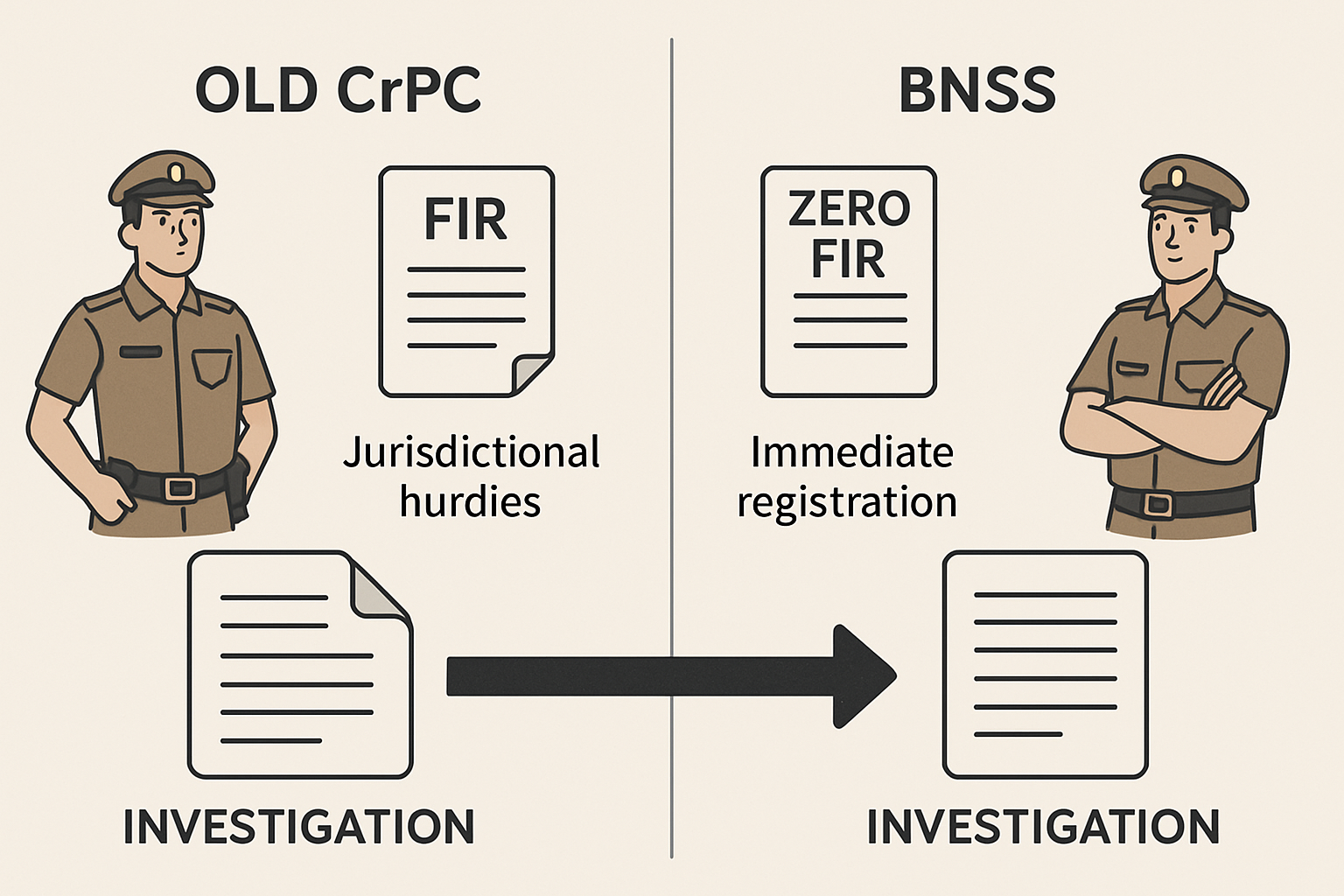
To truly appreciate the impact of Zero FIR under BNSS, it helps to draw a clear comparison with how things stood under the old Code of Criminal Procedure, 1973 (CrPC). While the concept of Zero FIR wasn’t entirely absent from the CrPC era, its status and implementation were markedly different. This comparison isn’t just academic; it highlights a crucial paradigm shift in India’s approach to criminal justice.
The CrPC Era: Judicial Interpretation and Discretion
Under the CrPC, there was no explicit section that mandated the registration of a Zero FIR. The principle largely evolved through judicial pronouncements, most notably the Supreme Court’s ruling in Lalita Kumari v. Government of U.P. [2]. The Court emphasized that if information disclosed a cognizable offense, FIR registration was mandatory, regardless of territorial jurisdiction.
However, the reality on the ground often differed:
- Lack of Statutory Backing: Because it wasn’t explicitly written into the law, there was often a degree of discretion at the police station level. Officers might hesitate, citing logistical difficulties or simply lack of clear understanding of the Supreme Court’s directives.
- Victim’s Burden: The onus was often on the victim to argue for the registration of a Zero FIR, or to seek legal recourse if turned away. This added immense pressure on individuals already suffering from a crime.
- Inconsistent Implementation: Application varied widely. In some progressive districts or urban areas, Zero FIRs might have been more common, while in others, jurisdictional excuses prevailed.
- No Specific Penalties: While refusal to register an FIR could lead to departmental action, there wasn’t a specific, codified penalty directly linked to the refusal of a Zero FIR, making accountability sometimes harder to enforce.
Essentially, under the CrPC, the Zero FIR was a powerful tool but one that relied heavily on judicial interpretation and the willingness of individual police officers to adhere to best practices, rather than a clear legislative command.
The BNSS Era: Statutory Mandate and Enhanced Accountability
Now, let’s look at the same concept through the lens of the BNSS, 2023. As discussed, Section 173 of the BNSS has fundamentally altered the landscape.
| Feature | CrPC (Pre-BNSS) | BNSS (2025 Onwards) |
|---|---|---|
| Legal Basis | Primarily judicial interpretation (Supreme Court rulings) | Explicit statutory mandate (Section 173) |
| Mandatory Nature | Implied/enforced through court orders | Explicitly mandatory for all cognizable offenses |
| Discretion | Significant discretion at police station level | Significantly reduced discretion; clear legal obligation |
| Victim Burden | Often on victim to push for Zero FIR | Police obligated to register; victim’s burden reduced |
| Accountability | Departmental action for refusal (general FIR rules) | Stronger accountability; refusal is clear legal violation |
| Special Provisions | No specific provisions for women victims | Mandates woman officer for certain crimes against women |
| Technology | Limited emphasis on digital processes | Encourages e-FIRs, digital recording, and transfer [4] |
This table clearly illustrates the paradigm shift. The BNSS moves the Zero FIR from a judicially recommended practice to a legally enforceable duty. This isn’t just about changing a few words in a statute; it’s about embedding the principle of victim-centric justice into the very fabric of criminal procedure. It says, unequivocally, that the state has a primary duty to record a crime, irrespective of initial jurisdictional complexities.
For you, as an aspiring lawyer, understanding this transition is key. It highlights how law evolves to address societal gaps and improve governance. It’s a testament to the fact that even established legal codes aren’t immune to reform. This kind of comparative analysis is exactly what you’ll be doing in law school and what we prepare you for at Lawgic Coaching. We believe in “accessible education for serious aspirants,” ensuring you get not just the facts, but the deep understanding that helps you connect the dots. For more insights into how to prepare for such evolving legal landscapes, explore our article on CLAT Prep Online.
With this comparison in mind, let’s look at what this means for you, a CLAT aspirant, and how to effectively integrate this knowledge into your preparation.
Preparing for CLAT 2025: Zero FIR Under BNSS and Beyond
As a CLAT aspirant, understanding the “Zero FIR” mandate under the BNSS isn’t just about memorizing a new section number; it’s about grasping a fundamental shift in criminal law. The Consortium of NLUs, which conducts CLAT, loves to test your ability to understand legal principles, analyze changes, and apply them to hypothetical situations. The BNSS, being a new and significant piece of legislation replacing the CrPC, is undoubtedly going to be a hot topic for CLAT 2025 and beyond.
Here’s how you can strategically prepare:
1. Master the Fundamentals of FIR
Before you can understand the nuances of Zero FIR under BNSS, make sure you’re crystal clear on what an FIR is, its purpose, who can file it, and the consequences of its registration. Understand the difference between cognizable and non-cognizable offenses, as Zero FIR specifically applies to cognizable ones. This foundational knowledge is non-negotiable.
2. Deep Dive into BNSS, 2023
You’ll need to familiarize yourself with the key provisions of the Bharatiya Nagarik Suraksha Sanhita, 2023. Pay special attention to:
- Section 173 (Information in Cognizable Cases): This is where Zero FIR is codified. Understand its wording, especially the provisos.
- Digitalization and Technology: The BNSS promotes e-FIRs, virtual trials, and digital evidence. Understand how these technological integrations will impact criminal procedure.
- Time-bound Investigations: BNSS introduces specific timelines for various stages of investigation and trial.
- New Offenses and Changes: Be aware of any new offenses or significant alterations to existing ones introduced by the Bharatiya Nyaya Sanhita (which replaces the IPC).
3. Compare and Contrast (CrPC vs. BNSS)
CLAT questions often test your analytical abilities by asking you to compare old and new legal frameworks. For Zero FIR, be ready to articulate:
- How the BNSS strengthens the Zero FIR compared to its status under CrPC.
- The statutory backing in BNSS vs. judicial interpretation in CrPC.
- The impact on victim’s rights and police accountability in both regimes.
- The special provisions for women victims under BNSS.
Create tables, flowcharts, and mind maps to visualize these comparisons. This will help you quickly recall information during the exam.
4. Focus on Legal Reasoning and Application
CLAT isn’t about rote memorization. It’s about how you apply legal principles to factual scenarios. For Zero FIR:
- Hypothetical Scenarios: Practice with hypothetical situations where a Zero FIR would be relevant. For example, a tourist from Delhi reports a theft in Goa; a victim of cybercrime reports it at their local police station, but the server is in another state. How would Zero FIR apply?
- Principle-Fact Questions: Expect passages describing the new provisions of BNSS (including Zero FIR) followed by principle-fact questions where you have to apply the legal principle to a given set of facts.
5. Stay Updated with Current Affairs and Legal Developments
The BNSS is new. There will be ongoing discussions, policy implementations, and potentially new judicial interpretations related to it. Staying updated through reliable legal news sources will give you an edge. This isn’t just about GK; it’s about understanding the living, breathing nature of law. Our 10 High-Yield GK Topics Every CLAT 2026 Aspirant Must Master article can help you in this regard.
6. Utilize Lawgic Coaching Resources
At Lawgic Coaching, we pride ourselves on “expert guidance without the premium price tag.” We know these changes can seem overwhelming, but we’re here to simplify them for you. Our curriculum for CLAT 2025 will extensively cover the BNSS, focusing on its most critical aspects, including Zero FIR. We offer:
- Updated Study Material: Our materials will reflect the latest legal changes, ensuring you’re studying the most relevant content.
- Experienced Faculty: Our mentors, often from top NLUs, have a deep understanding of these legal reforms and can explain them with clarity and practical examples.
- Mock Tests: Our mock tests will incorporate questions based on the new legal framework, helping you practice applying your knowledge under exam conditions. This helps you build that “exam-day confidence.” Learn more about boosting your CLAT readiness with mock tests.
- Personalized Mentorship: We offer personalized attention you deserve, helping you address specific doubts about BNSS or any other complex legal topic.
Remember, CLAT is not just a test of knowledge, but a test of your analytical ability and legal aptitude. The Zero FIR under BNSS is a perfect example of a topic that tests all three. Approach it with curiosity, analyze its implications, and connect it to broader legal principles. That’s how you’ll truly excel. Let’s build your law career together by mastering these essential legal reforms!
Conclusion
The introduction of the Bharatiya Nagarik Suraksha Sanhita (BNSS), 2023, marks a pivotal moment in India’s criminal justice system, and the strengthened mandate of the Zero FIR under BNSS stands out as a beacon of progress. This isn’t merely a procedural tweak; it’s a profound commitment to victim-centric justice, ensuring that the initial reporting of a crime is no longer hampered by geographical boundaries or bureaucratic inertia. By explicitly codifying the obligation of every police station to register information about a cognizable offense, irrespective of jurisdiction, the BNSS empowers victims, streamlines initial police action, and significantly enhances accountability within the force.
For you, as a CLAT aspirant, grasping the nuances of Zero FIR under BNSS is non-negotiable. It demonstrates your awareness of contemporary legal reforms, your ability to analyze their implications, and your understanding of the foundational principles of justice. This is the kind of insight that top NLUs look for—not just memorization, but thoughtful engagement with the law’s evolving landscape.
As you prepare for CLAT 2025 and beyond, remember that Lawgic Coaching is your dedicated partner. We provide the “flexible learning that fits your life” and the “proven strategies that actually work” to help you navigate these complex legal changes. Our “real mentors from top NLUs” are here to guide you, ensuring you don’t just learn about the law, but truly understand its impact. Mastering concepts like the Zero FIR under BNSS isn’t just about passing an exam; it’s about preparing you to be a lawyer who understands the pulse of justice and contributes meaningfully to society. Let’s build your law career together, grounded in a deep and current understanding of the law.
References
[1] Section 154, Code of Criminal Procedure, 1973 (CrPC). (Note: Under BNSS, this is now Section 173).[2] Lalita Kumari v. Government of U.P., (2014) 2 SCC 1.
[3] The Bharatiya Nagarik Suraksha Sanhita, 2023, Preamble and various sections promoting digital processes.
[4] The Bharatiya Nagarik Suraksha Sanhita, 2023, Sections related to electronic communication and record keeping.