CLAT PG Important Dates 2026: Complete Timeline and Registration Guide

Preparing for CLAT PG 2026 without knowing the critical dates is like showing up to an exam without knowing the syllabus. You’ll be scrambling, stressed, and probably missing opportunities that could make or break your admission to a top National Law University.
Here’s the thing. Every year, hundreds of talented law graduates miss out on their dream NLU seat simply because they weren’t tracking the registration deadlines or exam schedules properly. The Consortium of National Law Universities releases a detailed timeline, and staying on top of these dates isn’t just helpful, it’s absolutely essential for your LL.M. admission journey.
This comprehensive guide breaks down every crucial date you need to mark on your calendar for CLAT PG 2026. From registration windows to result announcements, we’ll walk you through the entire timeline so you can plan your preparation strategically and never miss a deadline.
Key Takeaways
- CLAT PG 2026 registration typically opens in January with the exam scheduled for June
- Missing registration deadlines means waiting another full year for your next attempt
- The entire process from registration to final counseling spans approximately six months
- Early registration allows more time for admit card verification and last-minute preparation
- Understanding the complete timeline helps you plan your preparation phases effectively
Understanding CLAT PG 2026: What You Need to Know First
CLAT PG is the gateway to pursuing your Master of Laws (LL.M.) degree at India’s prestigious National Law Universities. Conducted by the Consortium of National Law Universities, this national-level entrance exam determines admission to LL.M. programs across participating NLUs.
The exam tests your understanding of core legal subjects you studied during your undergraduate law degree. But beyond just testing knowledge, CLAT PG evaluates your analytical thinking, legal reasoning, and ability to apply legal principles to complex scenarios.
For 2026, the exam continues to be a computer-based test, making it crucial to familiarize yourself with the digital format well before your exam date. The competition remains intense, with thousands of law graduates competing for limited seats across top National Law Schools.
Understanding the complete preparation strategy early helps you allocate sufficient time to each subject area while managing your current professional or academic commitments.
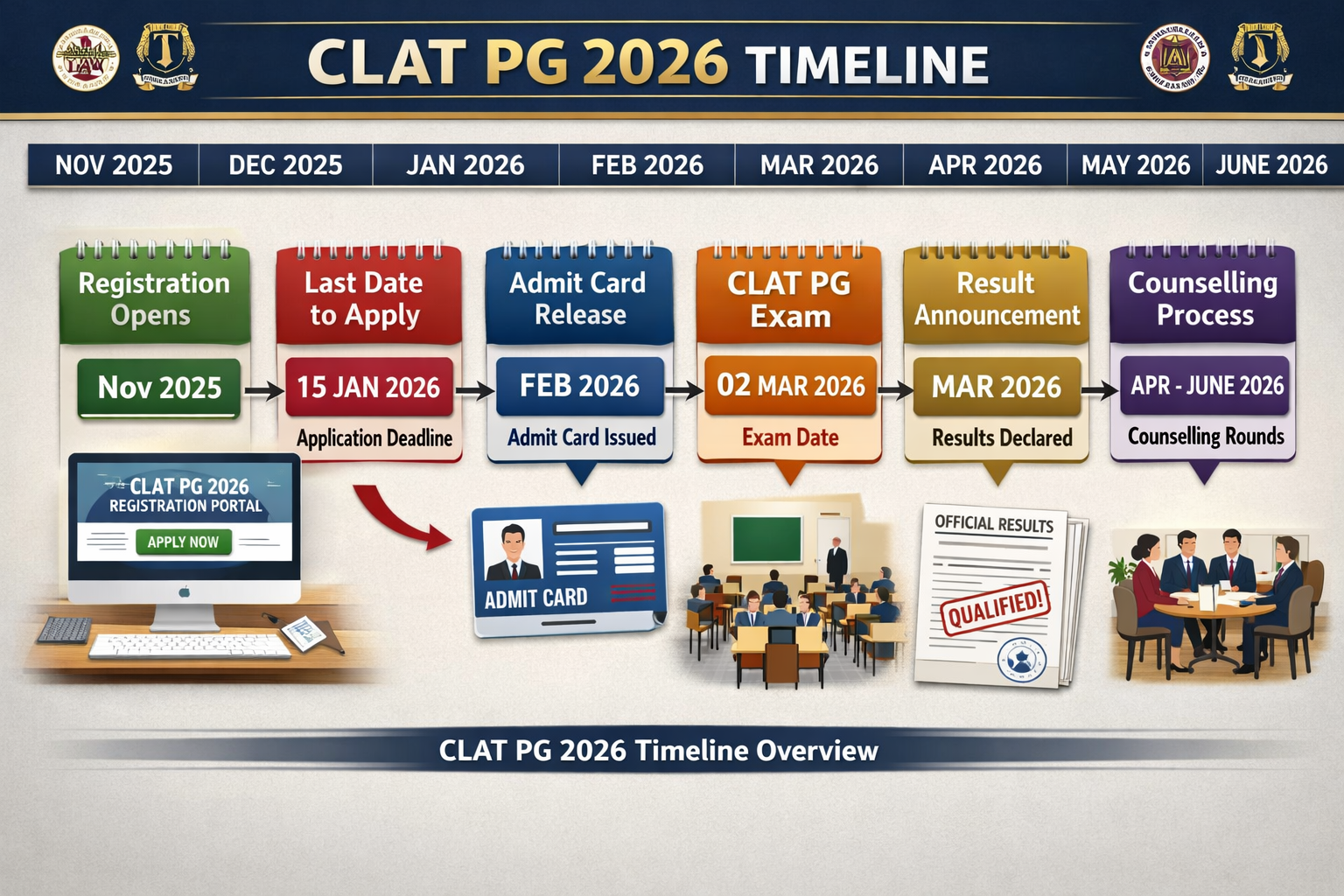
CLAT PG 2026 Important Dates: Complete Timeline
Let’s break down the entire CLAT PG 2026 calendar so you know exactly when to act.
Registration and Application Phase
Notification Release: Early January 2026
The Consortium typically releases the official notification in the first week of January. This document contains all essential information about eligibility criteria, exam pattern, participating universities, and the complete schedule.
Registration Opening: Mid-January 2026
Online registration usually begins around mid-January. This is when you can create your account on the official CLAT website and start filling out your application form.
Last Date for Registration: Late March to Early April 2026
The registration window typically stays open for about 10-12 weeks. However, waiting until the last moment creates unnecessary stress and increases the risk of technical glitches preventing submission.
Correction Window: Mid-April 2026
After registration closes, CLAT provides a brief correction window (usually 3-5 days) where you can edit specific details in your application form. You cannot make unlimited changes, so double-check everything before initial submission.
Pre-Exam Phase
Admit Card Release: Late May 2026
Admit cards become available for download approximately 10-15 days before the exam date. This document contains your exam center details, reporting time, and important instructions.
Check your admit card immediately upon release. Any discrepancies in your name, photograph, signature, or other details need to be reported to the Consortium right away.
Examination Phase
CLAT PG 2026 Exam Date: Early June 2026
The actual exam typically occurs in the first or second week of June. It’s a single-day, computer-based test lasting 120 minutes.
The exam usually starts in the afternoon slot, but confirm your specific reporting time on your admit card. Reach your exam center at least 60 minutes before the scheduled start time.
Post-Exam Phase
Answer Key Release: Within 3-5 Days After Exam
The provisional answer key is published shortly after the exam. This is your opportunity to raise objections if you believe any answer is incorrect.
Objection Window: 2-3 Days
You can challenge answer keys during this brief window. Each challenge requires a fee (typically around Rs. 1000 per question) and supporting documentation.
Final Answer Key: 7-10 Days After Objection Window
After reviewing all objections, the Consortium releases the final answer key. This becomes the basis for calculating your score.
Result Declaration: Late June to Early July 2026
Results are usually announced within 3-4 weeks after the exam. Your scorecard shows your raw score, percentile, and All India Rank.
Counseling and Admission Phase
First Counseling Round: Mid-July 2026
The first round of counseling typically begins in mid-July. You’ll need to register separately for counseling, submit preferences for universities and specializations, and participate in seat allocation.
Second Counseling Round: Late July 2026
If seats remain vacant after the first round, a second counseling round takes place. This is also when candidates who didn’t accept their first-round allocation get another chance.
Third Counseling Round (If Required): Early August 2026
Some years require a third round to fill remaining seats. Even if you missed earlier rounds, you might still secure admission here.
Final Admission and Classes Begin: August 2026
After seat allocation and fee payment, classes typically commence in August across various National Law Universities.
CLAT PG Registration Process: Step-by-Step Guide
Getting your registration right is the foundation of your CLAT PG journey. Here’s exactly how to navigate the process without complications.
Before You Begin: Documents and Information Required
Gather these essentials before starting your application:
Educational Documents:
- Scanned copy of your graduation degree or provisional certificate
- Mark sheets from all semesters of your law degree
- Category certificate (if applicable for SC/ST/OBC/PWD)
- Valid government-issued photo ID proof
Digital Files:
- Recent passport-size photograph (JPEG format, specific size requirements mentioned in notification)
- Signature image (JPEG format)
- Left thumb impression (JPEG format)
Payment Method:
- Credit card, debit card, or net banking facility
- Application fee varies by category (General: approximately Rs. 4000, Reserved categories: Rs. 3500)
Registration Steps
Step 1: Visit the Official CLAT Website
Go to the official Consortium of National Law Universities website. Look for the CLAT PG 2026 registration link, which becomes active when registration opens.
Step 2: Create Your Account
Click on “New Registration” and provide your basic details including name, email address, and mobile number. You’ll receive an OTP for verification.
Create a strong password you’ll remember. Write it down securely as you’ll need it multiple times throughout the process.
Step 3: Fill the Application Form
The application form has multiple sections:
Personal Details: Name, date of birth, gender, contact information, permanent and correspondence addresses.
Academic Details: Your law degree information, university name, year of passing, percentage or CGPA, division or class obtained.
Category Information: Select your category and upload relevant certificates if claiming reservation benefits.
Exam Center Preference: Choose your preferred exam cities. Select multiple options as final allocation depends on availability.
Step 4: Upload Documents
Upload all required documents in the specified format and size. Most applications get rejected due to incorrect file specifications, so follow the guidelines precisely.
Preview each uploaded document to ensure it’s clear and readable. Blurry or incorrect images lead to rejection.
Step 5: Pay Application Fee
After completing all sections, proceed to payment. The system accepts online payment through various methods.
Save your payment confirmation and transaction ID. Take a screenshot as backup proof.
Step 6: Submit and Download Confirmation
After successful payment, submit your application. Download and print the confirmation page showing your application number.
This confirmation page is your proof of registration. Keep multiple copies safe.
CLAT PG Exam Pattern 2026: What to Expect
Understanding the exam structure helps you prepare strategically and manage time effectively during the actual test.
Exam Format and Structure
Mode: Computer-Based Test (CBT)
Duration: 120 minutes (2 hours)
Total Questions: 120 objective-type multiple-choice questions
Total Marks: 120 marks (1 mark per question)
Negative Marking: Yes, 0.25 marks deducted for each incorrect answer
Language: English only
Subject-Wise Distribution
The CLAT PG exam covers core subjects from your undergraduate law curriculum:
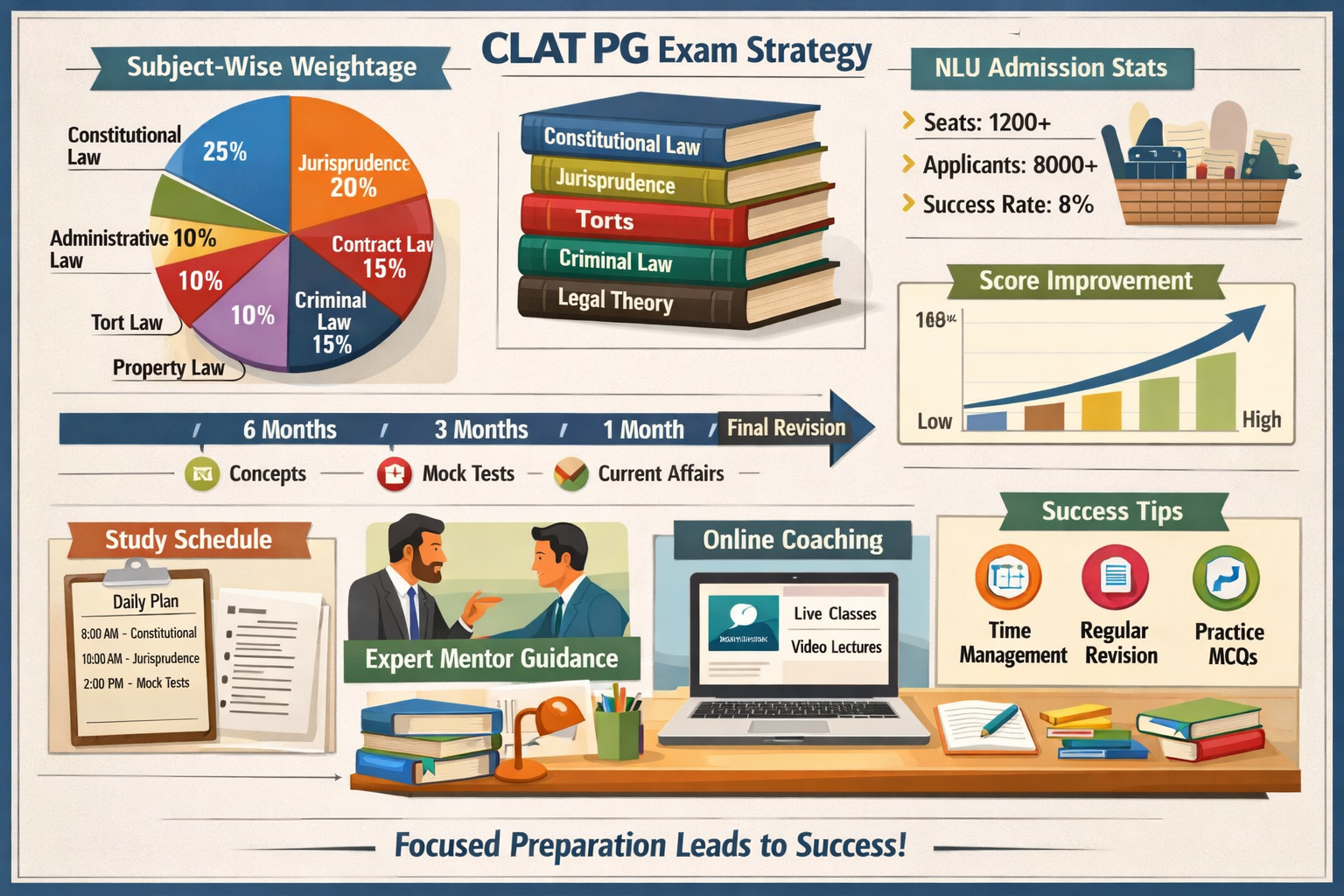
Constitutional Law: Approximately 30-35 questions covering fundamental rights, directive principles, constitutional amendments, landmark judgments, and constitutional interpretation.
Jurisprudence: Around 20-25 questions testing legal theory, schools of jurisprudence, legal concepts, and philosophical foundations of law.
Contract Law: Approximately 10-15 questions on contract formation, performance, breach, remedies, and specific contracts.
Tort Law: Around 10-12 questions covering various torts, defenses, vicarious liability, and remedies.
Criminal Law: Approximately 10-15 questions on IPC provisions, criminal procedure, evidence, and criminal jurisprudence.
Property Law: Around 8-10 questions covering transfer of property, easements, mortgages, and related concepts.
Administrative Law: Approximately 8-10 questions on principles of administrative law, judicial review, and delegated legislation.
Other Subjects: The remaining questions may come from International Law, Environmental Law, Labour Law, or other areas.
The exact distribution varies slightly each year, but Constitutional Law and Jurisprudence consistently carry the highest weightage.
Question Types and Difficulty Level
Questions range from direct knowledge-based queries to application and analysis-based problems. Recent years show an increasing trend toward:
Principle-based questions: You’re given a legal principle followed by a factual situation, and you must apply the principle correctly.
Case-based questions: Questions reference actual or hypothetical case scenarios requiring legal analysis.
Comparative questions: Testing your ability to distinguish between similar legal concepts or provisions.
The difficulty level typically ranges from moderate to challenging, with approximately 40% easy, 40% moderate, and 20% difficult questions.
CLAT PG Syllabus 2026: Subject-Wise Breakdown
Your preparation strategy depends entirely on understanding what topics fall within the exam scope. The CLAT PG syllabus encompasses your entire LL.B. curriculum, but certain areas demand more attention.
Constitutional Law
This forms the backbone of CLAT PG preparation. Focus areas include:
Part III – Fundamental Rights: Deep understanding of Articles 12-35, including restrictions, exceptions, and evolution through judicial interpretation.
Part IV – Directive Principles: Articles 36-51 and their relationship with Fundamental Rights.
Union and State Relations: Distribution of legislative and executive powers, emergency provisions, and inter-state relations.
Constitutional Amendments: Major amendments that significantly altered constitutional provisions, especially 42nd, 44th, 73rd, 74th, and recent amendments.
Landmark Judgments: Kesavananda Bharati, Maneka Gandhi, Minerva Mills, Vishaka, and other cases that shaped constitutional interpretation.
Study the Constitution not just as text but understand the philosophy and judicial reasoning behind interpretations.
Jurisprudence
This subject tests your conceptual understanding of legal theory:
Schools of Jurisprudence: Natural Law, Positivism, Historical School, Sociological School, Realist School, and their proponents.
Legal Concepts: Rights, duties, ownership, possession, legal personality, and liability.
Theories of Justice: Rawls, Nozick, and other philosophical approaches to justice.
Interpretation of Statutes: Various rules and principles of statutory interpretation.
Focus on understanding the philosophical foundations rather than just memorizing definitions. Questions often test application of jurisprudential concepts to practical scenarios.
Contract Law
Essential topics from the Indian Contract Act, 1872:
Formation of Contract: Offer, acceptance, consideration, capacity, free consent, and legality of object.
Performance and Discharge: Modes of performance, discharge by performance, agreement, impossibility, and breach.
Remedies: Damages, specific performance, injunctions, and quantum meruit.
Special Contracts: Indemnity, guarantee, bailment, pledge, and agency.
Understanding case law alongside bare provisions strengthens your grasp of contractual principles.
Tort Law
Key areas include:
General Principles: Tortious liability, vicarious liability, strict liability, and absolute liability.
Specific Torts: Negligence, nuisance, defamation, trespass, assault, battery, and false imprisonment.
Defenses: Volenti non fit injuria, necessity, statutory authority, and others.
Remedies: Damages, injunctions, and specific restitution.
Recent judicial developments in tort law, especially regarding consumer protection and environmental torts, appear frequently.
Criminal Law
Cover these essential components:
Indian Penal Code: General principles of criminal liability, specific offenses, and punishments.
Code of Criminal Procedure: Investigation, inquiry, trial procedures, and appeals.
Indian Evidence Act: Relevancy, admissibility, burden of proof, and examination of witnesses.
Understanding the interplay between these three statutes is crucial for answering integrated questions.
Property Law
Focus on the Transfer of Property Act, 1882:
Transfer of Property: Sale, mortgage, lease, exchange, and gift.
Actionable Claims and Easements: Rights and obligations.
Doctrine of Part Performance and Lis Pendens: Application and implications.
Property law questions often involve complex scenarios requiring careful application of statutory provisions.
For a comprehensive breakdown of preparation resources, check out the best CLAT PG books that cover all these subjects effectively.
CLAT PG Preparation Strategy: Proven Approaches That Work
Having a solid preparation strategy makes the difference between a good score and a great rank. Let’s talk about what actually works.
Creating Your Preparation Timeline
6 Months Before Exam (December 2025 – January 2026):
Start with a comprehensive review of your LL.B. notes. Create subject-wise folders and organize material systematically.
Focus on understanding concepts rather than memorization. Build strong foundations in Constitutional Law and Jurisprudence as these carry maximum weightage.
4-5 Months Before Exam (February – March 2026):
Intensify your preparation with focused subject-wise study. Complete your first reading of all subjects.
Start solving previous year question papers to understand question patterns and difficulty levels. This phase is about building comprehensive coverage.
2-3 Months Before Exam (April – May 2026):
Begin intensive revision and practice. Take full-length mock tests regularly to build speed and accuracy.
Identify weak areas and dedicate extra time to strengthening them. Create concise notes for quick revision.
Last Month Before Exam (May 2026):
Focus exclusively on revision and mock tests. Attempt at least 2-3 full-length tests per week.
Review all important case laws, amendments, and statutory provisions. Fine-tune your exam strategy based on mock test performance.
Subject-Wise Preparation Tips
Constitutional Law:
Read the Constitution alongside a good commentary. Bare reading helps with direct questions, while commentary provides context for application-based questions.
Create a timeline of constitutional amendments with their key provisions. This visual aid helps remember chronological developments.
Make a separate list of landmark judgments organized by topics. Understanding the ratio decidendi of major cases is more valuable than memorizing case facts.
Jurisprudence:
Create comparison charts for different schools of thought. Understanding similarities and differences helps answer comparative questions.
Link jurisprudential concepts to practical legal scenarios. This application-oriented approach prepares you for principle-based questions.
Study the contributions of major jurists systematically. Questions often ask about specific theories proposed by particular legal philosophers.
Contract and Tort Law:
Focus on illustrations given in bare acts. These examples clarify abstract legal principles.
Solve as many practical problems as possible. Both subjects are application-heavy, and practice builds problem-solving skills.
Create flowcharts for complex topics like discharge of contract or defenses in tort. Visual representations simplify complicated concepts.
Criminal Law:
Integrate your study of IPC, CrPC, and Evidence Act. Understanding their interconnection helps answer integrated questions.
Pay special attention to recent amendments and landmark criminal law judgments. These frequently appear in exams.
Practice distinguishing between similar offenses. Questions often test your ability to differentiate between closely related provisions.
The Role of Mock Tests
Mock tests aren’t just practice, they’re your reality check. Here’s how to use them effectively:
Start Early: Begin taking mocks at least 3 months before the exam. Early mocks identify knowledge gaps while you still have time to address them.
Simulate Exam Conditions: Take mocks in a quiet environment, strictly following the 120-minute time limit. This builds exam temperament.
Analyze Thoroughly: Spend as much time analyzing your mock test as you spent taking it. Understand why you got questions wrong and identify pattern errors.
Track Progress: Maintain a performance sheet tracking your scores across subjects. This data-driven approach shows where you’re improving and where you need more work.
Learn from Mistakes: Create a separate notebook for questions you got wrong. Review this regularly to avoid repeating mistakes.
At Lawgic Coaching, we provide comprehensive mock test series designed specifically for CLAT PG, complete with detailed solutions and performance analytics. Your success is our mission, and we’ve helped thousands crack CLAT with proven strategies that actually work.
Time Management During Preparation
Balancing CLAT PG preparation with professional or academic commitments requires smart time management:
Create a Realistic Schedule: Allocate specific hours to CLAT preparation based on your other commitments. Consistency matters more than long, irregular study sessions.
Use Dead Time Productively: Commute time, lunch breaks, and waiting periods can be used for quick revisions or reading case summaries.
Prioritize High-Weightage Topics: When time is limited, focus on Constitutional Law and Jurisprudence as they contribute maximum marks.
Take Strategic Breaks: Your brain needs rest to consolidate learning. Schedule regular breaks to maintain productivity.
Understanding how to avoid common preparation mistakes can save you valuable time and effort.
CLAT PG Result and Counseling Process
Understanding what happens after the exam helps you prepare for the final steps toward admission.
Result Declaration and Scorecard
When results are announced in late June or early July, you’ll receive a scorecard showing:
Raw Score: Total marks obtained out of 120
Percentile: Your performance relative to all test-takers
All India Rank (AIR): Your overall rank among all candidates
Category Rank: Your rank within your category (if applicable)
Download and save multiple copies of your scorecard. You’ll need it during counseling and admission processes.
Understanding Your Rank and Chances
Your rank determines which National Law Universities you can realistically target. While cutoffs vary yearly based on difficulty level and number of applicants, general patterns exist:
Top 100 Ranks: Strong chances at premier NLUs like NLSIU Bangalore, NALSAR Hyderabad, NLIU Bhopal, and WB NUJS Kolkata.
Ranks 100-300: Good chances at NLU Delhi, HNLU Raipur, GNLU Gandhinagar, and other established NLUs.
Ranks 300-500: Realistic chances at newer NLUs and specific specializations at mid-tier universities.
Category-wise reservations significantly impact seat allocation, so reserved category candidates have better chances even with relatively lower ranks.
Counseling Registration
Counseling registration is separate from the exam registration. When the Consortium announces counseling dates:
Register Online: Visit the CLAT counseling portal and create your account using your CLAT credentials.
Pay Counseling Fee: A separate counseling participation fee is required (typically around Rs. 20,000-50,000 depending on category).
Submit Preferences: Rank your preferred universities and specializations in order of preference. You can choose multiple combinations.
Upload Documents: Submit all required documents including graduation certificates, category certificates, and other supporting documents.
Seat Allocation Process
The counseling follows a preference-based allocation system:
Preference Submission: You submit your ranked list of university-specialization combinations.
Automated Allocation: Based on your rank and preferences, the system allocates seats following reservation rules.
Seat Acceptance: If allocated a seat, you must accept it within the specified timeframe (usually 2-3 days) and pay the seat acceptance fee.
Freeze, Float, or Slide Options: Depending on the counseling round, you might have options to freeze your current seat, float to a higher preference in subsequent rounds, or slide within the same university.
Document Verification
During counseling, you’ll need original documents for verification:
- LL.B. degree certificate or provisional certificate
- All semester mark sheets
- Category certificate (if applicable)
- Transfer certificate from previous institution
- Migration certificate
- Character certificate
- Medical fitness certificate
- Passport-size photographs
Keep multiple photocopies of all documents. Some universities require attested copies.
Fee Payment and Admission
After seat acceptance and document verification:
Pay Admission Fee: The first-year fee varies by university, typically ranging from Rs. 1.5 lakhs to Rs. 3 lakhs.
Collect Admission Letter: Receive your official admission letter from the university.
Complete Formalities: Submit any additional forms or documents required by your specific NLU.
Attend Orientation: Most universities conduct orientation programs before classes begin.
Maximizing Your CLAT PG Performance: Advanced Tips
Beyond basic preparation, these advanced strategies can give you the competitive edge.
Building a Strong Conceptual Foundation
Surface-level knowledge won’t cut it for CLAT PG. The exam tests deep understanding and application ability.
Connect Concepts Across Subjects: Legal principles often overlap. Understanding how constitutional law influences criminal law, or how jurisprudential concepts apply to contract law, creates a comprehensive understanding.
Study Judicial Reasoning: Don’t just memorize case outcomes. Understand the reasoning judges used to reach their conclusions. This analytical approach helps answer complex application questions.
Create Conceptual Maps: Visual representations showing relationships between different legal concepts strengthen retention and understanding.
Developing Exam-Day Strategy
Question Selection: Don’t attempt questions sequentially. Start with subjects you’re most confident about to build momentum and secure easy marks quickly.
Time Allocation: Allocate approximately 60 seconds per question on average. If a question takes longer, mark it for review and move on.
Negative Marking Management: Avoid wild guessing. If you can eliminate two options, educated guessing becomes statistically favorable. If you’re completely unsure, skip the question.
Review Time: Reserve the last 10-15 minutes for reviewing marked questions and ensuring you haven’t made silly mistakes.
Handling Exam Pressure
CLAT PG can be stressful, especially if you’re balancing it with professional responsibilities. Here’s how successful candidates manage pressure:
Practice Mindfulness: Regular meditation or breathing exercises improve focus and reduce anxiety.
Maintain Physical Health: Regular exercise, adequate sleep, and proper nutrition directly impact cognitive performance.
Create a Support System: Connect with fellow aspirants, join study groups, or work with mentors who understand your journey.
Maintain Perspective: Remember that CLAT PG is important, but it’s not the only path to success. This balanced perspective reduces unhealthy pressure.
Leveraging Technology for Preparation
Modern preparation tools can significantly enhance efficiency:
Digital Note-Taking: Apps like Notion or OneNote allow organized, searchable notes accessible across devices.
Flashcard Apps: Spaced repetition apps like Anki help with memorizing case names, statutory provisions, and legal maxims.
Online Discussion Forums: Engaging with other aspirants in online communities provides diverse perspectives and clarifies doubts.
Video Lectures: Quality video content can explain complex topics more effectively than text alone.
At Lawgic Coaching, we combine experienced faculty from top NLUs with flexible, accessible learning that fits real student schedules. Our online CLAT PG coaching provides expert guidance without the premium price tag, because we believe law school dreams shouldn’t be complicated or expensive.
Learning from Previous Toppers
Successful CLAT PG candidates share common traits:
Consistent Daily Study: Rather than irregular marathon sessions, they maintained consistent daily study schedules.
Quality Over Quantity: They focused on understanding concepts deeply rather than covering material superficially.
Regular Revision: They built multiple revision cycles into their preparation, ensuring long-term retention.
Mock Test Discipline: They took mocks seriously, analyzing performance meticulously and learning from every mistake.
Balanced Approach: They prepared all subjects rather than focusing exclusively on high-weightage areas, avoiding risky gaps in knowledge.
Common Mistakes to Avoid in CLAT PG Preparation
Learning from others’ mistakes saves you time and frustration. Here are pitfalls to avoid:
Starting Too Late
Many candidates underestimate CLAT PG difficulty, assuming their LL.B. knowledge is sufficient. Starting preparation only 1-2 months before the exam rarely yields good ranks.
Solution: Begin serious preparation at least 4-6 months before the exam date. This timeline allows comprehensive coverage and adequate revision.
Ignoring Previous Year Papers
Some aspirants study textbooks extensively but never practice actual exam questions. This creates a disconnect between knowledge and application.
Solution: Integrate previous year paper solving into your preparation from the beginning. Analyze question patterns and frequently tested topics.
Neglecting Weak Subjects
It’s tempting to focus on subjects you enjoy while avoiding challenging areas. This strategy creates dangerous knowledge gaps.
Solution: Identify weak subjects early and allocate extra time to them. Sometimes, weak subjects offer the most improvement potential.
Over-Reliance on Coaching Material Alone
While coaching materials provide structured content, limiting yourself to only these resources restricts your understanding.
Solution: Supplement coaching materials with standard textbooks, bare acts, and quality online resources. Diverse sources provide comprehensive understanding.
Skipping Mock Tests
Some candidates postpone mock tests until they’ve “completed” preparation. This delays crucial feedback about your actual performance level.
Solution: Start taking mocks early, even before completing the syllabus. Early mocks identify gaps while you still have time to address them.
Ignoring Current Legal Developments
CLAT PG increasingly includes questions on recent judgments, amendments, and legal developments. Ignoring current affairs creates blind spots.
Solution: Regularly read legal newspapers, follow Supreme Court judgments, and stay updated on significant legal developments.
Poor Time Management During Exam
Even well-prepared candidates sometimes score poorly due to ineffective time management during the actual exam.
Solution: Practice strict time management during every mock test. Develop and refine your question-attempting strategy well before exam day.
CLAT PG vs Other Law Entrance Exams: Making Informed Choices
Understanding how CLAT PG compares with other law entrance exams helps you make strategic decisions about which tests to attempt.
CLAT PG vs AILET PG
AILET (All India Law Entrance Test) PG is conducted specifically for admission to NLU Delhi’s LL.M. program.
Key Differences:
Scope: CLAT PG covers multiple NLUs, while AILET PG is only for NLU Delhi.
Exam Pattern: AILET PG has 150 questions in 90 minutes, making it faster-paced than CLAT PG’s 120 questions in 120 minutes.
Syllabus: Both cover similar subjects, but AILET PG sometimes includes more current affairs and general knowledge.
Difficulty: AILET PG is generally considered slightly more challenging due to time pressure.
Strategy: Many candidates appear for both exams since preparation overlaps significantly. The detailed comparison between AILET and CLAT coaching can help you understand preparation nuances.
CLAT PG vs DU LLM Entrance
Delhi University conducts its own entrance for LL.M. admission.
Key Differences:
Specializations: DU offers more specialized LL.M. programs compared to most NLUs.
Exam Pattern: DU’s exam pattern differs significantly, often including more subjective elements.
Preparation Approach: While core subjects overlap, DU entrance may require additional preparation for specific specializations.
Should You Attempt Multiple Exams?
Attempting multiple law entrance exams makes strategic sense:
Increased Opportunities: Each exam you clear opens additional admission possibilities.
Overlapping Preparation: Most LL.M. entrance exams cover similar subjects, so preparation effort overlaps significantly.
Reduced Pressure: Having multiple options reduces pressure on any single exam performance.
Cost-Benefit Analysis: The additional application fees and preparation time are minimal compared to the potential benefit of more admission options.
Financial Planning for CLAT PG and LL.M. Education
Understanding the complete financial picture helps you plan effectively for your legal education journey.
Exam and Application Costs
CLAT PG Application Fee: Approximately Rs. 4,000 (General category)
Counseling Fee: Around Rs. 20,000-50,000 depending on category
Other Entrance Exams: If attempting multiple exams, budget Rs. 10,000-15,000 for application fees
Preparation Costs: Quality coaching, books, and study materials: Rs. 15,000-50,000 depending on choices
LL.M. Program Costs
Tuition Fees: NLU annual fees range from Rs. 1.5 lakhs to Rs. 3 lakhs
Accommodation: Hostel fees vary by university, typically Rs. 50,000-1.5 lakhs annually
Books and Materials: Budget approximately Rs. 20,000-30,000 for the program
Living Expenses: Monthly expenses vary by location, ranging from Rs. 8,000-15,000
Total Program Cost: Expect to invest Rs. 3-6 lakhs for a one-year LL.M. program at an NLU
Scholarships and Financial Aid
Several options can reduce your financial burden:
Merit Scholarships: Most NLUs offer merit-based scholarships to top-ranked students
Need-Based Aid: Some universities provide financial assistance based on economic background
Government Schemes: Various central and state government scholarship programs support higher education
Bank Loans: Education loans specifically for professional courses offer favorable terms
Research Assistantships: Some universities offer RA positions providing stipends and fee waivers
Plan your finances early and explore all available options to make your LL.M. education more affordable.
Career Opportunities After CLAT PG
Understanding career prospects helps contextualize your LL.M. investment and motivates focused preparation.
Academic and Research Careers
Law Faculty Positions: An LL.M. from a premier NLU significantly enhances eligibility for teaching positions at law schools.
Research Opportunities: Universities, think tanks, and research institutions seek LL.M. graduates for legal research roles.
Ph.D. and Further Studies: LL.M. serves as a stepping stone for doctoral studies and academic specialization.
Specialized Legal Practice
Subject Matter Expertise: Specialized LL.M. programs (Constitutional Law, Corporate Law, IPR, etc.) position you as an expert in specific legal domains.
Niche Practice Areas: Specialization opens opportunities in emerging fields like cyber law, environmental law, and international trade law.
Higher Billing Potential: Specialized expertise commands premium fees in legal practice.
Corporate and In-House Counsel Roles
Corporate Law Departments: Companies increasingly prefer LL.M. graduates for senior legal positions.
Compliance Roles: Specialized knowledge in regulatory compliance is highly valued in corporate settings.
Policy and Advisory Positions: Businesses seek LL.M. graduates for strategic legal advisory roles.
International Opportunities
Foreign LL.M. Programs: A strong academic record including an Indian LL.M. enhances applications for foreign universities.
International Law Firms: Global firms value specialized legal education when hiring for their Indian offices.
International Organizations: UN bodies, international courts, and global NGOs recruit qualified legal professionals.
Judicial Services and Public Sector
Higher Judicial Services: While not mandatory, an LL.M. can strengthen applications for judicial positions.
Government Legal Services: Specialized legal education is valued in various government legal departments.
Public Policy Roles: LL.M. graduates contribute to policy formulation in various governmental and quasi-governmental bodies.
Your LL.M. journey begins with cracking CLAT PG. The investment in focused preparation pays dividends throughout your legal career.
Technology and Resources for CLAT PG Preparation
Modern preparation leverages technology effectively. Here are resources that actually help:
Essential Online Resources
Official CLAT Website: Your primary source for notifications, updates, and official information.
Indian Kanoon: Free database of Indian case law, essential for reading judgments.
SCC Online (Student Edition): Comprehensive legal database with case laws and commentaries.
PRS Legislative Research: Excellent resource for understanding recent legislation and policy.
Live Law and Bar & Bench: Stay updated on current legal developments and important judgments.
Recommended Books and Study Material
Constitutional Law:
- M.P. Jain’s “Indian Constitutional Law”
- D.D. Basu’s “Introduction to the Constitution of India”
Jurisprudence:
- Paton’s “Jurisprudence”
- Dr. N.V. Paranjape’s “Studies in Jurisprudence and Legal Theory”
Contract Law:
- Pollock and Mulla’s “Indian Contract and Specific Relief Acts”
- Avtar Singh’s “Law of Contract and Specific Relief”
Tort Law:
- Ratanlal and Dhirajlal’s “Law of Torts”
- R.K. Bangia’s “Law of Torts”
Criminal Law:
- Ratanlal and Dhirajlal’s “Indian Penal Code”
- K.D. Gaur’s “Criminal Law: Cases and Materials”
Quality matters more than quantity. Focus on standard textbooks rather than collecting numerous resources you’ll never complete.
Online Coaching Platforms
Quality online coaching provides structured guidance and expert mentorship. When choosing a platform, consider:
Faculty Credentials: Learn from teachers with proven track records and top NLU backgrounds.
Flexibility: Platforms offering recorded lectures and flexible schedules work better for working professionals.
Mock Test Quality: Comprehensive mock test series with detailed analytics are crucial.
Doubt Resolution: Effective doubt-clearing mechanisms ensure you don’t get stuck on challenging concepts.
Cost-Effectiveness: Quality education shouldn’t require premium prices.
We’ve designed our CLAT PG coaching keeping these principles in mind. Real mentors from top NLUs provide personalized attention you deserve, with flexible learning that fits your life. Results speak louder than promises, and we’ve helped thousands crack CLAT with proven strategies.
Frequently Asked Questions About CLAT PG 2026
When will CLAT PG 2026 registration begin?
Registration typically opens in mid-January 2026. The Consortium releases the official notification in early January with exact dates. Keep checking the official CLAT website regularly from the first week of January.
What is the eligibility criteria for CLAT PG?
You need a Bachelor’s degree in Law (LL.B. or equivalent) from a recognized university. There’s no minimum percentage requirement for appearing in the exam, though individual NLUs may have minimum percentage criteria for admission. Final year LL.B. students can also apply provisionally.
How many times can I attempt CLAT PG?
There’s no limit on the number of attempts. You can appear for CLAT PG as many times as you wish, regardless of age or previous attempts.
Can I change my exam center after registration?
The Consortium generally doesn’t allow exam center changes after registration closes. However, if you face genuine hardship, you can write to the Consortium explaining your situation. Approval isn’t guaranteed, so choose your exam center carefully during registration.
What happens if I miss the registration deadline?
Unfortunately, if you miss the registration deadline, you cannot appear for CLAT PG that year. The Consortium doesn’t extend deadlines or accept late applications. This is why marking important dates and registering well before the deadline is crucial.
How is CLAT PG different from CLAT UG?
CLAT PG is for admission to LL.M. programs and tests your knowledge of core law subjects studied during your LL.B. CLAT UG is for admission to five-year integrated law programs and tests aptitude, reasoning, and general knowledge rather than specialized legal knowledge.
Which NLUs participate in CLAT PG counseling?
Most National Law Universities participate in the common CLAT PG counseling process. However, a few NLUs like NLU Delhi (which conducts AILET) and some others may have separate admission processes. Check the official CLAT notification for the complete list of participating universities.
What is a good score in CLAT PG?
A “good score” depends on the year’s difficulty level and competition. Generally, scoring above 80-85 marks (out of 120) gives you strong chances at top NLUs. However, cutoffs vary significantly by category, specialization, and year.
Do I need coaching for CLAT PG preparation?
While self-study is possible, quality coaching provides structured guidance, comprehensive study material, regular mock tests, and expert mentorship. For working professionals or those who need focused preparation, coaching significantly improves efficiency and outcomes. The key is choosing the right coaching that offers flexible learning and proven teaching methods.
How should I prepare if I’m a working professional?
Create a realistic study schedule allocating 2-3 hours daily. Focus on high-weightage subjects first. Use weekends for longer study sessions and mock tests. Leverage online coaching platforms offering recorded lectures you can watch at your convenience. Consistency matters more than long, irregular study marathons.
Conclusion: Your CLAT PG 2026 Action Plan
You now have the complete roadmap for CLAT PG 2026, from important dates to preparation strategies. Let’s translate this knowledge into action.
Here’s your immediate next steps:
Mark Your Calendar: Add all important CLAT PG dates to your calendar with reminders. Set alerts for registration opening, last date, and exam date.
Assess Your Current Preparation Level: Take a diagnostic test or review previous year papers to understand where you stand. This honest assessment guides your preparation strategy.
Create Your Personalized Study Plan: Based on your available time and current knowledge level, design a realistic preparation schedule. Remember, consistency beats intensity.
Gather Resources: Collect essential books, register for quality coaching if needed, and organize your study materials systematically.
Start Immediately: The best time to start preparing was yesterday. The second-best time is now. Don’t wait for the “perfect moment” to begin.
Your journey to a premier National Law University starts with a single decision: committing to focused, strategic preparation. The competition is tough, but with the right guidance and consistent effort, you can secure your seat at your dream NLU.
At Lawgic Coaching, we’re here to support you every step of the way. Whether you’re just starting your preparation or looking to strengthen weak areas, our expert faculty from top NLUs provides personalized mentorship through flexible, accessible learning. We believe your law school dreams shouldn’t be complicated or expensive, and we’ve designed our programs to deliver results without the premium price tag.
Let’s build your law career together. Your success is our mission, and with proven strategies that actually work, we’ll help you crack CLAT PG 2026.
Ready to start your preparation journey? Explore our comprehensive CLAT PG coaching programs and take the first step toward your LL.M. at a premier National Law University.
The calendar is ticking. The dates are set. Your future at a top NLU awaits. Make 2026 the year you achieve your legal education goals.
CLAT PG 2026 Important Dates Timeline
Track all crucial dates and never miss a deadline