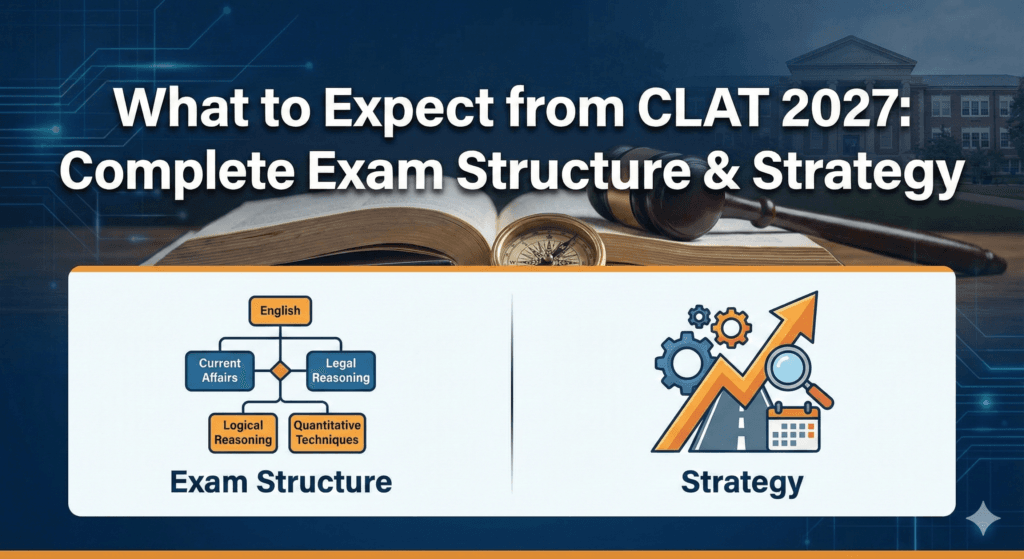
Here’s something most CLAT aspirants get wrong. They either completely ignore the mathematics section, thinking it’s too small to matter, or they panic unnecessarily, assuming it requires advanced calculus and complex formulas.
Neither approach works.
The CLAT Math’s Syllabus 2027 is straightforward, manageable, and completely based on Class 10 concepts. But here’s the catch: you need to know exactly what’s tested, how it’s tested, and the smartest way to prepare. This guide breaks down everything you need to know about the quantitative techniques section without any confusion or fluff.
Key Takeaways
- CLAT Math’s Syllabus 2027 covers only Class 10 level mathematical concepts with no advanced topics
- The quantitative techniques section carries 13-15 questions out of 120 total questions in the exam
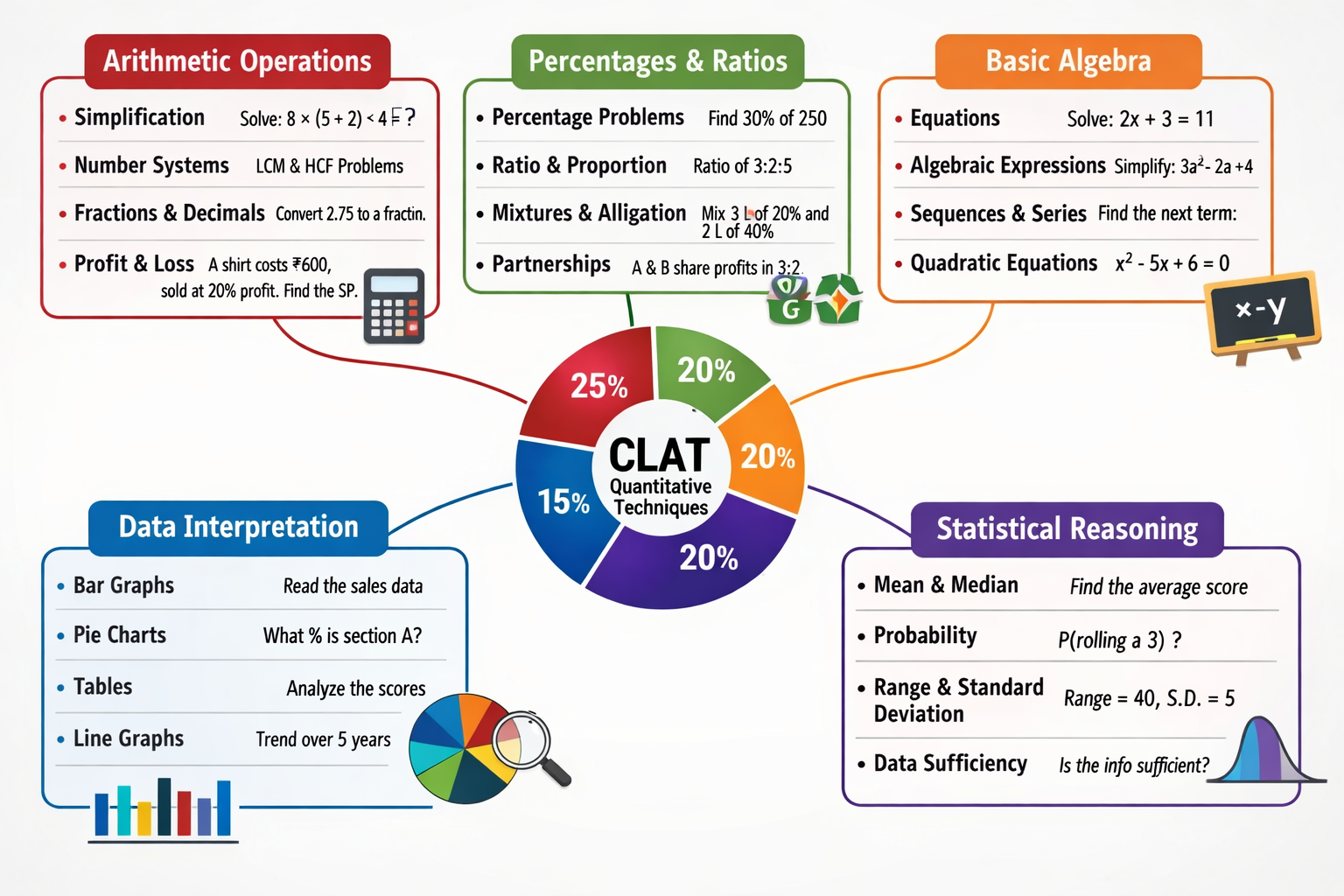
- Five core areas dominate: arithmetic operations, percentages and ratios, basic algebra, data interpretation, and statistical reasoning
- Questions are passage based, testing application of mathematical concepts to real world scenarios
- Strategic preparation focusing on accuracy and speed can secure full marks in this section
- Understanding question patterns from previous years reveals predictable topic distribution
Understanding CLAT Math’s Syllabus 2027: What You’re Actually Tested On
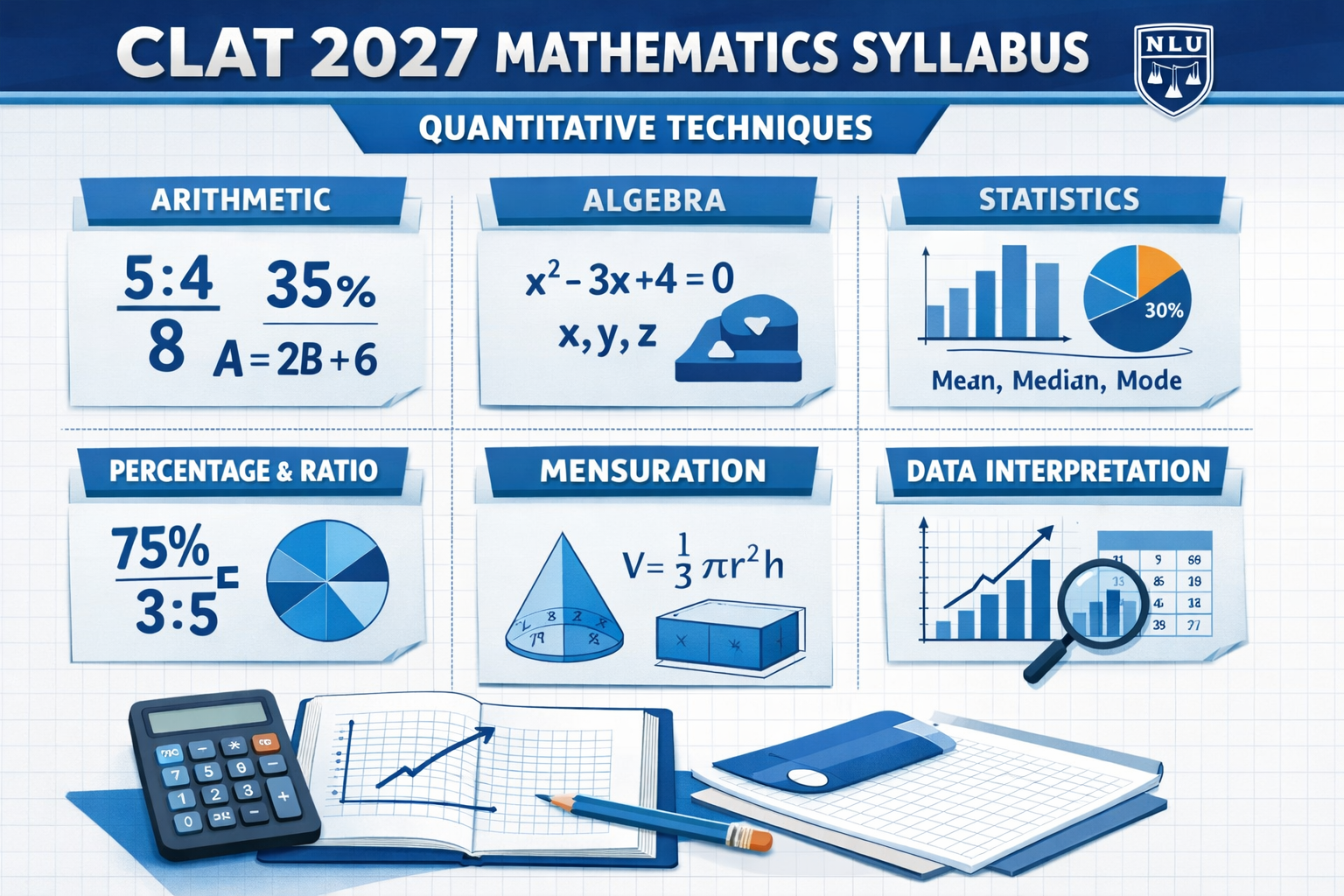
Let’s be honest. The mathematics section in CLAT isn’t about testing your ability to solve complex equations or prove theorems. It’s designed to assess whether you can apply basic mathematical reasoning to practical situations, especially those relevant to legal and business contexts.
The Consortium of National Law Universities has been crystal clear about this. The CLAT Math’s Syllabus 2027 restricts all questions to Class 10 level mathematics. Nothing beyond that. No trigonometry. No calculus. No coordinate geometry.
The Official Scope
According to the official CLAT notification, the quantitative techniques section will include short passages followed by questions that test your ability to derive, infer, and manipulate numerical information. The passages might discuss business scenarios, statistical data, economic trends, or social research findings.
What makes this section unique is the passage based format. You won’t see standalone arithmetic problems like “Calculate 15% of 840.” Instead, you’ll read a 300 word passage about, say, a company’s revenue distribution across different quarters, and then answer questions requiring percentage calculations, ratio comparisons, or trend analysis.
This format actually works in your favor if you prepare correctly. The context helps you understand what’s being asked, and the mathematical operations themselves remain elementary.
Complete Topic Breakdown of CLAT Math’s Syllabus 2027
Now we get to the specifics. What exactly should you study? Here’s the comprehensive breakdown.
1. Arithmetic Operations and Number Systems
This forms the foundation. You need absolute comfort with:
Basic Operations: Addition, subtraction, multiplication, and division with whole numbers, fractions, and decimals. Sounds simple, but under exam pressure with multi step problems, calculation errors creep in.
Number Properties: Understanding even and odd numbers, prime numbers, factors and multiples, HCF and LCM. These concepts often appear in ratio problems or when simplifying fractions.
Fractions and Decimals: Converting between fractions, decimals, and percentages. Comparing fractional values. Performing operations with mixed numbers.
Practical Application: A typical question might present data about a law firm’s case distribution among partners and ask you to calculate each partner’s share based on given ratios, requiring fraction manipulation and percentage conversion.
2. Percentages, Profit and Loss
This is arguably the most frequently tested area in the CLAT Math’s Syllabus 2027. Master these concepts:
Percentage Calculations: Finding percentage of a quantity, expressing one quantity as percentage of another, percentage increase and decrease.
Profit and Loss: Cost price, selling price, profit percentage, loss percentage, discount calculations, marked price versus selling price.
Successive Percentages: This trips up many students. If a price increases by 10% and then decreases by 10%, the final price isn’t the same as the original. Understanding this concept is crucial.
Real World Context: Expect passages about business transactions, sales data, economic indicators, or budget allocations. Questions will require you to calculate profit margins, discount percentages, or percentage changes in various metrics.
The approach to quantitative techniques in CLAT requires understanding these percentage concepts deeply because they appear across multiple question types.
3. Ratio and Proportion
Another high yield topic that appears consistently:
Basic Ratios: Simplifying ratios, comparing ratios, dividing quantities in given ratios.
Proportion: Direct and inverse proportion, continued proportion, fourth proportional.
Partnership and Mixture: Problems involving profit sharing based on investment ratios, mixture and alligation (though less common).
Application in Legal Context: You might encounter passages about resource allocation in government schemes, distribution of seats in legislative bodies, or demographic data requiring ratio analysis.
4. Basic Algebra
Don’t worry. This doesn’t mean solving quadratic equations or working with complex polynomials. The algebra in CLAT Math’s Syllabus 2027 is genuinely basic:
Linear Equations: Solving simple equations in one variable. Forming equations from word problems.
Simple Inequalities: Understanding greater than, less than relationships and solving basic inequalities.
Algebraic Expressions: Basic operations with algebraic terms, substitution of values.
Word Problems: Converting verbal statements into algebraic equations and solving them. For instance, “If the number of criminal cases is twice the number of civil cases, and the total is 450, find each type.”
5. Data Interpretation and Analysis
This section has grown in importance over recent years. It tests your ability to extract and analyze information from:
Tables: Reading data from complex tables with multiple rows and columns, making comparisons, calculating totals and averages.
Bar Graphs and Pie Charts: Interpreting visual data representations, calculating percentages from pie charts, comparing values from bar graphs.
Line Graphs: Understanding trends over time, calculating rate of change, identifying maximum and minimum values.
Mixed Representations: Sometimes you’ll need to combine information from multiple data sources.
The questions here aren’t about complex calculations. They test whether you can quickly locate relevant data and perform basic arithmetic operations accurately.
6. Averages and Statistics
Basic statistical concepts appear regularly:
Arithmetic Mean: Calculating average of given numbers, finding missing values when average is given, weighted averages.
Median and Mode: Understanding these measures of central tendency and calculating them from given data sets.
Range: Finding the difference between maximum and minimum values.
Application: Passages might discuss average incomes, average case disposal rates in courts, or average scores in various contexts.
7. Time, Speed, and Distance
While less frequent than percentages or ratios, these problems do appear:
Basic Calculations: Finding speed when time and distance are given, calculating time or distance when other parameters are known.
Unit Conversions: Converting between km/hr and m/s, hours and minutes.
Simple Applications: Problems involving travel time, meeting points, or relative speed (though complex train problems are rare).
8. Simple and Compound Interest
Financial mathematics appears occasionally:
Simple Interest: Calculating interest using the formula SI = (P × R × T) / 100, finding principal, rate, or time.
Compound Interest: Understanding the concept and using the formula for annual compounding.
Practical Context: Passages about loans, investments, or financial schemes requiring interest calculations.
Question Pattern and Weightage in CLAT Math’s Syllabus 2027
Understanding what’s tested is only half the battle. You also need to know how it’s tested.
Number of Questions
The quantitative techniques section typically contains 13 to 15 questions out of the total 120 questions in CLAT. Each question carries one mark, so this section contributes approximately 11-12% to your total score.
Some students dismiss this as “too small to matter.” That’s a mistake. In an exam where ranks are decided by single marks, and where the mathematics section is highly scorable with proper preparation, ignoring it means leaving easy marks on the table.
Passage Based Format
Here’s what a typical passage looks like:
You’ll read a 250-350 word passage presenting numerical data or a scenario involving calculations. This might be about:
- Economic data about different states or countries
- Business performance metrics of companies
- Demographic statistics from census or surveys
- Budget allocation across different sectors
- Legal statistics about case disposal rates, crime rates, etc.
Following the passage, you’ll see 3-5 questions testing various mathematical concepts based on the data presented.
Difficulty Level
Let’s be realistic about this. The mathematical concepts in CLAT Math’s Syllabus 2027 are not inherently difficult. If you’ve studied Class 10 mathematics reasonably well, you already know everything required.
The challenge comes from:
Time Pressure: You have roughly 1.5 to 2 minutes per question including reading time for passages. Quick mental calculation becomes essential.
Calculation Accuracy: Under pressure, silly mistakes happen. Misplacing a decimal, making addition errors, or choosing the wrong operation can cost you marks.
Passage Comprehension: Sometimes the challenge isn’t the math but understanding what the passage is asking for. You need to identify relevant data from the passage and determine which mathematical operation applies.
Application Rather Than Formula: Questions rarely ask you to simply apply a formula. They require you to understand the situation, identify the appropriate approach, and then calculate.
Topic Wise Distribution (Based on Recent Trends)
While the exact distribution varies each year, analysis of recent CLAT papers reveals these patterns:
- Percentages and Profit/Loss: 25-30% of questions
- Ratio and Proportion: 20-25% of questions
- Data Interpretation: 20-25% of questions
- Averages and Statistics: 10-15% of questions
- Arithmetic Operations: 10-15% of questions
- Other Topics (algebra, time-distance, interest): 10-15% of questions
This distribution should inform your preparation strategy. Focus maximum time on high frequency topics while ensuring you’re not completely weak in any area.
Preparation Strategy for CLAT Math’s Syllabus 2027
Knowing the syllabus is one thing. Preparing effectively is another. Here’s what actually works.
Start With Conceptual Clarity
Before jumping into practice questions, ensure you understand the fundamental concepts. Many students skip this step, assuming they remember Class 10 math well enough. Then they struggle with application questions.
Take percentages as an example. Do you clearly understand the difference between “A is 20% more than B” versus “A is 20% of B”? Can you quickly calculate percentage increase and decrease? Do you know why successive percentages don’t simply add up?
Spend the first week of your mathematics preparation reviewing concepts from a good Class 10 textbook or CLAT specific resource. The best books for CLAT preparation include several options with clear concept explanations.
Build Speed Through Mental Math
Here’s a skill that separates top scorers from average performers: mental calculation ability.
You cannot afford to reach for a calculator or spend minutes doing long division during the exam. You need to perform most calculations mentally or with minimal rough work.
Practice Techniques:
Percentage Shortcuts: Learn to calculate common percentages mentally. 10% is easy (move decimal one place left). 5% is half of 10%. 15% is 10% plus 5%. 25% is one quarter. Build from these basics.
Multiplication Tricks: Master multiplication tables up to 20. Learn techniques for multiplying numbers close to 100 (like 97 × 96).
Fraction to Decimal Conversions: Memorize common fractions as decimals. 1/8 = 0.125, 1/6 = 0.167, 3/8 = 0.375, etc.
Approximation Skills: Sometimes you don’t need the exact answer. If options are sufficiently apart, quick approximation can save time.
Dedicate 15-20 minutes daily to mental math practice. Use apps, online resources, or simply practice with numbers you encounter in daily life.
Topic Wise Practice
After building conceptual clarity and calculation speed, move to systematic topic wise practice.
Work through each topic in the CLAT Math’s Syllabus 2027 sequentially. For each topic:
- Review the concept with examples
- Solve basic problems to build confidence
- Attempt application based questions similar to CLAT format
- Analyze mistakes and identify weak areas
- Practice timed questions to build speed
Don’t rush this phase. It’s better to master one topic completely before moving to the next than to have superficial knowledge of all topics.
Passage Based Practice
Since CLAT questions come in passage format, you need specific practice for this.
After completing topic wise preparation, start practicing with passage based question sets. These are available in CLAT specific preparation books and online resources.
Key Skills to Develop:
Quick Reading: Scan the passage efficiently to identify what data is presented and how it’s organized.
Data Location: Quickly locate specific information when a question asks for it.
Multi Step Thinking: Many questions require multiple calculations. Plan your approach before starting to calculate.
Answer Verification: Develop the habit of quickly checking if your answer makes logical sense in the context of the passage.
Mock Tests and Previous Year Papers
This is non negotiable. You must solve previous year CLAT papers and take regular mock tests.
Why Previous Year Papers Matter:
They show you exactly how questions are framed, what difficulty level to expect, and which topics appear most frequently. Solve CLAT papers from at least the last five years.
Why Mock Tests Matter:
They simulate exam conditions, help you build stamina, and reveal your weak areas. Take full length mocks regularly, not just for mathematics but for the entire CLAT paper.
After each mock test, spend time analyzing your performance in the quantitative section:
- Which topics did you get wrong?
- Were mistakes due to conceptual gaps or calculation errors?
- Did you spend too much time on certain questions?
- Which questions could you have solved faster?
This analysis is more valuable than simply taking the test. The CLAT 2027 exam syllabus complete guide provides insights into integrating mathematics preparation with other sections.
Common Mistakes to Avoid
Learn from what others get wrong:
Skipping Basics: Assuming you remember Class 10 math without actually reviewing it. This leads to gaps in fundamental concepts.
Ignoring Accuracy: Focusing only on speed without building accuracy first. You need both, but accuracy comes first.
No Regular Practice: Studying mathematics in intensive bursts rather than consistent daily practice. Math skills need regular reinforcement.
Neglecting Data Interpretation: Some students focus only on arithmetic and percentages while ignoring graph and table based questions.
Not Timing Practice: Solving questions without time pressure during practice, then struggling with time management in the actual exam.
Skipping Revision: Learning topics once and never revisiting them. Mathematical concepts need periodic revision to stay sharp.
Time Management for the Mathematics Section
Here’s a practical approach to managing time for quantitative techniques during the CLAT exam.
Optimal Time Allocation
For 13-15 mathematics questions, allocate approximately 20-25 minutes from your total 120 minutes. This gives you roughly 1.5 to 2 minutes per question including passage reading time.
This might seem tight, but remember you have more time for other sections. Don’t spend excessive time on mathematics at the cost of legal reasoning or current affairs.
Question Selection Strategy
Not all questions are equally time consuming. Develop the ability to quickly assess question difficulty.
Quick Wins: Some questions require simple calculations or direct reading from graphs. Identify and solve these first.
Medium Difficulty: Questions requiring two or three step calculations. Attempt these next.
Time Consuming: Complex questions with multiple steps or tricky wording. If you’re running short on time, make educated guesses on these rather than spending 5 minutes on a single question.
Passage Reading Technique
When you encounter a mathematics passage:
First 30 Seconds: Quickly scan to understand what data is presented. Is it a table? Graph? Numerical scenario?
Next 30 Seconds: Read the questions first before diving deep into the passage. This tells you what information you actually need.
Then Calculate: Go back to the passage, locate relevant data, and solve questions.
This approach is more efficient than reading the entire passage carefully first and then looking at questions.
When to Skip and Return
If you’re stuck on a question for more than 2 minutes, mark it and move on. You can return if time permits.
The opportunity cost of spending 5 minutes on one difficult mathematics question is too high. In that time, you could solve multiple questions from other sections.
Practice Resources and Study Materials
What should you actually use for preparation?
NCERT Class 10 Mathematics
Start here. The NCERT textbook covers all concepts in the CLAT Math’s Syllabus 2027. It’s free, comprehensive, and builds strong fundamentals.
Focus on these chapters:
- Real Numbers
- Polynomials (basic parts only)
- Linear Equations
- Arithmetic Progressions (basic concepts)
- Statistics
- Probability (basic concepts)
CLAT Specific Books
Several publishers offer CLAT specific quantitative techniques books. These provide passage based questions and CLAT pattern practice.
Look for books that include:
- Concept explanations with examples
- Topic wise practice questions
- Passage based question sets
- Previous year CLAT questions
- Mock test papers
The CLAT 2027 booklist provides detailed recommendations for mathematics and other sections.
Online Resources and Apps
YouTube Channels: Many educators provide free CLAT mathematics tutorials. Look for channels focusing specifically on law entrance exams rather than general Class 10 math.
Practice Apps: Mental math apps help build calculation speed. Dedicate 10-15 minutes daily to these.
Mock Test Platforms: Several platforms offer CLAT specific mock tests. Regular practice with these is invaluable.
Coaching and Mentorship
While self study is possible for mathematics, structured guidance helps many students.
At Lawgic Coaching, we’ve helped thousands crack CLAT with personalized attention to each section including quantitative techniques. Our faculty from top NLUs understand exactly what works for this exam. We provide topic wise video lessons, practice question banks, regular doubt clearing sessions, and detailed mock test analysis.
The advantage of expert guidance is not just concept teaching but strategy development. When should you use approximation? Which calculation method is fastest for which question type? How do you avoid common traps? These insights come from experience.
Connecting Mathematics to Legal Reasoning
Here’s something most preparation resources miss. The mathematical reasoning you develop for CLAT isn’t isolated from other sections.
Analytical Thinking
The logical approach you use to solve math problems, breaking complex questions into steps, identifying what’s given and what’s asked, this same analytical framework applies to legal reasoning passages.
When you read a legal principle and a fact situation, you’re essentially solving a different kind of problem. The structured thinking mathematics develops transfers directly.
Data Analysis in Current Affairs
Many current affairs questions involve interpreting statistics, understanding economic data, or analyzing numerical information about policies and schemes.
Your data interpretation skills from the mathematics section help you quickly process this information in GK questions.
Numerical Reasoning in English Comprehension
Some reading comprehension passages present arguments involving statistics or numerical comparisons. Your comfort with numbers helps you understand these arguments better.
Quantitative Legal Scenarios
In actual law practice, you’ll encounter numerical reasoning regularly. Contract disputes involve calculations. Property law involves measurements and valuations. Tax law is fundamentally mathematical. Corporate law requires financial analysis.
The CLAT Math’s Syllabus 2027 isn’t just about scoring marks. It’s testing a skill set relevant to legal practice.
Section Wise Scoring Strategy
Let’s talk about realistic score targets and how to achieve them.
What’s a Good Score?
In the mathematics section, aiming for 12-14 correct answers out of 13-15 questions is a strong target. This translates to 80-90% accuracy.
Given the relatively straightforward nature of questions and the fact that concepts are limited to Class 10 level, this target is achievable with focused preparation.
Accuracy Over Attempts
Here’s a crucial point. It’s better to attempt 12 questions with high confidence and get 11-12 correct than to attempt all 15 questions hastily and get only 9-10 correct.
CLAT has negative marking (0.25 marks deducted for wrong answers). Every incorrect answer costs you 1.25 marks (1 mark you didn’t gain plus 0.25 penalty).
So your strategy should prioritize accuracy. Attempt questions you’re confident about. Make educated guesses only when you can eliminate at least two options.
Building Confidence Through Practice
Confidence in the mathematics section comes from repeated successful problem solving.
When you’ve solved 500+ questions across all topics, when you’ve taken 20+ mock tests, when you’ve analyzed your mistakes and corrected them, you walk into the exam knowing you can handle whatever appears.
This confidence prevents panic. Even if you encounter an unfamiliar question type, you stay calm and apply your problem solving approach systematically.
Special Preparation Tips for Different Student Profiles
Different students have different starting points and challenges.
For Students Weak in Mathematics
If mathematics has never been your strong subject, don’t panic. The CLAT Math’s Syllabus 2027 is manageable even for math anxious students.
Start Early: Give yourself at least 4-6 months for mathematics preparation if you’re starting from a weak foundation.
Focus on Basics: Spend extra time on fundamental concepts. Use Class 8 and 9 NCERT books if needed to build prerequisites.
Seek Help: Don’t struggle alone. Join coaching, find a tutor, or use online resources. The investment in getting proper guidance pays off.
Practice Consistently: Daily practice is essential. Even 30 minutes daily is better than 3 hours once a week.
Celebrate Small Wins: Track your improvement. When you master a topic or improve your mock test score, acknowledge the progress. This builds motivation.
The avoiding CLAT pitfalls guide discusses how to overcome subject specific weaknesses systematically.
For Students Strong in Mathematics
If you’ve always been good at math, you have an advantage. But don’t become complacent.
Don’t Overstudy: You don’t need to spend months on mathematics. A focused 2-3 month preparation is sufficient.
Focus on Speed: Your challenge isn’t solving questions but solving them quickly. Practice timed question sets.
Avoid Overconfidence: Don’t skip mock tests or previous year papers thinking you’ll easily handle them. Exam conditions are different from practice.
Balance Preparation: Don’t let mathematics comfort lead you to neglect other sections. CLAT success requires balanced preparation across all sections.
For Commerce Students
Commerce students often have an advantage in topics like percentages, profit and loss, interest calculations, and data interpretation since these appear in accountancy and business studies.
Leverage Your Strength: Use your familiarity with business contexts to quickly understand passage scenarios.
Don’t Ignore Pure Math: While you’re comfortable with applied mathematics, ensure you’re equally strong in basic algebra and number systems.
For Science Students
Science students typically have strong mathematical foundations from studying physics and chemistry.
Adapt to Application: While you’re comfortable with formulas and calculations, CLAT tests application to real world scenarios more than pure mathematical problem solving.
Simplify Your Approach: Avoid overthinking. CLAT math questions are simpler than what you’re used to in science subjects.
For Humanities Students
Humanities students sometimes feel disadvantaged in the mathematics section. This is unfounded.
Remember the Level: CLAT tests only Class 10 concepts. You’ve studied these before. It’s about revision and practice, not learning completely new material.
Use Your Strengths: Your strong reading comprehension skills help with passage based questions. You’re good at understanding context and extracting information.
Systematic Preparation Works: Follow the preparation strategy outlined earlier. Many top CLAT rankers come from humanities backgrounds and score perfectly in mathematics.
Integrating Mathematics with Overall CLAT Preparation
Mathematics preparation doesn’t happen in isolation. It needs to fit into your overall CLAT study plan.
Time Distribution Across Sections
A balanced CLAT preparation schedule might allocate:
- English and Reading Comprehension: 25-30% of study time
- Current Affairs and GK: 25-30% of study time
- Legal Reasoning: 20-25% of study time
- Logical Reasoning: 15-20% of study time
- Quantitative Techniques: 10-15% of study time
Notice mathematics gets the smallest time allocation. This is appropriate given it has the fewest questions and the most limited syllabus.
But this doesn’t mean it’s unimportant. That 10-15% of your preparation time needs to be used efficiently.
Daily Study Routine
A practical daily routine might include:
Morning (2-3 hours): Focus on sections requiring fresh mental energy like legal reasoning or logical reasoning.
Afternoon (1-2 hours): Current affairs reading, newspaper analysis, GK revision.
Evening (1-2 hours): English practice, reading comprehension, vocabulary building.
Night (30-45 minutes): Mathematics practice. This works well as an evening activity because solving math problems doesn’t require the same reading stamina as other sections.
This is just one approach. Find what works for your schedule and energy levels. The key is consistency.
Weekly Planning
On a weekly basis, ensure you’re covering:
- Topic wise study for at least 2-3 topics across different sections
- One full length mock test under exam conditions
- Revision of previously covered topics
- Current affairs compilation from the week
- Doubt clearing for concepts you struggled with
Your mathematics preparation should include dedicated topic wise study for 2-3 days, practice questions on other days, and analysis of mock test performance.
Monthly Milestones
Set monthly targets for mathematics preparation:
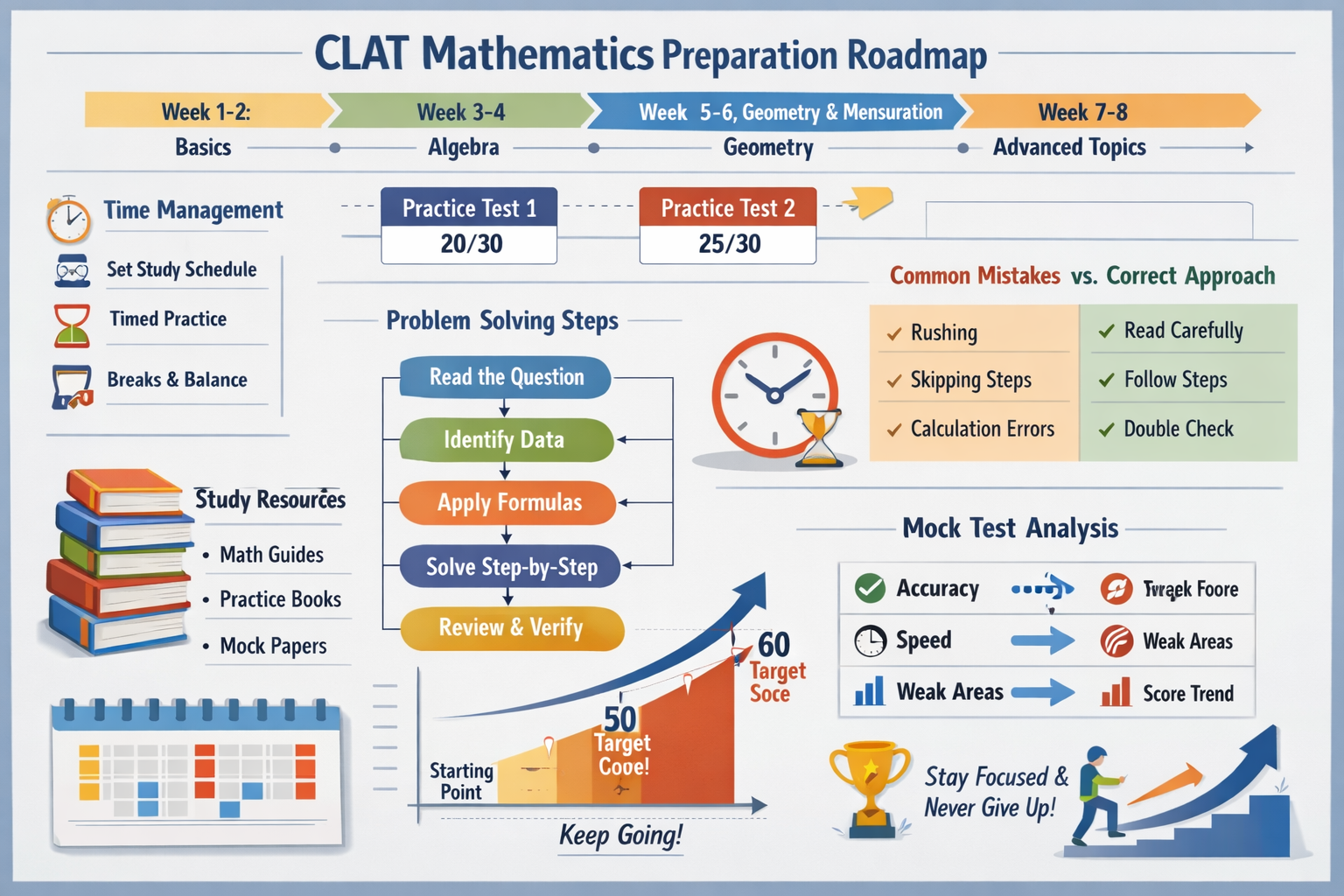
Month 1: Complete conceptual revision of all topics in CLAT Math’s Syllabus 2027. Solve basic topic wise questions.
Month 2: Complete advanced topic wise practice. Start passage based question practice. Solve previous year CLAT mathematics questions.
Month 3: Focus on mock tests and speed building. Identify and strengthen weak areas. Practice mental math daily.
Month 4 onwards: Maintain skills through regular practice. Take weekly mock tests. Focus on accuracy and time management.
These milestones keep you on track and ensure you’re making measurable progress.
Psychological Approach to the Mathematics Section
Your mindset matters as much as your preparation.
Overcoming Math Anxiety
Many students carry negative beliefs about mathematics from school experiences. “I’m not a math person.” “I always make silly mistakes.” “Math makes me nervous.”
These beliefs become self fulfilling prophecies. If you believe you’ll struggle, you probably will.
Reframe Your Thinking: You’re not inherently bad at math. You simply need practice with these specific topics. The CLAT Math’s Syllabus 2027 is limited and learnable.
Focus on Progress: Don’t compare yourself to students who find math easy. Compare yourself to where you were last month. Are you improving? That’s what matters.
Normalize Mistakes: Everyone makes calculation errors. The difference is that prepared students catch and correct them. Mistakes are learning opportunities, not evidence of inability.
Building Exam Day Confidence
Confidence for the mathematics section comes from:
Thorough Preparation: When you’ve practiced extensively, you trust your ability to handle questions.
Successful Mock Tests: Regular good performance in mocks builds belief that you can replicate it in the actual exam.
Clear Strategy: Knowing exactly how you’ll approach the section (which questions to attempt first, how much time to allocate, when to skip and move on) reduces anxiety.
Backup Plans: Having strategies for when things don’t go as expected. What if you encounter an unfamiliar question type? What if you’re running short on time? Having thought through these scenarios prevents panic.
Staying Calm Under Pressure
During the exam, if you encounter a difficult mathematics question:
Breathe: Take a deep breath. Panic clouds thinking.
Read Carefully: Often the difficulty is in understanding what’s being asked, not the calculation itself.
Break It Down: Divide complex questions into smaller steps.
Use Elimination: Even if you can’t solve completely, eliminating obviously wrong options improves your guess.
Move On If Needed: Don’t let one question derail your entire section performance.
The CLAT exam anxiety guide provides comprehensive strategies for managing exam stress across all sections.
Technology Enabled Learning for Mathematics
Modern preparation tools can significantly enhance your mathematics preparation.
Online Learning Platforms
Platforms offering CLAT preparation provide several advantages:
Video Lessons: Visual explanations of concepts often work better than reading textbooks, especially for topics like data interpretation.
Interactive Practice: Immediate feedback on practice questions helps you learn faster than solving from books and checking answers later.
Personalized Learning Paths: Adaptive platforms identify your weak areas and provide targeted practice.
Progress Tracking: Detailed analytics show which topics you’re strong in and which need more work.
At Lawgic Coaching, our online platform provides all these features with content specifically designed for CLAT, not generic competitive exam preparation.
Mobile Apps for Practice
Mental Math Apps: Apps like “Math Workout” or “Elevate” provide daily practice for calculation speed.
Formula Reference Apps: Quick access to important formulas and concepts when you’re studying on the go.
Mock Test Apps: Practice tests you can take anytime, anywhere.
The key is using technology as a supplement to structured preparation, not as a replacement for it.
YouTube and Free Resources
Excellent free content is available for every topic in the CLAT Math’s Syllabus 2027. The challenge is finding quality resources among the noise.
Look for:
- Channels specifically focused on law entrance exams
- Clear explanations with examples
- Practice questions in CLAT pattern
- Recent content aligned with current exam pattern
Digital Note Taking
Consider maintaining digital notes for mathematics:
Formula Sheets: A compiled document with all important formulas and shortcuts.
Error Log: Document mistakes you make in practice and how to avoid them.
Quick Reference: Short notes on concepts you tend to forget.
Digital notes are searchable, always accessible, and easy to update.
Comparative Analysis: CLAT Mathematics vs Other Exams
Understanding how CLAT mathematics compares to other exams provides perspective.
CLAT vs AILET
AILET (All India Law Entrance Test for NLU Delhi) has a similar mathematics section with Class 10 level concepts.
Key Differences:
- AILET sometimes includes slightly more questions on logical reasoning mixed with mathematics
- The passage format is similar but AILET passages are sometimes shorter
- Difficulty level is comparable
Students preparing for both exams can use largely the same preparation strategy. The AILET vs CLAT coaching differences guide provides detailed comparison.
CLAT vs Other Law Entrances
State level law entrances (MH CET Law, AP LAWCET, etc.) have varying mathematics components:
MH CET Law: Includes mathematics but with slightly different weightage and sometimes different topic emphasis.
AP LAWCET: Similar Class 10 level mathematics.
Most preparation for CLAT Math’s Syllabus 2027 transfers well to these exams with minor adjustments.
CLAT vs General Aptitude Exams
Compared to exams like CAT, GMAT, or even general aptitude sections in other competitive exams:
CLAT is Simpler: The mathematical concepts are more basic. CAT includes complex topics like permutations, combinations, advanced algebra, and geometry.
CLAT is More Application Based: While CAT tests pure problem solving ability, CLAT focuses on applying basic math to real world scenarios.
CLAT Requires Less Specialized Training: You don’t need years of preparation or specialized coaching for CLAT mathematics like you might for CAT quant.
This comparison should reassure you. The CLAT Math’s Syllabus 2027 is genuinely manageable with focused preparation.
Success Stories and Learning from Toppers
What do students who score perfectly in the mathematics section do differently?
Common Patterns Among High Scorers
Early Start: Most top performers started mathematics preparation early, giving themselves adequate time to build strong foundations.
Consistent Practice: They practiced daily, even if just for 20-30 minutes, rather than intensive cramming sessions.
Mock Test Discipline: Regular full length mocks under timed conditions, followed by detailed analysis.
Accuracy Focus: They prioritized getting questions right over attempting all questions. Their attempt rate was often 85-90% but accuracy was 95%+.
Mental Math Mastery: Strong mental calculation ability allowed them to solve questions quickly without extensive rough work.
Calm Approach: They didn’t panic over difficult questions. They had clear strategies for time management and question selection.
Learning from Mistakes
Top scorers made mistakes during preparation just like everyone else. The difference is how they responded:
Systematic Error Analysis: After every mock test or practice session, they analyzed what went wrong. Was it a conceptual gap? Calculation error? Misreading the question?
Targeted Improvement: Based on error analysis, they focused additional practice on weak areas rather than randomly solving more questions.
Mistake Documentation: Many maintained error logs, noting down mistakes and reviewing them periodically to avoid repetition.
Seeking Help: When stuck on concepts, they didn’t waste time struggling alone. They asked teachers, joined study groups, or used online resources.
Realistic Expectations
Here’s an important point. Not every CLAT topper was naturally brilliant at mathematics. Many struggled initially but improved through systematic preparation.
Your starting point doesn’t determine your ending point. What matters is consistent effort and smart preparation strategy.
Final Preparation Phase: Last Month Strategy
As you approach the exam, your mathematics preparation strategy should evolve.
Revision Over New Learning
In the last month, don’t try to learn new topics or techniques. Focus on strengthening what you already know.
Formula Revision: Review all important formulas and shortcuts daily.
Concept Refresh: Quickly revise key concepts from each topic.
Previous Mistakes: Review your error log and practice question types you previously got wrong.
Mock Test Intensive Phase
Take at least 2-3 full length mock tests per week in the last month.
Exam Simulation: Take mocks at the same time as your actual CLAT exam to build circadian rhythm.
Detailed Analysis: Spend as much time analyzing mocks as taking them. Identify patterns in your mistakes.
Section Wise Practice: If mathematics is a weak area, take additional section specific tests.
Speed Building
By now your accuracy should be good. Focus on improving speed:
Timed Practice Sets: Solve mathematics question sets with strict time limits.
Mental Math Drills: Daily practice with mental calculation to reduce dependence on rough work.
Shortcut Application: Practice using shortcuts and approximation techniques you’ve learned.
Maintaining Calm
The last month can be stressful. For mathematics specifically:
Don’t Panic Over Difficult Questions: If you encounter tough questions in mocks, don’t assume the exam will be that hard. Difficulty varies.
Trust Your Preparation: If you’ve followed a systematic preparation plan, trust that you’re ready.
Balanced Focus: Don’t neglect other sections to obsess over mathematics. Maintain balanced preparation.
Exam Day Preparation
Night Before: Don’t study new mathematics content. Light revision of formulas is fine, but avoid intensive problem solving.
Morning Of: Review your formula sheet briefly. Do a few mental math warm up calculations if it helps you feel ready.
During Exam: Stick to your planned strategy. Don’t let unexpected questions derail your approach.
Beyond CLAT: Long Term Value of Quantitative Skills
The mathematical reasoning you develop for CLAT serves you well beyond the exam.
In Law School
Many law school subjects involve numerical reasoning:
Economics Courses: Understanding economic principles requires comfort with graphs, percentages, and statistical concepts.
Corporate Law: Financial statements, company valuations, and economic analysis of legal issues.
Tax Law: Fundamentally involves calculations and numerical reasoning.
Constitutional Law: Analyzing demographic data, understanding representation calculations.
Research Methodology: Legal research often involves statistical analysis and data interpretation.
In Legal Practice
Practicing lawyers use quantitative reasoning regularly:
Contract Disputes: Calculating damages, interest, penalties.
Property Law: Area calculations, valuation, partition of property.
Corporate Transactions: Financial analysis, due diligence involving numbers.
Litigation: Presenting statistical evidence, analyzing numerical data in cases.
Alternative Dispute Resolution: Settlement calculations, cost benefit analysis.
In Legal Academia and Research
For those pursuing academic careers:
Empirical Legal Research: Growing field requiring statistical analysis and data interpretation.
Policy Analysis: Evaluating legal policies involves understanding economic data and social statistics.
Comparative Legal Studies: Analyzing legal systems using quantitative metrics.
Transferable Skills
Beyond specific applications, the skills you develop include:
Analytical Thinking: Breaking complex problems into manageable steps.
Attention to Detail: Catching errors and ensuring accuracy.
Logical Reasoning: Following structured approaches to problem solving.
Data Literacy: Understanding and interpreting numerical information critically.
These skills benefit you regardless of your specific career path within law.
Conclusion: Your Roadmap to Mastering CLAT Math’s Syllabus 2027
Let’s bring this together with clear, actionable next steps.
The CLAT Math’s Syllabus 2027 is comprehensive yet completely manageable. It tests Class 10 level mathematical concepts applied to real world scenarios through passage based questions. With 13-15 questions contributing approximately 11-12% to your total score, this section is too important to ignore but not so large that it should dominate your preparation time.
Your success in this section depends on:
Conceptual clarity in arithmetic, percentages, ratios, basic algebra, data interpretation, and statistics. Build this through systematic topic wise study using NCERT Class 10 mathematics and CLAT specific resources.
Calculation speed and accuracy developed through daily mental math practice and timed question solving. Aim for the ability to perform most calculations mentally or with minimal rough work.
Application skills practiced through passage based question sets and previous year CLAT papers. Learn to quickly extract relevant data from passages and identify appropriate mathematical operations.
Strategic approach to time management, question selection, and accuracy optimization. Know when to attempt, when to skip, and how to maximize your score within time constraints.
Consistent practice integrated into your overall CLAT preparation schedule. Regular daily practice is more effective than intensive cramming sessions.
Here’s your immediate action plan:
This Week: Assess your current level by solving one previous year CLAT mathematics section. Identify which topics you’re comfortable with and which need work.
Next Month: Complete conceptual revision of all topics in the CLAT Math’s Syllabus 2027. Use NCERT Class 10 textbook and CLAT specific resources. Solve basic topic wise questions to build confidence.
Following Months: Progress to advanced topic wise practice, then passage based questions, then full mock tests. Maintain daily practice throughout.
Last Month: Focus on revision, mock tests, speed building, and maintaining calm. Trust your preparation.
Remember: The mathematics section is highly scorable. Students who prepare systematically often achieve 90%+ accuracy. These marks can make the difference between getting your dream NLU and missing out.
Your success is our mission at Lawgic Coaching. We’ve helped thousands crack CLAT with expert guidance from top NLU faculty, flexible learning that fits your schedule, and personalized attention to each section including quantitative techniques. Whether you’re strong in mathematics and need just strategic practice or you’re starting from a weak foundation and need comprehensive support, we have proven strategies that actually work.
The CLAT Math’s Syllabus 2027 isn’t an obstacle. It’s an opportunity to secure easy marks through smart preparation. Start today. Practice consistently. Stay focused. And watch your confidence and scores grow.
Your law school dream is within reach. Let’s build your CLAT success together.