Here’s what keeps CLAT aspirants awake at night: you’ve finished the exam, calculated your approximate score, but have no idea what rank that translates to or which National Law University you can realistically target. Understanding CLAT marks vs rank correlation isn’t just helpful, it’s absolutely critical for making informed decisions during counselling. The relationship between your raw score and final rank depends on multiple factors including exam difficulty, normalization process, total test takers, and category-specific reservations. This comprehensive guide breaks down exactly how CLAT marks convert to ranks in 2026, what scores you need for top NLUs, and how to strategically plan your college selection based on your expected performance.
Key Takeaways
- CLAT rank depends on normalized marks, not raw scores, making direct prediction challenging without understanding the normalization formula
- A score of 100+ marks typically secures a rank within top 100, while 85-95 marks generally place you in the 100-500 rank bracket for General category
- Your CLAT rank determines NLU admission chances more than absolute marks, with each NLU having different cutoff ranks across categories
- Historical trends show rank-to-marks ratio varies by 10-15% annually based on paper difficulty and candidate pool strength
- Strategic college selection requires understanding both your predicted rank and category-wise cutoffs across all 22 NLUs
What is CLAT Marks vs Rank and Why Does It Matter?
The CLAT marks vs rank relationship represents how your actual exam score translates into your All India Rank in the merit list. This isn’t a simple one-to-one conversion. Your marks go through a normalization process (when the exam is conducted in multiple slots), then get ranked against all other candidates who appeared for the exam.
Let’s be honest, marks alone don’t secure admission. Your rank does.
Two students with identical raw scores might end up with different normalized marks if they appeared in different exam slots. The CLAT Consortium uses a normalization formula to ensure fairness across all sessions, adjusting for variations in paper difficulty.
Why this matters for your law school dreams:
Your rank directly determines which NLUs you’re eligible for during counselling. National Law School of India University Bangalore (NLSIU) might close admissions at Rank 50 for General category, while other NLUs accept candidates with ranks in the thousands. Understanding where your expected marks place you in the ranking hierarchy helps you set realistic goals and backup options.
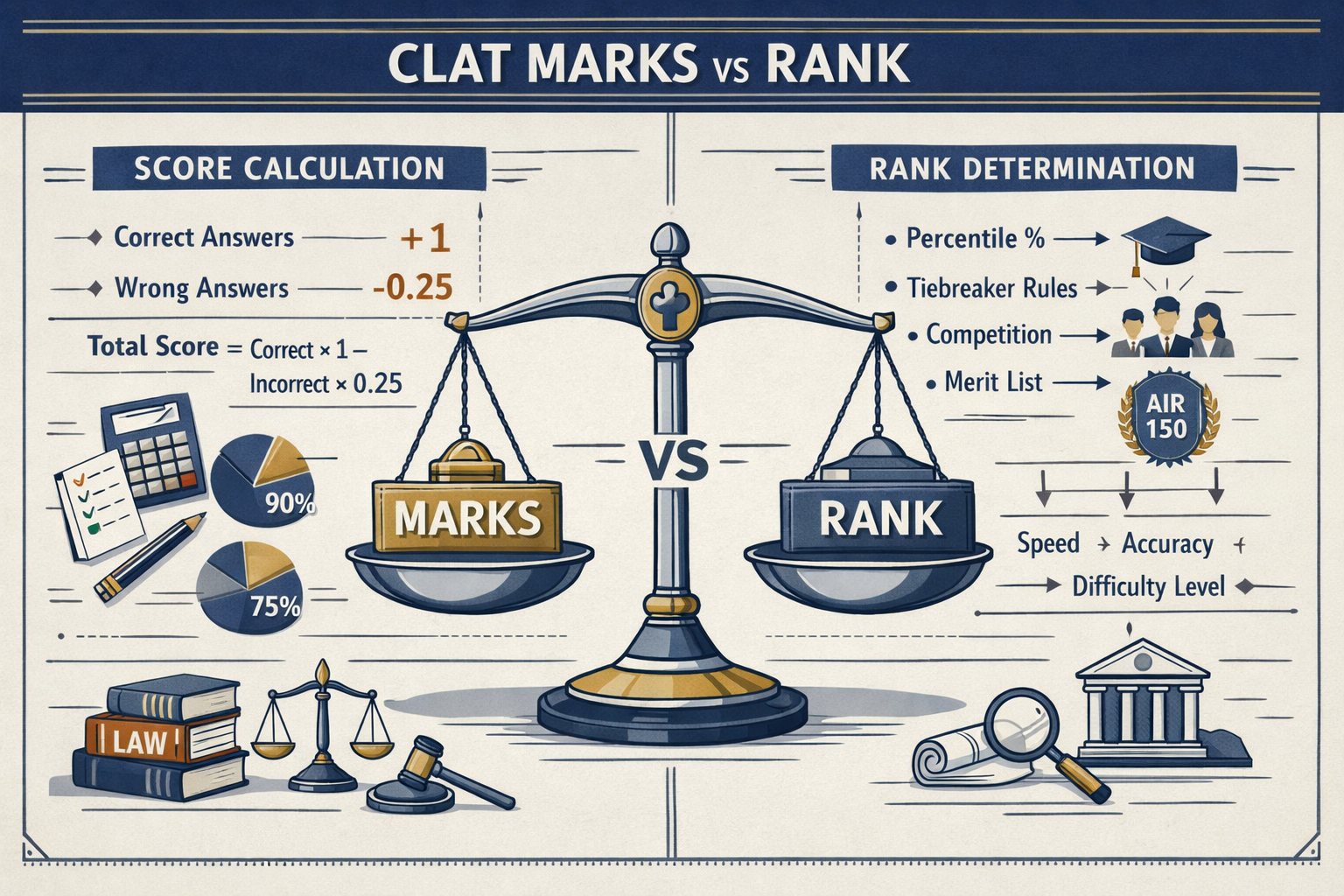
The CLAT consortium scoring system awards one mark for each correct answer and deducts 0.25 marks for every incorrect response. With 120 questions carrying 120 marks total, your final score can range theoretically from negative values to 120, though practically, toppers usually score between 100-115 marks.
Understanding the CLAT Rank Calculation Process
The journey from your answer sheet to your final rank involves several technical steps that most aspirants don’t fully understand. Here’s what actually happens behind the scenes.
Raw Score Calculation
First, the system calculates your raw score using this formula:
Raw Score = (Correct Answers × 1) – (Incorrect Answers × 0.25)
If you attempted 110 questions, got 95 correct and 15 wrong, your raw score would be:
95 – (15 × 0.25) = 95 – 3.75 = 91.25 marks
Unattempted questions carry no penalty, which is why strategic skipping matters during the exam.
Normalization Process (Multi-Slot Exams)
When CLAT is conducted across multiple slots or days, normalization becomes necessary. The Consortium uses a percentile-based normalization formula to ensure candidates who faced a tougher paper aren’t disadvantaged.
The normalization formula considers:
- Mean score of your slot
- Standard deviation of your slot
- Mean score of the base slot (usually the easiest)
- Standard deviation of the base slot
Your normalized marks might be higher or lower than your raw score depending on your slot’s overall performance. This is why you can’t accurately predict your rank immediately after the exam without knowing how other slots performed.
Merit List Preparation
After normalization, all candidates are ranked in descending order of their normalized marks. In case of ties (multiple candidates with identical marks), the CLAT Consortium applies tie-breaking rules:
- Candidate with higher marks in Legal Reasoning section ranks higher
- If still tied, higher marks in Logical Reasoning section
- If still tied, higher marks in English Language section
- If still tied, older candidate by date of birth ranks higher
This ranked list becomes your All India Rank (AIR), which determines your entire admission journey.
Category-Wise Rank Lists
Beyond your AIR, you also receive a category rank if you belong to reserved categories (OBC-NCL, SC, ST, EWS, PwD). These separate rank lists are crucial because NLUs have category-specific seat reservations.
A General category student with AIR 800 might not get into NLSIU, but an SC category student with the same AIR could secure admission due to reserved seats and different cutoff ranks.
CLAT 2026 Marks vs Rank Analysis: What Scores Get What Ranks
Based on historical data from CLAT 2023, 2024, and 2025, we can establish approximate correlations between marks and ranks. Remember, these are estimates that vary by 10-15% based on annual factors.
General Category Marks to Rank Conversion
| Marks Range | Expected Rank Range | Admission Prospects |
|---|---|---|
| 105-120 | 1-50 | NLSIU Bangalore, NALSAR Hyderabad guaranteed |
| 95-104 | 51-200 | Top 5 NLUs highly probable |
| 85-94 | 201-500 | Top 10 NLUs accessible |
| 75-84 | 501-1000 | Most NLUs except top 3-4 |
| 65-74 | 1001-2000 | Mid-tier NLUs, good options available |
| 55-64 | 2001-4000 | Newer NLUs, some seats in older NLUs |
| 45-54 | 4001-7000 | Limited NLU options, consider state universities |
These numbers shift based on exam difficulty. A relatively easy paper pushes cutoffs higher, while a tough paper brings them down.
Reserved Category Variations
Reserved category candidates need significantly lower marks for similar admission outcomes:
OBC-NCL Category:
- 90+ marks: Top 3 NLUs accessible
- 75-89 marks: Top 10 NLUs probable
- 60-74 marks: Most NLUs have options
SC Category:
- 80+ marks: Top NLUs including NLSIU possible
- 65-79 marks: Wide range of NLU choices
- 50-64 marks: Several NLU options available
ST Category:
- 75+ marks: Premium NLUs accessible
- 60-74 marks: Good NLU selection
- 45-59 marks: Multiple NLU seats available
EWS Category:
- Cutoffs typically 5-8% lower than General category
- 95+ marks: Top NLUs probable
- 80-94 marks: Top 10 NLUs accessible
Understanding these category-specific patterns helps set realistic targets during CLAT preparation.
How to Predict Your CLAT Rank Before Results
Waiting for results feels endless, but you can make educated predictions about your probable rank using several methods.
Answer Key Comparison Method
Once CLAT releases the provisional answer key (usually within 3-4 days of the exam), you can:
- Download your response sheet from the official website
- Compare your answers with the provisional answer key
- Calculate your raw score accounting for correct answers and negative marking
- Check if normalization applies (multiple slots)
- Compare your score with previous year cutoffs adjusted for difficulty
This gives you a ballpark figure, though normalization remains the unpredictable element.
Percentile-Based Estimation
If you know the total number of test takers (CLAT Consortium announces this), you can estimate rank from percentile:
Rank = (100 – Percentile) × Total Candidates / 100
If 60,000 students appeared and you estimate you’re in the 98th percentile:
Rank = (100 – 98) × 60,000 / 100 = 1,200
This method works better after normalization details emerge.
Coaching Institute Rank Predictors
Many coaching platforms release rank predictors within hours of the exam. These tools:
- Collect data from thousands of students
- Apply statistical models based on historical patterns
- Factor in reported difficulty levels
- Provide probability-based rank ranges
While not perfectly accurate, they offer reasonable estimates when you input your expected score.
At Lawgic Coaching, we provide personalized rank prediction analysis for our students, combining their mock test performance trends with actual exam responses to give realistic expectations. Your success is our mission, and that includes helping you navigate the anxious post-exam period with data-driven insights.
Previous Year Comparison with Difficulty Adjustment
Compare your expected score with previous year rank vs marks data, then adjust for this year’s difficulty:
- If 2026 paper was easier than 2025: Add 3-5 marks to previous year’s cutoff for same rank
- If 2026 paper was tougher: Subtract 3-5 marks from previous year’s cutoff
- If similar difficulty: Use previous year data directly
Difficulty perception comes from student feedback, coaching institute analysis, and your own experience with CLAT mock tests.
CLAT Cut-off Marks and Trends Analysis (2022-2026)
Cutoff trends reveal important patterns that help you understand how CLAT marks vs rank dynamics have evolved.
Top NLU Cutoffs: Five-Year Trend
NLSIU Bangalore (General Category):
- 2022: Rank 47 (approx. 102 marks)
- 2023: Rank 52 (approx. 98 marks)
- 2024: Rank 45 (approx. 105 marks)
- 2025: Rank 50 (approx. 101 marks)
- 2026 (Predicted): Rank 48-55 (approx. 99-104 marks)
NALSAR Hyderabad (General Category):
- 2022: Rank 145 (approx. 95 marks)
- 2023: Rank 158 (approx. 92 marks)
- 2024: Rank 140 (approx. 97 marks)
- 2025: Rank 152 (approx. 94 marks)
- 2026 (Predicted): Rank 145-160 (approx. 93-96 marks)
NLUD Delhi (General Category):
- 2022: Rank 320 (approx. 88 marks)
- 2023: Rank 342 (approx. 85 marks)
- 2024: Rank 315 (approx. 90 marks)
- 2025: Rank 335 (approx. 87 marks)
- 2026 (Predicted): Rank 320-345 (approx. 86-89 marks)
What These Trends Tell You
Cutoffs haven’t changed dramatically over five years, fluctuating within a 5-8% range. This stability means historical data remains relevant for prediction.
However, the candidate pool has grown significantly. CLAT 2022 saw approximately 52,000 candidates, while 2025 crossed 68,000. Despite more competition, cutoff ranks haven’t increased proportionally because:
- NLUs added more seats (NLU Tripura, NLU Nagaland joined the consortium)
- Better preparation resources filtered out unprepared candidates
- Normalization process maintained consistent difficulty standards
Section-Wise Performance Impact
Your overall marks matter most, but section-wise performance affects tie-breaking and reveals preparation gaps:
Legal Reasoning: Typically the highest-scoring section for toppers (24-28 out of 28-30 questions)
Logical Reasoning: Moderate scoring (20-24 out of 28-30 questions)
English Language: High scoring for well-prepared students (24-27 out of 28-30 questions)
Current Affairs & GK: Most variable section (18-26 out of 28-30 questions)
Quantitative Techniques: Moderate to high scoring (20-25 out of 6-8 questions)
Students who score consistently across sections tend to achieve better ranks than those with extreme variations. A balanced preparation strategy, like the one we follow at Lawgic Coaching, ensures you’re not vulnerable to one difficult section destroying your rank.
NLU Admission Chances Based on Your CLAT Rank
Your rank opens specific doors. Here’s a realistic breakdown of what different rank brackets can expect during counselling.
Rank 1-100: Premium Choices
With a rank under 100, you have access to virtually any NLU and any specialization. Your decision factors shift from “Will I get in?” to “Which location and specialization suit me best?”
Top choices in this bracket:
- NLSIU Bangalore (Rank 1-50)
- NALSAR Hyderabad (Rank 1-160)
- NLUD Delhi (Rank 1-320)
- WBNUJS Kolkata (Rank 1-280)
- NLU Jodhpur (Rank 1-350)
Students in this bracket should research faculty specializations, campus culture, moot court opportunities, and placement records rather than just brand names.
Rank 101-500: Strong Options
This bracket still offers excellent NLU options, though the very top 2-3 might be out of reach for General category.
Realistic targets:
- NALSAR Hyderabad (if rank is 101-160)
- NLUD Delhi (high probability)
- WBNUJS Kolkata (good chances)
- NLU Jodhpur (very good chances)
- HNLU Raipur (excellent chances)
- GNLU Gandhinagar (excellent chances)
- RMLNLU Lucknow (excellent chances)
This rank range represents strong CLAT performance. You’ll get into a well-established NLU with good academic reputation and placement support.
Rank 501-1500: Solid Mid-Tier NLUs
Students in this bracket access most NLUs except the top 4-5 for General category. Your focus should be on finding the right fit rather than just the highest-ranked NLU.
Available options:
- HNLU Raipur
- GNLU Gandhinagar
- RMLNLU Lucknow
- RGNUL Punjab
- NLU Odisha
- NLUJA Assam
- NLUO Cuttack
- CNLU Patna
These NLUs offer quality legal education, decent placement opportunities, and strong alumni networks. Don’t underestimate them based solely on ranking lists.
Rank 1501-3500: Newer and Emerging NLUs
This bracket requires strategic thinking. Newer NLUs might lack established alumni networks but often have modern infrastructure and enthusiastic faculty.
Typical options:
- MNLU Mumbai
- NLIU Bhopal
- DSNLU Visakhapatnam
- NLUJAA Guwahati
- NLU Tripura
- NLU Nagaland
- NLUM Aurangabad
Consider factors beyond rankings: location preferences, specific faculty expertise, infrastructure quality, and your long-term career goals. A newer NLU in a metro city might offer better internship opportunities than an older NLU in a remote location.
Rank 3500+: Alternative Strategies
Beyond rank 3500, NLU options become limited for General category, though reserved category candidates still have multiple choices.
Strategic alternatives:
- Wait for subsequent counselling rounds (some candidates don’t join, opening seats)
- Consider excellent state universities (Delhi University, Symbiosis, Christ University)
- Evaluate private law schools with strong placement records
- Assess whether appearing again next year makes sense
Many successful lawyers graduated from non-NLU institutions. Your college matters, but your dedication, internships, and skill development matter more in the long run.
Understanding CLAT cutoff predictions for different NLUs helps you create a realistic preference list during counselling.
Score Prediction Methods and Tools
Accurate score prediction reduces anxiety and helps you plan your next steps strategically.
Official Answer Key Method
The CLAT Consortium releases a provisional answer key within 3-4 days of the exam. This is your most reliable prediction tool.
Step-by-step process:
- Log into the CLAT official website using your credentials
- Download your response sheet (shows questions and your marked answers)
- Download the provisional answer key
- Create a spreadsheet with columns: Question Number, Your Answer, Correct Answer, Result
- Mark each question as Correct (+1), Incorrect (-0.25), or Unattempted (0)
- Sum up your total marks
- Check if normalization applies to your slot
If you disagree with any answer in the provisional key, you can file objections (usually with a fee). If your objection is accepted, the final answer key changes, potentially affecting your score.
Mock Test Performance Correlation
Your performance in quality mock tests provides predictive value, especially mocks taken in the final month before CLAT.
Correlation factors:
Students typically score 5-10% lower in the actual CLAT compared to their average mock test scores due to exam pressure. However, if you consistently scored 95+ in mocks, you’re likely to score 85-90+ in the actual exam.
Track your mock test rank vs marks ratio. If you scored 88 marks and got rank 450 in a mock taken by 15,000 students, apply proportional scaling to estimate your actual CLAT rank if 60,000 students appeared.
At Lawgic Coaching, we’ve helped thousands crack CLAT by providing mock tests that closely mirror actual exam patterns. Our students report that our mocks are slightly tougher than actual CLAT, which means their real exam performance often exceeds their mock averages.
Coaching Institute Predictors
Within hours of CLAT, major coaching institutes release rank and score predictors. These tools aggregate data from thousands of students who input their responses.
How they work:
- Students enter their answers or expected marks
- The system compares against the provisional answer key
- Statistical algorithms apply historical rank-to-marks correlations
- The tool provides a probable rank range with confidence intervals
Reliability factors:
- Predictors with larger sample sizes (10,000+ inputs) are more accurate
- Early predictions (before answer key) are less reliable
- Predictions improve after normalization details emerge
- Most predictors are accurate within ±200 ranks for top 1000 ranks
Statistical Models Based on Historical Data
If you understand basic statistics, you can build your own prediction model using historical data.
Required data points:
- Your expected marks
- Total number of candidates this year
- Previous year’s rank vs marks data
- Difficulty level adjustment factor
- Category-specific conversion ratios
Simple prediction formula:
Estimated Rank = (Previous Year Rank for Similar Marks) × (This Year Candidates / Previous Year Candidates) × Difficulty Adjustment Factor
If 90 marks gave Rank 500 last year with 55,000 candidates, and this year has 60,000 candidates with similar difficulty:
Estimated Rank = 500 × (60,000 / 55,000) × 1.0 = 545
This method provides ballpark figures, not precise predictions.
Strategic College Selection Based on CLAT Rank
Getting a good rank is half the battle. Using it wisely during counselling is the other half.
Creating Your Preference List
CLAT counselling allows you to list NLU preferences. This list is crucial because seat allocation happens based on your rank and preference order.
Strategic principles:
-
Put your dream NLU first, even if it seems like a stretch. Seat allocation happens in rounds, and sometimes cutoffs drop in later rounds.
-
Follow with realistic options based on your rank and category. Research previous year cutoffs carefully.
-
Include safe options where your rank comfortably exceeds the cutoff by 200-300 ranks.
-
Don’t leave gaps. If you want NLU Jodhpur and GNLU Gandhinagar but skip HNLU Raipur in between, you might miss HNLU even if you don’t get Jodhpur.
-
Consider geography seriously. Five years is a long time. Choose a location where you can thrive personally, not just academically.
Factors Beyond Rankings
NLU rankings published by various agencies shouldn’t be your only decision criterion.
Equally important factors:
Faculty Quality: Research faculty publications, their areas of expertise, and student feedback. Some newer NLUs have excellent faculty who chose them for research freedom.
Infrastructure: Modern libraries, moot court halls, hostels, and technology infrastructure significantly impact your learning experience.
Location Advantages: NLUs in metro cities (Mumbai, Delhi, Bangalore, Hyderabad) offer better internship opportunities during semester breaks.
Specialization Opportunities: If you’re interested in IPR, GNLU Gandhinagar has strong programs. For corporate law, NLSIU and NALSAR excel.
Alumni Network: Established NLUs have alumni in top law firms, judiciary, and corporate legal departments who can mentor and open doors.
Placement Records: Check average salary, top recruiters, percentage of students placed, and diversity of opportunities (litigation, corporate, judiciary, academia).
Category-Specific Counselling Strategy
Reserved category candidates have additional strategic considerations.
Key points:
- You compete for both general category seats (if your rank qualifies) and reserved category seats
- Sometimes a lower-ranked NLU’s general category seat is strategically better than a higher-ranked NLU’s reserved seat (no category label on degree)
- Category certificates must be valid and from competent authority, or your admission will be cancelled
- EWS category has annual income limits that must be satisfied at the time of admission
Round-by-Round Strategy
CLAT counselling typically has 3-4 rounds plus a spot round.
Round 1: Cutoffs are highest. Many students get their top choices. If you get your top 3 preference, strongly consider accepting.
Round 2: Some seats open up as students from Round 1 upgrade or don’t join. Cutoffs might drop by 50-150 ranks for some NLUs.
Round 3: Further seat openings, cutoffs can drop by 100-300 ranks from Round 1 for mid-tier NLUs.
Spot Round: Significant cutoff drops possible (300-500 ranks for some NLUs) as the Consortium tries to fill all seats. However, choices become limited.
Strategic decision: If you get a decent NLU in Round 1 but want to try for a better one in Round 2, you must pay the acceptance fee and then participate in Round 2. If you get a better option in Round 2, you lose the Round 1 fee but upgrade. If you don’t get better, you keep your Round 1 seat.
This requires financial planning and risk assessment. Discuss with family before making decisions.
Psychological Preparation for Rank Anxiety
The gap between taking CLAT and receiving results creates intense anxiety. Your mental health during this period matters.
Managing Post-Exam Stress
After CLAT, you’ll experience a range of emotions: relief, anxiety, regret about specific questions, hope, fear. All of this is completely normal.
Healthy coping strategies:
Limit answer key obsession: Check your score once using the official answer key. Repeatedly calculating and recalculating doesn’t change your marks, it only increases anxiety.
Avoid comparison: Your friends discussing their performance can trigger unnecessary stress. Everyone has different expectations and contexts. Your 85 marks might be a victory while someone else’s 95 feels disappointing.
Stay physically active: Exercise releases endorphins that combat stress. Even a 30-minute daily walk helps significantly.
Maintain routine: Don’t let the waiting period become a void. Read, learn new skills, spend time with family, pursue hobbies.
Prepare for multiple outcomes: Mentally prepare for various scenarios. What if you get your dream NLU? What if you don’t? Having thought through different paths reduces shock and helps you respond rather than react.
Dealing with Unexpected Ranks
Sometimes your rank doesn’t match your expectations. This can happen due to normalization, calculation errors, or simply a tougher competition pool.
If your rank is lower than expected:
Take 24 hours to process the disappointment. Feel whatever you feel without judgment. Then shift to solution mode.
Research NLUs available at your rank. You might discover excellent options you hadn’t considered. Many successful lawyers graduated from NLUs ranked 10-15, not top 5.
Consider whether appearing again next year makes sense. If you’re in Class 12 and got Rank 2500, maybe a gap year with focused preparation could get you to Rank 500 next year. But if you’re already a dropper, carefully weigh the opportunity cost.
Explore excellent non-NLU options. Delhi University Faculty of Law, Symbiosis Pune, Christ University Bangalore, and others produce outstanding lawyers.
Remember: your college influences your journey, but your dedication determines your destination. The legal field rewards skill, ethics, and hard work more than pedigree.
If your rank is better than expected:
Congratulations, but don’t let euphoria cloud judgment. Research your options thoroughly. A top rank opens doors, but you still need to choose the right door for your specific goals.
Talk to current students and alumni of shortlisted NLUs. Their insights about daily life, teaching quality, and opportunities will help you decide better than any ranking list.
At Lawgic Coaching, we provide post-result counselling for our students, helping them navigate these emotional and strategic challenges. We’ve seen students with Rank 3000 build more successful careers than some with Rank 300, because they made smarter choices and worked harder. Let’s build your law career together, regardless of your rank.
Hidden Factors Affecting CLAT Rank Beyond Marks
Your marks are the primary factor, but several other elements influence your final rank and admission prospects.
Normalization Impact
When CLAT is conducted in multiple slots, normalization can significantly alter your rank.
Real example scenario:
Student A appears in Slot 1 (easier paper), scores 92 raw marks
Student B appears in Slot 2 (tougher paper), scores 88 raw marks
After normalization:
Student A’s normalized marks: 90
Student B’s normalized marks: 91
Student B ranks higher despite scoring lower raw marks because the normalization formula accounted for their slot’s difficulty.
You have no control over which slot you get or its difficulty level. This randomness frustrates many students, but it’s designed to ensure fairness across all test-takers.
Tie-Breaking Rules
With 60,000+ candidates and marks rounded to two decimal places, ties are inevitable. The CLAT Consortium’s tie-breaking mechanism can affect hundreds of students.
The hierarchy:
- Legal Reasoning marks (first tie-breaker)
- Logical Reasoning marks (second tie-breaker)
- English Language marks (third tie-breaker)
- Age (older candidate ranks higher)
This is why balanced section-wise performance matters. If you and another candidate both score 89.50 marks, but you scored 26/28 in Legal Reasoning while they scored 24/28, you rank higher.
Students often ignore this during preparation, focusing only on overall marks. Strategic preparation addresses section-wise targets, not just total score targets.
Answer Key Challenges and Changes
After the provisional answer key is released, students can challenge answers they believe are incorrect. If challenges are accepted, the final answer key changes.
Impact on ranks:
If a question’s answer changes from Option B to Option C:
- Students who marked C gain 1.25 marks (from -0.25 to +1)
- Students who marked B lose 1.25 marks (from +1 to -0.25)
- Students who marked other options or didn’t attempt remain unaffected
These changes can shift ranks by 50-200 positions for students near cutoff boundaries. A question that gets marked as “bonus” (all students get marks regardless of their answer) benefits everyone equally, so relative ranks don’t change much.
Category Certificate Validity
Your category rank only matters if your category certificate is valid. Every year, some students lose their reserved category admission because:
- Certificate was from an incompetent authority
- Income limit was exceeded for EWS category
- Caste certificate didn’t match the exact format required
- Certificate was issued after the cutoff date specified
Protect yourself:
Get your category certificate verified by the issuing authority before counselling. Ensure it mentions the exact caste/category name as recognized by the Central Government. For EWS, ensure your family’s gross annual income is below ₹8 lakh and you don’t own specified agricultural land or residential property beyond limits.
Losing admission after counselling due to certificate issues is heartbreaking and avoidable.
Alternative Paths for Different Rank Ranges
Not everyone gets their dream rank. Here’s how to build a successful legal career regardless of your CLAT performance.
For Ranks Beyond NLU Cutoffs
If your rank doesn’t secure an NLU seat, you have several excellent alternatives.
Top Non-NLU Law Schools:
Symbiosis Law School, Pune: Conducts its own entrance exam (SET), excellent placement records, strong corporate law focus, good faculty, and infrastructure comparable to top NLUs.
Faculty of Law, Delhi University: Highly competitive, excellent faculty, Delhi location provides unmatched internship opportunities, strong alumni network in judiciary and practice.
Christ University, Bangalore: Good academic environment, decent placements, Bangalore location advantageous for corporate law internships.
Jindal Global Law School, Sonipat: Private university with international collaborations, modern infrastructure, strong research culture, good placements in corporate sector.
ILS Law College, Pune: One of India’s oldest law schools, strong litigation culture, excellent for students interested in practice rather than corporate law.
These institutions have produced numerous successful lawyers, judges, and legal academics. Your NLU rank doesn’t define your legal career’s ceiling.
Appearing Again: When It Makes Sense
Some students consider appearing for CLAT again to improve their rank. This decision requires careful analysis.
Appear again if:
- You’re currently in Class 12 and got a rank significantly below your mock test performance (suggesting underperformance, not lack of preparation)
- You have identified specific preparation gaps that caused the lower rank
- You’re willing to invest another full year of focused preparation
- Your family supports a gap year emotionally and financially
- You have a clear plan for how you’ll prepare differently
Don’t appear again if:
- You’re already a dropper (two attempts should be maximum)
- Your rank gets you into a decent NLU (Rank 1500 is not a “bad” rank)
- You’re considering dropping because of peer pressure or parental expectations rather than your own conviction
- You don’t have a clear preparation strategy for improvement
The opportunity cost of a gap year is significant. One year of legal education, internships, networking, and skill development has value. Weigh this against the potential benefit of a better NLU.
If you decide to appear again, consider joining a structured program. At Lawgic Coaching, our dropper-specific batches focus on identifying and fixing specific weaknesses rather than repeating everything. We’ve helped hundreds of students improve their ranks by 1000-3000 positions in their second attempt through targeted preparation.
Building Success from Any Starting Point
Here’s what matters more than your CLAT rank in the long run:
Internship quality: A student from NLU ranked 15 who does internships at Supreme Court and top law firms will have better career prospects than a student from NLU ranked 3 who doesn’t intern seriously.
Skill development: Legal research, writing, client counselling, negotiation, and courtroom skills matter more than your college name after your first job.
Networking: Building relationships with seniors, alumni, professors, and practitioners opens doors throughout your career.
Specialization: Developing expertise in a specific area (IPR, tax, corporate, constitutional law, etc.) makes you valuable regardless of your college.
Ethics and professionalism: Reputation in the legal community depends on integrity, work quality, and professionalism, not your CLAT rank.
Your rank determines where you start your legal education journey. Your dedication, choices, and character determine where you finish.
Frequently Asked Questions (FAQs)
Q1: How is CLAT rank calculated from marks?
CLAT rank is calculated by arranging all candidates in descending order of their normalized marks. If you score 95 marks and 250 candidates score higher than you, your rank is 251. In case of tied marks, tie-breaking rules apply based on section-wise performance (Legal Reasoning first, then Logical Reasoning, then English Language) and finally age.
Q2: What marks are needed for Rank 100 in CLAT 2026?
Based on historical trends, approximately 100-105 marks typically secure a rank within the top 100 for General category candidates. However, this varies by 5-8% based on exam difficulty and normalization. Reserved category candidates need lower marks for similar ranks.
Q3: Can I get into NLSIU with 95 marks?
95 marks typically translates to a rank between 100-250 for General category, which historically falls short of NLSIU’s cutoff (usually Rank 50-60). However, for reserved categories, 95 marks significantly improves chances. Also, if the paper was particularly difficult, 95 marks might secure a better rank.
Q4: Does CLAT rank depend only on marks?
Primarily yes, but not exclusively. Your rank depends on normalized marks (which considers exam slot difficulty), tie-breaking rules if multiple candidates have identical marks, and the total number of candidates who appeared. Section-wise performance also matters for tie-breaking.
Q5: What is normalization in CLAT and how does it affect rank?
Normalization is a statistical process used when CLAT is conducted in multiple slots to ensure fairness. It adjusts your raw marks based on your slot’s overall difficulty compared to other slots. You might score 90 raw marks but get 92 normalized marks if your slot was tougher, or 88 normalized marks if your slot was easier. This normalized mark determines your rank.
Q6: Which NLUs can I get with Rank 500?
With Rank 500 in General category, you can typically access NLUD Delhi, WBNUJS Kolkata, NLU Jodhpur, HNLU Raipur, GNLU Gandhinagar, and RMLNLU Lucknow. Reserved category candidates with Rank 500 have access to even top 3 NLUs. Exact options vary based on annual cutoff fluctuations.
Q7: How accurate are CLAT rank predictors?
Coaching institute rank predictors are reasonably accurate (within ±200 ranks) for top 2000 ranks when based on large sample sizes (10,000+ students) and used after the official answer key is released. Early predictions before the answer key are less reliable. Normalization remains the unpredictable factor affecting accuracy.
Q8: Can my CLAT rank improve in subsequent counselling rounds?
Your rank itself doesn’t change, but the effective cutoff ranks for various NLUs can drop in later counselling rounds as some students don’t join or upgrade to better options. This means an NLU that was out of reach in Round 1 might become accessible in Round 2 or 3, even though your rank remains the same.
Q9: What if I disagree with the CLAT answer key?
You can challenge the provisional answer key by submitting objections through the official CLAT portal, usually within 24-48 hours of answer key release. Each challenge requires a fee (typically ₹1000 per question). If your objection is accepted, the final answer key changes, potentially affecting your marks and rank.
Q10: Should I take a drop year if my CLAT rank is not good enough?
Consider a drop year only if you’re currently in Class 12, significantly underperformed compared to your preparation level, have identified specific gaps to address, and have family support. If you’re already a dropper or got a rank that secures admission to a decent NLU (even if not top 5), joining and building your career from there is usually better than taking another year.
Preparing for CLAT Success: Strategic Insights
Understanding CLAT marks vs rank correlation is valuable, but achieving a good rank requires strategic preparation.
Focus on High-Yield Topics
Not all topics carry equal weight in CLAT. Strategic preparation focuses on areas with maximum question frequency.
High-yield areas by section:
Legal Reasoning: Constitutional law principles (fundamental rights, directive principles, constitutional amendments), contract law basics, tort law principles, criminal law concepts, family law fundamentals.
Logical Reasoning: Assumption-conclusion relationships, strengthening/weakening arguments, inference questions, logical sequences, analytical reasoning.
English Language: Reading comprehension (literary, journalistic, and legal passages), vocabulary in context, grammar application, sentence correction.
Current Affairs: Supreme Court judgments (last 12 months), major government schemes and policies, international relations developments, economic policy changes, social issues and movements.
Quantitative Techniques: Percentages, ratios, averages, profit and loss, time and distance, data interpretation.
We’ve analyzed CLAT papers from the past five years at Lawgic Coaching, and found that 60% of questions consistently come from just five core areas. Focusing your preparation on these high-yield topics maximizes your score efficiency.
Section-Wise Strategy for Maximum Marks
Each CLAT section requires a different approach to maximize marks.
Legal Reasoning Strategy:
Read the passage carefully first, then questions. Legal passages often contain subtle details that determine correct answers. Don’t bring outside legal knowledge unless specifically asked. Answer based on the passage content and the legal principle provided.
Practice identifying the legal principle, applying it to facts, and eliminating options systematically. This section rewards careful reading more than legal expertise.
Logical Reasoning Strategy:
Identify the question type first (assumption, inference, strengthening, etc.). Each type has specific solution approaches. Practice enough that you recognize patterns instantly.
Don’t spend more than 90 seconds per question. If you’re stuck, mark for review and move on. Logical reasoning questions can be time traps.
English Language Strategy:
Improve reading speed without sacrificing comprehension. Practice reading 500-600 words passages in 2-3 minutes while retaining key details.
Build vocabulary through contextual learning, not rote memorization. Read quality newspapers (The Hindu, Indian Express) and note how words are used in context.
Current Affairs Strategy:
Focus on understanding issues, not just facts. CLAT asks analytical questions about current affairs, not just “what happened when.”
Maintain monthly current affairs notes covering major developments in polity, economy, international relations, environment, science, and social issues. Review these notes weekly.
Check out our guide on high-yield GK topics for CLAT 2026 for focused preparation.
Quantitative Techniques Strategy:
Master fundamental concepts thoroughly rather than attempting advanced problems. CLAT quant questions are moderate difficulty but require quick application.
Practice mental math to save time. You should be able to calculate percentages, basic multiplications, and divisions mentally without always reaching for the calculator.
Mock Test Strategy for Rank Improvement
Mock tests are your most valuable preparation tool, but only if used strategically.
Effective mock test approach:
Frequency: Take 2-3 full-length mocks per week in the final two months. Before that, 1-2 per week is sufficient.
Timing: Take mocks at the same time as your actual CLAT slot (if known) to condition your peak performance timing.
Analysis: Spend 2-3 hours analyzing each mock. Identify not just wrong answers, but why you got them wrong (concept gap, silly mistake, time pressure, misreading).
Tracking: Maintain a performance tracker noting section-wise scores, accuracy percentage, time management, and rank trends. Look for patterns.
Variety: Take mocks from different sources. Each platform has slightly different difficulty levels and question styles. This prevents over-adaptation to one pattern.
Our students at Lawgic Coaching have access to 100+ full-length mocks designed to be slightly tougher than actual CLAT. This ensures they’re over-prepared, making the actual exam feel manageable. Proven strategies that actually work, not just theoretical advice.
Common Preparation Mistakes to Avoid
Learning from others’ mistakes saves you time and rank positions.
Mistake 1: Ignoring Current Affairs until the last month
Current affairs requires consistent daily reading, not last-minute cramming. Students who start GK preparation two months before CLAT rarely score above 20/28-30 in that section.
Mistake 2: Over-relying on coaching material without self-study
Coaching provides structure and guidance, but self-study develops deeper understanding. Students who only study coaching material without reading newspapers, practicing independently, and exploring topics deeply plateau at moderate scores.
Mistake 3: Not practicing under timed conditions
Practicing questions without time pressure creates false confidence. CLAT’s challenge isn’t just knowing answers, it’s answering quickly and accurately under pressure.
Mistake 4: Neglecting negative marking impact
Some students adopt an “attempt everything” strategy, ignoring negative marking. This typically reduces net scores by 5-10 marks compared to strategic skipping of uncertain questions.
Mistake 5: Comparing preparation with peers constantly
Your friend’s study schedule, mock scores, and preparation strategy might not suit you. Constant comparison creates anxiety and makes you doubt your own effective methods.
Avoid these common CLAT preparation mistakes to optimize your rank potential.
Expert Insights on CLAT Performance Optimization
Learning from those who’ve successfully navigated CLAT provides valuable perspective.
Insights from CLAT Toppers
Time management matters more than you think: Multiple toppers emphasize that knowing answers isn’t enough. Answering quickly enough to attempt all questions is equally crucial. They recommend practicing speed-reading and quick decision-making.
Consistency beats intensity: Studying 4-5 hours daily with full focus for six months produces better results than studying 10 hours daily for two months with frequent burnout.
Section-wise balance is key: Toppers rarely have a weak section. They ensure 70%+ accuracy across all sections rather than 95% in some and 50% in others.
Mock test analysis is more valuable than taking mocks: Spending three hours analyzing one mock teaches more than taking three mocks without analysis.
Mental health directly affects performance: Managing stress, getting adequate sleep, and maintaining physical health aren’t “nice to have” factors. They directly impact cognitive performance and exam-day execution.
Faculty Perspectives on Rank Achievement
Experienced CLAT faculty observe patterns in students who achieve top ranks:
They ask “why” not just “what”: High-rankers don’t just memorize that a Supreme Court judgment was delivered. They understand the legal reasoning, implications, and context.
They practice explaining concepts: Teaching concepts to peers or even explaining aloud to themselves solidifies understanding and reveals gaps.
They maintain error logs: Systematically tracking mistakes and revisiting them prevents repetition. Most students make the same types of errors repeatedly without realizing it.
They balance breadth and depth: They have broad coverage of all topics (no major gaps) and deep understanding of high-yield areas, rather than expert-level knowledge of few topics and ignorance of others.
They simulate exam conditions regularly: Beyond mock tests, they practice individual sections under timed conditions, building stamina and speed systematically.
At Lawgic Coaching, our faculty from top NLUs bring these insights into every session. Real mentors from top NLUs who understand not just CLAT content, but CLAT strategy. We focus on building understanding, not just coverage, because that’s what separates Rank 500 from Rank 50.
Taking Action: Your Next Steps
You’ve now understood CLAT marks vs rank correlation comprehensively. Knowledge without action doesn’t change results. Here’s what to do next based on your current situation.
If You’re Preparing for CLAT 2026 or 2027
Immediate actions:
-
Assess your current level: Take a diagnostic mock test to understand your baseline score and section-wise strengths/weaknesses.
-
Create a realistic study plan: Based on months remaining until CLAT, allocate time to each section proportional to its weight and your current proficiency.
-
Set section-wise targets: Don’t just aim for “100 marks overall.” Set specific targets like “26/28 in English, 24/28 in Legal Reasoning, 22/28 in Logical Reasoning, 20/28 in Current Affairs, 6/8 in Quant.”
-
Start current affairs tracking today: Don’t postpone this. Create a system for daily current affairs coverage and weekly revision.
-
Join a structured program if needed: Self-study works for some, but most students benefit from expert guidance, peer learning, and accountability that coaching provides.
If you’re looking for flexible learning that fits your life without the premium price tag, explore Lawgic Coaching’s programs. We offer personalized attention you deserve with faculty who’ve actually cracked CLAT and studied at top NLUs. No cookie-cutter approach here, just proven strategies tailored to your specific needs.
If You’re Awaiting CLAT 2026 Results
Immediate actions:
-
Calculate your expected score using the official answer key once released.
-
Research NLU options at various rank ranges so you’re prepared for any outcome.
-
Prepare required documents for counselling: category certificates, domicile certificates, Class 10 and 12 mark sheets, photographs, etc.
-
Plan your counselling strategy: Create a preliminary preference list of NLUs based on your expected rank, but remain flexible to adjust based on actual rank.
-
Manage anxiety healthily: Limit obsessive score calculation, stay physically active, maintain social connections, and prepare mentally for various outcomes.
-
Explore backup options: Research good non-NLU law schools in case your rank doesn’t secure NLU admission.
If You’re Considering Appearing Again
Immediate actions:
-
Analyze what went wrong: Was it preparation gaps, exam anxiety, time management, or genuine lack of knowledge? Honest diagnosis is crucial.
-
Assess improvement potential: Can you realistically improve your rank by 1000+ positions with another year of preparation? What specifically will you do differently?
-
Explore current options thoroughly: Before deciding to drop, seriously evaluate the NLUs or other law schools available at your current rank. Talk to students there.
-
Discuss with family: Ensure you have emotional and financial support for a gap year if you decide to appear again.
-
Create a detailed preparation plan: If you decide to drop, don’t just repeat what you did before. Identify specific weaknesses and create a targeted improvement plan.
If you’re a dropper looking for expert guidance without the premium price tag, our dropper-specific batches at Lawgic Coaching focus on strategic improvement. We’ve helped hundreds of students improve their ranks by 1000-3000 positions through focused preparation on identified gaps.
Conclusion
Understanding CLAT marks vs rank correlation empowers you to set realistic goals, predict admission chances, and make strategic decisions during counselling. Your CLAT rank depends primarily on normalized marks, but also on tie-breaking rules, total candidate pool, and category-specific factors. While approximate correlations exist (100+ marks for top 100 rank, 85-95 marks for 100-500 rank, 75-84 marks for 501-1000 rank), annual variations of 10-15% occur based on exam difficulty and competition intensity.
Your rank opens specific doors, but doesn’t determine your legal career’s ceiling. Students from NLUs ranked 15-20 build successful careers through internships, skill development, and dedication. Strategic college selection considers factors beyond rankings: faculty quality, location advantages, specialization opportunities, and personal fit.
The journey from CLAT preparation to admission involves understanding score prediction methods, managing rank anxiety, and making informed counselling decisions. Whether you achieve your target rank or not, multiple paths lead to successful legal careers. Your dedication, choices, and character matter more than your starting point.
Take action based on your current situation. If you’re preparing, focus on high-yield topics, practice strategically, and build section-wise strengths. If you’re awaiting results, prepare for various outcomes and research your options. If you’re considering appearing again, honestly assess improvement potential and create a targeted plan.
Your success is our mission at Lawgic Coaching. Whether you’re starting CLAT preparation, need guidance for improvement, or want strategic counselling support, we’re here with expert guidance without the premium price tag. Let’s build your law career together, one strategic step at a time.
Ready to transform your CLAT preparation with personalized mentorship from top NLU faculty? Explore our flexible, accessible programs designed for serious aspirants who deserve results, not just promises. Your law school dream doesn’t have to be complicated or expensive. We’ve helped thousands crack CLAT, and you could be next.
References
[1] CLAT Consortium Official Website – Examination Pattern and Scoring System[2] National Law School of India University – Historical Cutoff Data (2022-2025)
[3] CLAT 2025 Information Brochure – Normalization Process and Tie-Breaking Rules
[4] Common Law Admission Test – Category-wise Reservation Policy
[5] Analysis of CLAT Rank vs Marks Trends – Legal Education Review (2023)
[6] NALSAR University of Law – Admission Statistics and Cutoff Trends
[7] CLAT Post-Examination Analysis Reports (2022-2025)
[8] National Law Universities – Seat Matrix and Category Distribution Data