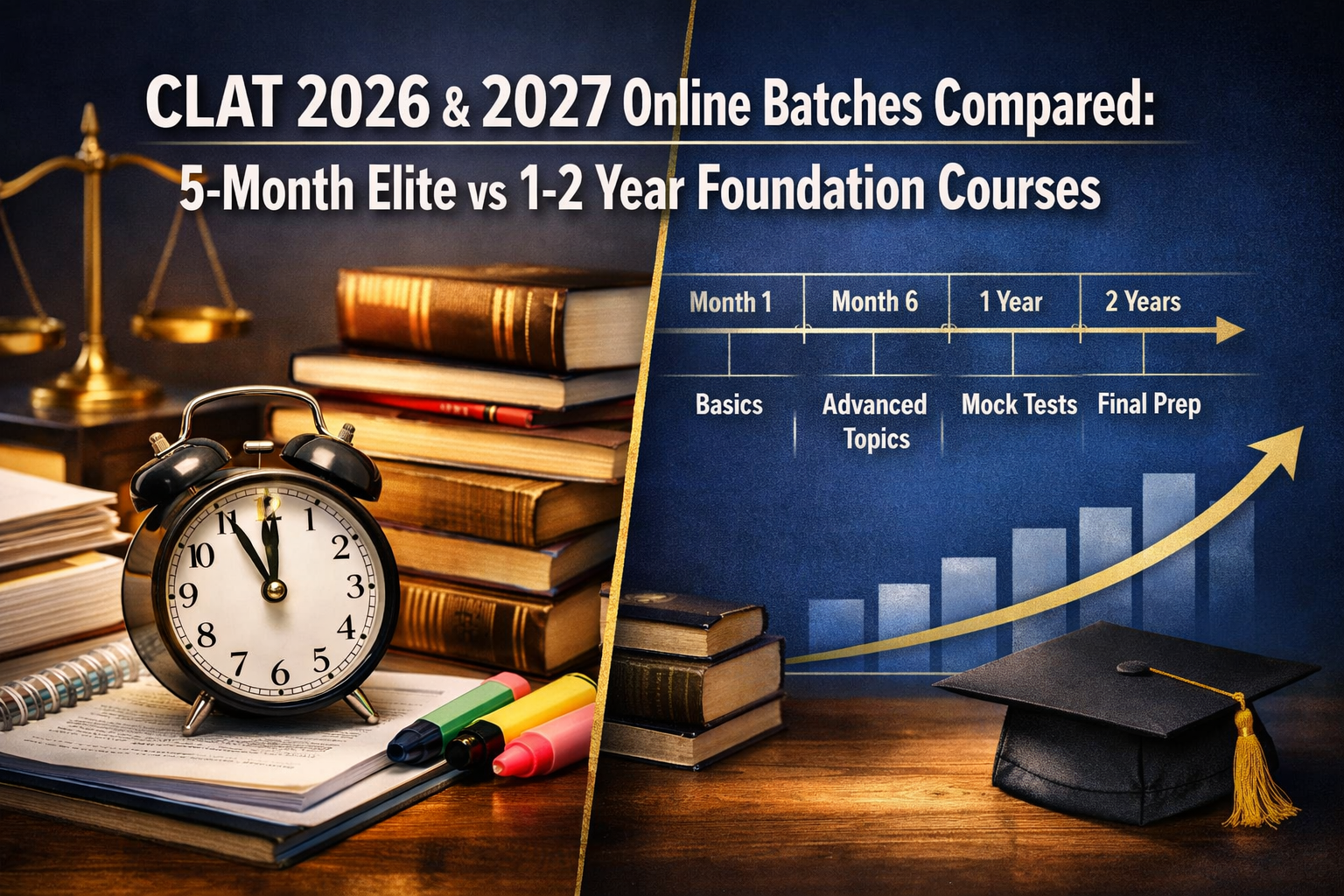
Choosing between a 5-month intensive elite program and a comprehensive 1-2 year foundation course for CLAT preparation isn't just about timeline preferences. It's about matching your current academic situation, learning style, and target goals with the right preparation strategy. When comparing CLAT 2026 & 2027 Online Batches Compared: 5-Month Elite vs 1-2 Year Foundation Courses, the decision becomes even more critical as you're essentially choosing your entire preparation philosophy.
Here's the reality: Class 11 students have different needs than droppers. Someone targeting AIR 1-50 requires a different approach than someone aiming for any decent NLU. Let's break down exactly which course format aligns with your specific situation and goals.
Key Takeaways
• Elite 5-month programs work best for focused droppers, Class 12 students with strong basics, and those targeting specific high-ranking NLUs with intensive preparation
• Foundation 1-2 year courses suit Class 11 beginners, students balancing board exams, and those preferring gradual skill building with comprehensive coverage
• Cost differences range from ₹25,000 for recorded courses to ₹1.5 lakhs for premium live programs, with scholarships available up to 100%
• Success rates vary significantly based on student profile matching – elite programs show 40% higher completion rates when student readiness aligns with course intensity
• Online coaching proves more time-efficient than offline options, providing extra hours for practice and revision without daily commuting
Understanding CLAT 2026 & 2027 Online Batch Structures
The landscape of CLAT preparation has evolved dramatically. Multiple course formats are now standard offerings across platforms, with year-long programs, crash courses, test-series-only options, and sectional courses accommodating different preparation timelines[1].
Elite 5-Month Programs: The Intensive Approach
These programs compress comprehensive CLAT preparation into a focused timeline. They're designed for students who already have foundational knowledge and can handle intensive daily study schedules. The structure typically includes:
- Daily 4-6 hours of structured learning
- Rapid concept coverage across all five CLAT sections
- Intensive mock testing with immediate analysis
- Quick revision cycles every two weeks
- Expert mentorship for targeted weak area improvement
Elite programs assume you can dedicate significant time daily and absorb concepts quickly. They work exceptionally well for droppers who've already completed their boards and can focus entirely on CLAT preparation.
Foundation 1-2 Year Programs: The Comprehensive Build
Foundation courses take a different philosophy entirely. They build concepts gradually, allowing time for deep understanding and extensive practice. The typical structure includes:
- Gradual concept introduction starting from basics
- Systematic skill building across multiple months
- Regular practice sessions with progressive difficulty
- Comprehensive coverage of all topics and subtopics
- Long-term mentorship tracking progress over extended periods
These programs work perfectly for Class 11 students who need to balance CLAT preparation with board exam requirements. The extended timeline allows for natural learning curves and doesn't overwhelm students with information overload.
For students wondering about preparation timelines and strategies, understanding your current academic situation becomes crucial in making this choice.
Detailed Comparison: CLAT 2026 & 2027 Online Batches Elite vs Foundation Features

Study Schedule and Time Commitment
Elite 5-month programs demand intense daily commitment. Students typically spend 6-8 hours daily on CLAT preparation, including classes, self-study, and mock analysis. This works when you can dedicate your entire day to preparation.
Foundation courses spread this commitment across longer periods. Daily study requirements range from 2-4 hours, making them manageable alongside school or college. The extended timeline allows for natural breaks, revision cycles, and gradual skill building.
Content Coverage and Depth
Elite programs cover the same syllabus but at accelerated pace. Concepts are taught efficiently, assuming quick grasp and minimal repetition needs. Advanced strategies and shortcuts receive more emphasis than foundational building.
Foundation courses provide comprehensive coverage with multiple revision cycles. Each concept gets thorough treatment, with plenty of practice opportunities before moving forward. This approach ensures stronger conceptual clarity but requires patience.
Mock Test Strategy
Elite programs typically include 50-80 full-length mocks compressed into the preparation period. The frequency is high – sometimes daily mocks in final months. Quick analysis and immediate improvement become critical skills.
Foundation courses spread 100+ mocks across the entire timeline. Students get time to thoroughly analyze each mock, identify patterns, and implement improvements gradually. The approach emphasizes learning from mistakes rather than rapid testing.
Faculty Interaction and Mentorship
Elite programs offer intensive mentorship with frequent one-on-one sessions. Faculty availability is high during the compressed timeline, but the relationship is intense and focused on quick results.
Foundation programs provide sustained mentorship relationships. Students develop long-term connections with faculty, allowing for personalized guidance that evolves with their preparation journey.
Cost Structure Analysis
Elite programs often cost more per month but less overall due to shorter duration. Typical range: ₹40,000-80,000 for 5-month intensive programs.
Foundation courses cost less per month but more overall due to extended duration. Range: ₹60,000-1.5 lakhs for comprehensive 1-2 year programs, with scholarships available up to 100% through scholarship tests[2].
For budget-conscious students, exploring affordable yet effective coaching options becomes essential in making this decision.
Choosing Between Elite and Foundation: CLAT 2026 & 2027 Online Batches Decision Framework

Academic Year and Current Status
Class 11 Students: Foundation courses align perfectly with your timeline. You have 1.5-2 years for preparation, can balance board exam requirements, and benefit from gradual skill building. Starting with intensive programs this early often leads to burnout.
Class 12 Students: The choice depends on your preparation level. If you're starting fresh, foundation courses work better despite the shorter timeline. If you have basic preparation done, elite programs can provide the final push needed.
Droppers: Elite programs often suit droppers who can dedicate full time to preparation. However, if you're taking a drop specifically because previous preparation was insufficient, foundation courses might address those gaps better.
Current Preparation Level
Students with strong English comprehension, basic legal awareness, and decent quantitative skills can handle elite program pace. Those struggling with reading speed, basic math, or general knowledge benefit more from foundation course gradual building.
Take honest stock of your current abilities. Can you solve 25-30 English comprehension questions in 30 minutes? Do you understand basic legal principles? Are you comfortable with percentage and ratio calculations? Your answers guide the choice.
Target NLU and Rank Goals
For top 5 NLUs (NLSIU, NALSAR, WBNUJS, NLUD, GNLU), both approaches can work, but the student's learning style matters more than course duration. Elite programs work when you're already close to target level and need refinement.
For NLUs ranked 6-15, foundation courses often provide better preparation because they ensure comprehensive coverage without gaps. The extended timeline allows for multiple weak area improvements.
For any NLU admission (rank 1500+), foundation courses typically provide better value because they build sustainable skills rather than just exam strategies.
Learning Style and Personality
Some students thrive under pressure and prefer intensive, focused preparation. Others need time to absorb concepts and perform better with gradual building. Neither approach is superior – they suit different personalities.
Consider how you've performed in past academic situations. Did you excel with last-minute intensive preparation, or did you perform better with consistent, spread-out study? Your historical patterns predict future success.
Family and Financial Considerations
Elite programs require family support for intensive study schedules. If you need to balance other responsibilities or contribute to household activities, foundation courses provide more flexibility.
Financial planning also matters. Elite programs have lower total cost but higher monthly burden. Foundation courses spread costs but require longer financial commitment. Factor in potential scholarship opportunities and family budget constraints.
Students dealing with exam anxiety and stress management often find foundation courses less overwhelming than intensive programs.
Platform-Specific Offerings and Track Records
Law Prep Tutorial demonstrated strongest CLAT 2026 results with 1600+ NLU selections, including AIR-1, AIR-3, AIR-8, and AIR-9, plus 8 state toppers across multiple states[2]. Their fee structure ranges from ₹25,000 for recorded courses up to ₹1.5 lakhs for 2-year live online programs.
LegalEdge by Toprankers offers structured long-term and crash options with year-long programs, crash courses, foundation, and droppers' batches, emphasizing regular classes and systematic teaching sequences[1]. They provide 135+ mock tests with tailored mentorship, performance review, and access to 1000+ hours of coaching classes[4].
CLAT Tribe provides exclusive rank-focused programs, with their Director's Batch positioned as an elite program for serious aspirants targeting top NLU rankings, including mentorship from those who have guided AIR-1 achievers[3].
When comparing live classes versus recorded lectures, consider how each format aligns with your chosen course duration and learning preferences.
Making the Final Decision
The choice between CLAT 2026 & 2027 Online Batches Compared: 5-Month Elite vs 1-2 Year Foundation Courses ultimately depends on honest self-assessment. Elite programs work when preparation level, time availability, and learning style align with intensive requirements. Foundation courses work when you need comprehensive building, have time constraints, or prefer gradual learning.
Online coaching proves more time-efficient than offline alternatives, providing zero daily travel time and more hours for practice, revision, and mock analysis – a critical advantage regardless of which course duration you choose[3].
Structured paid batches consistently outperform self-study approaches, with students completing 35-40% more practice questions and showing measurably better results compared to free resources or independent preparation[5].
Consider starting with a trial or shorter program to test your response to the teaching style and pace before committing to longer durations. Most successful CLAT aspirants find their optimal preparation approach through experimentation rather than theoretical planning alone.
Conclusion
The decision between 5-month elite and 1-2 year foundation courses for CLAT 2026 & 2027 preparation isn't about which approach is objectively better – it's about which aligns with your specific situation, goals, and learning style. Elite programs excel when you have strong foundations, can dedicate full time, and thrive under intensive pressure. Foundation courses work better when you're building from basics, balancing multiple commitments, or prefer gradual skill development.
Your success is our mission at Lawgic Coaching, and we've seen students achieve excellent results through both approaches. The key lies in honest self-assessment: evaluate your current preparation level, available time, target goals, and learning preferences before making this crucial decision.
Next Steps:
- Assess your current level using practice tests across all five CLAT sections
- Calculate available study hours realistically, considering other commitments
- Research specific programs that match your identified needs and budget
- Take trial classes from shortlisted platforms to test teaching compatibility
- Commit fully to your chosen approach – consistency matters more than course duration
Remember, the best preparation strategy is the one you can sustain consistently until exam day. Whether you choose intensive elite preparation or comprehensive foundation building, your dedication and smart practice will ultimately determine your success in cracking CLAT and securing admission to your dream NLU.
References
[1] Best Clat Online Coaching Platforms In 2027 – https://www.cuet.com/best-clat-online-coaching-platforms-in-2027 [2] Best Clat Online Coaching Platforms Compared Fee Result Faculty – https://www.republicworld.com/initiatives/best-clat-online-coaching-platforms-compared-fee-result-faculty [3] Clat Online Coaching Best For Clat 2027 Aspirants – https://www.clattribe.com/blogs/clat-online-coaching-best-for-clat-2027-aspirants [4] Clat Online Coaching – https://www.toprankers.com/clat-online-coaching [5] Free Vs Paid Clat Online Coaching What Works Better – https://www.clatnlti.com/blog-details/350/free-vs-paid-clat-online-coaching-what-works-betterSEO Meta Title: CLAT 2026 & 2027 Online Batches: Elite vs Foundation Courses
SEO Meta Description: Compare 5-month elite vs 1-2 year foundation CLAT courses for 2026 & 2027. Find the perfect online batch matching your timeline, goals & learning style.