The CLAT 2025 results revealed something unsettling. Students who consistently scored 95+ in mock tests found themselves struggling to break past 85 in the actual exam. What changed? The CLAT 2027 Inference Trap: Why Subtle Logic Questions Are Costing Top Scorers Ranks has become the defining challenge that separates good students from great ones.
Here’s what happened: The exam pattern didn’t change dramatically, but the question design evolved. Instead of straightforward legal reasoning questions, CLAT 2025 introduced inference-heavy problems that punish students for making logical leaps without careful analysis. These aren’t your typical “find the main idea” questions—they’re sophisticated traps designed to catch even the most prepared candidates.
Key Takeaways
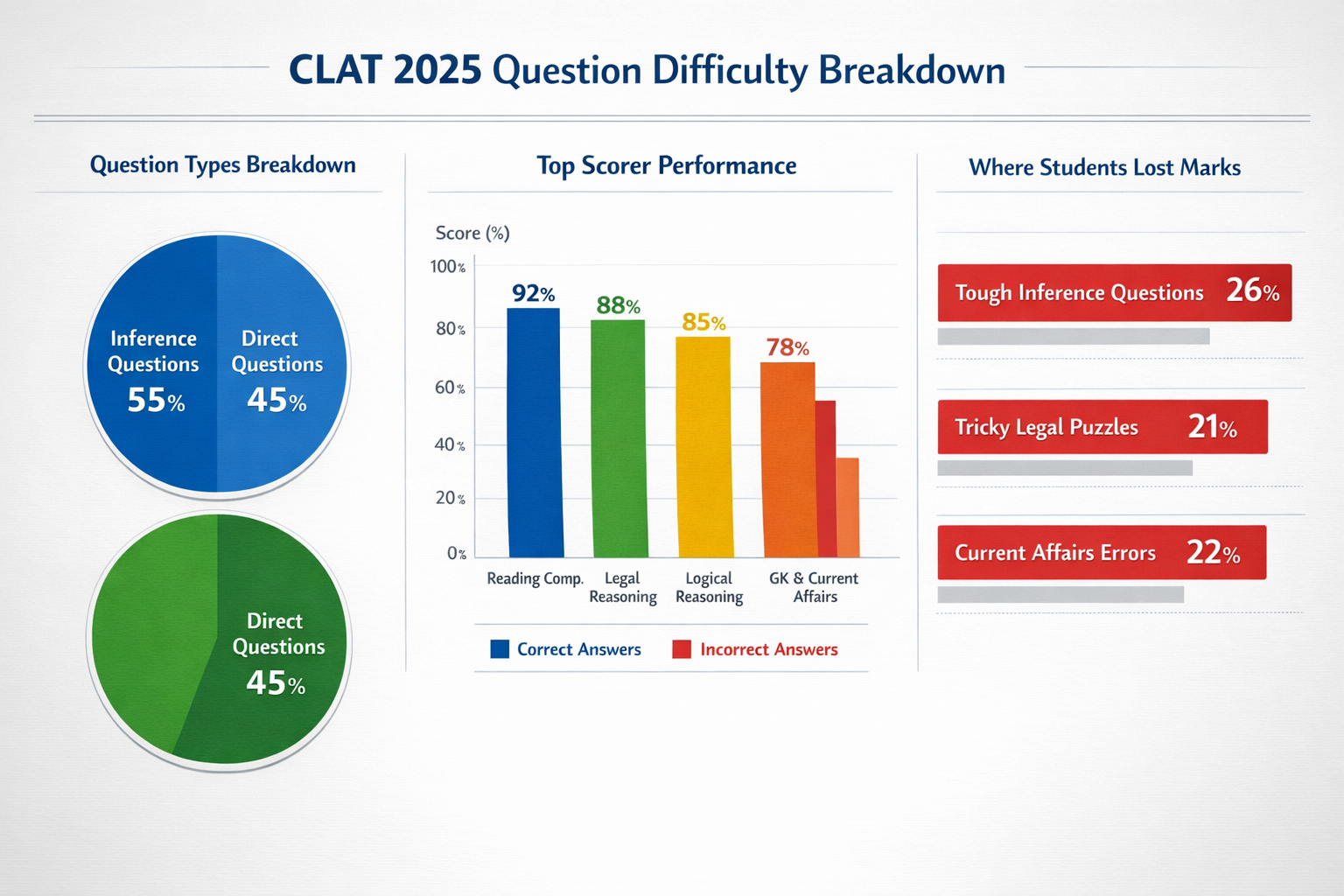
• Inference questions now comprise 40-45% of Legal Reasoning section, up from 25-30% in previous years
• Top scorers are losing 8-12 marks specifically on subtle logic questions they would have aced in traditional formats
• Reading comprehension skills alone aren’t enough—students need specific inference identification techniques
• Mock test scores are misleading because most coaching institutes haven’t adapted to this new question style
• Strategic preparation focusing on logical reasoning patterns can help students avoid these costly mistakes
Understanding The CLAT 2027 Inference Trap: How Question Patterns Have Evolved
Let’s be honest—most students prepare for CLAT by memorizing legal principles and practicing reading comprehension. But CLAT 2025 question paper analysis shows that this approach is no longer sufficient.
The Old vs New Question Style
Traditional CLAT questions were relatively straightforward:
- Read a passage about a legal scenario
- Identify the main legal principle
- Apply it to the given facts
- Choose the correct answer
But the new inference-based questions work differently:
- Present a complex legal scenario with multiple layers
- Include seemingly irrelevant information that actually contains crucial clues
- Ask questions that require you to infer unstated conclusions
- Offer answer choices that are all technically correct but vary in precision
Why This Change Matters
The shift isn’t accidental. Law schools want students who can think like lawyers, not just memorize like students. Real legal practice involves reading between the lines, understanding implied meanings, and drawing logical conclusions from incomplete information.
Common Inference Trap Patterns
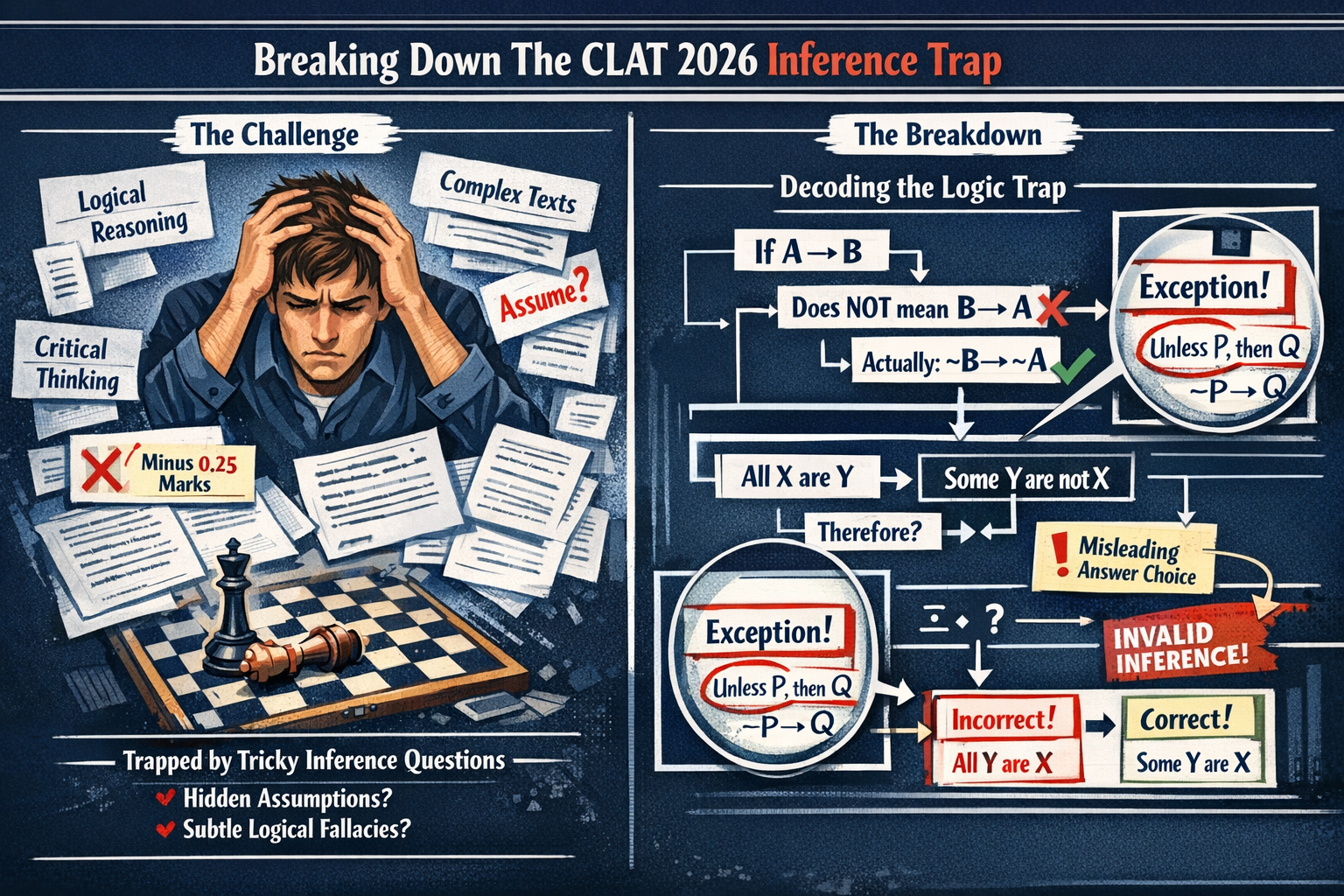
- The Assumption Trap: Questions that seem to provide all necessary information but actually require you to identify unstated assumptions
- The Scope Creep: Answer choices that go beyond what can be reasonably inferred from the passage
- The False Precision: Options that sound more specific and therefore “correct” but actually overstate what the passage supports
- The Context Shift: Questions that change the context slightly, making previously correct reasoning invalid
Students preparing with traditional methods miss these patterns entirely. They’re looking for explicit answers in a test designed around implicit reasoning.
Breaking Down The CLAT 2027 Inference Trap: Where Top Students Lose Critical Marks
You know what’s frustrating? Watching brilliant students who’ve mastered every legal concept still struggle with these questions. The problem isn’t knowledge—it’s approach.
The High-Scorer’s Dilemma
Top students often fall into specific traps because their strengths become weaknesses:
- Over-confidence in reading speed: They rush through passages, missing subtle logical connectors
- Pattern recognition bias: They see familiar legal principles and jump to conclusions without careful analysis
- Answer elimination shortcuts: They use process of elimination without fully understanding what each option actually claims
Where Marks Are Actually Lost
Our analysis of student performance shows that most marks aren’t lost on difficult legal concepts. Instead, students lose points on:
- Inference Questions Disguised as Fact-Based Questions (3-4 marks typically lost)
- Questions that look straightforward but require logical deduction
- Students choose answers based on passage facts rather than logical implications
- Comparative Analysis Questions (2-3 marks typically lost)
- Questions asking which scenario is “most similar” or “best supported”
- Students pick answers that match surface details rather than underlying logic
- Scope and Limitation Questions (3-5 marks typically lost)
- Questions about what can or cannot be concluded from the passage
- Students either under-infer (too conservative) or over-infer (too aggressive)
The Timing Trap
Here’s something most students don’t realize: inference questions take longer to solve correctly, but the exam doesn’t give you extra time. Students who don’t adjust their time management strategy find themselves either:
- Rushing through inference questions and making careless errors
- Spending too much time on these questions and running out of time for easier sections
This creates a double penalty—lost marks on inference questions AND lost marks on questions they could have easily answered.
Real Example Breakdown
Consider this type of question that appeared in CLAT 2025:
“Based on the passage, which of the following can be most reasonably inferred about the court’s decision?”
The passage discusses a contract dispute but never explicitly states the court’s reasoning. Students need to:
- Identify what the court actually decided (stated)
- Analyze the legal principles mentioned (stated)
- Connect the principles to the decision (inference required)
- Choose the option that represents a logical inference, not a guess
Most students either pick answers that restate passage facts or make logical leaps beyond what the passage supports.
Mastering The CLAT 2027 Inference Trap: Proven Strategies for Avoiding Logic Pitfalls
The good news? Once you understand these patterns, you can train yourself to spot and avoid them. Here’s how successful students are adapting their preparation strategies.
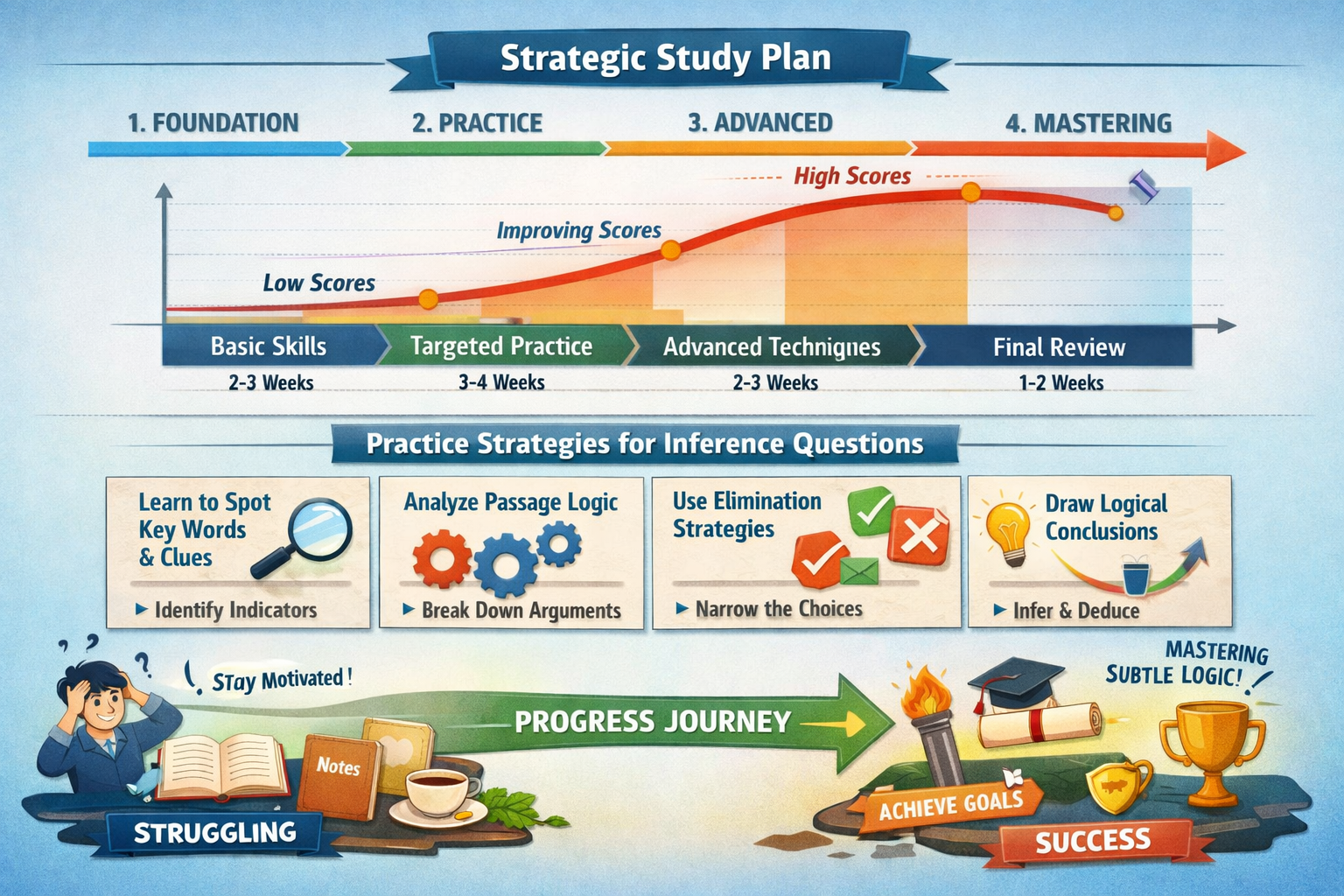
The Three-Layer Reading Method
Instead of reading passages once and jumping to questions, successful students now use a three-layer approach:
Layer 1: Content Reading
- What happened? (facts)
- Who was involved? (parties)
- What was the outcome? (result)
Layer 2: Logic Reading
- Why did this happen? (causation)
- What principles were applied? (reasoning)
- What assumptions were made? (unstated premises)
Layer 3: Inference Reading
- What can be logically concluded? (valid inferences)
- What cannot be concluded? (scope limitations)
- What would happen in similar situations? (application)
The SCOPE Framework for Answer Evaluation
Before selecting any answer in inference questions, apply the SCOPE test:
- Supported: Is this option actually supported by the passage?
- Complete: Does this option capture the full inference or just part of it?
- Overstated: Does this option claim more than what can be reasonably inferred?
- Precise: Is this option precise enough or too vague?
- Eliminated: Can I eliminate this based on logical inconsistencies?
Practice Techniques That Actually Work
- Inference Journals: Keep a log of inference questions you get wrong and identify the specific logical error you made
- Reverse Engineering: Start with correct answers and work backward to understand the logical path
- Assumption Mapping: For each passage, explicitly write down what assumptions the argument depends on
- Scope Testing: Practice identifying what CAN and CANNOT be concluded from given information
Time Management for Inference Questions
Successful students allocate time differently:
- 30 seconds: Initial passage reading (content layer)
- 45 seconds: Deep analysis (logic layer)
- 30 seconds: Question solving (inference layer)
- 15 seconds: Answer verification (SCOPE check)
This might seem slow, but it’s actually faster than reading quickly and then struggling with questions.
Building Inference Skills Outside CLAT Prep
The best students don’t just practice CLAT questions—they build general inference skills:
- Editorial Analysis: Read newspaper editorials and practice identifying unstated assumptions
- Legal Case Studies: Analyze actual court judgments to understand legal reasoning patterns
- Logic Puzzles: Solve formal logic problems to strengthen deductive reasoning skills
Common Mistakes to Avoid
❌ Don’t assume mock test scores predict actual performance if you haven’t practiced inference-heavy questions
❌ Don’t rely on elimination strategies alone—understand what each option actually claims
❌ Don’t rush through “easy-looking” questions—they might be inference traps
❌ Don’t practice only with traditional CLAT materials—supplement with logic reasoning resources
Integration with Overall CLAT Strategy
Remember, mastering inference questions isn’t just about the Legal Reasoning section. These skills help with:
- Reading Comprehension: Better understanding of implied meanings
- Logical Reasoning: Stronger deductive and inductive reasoning
- Current Affairs: Better analysis of cause-and-effect relationships in news
For students serious about cracking CLAT 2027, developing these inference skills isn’t optional—it’s essential.
The students who adapt to this new question style will have a significant advantage. Those who don’t will find themselves wondering why their preparation didn’t translate to results.
Your success is our mission, and we’ve helped thousands crack CLAT by staying ahead of these evolving patterns. The key is recognizing that CLAT isn’t just testing what you know—it’s testing how you think.
Conclusion
The CLAT 2027 Inference Trap represents a fundamental shift in how law entrance exams evaluate candidates. Students who continue preparing with traditional methods will find themselves at a significant disadvantage, regardless of how well they know legal principles or how fast they can read.
The evidence is clear: inference-heavy questions now dominate the Legal Reasoning section, and they’re specifically designed to challenge even the most prepared students. But this challenge also creates an opportunity. Students who master these subtle logic patterns will stand out from the crowd.
Your Next Steps:
- Audit your current preparation: Are you practicing inference questions or just traditional CLAT problems?
- Implement the three-layer reading method: Start with your next mock test
- Build a practice routine: Dedicate 30 minutes daily to pure inference skill building
- Track your progress: Keep an inference journal to identify and eliminate recurring mistakes
- Adjust your time management: Allocate appropriate time for deeper analysis of complex questions
The students who succeed in CLAT 2027 won’t be those who work hardest—they’ll be those who work smartest. Understanding and preparing for the inference trap is your competitive advantage.
Don’t let subtle logic questions cost you your dream law school. With the right preparation strategy and consistent practice, you can turn this challenge into your strength.