Last updated: April 20, 2026
Quick Answer
Most CLAT toppers lose 15+ marks in GK not because they didn’t study, but because they studied the wrong things. If the goal is how to score 100+ in CLAT 2027 GK, the winning plan is simple: focus on the last 12 to 14 months of current affairs, revise in cycles, connect news with static legal topics, and practice CLAT-style passages every week. Current Affairs and GK can contribute around 28 to 32 marks out of 120, so this section can push an average paper into a top-rank paper when prepared smartly [2].
Key Takeaways
- Use a 70/30 split: 70% time on current affairs, 30% on high-weightage static GK.
- Cover the last 12 to 14 months before the exam, not random old facts [4][5].
- Read only 3 daily sources: The Hindu editorial, Insight Secured, and Law Street GK compilations.
- Use 2 weekly revision resources: one monthly compilation and one weekly quiz/PDF.
- Practice 50 to 70 GK questions per week plus one CLAT-style passage set [4].
- Attempt 1 to 2 mocks weekly and spend at least 90 minutes analyzing mistakes [2].
- Build reading comprehension skills because GK is passage-based now [2].
- Avoid red flags like reading full articles, memorizing trivia, and skipping 48-hour revision.
- Strong CLAT scores need section-wise preparation, not just GK obsession.
- Mental stability matters. Consistency beats panic in law entrance exam preparation.
What is CLAT and why is GK so important for scoring 100+?
CLAT is the national-level entrance exam for admission to many NLUs, and GK is one of its highest-impact sections. For any aspirant asking how to score 100+ in CLAT 2027 GK, the answer starts with understanding one fact: GK is one of the fastest sections to solve when preparation is sharp [2].
CLAT has 120 questions across five sections, and Current Affairs with GK typically carries about 28 to 32 marks, depending on the paper pattern and question spread [2]. That makes it one of the most efficient score boosters in your CLAT 2027 preparation.
Why does this matter so much?
- GK takes less solving time than Legal or Logical when you know the answer.
- Passage-based GK also rewards reading comprehension techniques.
- A well-prepared GK section creates time for tougher sections later in the paper.
- Strong GK improves your NLU admission strategy, especially when cutoffs are tight.
For a full overview of the exam, see the CLAT 2027 exam structure and strategy guide and the complete CLAT 2027 syllabus breakdown.
A serious CLAT score is rarely built in the last month. It is built in small, repeated revision cycles.
How to score 100+ in CLAT 2027 GK with the right 70/30 framework?
To score 100+ overall, spend 70% of GK time on current affairs and 30% on static topics linked to current events. This split works because recent CLAT papers reward event-based awareness far more than random fact memorization, while static support helps decode legal and political context [1][2][5].
Why the 70/30 split works
Current Affairs dominates because CLAT asks:
- major legal developments
- Supreme Court and constitutional events
- appointments
- international relations
- important government schemes
- awards, reports, summits, sports with context
Static GK still matters, but mostly in these linked areas:
- Constitution
- Judiciary
- Parliament
- IPC and criminal law basics
- important amendments
- international organizations
A practical decision rule:
- Choose current affairs first if you have less than 8 months.
- Choose balanced 70/30 prep if you have 8 to 12 months.
- Choose static-heavy repair mode only if your current affairs base is already strong.
For a deeper static-current balance, read static vs current affairs in CLAT GK and the ultimate CLAT GK strategy.
High-weightage static topics inside the 30%
Focus on:
- Preamble and key constitutional features
- Fundamental Rights and Duties
- Parliament and law-making process
- President, Prime Minister, Governor, Chief Justice
- Supreme Court and High Courts
- Important committees and commissions
- Basic criminal law terms from IPC/BNS context
- Landmark legal doctrines in the news
Common mistake
Many students flip the ratio. They spend 70% time memorizing capitals, parks, days, and books. That almost never pays off in a CLAT paper.
How to effectively prepare for CLAT current affairs month by month?
The best way to prepare current affairs is to divide the timeline by priority, not by blind chronology. For how to score 100+ in CLAT 2027 GK, a month-window method helps students revise faster and spot recurring themes [3][4][5].
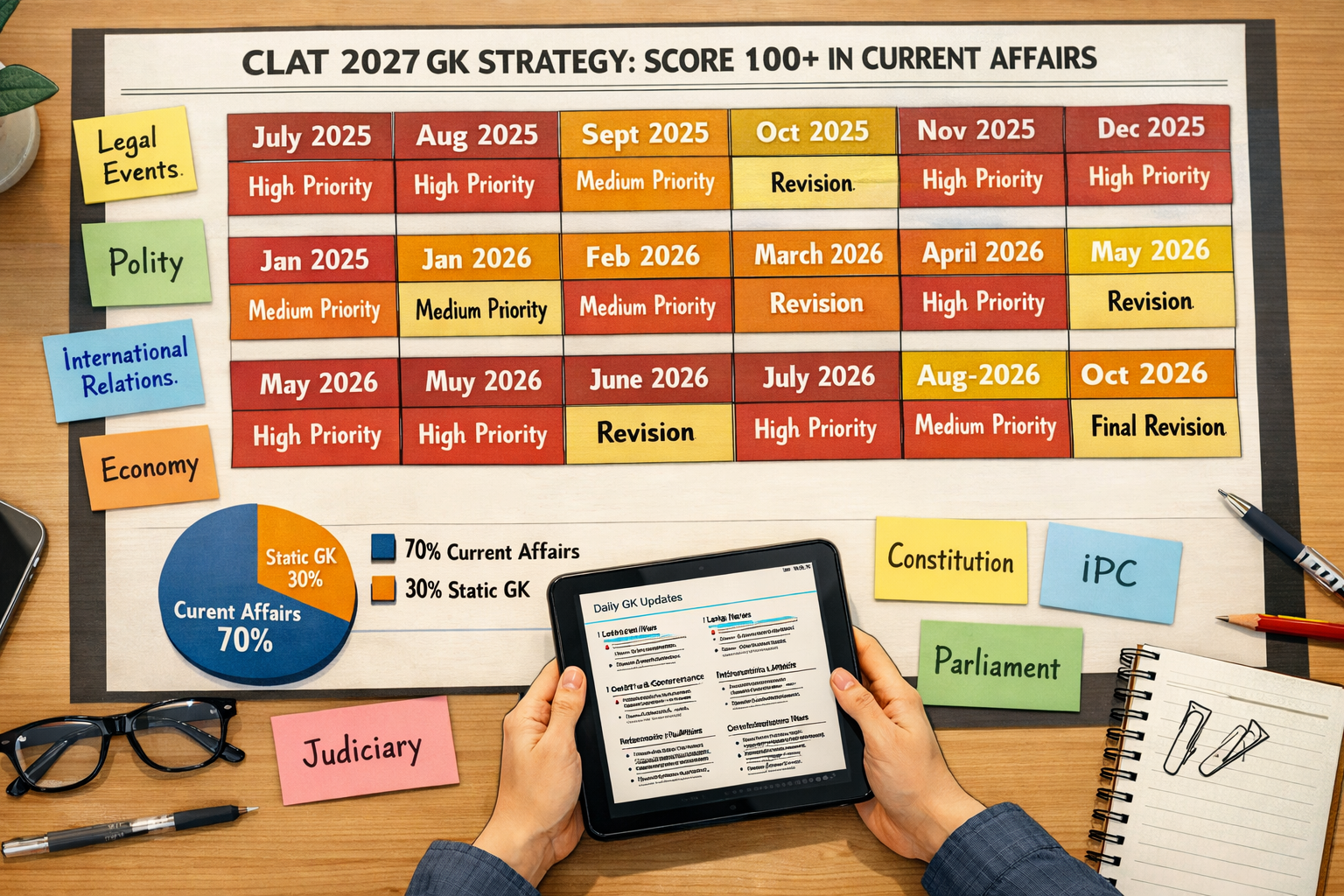
Below is a practical current affairs plan assuming CLAT 2027 preparation through 2026. Since CLAT usually rewards the previous 10 to 12 months, and often slightly beyond that for major legal events, a 12 to 14 month net is the safest range [4][5].
Month-by-month current affairs priority plan for CLAT 2027
| Month window | Priority | What to cover | Why it matters |
|---|---|---|---|
| July 2025 to October 2025 | High | Major legal, political, constitutional, international, economy events | These months often contain policy and court developments that continue in later debates |
| November 2025 to January 2026 | Medium-High | Winter session updates, judgments, appointments, global conflicts, budget context buildup | Many themes repeat in editorials and CLAT passages |
| February 2026 to April 2026 | Very High | Budget, economic survey themes, major court cases, election-linked legal discourse, international groupings | CLAT loves governance and economy with interpretation |
| May 2026 to July 2026 | Very High | Summits, reports, sports, environment, appointments, legal reforms | Fresh and highly testable |
| August 2026 to October 2026 | Highest | Final revision zone, all major updates, latest legal and political events | Closest to exam cycle, usually most relevant |
| Final 6 to 8 weeks | Revision only | Monthly compilations, passage drills, error log revision | No new overload, only sharpening |
Which months usually produce recurring CLAT themes?
CLAT often favors periods with:
- Parliament sessions
- major Supreme Court decisions
- Union Budget and Economic Survey
- international summits like G20, UN, COP
- election-linked constitutional debate
- major appointments in judiciary and executive
So in practical terms:
- February to April is always a strong cluster.
- August to October is usually a high-attention revision cluster.
- Months with major legal reforms should be upgraded to top priority even if they are older.
What to do each month
Every month should include:
- 1 monthly compilation
- 4 weekly revision rounds
- 50 to 70 MCQs weekly [4]
- 1 CLAT-style GK passage set weekly [4]
- 1 one-page monthly summary sheet
Quick example
If a Supreme Court judgment becomes headline news in March 2026:
- note the case name
- understand the issue
- know the constitutional article involved
- connect it with static law
- revise it in 48 hours
- revise again on Sunday
- revise once more in the monthly recap
That’s current affairs analysis, not passive reading.
Which exact daily and weekly sources should CLAT aspirants use?
Use only three daily sources and two weekly revision resources. Too many sources create repetition, confusion, and backlog.
The 3 daily sources
-
The Hindu editorial
Best for reading comprehension, constitutional issues, governance, and quality vocabulary.
Use it for: editorials, explained legal-political developments, opinion framing. -
Insight Secured
Best for compressed current affairs notes and issue-based summaries.
Use it for: revision-friendly note-making and daily capsule tracking. -
Law Street GK compilations
Best for law-focused current affairs and legal knowledge enhancement.
Use it for: legal updates, court-related developments, institutions, law-based MCQs.
TopRankers also recommends quality newspaper reading such as The Hindu and The Indian Express for current affairs understanding [2]. The key is not reading every line. The key is reading what helps in the exam.
The 2 weekly revision resources
Use:
- One monthly current affairs PDF or magazine
- One weekly quiz or weekly revision PDF
Choose the same two every week. Consistency matters more than variety.
If daily newspapers feel heavy, this guide on mastering CLAT current affairs without daily newspapers can save a lot of time.
Source selection rule
Choose a source if it does one of these:
- helps you revise faster
- explains the background
- matches CLAT passage style
- improves legal aptitude development
Drop a source if it:
- repeats the same news in long form
- focuses on UPSC-style factual overload
- gives no weekly revision support
How to score 100+ in CLAT 2027 GK without wasting hours every day?
You do not need 4 hours of daily GK study. Most aspirants can do well with 60 to 90 focused minutes a day, if the workflow is tight and revision-based [1][2][4].
The daily workflow that actually works
Step 1: Read for 30 minutes
- 1 editorial or explained article
- 1 legal or policy note
- 5 to 8 key news items only
Step 2: Make notes for 15 to 20 minutes
- one-line summary
- why it matters
- linked static topic
- one probable CLAT question angle
Step 3: Revise old notes for 10 to 15 minutes
- same-day recall
- previous 48-hour notes
- weekly flash review
Step 4: Practice for 10 to 20 minutes
- 10 to 15 MCQs
- or one short passage
Best note-making format
Use 4 columns:
| Event | Why in news | Static link | One-line takeaway |
|---|
This format keeps notes short and revision-friendly [5].
Tech tools that help
Competitors often miss this, but technology can make competitive exam preparation easier.
Useful low-cost tools:
- Google Sheets for monthly event trackers
- Notion for subject-wise current affairs
- Anki for spaced repetition
- Telegram saved messages for quick revision lists
- Forest or Pomodoro apps for time control
Technology helps only if it reduces friction. If an app takes more setup time than study time, skip it.
For more on smart prep tools, see tech tips for tomorrow’s lawyers and free CLAT resources for budget preparation.
What section-wise CLAT preparation strategy supports a 100+ score?
A 100+ score needs strong GK, but it also needs stable performance in every section. The smartest CLAT exam strategy is to build reading speed, legal reasoning accuracy, and mock discipline together.
Suggested target by section
These are practical target ranges, not guarantees:
- English Language: 18 to 22
- Current Affairs including GK: 22 to 28
- Legal Reasoning: 26 to 30
- Logical Reasoning: 18 to 22
- Quantitative Techniques: 8 to 12
This makes 100+ realistic without expecting perfection.
English and reading comprehension skills
Reading comprehension is the foundation of modern CLAT papers [2]. To improve:
- read one editorial daily
- summarize the author’s main claim
- practice identifying tone, inference, and assumptions
- train on 450-word passages
Helpful reading resources:
Legal reasoning and legal aptitude preparation
Legal Reasoning rewards:
- principle-fact application
- calm reading
- issue spotting
- legal language comfort
Do this weekly:
- 3 legal passages
- 1 legal vocabulary list
- 1 error review session
Also read common mistakes in CLAT legal reasoning and legal mindset tips for CLAT.
Logical Reasoning
Focus on:
- argument structure
- assumptions
- strengthening and weakening
- statement-conclusion links
Quantitative Techniques
Even non-math students can secure safe marks with topic selection and regular practice. This guide on CLAT maths syllabus and strategy is useful.
How should mock test analysis and time management work?
Take 1 to 2 mocks every week and spend at least 90 minutes analyzing each mock. Mock analysis is where score growth actually happens [2].
Mock schedule
- Early phase: 2 to 3 sectionals per week, 1 full mock every 10 to 14 days
- Middle phase: 1 full mock weekly
- Final phase: 2 full mocks weekly, but only if analysis quality stays high
What to analyze after every mock
Use an error log with these columns:
- Question number
- Section
- Mistake type
- Why it happened
- Fix for next test
Common mistake types:
- didn’t know fact
- misread passage
- rushed answer
- guessed without elimination
- poor time allocation
Time management techniques for the actual paper
A practical exam flow:
- Start with the section that settles your nerves.
- Finish GK quickly if prepared well.
- Do not overstay on one passage.
- Mark doubtful questions and move on.
- Keep the last 8 to 10 minutes for review.
Decision rule:
- Choose fast-first strategy if anxiety rises when stuck.
- Choose fixed-order strategy if changing sections disrupts concentration.
For score improvement through mocks, read from 30 to 95 in CLAT mocks and continuous feedback in your CLAT journey.
What are the biggest red flags that waste GK preparation time?
The biggest score-killers are not always lack of effort. Usually, they are bad methods.
Red flags to fix immediately
- Reading full newspaper articles instead of making notes
- Memorizing random static facts with no CLAT link
- Ignoring monthly compilations
- Not revising within 48 hours
- Collecting sources instead of mastering one system
- Studying current affairs without linking them to Constitution, judiciary, or governance
- Practicing MCQs without checking why answers are right
- Skipping passage-based GK practice
What to do instead
Replace bad habits with better rules:
- read selectively
- revise fast
- connect current to static
- test weekly
- analyze mistakes honestly
Aspirants dealing with backlog should read the CLAT GK backlog clearance guide.
How do psychological preparation and budget-friendly planning affect CLAT scores?
Mental consistency is a real score factor. Law entrance exam preparation is not just about legal knowledge enhancement. It is also about keeping focus when mock marks drop, when school work increases, and when comparison starts getting loud.
Psychological preparation that actually helps
Do these every week:
- review progress, not just rank
- keep one mistake journal
- limit peer comparison
- sleep properly before mocks
- practice one reset routine, like breathing or a short walk
A useful rule:
- if mock scores dip for two weeks, change the method
- if mock scores dip for one test, do not panic
And yes, emotional stability can be trained. This CLAT exam anxiety guide helps.
Budget-friendly preparation resources
You don’t need expensive material from ten institutes. Most students need:
- one newspaper or daily source set
- one monthly current affairs compilation
- one mock platform
- one notebook or digital tracker
- one mentor or feedback source
For students planning affordable prep, see can you crack CLAT without expensive coaching? and clear CLAT exam on a budget.
That’s where Lawgic Coaching stands apart. Your success is our mission, and that means expert guidance without the premium price tag, real mentors from top NLUs, and flexible learning that fits your life. No cookie-cutter approach here. Serious aspirants deserve personalized attention.
What weekly routine should CLAT aspirants follow for GK and overall balance?
A weekly routine works best when it repeats the same core actions: learn, revise, practice, analyze. For students asking how to score 100+ in CLAT 2027 GK, the table below is practical, sustainable, and easy to follow alongside school or college.
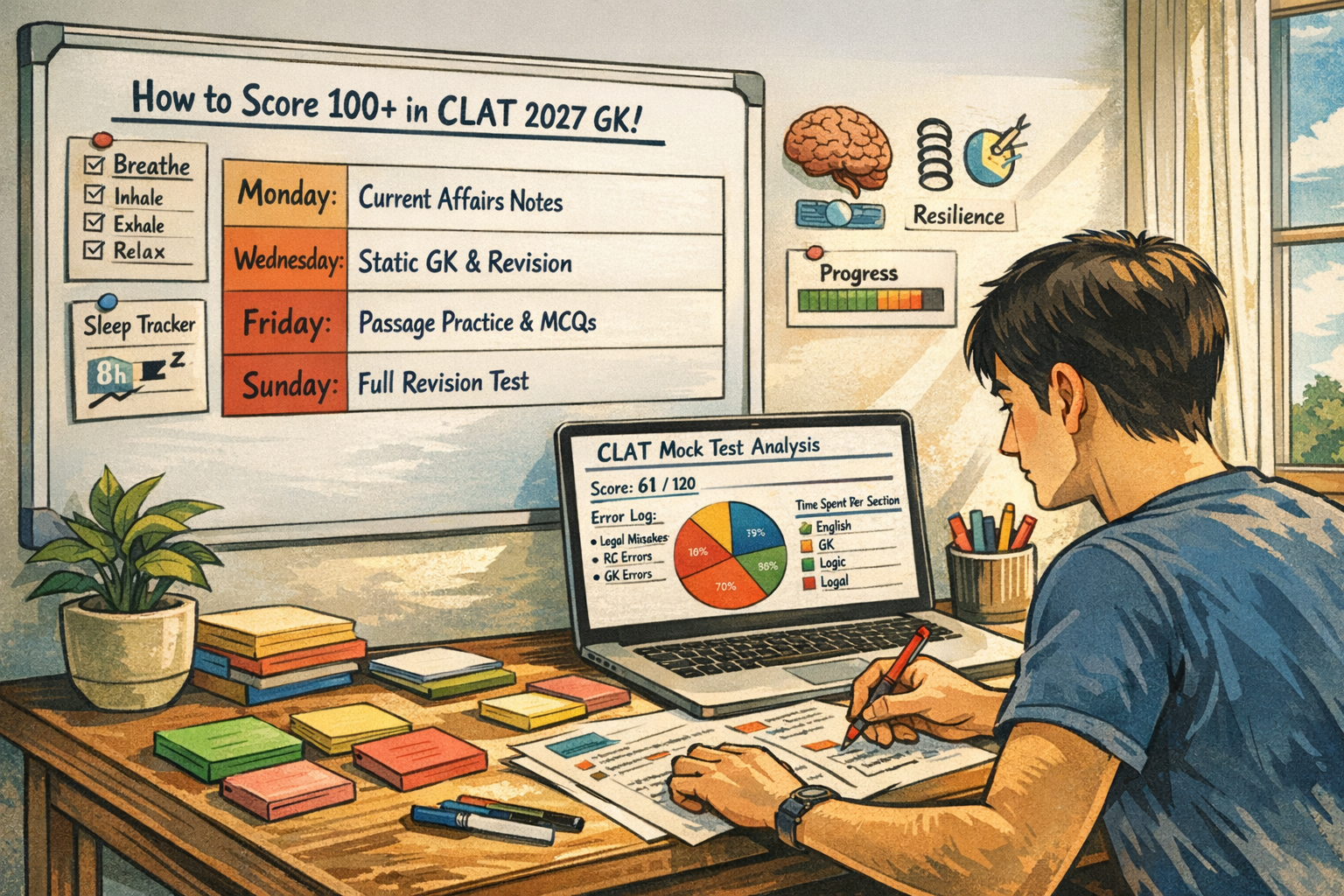
Weekly routine table
| Day | Primary task | Secondary task | Time |
|---|---|---|---|
| Monday | Current Affairs reading + notes | 10 GK MCQs | 75 to 90 mins |
| Tuesday | Legal reasoning passage practice | Revise Monday notes | 60 to 75 mins |
| Wednesday | Static GK: Constitution/Judiciary/IPC | 15 MCQs | 60 to 90 mins |
| Thursday | Current Affairs revision of last 7 days | One short passage set | 60 mins |
| Friday | Full GK practice set or sectional | Error log update | 75 mins |
| Saturday | Full mock or mixed sectional test | 90-minute mock analysis | 2.5 to 3 hours |
| Sunday | Weekly revision test | Monthly compilation review + planning | 90 mins |
If boards or school are also running
Reduce daily load, but don’t break the chain:
- weekdays: 45 to 60 mins
- weekends: longer revision blocks
This article on balancing school and CLAT preparation can help if time feels tight.
Conclusion
Scoring 100+ in CLAT does not require studying everything. It requires studying what repeats, what matters, and what fits the paper. That is the heart of how to score 100+ in CLAT 2027 GK.
The strongest plan is clear:
- cover the last 12 to 14 months
- use the 70/30 current-static split
- stick to 3 daily sources and 2 weekly revision tools
- revise within 48 hours
- practice 50 to 70 questions weekly
- analyze mocks deeply
- improve reading comprehension across all sections
And keep perspective. CLAT is a serious exam, but it does not need chaos. It needs structure.
At Lawgic Coaching, we’ve helped thousands crack CLAT with proven strategies that actually work, study at your own pace systems, and accessible education for serious aspirants. If you want a smarter plan, not a louder one, this is the right time to start. Let’s build your law career together.
FAQ
How many months of current affairs should be covered for CLAT 2027?
Cover at least 10 to 12 months, and ideally 12 to 14 months to stay safe for major recurring legal and political issues [4][5].
Is static GK important for CLAT 2027?
Yes, but static GK should support current affairs. Constitution, judiciary, Parliament, and criminal law basics matter more than random trivia.
Can current affairs alone help score 100+ in CLAT?
No. Current affairs can lift the score sharply, but 100+ needs balanced performance in English, Legal Reasoning, Logical Reasoning, and Quant too.
How many GK questions should be practiced every week?
A good target is 50 to 70 GK questions weekly, along with one CLAT-style passage set [4].
Which newspaper is best for CLAT current affairs?
The Hindu is a strong choice for editorials and issue understanding. TopRankers also recommends The Indian Express as a quality source [2].
How often should CLAT mocks be taken?
Most aspirants should take 1 to 2 mocks per week and analyze each mock carefully [2].
Is reading comprehension important for GK in CLAT?
Yes. CLAT GK is passage-based, so reading speed and extraction skills directly affect marks [2].
Should students make handwritten notes or digital notes?
Choose the format that you will revise consistently. Digital notes work well if they stay short, searchable, and updated.
What is the biggest mistake in CLAT GK preparation?
The biggest mistake is reading too much and revising too little. Without revision within 48 hours, most news gets forgotten.
Can CLAT 2027 be cracked without expensive coaching?
Yes, with the right sources, revision system, mocks, and feedback loop. Coaching helps most when it gives structure and personal guidance, not just content.
References
[1] How To Score 100 In Clat 2027 – https://www.pw.live/law/exams/how-to-score-100-in-clat-2027[2] How To Score 100 In Clat – https://www.toprankers.com/how-to-score-100-in-clat
[3] 12month Study Plan For Clat 2027 Monthbymonth – https://www.clatnlti.com/blog-details/628/12month-study-plan-for-clat-2027-monthbymonth
[4] Clat 2027 Gk Current Affairs Prep – https://www.delhilawacademy.com/clat-2027-gk-current-affairs-prep/
[5] Watch – https://www.youtube.com/watch?v=O966mlry5C8
[6] Watch – https://www.youtube.com/watch?v=TidNQO_Bexw
[7] Clat 2027 Complete Preparation Guide – https://jurylawacademy.com/blog/clat-2027-complete-preparation-guide
[8] Step By Step Guide To Prepare For Clat 2027 – https://geetalawcollege.in/blog/step-by-step-guide-to-prepare-for-clat-2027/
[9] Watch – https://www.youtube.com/watch?v=9iROljcjSbE
[10] How To Prepare For Clat 2027 In 6 Months – https://clatgurukul.com/how-to-prepare-for-clat-2027-in-6-months/
Meta title and description
how to score 100+ in CLAT 2027 GK, CLAT 2027 preparation, CLAT current affairs, CLAT exam strategy, law entrance exam preparation, legal reasoning, reading comprehension, NLU admission strategy, CLAT mock test tips, static GK, time management, comprehensive CLAT study plan