Last updated: July 19, 2026
Quick Answer
To become a lawyer in India, complete Class 12 from any stream, clear a law entrance exam like CLAT, join either a 5-year integrated LLB programme (BA LLB, BBA LLB, etc.) directly after Class 12 or a 3-year LLB after any graduation, enrol with your State Bar Council after degree completion, and clear the All India Bar Examination (AIBE) to receive your Certificate of Practice. The entire journey takes 6 to 8 years from Class 12 [1][5].
Key Takeaways
- Any stream in Class 12 (Science, Commerce, Arts) qualifies you for law admission, stream does not restrict eligibility.
- The 5-year BA LLB route after Class 12 is the most popular path; the 3-year LLB after graduation is the alternative.
- CLAT 2027 is scheduled for December 6, 2026 and is the primary entrance exam for National Law Universities (NLUs).
- After your LLB degree, you must register with a State Bar Council and clear AIBE to legally practise as an advocate.
- NLU fees run roughly ₹2 to ₹5 lakh per year; government law colleges are significantly cheaper.
- Career options include litigation, corporate law, judicial services, legal academia, and policy work.
- You cannot practise law in India without AIBE clearance and State Bar Council enrolment, regardless of your degree.
- A foreign law degree alone does not entitle you to practise in Indian courts without meeting Bar Council of India (BCI) requirements.
What Are the Basic Requirements to Become a Lawyer in India?
To become a lawyer in India, you need a Class 12 pass certificate from a recognised board with at least 45% marks (40% for SC/ST candidates), followed by an LLB degree from a BCI-approved institution [12]. No specific stream is required in Class 12.
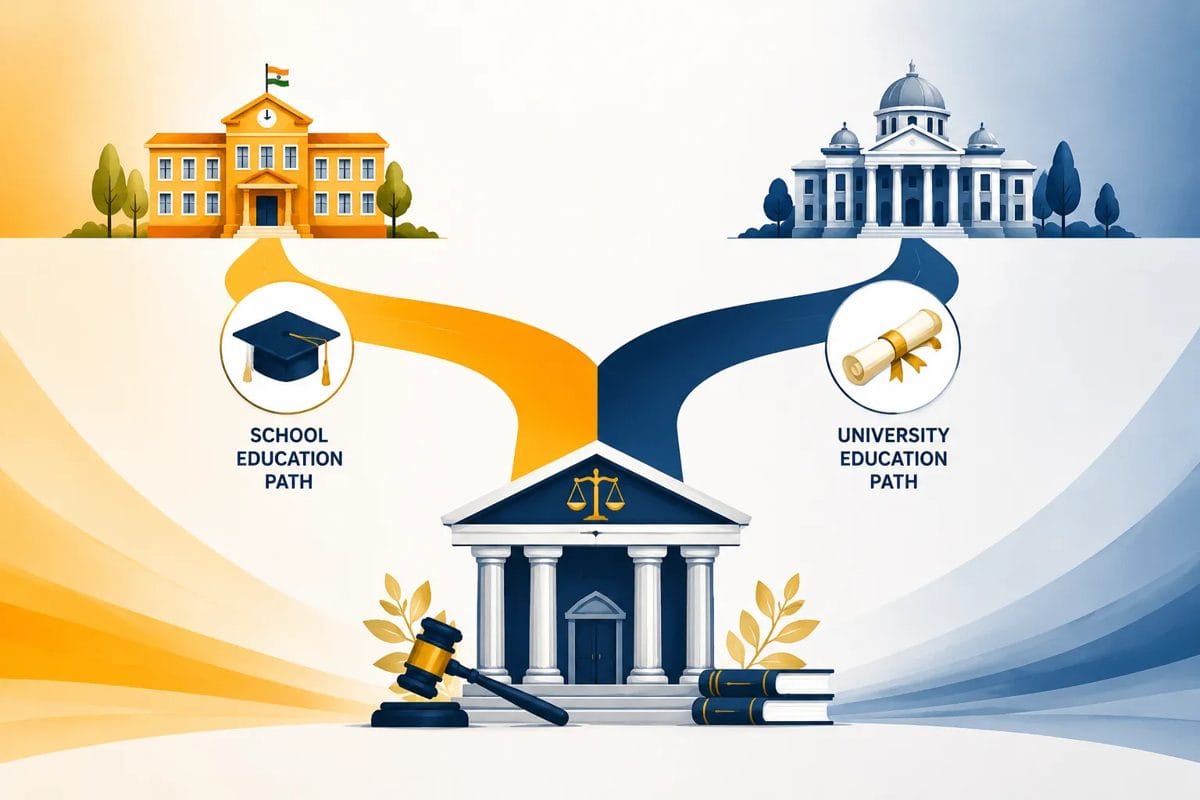
Here is what the eligibility looks like in practice:
- Class 12 qualification: Any stream (Science, Commerce, Humanities) is accepted.
- Minimum marks: 45% aggregate for general category; approximately 40% for SC/ST candidates [12].
- Age limit: No upper age limit for the 3-year LLB. For the 5-year integrated programme, the age limit is typically 20 years for general category and 22 years for SC/ST/OBC candidates (as per BCI rules).
- Degree from BCI-approved college: Your law college must be recognised by the Bar Council of India.
- State Bar Council enrolment + AIBE: Mandatory before you can appear in court as an advocate [5].
One common mistake students make is assuming they need to be from the Arts stream to study law. That is simply not true. Science and Commerce students crack CLAT every year and go on to build outstanding legal careers.
How to Become a Lawyer in India: The Two Main Routes
There are two clear paths to becoming a lawyer in India. Choose based on where you are right now [1][3].
Route 1: 5-Year Integrated LLB (After Class 12)
This is the most direct and popular path. You join a programme like BA LLB, BBA LLB, B.Com LLB, or BSc LLB immediately after Class 12 through entrance exams like CLAT or AILET.
Route 2: 3-Year LLB (After Graduation)
If you already hold a bachelor's degree in any discipline, you can apply for a standalone 3-year LLB programme. Many engineers, commerce graduates, and science graduates take this route.
Route Comparison Table
Let's be honest: if you are in Class 11 or 12 and law excites you, the 5-year route is almost always the better choice. You save a year, you get a dual degree, and you graduate from an NLU with a strong alumni network.
Your Path to the Bar, Step by Step
Tap each stage to see what happens there and how long it takes.
What Entrance Exams Do I Need to Take for Law in India?
The entrance exam you need depends on which colleges you are targeting. CLAT is the primary gateway to 25+ National Law Universities across India [5][6].
CLAT 2027 (Primary Exam)
CLAT (Common Law Admission Test) is conducted by the Consortium of NLUs. CLAT 2027 is scheduled for December 6, 2026. It covers English language, current affairs and GK, legal reasoning, logical reasoning, and quantitative techniques. For a complete breakdown of what to expect, check out this Complete CLAT Success Guide for 2027.
Other Major Law Entrance Exams
Decision rule: If your target is an NLU, prepare for CLAT first. If NLU Delhi specifically is your goal, prepare for AILET alongside CLAT since the syllabi overlap significantly. For Symbiosis, add SLAT to your list. You can read a detailed AILET vs CLAT comparison to figure out which exam deserves more of your time.
Preparing for CLAT does not have to drain your savings either. There are affordable CLAT preparation options that work if you are disciplined and have the right resources.
What Is the Difference Between LLB and BA LLB in India?
BA LLB is a 5-year integrated programme that combines a Bachelor of Arts with a Bachelor of Laws, awarded as a single dual degree. A standalone LLB is a 3-year professional degree for students who already hold a bachelor's degree in any field [2][3].
In practical terms:
- BA LLB covers humanities, social sciences, and law subjects together over five years.
- BBA LLB combines business administration with law, popular among students targeting corporate law.
- B.Com LLB pairs commerce with law, useful for tax law and financial regulation careers.
- BSc LLB is less common but available, combining science with law.
- LLB (3-year) is a pure law programme for graduates.
All these degrees, when obtained from a BCI-recognised institution, qualify you for State Bar Council enrolment and AIBE.
What Entrance Exams and Steps Come After LLB: The Bar Exam Process in India
After completing your LLB, two mandatory steps stand between you and a courtroom: State Bar Council enrolment and the All India Bar Examination (AIBE) [5][10].
Step 1: Enrol with a State Bar Council
Apply to the Bar Council of the state where you intend to practise. You will need:
- Original LLB degree certificate
- Marksheets from all semesters
- Character certificate
- Proof of identity and address
- Enrolment fee (varies by state)
Once enrolled, you are officially an "advocate" under the Advocates Act, 1961. But you still cannot appear in court independently until you clear AIBE.
Step 2: Clear the All India Bar Examination (AIBE)
AIBE is conducted by the Bar Council of India. It is an open-book exam covering 18 to 20 subjects of law. You need to score at least 45% (general) or 40% (SC/ST/OBC) to pass. Upon clearing AIBE, you receive your Certificate of Practice, which authorises you to appear in courts across India [5][10].
Important: AIBE can be attempted multiple times if you do not clear it on the first try. There is no cap on attempts.
How Long Does It Take to Become a Lawyer in India?
The minimum time to become a practising lawyer in India is about 6 years from Class 12 (5-year LLB + AIBE preparation and clearance). For those taking the 3-year LLB route after a 3-year graduation, the total is closer to 7 to 8 years [1][6].
Realistic Timeline from Class 12 to First Case
So realistically, a student who clears CLAT 2027 (December 2026), joins an NLU in 2027, and completes the 5-year programme will be eligible to appear in court by late 2032 or early 2033. That sounds far, but those five years in a good NLU are genuinely formative.
How Much Does Law School Cost in India?
Law school costs in India vary widely depending on the type of institution. NLUs charge roughly ₹2 to ₹5 lakh per year in tuition and fees, while government law colleges can be significantly cheaper, sometimes under ₹50,000 per year [5][6].
Approximate Annual Fee Ranges
Most NLUs offer merit-based scholarships and fee waivers for SC/ST/OBC students. If cost is a concern, government law colleges affiliated with state universities offer quality education at a fraction of the price. The degree still qualifies you for Bar Council enrolment and AIBE.
Expert guidance does not have to cost a fortune either. At Lawgic Coaching, we offer expert CLAT guidance without the premium price tag so that financial constraints do not stand between you and your law career.
Best Law Colleges in India for Aspiring Lawyers
The best law college for you depends on your entrance score, budget, and career goals. NLUs consistently rank at the top for placement and faculty quality [6][10].
Top NLUs by CLAT Rank (General Guidance)
- NLSIU Bangalore (NLU 1), Consistently India's top-ranked law school
- NALSAR Hyderabad (NLU 2)
- WBNUJS Kolkata (NLU 3)
- NLU Delhi (via AILET, separate exam)
- NLU Jodhpur, GNLU Gandhinagar, RMLNLU Lucknow (strong mid-tier NLUs)
Outside the NLU system, Symbiosis Law School (Pune), Faculty of Law at Delhi University, Government Law College Mumbai, and Christ University Bangalore have strong reputations.
Choose NLUs if your CLAT rank is competitive and you want the best placement and alumni network. Choose government colleges if cost is the primary constraint and you plan to pursue litigation or judicial services.
What Career Options Are Available After Becoming a Lawyer in India?
After clearing AIBE and enrolling with a State Bar Council, lawyers in India can pursue litigation, corporate law, judicial services, legal academia, or policy and government work [2][5].

Main Career Paths
Litigation
Appearing in district courts, High Courts, and the Supreme Court on behalf of clients. Most lawyers start here as juniors under a senior advocate. Income in early years is modest but grows substantially with experience and reputation.
Corporate Law
Working in-house at companies or at law firms advising on contracts, mergers, compliance, and intellectual property. Law firm associates at top-tier firms can earn competitive starting salaries. For a detailed look at earning potential, see this guide on highest paid lawyers in India.
Judicial Services
Becoming a judge at the district level through state judicial service examinations. Since the Supreme Court’s May 2025 ruling in All India Judges Association v. Union of India, candidates need a minimum of three years of practice as an advocate (experience as a law clerk counts) before sitting for the Civil Judge (Junior Division) examination. The rule is under review in 2026, but it currently applies nationwide. Check the specific rules for your state since requirements vary.
Other Options
- Legal academia (teaching at law colleges)
- Government legal officer roles
- Law officer positions in PSUs and banks
- Legal policy and NGO work
- Legal technology and compliance roles (a growing area, digital literacy is increasingly essential for lawyers)
How Much Do Lawyers Earn in India?
Lawyer earnings in India vary enormously based on specialisation, city, and years of experience. There is no single salary figure that applies across the profession [2][5].
Here is a general picture based on publicly available data:
- Junior litigation lawyers (0 to 3 years): Income can be irregular and modest in early years, especially in district courts.
- Law firm associates (top-tier firms): Starting packages at Tier 1 firms in cities like Mumbai and Delhi are competitive and well above average graduate salaries.
- Corporate in-house counsel: Mid-level in-house lawyers at large companies earn well, with significant variation by sector.
- Senior advocates and partners: Earnings at this level can be substantial, but reaching this stage typically takes 10 to 20 years.
The honest truth? Law is not a get-rich-quick career. The early years require patience and persistence. But the long-term ceiling is genuinely high, particularly in corporate law and senior litigation.
What Specialisations Can I Choose as a Lawyer in India?
Indian lawyers can specialise in virtually any area of law after their basic LLB degree. Specialisation typically happens through LLM programmes, work experience, or focused practice [2][3].
Popular specialisations include:
- Criminal law (litigation-focused)
- Corporate and commercial law (M&A, contracts, compliance)
- Intellectual property law (patents, trademarks, copyright)
- Constitutional law (public interest litigation, fundamental rights)
- Tax law (direct and indirect taxation)
- Family and matrimonial law
- Cyber law and technology law (rapidly growing)
- Environmental law
- Arbitration and dispute resolution
If you are unsure which specialisation suits you, do not worry about it in Class 12. Your first two years of law school will expose you to multiple areas, and most students find their niche organically.
Can I Practise Law in India With a Foreign Law Degree?
A foreign law degree alone does not automatically qualify you to practise in Indian courts. The Bar Council of India has specific rules about foreign-qualified lawyers, and as of 2026, the position is nuanced [5].
The BCI permits foreign lawyers and law firms to practise in India in limited capacities, primarily in non-litigious matters and international arbitration, following a Supreme Court ruling and subsequent BCI regulations. However, if you want to appear in Indian courts as an advocate, you generally need an LLB from a BCI-recognised Indian institution and must comply with standard enrolment requirements.
Practical advice: If you studied law abroad and want to practise in India, consult the Bar Council of India directly for the most current requirements, as this area has seen regulatory changes.
Can I Become a Lawyer in India Without Going to Law School?
No. You cannot become a practising advocate in India without an LLB degree from a BCI-recognised institution. The Advocates Act, 1961 makes this a non-negotiable requirement [5][10].
There is no apprenticeship route, no alternative qualification pathway, and no grandfather clause that bypasses the degree requirement. Anyone claiming otherwise is misinformed.
What you can do without a law degree is work in legal-adjacent roles such as legal process outsourcing (LPO), paralegal work, or compliance support. But appearing in court as an advocate requires the full qualification pathway.
What Are Common Mistakes People Make When Pursuing Law in India?
The biggest mistakes are choosing law without genuine interest, picking a college solely on brand name without checking BCI recognition, and underestimating the CLAT preparation timeline [6][10].
Here are the most common ones to avoid:
- Starting CLAT prep too late: CLAT rewards consistent preparation over 12 to 18 months, not last-minute cramming. Check out common CLAT pitfalls and how to avoid them.
- Ignoring internships during law school: Practical experience during your five years is as important as your academic score.
- Not verifying BCI recognition: Some private colleges advertise aggressively but are not BCI-approved. Always verify before paying fees.
- Assuming litigation is the only career: Many students limit themselves without exploring corporate law, policy, or legal tech.
- Skipping AIBE preparation: AIBE is not automatic. Some students delay it and lose months of practice time.
- Choosing stream in Class 12 based on law myths: Arts is not compulsory. Any stream works.
Is Becoming a Lawyer in India Worth It?
For students with genuine intellectual curiosity, strong communication skills, and the patience to build a career over years rather than months, law is absolutely worth it. It offers intellectual depth, social impact, and long-term earning potential that few careers match [1][2].
Let's be honest about the challenges too. The early years in litigation can be financially tough. The CLAT competition is real. And law school demands consistent effort. But here is the thing: students who go in with clear goals and the right preparation consistently build rewarding careers.
Your success is our mission at Lawgic Coaching, and we have seen thousands of students transform from uncertain Class 12 aspirants to confident NLU graduates. Results speak louder than promises, and the students who commit to the process get there.
Find Your Route to Law in 10 Seconds
Two questions. Your personalised path appears below.
Frequently Asked Questions
Q: Can a Science or Commerce student become a lawyer in India?
Yes. Class 12 stream does not restrict law admission. Science, Commerce, and Arts students are all eligible for CLAT and other law entrance exams, provided they meet the minimum percentage requirement (45% for general category).
Q: What is the minimum age to appear for CLAT?
There is no minimum age specified by the Consortium of NLUs for CLAT. However, the BCI's 5-year integrated programme rules typically set an upper age limit of 20 years for general category applicants at the time of admission.
Q: Is AIBE very difficult to clear?
AIBE is an open-book exam, which makes it more accessible than a closed-book test. The pass percentage has historically been reasonable, though exact figures vary by year. Focused preparation over two to three months is generally sufficient for most LLB graduates.
Q: How many attempts are allowed for CLAT?
CLAT has no restriction on the number of attempts, as long as you meet the age and eligibility criteria at the time of each attempt.
Q: Do I need to study in a specific state to enrol with that state's Bar Council?
Not necessarily. You can enrol with any State Bar Council, but most lawyers enrol in the state where they intend to practise, since local court familiarity and professional networks matter significantly.
Q: What is the difference between UG CLAT and PG CLAT?
UG CLAT is for admission to 5-year integrated LLB programmes after Class 12. PG CLAT is for admission to LLM programmes after completing an LLB. Both are conducted on the same day by the Consortium of NLUs. For more details, see this guide on UG vs PG CLAT differences.
Conclusion
The path to becoming a lawyer in India is clear, structured, and absolutely achievable. Here is the complete roadmap in brief: clear Class 12 with at least 45% marks, prepare for and crack CLAT 2027 (December 6, 2026) or another law entrance exam, complete a 5-year integrated LLB or a 3-year LLB after graduation, enrol with your State Bar Council, clear AIBE, and start practising as an advocate.
The journey takes commitment. But every step has a clear process, and no step is impossible with the right preparation.
Your next action steps:
- Confirm your Class 12 eligibility and check your percentage against the 45% threshold.
- Start CLAT preparation now. CLAT 2027 is on December 6, 2026, and consistent preparation over 12 months makes a real difference.
- Research NLUs and other law colleges to identify your target institutions.
- Explore CLAT preparation resources and coaching options that fit your schedule and budget.
Let's build your law career together. Flexible learning that fits your life, real mentors from top NLUs, and proven strategies that actually work. That is what Lawgic Coaching is here for.
References
[1] How To Become Lawyer – https://in.indeed.com/career-advice/career-development/how-to-become-lawyer[2] How To Become Lawyer In India – https://www.upgrad.com/blog/how-to-become-lawyer-in-india/
[3] How To Become A Lawyer A Comprehensive Step By Step Guide – https://www.cpj.edu.in/how-to-become-a-lawyer-a-comprehensive-step-by-step-guide/
[5] How To Become A Lawyer In India – https://www.bajajfinserv.in/how-to-become-a-lawyer-in-india
[6] Times of India – https://timesofindia.indiatimes.com/education/careers/how-to-become-a-lawyer-in-india-heres-your-step-by-step-guide/articleshow/104472687.cms
[10] How To Become A Lawyer In India In 2025 – https://www.iamrlawcollege.com/how-to-become-a-lawyer-in-india-in-2025