Understanding the Anti-Defection Law: A CLAT Aspirant’s Essential Guide for 2025
Ever wondered what happens when a politician switches parties after getting elected? It’s a pretty common scenario, right? One day they’re with Party A, the next they’re waving the flag for Party B. Well, in India, we have a specific rulebook for this exact situation: the anti-defection law. This isn’t just some obscure legal jargon; it’s a critical piece of our democratic puzzle, designed to maintain political stability and uphold the mandate given by the voters. As you prepare for CLAT in 2025, understanding the nuances of this law is absolutely essential. It touches on constitutional provisions, legislative ethics, and the very foundation of our parliamentary democracy. Let’s dive deep into this fascinating aspect of Indian law.
Key Takeaways
- The anti-defection law, enshrined in the 10th Schedule of the Indian Constitution, aims to prevent elected representatives from changing political parties for personal gain or to destabilize governments.
- It was introduced in 1985 through the 52nd Amendment, primarily to curb the “Aya Ram Gaya Ram” phenomenon, which had plagued Indian politics with frequent and opportunistic floor-crossing.
- Disqualification under this law can occur if a legislator voluntarily gives up membership of their political party, or votes/abstains from voting contrary to their party’s whip without prior permission.
- The presiding officer (Speaker in Lok Sabha/Assembly, Chairman in Rajya Sabha/Council) is the final authority on disqualification, though their decisions have been subject to judicial review by the Supreme Court.
- While designed to foster political stability and party discipline, the law has also faced criticism for potentially stifling dissent and inner-party democracy.
The Genesis of the Anti-Defection Law: From Chaos to Constitutional Safeguard

Imagine a time when politicians would switch parties as easily as changing clothes. This isn’t a hypothetical situation; it was a stark reality in India, particularly in the 1960s and 70s. This era gave birth to a famous phrase: “Aya Ram Gaya Ram.” It originated from a Haryana MLA named Gaya Lal, who changed his party three times in a single day in 1967! This kind of political defection led to immense instability, toppling governments and making a mockery of the electoral mandate. It was clear that something needed to be done to ensure legislative accountability and maintain public trust.
To combat this rampant political opportunism, the anti-defection law was introduced. It was a monumental step, bringing much-needed reform to our parliamentary democracy. The law was enacted through the 52nd Amendment to the Constitution in 1985, and it added the Tenth Schedule to the Indian Constitution. This schedule specifically lays down the provisions relating to disqualification on the ground of defection. The goal was simple: to deter legislators from switching parties after being elected, thereby ensuring political stability and respecting the voters’ choice.
Before this law, a legislator could easily defect without any real consequences, often for ministerial berths or other inducements. This undermined the very idea of stable government and responsible representation. The 10th Schedule, therefore, became a crucial constitutional safeguard against such practices, aiming to strengthen party discipline and ethical conduct among elected representatives. For CLAT aspirants, understanding this historical context is key to appreciating why such a law was necessary and how it shapes the current political landscape. It’s about more than just rules; it’s about the evolution of democratic principles in India. You’ll find that many of these constitutional provisions are designed to protect the integrity of our democratic process.
The Mechanics of Disqualification: How the 10th Schedule Works
So, how exactly does the anti-defection law operate in practice? The 10th Schedule outlines the specific grounds on which an elected member of Parliament or a State Legislature can be disqualified for party switching. It’s not a blanket ban on all changes, but it sets clear boundaries.
Here are the primary grounds for disqualification:
- Voluntarily Giving Up Party Membership: If an elected member, who belongs to a political party, voluntarily gives up their membership of such political party. This doesn’t necessarily mean formally resigning; actions that imply a surrender of membership can also lead to disqualification. For example, publicly stating opposition to the party or working against its interests could be interpreted as voluntarily giving up membership.
- Voting Against the Party Whip: If a member votes or abstains from voting in the House contrary to any direction (known as a “whip”) issued by their political party, without obtaining prior permission. The only exception here is if the member’s act is condoned by the party within fifteen days of such voting or abstention. This provision is designed to ensure party discipline and collective responsibility.
- Independent Members Joining a Political Party: An independently elected member (someone who doesn’t belong to any political party at the time of election) gets disqualified if they join any political party after their election.
- Nominated Members Joining a Political Party: A nominated member gets disqualified if they join any political party after the expiry of six months from the date on which they take their seat in the House. They have a six-month window to choose a party; after that, they cannot join one without risking disqualification.
It’s important to remember that these constitutional provisions apply to both members of Parliament (Lok Sabha and Rajya Sabha) and members of State Legislative Assemblies and Councils. The idea is to ensure legislative integrity across all levels.
The Disqualification Process
The power to decide on the disqualification of a member rests with the presiding officer of the House—that is, the Speaker in the Lok Sabha or State Assembly, and the Chairman in the Rajya Sabha or State Legislative Council. A petition for disqualification can be made by any other member of the House.
Here’s the usual flow:
- Petition: A member files a petition with the presiding officer alleging defection.
- Response: The presiding officer usually gives the accused member a chance to respond.
- Hearing: A hearing may be conducted, though the rules for this can vary.
- Decision: The presiding officer makes a final decision.
Initially, the presiding officer’s decision was considered final and not subject to judicial review. However, in the landmark Kihoto Hollohan v. Zachillhu (1992) case, the Supreme Court ruled that the decision of the Speaker/Chairman under the 10th Schedule is subject to judicial review, though only after the final decision is made. This ensures a check on the powers of the presiding officer and upholds democratic principles. It’s a crucial case to remember for your CLAT preparation, as it defines the limits of the anti-defection law’s application. We’ve helped thousands crack CLAT by emphasizing these key judicial precedents. For more insights on legal reasoning, check out our guide on CLAT 2026 Legal Reasoning Passages: Step-by-Step Approach.
Exceptions to Disqualification: When Party Switching is Allowed
While the anti-defection law is strict, it isn’t absolute. There are specific circumstances under which a defection does not lead to disqualification. These exceptions were initially broader but were narrowed down over time.
Before 2003, the law allowed for two major exceptions:
- Split: If one-third of the members of a legislative party “split” from the original party, they would not be disqualified. This was often misused, leading to horse-trading and smaller groups splitting off to form new alignments.
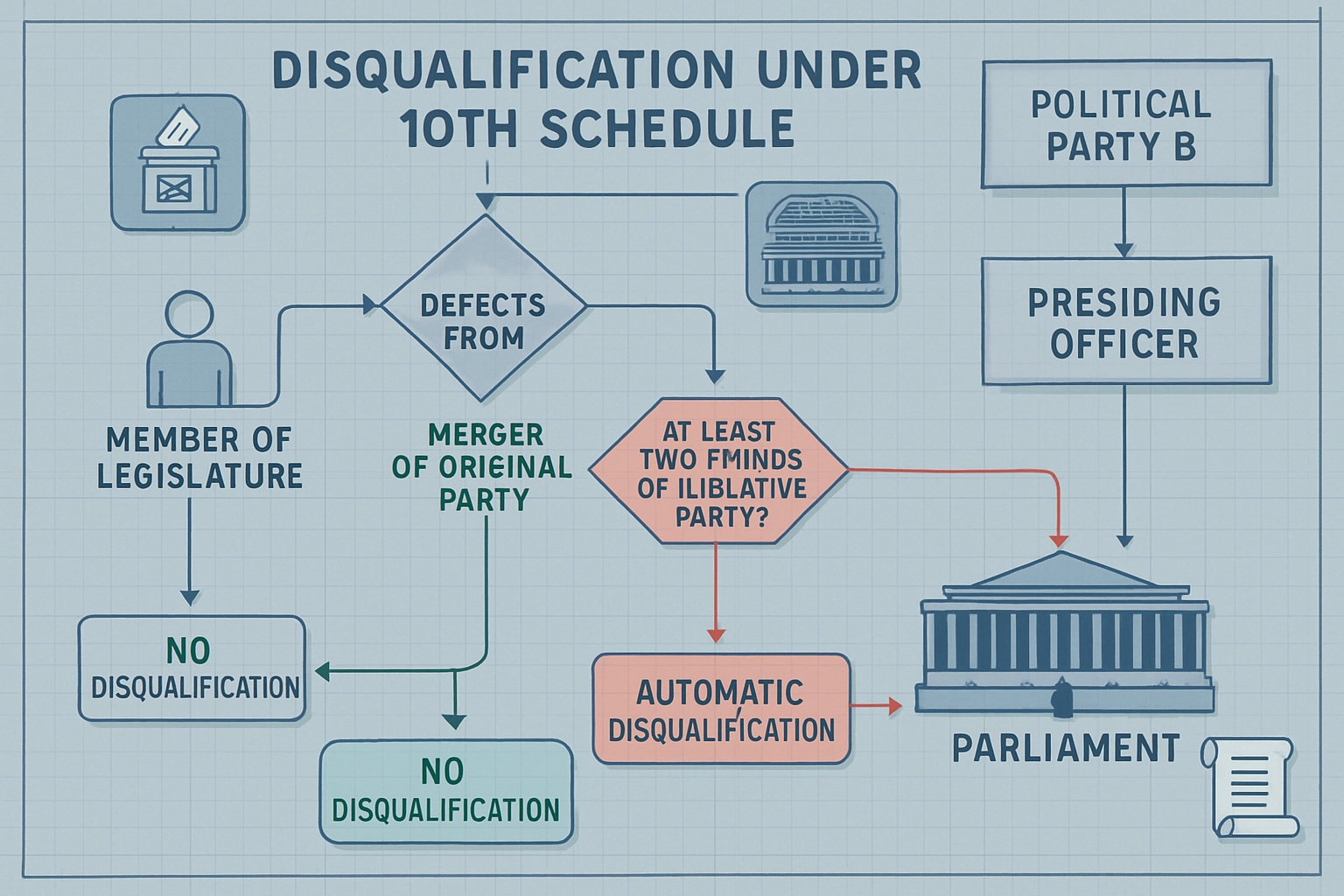
- Merger: If a political party “merges” with another political party, and at least two-thirds of the members of the legislative party agree to such a merger, then neither the members who agree to the merger nor the original party members are disqualified.
The “split” provision (point 1) was widely criticized for being a loophole that still allowed for opportunistic political migration and instability. Consequently, the 91st Constitutional Amendment Act of 2003 removed the exception relating to a “split.” This means that after 2003, if even one-third of the members split, they will be disqualified unless they fall under the “merger” exception.
So, as of 2025, the only significant exception to disqualification under the anti-defection law is the merger clause. This requires at least two-thirds of the legislative party members to agree to the merger with another party. This provision acknowledges that genuine political realignments and party integrations can occur and should not be unfairly penalized. This is an important distinction to understand when studying legislative disqualification.
The Nuances of Party Discipline and Electoral Mandate
The law’s aim is to balance party discipline with the electoral mandate. On one hand, it seeks to prevent legislators from betraying the trust placed in them by voters who cast their ballot for a particular party and its ideology. On the other hand, it empowers political parties to maintain cohesion and ensures that governments have stable majorities.
However, this balance is often debated. Critics argue that the strictness of the law, especially the whip provision, can stifle individual legislators’ freedom of speech and expression within the house. They are essentially bound by their party’s dictates, even if it goes against their conscience or the interests of their constituents. This is a crucial point for discussions on legislative ethics and constitutional safeguards in a democratic setup. Your success is our mission, and we help you understand these complex legal arguments thoroughly. You can explore more about constitutional law topics in our comprehensive UPSC preparation materials, which often overlap with CLAT PG syllabi.
Criticisms and Controversies Surrounding the Anti-Defection Law
While the anti-defection law was brought in with noble intentions—to curb political opportunism and ensure stability—it has faced its fair share of criticism and generated numerous controversies over the years. As CLAT aspirants, it’s vital to look beyond the surface and understand these debates.
- Stifling Dissent and Inner-Party Democracy: One of the most significant criticisms is that the law restricts a legislator’s freedom of speech and conscience. By binding members to the party whip on almost all votes, it can prevent them from voting according to their own beliefs or the specific needs of their constituency. This essentially means party leaders, not elected representatives, dictate legislative actions, potentially undermining inner-party democracy.
- Role of the Presiding Officer: The Speaker or Chairman, who decides on disqualification petitions, is often a member of the ruling party. This raises concerns about their neutrality and impartiality. There have been instances where decisions are delayed indefinitely or appear politically motivated. The Supreme Court, in the Kihoto Hollohan case, allowed judicial review, but this review only happens after the decision, and delays can still cause significant political instability. The lack of a fixed timeline for the presiding officer to make a decision is a major weakness competitors often miss, but we highlight it because it’s crucial for understanding the practical challenges.
- No Distinction Between Dissent and Defection: Critics argue that the law doesn’t differentiate between genuine dissent on policy matters and opportunistic defection for personal gain. A legislator might genuinely disagree with their party’s stance on a particular bill, but voting against the whip could lead to disqualification. This can reduce meaningful debate and compromise legislative accountability.
- Encourages Mass Defections (Mergers): By removing the ‘split’ exception but retaining the ‘merger’ clause, the law inadvertently encourages large-scale defections, often involving two-thirds of a party. This means that while individual or small group defections are punished, a large enough group can switch parties without consequence, sometimes leading to entire state governments being destabilized, as seen in various state-level political crises. This dynamic has significant economic impacts of political instability.
- Focus on Party, Not Individual: The law prioritizes the political party over the individual legislator and, by extension, the voters of that constituency. The electoral mandate is often seen as given to the party symbol, not just the individual candidate. However, some argue that voters elect individuals based on their character and promises, not just their party affiliation.
These issues highlight the complex interplay between party discipline, individual freedom, and democratic principles. Understanding these controversies is key to developing a nuanced perspective, something expert guidance without the premium price tag from Lawgic Coaching aims to provide.
Supreme Court Interpretations and Landmark Judgments
The Supreme Court of India has played a pivotal role in interpreting and shaping the anti-defection law, ensuring its application aligns with constitutional principles and safeguards democratic principles. As a CLAT aspirant, these landmark judgments are non-negotiable for your preparation.
-
Kihoto Hollohan v. Zachillhu (1992): This is arguably the most important judgment regarding the 10th Schedule.
- Key Ruling: The Supreme Court upheld the constitutional validity of the anti-defection law.
- Crucial Amendment: However, it declared that the decision of the Speaker/Chairman under the 10th Schedule is subject to judicial review. This was a significant check on the power of the presiding officer, ensuring that their decisions are not arbitrary or politically motivated. The Court clarified that judicial review would be available on grounds of perversity, illegality, irrationality, or constitutional impropriety.
- Presiding Officer’s Position: The Court equated the Speaker/Chairman with a tribunal when adjudicating defection cases.
-
Ravi S. Naik v. Union of India (1994): This case further clarified the term “voluntarily giving up membership.”
- Key Ruling: The Supreme Court held that “voluntarily giving up membership” does not necessarily mean a formal resignation from the party. It can also be inferred from the conduct of the member. For instance, publicly opposing the party’s stand, joining another party’s activities, or working against the party’s interests can all be grounds for disqualification.
-
G. Viswanathan v. Speaker, Tamil Nadu Legislative Assembly (1996): This judgment reinforced the idea of inferred voluntary relinquishment.
- Key Ruling: The Court reiterated that even without formally resigning, if an independent member joins a political party, or an elected member acts contrary to the interests of their original party, they can be deemed to have voluntarily given up membership.
-
Jagjit Singh v. State of Haryana (2006): This case highlighted the issue of the Speaker’s delay in making a decision.
- Key Ruling: The Supreme Court expressed concern over the inordinate delay by Speakers in deciding disqualification petitions, noting that such delays defeat the very purpose of the anti-defection law. While it didn’t set a strict timeline, it strongly advocated for prompt decisions.
These judgments showcase the judiciary’s proactive role in refining the application of the anti-defection law, aiming to strike a balance between legislative accountability and the powers of the presiding officer. For your CLAT exam, knowing these cases and their implications is crucial for legal reasoning and general knowledge sections. These proven strategies that actually work are part of what makes Lawgic Coaching stand out. We focus on results speak louder than promises, helping you understand complex constitutional jurisprudence.
Reform Suggestions and the Path Forward for 2025
The enduring debates and controversies surrounding the anti-defection law have naturally led to numerous suggestions for reform. As aspiring legal eagles, understanding these proposals is crucial for critical analysis, especially as we look towards how this law might evolve by 2025 and beyond.
- Fixed Timeline for Speaker’s Decision: One of the most common and vital suggestions is to set a clear, time-bound deadline for the Speaker or Chairman to decide on disqualification petitions. The Supreme Court has repeatedly expressed concern over delays, and a fixed timeline (e.g., three months) could prevent political manipulation and ensure timely justice. This would address a significant competitor weakness by providing a concrete solution to a prevalent issue.
- Referral to an Independent Authority: Many experts suggest that the power to decide disqualification cases should be shifted from the Speaker (who is often a party member) to an independent body. Options include:
- Election Commission of India (ECI): Empowering the ECI to decide on these matters, similar to how it handles cases of disqualification for ‘office of profit.’ This would ensure greater impartiality.
- President/Governor (acting on ECI advice): Similar to Article 103/192 regarding other disqualifications.
- High Court/Supreme Court bench: Creating a dedicated bench to handle defection cases expeditiously.
- Limiting the Scope of Whip: The law could be amended to limit the applicability of the party whip only to crucial votes like confidence motions, no-confidence motions, or budgetary matters. This would allow legislators more freedom to vote according to their conscience on other legislative business, fostering genuine legislative integrity and preventing the stifling of dissent.
- Distinguishing Dissent from Defection: A more nuanced approach could be adopted to differentiate between genuine intra-party dissent (which should be encouraged for healthy democracy) and opportunistic defection. Perhaps a certain threshold of dissent within the party, if not resulting in joining another party, could be protected.
- Strengthening Inner-Party Democracy: Ultimately, one of the best ways to reduce defection is to foster stronger, more democratic internal structures within political parties. If members feel heard and have avenues to express dissent within their party, the temptation to defect might decrease. This goes beyond legal fixes and touches upon the ethical frameworks for legislative conduct.
- Pre-election Pledges and Public Disclosure: Encouraging political parties to make pre-election pledges regarding defections and requiring greater transparency from individual candidates about their commitment to their party could increase public pressure and accountability.
These suggestions aim to refine the anti-defection law to better serve its original purpose without unduly hindering democratic principles or individual legislative accountability. For serious aspirants, discussing such reform suggestions in essays or interviews demonstrates a deep understanding of political stability and democratic principles. Lawgic Coaching believes in personalized attention you deserve, helping you dissect these complex issues for your CLAT PG preparation. You can also explore 5 Mistakes to Avoid When Choosing the Best Online CLAT Coaching to ensure you’re getting the best possible preparation.
International Comparative Perspectives on Political Defection
It’s easy to think of the anti-defection law as a uniquely Indian phenomenon, but the challenges of political opportunism and legislative stability are global. Many other parliamentary democracies grapple with similar issues, though their approaches to curbing floor-crossing vary significantly. A comparative international analysis can offer valuable insights and fresh perspectives, which is a content gap many competitors miss, but we prioritize for a holistic understanding.
United Kingdom (UK)
The UK, the mother of parliaments, does not have a formal anti-defection law like India’s 10th Schedule.
- “Floor Crossing” Consequences: While not legally disqualified, “floor crossing” (as defection is known there) is generally seen as a serious breach of trust with voters and the party. It usually leads to significant political consequences, such as losing party endorsement in future elections or facing public backlash.
- Party Discipline: Party discipline is maintained primarily through the “whip” system, where party whips communicate the party line and ensure members vote accordingly. Persistent defiance can lead to expulsion from the party, but not from Parliament itself.
Canada
Canada, another Westminster-style democracy, also lacks a formal anti-defection law.
- Strong Party Discipline: Canadian political parties exert strong discipline, primarily through internal party rules and the leader’s power.
- Consequences: Defecting members might lose their party’s nomination for the next election, face internal party sanctions, or even be expelled from the party caucus. The political cost is usually sufficient to deter frequent defections.
Australia
Australia, like the UK and Canada, does not have specific anti-defection legislation.
- Party Solidarity: The emphasis is on party solidarity, and members who cross the floor or vote against their party face political repercussions rather than legal disqualification.
- Electoral System: The preferential voting system and strong party branding often mean voters primarily vote for the party, making defection a risky move for a politician’s career.
Other Models
- Fixed-Term Parliaments: Some countries, like Germany, have fixed-term parliaments, which can reduce the incentive for defections aimed at toppling governments, as governments are more stable.
- Recall Mechanisms: In a few systems, voters have the power to recall an elected representative, providing a direct democratic check on errant behavior, including defection.
Key Takeaways from Comparative Analysis
- Legal vs. Political Consequences: India’s anti-defection law stands out for imposing legal disqualification, whereas many other mature democracies rely more on political and electoral consequences, coupled with strong internal party discipline.
- Trust in Voters vs. Party: The Indian law places a strong emphasis on the party’s role in the electoral mandate, while in other countries, there’s often an expectation that voters will punish defectors at the ballot box.
- Stifling Dissent: The absence of a strict anti-defection law in countries like the UK allows for more intra-party dissent, though it can also lead to leadership challenges.
Understanding these international perspectives helps CLAT aspirants appreciate the unique features of India’s anti-defection law and evaluate its effectiveness within our specific political context. It underscores the challenges of balancing party discipline with legislative freedom in a diverse democracy. We bring you these real experiences and specific examples to help you understand the nuances.
Psychological Motivations and Economic Impacts of Defection
Moving beyond the legal provisions, it’s fascinating to delve into the deeper, often unspoken, aspects of defection. What truly drives a legislator to switch parties, and what are the broader consequences beyond just political instability? This is a content gap where we offer unique value.
Psychological Motivations Behind Defection
Why do legislators defect? It’s rarely a simple, one-dimensional decision. Several psychological and personal factors often come into play:
- Personal Ambition and Opportunism: Let’s be honest, this is often a major driver. A legislator might feel overlooked in their current party, denied a ministerial portfolio, or see better career prospects in another party that’s likely to form the government. The promise of power, position, or prestige can be incredibly tempting. This aligns with the “political opportunism” the law seeks to curb.
- Ideological Disillusionment: While less common than pure opportunism, some defections genuinely stem from a growing ideological rift with their original party. Over time, a legislator’s core beliefs might diverge significantly from the party line, leading them to seek alignment elsewhere. However, proving this as the sole motivation is often challenging.
- Constituency Pressure: Sometimes, a legislator might genuinely feel that their party is not addressing the specific needs or demands of their constituency. If joining another party appears to be the only way to secure development projects or represent local interests, they might consider it.
- Charismatic Leadership: A new, strong leader in another party might attract members from rival factions, especially if they believe that leader offers a better vision or a greater chance of electoral success.
- Fear of Losing Elections: If a legislator senses their current party is losing popularity in their constituency, they might jump ship to a more viable party to ensure their re-election. This is a survival instinct in the cut-throat world of politics.
Understanding these motivations allows for a more comprehensive analysis of the anti-defection law and its real-world impact. It’s not just about the rules; it’s about human nature in politics.
Economic Impacts of Political Instability Caused by Defection
The constant threat or actual occurrence of defections and subsequent government instability can have profound economic consequences, a critical aspect often overlooked.
- Stalled Policy-Making: When governments are constantly fighting to retain their majority or facing imminent collapse, their focus shifts from governance to political survival. This leads to stalled policy-making, delayed reforms, and an inability to pass crucial legislation, directly impacting economic growth and development.
- Uncertainty for Investors: Political instability creates an environment of uncertainty. Domestic and international investors are wary of putting their money into a region or country where governments are fragile and policies might change frequently. This can lead to reduced foreign direct investment (FDI) and capital flight.
- Impact on Development Projects: Long-term development projects, especially those requiring significant public funds or private sector participation, are often put on hold or abandoned when governments change frequently. This affects infrastructure, employment, and overall economic progress.
- Misallocation of Resources: In an attempt to prevent defections, ruling parties might offer inducements like ministerial positions or special financial packages, leading to a misallocation of public resources away from genuinely needed areas.
- Damage to Reputation: A nation known for political instability due to defections can suffer reputational damage on the global stage, affecting its diplomatic relations, trade agreements, and overall standing.
The anti-defection law was partly designed to mitigate these economic risks by ensuring political stability. However, as we’ve discussed, its effectiveness in preventing all forms of instability is still a subject of debate. This broader perspective on the economic impacts offers a richer understanding of why constitutional safeguards like the 10th Schedule are so critical. Lawgic Coaching focuses on holistic learning, making sure you grasp these intricate connections.
The Future of Anti-Defection Law: Technological Solutions and Ethical Frameworks for 2025
As we look towards 2025 and beyond, the discussion around the anti-defection law isn’t static. New ideas, including technological solutions and refined ethical frameworks, are emerging to address its persistent challenges and strengthen our democratic principles. This forward-looking perspective is a unique angle that enriches your understanding beyond typical CLAT prep.
Technological Solutions to Prevent Defection
Could technology play a role in making the anti-defection law more effective or transparent? Here are some speculative but intriguing possibilities:
- Blockchain for Mandate Tracking: Imagine a system where a legislator’s electoral mandate and party affiliation are recorded on a secure, immutable blockchain. Any deviation from the party whip or declared defection would be automatically flagged, creating an unalterable public record. While not directly enforcing disqualification, it could dramatically increase transparency and public accountability.
- Digital Voting Records with Automated Alerts: Most legislative voting is already digital. We could enhance this with automated systems that flag instances of a legislator voting against a registered party whip. This would streamline the evidence-gathering process for disqualification petitions, reducing delays.
- AI-Powered Predictive Models of Political Migration: While controversial, AI could potentially analyze historical data, social media sentiment, and public statements to identify patterns and predict instances of potential defections. This isn’t about preventing it physically but giving parties and the public an early warning, fostering greater transparency and potentially allowing for proactive measures to address dissent.
- Secure Platforms for Intra-Party Debate: To counter the argument that the law stifles dissent, secure and encrypted digital platforms could be developed within parties. These platforms would allow members to voice disagreements, debate policies, and even conduct internal polls confidentially, without the fear of their dissent being misinterpreted as an intent to defect. This could strengthen inner-party democracy.
While some of these ideas are futuristic, they show how technology could potentially enhance legislative accountability and make the anti-defection law more robust and transparent.
Ethical Frameworks for Legislative Conduct
Beyond legal mandates, fostering a strong ethical framework for legislative conduct is paramount for a healthy democracy. The anti-defection law is a legal tool, but true democratic principles are upheld by the ethical compass of elected representatives.
- Oath of Office and Constituency Allegiance: Re-emphasizing the moral and ethical weight of the oath of office, which binds legislators to uphold the Constitution and serve their constituents, can act as an internal check against opportunistic defection. Discussions on legislative ethics often focus on balancing party loyalty with the public good.
- Codes of Conduct for Political Parties: Political parties themselves could adopt stricter, publicly declared codes of conduct regarding internal dissent, candidate selection, and the handling of disciplinary actions. This could foster a culture where defection is genuinely seen as an ethical breach, not just a legal one.
- Public Education on Electoral Mandate: Educating voters on the implications of their vote—whether for an individual, a party, or a combination—can empower them to hold defecting legislators accountable at the next election. A well-informed electorate is the strongest deterrent against unethical legislative behavior.
- Promoting “Conscience Voting” on Specific Issues: Creating a culture where “conscience voting” is respected (e.g., on ethical or moral issues) rather than always being bound by a strict whip could provide an outlet for genuine dissent without leading to defection. This would require a mature political environment.
By combining robust legal frameworks like the anti-defection law with technological advancements and a strong emphasis on ethical conduct, India can further strengthen its parliamentary democracy in 2025 and beyond. This is about building your law career together with a deep understanding of these complex and evolving issues.
Conclusion
The anti-defection law, enshrined in the 10th Schedule of the Indian Constitution, is a fascinating and crucial element of our democratic framework. Born from the chaos of “Aya Ram Gaya Ram,” it was designed to prevent the constant toppling of governments due to opportunistic political defection, thereby ensuring stability and upholding the electoral mandate. We’ve explored its historical context, the intricate mechanics of disqualification, the significant exceptions, and the pivotal role of Supreme Court interpretations in shaping its application.
However, as we’ve discussed, the law isn’t without its critics. Concerns about stifling dissent, the neutrality of the presiding officer, and the encouragement of mass defections via the merger clause highlight the delicate balance it attempts to strike between party discipline and individual legislative freedom. As CLAT aspirants, understanding these debates, alongside potential reforms like a fixed timeline for decisions or referral to an independent body, is vital for developing a comprehensive and critical perspective on constitutional law.
Looking ahead to 2025, the conversation around the anti-defection law continues to evolve, incorporating ideas from international comparisons, exploring the psychological motivations behind defections, and even contemplating technological solutions and stronger ethical frameworks for legislative conduct. Your journey towards becoming a legal professional requires not just knowing the law, but also understanding its genesis, its impact, and its potential future.
At Lawgic Coaching, we believe in making these complex legal concepts accessible and engaging. We’re here to provide the expert guidance without the premium price tag, ensuring you’re not just prepared for CLAT, but also equipped with the critical thinking skills necessary for a successful legal career. Your success is our mission, and we’re committed to helping you navigate every constitutional provision, every landmark judgment, and every nuanced debate. Ready to dive deeper into constitutional law or other CLAT subjects? Explore our courses designed with flexible learning that fits your life.
Quick Check: Test Your Anti-Defection Law Knowledge!
1. The Anti-Defection Law was introduced into the Indian Constitution by which amendment?
2. Which Schedule of the Indian Constitution contains the Anti-Defection Law?
3. Who is the final authority to decide on disqualification of a member under the Anti-Defection Law?
4. Which landmark Supreme Court case made the Speaker’s decision on defection subject to judicial review?