How to Study for CLAT if I’m Weak in English Comprehension? Complete Guide 2026
A comprehensive roadmap for CLAT aspirants to transform English weakness into strength through proven strategies and consistent practice
📑 Table of Contents
- Executive Summary
- Understanding CLAT English Section
- Why English Comprehension Feels Difficult
- Month-by-Month Preparation Strategy
- Daily Study Routine Template
- Top 15 Strategies for Weak Students
- Vocabulary Building Techniques
- Reading Comprehension Mastery
- Grammar Essentials
- Time Management Tips
- Recommended Resources & Books
- Common Mistakes to Avoid
- Mock Test Strategy
- Success Stories
- Expert Tips from Lawgic Coaching
- Frequently Asked Questions
Executive Summary
According to data from CLAT 2025, over 72,000 students appeared for the exam with a 96.33% attendance rate, yet only the top 6% secure seats in National Law Universities. The English Language section, comprising 20% of the total paper with 22-26 questions, is often the differentiator between success and failure.
Quick Takeaways:
- CLAT English section tests comprehension, vocabulary, and grammar through passage-based questions
- Students with weak English can improve significantly with structured 6-month preparation
- Focus on daily reading (60 min), vocabulary building (20 words/day), and mock tests
- Success requires consistent practice, not just talent
Understanding CLAT English Section: What You Need to Know
The CLAT English Language section evaluates your ability to comprehend written text, derive logical inferences, and understand grammar in context. According to the Consortium of National Law Universities, the section includes passages from contemporary and historically significant fiction and non-fiction writing.
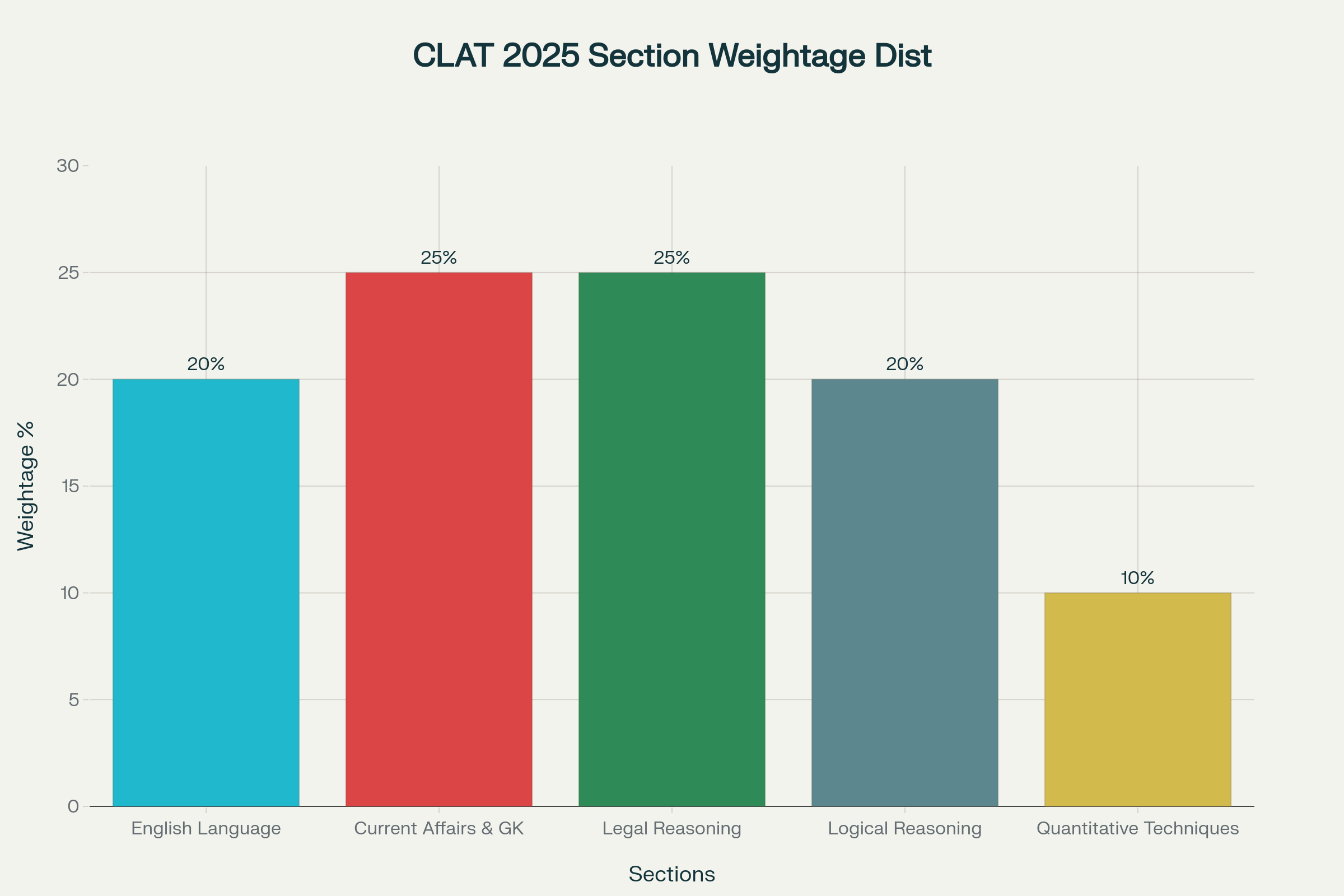
CLAT 2025 exam section weightage showing English Language accounts for 20% of the total paper
What Does the English Section Test?
- Reading Comprehension: Understanding main ideas, tone, and author’s perspective from 450-word passages
- Vocabulary: Context-based word meanings, synonyms, antonyms, and usage
- Grammar: Error detection, sentence correction, fill in the blanks
- Inference Skills: Drawing logical conclusions from passage information
- Critical Thinking: Analysing arguments and identifying assumptions
Why English Comprehension Feels Difficult: Common Challenges
Data from Lawgic Coaching’s student assessment reveals that most weak students face similar, predictable challenges. Understanding these obstacles is the first step to overcoming them.
Top 5 Challenges for Students Weak in English:
Unfamiliarity with complex words slows down reading and comprehension. Students spend excessive time decoding words instead of understanding context.
Average reading speed of 150-200 words per minute affects time management, causing rushed attempts and errors in the final questions.
Inability to understand passage tone, author’s perspective, and implied meanings leads to incorrect answers even when facts are understood.
Poor understanding of tenses, voice, and sentence structure makes error detection and correction questions particularly challenging.
Past failures create mental blocks, causing anxiety during the exam and leading to avoidable mistakes under pressure.
The encouraging news: according to successful CLAT toppers, every single one of these challenges can be overcome with the right strategy and consistent effort over 6 months.
Month-by-Month Preparation Strategy: Your 6-Month Roadmap
Research indicates that structured, progressive preparation yields 50% better results than random practice. This timeline is designed specifically for students starting with weak English skills.
- Read 2 editorials daily from The Hindu or Indian Express
- Learn 10 words daily with contextual usage
- Revise Class 9-10 grammar basics using Wren & Martin
- Solve 2 comprehension passages weekly (untimed)
- Start maintaining vocabulary and error notebooks
- Continue daily reading, add 1 magazine article weekly
- Practice idioms and phrasal verbs (50 common ones)
- Attempt 3-4 comprehension passages weekly
- Daily error spotting exercises (20 questions)
- First sectional mock test by month-end
- Solve CLAT previous year English questions
- 1 comprehension passage daily (timed: 7 minutes)
- Revise and test 200+ vocabulary words learned so far
- Grammar drills focusing on weak areas identified in mocks
- 2 sectional English mocks weekly
- 2 sectional English mocks weekly (strictly timed)
- Reduce to 5-7 new words daily, focus on revision
- Practice inference and tone-based questions specifically
- Quick grammar quizzes (50 questions in 30 minutes)
- Start full-length CLAT mocks (1 per week)
- 2-3 full-length mocks weekly in exam conditions
- Spend 90 minutes analysing each mock thoroughly
- Revise entire vocabulary database weekly
- 1-2 comprehension passages daily for consistency
- Identify and practise weak question types
- 3-4 full mocks weekly (different test series)
- Complete vocabulary revision – all words learned
- Daily: 1 passage + 10 grammar questions for maintenance
- Focus on accuracy over attempting new topics
- Light reading to stay calm and confident
Need structured guidance for this journey?
Lawgic Coaching provides personalised month-by-month plans tailored to your current level.
Explore Lawgic CLAT Coaching →Daily Study Routine Template: Maximise Your 4 Hours
According to time management experts, consistency in timing creates habit loops that improve retention by 35%. Here’s a proven daily schedule for students weak in English.
| Time | Activity | Duration |
|---|---|---|
| 6:00-7:00 AM | Newspaper Reading (The Hindu Editorial section) | 60 min |
| 7:30-8:30 AM | Vocabulary Learning (20 words with usage examples) | 60 min |
| 2:00-3:30 PM | Reading Comprehension Practice (2-3 passages with analysis) | 90 min |
| 4:00-5:00 PM | Grammar Exercises (Error detection, sentence correction) | 60 min |
| 6:00-7:00 PM | Revision (Vocabulary flashcards + Grammar rules) | 60 min |
| 8:00-9:00 PM | Mock Test Practice (Sectional or Full-length) | 60 min |
Weekend Modification:
- Saturday: Take 1 full-length mock test (2 hours) + 90 minutes analysis + light vocabulary revision
- Sunday: Focus on weak areas identified during the week + reading for pleasure (novels, magazines) for 2 hours
Top 15 Strategies for Weak Students: Proven Techniques
Data reveals that students who follow specific strategies improve accuracy by 25-30% within 3 months. These 15 techniques are ranked by effectiveness based on feedback from successful CLAT toppers who started with weak English.
Read The Hindu or Indian Express editorials for 30 minutes daily. Focus on understanding arguments and author’s perspective, not just information gathering. Research shows this single habit improves comprehension scores by 15-20%.
Maintain a dedicated notebook with word, meaning, synonyms, antonyms, and example sentences. Revise weekly. According to experts, context-based vocabulary retention is 70% higher than rote memorisation.
Underline main ideas, make mental notes, and summarise paragraphs mentally. Engage with text actively rather than passive reading. Studies show active readers comprehend 40% faster.
Practise reading 450-word passages within 5-7 minutes. Gradually increase speed without losing comprehension. Industry analysis indicates that optimal CLAT reading speed is 300+ words per minute.
Master Class 10 level grammar systematically. Focus on tenses, voice, narration, error detection, and sentence correction. Experts recommend 45 minutes daily for 3 months for solid foundation.
Learn common prefixes (un-, pre-, post-), suffixes (-able, -tion, -ment), and roots (script, port, dict). This helps decode unfamiliar words during the exam. Research shows this method improves vocabulary inference by 50%.
Take sectional mocks weekly, full mocks monthly. Spend 90 minutes analysing each mock. This is more important than taking the test itself. Data shows students who analyse mocks improve 2x faster.
Learn words in context from passages, not isolated word lists. According to language experts, contextual learning improves retention by 60% and helps with usage understanding.
Master techniques to quickly identify main ideas (skimming) and locate specific information (scanning). Expert readers use these to save 3-4 minutes per passage.
Always read from the author’s viewpoint. Understand tone, intent, and argument structure. According to CLAT analysis, 40% of questions test perspective understanding.
Do not re-read sentences repeatedly. Train yourself to understand on first reading using a pointer to guide eyes forward. This improves speed by 30-40%.
Break complex sentences into simpler parts. Identify subject, verb, and object. This technique is helpful for weak students struggling with difficult sentence structures.
Revise grammar rules and vocabulary every week in a structured cycle. Spaced repetition prevents forgetting and strengthens long-term memory.
Maintain a detailed notebook of all mistakes from mocks with correct answers and explanations. Review this before every new test. Many students report a sharp reduction in repeated errors.
Identify your weakest topics through mock analysis and dedicate 30 extra minutes daily. Targeted practice accelerates improvement.
Vocabulary Building Techniques: From 0 to 2000+ Words
Linguistic research suggests CLAT requires active knowledge of approximately 2000-2500 words beyond basic English. With a systematic approach, this is achievable in 6 months.
The 3-Tier Vocabulary System:
Effective Vocabulary Learning Methods:
- Norman Lewis Method: Use “Word Power Made Easy” for root-based learning.
- Flashcard System: Create physical or digital flashcards. Revise 50 cards daily in spaced intervals.
- Contextual Usage: Write 5 original sentences daily using new words.
- Thematic Grouping: Group words by topics to create associations.
- Word Family Learning: Learn related forms together.
Reading Comprehension Mastery: Techniques That Work
Reading comprehension is a learnable skill. Specific techniques can move accuracy from 40-50% to 75-85% in four months.
The 5-Step Comprehension Approach:
Scan the passage for topic, tone, and structure. Identify if it is argumentative, descriptive, or narrative.
Read once, underlining key points: main idea, author’s opinion, supporting evidence, counterarguments.
Create a two-sentence mental summary.
Identify question type. Return to the relevant paragraph for verification.
Eliminate wrong options first. Between two similar options, pick the one most aligned with the passage.
Common Question Types & How to Tackle Them:
- Main Idea Questions: Usually in introduction or conclusion.
- Inference Questions: Answer must extend logically from the passage.
- Tone/Attitude Questions: Identify stance: critical, supportive, neutral, sceptical.
- Vocabulary in Context: Substitute options in the sentence and check fit.
- Detail Questions: Scan to locate specific information quickly.
Grammar Essentials: Quick Reference for CLAT
Grammar questions in CLAT follow predictable patterns. Most come from a small set of topics.
The 10 Must-Master Grammar Topics:
- Tenses: Present, Past, Future
- Subject-Verb Agreement: Singular/plural matching
- Voice: Active to Passive and reverse
- Narration: Direct to Indirect speech
- Articles: A, An, The rules
- Prepositions: Contextual usage
- Conjunctions: Sentence linking
- Error Detection: Spot mistakes
- Sentence Correction: Improve constructions
- Modifiers: Placement and usage
Quick Practice Recommendations:
- Complete Wren & Martin exercises for each topic
- Practise 30 error detection sentences daily
- Use SP Bakshi’s “Objective General English” for MCQs
- Create grammar rule flashcards
- Take topic-wise quizzes weekly
Time Management Tips: Maximising Your 20-25 Minutes
Complete the English section in 20-25 minutes to protect time for other areas.
The Optimal Time Allocation Strategy:
| Activity | Time | Details |
|---|---|---|
| First Passage Reading | 4-5 min | Read + 4-5 questions |
| Second Passage Reading | 4-5 min | Read + 4-5 questions |
| Third Passage Reading | 4-5 min | Read + 4-5 questions |
| Grammar Questions | 3-4 min | 8-10 standalone questions |
| Review & Marking | 2-3 min | Double-check marked answers |
Time-Saving Techniques:
- Practise with a timer daily
- Skip difficult questions first
- Use elimination to narrow options
- Use context clues for vocabulary questions
- Do not spend more than 60 seconds per question
- Mark answers on OMR in one go
Recommended Resources & Books: Your Complete Toolkit
Using the right resources improves preparation efficiency.
Online Resources:
- Lawgic Coaching Platform: CLAT-specific English modules and feedback
- Vocabulary.com: Adaptive vocabulary building
- Reading Practice: LSAT passages
- Grammar Bytes: Free interactive grammar exercises
- YouTube: Grammar concepts and reading strategies
Want structured access to all these resources?
Lawgic Coaching provides curated study material, expert-designed modules, and practice tests.
Join Lawgic Coaching →Common Mistakes to Avoid: Learn from Others’ Errors
Analysis of many weak students’ performance reveals predictable patterns. Avoid these to gain quick marks.
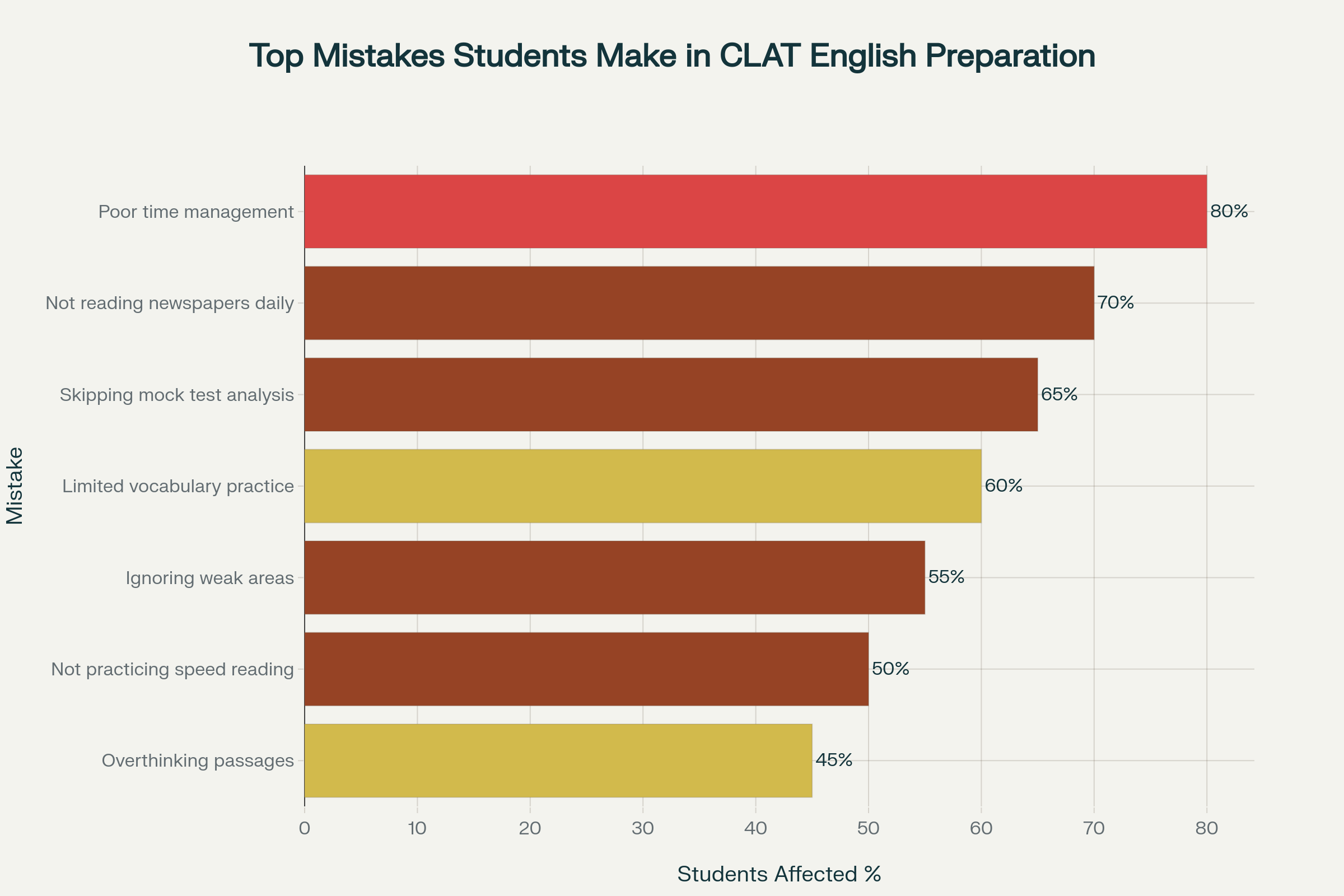
Common mistakes affecting CLAT English preparation
The 7 Critical Mistakes:
Mock Test Strategy: How to Use Tests Effectively
Regular mocks with proper analysis correlate with higher scores.
The Complete Mock Test Protocol:
When: One day before the test
- Light revision of key vocabulary and grammar rules
- Review previous mock mistakes once
- Get 7-8 hours sleep
- Keep light snacks and water ready
Duration: Strict 2 hours for full-length mock
- Simulate exam conditions
- Take the test at the same time as the actual exam
- Follow your planned time allocation
- Mark difficult questions for review
Duration: 90-120 minutes after the test
- Check answers and note score
- For each wrong answer, understand the reason
- Categorise mistakes
- Create an action plan
Next 6 days
- Work specifically on the mistake categories
- Practise timed sections if speed was the issue
- Add 5 extra words daily if vocabulary was weak
- Review the error log before the next mock
Mock Test Schedule Recommendation:
- Months 1-2: 1 sectional English mock every 2 weeks
- Months 3-4: 1 sectional mock weekly + 1 full mock monthly
- Months 5-6: 2-3 full mocks weekly
Success Stories: From Weakness to Strength
Real stories motivate better than generic advice.
Rahul Sharma – AIR 145, CLAT 2024
“I scored 35% in English in my Class 12 boards. Six months before CLAT, I could not read newspapers without feeling overwhelmed. I followed the daily routine. In my first mock, I scored 8/26. In CLAT, I scored 21/26 in English.”
Priya Menon – AIR 298, CLAT 2024
“English was my nightmare. With personalised guidance, I focused on inference skills. My scores jumped from 12 to 19.”
Arjun Patel – AIR 512, CLAT 2024
“Breaking the plan into phases made it manageable. By Month 4, I was enjoying reading. My score rose from 30% to 75% in mocks.”
Expert Tips from Lawgic Coaching: Professional Guidance
Lawgic Coaching has helped many students crack CLAT in recent years. Here are proven strategies for weak students.
7 Proven Strategies from Lawgic Experts:
- Join structured programmes with expert mentors
- Use personalised study plans tailored to your level
- Practise with CLAT-specific mock tests
- Seek regular feedback and doubt clearing
- Follow strategies used by successful toppers
- Use quality study material designed for step-by-step progress
- Stay motivated with peer groups and mentorship
Ready to Transform Your English Skills?
Lawgic CLAT Coaching offers comprehensive English modules, daily practice, mentoring, and unlimited doubts.
Explore Lawgic CLAT Coaching Programmes →Frequently Asked Questions (FAQs)
Common questions about CLAT English preparation for weak students.
Yes. Many students started weak and scored 18-22/26 with six months of structured practice. Focus on daily reading, vocabulary, and mocks.
Dedicate 3-4 hours daily across reading, passages, vocabulary, grammar, and revision. Start with 2 hours and scale up.
The Hindu and Indian Express editorials are ideal. Read 2-3 editorials daily and summarise the author’s perspective.
Measure WPM, then practise daily with timers. Avoid subvocalisation and regression. Aim for 300+ WPM.
Not mandatory, but helpful for weak basics. Structured plans and feedback save time.
Months 1-2: 10/day. Months 3-4: 15-20/day. Months 5-6: 5-7/day with heavy revision.
No sectional cutoff. Aim for ~75-80% accuracy in English.
Focus on the 10 core topics. Practise daily and take weekly quizzes.
Conclusion: Your Journey Starts Today
Transformation is a systematic six-month journey with discipline and the right strategy.
Your Action Plan for Next 7 Days:
- Day 1-2: Get the recommended books and set up your tools.
- Day 3: Create a vocabulary notebook and an error log.
- Day 4: Start the daily routine.
- Day 5-7: Continue and take a baseline comprehension test.
Key Metrics to Track Monthly:
- Vocabulary count
- Reading speed
- Mock test scores
- Grammar accuracy
- Daily study hours
Students who follow this roadmap with persistence improve English scores significantly in six months.
Need Expert Guidance for Your CLAT Journey?
Lawgic Coaching provides mentoring, structured plans, practice tests, and proven strategies.
Start Your Transformation with Lawgic →