
What if you could eliminate that daily confusion of “what should I read today?” with a single, repeatable Daily Reading Framework for CLAT Online Prep: How to Build a 90-Minute Digital Routine That Covers All Five Sections? That’s exactly what thousands of successful CLAT aspirants have done, and it’s what you’ll master by the end of this guide.
Your success is our mission, which is why we’re sharing this proven framework that our top scorers use daily. This isn’t another generic study plan—it’s a precise, digital-first routine that ensures you touch all five CLAT sections systematically without wasting a single minute.
Key Takeaways
- Structured 90-minute daily routine that covers English Language, Current Affairs, Legal Reasoning, Logical Reasoning, and Quantitative Techniques
- 18-minute focused blocks for each section with specific digital resources and reading strategies
- Elimination of decision fatigue through pre-planned daily reading lists and bookmarked sources
- Flexible framework that adapts to your schedule while maintaining consistency across all CLAT sections
- Digital-first approach using curated online resources, news portals, and practice platforms for maximum efficiency
Understanding the Five-Section Challenge in CLAT 2026
Let’s be honest about what you’re facing. The CLAT exam tests five distinct areas, each requiring different reading skills and knowledge bases. English Language demands comprehension speed, Current Affairs needs daily updates, Legal Reasoning requires analytical thinking, Logical Reasoning tests pattern recognition, and Quantitative Techniques calls for quick calculations.
Most aspirants make the mistake of randomly jumping between these sections or focusing too heavily on their comfort zones. But here’s what makes the difference: systematic daily exposure to all five areas through carefully curated digital content.
The beauty of building a Daily Reading Framework for CLAT Online Prep: How to Build a 90-Minute Digital Routine That Covers All Five Sections lies in its predictability. When you know exactly what to read each day, your brain can focus on learning instead of deciding.
Our expert faculty from top NLUs have observed that students who follow structured daily routines score 15-20% higher than those who study randomly. That’s the difference between getting into your dream NLU and settling for alternatives.
The 90-Minute Digital Framework: Section-by-Section Breakdown
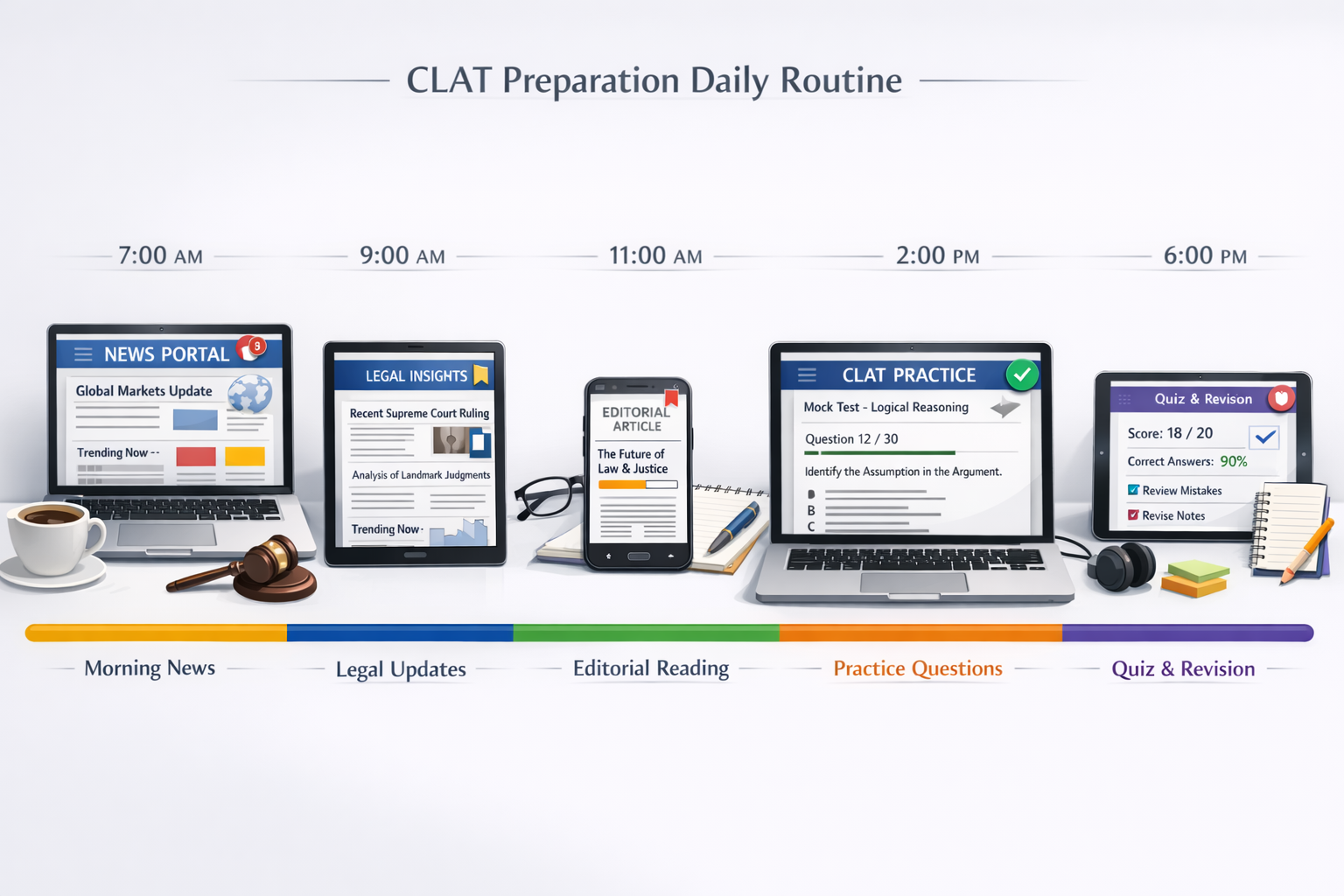
English Language (18 Minutes Daily)
Minutes 1-10: Comprehension Practice
Start with one 450-word passage from reputable sources like The Hindu editorials or Indian Express opinion pieces. Don’t just read—practice the proven techniques for reading CLAT passages that focus on speed and retention.
Minutes 11-18: Vocabulary and Grammar
Use digital flashcard apps like Anki or Quizlet for 5 new words daily. Spend the remaining 3 minutes on grammar rules through apps like Grammarly’s insights or dedicated grammar websites.
Pro tip: Bookmark 5-7 reliable editorial sources and rotate through them weekly. This prevents content fatigue while ensuring diverse writing styles.
Current Affairs and General Knowledge (18 Minutes Daily)
Minutes 19-28: Daily News Digest
Focus on legal news, Supreme Court judgments, and policy changes. Use curated sources like Live Law, Bar & Bench, or legal sections of major newspapers.
Minutes 29-36: Static GK Review
Alternate between Indian polity, history, and geography using digital resources. Apps like Unacademy or dedicated GK websites work perfectly here.
The key is consistency over intensity. Our students who follow this current affairs strategy without newspapers often outperform those who randomly browse news all day.
Legal Reasoning (18 Minutes Daily)
Minutes 37-46: Principle Application Practice
Read one legal principle and solve 2-3 related questions. Use online platforms that provide daily legal reasoning questions with explanations.
Minutes 47-54: Case Law Awareness
Spend these minutes reading summaries of recent Supreme Court or High Court judgments. Focus on understanding the legal principles rather than memorizing case names.
Avoid the common legal reasoning mistakes that trip up even bright students.
Logical Reasoning (18 Minutes Daily)
Minutes 55-64: Pattern Recognition
Practice 5-7 logical reasoning questions covering different types: syllogisms, blood relations, coding-decoding, or logical sequences.
Minutes 65-72: Analytical Reasoning
Focus on arrangement problems, logical puzzles, or critical reasoning passages. Use online platforms that provide instant feedback and explanations.
The secret sauce? Track your accuracy patterns. Most students improve dramatically when they identify their weak logical reasoning areas and target them specifically.
Quantitative Techniques (18 Minutes Daily)
Minutes 73-82: Formula Application
Practice 8-10 quick math problems covering arithmetic, algebra, and basic geometry. Focus on speed and accuracy rather than complex problem-solving.
Minutes 83-90: Mental Math Drills
Use apps like Vedic Math or practice percentage calculations, ratio problems, and basic statistics without a calculator.
Remember, CLAT math isn’t about advanced concepts—it’s about doing simple calculations quickly and accurately under pressure.
Creating Your Personalized Digital Reading Schedule
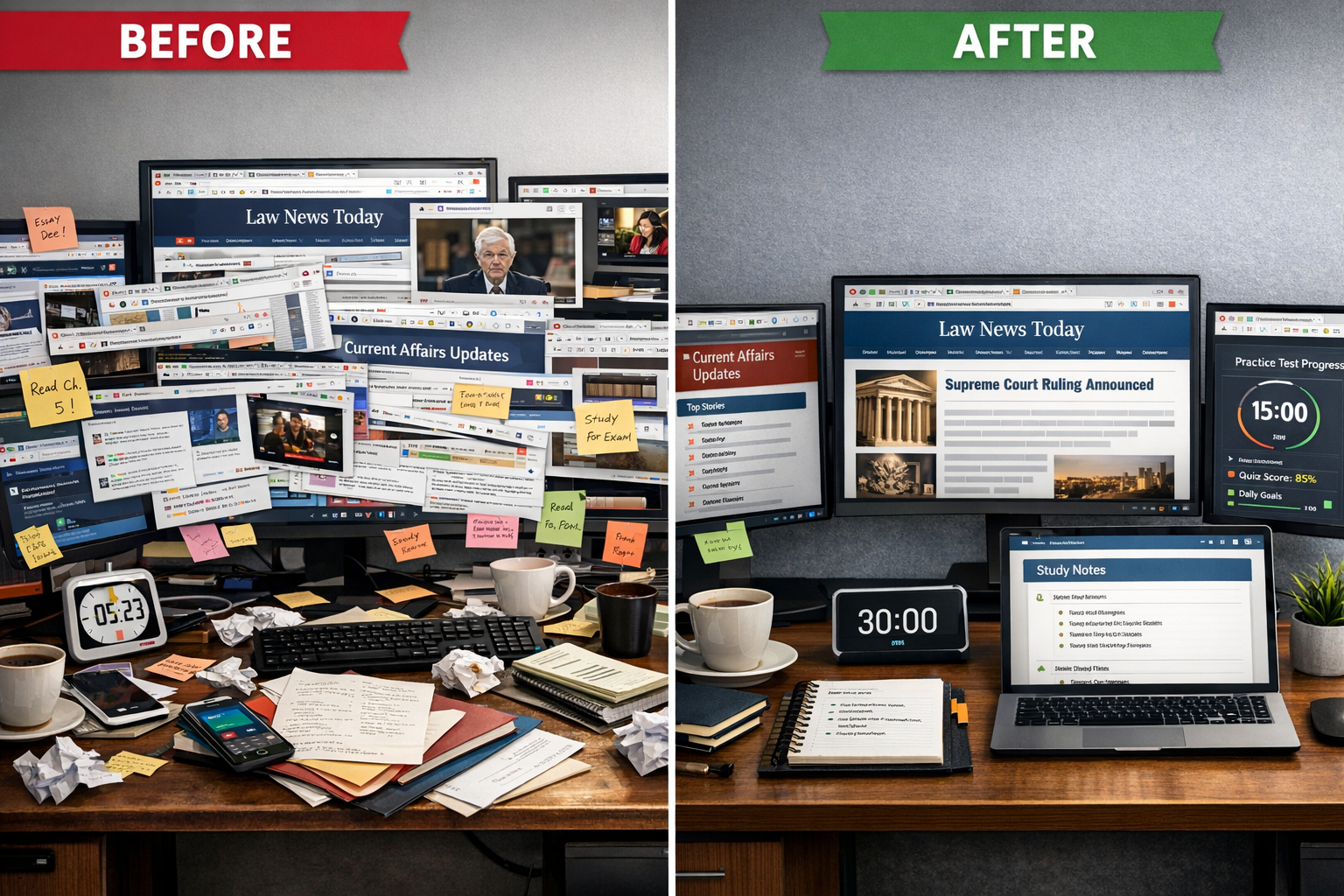
Building your Daily Reading Framework for CLAT Online Prep: How to Build a 90-Minute Digital Routine That Covers All Five Sections requires personalization. Here’s how to adapt this framework to your unique situation:
Morning Routine (6:00 AM – 7:30 AM)
Best for: Students who are fresh and alert in the morning
- Start with English comprehension when your mind is sharp
- Follow with current affairs to stay updated on overnight developments
- End with logical reasoning to activate analytical thinking
Evening Routine (7:00 PM – 8:30 PM)
Best for: Students who prefer studying after school/college
- Begin with quantitative techniques to warm up your brain
- Move to legal reasoning when you’re mentally active
- Finish with current affairs to wind down
Split Routine (45 minutes morning + 45 minutes evening)
Best for: Students with packed schedules
- Morning: English + Current Affairs + Legal Reasoning
- Evening: Logical Reasoning + Quantitative Techniques + Review
The flexibility of this framework means you can maintain consistency even during exam periods or when life gets hectic. That’s what we call accessible education for serious aspirants.
Digital Tools and Resource Curation
Essential Bookmarks for Your Browser:
- News Sources: The Hindu, Indian Express, Live Law, Bar & Bench
- Practice Platforms: Your coaching portal, free mock test sites
- Reference Materials: Legal dictionaries, GK databases, math formula sheets
- Productivity Tools: Timer apps, progress trackers, digital notebooks
Weekly Resource Rotation:
Don’t stick to the same sources every day. Rotate through different editorial writers, legal news portals, and practice question banks to ensure diverse exposure.
Progress Tracking:
Use simple spreadsheets or apps to track your daily completion rates, accuracy percentages, and areas needing improvement. This data becomes invaluable when you’re assessing your CLAT progress.
Optimizing Your Digital Environment for Maximum Efficiency
The difference between successful and struggling CLAT aspirants often comes down to how well they manage their digital study environment. Here’s how to set yourself up for success:
Browser Organization Strategies
Create separate browser profiles or bookmark folders for each section. When it’s time for current affairs, you should be able to access your curated news sources within seconds, not waste time searching through bookmarks.
Folder Structure:
- CLAT English (editorials, vocabulary tools, grammar resources)
- CLAT Current Affairs (news sites, legal updates, GK databases)
- CLAT Legal Reasoning (case law sites, principle databases, practice questions)
- CLAT Logical Reasoning (puzzle sites, practice platforms, solution guides)
- CLAT Quantitative Techniques (formula sheets, practice sites, calculator tools)
Distraction Management
Use website blockers during your 90-minute sessions. Apps like Cold Turkey or StayFocusd can block social media and entertainment sites, ensuring you stay focused on your Daily Reading Framework for CLAT Online Prep: How to Build a 90-Minute Digital Routine That Covers All Five Sections.
Speed Reading Development
Your success depends heavily on reading speed and comprehension. Practice the techniques outlined in our guide on improving reading speed for CLAT to maximize the value of your 90-minute sessions.
Troubleshooting Common Framework Challenges
“I Can’t Stick to the 18-Minute Limits”
This is normal initially. Start with 20-minute blocks and gradually reduce to 18 minutes as you become more efficient. The key is maintaining the sequence and covering all five sections daily.
“Some Days I Don’t Have 90 Minutes”
Create a condensed 45-minute version: 9 minutes per section. It’s better to maintain the habit with reduced time than to skip entirely.
“I’m Not Seeing Improvement”
Track your performance weekly, not daily. Improvement in CLAT preparation often comes in waves rather than linear progression. If you’re following a 6-month preparation timeline, trust the process.
“The Content Feels Repetitive”
Rotate your sources weekly. Use different editorial writers, legal news portals, and question banks to maintain freshness while preserving the structure.
Advanced Framework Modifications
Integration with Mock Tests
On mock test days, reduce your framework to 60 minutes (12 minutes per section) and use it as a warm-up before the full-length test. This keeps your daily routine intact while accommodating longer practice sessions.
Exam Proximity Adjustments
In the final month before CLAT, modify your framework to emphasize revision over new learning:
- English: Focus on speed reading practice
- Current Affairs: Review recent compilations
- Legal Reasoning: Revisit challenging principles
- Logical Reasoning: Practice question types you find difficult
- Quantitative Techniques: Speed drill on basic calculations
Weekend Intensive Sessions
Use weekends to go deeper into areas where your daily framework reveals weaknesses. If logical reasoning consistently challenges you, dedicate Saturday mornings to extended practice while maintaining your regular framework on other days.
Measuring Success and Making Adjustments
Weekly Performance Metrics
Track these indicators every week:
- Completion Rate: Percentage of days you completed the full 90-minute routine
- Section Accuracy: Performance on practice questions within each 18-minute block
- Speed Improvements: Time taken to complete reading tasks and solve problems
- Knowledge Retention: Weekly quiz scores on topics covered in your daily routine
Monthly Framework Reviews
Every month, evaluate and adjust:
- Which sections need more time allocation?
- Are your digital sources providing quality content?
- Is your reading speed improving consistently?
- Are you retaining current affairs information effectively?
This systematic approach to improvement is what separates top performers from average scorers. We’ve helped thousands crack CLAT using exactly these principles.
Seasonal Adjustments
Your framework should evolve with your preparation timeline:
- Early Preparation (8+ months out): Focus more on building reading habits and basic concept clarity
- Mid Preparation (4-8 months out): Emphasize speed and accuracy improvements
- Final Preparation (1-4 months out): Prioritize revision and maintaining peak performance levels
Integration with Comprehensive CLAT Preparation
Your Daily Reading Framework for CLAT Online Prep: How to Build a 90-Minute Digital Routine That Covers All Five Sections works best when integrated with other preparation elements:
Coordination with Coaching Classes
If you’re enrolled in online CLAT coaching, schedule your 90-minute routine to complement, not compete with, your class timings. Many students find early morning framework sessions prepare them better for evening classes.
Mock Test Integration
Use your daily framework performance to identify focus areas for weekend mock tests. If your 18-minute legal reasoning sessions consistently reveal gaps, prioritize legal reasoning questions in your next mock.
Revision Schedule Harmony
Your daily framework naturally creates spaced repetition across all sections. This makes your formal revision periods more effective because you’re reinforcing rather than relearning concepts.
Building Long-Term Success Habits
The real power of this framework extends beyond CLAT preparation. You’re building habits that will serve you throughout law school and your legal career:
Information Processing Skills
Daily practice with diverse content sources develops the information synthesis skills essential for legal research and case preparation.
Time Management Mastery
Managing five different subjects in 90 minutes teaches the time allocation skills you’ll need for law school exams and professional deadlines.
Consistent Learning Discipline
The habit of daily, structured learning becomes invaluable during law school’s demanding academic schedule.
Remember, this isn’t just about cracking CLAT—it’s about developing the learning systems that will make you successful throughout your legal education and career.
Conclusion
Your Daily Reading Framework for CLAT Online Prep: How to Build a 90-Minute Digital Routine That Covers All Five Sections is more than a study schedule—it’s your pathway to CLAT success without the confusion and overwhelm that derails so many aspirants.
The framework’s power lies in its simplicity and completeness. Eighteen minutes per section, five sections daily, 90 minutes total. No decision fatigue, no missed areas, no wasted time wondering what to study next.
Thousands of successful CLAT aspirants have used variations of this exact framework. They’ve gone from scoring 30s in mock tests to achieving 95+ percentiles, from feeling overwhelmed by CLAT’s scope to confidently tackling every section.
Your next steps are straightforward:
- Set up your digital environment with organized bookmarks and distraction blockers
- Choose your optimal timing (morning, evening, or split routine)
- Start tomorrow with the 18-minute section blocks
- Track your progress weekly and adjust as needed
- Stay consistent for at least 30 days to establish the habit
The difference between CLAT success and disappointment often comes down to having a system you can follow daily, regardless of motivation levels or external circumstances. This framework is that system.
Your law school dreams deserve a structured, proven approach. Let’s build your law career together with expert guidance without the premium price tag and flexible learning that fits your life.
Start your 90-minute routine tomorrow. Your future self—the one celebrating CLAT success and starting at your dream NLU—will thank you for taking action today.

