Last updated: May 3, 2026
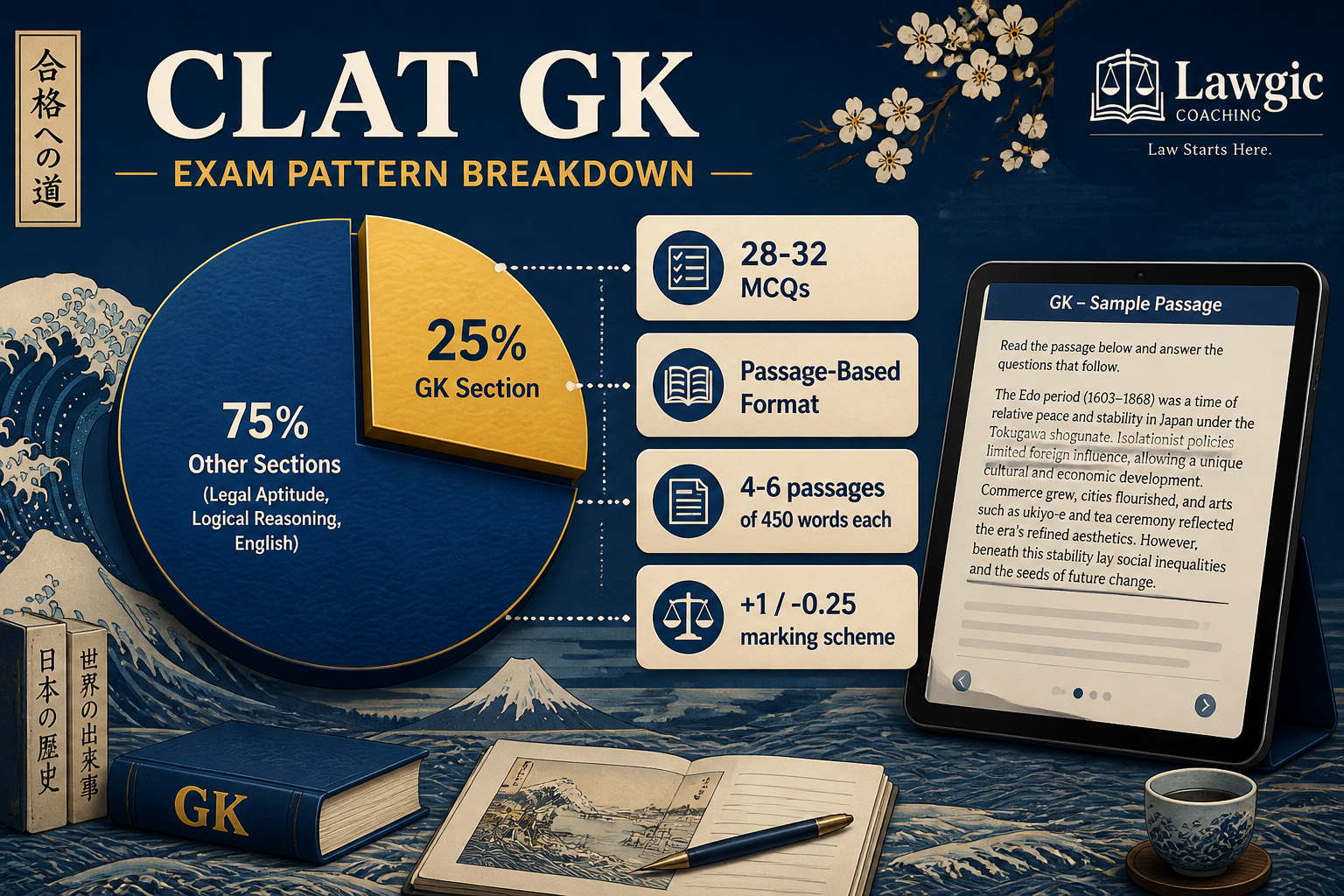
Quick Answer: CLAT GK questions are passage-based, context-driven questions that test your understanding of current events rather than rote factual recall. The GK section carries approximately 25% of the total CLAT paper (28-32 questions), and the best way to master it is through consistent daily reading, legal current affairs tracking, and practicing passage-based question formats. Start at least 6-12 months before the exam for best results.
Key Takeaways
- The CLAT GK section has 28-32 MCQs worth approximately 25% of the paper, with +1 for correct answers and -0.25 for wrong ones [4]
- Questions are passage-based, not factual recall. Expect 4-6 passages of roughly 450 words each, with 4-6 questions per passage [4]
- CLAT does not ask "What is the capital of X?" type questions. It tests contextual understanding through news-based passages [2]
- The section covers both Static GK and Current Affairs, with current affairs carrying significantly more weight in recent years [4]
- Legal current affairs (Supreme Court judgments, new amendments, landmark cases) are among the highest-priority topics
- Consistent daily reading from quality sources matters more than last-minute cramming
- Mock tests specifically designed for passage-based current affairs are essential for scoring well
- Psychological preparation and stress management directly affect GK retention and recall on exam day
What Exactly Are CLAT GK Questions and How Does the Section Work?
CLAT GK questions are not the trivia-style questions you might remember from school quizzes. They are passage-based, context-driven questions built around real news events, legal developments, and global affairs. The Consortium of NLUs designs these questions to test whether you understand the world around you, not just whether you memorized a list of facts.
Here is how the section breaks down [4][2]:
| Feature | Details |
|---|---|
| Number of Questions | 28-32 MCQs |
| Weightage | ~25% of total paper |
| Correct Answer | +1 mark |
| Incorrect Answer | -0.25 marks |
| Passage Length | ~450 words per passage |
| Passages Per Paper | 4-6 passages |
| Questions Per Passage | 4-6 questions |
| Difficulty Level | Moderate (with contextual preparation) |
What kinds of passages appear?
Passages are sourced from news articles, government reports, international event summaries, economic updates, and legal commentary [2]. You will not be asked to recall isolated facts. Instead, you will read a passage about, say, a recent Supreme Court judgment or a G20 summit outcome, and then answer questions that test your understanding of what happened, why it matters, and what it connects to.
Common mistake: Many aspirants prepare for CLAT GK like a general knowledge quiz show. That approach wastes time and misses marks. The exam rewards contextual understanding, not encyclopedic memory.
What Topics Do CLAT GK Questions Actually Cover?
The GK section is divided into two broad categories: Static GK and Current Affairs [4]. Both matter, but current affairs dominate the passage-based format of the modern CLAT paper.
Static GK Topics to Know
Static GK covers facts that do not change. These appear less frequently in passages now, but they provide the background knowledge that helps you understand current affairs passages better.
- History: Major events in Indian and world history, independence movement, constitutional history
- Geography: Physical and political geography of India, major rivers, mountain ranges, states and capitals
- Indian Polity: Constitutional provisions, fundamental rights, directive principles, amendment procedures
- General Science: Basic concepts in physics, chemistry, biology relevant to everyday news
- Art and Culture: Classical dance forms, UNESCO heritage sites, major festivals and their significance
- Economics Basics: GDP, inflation, monetary policy fundamentals
Current Affairs Topics That Appear Most in CLAT GK Questions
This is where most of your preparation time should go. Based on the Consortium's stated approach and past paper analysis [2][5]:
National Affairs:
- Budget highlights and Economic Survey summaries
- Major bills passed in Parliament and constitutional amendments
- Government schemes and welfare policies (with eligibility and objectives)
- Supreme Court judgments on significant constitutional and social issues
- Environmental policy and sustainable development initiatives
International Affairs:
- Outcomes of major summits: G20, G7, COP climate conferences, BRICS
- International treaties and trade agreements India is part of
- Conflicts and geopolitical developments affecting India
- Key international organizations: UN, WTO, WHO, IMF, World Bank
Legal Current Affairs (High Priority):
- Landmark Supreme Court decisions
- New statutory instruments and ordinances
- Constitutional amendments and their implications
- Contemporary legal debates covered in mainstream media [5]
Other Important Areas:
- Awards and honors (national and international)
- Appointments and resignations of key officials
- Sports news with national significance
- Space missions (ISRO and global agencies)
- Scientific and technological developments
- Global indices where India features (Human Development Index, Ease of Doing Business, Press Freedom Index)
For a deeper look at how to balance static and current affairs in your preparation, check out this guide on static vs current affairs in CLAT GK.
How Should You Study Current Affairs for CLAT Every Day?
Consistent daily reading beats intensive weekend cramming every single time. Here is a practical daily routine that works for serious aspirants.
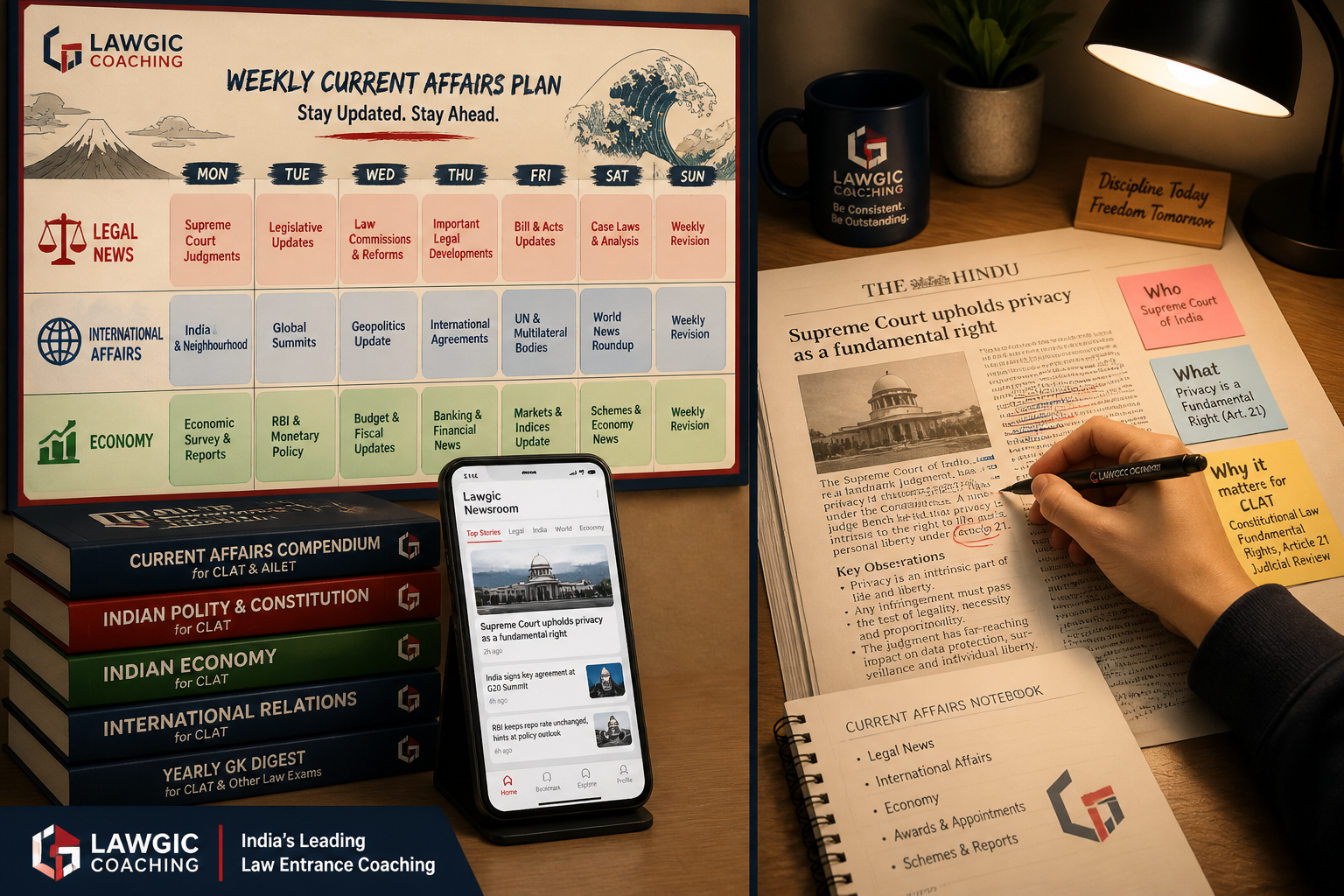
The 45-Minute Daily Current Affairs Routine
Step 1: Morning News Scan (15 minutes)
Pick one reliable source (The Hindu, Indian Express, or a curated CLAT current affairs digest) and scan the top stories. You are not reading every article. You are identifying which stories are CLAT-relevant.
Step 2: Deep Read on 2-3 Key Stories (20 minutes)
For stories that touch legal affairs, government policy, international relations, or major events, read in depth. Ask yourself:
- What happened?
- Who are the key stakeholders?
- What is the legal or policy angle?
- Why would CLAT examiners find this passage-worthy?
Step 3: Note the Context, Not Just the Fact (10 minutes)
Write a 3-4 line summary in your own words. This is the most important step. CLAT GK questions test contextual understanding, so your notes should capture the background and implications of an event, not just the headline.
What to do on weekends:
- Review the week's notes
- Attempt 1-2 passage-based practice sets
- Connect related stories (for example, link a Supreme Court judgment to the constitutional provision it interprets)
Weekly and Monthly Review System
| Frequency | Activity |
|---|---|
| Daily | 45-minute news reading and note-making |
| Weekly | Review notes, attempt practice passages, connect themes |
| Monthly | Compile a topic-wise summary, identify gaps, revise |
| Every 3 months | Full mock test including GK section, analyze errors |
For aspirants who struggle to find time for daily newspapers, there is a practical alternative approach covered in this guide on mastering CLAT current affairs without daily newspapers.
What Are the Best Sources for CLAT GK Preparation?
Choosing the right sources saves hours every week. Here is what actually works, ranked by usefulness for CLAT specifically.
Tier 1: Must-Use Sources
-
The Hindu / Indian Express: Best for legal affairs, Supreme Court coverage, policy analysis, and international news. Read the editorial and national sections daily.
-
PIB (Press Information Bureau): Official government press releases. Essential for government schemes, policy announcements, and budget summaries. Free and reliable.
-
Lawgic Coaching's Current Affairs Digests: Curated specifically for CLAT aspirants, so you get only what is relevant. Expert guidance without the premium price tag.
-
CLAT-specific monthly magazines: Several publishers release monthly current affairs booklets tailored to law entrance exams. These are time-efficient for revision.
Tier 2: Supplement With These
-
PRS Legislative Research (prsindia.org): For bills, amendments, and parliamentary developments. Excellent for understanding the context behind legislative changes.
-
Supreme Court of India website: For recent judgment summaries. You do not need to read full judgments. A 2-3 paragraph summary of the key holding is enough.
-
Yojana and Kurukshetra magazines: For government schemes, rural development, and social policy topics.
-
AI-powered news aggregators: Tools like Feedly or Google News, set up with custom feeds for Indian legal news, Supreme Court, and CLAT-relevant topics, can save significant time. Set up keyword alerts for "Supreme Court judgment," "Parliament bill passed," and "India foreign policy."
What to Avoid
- Random WhatsApp forwards and unverified GK lists: These often contain outdated or incorrect information.
- Memorizing static GK lists without context: Dates and names without understanding their significance will not help with passage-based questions.
- Overdependence on a single source: Cross-referencing two sources ensures accuracy and gives you multiple angles on the same event.
For a detailed comparison of books and resources, see the expert guide to CLAT GK books.
How Do Passage-Based CLAT GK Questions Actually Work? (With Examples)
Understanding the question format is half the battle. Let's be honest: many aspirants lose marks not because they lack knowledge, but because they do not understand how to read and respond to passage-based current affairs questions.
The Anatomy of a CLAT GK Passage
A typical passage in the GK section:
- Is approximately 450 words long [4]
- Is written in a journalistic or analytical style
- Contains background context, key facts, and often a policy or legal angle
- Is followed by 4-6 questions
The questions typically ask you to:
- Identify the main idea or central theme of the passage
- Infer the implications of an event described
- Identify which statement is supported or contradicted by the passage
- Apply information from the passage to a related scenario
- Identify the correct factual detail as stated in the passage
Sample Question Type (Illustrative)
Passage theme: A recent Supreme Court judgment on the right to privacy and data protection.
Question: Based on the passage, which of the following best describes the Court's reasoning for extending the right to privacy to digital communications?
This question tests whether you understood the Court's rationale, not just the outcome. You cannot answer it from a one-line fact. You need to have read the passage carefully and understood the argument.
Key skill: Read passages for the "why" and "so what," not just the "what." [2]
How to Approach a GK Passage in the Exam
- Read the questions first (30 seconds): Know what you are looking for before you read.
- Read the passage actively (2-3 minutes): Underline key claims, names, and causal links.
- Answer directly from the passage: Do not bring in outside knowledge that contradicts the passage's stated position.
- Use elimination: For inference questions, eliminate options that go beyond what the passage states.
For more on handling long passages efficiently, the guide on how to read 450-word CLAT passages has specific techniques that work.
What Is the Best Preparation Strategy for CLAT GK Questions? (Month-by-Month Plan)
A structured timeline prevents the panic that sets in when aspirants realize they have six months of current affairs to cover with two months left. Here is a realistic plan.
12 Months Before the Exam
- Start daily current affairs reading immediately. Do not wait until you feel "ready."
- Build your source list and set up your note-taking system.
- Cover static GK topics systematically: one topic per week (Indian Polity, History, Geography, etc.)
- Begin reading The Hindu editorial daily to build analytical reading habits.
6-9 Months Before the Exam
- Increase current affairs depth. Start tracking legal news specifically.
- Attempt passage-based practice questions weekly.
- Build a topic-wise current affairs file: separate sections for legal, economic, international, environmental.
- Take one full-length mock test per month and analyze GK section performance.
3-6 Months Before the Exam
- Compile monthly current affairs summaries and revise older months.
- Increase mock test frequency to bi-weekly.
- Focus on connecting events across topics (for example, how a new environmental law connects to a recent Supreme Court order).
- Identify your weak topic areas from mock analysis and address them specifically.
Final 3 Months
- Revise compiled notes rather than reading new sources extensively.
- Attempt at least 2 full-length mocks per week.
- Practice timed passage reading to build speed and accuracy.
- Cover the last 12-18 months of current affairs comprehensively.
For a complete strategy guide, see Lawgic Coaching's ultimate CLAT GK strategy for 2026.
What Are the Most Common Mistakes in CLAT GK Preparation?
Knowing what not to do saves as much time as knowing what to do. These are the mistakes that consistently hold aspirants back.
Mistake 1: Treating CLAT Like a General Knowledge Quiz
Memorizing lists of capitals, currencies, and national animals is not how CLAT GK works. The exam tests contextual understanding through passages. Every hour spent on rote memorization of static facts is an hour not spent on contextual current affairs reading.
Fix: Spend 70% of your GK preparation time on current affairs with context, 30% on static GK as background knowledge.
Mistake 2: Starting Current Affairs Preparation Too Late
Current affairs for CLAT covers roughly the last 12-18 months before the exam. Starting three months before means you have a massive backlog to clear under pressure.
Fix: Start daily reading at least 12 months before your target exam date. If you have a backlog already, the CLAT GK backlog clearance guide has a step-by-step recovery plan.
Mistake 3: Reading Without Retention Systems
Reading the news every day without a note-taking system means most of what you read is forgotten within a week.
Fix: Use the "3-line context summary" method. After reading any CLAT-relevant story, write: (1) What happened, (2) Why it happened, (3) What it means for law, policy, or society.
Mistake 4: Ignoring Legal Current Affairs
Many aspirants focus on general news and neglect the legal current affairs that CLAT specifically emphasizes. Supreme Court judgments, new bills, and constitutional developments are high-yield topics. [5]
Fix: Dedicate at least 15 minutes per day specifically to legal news. Follow Supreme Court judgment summaries from reliable sources.
Mistake 5: Skipping Mock Tests for the GK Section
Some aspirants practice Logical Reasoning and Legal Reasoning extensively but treat GK as something to "just read for." Without timed passage practice, exam-day performance suffers.
Fix: Attempt full GK section mocks regularly. Analyze which passage types give you trouble and practice those specifically.
Mistake 6: Neglecting Psychological Preparation
Exam anxiety directly affects recall. Students who have strong content knowledge but poor stress management often underperform in the GK section because they second-guess answers or lose focus mid-passage.
Fix: Build a pre-exam routine that includes brief mindfulness or breathing exercises. For comprehensive strategies, the CLAT exam anxiety guide covers this in depth.
How Do Successful CLAT Candidates Approach Legal Current Affairs?
Legal current affairs is the area where CLAT GK questions most directly connect to the nature of the exam itself. It is also where many aspirants underinvest their preparation time.
What "Legal Current Affairs" Actually Means for CLAT
It is not just Supreme Court judgments. It includes:
- Landmark constitutional cases: Decisions that interpret fundamental rights, federalism, or separation of powers
- Recent amendments: Changes to major statutes (IPC, CrPC, now BNS/BNSS, Companies Act, etc.)
- New legislation: Bills passed in Parliament, especially those with social or economic impact
- Government ordinances: Executive actions with legal force
- International legal developments: Treaties India has signed, decisions by international courts relevant to India
- Legal debates in media: Issues like bail reform, sedition law, LGBTQ+ rights, environmental law that receive sustained media coverage [5]
How to Track Legal Current Affairs Efficiently
- Follow the Supreme Court's official website for recent judgment summaries
- Use PRS Legislative Research for bill tracking
- Read legal news sections in The Hindu and Bar and Bench (for court-specific coverage)
- Set up Google News alerts for "Supreme Court India," "Parliament bill 2026," and "constitutional amendment"
Here is the thing: you do not need to understand every legal nuance. You need to understand the context, the parties involved, the core issue, and the outcome. That is what CLAT passages will test.
For a broader look at legal topics that matter for CLAT, the guide on 7 ultimate CLAT legal topics for 2026 success is worth bookmarking.
How Can Technology Help You Track Current Affairs More Efficiently?
Smart use of tools can cut your daily preparation time significantly without reducing quality.
AI-Powered Current Affairs Tracking
- Google Alerts: Set up free alerts for keywords like "Supreme Court judgment," "India foreign policy," "Parliament session 2026," and "CLAT current affairs." Relevant stories arrive in your inbox daily.
- AI summarization tools: Tools like Perplexity AI or similar platforms can summarize long news articles quickly. Use them to get the key points of complex stories, then read the full article only if the topic is high-priority.
- Feedly or Inoreader: RSS feed aggregators that let you follow multiple news sources in one place. Create a "CLAT GK" folder with your top 5-6 sources.
Digital Note-Taking for Current Affairs
- Notion or Google Docs: Create a topic-wise current affairs database. Use tags like "Legal," "International," "Economy," "Environment." This makes revision dramatically faster.
- Anki (flashcard app): For static GK facts that need memorization, spaced repetition flashcards are far more effective than re-reading notes.
- Voice memos: If you commute, record 2-3 minute summaries of the day's key stories. Listening back reinforces retention.
The 80/20 Rule for Current Affairs Sources
You do not need to read everything. Roughly 80% of CLAT GK questions come from a predictable set of topic areas. Focus your source consumption on:
- 1 national newspaper (daily)
- 1 legal news source (3-4 times per week)
- 1 government source like PIB (weekly)
- 1 monthly CLAT-specific digest (monthly revision)
That combination covers the vast majority of what actually appears in the exam.
Revision and Retention Techniques That Actually Work for CLAT GK
Reading is only half the job. Retention is what converts reading time into exam marks.
The Feynman Technique for Current Affairs
After reading about a major event or judgment, close your notes and explain it out loud as if you are teaching a friend who knows nothing about it. If you cannot explain it simply, you have not understood it well enough to answer passage-based questions about it.
Spaced Repetition for Static GK
Static GK facts (constitutional articles, historical dates, geographical features) respond well to spaced repetition. Review new information after 1 day, then 3 days, then 1 week, then 1 month. Apps like Anki automate this scheduling.
Theme-Based Revision
Rather than reviewing current affairs chronologically, revise by theme. Spend one revision session on "all Supreme Court judgments from the last 12 months," another on "all major international summits," another on "government schemes announced in 2025-2026." This builds the connected understanding that CLAT passages reward.
The "Passage Preview" Method
Take a current affairs topic you have studied and try writing a 200-word passage about it yourself, then create 3 questions from it. This exercise forces you to think like an examiner and dramatically improves your ability to answer passage-based questions.
For a complete revision system, the ultimate CLAT revision mastery guide covers spaced repetition, active recall, and exam-week revision schedules in detail.
Frequently Asked Questions About CLAT GK Questions
Q: How many questions are in the CLAT GK section?
The CLAT GK section typically has 28-32 MCQs, representing approximately 25% of the total paper. Questions are passage-based, with 4-6 passages of roughly 450 words each. [4]
Q: Does CLAT ask static GK questions or only current affairs?
Both. The section is divided into Static GK (historical events, geography, polity) and Current Affairs (recent events from the last 12-18 months). Current affairs dominate the passage-based format in recent years. [4]
Q: How far back should current affairs preparation go for CLAT 2026?
Cover at least the last 18 months comprehensively. For CLAT 2026, that means events from approximately mid-2024 through the exam date in December 2025 or early 2026, depending on the notification schedule.
Q: Is The Hindu enough for CLAT current affairs preparation?
The Hindu is an excellent primary source, especially for legal, political, and international affairs. But supplement it with PIB for government schemes and a legal news source like Bar and Bench or PRS for legislative tracking. One source is rarely enough on its own.
Q: How much time should I spend on GK preparation daily?
45-60 minutes daily is sufficient if the time is used efficiently: reading with context, note-making, and weekly revision. Quality of reading matters more than hours spent.
Q: Do CLAT GK questions repeat from previous years?
Topics repeat (Supreme Court, government schemes, international relations) but specific questions do not. Studying previous year papers helps you understand the format and topic emphasis, not predict specific questions. [7]
Q: What is the negative marking in the CLAT GK section?
Each correct answer earns +1 mark. Each incorrect answer deducts 0.25 marks. Unattempted questions carry no penalty. [4]
Q: Can I prepare for CLAT GK without reading newspapers daily?
Yes, with the right alternative sources: monthly current affairs digests, curated CLAT-specific resources, and AI news aggregators. It requires more discipline in source selection but is entirely achievable. See this guide for details.
Q: Which legal topics are most important for CLAT GK?
Supreme Court judgments on constitutional rights, major new legislation (especially criminal law reforms), environmental law developments, and international legal agreements involving India. [5]
Q: How do I avoid losing marks to negative marking in the GK section?
Attempt questions where you are reasonably confident based on the passage content. For inference questions, stay strictly within what the passage states. Avoid guessing on questions where you have no basis for choosing between options.
Q: Should I make handwritten notes or digital notes for current affairs?
Either works. The key is having a searchable, topic-organized system you actually review regularly. Digital notes (Notion, Google Docs) are easier to search and revise. Handwritten notes may aid initial retention for some learners.
Q: How important are international affairs for CLAT GK?
Very important. The Consortium explicitly includes global issues from major summits, international organizations, and geopolitical developments. Expect at least 1-2 passages with an international affairs angle in most CLAT papers. [5]
Conclusion: Your Action Plan for Mastering CLAT GK Questions
Mastering CLAT GK questions is not about knowing everything. It is about knowing the right things, understanding them in context, and being able to read and respond to passage-based questions under time pressure.
Here is what to do starting today:
- Set up your daily reading routine. 45 minutes, consistent sources, context-focused note-making.
- Prioritize legal current affairs. Supreme Court judgments, new legislation, and constitutional developments are high-yield areas.
- Practice passage-based questions weekly. Reading without practice does not build exam skills.
- Build a revision system. Theme-based monthly reviews prevent knowledge decay.
- Use technology smartly. Google Alerts, RSS aggregators, and AI summarization tools save time without cutting quality.
- Take care of your mental preparation. Stress management and consistent sleep directly affect recall on exam day.
Your success is our mission at Lawgic Coaching. We have helped thousands of aspirants crack CLAT with proven strategies that actually work, real mentors from top NLUs, and personalized attention you deserve. No cookie-cutter approach here.
If you want a personalized current affairs strategy built around your timeline and starting point, connect with our team and let's build your law career together.
And if you are looking for a complete picture of the CLAT exam beyond just GK, the ultimate CLAT exam questions guide for 2026 covers every section in detail.
Results speak louder than promises. Start today.