
The air around CLAT aspirants is buzzing, and it’s not just the usual pre-exam jitters. There’s a new kind of anticipation, a nervous energy surrounding the significant shifts in the CLAT 2026 examination, particularly concerning the Logical Reasoning section. You’ve heard the whispers, seen the headlines, and perhaps even felt a pang of worry about the CLAT 2026 Logical Reasoning pattern change. It’s often referred to as the “Puzzle Shock,” and for good reason. This isn’t just a minor tweak; it’s a fundamental reimagining of what the Consortium expects from aspiring legal minds.
For years, Logical Reasoning in CLAT meant a specific set of skills: syllogisms, blood relations, seating arrangements, coding-decoding, and a smattering of critical reasoning. But for CLAT 2026, the game has changed entirely. The focus has decisively shifted towards critical reasoning, inference-based questions, and a deeper engagement with text. This means less emphasis on purely analytical puzzles and more on your ability to dissect arguments, identify assumptions, evaluate conclusions, and understand complex logical structures embedded within lengthy passages. It’s a challenge, yes, but it’s also an opportunity to truly distinguish yourself.
Here at Lawgic Coaching, we understand that changes like these can feel daunting. But remember, your success is our mission. We’re here to break down exactly what this CLAT 2026 Logical Reasoning pattern change entails, why it happened, and most importantly, how you can not only adapt but thrive in this new landscape. Consider us your experienced mentors, ready to guide you through every twist and turn.
Key Takeaways
- Significant Shift: The CLAT 2026 Logical Reasoning pattern change marks a definitive move away from traditional analytical puzzles (like syllogisms, arrangements) towards critical reasoning and inference-based questions.
- Emphasis on Comprehension: Success now hinges on your ability to deeply comprehend passages, identify premises and conclusions, spot assumptions, and evaluate arguments.
- Time Management Critical: Longer passages and complex reasoning demand enhanced reading speed and efficient logical deduction under pressure.
- New Preparation Strategy: Aspirants must pivot their study plans to focus heavily on practicing critical reasoning question types, reading diverse texts, and understanding logical fallacies.
- Lawgic Coaching’s Role: We offer specialized, flexible learning that fits your life, providing expert guidance and proven strategies tailored to this new pattern.
Unpacking the ‘Puzzle’ Shock: The CLAT 2026 Logical Reasoning Pattern Change
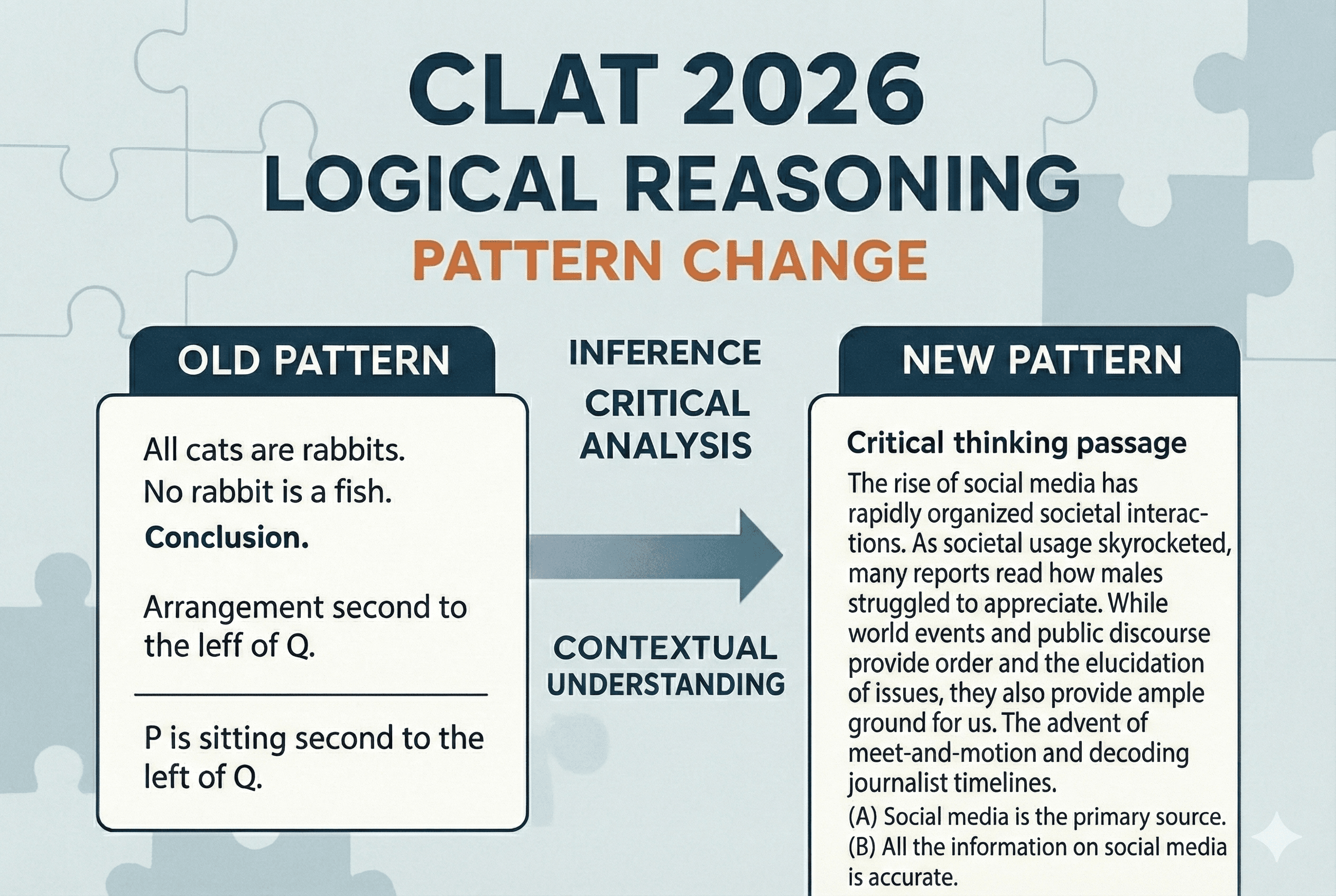
The term “Puzzle Shock” truly captures the essence of what many aspirants felt when the extent of the CLAT 2026 Logical Reasoning pattern change became clear. For years, the Logical Reasoning section was predictable. You’d practice a certain type of question, master its mechanics, and feel confident walking into the exam. Now, the goalposts have moved, and the playing field looks different.
The Old Guard vs. The New Paradigm
To truly appreciate the magnitude of this shift, let’s briefly look at what Logical Reasoning used to be and what it has become.
The Traditional CLAT Logical Reasoning (Pre-2025):
- Focus: Primarily analytical and deductive reasoning.
- Question Types: Syllogisms, coding-decoding, blood relations, direction sense, seating arrangements, linear and circular arrangements, puzzles, input-output, series, analogies, and a smaller component of critical reasoning.
- Skills Tested: Your ability to follow rules, identify patterns, and apply logical principles in structured scenarios. These were often self-contained problems that required careful step-by-step deduction.
- Preparation Approach: Mastering specific problem-solving techniques for each puzzle type.
The CLAT 2026 Logical Reasoning Pattern Change: A Critical Shift
- Focus: Overwhelmingly on critical reasoning, inference, argument analysis, and contextual understanding.
- Question Types: Passages of 300-450 words, each followed by a series of questions. These questions assess your ability to:
- Identify the main point or conclusion of an argument.
- Recognize premises and supporting evidence.
- Spot underlying assumptions.
- Evaluate the strength or weakness of an argument.
- Draw logical inferences and conclusions from given information.
- Identify logical fallacies.
- Understand the function of a part of the argument.
- Identify parallel reasoning.
- Skills Tested: This new format demands sophisticated reading comprehension, the ability to discern subtle meanings, critical evaluation of presented information, and rapid identification of logical structures within verbose texts. It’s about understanding why an argument works or fails, not just if it fits a pattern.
- Preparation Approach: Deep dives into reading comprehension strategies, extensive practice with argument-based questions, developing critical thinking, and broad exposure to various subjects (philosophy, economics, social sciences, current affairs).
You can see the difference, right? It’s like moving from solving a jigsaw puzzle with a clear picture to analyzing a complex abstract painting and explaining its underlying message. This isn’t just about speed; it’s about depth of thought.
Why the Change? The Consortium’s Vision
The Consortium for CLAT doesn’t make these changes lightly. The move towards an inference-heavy, critical reasoning-focused Logical Reasoning section for CLAT 2026 is deliberate, and it reflects a broader vision for legal education.
- Alignment with Legal Practice: Modern legal practice isn’t about solving simple puzzles. It’s about analyzing complex cases, understanding intricate legal arguments, dissecting evidence, identifying precedents, and constructing persuasive arguments. This new pattern much more accurately mirrors the daily demands on a lawyer. A lawyer needs to read dense legal texts, identify the crux of an argument, and understand its implications. This section now directly tests those foundational skills.
- Evaluating Higher-Order Thinking: Traditional puzzles, while requiring logic, often tested a more procedural type of intelligence. The new format assesses higher-order thinking skills: analysis, synthesis, evaluation, and inference. These are the cognitive abilities essential for success in a top National Law University (NLU) and beyond.
- Reducing Rote Learning: The old pattern could, to some extent, be ‘gamed’ by memorizing specific problem types and solution steps. The new format largely eliminates this, as each passage presents a unique challenge, requiring genuine comprehension and critical engagement. There’s no cookie-cutter approach here.
- Standardizing Analytical Skills: By focusing on a uniform critical reasoning format, the Consortium aims to assess a common set of analytical skills that are universally applicable and crucial for legal studies, rather than a fragmented set of specific puzzle-solving abilities.
- International Benchmarking: Many top-tier law entrance exams globally, such as the LSAT in the US, heavily emphasize critical reasoning. This change could also be seen as an effort to align CLAT more closely with international standards for legal aptitude testing.
“The CLAT 2026 Logical Reasoning pattern change isn’t a curveball; it’s a strategic move to find the sharpest legal minds.”
This transition might feel like a hurdle, but it’s fundamentally about preparing you better for law school. It challenges you to think like a lawyer before you even step into a classroom. For more insights on the broader exam, you might want to check out our CLAT 2026 study strategy: your ultimate guide to success.
What Does This Mean for You, the CLAT Aspirant?
The implications of this CLAT 2026 Logical Reasoning pattern change are significant for every aspirant.
- Rethink Your Preparation: If your study plan still heavily features traditional analytical puzzles, it’s time for a major overhaul. The vast majority of your Logical Reasoning preparation must now focus on critical reasoning.
- Focus on Reading Comprehension: Your ability to read quickly, understand deeply, and retain information from complex passages is now paramount. This isn’t just for the English section anymore; it’s central to Logical Reasoning.
- Develop Critical Thinking: You can’t just ‘solve’ these problems; you need to ‘think through’ them. This means actively questioning what you read, identifying biases, and understanding the interplay of ideas.
- Practice, Practice, Practice: There’s no substitute for consistent practice with the new question types. Exposure to a wide variety of critical reasoning passages will build your intuition and speed.
- Mocks are More Important Than Ever: Taking full-length mock tests under timed conditions will be crucial to adapting to the new format and managing your time effectively. This will help you in boosting your CLAT readiness with CLAT mock tests.
It’s natural to feel a bit overwhelmed by such a substantial change. But remember, every aspirant is in the same boat. What will set you apart is how strategically and effectively you adapt. And that’s exactly where Lawgic Coaching comes in – we’re dedicated to providing you with the personalized attention you deserve.
Mastering the New Landscape: Strategies for the CLAT 2026 Logical Reasoning Pattern
Now that we understand the ‘why’ behind the CLAT 2026 Logical Reasoning pattern change, let’s dive into the ‘how.’ How do you prepare effectively for this new challenge? It requires a shift in mindset and a disciplined approach to your studies. We’ve helped thousands crack CLAT, and these proven strategies that actually work are designed to guide you.
1. Cultivate Superior Reading Comprehension
This is the bedrock of success in the new Logical Reasoning section. You cannot analyze an argument if you don’t fully understand the passage.
- Read Widely and Deeply: Don’t just stick to current affairs. Read editorials, opinion pieces, philosophical essays, scientific articles, and excerpts from books on diverse subjects. The more varied your reading, the better you’ll become at understanding different writing styles, complex vocabulary, and intricate arguments.
- Active Reading Techniques: Don’t just passively read. Engage with the text:
- Highlight/Underline Key Information: Identify the main conclusion, supporting premises, and any counterarguments.
- Annotate: Jot down notes in the margins (if practicing with physical copies) or mentally summarize paragraphs. Ask yourself: “What is the author trying to convince me of?” “What evidence are they providing?”
- Summarize: After reading a passage, try to summarize its main argument in your own words. This confirms your understanding.
- Speed Reading with Comprehension: Practice reading faster without sacrificing understanding. Start with simpler texts and gradually move to more complex ones. Remember, it’s not just about how fast you read, but how much you absorb. This skill will also significantly help you with the CLAT 2026 English section.
2. Deconstruct Arguments Like a Detective
The core of critical reasoning is argument analysis. You need to be able to pull an argument apart and examine its components.
- Identify the Conclusion: This is the main point the author is trying to prove. Look for indicator words like “therefore,” “thus,” “consequently,” “so,” “it follows that,” “hence,” “clearly,” “as a result.” Sometimes, the conclusion might be implied or presented first.
- Identify the Premises: These are the statements or evidence provided to support the conclusion. Look for words like “because,” “since,” “for,” “given that,” “as.”
- Uncover Assumptions: This is often the trickiest part. Assumptions are unstated premises that must be true for the conclusion to logically follow from the premises. They are the missing links in the argument. Practice thinking: “What else has to be true for this conclusion to be valid, even if the author didn’t say it?”
- Spot Weaknesses and Strengths: Once you’ve identified the conclusion, premises, and assumptions, you can evaluate the argument.
- Is the evidence relevant?
- Is it sufficient?
- Are there any logical gaps?
- Does the conclusion overstate what the premises support?
- Are there alternative explanations?
- Recognize Logical Fallacies: Familiarize yourself with common errors in reasoning. Knowing about “ad hominem,” “straw man,” “false dilemma,” “hasty generalization,” or “correlation vs. causation” can help you quickly spot flawed arguments.
3. Practice, Practice, Practice the Right Way
Mere quantity of practice won’t suffice; it needs to be targeted and analytical.
- Source High-Quality Questions: Look for critical reasoning questions from sources like LSAT Logical Reasoning sections (though the difficulty might be higher, the type of thinking is similar), GMAT Critical Reasoning, and of course, CLAT-specific mock tests designed for the new pattern. Lawgic Coaching provides extensive, updated practice materials tailored to the CLAT 2026 Logical Reasoning pattern change.
- Focus on ‘Why’: After attempting a question, don’t just check if your answer is right or wrong. Understand why the correct answer is correct and why the incorrect answers are wrong. This analytical review is where the real learning happens.
- Timed Practice: As you get more comfortable, start practicing under timed conditions. Time management is crucial, as longer passages mean less time per question. Aim to read and comprehend efficiently, then apply your logical skills quickly.
- Review Mistakes Thoroughly: Maintain an error log. Note down the type of question you got wrong, why you got it wrong, and the correct reasoning. This helps identify your recurring weaknesses.
4. Develop a Strategic Approach to Passages
When you encounter a Logical Reasoning passage in the exam, a systematic approach can save you valuable time.
- Read the Passage First: Get a good grasp of the main argument. Don’t jump to questions immediately. Understand the flow of ideas.
- Identify the Conclusion and Premises: As discussed above, quickly pinpoint these. You might even mentally note assumptions.
- Read the Question Stem Carefully: Each question asks for something specific (e.g., “strengthen,” “weaken,” “identify assumption,” “infer,” “main point”). Understand exactly what is being asked.
- Evaluate Answer Choices:
- Eliminate Obvious Irrelevancies: Many answer choices will be clearly off-topic or introduce new information not mentioned in the passage.
- Be Wary of Extremes: Choices with words like “always,” “never,” “all,” “none” are often incorrect, as arguments rarely make such sweeping claims.
- Focus on Scope: Ensure the answer choice directly addresses the question and stays within the scope of the passage’s argument.
- Test Assumptions: If asked to identify an assumption, try negating the answer choice. If negating it destroys the argument, it’s likely a correct assumption.
- Don’t Bring Outside Knowledge: Base your answers only on the information provided in the passage. Your personal opinions or external knowledge are irrelevant.
5. Leverage Expert Guidance and Resources
Navigating such a significant change alone can be overwhelming. This is where expert guidance becomes invaluable.
At Lawgic Coaching, we pride ourselves on being your CLAT Success Partner. We offer:
- Updated Curriculum: Our courses are immediately updated to reflect the CLAT 2026 Logical Reasoning pattern change. We provide materials and practice questions specifically designed for the new format.
- Experienced Faculty: Our mentors, many from top NLUs, have a deep understanding of logical reasoning and are adept at teaching critical thinking skills. They’ve been there, they understand the pressure, and they know how to help you succeed.
- Flexible Learning: We offer flexible learning that fits your life. Our online platform means you can study at your own pace, accessing live classes, recorded sessions, and practice modules whenever and wherever it suits you. This is crucial when you’re balancing school and CLAT prep.
- Personalized Mentorship: We don’t believe in a cookie-cutter approach here. We provide personalized attention you deserve, helping you identify your weaknesses in Logical Reasoning and tailoring strategies to turn them into strengths.
- Comprehensive Mock Tests: Our mock tests are meticulously crafted to simulate the actual CLAT 2026 exam, including the new Logical Reasoning section, giving you a realistic test-taking experience.
- Affordable Excellence: We believe law school dreams shouldn’t be complicated or expensive. We offer expert guidance without the premium price tag, making accessible education for serious aspirants a reality. You can learn more about us and our mission on our About Us page.
Remember, mastering the CLAT 2026 Logical Reasoning pattern change isn’t just about learning new facts; it’s about developing a new way of thinking. It’s an investment in your analytical abilities that will serve you throughout your legal career. Let’s build your law career together.
The Role of Current Affairs and General Knowledge
While not directly part of the Logical Reasoning section, a strong foundation in current affairs and general knowledge can indirectly aid your performance. Passages often draw on themes from contemporary issues, politics, economics, and social sciences. Familiarity with these topics can provide context, making it easier to grasp complex arguments presented in the Logical Reasoning passages. For instance, understanding the basics of a particular economic theory or a recent legal development can help you comprehend a passage discussing it more quickly. So, don’t neglect your CLAT GK preparation.
Overcoming Common Hurdles
It’s common to face certain challenges when adapting to the CLAT 2026 Logical Reasoning pattern change.
- Time Crunch: The biggest challenge for many is completing the section accurately within the allotted time. This underscores the need for effective reading speed and quick argument deconstruction. Practice is the only antidote here.
- Ambiguity: Critical reasoning questions can sometimes feel ambiguous, with multiple answer choices seeming plausible. This is where precise understanding of premises, conclusions, and assumptions, along with careful elimination, becomes vital.
- Mental Fatigue: Reading and analyzing complex passages back-to-back can be mentally exhausting. Building stamina through consistent practice and taking short, strategic breaks during study sessions can help. Learn more about boosting your CLAT prep by taking breaks.
- Distractions: Irrelevant information or “distractor” answer choices are deliberately placed to mislead you. Develop the discipline to stick to the core argument and the exact question asked.
Your journey to cracking CLAT 2026 might have just gotten a little more complex, but it’s far from impossible. With the right mindset, a strategic approach, and the unwavering support of Lawgic Coaching, you’re not just preparing for an exam; you’re honing the skills that will define your success in law school and beyond. We believe in results speak louder than promises, and we’re here to help you achieve yours.
The Bigger Picture: CLAT 2026 and Your Legal Career
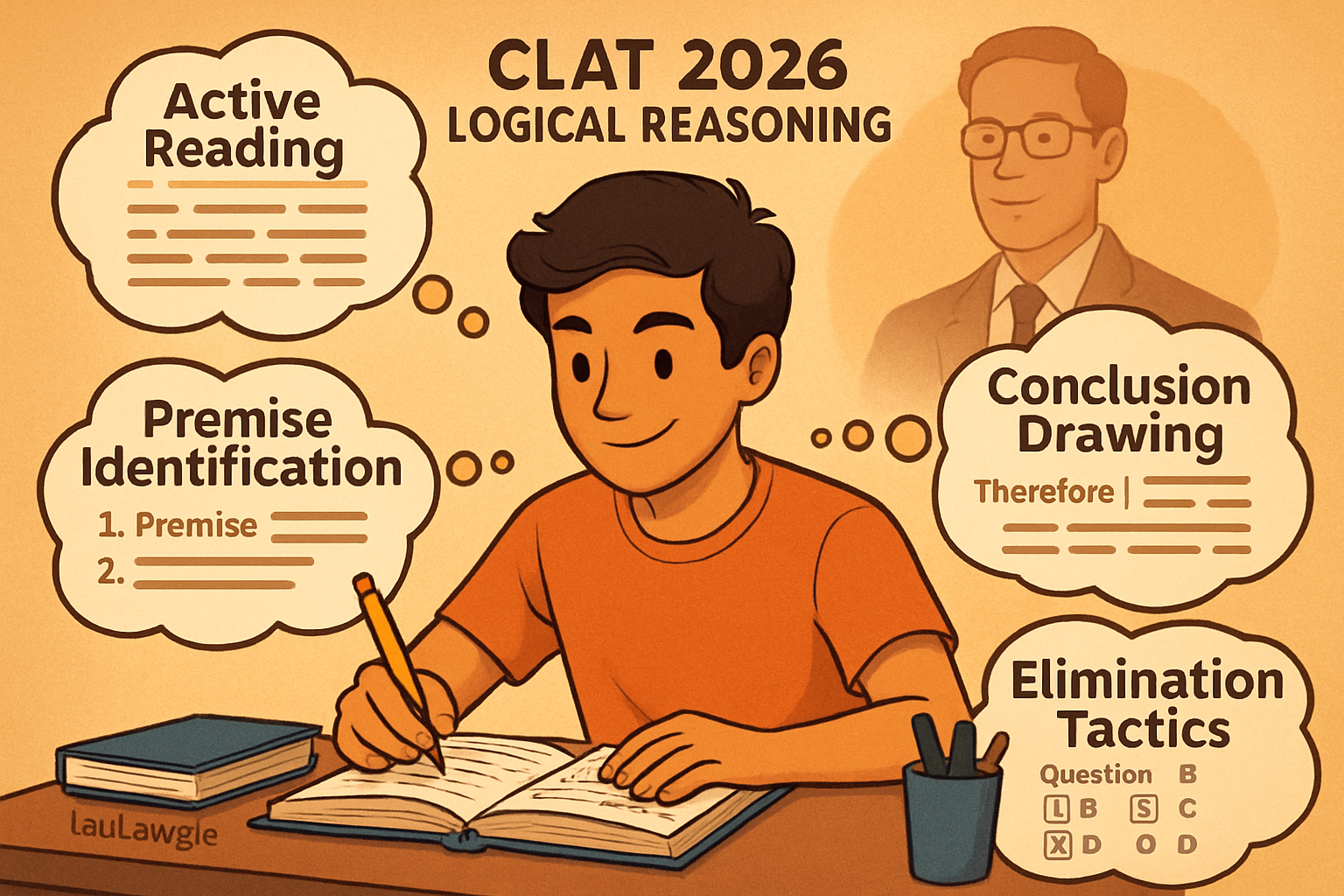
The CLAT 2026 Logical Reasoning pattern change is more than just an exam modification; it’s an indicator of the evolving demands of the legal profession itself. The legal landscape is becoming increasingly intricate, requiring professionals who can not only recall facts but also analyze complex situations, synthesize diverse information, and formulate nuanced arguments. By emphasizing critical reasoning, the CLAT Consortium is ensuring that future law students are equipped with these essential skills from day one.
Think of it this way: law is fundamentally about arguments. It’s about dissecting statutes, analyzing case law, understanding precedents, and constructing persuasive narratives. Whether you’re a litigator presenting a case, a corporate lawyer drafting a contract, or a policy analyst advising on legislation, your ability to think critically, identify flaws in reasoning, and construct robust arguments will be paramount. The CLAT 2026 Logical Reasoning section, in its new avatar, is essentially an early training ground for these crucial aspects of legal thinking.
This reorientation also highlights the importance of analytical thinking across all sections of the CLAT. While we’re focusing on Logical Reasoning here, the skills you develop for this section – deep comprehension, identifying underlying structures, evaluating arguments – will undoubtedly spill over into other areas like the English section (especially for reading comprehension) and even Legal Reasoning, where understanding the principles and applying them critically is key. Check out our guide on CLAT 2026 Legal Reasoning passages: a step-by-step approach to see how these skills interlink.
Adapting Beyond Logical Reasoning
The mindset you develop for the new Logical Reasoning section should permeate your entire CLAT preparation.
- English Language: Approach reading comprehension passages with the same critical eye. Look for the author’s main point, tone, and underlying assumptions.
- Legal Reasoning: While this section tests legal principles, your ability to critically analyze hypothetical situations and apply those principles accurately will be enhanced by strong logical reasoning skills. You can learn more about avoiding CLAT pitfalls by developing this critical eye.
- Quantitative Techniques: Even in this section, strong logical reasoning can help you interpret data presented in graphs and charts, and choose the most effective problem-solving approach. Our guide on approaching quantitative techniques in CLAT offers more insight.
- General Knowledge: Your ability to connect current events to broader themes and understand their implications will benefit from a critical perspective.
Ultimately, the CLAT 2026 Logical Reasoning pattern change is not designed to trick you, but to truly test your aptitude for legal studies. It’s about identifying students who possess the innate or cultivated ability to think deeply, analyze thoroughly, and reason effectively – qualities that are indispensable for a successful legal career. And that’s precisely what Lawgic Coaching aims to nurture in every single one of our students. We’re here to help you not just pass an exam, but to build a strong foundation for your future in law. Your journey to a top NLU starts here, with focused, smart preparation.
Conclusion: Embrace the Change, Conquer the Challenge
The “Puzzle Shock” of the CLAT 2026 Logical Reasoning pattern change may have initially felt like a daunting hurdle, but it’s truly an opportunity. An opportunity to evolve your thinking, sharpen your analytical prowess, and truly demonstrate your aptitude for a demanding, intellectually stimulating legal career. This isn’t about memorizing formulas; it’s about developing the critical thinking muscles that will serve you long after CLAT is over.
Here at Lawgic Coaching, we understand the pressure you’re under. We also know, from years of experience and countless success stories, that every challenge is surmountable with the right strategy and support. This CLAT 2026 Logical Reasoning pattern change is no different.
Your Actionable Next Steps:
- Re-evaluate Your Study Plan: Immediately shift your Logical Reasoning focus from traditional puzzles to critical reasoning.
- Immerse Yourself in Reading: Make reading diverse, complex texts a daily habit. Practice active reading techniques.
- Deconstruct Arguments: Learn to systematically identify conclusions, premises, and assumptions in every argument you encounter.
- Practice Smart: Seek out high-quality critical reasoning questions and dedicate significant time to understanding why answers are correct or incorrect.
- Leverage Expert Guidance: Don’t navigate this alone. Partner with a coaching platform like Lawgic Coaching that offers updated curriculum, experienced mentors from top NLUs, and flexible learning that fits your life. We provide the proven strategies that actually work and the personalized attention you deserve.
- Stay Positive and Persistent: This change affects everyone. Your resilience and adaptability will be your greatest assets.
Remember, your success is our mission. We’re more than just an online CLAT coaching platform; we’re your dedicated partners in this journey. We believe in accessible education for serious aspirants, and we’re committed to guiding you every step of the way, without the premium price tag. Let’s conquer this new challenge and build your law career together. Your NLU dream is within reach, and with Lawgic Coaching, you’re equipped to make it a reality.
References
[1] Consortium of National Law Universities. (2024). CLAT 2026 Information Brochure. (Details about specific syllabus and pattern changes are typically released through official notifications.) [2] Khan, A. (2023). Understanding Critical Reasoning for Law Entrance Exams. Legal Aptitude Press.