Questions Asked in CLAT Exam: Complete 2026 Guide for Serious Aspirants
Every year, thousands of law aspirants stare at their CLAT admit cards with one burning question: what exactly will they face in that examination hall? The Common Law Admission Test isn’t just another entrance exam. It’s your gateway to 22 National Law Universities across India, and understanding the questions asked in CLAT exam can make the difference between studying smart and studying hard.
Here’s the thing. Most students waste months preparing for the wrong question types. They memorize legal provisions when CLAT tests reasoning. They cram GK facts when the exam demands analytical reading. At Lawgic Coaching, we’ve helped thousands crack CLAT, and we’ve noticed a pattern: students who understand the question structure score significantly higher than those who simply study more hours.
Key Takeaways
- CLAT 2026 features five distinct sections with passage-based questions testing comprehension and analytical skills rather than rote memorization
- 120 questions in 2 hours means you have exactly one minute per question, making speed and accuracy equally critical
- Negative marking of 0.25 for each wrong answer requires strategic guessing and confident elimination techniques
- Current affairs and legal reasoning dominate 50% of the paper, making daily reading non-negotiable for serious aspirants
- No direct legal knowledge required for UG CLAT—the exam tests your ability to read, analyze, and apply principles to new situations
Understanding the CLAT Exam Structure: What Makes It Different
The Consortium of National Law Universities redesigned CLAT in 2020, fundamentally changing the questions asked in CLAT exam. Gone are the days of standalone MCQs testing isolated facts. Today’s CLAT follows an international pattern inspired by law entrance exams worldwide.
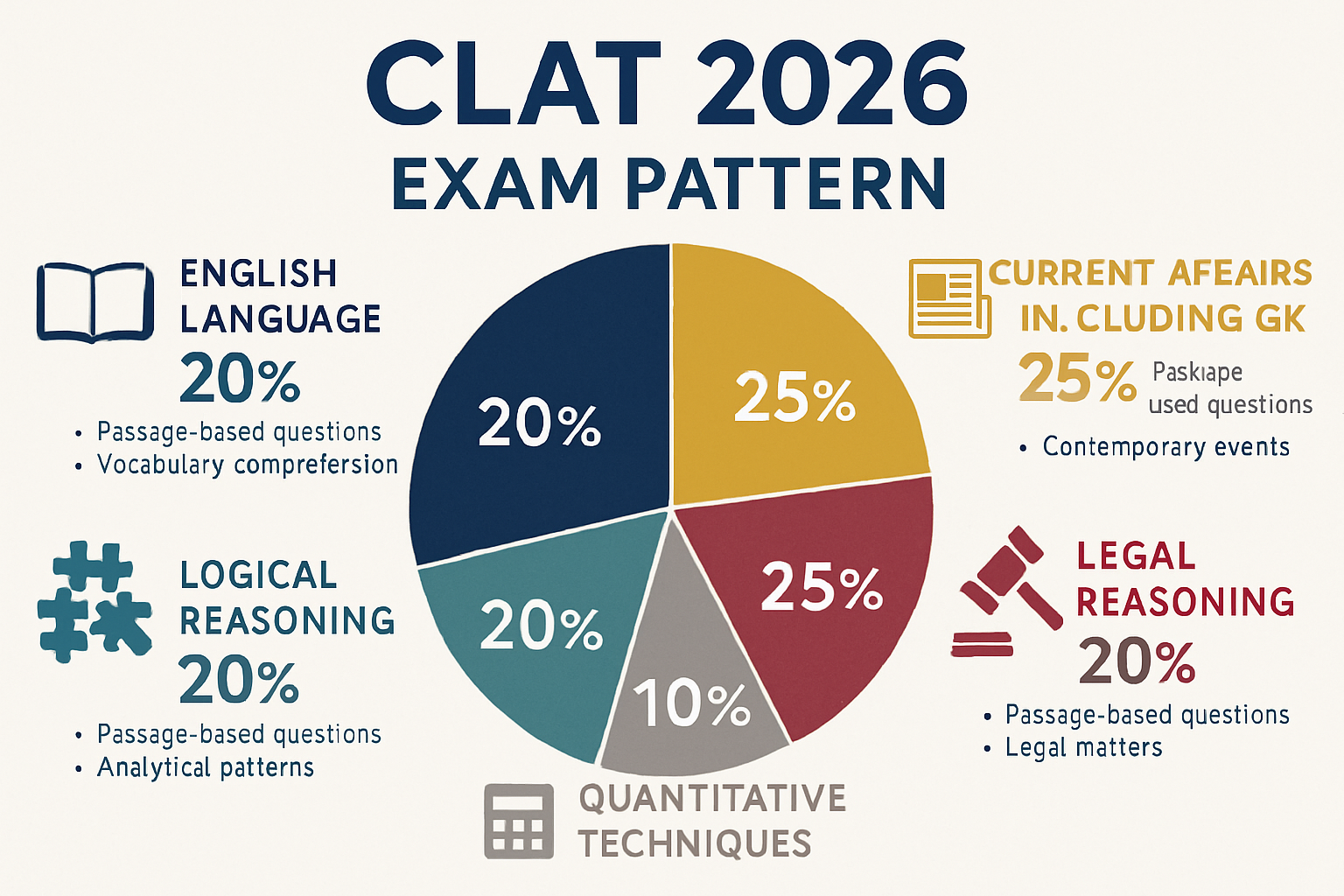
The exam contains 120 multiple-choice questions distributed across five sections. Each question carries one mark. Wrong answers cost you 0.25 marks. You get exactly 120 minutes, which sounds generous until you realize that includes reading lengthy passages, analyzing complex scenarios, and marking answers.
What makes CLAT unique? Unlike engineering or medical entrance exams, CLAT doesn’t test what you’ve memorized. It tests how you think. Can you read a 450-word passage about cryptocurrency regulation and answer five questions testing your comprehension, inference, and analytical skills? That’s what law school demands, and that’s what CLAT measures.
The shift toward passage-based questions reflects what legal education actually requires. Law students spend years reading judgments, analyzing statutes, and applying principles to facts. CLAT 2026 simulates this experience through carefully crafted passages and scenarios.
The Five Sections: A Detailed Breakdown
Let’s examine each section and the specific questions asked in CLAT exam across these areas.
English Language: Testing Comprehension, Not Grammar Rules
Weightage: 22-26 questions (approximately 20% of the paper)
Forget your school English exams. CLAT doesn’t care whether you know the difference between “affect” and “effect.” The English section presents 4-5 passages of approximately 450 words each, drawn from contemporary fiction, non-fiction, and historical texts.
Each passage generates 4-5 questions testing:
- Reading comprehension: What did the author actually say?
- Inference skills: What can you logically conclude from the passage?
- Vocabulary in context: What does this word mean here, in this specific usage?
- Critical reasoning: What assumptions underlie the author’s argument?
Recent CLAT papers have featured passages from authors like Amitav Ghosh, excerpts from The Economist, and historical documents about India’s independence movement. The passages are deliberately chosen to be unfamiliar—CLAT wants to see how you handle new material under pressure.
Sample question pattern: After reading a passage about climate change litigation, you might face questions like “Which of the following best describes the author’s attitude toward judicial activism in environmental cases?” or “The word ‘standing’ in paragraph 3 most nearly means…”
Your success here depends on active reading skills. Students who highlight key phrases, track argument structure, and read questions before diving into passages consistently outperform those who passively read and hope to remember details.
We’ve analyzed five years of CLAT papers and found that approximately 60% of English questions test straightforward comprehension, 25% require inference, and 15% focus on vocabulary or tone. Understanding this distribution helps you allocate practice time effectively.
Current Affairs Including General Knowledge: The Game-Changer Section
Weightage: 28-32 questions (approximately 25% of the paper)
This section separates serious aspirants from casual test-takers. The questions asked in CLAT exam for current affairs aren’t “Who won the Nobel Prize in Physics?” trivia. Instead, you’ll read passages about recent developments in politics, economics, science, technology, sports, and culture, then answer analytical questions.
CLAT 2026 will present 5-6 passages covering:
- Contemporary national and international affairs from the preceding year
- Historical events with current relevance
- Significant developments in arts, culture, and sports
- Economic and political changes affecting India and the world
Each passage spawns 4-5 questions requiring you to:
- Understand the factual content
- Analyze implications and consequences
- Connect current events to broader trends
- Evaluate different perspectives on controversial issues
Here’s what catches most students off-guard: You can’t prepare for this section by memorizing GK books. A question about India’s semiconductor policy won’t ask “When was the policy announced?” Instead, it might present a 400-word passage explaining the policy, then ask “Which of the following challenges is the passage most concerned with addressing?”
The timeline matters significantly. For CLAT 2026 (scheduled for December 2026), focus on current affairs from January 2025 through November 2026. Events from 2024 rarely appear except when they have ongoing relevance.
Strategic preparation approach: Daily newspaper reading isn’t optional—it’s mandatory. But don’t just read. Analyze. When you read about a new government policy, ask yourself: What problem does this solve? Who benefits? What are the potential downsides? These analytical habits translate directly into CLAT performance.
At Lawgic Coaching, we’ve identified 10 high-yield GK topics that consistently appear in CLAT. Focusing on these areas while maintaining broad awareness creates an efficient preparation strategy.
Legal Reasoning: Where Law School Actually Begins
Weightage: 28-32 questions (approximately 25% of the paper)
Many aspirants panic about legal reasoning, assuming they need legal knowledge. They don’t. The questions asked in CLAT exam for this section test your ability to read a legal principle, understand it, and apply it to new factual situations—exactly what first-year law students do.
CLAT presents 5-6 passages containing:
- Legal principles from various areas of law (contracts, torts, criminal law, constitutional law, etc.)
- Factual scenarios where these principles might apply
- Questions testing whether you can correctly apply the principle to the facts
The standard format looks like this:
Principle: A person is liable for negligence if they owe a duty of care to another person, breach that duty, and cause harm as a result of the breach.
Facts: Ramesh, a driver, was texting while driving and hit Suresh, a pedestrian crossing at a designated crossing. Suresh suffered injuries requiring hospitalization.
Question: Based on the principle above, which of the following is most accurate?
The answer choices then test whether you correctly identified that (a) Ramesh owed a duty of care, (b) he breached it by texting, and (c) this breach caused Suresh’s harm.
What makes this section challenging? The principles can be complex, with multiple conditions and exceptions. The facts might involve several parties with different relationships. You need to read carefully, identify relevant facts, and match them precisely to the principle’s requirements.
Recent CLAT papers have included principles from:
- Constitutional law (fundamental rights, state action, reasonable restrictions)
- Contract law (offer, acceptance, consideration, breach)
- Tort law (negligence, defamation, nuisance)
- Criminal law (intention, knowledge, self-defense)
- Property law (ownership, possession, transfer)
Pro tip: You don’t need to know these areas of law beforehand. Each passage provides the complete principle you need. Your job is reading comprehension and logical application, not legal expertise.
However, familiarity with legal terminology helps. When you’ve seen terms like “consideration,” “vicarious liability,” or “natural justice” before, you process passages faster. Our CLAT preparation approach includes building this familiarity without overwhelming students with law school content.
Logical Reasoning: Puzzles With Purpose
Weightage: 22-26 questions (approximately 20% of the paper)
Logical reasoning questions asked in CLAT exam test your ability to identify patterns, spot assumptions, evaluate arguments, and solve analytical puzzles. Like other sections, CLAT presents passages followed by questions rather than standalone logic problems.
You’ll encounter 5-6 passages featuring:
- Critical reasoning scenarios: Evaluate whether an argument is strong or weak, identify assumptions, find logical flaws
- Analytical reasoning puzzles: Arrange items in order, determine relationships, solve constraint-based problems
- Argument analysis: Strengthen or weaken given arguments, identify conclusions, spot missing information
Sample critical reasoning question:
Passage: “The city council should ban plastic bags because they harm the environment. Studies show plastic bags take 500 years to decompose and kill marine life.”
Question: Which of the following, if true, would most weaken the argument?
This tests whether you can identify what evidence would undermine the conclusion—perhaps showing that alternatives cause more environmental harm, or that the studies are flawed.
Sample analytical reasoning question:
Passage: “Five students—Amit, Priya, Ravi, Sneha, and Tarun—sit in a row. Amit sits next to Priya. Ravi sits at one end. Sneha does not sit next to Amit.”
Question: If Tarun sits next to Ravi, which of the following must be true?
This requires working through the constraints systematically to determine what arrangement satisfies all conditions.
The key to success: Practice diverse question types. Many students focus exclusively on seating arrangement puzzles and then panic when CLAT presents argument evaluation questions instead. The exam tests flexible thinking, not pattern recognition for specific puzzle types.
Logical reasoning overlaps significantly with legal reasoning—both require careful reading, precise thinking, and systematic analysis. Students strong in one section typically perform well in the other.
Quantitative Techniques: Math for Lawyers
Weightage: 13-17 questions (approximately 10-13% of the paper)
Don’t let the small weightage fool you. These questions asked in CLAT exam for quantitative techniques are often the fastest to solve, making them crucial for time management. CLAT presents 2-3 passages with numerical information, followed by questions requiring basic mathematical operations.
The math tested includes:
- Percentages and ratios: Calculate increases, decreases, proportions
- Profit and loss: Determine costs, revenues, margins
- Simple and compound interest: Calculate returns on investments
- Averages and statistics: Find means, interpret data
- Basic algebra: Solve simple equations
- Data interpretation: Read graphs, charts, tables
Critically important: The math itself is at the Class 10 level. What makes it challenging is reading comprehension. Questions hide the mathematical problem inside lengthy passages about business scenarios, government budgets, or economic trends.
Sample question pattern:
Passage: “A company’s revenue was ₹50 lakhs in 2024. In 2025, revenue increased by 20%. Operating costs, which were 60% of revenue in 2024, increased by 15% in 2025.”
Question: What was the company’s profit (revenue minus costs) in 2025?
You need to: (1) calculate 2025 revenue (₹60 lakhs), (2) calculate 2024 costs (₹30 lakhs), (3) calculate 2025 costs (₹34.5 lakhs), and (4) find the difference (₹25.5 lakhs). The math is straightforward, but extracting the right numbers from the passage requires careful reading.
Time-saving strategy: Solve these questions first. While other sections require reading 450-word passages, quantitative passages are shorter and questions are faster to answer. Banking these marks early builds confidence and creates time cushion for tougher sections.
Many students neglect quantitative techniques because of its small weightage. That’s a mistake. Our approach to quantitative techniques emphasizes speed and accuracy—these questions can be your score boosters.
Breaking Down the Questions Asked in CLAT Exam: Pattern Analysis
After analyzing CLAT papers from 2020 to 2025, clear patterns emerge in the questions asked in CLAT exam:
Passage length and complexity: Most passages range from 400-500 words. English and current affairs passages tend toward the longer end. Legal reasoning passages are often shorter but denser. Quantitative passages are typically the shortest at 200-300 words.
Question distribution per passage: Each passage generates 4-5 questions. This means you can’t skip passages—each represents significant marks. However, if you’re genuinely stuck on a passage, moving on and returning later prevents time wastage.
Difficulty progression: CLAT doesn’t arrange questions by difficulty. You might encounter the hardest legal reasoning question first and the easiest last. This randomness requires mental flexibility—don’t let one tough question derail your confidence.
Answer choice patterns: CLAT uses four options (A, B, C, D) for each question. Statistically, over the entire paper, each option appears roughly 25% of the time. However, this doesn’t help for individual questions—never guess based on “I haven’t chosen C in a while.”
Negative marking impact: With -0.25 for wrong answers, random guessing hurts you. If you can eliminate even one option, guessing becomes mathematically favorable. If you have no clue, leaving it blank is smarter than random selection.
How Questions Have Evolved: 2020 vs 2025 CLAT
The Consortium made significant changes in 2020, but subtle evolution continues. Comparing questions asked in CLAT exam across years reveals important trends:
Increased passage complexity: Early post-reform papers (2020-2021) featured relatively straightforward passages. Recent papers (2024-2025) include more nuanced arguments, complex sentence structures, and sophisticated vocabulary. This reflects rising competition and the Consortium’s desire to differentiate top performers.
More application, less recall: Current affairs questions increasingly present unfamiliar events in passages rather than testing whether you remember specific facts. This rewards analytical reading over memorization.
Trickier legal reasoning: Recent legal principles include more conditions, exceptions, and nuanced language. The facts scenarios involve more parties and complex relationships. This tests careful reading under pressure.
Integrated logical reasoning: Rather than standalone puzzles, logical reasoning increasingly appears within realistic scenarios—evaluating a judge’s reasoning, analyzing a policy argument, assessing business decisions.
Data-heavy quantitative questions: Recent papers present more complex data sets with multiple variables. You might need to calculate several intermediate steps before reaching the final answer.
Our detailed CLAT 2025 question paper analysis breaks down these trends with specific examples.
Common Question Types You’ll Definitely Encounter
Based on consistent patterns, certain question types appear in virtually every CLAT paper:
In English Language:
- Main idea questions: “What is the primary purpose of this passage?”
- Inference questions: “Which of the following can be inferred from paragraph 3?”
- Vocabulary in context: “The word ‘sanction’ in line 15 most nearly means…”
- Tone and attitude: “The author’s tone can best be described as…”
- Specific detail questions: “According to the passage, what caused…?”
In Current Affairs:
- Factual comprehension: “According to the passage, which country recently…?”
- Implication questions: “What is the likely consequence of the policy described?”
- Comparison questions: “How does the passage distinguish between X and Y?”
- Perspective questions: “Which stakeholder would most likely oppose this development?”
In Legal Reasoning:
- Direct application: “Based on the principle, is X liable?”
- Exception identification: “In which scenario would the principle NOT apply?”
- Multiple party scenarios: “Among the parties described, who has the strongest claim?”
- Principle comparison: “Which principle is most relevant to these facts?”
In Logical Reasoning:
- Assumption identification: “The argument assumes which of the following?”
- Strengthen/weaken: “Which statement would most strengthen this conclusion?”
- Logical flaw: “The reasoning is flawed because it…”
- Arrangement problems: “If X is third, where must Y be?”
- Must be true: “Based on the information, which must be true?”
In Quantitative Techniques:
- Percentage calculations: “What percentage increase/decrease…?”
- Ratio and proportion: “If the ratio of X to Y is 3:5, and X = 60, what is Y?”
- Profit/loss: “What is the profit percentage?”
- Data interpretation: “According to the graph, in which year was growth highest?”
Preparation Strategies for Different Question Types
Understanding what questions are asked in CLAT exam is only half the battle. Here’s how to prepare effectively for each type:
For Passage-Based Questions (All Sections):
Active reading is non-negotiable. As you read, mentally summarize each paragraph. Note the main argument. Identify supporting evidence. Track shifts in tone or perspective.
Read questions first for some sections. In current affairs and quantitative techniques, reading questions before the passage helps you know what information to look for. In English and legal reasoning, this strategy is less effective because you need to understand the entire passage anyway.
Practice elimination. With four options, eliminating two obviously wrong answers doubles your chances from 25% to 50%. Train yourself to spot extreme language (“always,” “never”), out-of-scope options, and answers that distort passage content.
For English Language:
Read diverse sources daily. The Hindu editorials, The Indian Express opinion pieces, The Economist articles, and quality fiction all build the reading stamina and vocabulary CLAT demands.
Don’t just read—analyze. After reading an article, ask yourself: What was the author’s main argument? What evidence supported it? What assumptions did they make? This active engagement translates directly into CLAT performance.
Build vocabulary contextually. When you encounter unfamiliar words, note the sentence they appear in. Understanding words in context (how CLAT tests vocabulary) is more valuable than memorizing dictionary definitions.
For Current Affairs:
Create a system. Whether it’s a dedicated notebook, digital notes, or flashcards, systematically record important developments. Organize by theme (politics, economics, international relations, science, etc.) rather than chronologically.
Focus on analysis, not just facts. Don’t just note “India signed a trade agreement with Country X.” Ask: Why? What does each country gain? Who might oppose this? What are the potential challenges?
Connect events to broader trends. CLAT passages often link current events to historical context or future implications. Practice making these connections in your preparation.
Our guide to CLAT GK preparation provides a detailed month-by-month approach to building current affairs knowledge without overwhelming yourself.
For Legal Reasoning:
Read the principle multiple times. Legal principles contain precise language where every word matters. A principle about “intentional” harm is different from one about “negligent” harm. Read carefully.
Identify the principle’s requirements. Most legal principles follow an if-then structure: “If X, Y, and Z are present, then consequence A follows.” List out X, Y, and Z. Then check whether the facts satisfy each requirement.
Match facts to requirements systematically. Don’t rely on intuition about what “seems fair.” CLAT tests whether you can follow the stated principle, even if it leads to a seemingly unfair result.
Practice with diverse legal areas. Don’t just solve contract law problems. Expose yourself to constitutional law, criminal law, tort law, and property law principles so no passage feels completely foreign.
For Logical Reasoning:
Learn standard question types. Familiarize yourself with assumption questions, strengthen/weaken questions, logical flaw questions, and arrangement puzzles. Each type has specific strategies.
Diagram complex scenarios. For arrangement puzzles or multi-party scenarios, draw quick diagrams. Visual representation makes constraints clearer and prevents errors.
Identify conclusion and evidence. In argument-based questions, clearly distinguish what the argument concludes from what evidence it provides. This separation makes assumption and flaw questions much easier.
Practice timed puzzles. Logical reasoning can be time-consuming. Regular practice under timed conditions builds the speed CLAT demands.
For Quantitative Techniques:
Refresh basic concepts. Review percentages, ratios, profit/loss, simple/compound interest, and basic algebra. The math itself is straightforward—you just need the formulas fresh.
Practice extracting information from passages. The challenge isn’t solving “What is 20% of 50?” It’s reading a 300-word passage about business performance and identifying that you need to calculate 20% of 50.
Use approximation strategically. CLAT answer choices are usually distinct enough that you can round numbers for faster calculation. If choices are ₹24,500, ₹28,750, ₹32,200, and ₹35,800, you don’t need exact precision.
Solve these questions early. They’re typically faster than other sections. Banking these marks first creates time cushion and builds confidence.
Time Management: The Hidden Challenge in CLAT
Even if you know how to solve every question type, poor time management can destroy your score. With 120 questions in 120 minutes, you average one minute per question. But passages require reading time, so individual questions need faster solving.
Recommended time allocation:
- English Language (24 questions): 22-25 minutes
- Current Affairs (30 questions): 28-32 minutes
- Legal Reasoning (30 questions): 28-32 minutes
- Logical Reasoning (24 questions): 22-25 minutes
- Quantitative Techniques (12 questions): 10-12 minutes
- Review and guessing: 8-10 minutes
This allocation assumes you’ll spend more time per question on legal and logical reasoning (which require careful analysis) and less on quantitative techniques (which are faster once you identify the calculation needed).
Section strategy matters. Some students prefer solving sections in order. Others start with their strongest section to build confidence, or begin with quantitative techniques to bank quick marks. Experiment during practice to find what works for you.
The two-pass approach works well. First pass: Solve everything you can do confidently within time limits. Second pass: Return to tougher questions, eliminate options, and make educated guesses. This prevents getting stuck on one hard question while easier questions remain unattempted.
Practice with realistic timing. Solving 120 questions untimed teaches you nothing about CLAT performance. Every practice session should be timed. Feel the pressure. Learn to make quick decisions under time constraints.
Mock Tests: Your Most Valuable Preparation Tool
Understanding what questions are asked in CLAT exam theoretically is different from solving them under exam conditions. Mock tests bridge this gap.
Why mocks matter:
-
Simulate exam pressure: Your brain works differently under timed, high-stakes conditions. Regular mocks train you to think clearly despite pressure.
-
Identify weak areas: You might think you’re good at legal reasoning until a mock test reveals you’re making careless errors under time pressure.
-
Build stamina: Maintaining focus for two hours straight is exhausting. Mocks build the mental endurance CLAT demands.
-
Test strategies: Should you solve quantitative first or last? Do you read questions before passages? Mocks let you experiment safely.
-
Track improvement: Regular mocks create data showing whether your preparation is working. Stagnant scores signal the need for strategy changes.
How many mocks should you take? In the final three months before CLAT, aim for at least two full-length mocks per week. That’s 24+ mocks, creating substantial data about your performance patterns.
Mock test analysis matters more than taking the test. After each mock, spend 2-3 hours reviewing:
- Every wrong answer: Why did you get it wrong? Careless error? Conceptual gap? Time pressure?
- Every correct guess: Did you get lucky, or did you eliminate options systematically?
- Time management: Which sections consumed too much time? Where did you rush?
- Question types: Which types consistently trouble you?
This analysis identifies specific areas for improvement. Generic “I need to study harder” conclusions don’t help. Specific insights like “I’m making errors in legal reasoning questions involving multiple parties” guide targeted practice.
At Lawgic Coaching, our students take regular mocks with detailed performance analytics. We’ve found that students who analyze mocks thoroughly improve scores 15-20% faster than those who just take tests and move on.
Common Mistakes to Avoid
After working with thousands of CLAT aspirants, we’ve identified recurring mistakes that hurt scores:
Mistake 1: Preparing for the wrong exam. Some students study as if CLAT tests legal knowledge. It doesn’t. Others memorize GK facts when CLAT tests analytical reading. Understanding the actual question format is fundamental.
Mistake 2: Neglecting daily reading. You can’t build reading comprehension and current affairs knowledge in the final month. These skills require consistent daily practice over months. Avoiding this and other preparation pitfalls significantly improves your chances.
Mistake 3: Practicing without timing. Untimed practice builds skills but doesn’t prepare you for CLAT’s time pressure. Always practice under realistic conditions.
Mistake 4: Ignoring negative marking. Random guessing costs you marks. If you can’t eliminate any options, leaving the question blank is smarter.
Mistake 5: Perfectionism. Trying to score 100% leads to time wastage on impossible questions while easier questions remain unattempted. CLAT rewards strategic optimization, not perfection.
Mistake 6: Studying in isolation. Discussing questions with peers, learning from others’ approaches, and teaching concepts to fellow aspirants deepens understanding. Choosing the right coaching environment provides this collaborative learning.
Mistake 7: Neglecting mental health. CLAT preparation is marathon, not a sprint. Burnout destroys performance. Regular breaks, adequate sleep, and stress management aren’t luxuries—they’re necessities.
Resources That Actually Help
The internet overflows with CLAT preparation resources. Most are mediocre. Here’s what actually works:
For English Language:
- The Hindu editorials (daily reading builds comprehension and vocabulary)
- The Indian Express opinion section
- Quality fiction (builds reading stamina and exposes you to diverse writing styles)
- Word Power Made Easy by Norman Lewis (for vocabulary building)
For Current Affairs:
- Daily newspaper (The Hindu or Indian Express)
- Monthly current affairs compilations from reliable sources
- Manorama Yearbook (for annual overview)
- PRS Legislative Research (for understanding government policies)
For Legal Reasoning:
- Legal Reasoning for CLAT by A.P. Bhardwaj
- Universal’s Guide to CLAT Legal Reasoning
- Previous year CLAT questions (best source for understanding question patterns)
For Logical Reasoning:
- Analytical Reasoning by M.K. Pandey
- A Modern Approach to Logical Reasoning by R.S. Aggarwal
- Previous CLAT papers and quality mock tests
For Quantitative Techniques:
- Class 10 NCERT Mathematics (covers all required concepts)
- Quantitative Aptitude by R.S. Aggarwal (for additional practice)
- Previous year questions (shows how math is tested in passage format)
Most valuable resource: Previous year CLAT question papers. Nothing teaches you the questions asked in CLAT exam better than actual CLAT questions. Solve every available paper from 2020 onwards multiple times.
Your Personalized Preparation Timeline
CLAT preparation isn’t one-size-fits-all, but general timelines help structure your approach:
12+ Months Before CLAT:
Focus: Building foundational skills
- Start daily newspaper reading (30-45 minutes)
- Read one English article daily and summarize it
- Complete basic math revision (Class 10 concepts)
- Understand CLAT exam pattern thoroughly
- Take diagnostic test to identify baseline
6-12 Months Before CLAT:
Focus: Systematic section-wise preparation
- Continue daily newspaper reading, now making notes
- Solve 10-15 English comprehension passages weekly
- Practice 20-25 legal reasoning questions weekly
- Solve 20-25 logical reasoning questions weekly
- Complete quantitative techniques concept revision
- Take one mock test monthly to track progress
3-6 Months Before CLAT:
Focus: Intensive practice and mock tests
- Daily newspaper reading with analytical notes
- Solve 5-7 passages daily across all sections
- Take 2 mock tests weekly
- Analyze every mock test thoroughly
- Identify weak areas and practice targeted questions
- Build question-solving speed
Final 3 Months:
Focus: Refinement and exam readiness
- Continue daily current affairs (crucial for recent events)
- Take 2-3 mock tests weekly
- Revise concepts showing up repeatedly in mocks
- Practice time management strategies
- Work on mental stamina and stress management
- Fine-tune section-wise strategies
Final Month:
Focus: Consolidation and confidence building
- Take 3-4 full-length mocks weekly
- Quick revision of formulas, common question types
- Stay updated with current affairs until exam day
- Reduce study hours slightly to prevent burnout
- Visualize exam day success
- Ensure all logistics (admit card, exam center location) are sorted
This timeline assumes you’re starting from scratch. If you’re already strong in certain areas, adjust accordingly. The key is consistent daily effort rather than sporadic intense study sessions.
Beyond CLAT: What This Preparation Teaches You
Here’s something most coaching institutes won’t tell you: preparing for CLAT develops skills far more valuable than just cracking one exam.
The questions asked in CLAT exam train you to:
- Read critically: Identify arguments, spot assumptions, evaluate evidence—skills essential for law school and legal practice
- Think analytically: Break complex problems into components, apply principles systematically
- Manage time under pressure: Make quick decisions with incomplete information
- Stay informed: Understand current events and their broader implications
- Communicate precisely: Legal reasoning questions teach you that words matter and precision is crucial
These skills serve you throughout law school and legal career. The student who masters CLAT-style analytical reading excels at reading judgments. The student who handles time pressure well thrives during law school exams. The student who stays updated with current affairs becomes a more effective lawyer.
So yes, CLAT is your gateway to National Law Universities. But the preparation process itself shapes you into the kind of thinker law school needs and legal profession demands.
Why Quality Coaching Makes a Difference
Can you crack CLAT through self-study? Absolutely. Many students do. But quality coaching accelerates your preparation and helps avoid common pitfalls.
What good coaching provides:
- Structured approach: Instead of figuring out what to study when, you follow a proven roadmap
- Expert guidance: Learn from faculty who’ve studied at top NLUs and understand what works
- Regular assessment: Consistent mocks and feedback identify issues before they become habits
- Peer learning: Study alongside serious aspirants, learn from their approaches, stay motivated
- Resource curation: Access quality study material without wasting time on mediocre resources
- Doubt resolution: Get stuck on a legal reasoning question? Expert help prevents hours of frustration
- Motivation and accountability: Regular classes and deadlines keep you on track when motivation wavers
At Lawgic Coaching, we’ve built our program around what CLAT actually tests. Our faculty from top NLUs understand the questions asked in CLAT exam because they’ve cracked it themselves. We combine expert guidance without the premium price tag, making quality preparation accessible to serious aspirants everywhere.
Your success is our mission. We’ve helped thousands crack CLAT, and we’ve learned exactly what works. No cookie-cutter approach here—we provide personalized attention you deserve while you study at your own pace through our flexible online platform.
Frequently Asked Questions About CLAT Questions
Q: Do I need to study law books to prepare for CLAT legal reasoning?
No. CLAT provides all legal principles you need within the passage. Your job is reading comprehension and logical application, not prior legal knowledge. However, familiarity with legal terminology helps you process passages faster.
Q: How much current affairs should I prepare? Just the last year?
For CLAT 2026, focus primarily on January 2025 through November 2026. Events from 2024 rarely appear unless they have ongoing relevance. However, some questions connect current events to historical context, so basic awareness of major historical developments helps.
Q: Are CLAT questions getting harder every year?
The difficulty level fluctuates. Some years are objectively harder than others. However, what matters is your performance relative to other aspirants, not absolute difficulty. Focus on maximizing your score regardless of paper difficulty.
Q: Should I attempt all 120 questions?
Only if you can make educated guesses. With negative marking, random guessing hurts your score. If you can eliminate even one option, attempting makes mathematical sense. If you’re completely clueless, skip it.
Q: Which section should I solve first?
There’s no universal answer. Some students start with their strongest section for confidence. Others begin with quantitative techniques to bank quick marks. Experiment during practice to find what works for you. Our CLAT preparation strategies help you develop personalized approaches.
Q: How important are mock tests?
Extremely important. Mock tests are arguably the most valuable preparation tool after a certain point. They simulate exam conditions, identify weak areas, build stamina, and let you test strategies safely. In the final three months, take at least two full-length mocks weekly.
Q: Can I crack CLAT in 3 months?
Possible but challenging. Three months is enough if you have strong foundational skills (good reading comprehension, basic math knowledge, general awareness). It’s insufficient if you’re starting from scratch. The timeline depends on your current skill level and daily study hours available.
Taking the Next Step: Your Action Plan
You now understand what questions are asked in CLAT exam, how they’re structured, and how to prepare effectively. Knowledge without action changes nothing. Here’s your immediate action plan:
This week:
- Take a diagnostic mock test to establish your baseline
- Start daily newspaper reading (commit to 30-45 minutes daily)
- Solve 10 previous year CLAT questions to experience actual question format
- Create a study schedule based on your timeline (how many months until CLAT?)
This month:
- Complete one full section of preparation (e.g., finish quantitative techniques concept revision)
- Take 2-3 full-length mock tests
- Build current affairs note-making system
- Identify your weakest section and create targeted improvement plan
Next three months:
- Follow systematic section-wise preparation
- Take regular mock tests (increasing frequency as exam approaches)
- Maintain daily reading and current affairs habits
- Track progress and adjust strategy based on mock test performance
The path from CLAT aspirant to National Law University student isn’t mysterious. It’s systematic preparation, consistent effort, and strategic practice. Thousands of students crack CLAT every year. With the right approach, you can be one of them.
Let’s build your law career together. The questions asked in CLAT exam are designed to identify students who can think analytically, read critically, and apply principles systematically. Develop these skills, practice consistently, and walk into that examination hall with confidence.
Your CLAT success story starts with the decision to prepare seriously and systematically. Make that decision today. Your future at a National Law University awaits.
Conclusion
The questions asked in CLAT exam have evolved significantly since the 2020 reforms, shifting from fact-based MCQs to passage-based analytical questions that test comprehension, reasoning, and application skills. Understanding this fundamental change is the first step toward effective preparation.
CLAT 2026 will present 120 questions across five sections—English Language, Current Affairs, Legal Reasoning, Logical Reasoning, and Quantitative Techniques. Each section uses passages followed by questions, requiring you to read actively, think analytically, and respond quickly under time pressure.
Success in CLAT doesn’t come from memorizing facts or studying law books. It comes from developing specific skills: reading comprehension, analytical thinking, logical reasoning, and basic mathematical ability. These skills build gradually through consistent daily practice over months.
Your preparation should include daily newspaper reading for current affairs and comprehension skills, regular practice of section-wise questions, frequent full-length mock tests under timed conditions, and thorough analysis of every mock to identify improvement areas.
The timeline matters. Starting 12+ months before CLAT gives you time to build foundational skills gradually. Starting with only 3 months requires intensive daily effort and strong existing skills. Assess your current level honestly and plan accordingly.
Quality resources, strategic practice, effective time management, and mental resilience separate successful aspirants from the rest. CLAT tests not just what you know but how you think under pressure.
At Lawgic Coaching, we’ve guided thousands of students through this journey. We understand the questions asked in CLAT exam because we’ve cracked it ourselves and helped countless others do the same. Expert guidance without the premium price tag, flexible learning that fits your life, and personalized attention you deserve—that’s what we offer.
Your law school dreams don’t have to be complicated or expensive. With the right preparation strategy, consistent effort, and expert guidance, CLAT becomes an achievable goal rather than an intimidating obstacle.
The examination hall awaits. The National Law Universities are ready for their next batch of students. Will you be among them? Your preparation starts now. Make it count.
CLAT Preparation Readiness Calculator
Assess your current preparation level and get personalized recommendations