
Here’s the honest truth about CLAT preparation timelines: most successful candidates invest 12 to 24 months of focused preparation, but the exact duration depends entirely on your current academic foundation, study consistency, and target National Law University. According to data from the Consortium of National Law Universities, students who begin preparation at least 18 months before the exam show 67% higher success rates in securing seats at top-tier NLUs compared to those who start just six months prior [1]. So when someone asks how much time is required to prepare for CLAT, the answer isn’t one-size-fits-all, but understanding the preparation frameworks can help you chart your personalized roadmap to success.
The CLAT 2025 exam witnessed over 65,000 registrations competing for approximately 2,500 seats across 22 NLUs, making it one of India’s most competitive law entrance examinations [2]. This competition demands not just hard work but strategic, well-timed preparation that builds comprehensive skills across five distinct sections while maintaining academic performance.
Let’s break down exactly how much preparation time you need and how to use every month effectively.
Key Takeaways
- Ideal preparation timeline: 18-24 months provides comprehensive coverage and reduces exam pressure significantly
- Minimum viable preparation: 6-12 months of intensive study can work for students with strong foundational skills
- Section-wise distribution matters: Allocate time proportionally based on weightage and personal strengths
- Mock tests are non-negotiable: Regular testing from month six onwards dramatically improves performance and time management
- Flexibility is essential: Adapt your timeline based on school commitments, learning pace, and progress tracking
Understanding the CLAT Exam Pattern Before Planning Your Timeline
Before deciding how much time is required to prepare for CLAT, you need to understand what you’re preparing for. The CLAT exam has undergone significant reforms, and the current pattern emphasizes comprehension-based questions rather than rote memorization.
The CLAT UG exam consists of 120 questions to be solved in 120 minutes, testing five core areas:
| Section | Number of Questions | Weightage |
|---|---|---|
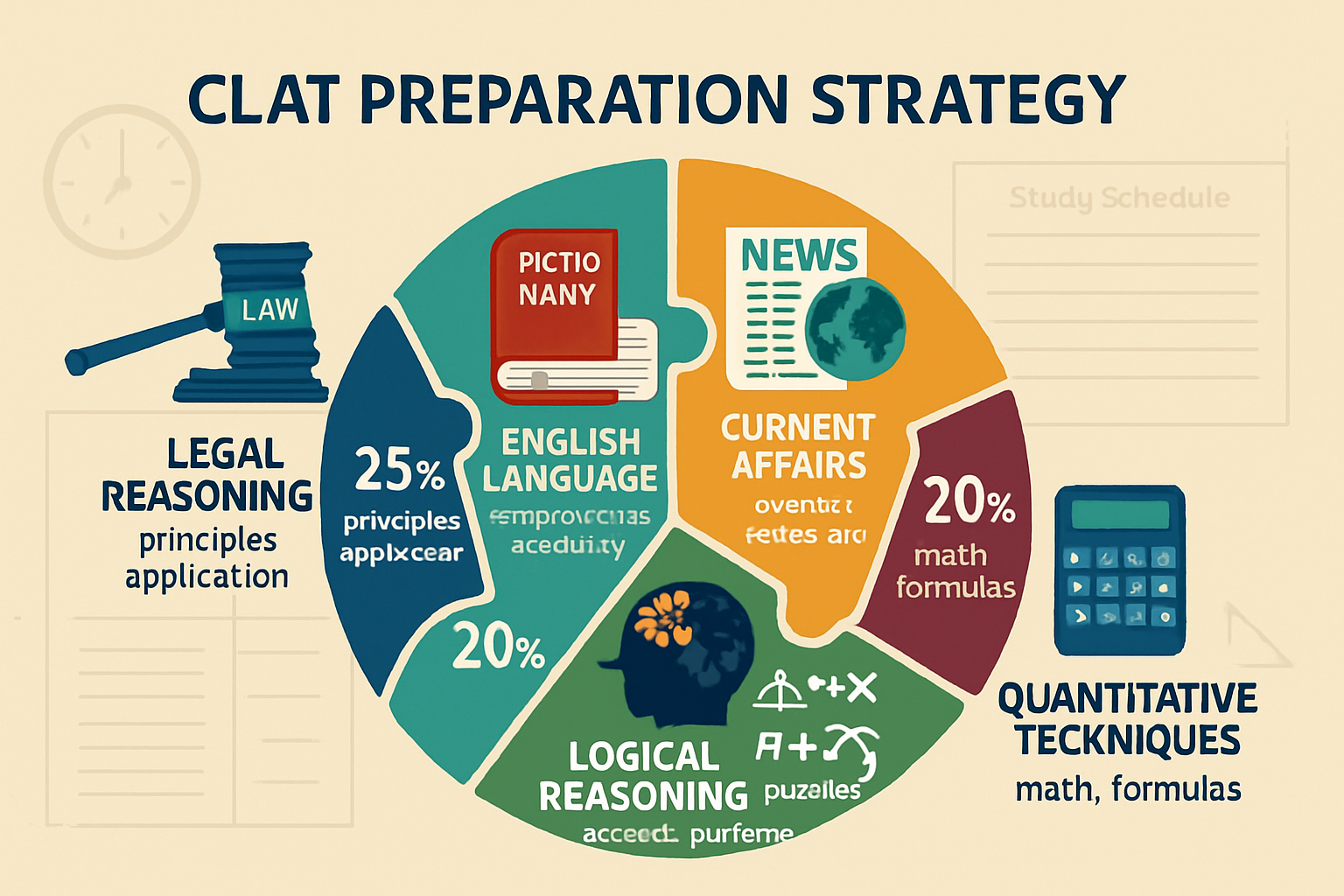
| English Language | 22-26 questions | ~20% |
| Current Affairs including GK | 28-32 questions | ~25% |
| Legal Reasoning | 28-32 questions | ~25% |
| Logical Reasoning | 22-26 questions | ~20% |
| Quantitative Techniques | 10-14 questions | ~10% |
This pattern requires passage-based analytical skills rather than just factual recall. That’s why preparation timelines need to account for skill development, not just content coverage.
The exam tests reading speed, comprehension accuracy, analytical thinking, and decision-making under time pressure. Building these competencies takes consistent practice over extended periods, which is precisely why rushed preparation rarely yields top NLU admissions.
How Much Time Is Required to Prepare for CLAT: The Realistic Timeline Breakdown
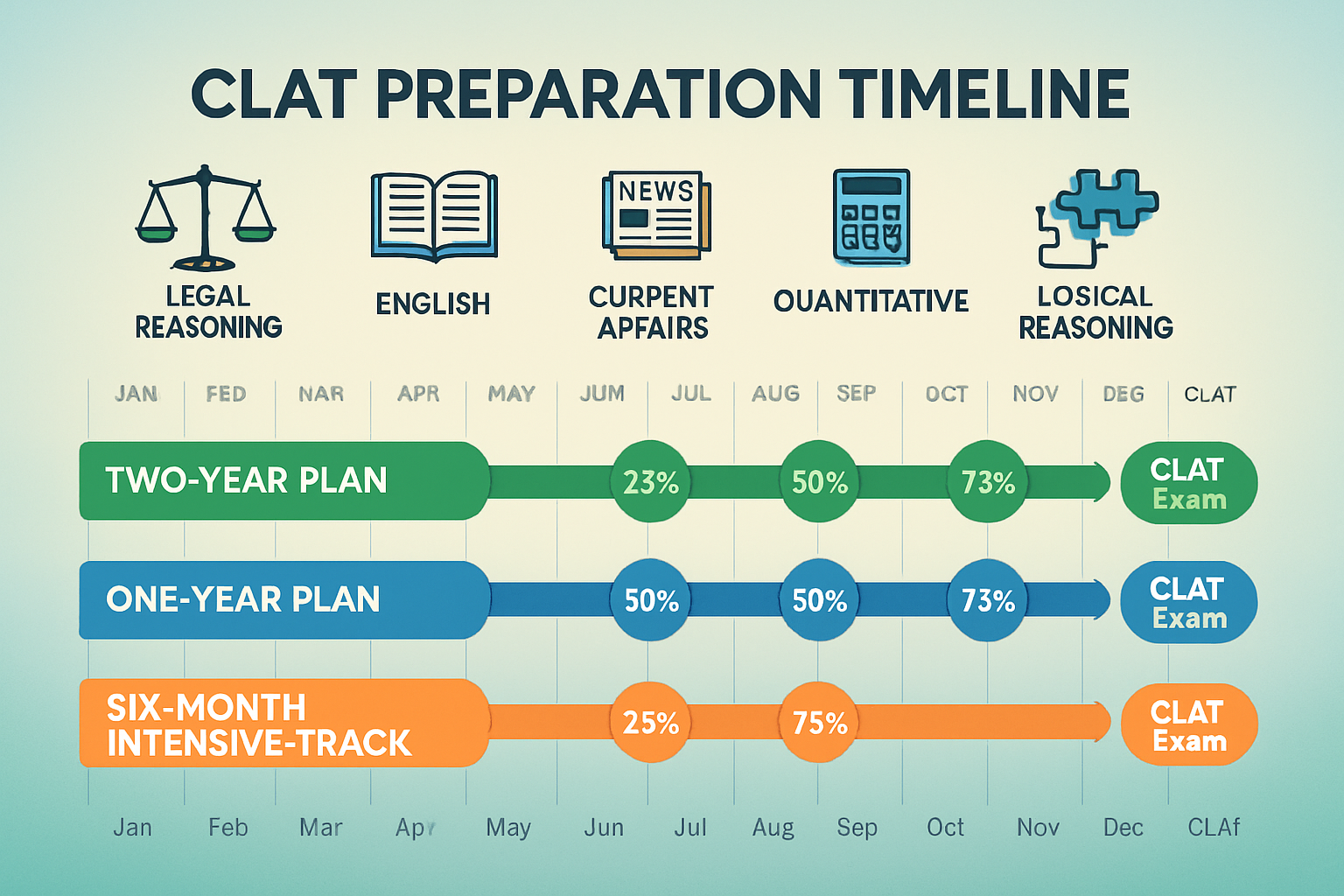
The Two-Year Preparation Plan (Recommended for Class 11 Students)
Starting your CLAT preparation in Class 11 gives you the luxury of building strong foundations without compromising school academics. This timeline is ideal if you’re serious about securing admission to top NLUs like NLSIU Bangalore, NALSAR Hyderabad, or NLUD Delhi.
Months 1-6: Foundation Building Phase
During this initial phase, focus on understanding basic concepts across all sections. Read quality newspapers daily to build current affairs awareness and improve reading speed. Start with NCERT books for quantitative techniques and basic reasoning concepts.
Your daily commitment during this phase should be around 2-3 hours alongside regular school studies. This phase isn’t about intensity but consistency and habit formation.
Months 7-12: Concept Strengthening Phase
By now, you should have completed one round of all basic materials. This phase involves deeper engagement with legal reasoning through landmark judgment reading and understanding legal principles. Your current affairs coverage should expand to include international relations, economics, and constitutional developments.
Increase daily study time to 3-4 hours. Introduce weekly self-assessment tests to identify weak areas. Many students find online CLAT coaching platforms helpful during this phase for structured guidance.
Months 13-18: Advanced Preparation and Application
This is where your preparation becomes exam-oriented. Start solving previous year papers under timed conditions. Analyze your performance meticulously to understand patterns in your mistakes.
Join quality mock test series and aim to attempt at least two full-length mocks weekly. Your study time should now be 4-5 hours daily, with weekends dedicated to longer practice sessions and revision.
Months 19-24: Intensive Revision and Mock Testing
The final six months before CLAT should focus heavily on revision, mock tests, and fine-tuning exam strategy. By this point, you shouldn’t be learning new concepts but reinforcing existing knowledge and improving speed.
Attempt daily sectional tests and at least three full-length mocks weekly. Analyze every mock thoroughly, spending as much time on analysis as on attempting the test itself. This is also when you should focus on avoiding common CLAT pitfalls that trip up even well-prepared students.
The One-Year Preparation Plan (Suitable for Class 12 Students)
If you’re starting CLAT preparation in Class 12, you can still achieve excellent results with disciplined, intensive preparation. This compressed timeline requires greater daily commitment and strategic prioritization.
Months 1-3: Rapid Foundation Building
Cover all basic concepts across sections simultaneously. This requires 4-5 hours of daily focused study. Prioritize high-weightage sections like Current Affairs, Legal Reasoning, and English.
Use comprehensive study materials and consider joining structured coaching programs to avoid wasting time on irrelevant resources. The CLAT 2027 exam syllabus guide provides detailed section-wise coverage strategies.
Months 4-6: Intensive Practice Phase
Begin regular mock testing while continuing content coverage. Your focus should shift from learning to application. Solve passage-based questions daily to build reading stamina and analytical speed.
Dedicate specific days to specific sections for deeper practice. For instance, Mondays for Legal Reasoning, Tuesdays for Current Affairs, and so on. This creates focused learning blocks while ensuring comprehensive coverage.
Months 7-9: Mock Test Intensive Period
By month seven, you should be attempting full-length mocks at least four times weekly. This intensive testing phase identifies remaining weak areas and builds exam temperament.
Maintain a detailed error log categorizing mistakes by section, concept, and error type (conceptual, silly mistake, time pressure, etc.). This systematic analysis drives targeted improvement.
Months 10-12: Final Revision and Strategy Refinement
The last three months should be pure revision and testing. No new topics. Focus on strengthening weak areas identified through mock analysis while maintaining strengths.
Develop your personalized exam strategy: section order, time allocation, question selection criteria, and guessing strategy. Practice this strategy consistently in mocks so it becomes automatic on exam day.
The Six-Month Intensive Plan (For Strong Foundation Students)
Can you prepare for CLAT in six months? Yes, but only if you have strong English skills, good current affairs awareness, and solid logical reasoning abilities. This timeline is not recommended for beginners but can work for students switching from other competitive exams or those with exceptional learning capabilities.
Months 1-2: Aggressive Coverage
Study 6-7 hours daily covering all sections simultaneously. Use condensed study materials and focus exclusively on high-yield topics. The guide on high-yield GK topics for CLAT can help prioritize effectively.
Skip peripheral topics and focus on areas with maximum question frequency. This requires strategic sacrifice, accepting that you won’t cover everything comprehensively.
Months 3-4: Practice Intensive Phase
Shift almost entirely to practice mode. Solve previous year papers, sectional tests, and full-length mocks daily. Your learning should now happen through problem-solving rather than reading.
Identify and drill weak areas through targeted practice. If Legal Reasoning is weak, solve 50 legal reasoning passages. If Quantitative Techniques troubles you, practice 100 quant problems daily.
Months 5-6: Mock Marathon and Revision
Attempt one full-length mock daily, analyze it thoroughly, and revise weak areas identified. This creates a continuous improvement loop.
Maintain quick revision notes for each section that you can review daily. These condensed notes ensure retention while allowing time for extensive practice.
Section-Wise Time Allocation Strategy
Understanding how much time is required to prepare for CLAT also means knowing how to distribute that time across sections effectively.
English Language: Building Reading Speed and Comprehension
Allocate 20% of your daily preparation time to English. This section rewards consistent practice more than intensive cramming. Read quality newspapers, magazines, and editorials daily. The Hindu, Indian Express, and Frontline magazine provide excellent reading material.
Focus on improving reading speed to 300-350 words per minute while maintaining 80%+ comprehension. Practice passage-based questions daily, timing yourself strictly.
Vocabulary building should be organic through reading rather than memorizing word lists. However, maintain a personal vocabulary journal of new words encountered with contextual usage.
Current Affairs and General Knowledge: The Daily Discipline Section
This section requires the longest sustained effort, ideally starting at least 12-15 months before the exam. Allocate 25-30% of your preparation time here.
Read newspapers daily without fail. Focus on editorial pages, national news, international relations, economic developments, and legal/constitutional matters. Maintain monthly current affairs compilations organized by themes.
For static GK, cover Indian polity, history, geography, economics, and important national/international organizations systematically. Use standard reference books and make concise notes for revision.
The key to current affairs preparation is consistency over intensity. Thirty minutes daily for 12 months beats three hours daily for three months.
Legal Reasoning: Developing Legal Aptitude
Legal Reasoning typically requires 25% of your preparation time. This section tests your ability to understand legal principles and apply them to fact situations, not your knowledge of law.
Start by reading landmark Supreme Court judgments to understand legal reasoning patterns. Focus on constitutional law cases, criminal law principles, and contract law basics.
Practice passage-based legal reasoning questions daily. Learn to identify the legal principle, understand the fact situation, and apply the principle logically. Speed comes with practice, so solve at least 10-15 legal reasoning passages daily.
Many students find this section challenging initially but see dramatic improvement with consistent practice. Understanding how to approach CLAT legal reasoning passages can accelerate your learning curve.
Logical Reasoning: Pattern Recognition and Critical Thinking
Allocate 20% of your time to Logical Reasoning. This section tests analytical abilities through passage-based critical reasoning questions.
Practice different question types: assumptions, inferences, strengthening/weakening arguments, conclusions, and paradoxes. Learn to identify argument structures and evaluate logical validity.
Solve puzzles, Sudoku, and logical games to build general reasoning abilities. These activities improve pattern recognition and analytical thinking beyond just exam preparation.
Quantitative Techniques: The High-ROI Section
Despite carrying only 10% weightage, don’t neglect Quantitative Techniques. These questions are typically straightforward and can be solved quickly, making them high-value targets.
Cover basic mathematics: percentages, ratios, averages, profit-loss, simple and compound interest, time-speed-distance, and data interpretation. Most questions are at Class 10 level, so strong school math foundation helps immensely.
Practice mental calculation and approximation techniques to solve questions quickly without lengthy calculations. Speed is crucial since you should aim to solve quant questions in under 60 seconds each.
The Critical Role of Mock Tests in Your Preparation Timeline
Regardless of whether you have two years or six months, mock tests are absolutely non-negotiable. Research shows that students who attempt at least 50 full-length mocks before CLAT score significantly higher than those who attempt fewer [3].
When to Start Mock Testing
Begin sectional mocks after completing at least 40% of syllabus coverage. Start full-length mocks after 60% completion. This ensures you have sufficient knowledge base to make mock tests productive rather than demoralizing.
For two-year preparation plans, start full-length mocks around month 12. For one-year plans, begin around month 4-5. For six-month intensive preparation, start by month 3.
How Many Mocks Should You Attempt?
Aim for minimum 50 full-length mocks before your actual CLAT exam. In the final three months, attempt at least 3-4 mocks weekly. Quality matters more than quantity, so choose mocks that closely simulate actual CLAT difficulty and pattern.
Platforms like Lawgic Coaching offer comprehensive mock test series designed by NLU faculty that mirror actual exam patterns and difficulty levels.
The Mock Analysis Process
Spend at least as much time analyzing mocks as attempting them. Create a detailed error log tracking:
- Question type and section
- Concept tested
- Why you got it wrong (conceptual gap, silly mistake, time pressure, guessing)
- Correct approach and learning
Review this error log weekly to identify patterns. If you consistently make silly mistakes in Legal Reasoning, you need to slow down and read more carefully. If you struggle with inference questions in English, you need targeted practice on that question type.
Mock analysis transforms testing from mere practice to active learning, making it the highest-ROI activity in your preparation timeline.
Time Management: Balancing School, CLAT Prep, and Life
One of the biggest challenges in determining how much time is required to prepare for CLAT is balancing preparation with school academics and personal wellbeing.
Creating Your Personalized Study Schedule
Design a realistic schedule that accounts for school hours, commute time, meals, sleep, and breaks. Unrealistic schedules that demand 8-hour study days while attending school lead to burnout and inconsistency.
For Class 11 students, 2-3 hours daily on weekdays and 5-6 hours on weekends is sustainable. For Class 12 students, especially after board exams, you can increase to 6-7 hours daily.
Block your most productive hours for CLAT preparation. If you’re a morning person, wake up early and study before school. If you’re sharper in the evening, schedule intensive preparation after school.
Include buffer time in your schedule for unexpected events. A schedule with zero flexibility will collapse at the first disruption.
The Importance of Breaks and Mental Health
Continuous studying without breaks leads to diminishing returns and eventual burnout. Schedule regular breaks using techniques like Pomodoro (25 minutes study, 5 minutes break) or longer study blocks with substantial breaks.
Take at least one complete day off weekly for rest and recreation. This isn’t wasted time but essential recovery that improves overall productivity and retention.
Physical exercise, adequate sleep (7-8 hours), and healthy eating directly impact cognitive performance. Sacrificing these for extra study hours is counterproductive.
If you feel overwhelmed, anxious, or demotivated, don’t ignore these signals. Talk to mentors, family, or counselors. The CLAT exam anxiety guide offers practical strategies for managing preparation stress.
Resource Selection: Quality Over Quantity
Having more time doesn’t mean using more resources. In fact, longer preparation timelines allow you to use fewer, higher-quality resources more thoroughly.
Choosing the Right Study Materials
For each section, select 2-3 quality resources maximum and complete them thoroughly rather than collecting dozens of books you’ll never finish.
For English and Reading Comprehension, quality newspapers and magazines are your primary resources. For Legal Reasoning, bare acts, landmark judgments, and good question banks suffice.
Current Affairs requires daily newspaper reading plus monthly compilations. For Logical Reasoning and Quantitative Techniques, standard competitive exam books work well.
Avoid the temptation to buy every recommended book. More resources create confusion and prevent deep learning from any single source. The guide on best books for CLAT preparation can help you make informed choices.
The Role of Coaching in Your Timeline
Quality coaching can significantly reduce the time required for effective preparation by providing structure, expert guidance, and accountability.
However, coaching isn’t mandatory. Self-study with good resources and discipline can yield excellent results. The decision depends on your learning style, discipline levels, and access to guidance.
If you choose coaching, consider online options that offer flexibility without commute time. Many students find that online CLAT coaching provides the perfect balance of expert guidance and schedule flexibility.
At Lawgic Coaching, we’ve helped thousands crack CLAT through personalized mentorship from top NLU faculty. Our flexible learning approach fits your schedule, whether you’re starting two years ahead or six months before the exam.
Common Mistakes That Waste Preparation Time
Understanding what not to do is as important as knowing what to do when planning how much time is required to prepare for CLAT.
Starting Without a Plan
Many students start preparing enthusiastically but without a structured plan. They study randomly, jumping between sections and resources without systematic coverage.
Create a detailed month-wise plan before starting preparation. Know what you’ll cover each month, which resources you’ll use, and how you’ll track progress.
Neglecting Weak Sections
It’s human nature to spend more time on sections you enjoy and avoid ones you find difficult. This creates dangerous gaps that become apparent only during mocks or the actual exam.
Force yourself to spend proportionally more time on weak sections. If you’re weak in Legal Reasoning, allocate extra time there even if it’s uncomfortable.
Over-Relying on Coaching Without Self-Study
Coaching provides guidance, but learning happens through personal effort. Attending classes without regular self-study, revision, and practice leads to superficial preparation.
For every hour of coaching, invest at least two hours in self-study, practice, and revision. Coaching should complement your preparation, not constitute it entirely.
Ignoring Previous Year Papers
Previous year papers are the most valuable resource for understanding exam patterns, difficulty levels, and question types. Yet many students attempt them casually or skip them entirely.
Solve at least 10 years of previous year papers under timed conditions. Analyze them thoroughly to understand evolving patterns and frequently tested concepts.
Postponing Mock Tests
Many students delay mock testing until they feel “fully prepared.” This is a mistake because you learn tremendously through testing, and waiting too long means missing valuable learning opportunities.
Start mock testing early, even if you don’t feel ready. The discomfort of scoring poorly in early mocks is valuable feedback that guides targeted improvement.
Adapting Your Timeline: Flexibility and Course Correction
Your initial preparation timeline is a hypothesis that needs regular testing and adjustment based on actual progress.
Monthly Progress Reviews
Conduct honest monthly reviews assessing:
- Syllabus coverage percentage
- Mock test scores and trends
- Weak areas and improvement patterns
- Schedule adherence and productivity levels
Based on these reviews, adjust your plan. If you’re ahead of schedule, you can either relax slightly or aim for higher targets. If you’re behind, identify bottlenecks and intensify efforts or adjust expectations.
Dealing with Unexpected Disruptions
School exams, illness, family events, or other disruptions will inevitably affect your preparation. Build buffer time into your schedule and don’t panic when disruptions occur.
If you lose a week due to school exams, don’t try to “catch up” by cramming. Instead, adjust your schedule slightly and continue consistently. Consistency over time matters more than occasional intensive bursts.
When to Seek Help
If despite consistent effort you’re not seeing improvement, seek help. This could be joining coaching, finding a mentor, or working with peers.
Struggling alone with conceptual difficulties wastes precious time. Quality guidance can resolve in one hour what might take weeks of independent struggle.
The Final Month Strategy: Maximum Impact Preparation
Regardless of your total preparation timeline, the final month before CLAT requires a specific approach focused on consolidation, confidence building, and exam readiness.
Stop Learning New Content
One month before the exam, stop covering new topics. Focus entirely on revision, practice, and testing. Learning new content this late creates confusion and anxiety.
Intensive Mock Testing
Attempt one full-length mock daily, analyze it thoroughly, and revise weak areas identified. This creates a rapid improvement cycle.
Revision of High-Yield Topics
Focus revision on high-frequency topics that appear regularly in CLAT. Use your error log and previous year paper analysis to identify these topics.
Exam Day Strategy Practice
Finalize your exam day strategy: section order, time allocation per section, question selection criteria, and guessing approach. Practice this strategy consistently in mocks so it becomes automatic.
Stress Management and Confidence Building
The final month is as much about mental preparation as academic readiness. Practice relaxation techniques, maintain regular exercise and sleep, and build confidence through consistent performance in mocks.
Review your progress over the entire preparation journey. Looking back at where you started versus where you are now builds tremendous confidence.
Success Stories: Different Timelines, Same Destination
Real success stories illustrate that while preparation duration matters, how you use that time matters more.
Priya’s Two-Year Journey to NLSIU
Priya started CLAT preparation in Class 11 with average academic performance. She followed a disciplined two-year plan, studying 3 hours daily during Class 11 and 5 hours daily in Class 12. She attempted over 80 full-length mocks and maintained detailed error logs.
Her consistent effort paid off with a rank under 100, securing admission to NLSIU Bangalore. She credits her success to starting early, which allowed her to build strong foundations without stress.
Rahul’s One-Year Intensive Preparation
Rahul decided to pursue law only in Class 12, giving him just one year to prepare. He joined structured online coaching, studied 5-6 hours daily, and focused intensively on high-weightage sections.
His strategic approach and intensive mock testing (over 60 full-length mocks) helped him secure a rank under 300, earning admission to NALSAR Hyderabad. He emphasizes that compressed timelines work if you’re disciplined and strategic.
Anjali’s Six-Month Sprint
Anjali was preparing for engineering entrances but switched to law six months before CLAT. Her strong quantitative and logical reasoning skills from engineering prep gave her an advantage.
She focused heavily on Legal Reasoning and Current Affairs, her weak areas, while maintaining her strengths. Intensive preparation (7 hours daily) and over 40 mocks helped her secure admission to a top-10 NLU.
These stories show that success is possible with various timelines, but each requires commitment, strategy, and consistent effort.
Making Your Decision: How Much Time Do YOU Need?
So, how much time is required to prepare for CLAT for you specifically? Consider these factors:
Current Academic Foundation
If you have strong English skills, good general awareness, and solid reasoning abilities, you can prepare effectively in 6-12 months. If you’re starting from scratch with weak foundations, invest 18-24 months.
Daily Available Time
How many hours can you realistically dedicate daily without compromising school performance or health? More available time means you can prepare in a shorter total duration.
Target NLU
Aiming for top-3 NLUs (NLSIU, NALSAR, NLUD) requires more intensive preparation than targeting top-15 NLUs. Higher targets generally benefit from longer preparation timelines.
Learning Pace and Style
Some students grasp concepts quickly while others need more time and repetition. Be honest about your learning pace and plan accordingly.
Access to Guidance
Quality coaching or mentorship can reduce required preparation time by providing structure and expert guidance. Self-study requires more time for trial and error.
Your Next Steps: Starting Your CLAT Preparation Journey
Understanding how much time is required to prepare for CLAT is just the beginning. Now it’s time to act.
Step 1: Assess Your Current Position
Take a diagnostic test to understand your current level across all CLAT sections. This baseline helps you plan realistically.
Step 2: Set Your Timeline
Based on your current position, available time, and target NLU, decide whether you’ll follow a two-year, one-year, or six-month preparation plan.
Step 3: Create Your Detailed Study Plan
Break down your timeline into monthly, weekly, and daily plans. Specify what you’ll cover, which resources you’ll use, and how you’ll track progress.
Step 4: Gather Quality Resources
Select 2-3 quality resources per section. Don’t over-collect materials. Focus on thorough completion of fewer resources.
Step 5: Start Consistently
The best time to start was yesterday. The second-best time is now. Begin your preparation with consistency, even if you can only dedicate one hour daily initially.
Step 6: Track and Adjust
Monitor your progress weekly and review monthly. Adjust your plan based on actual results rather than sticking rigidly to an unrealistic schedule.
Step 7: Seek Support When Needed
Don’t struggle alone. Whether it’s joining coaching, finding study partners, or seeking mentorship, get the support you need to stay on track.
At Lawgic Coaching, we understand that every CLAT aspirant’s journey is unique. That’s why we offer personalized study plans, flexible learning schedules, and expert mentorship from top NLU faculty. Whether you’re starting two years ahead or six months before the exam, we’re here to guide you every step of the way.
Your success is our mission. We’ve helped thousands of students crack CLAT and secure admissions to their dream NLUs through proven strategies that actually work. No cookie-cutter approach here, just personalized attention you deserve and flexible learning that fits your life.
Conclusion
The question of how much time is required to prepare for CLAT doesn’t have a single answer because every aspirant brings different strengths, challenges, and circumstances to their preparation journey. However, the evidence is clear: 18-24 months of structured preparation provides the most comprehensive coverage and highest success rates, while 12 months of intensive preparation can work for students with strong foundations, and even 6 months is possible for exceptionally disciplined students with the right guidance.
What matters more than the total duration is how you use that time. Consistent daily effort beats sporadic intensive bursts. Strategic focus on high-yield topics outperforms aimless comprehensive coverage. Regular mock testing and analysis drives improvement faster than passive studying. And balanced preparation that maintains mental and physical health sustains long-term performance better than burnout-inducing schedules.
Your CLAT preparation timeline should be personalized to your unique situation, realistic about your constraints, and flexible enough to adapt as you progress. Start with honest self-assessment, create a detailed plan, gather quality resources, and begin with consistency.
Remember that this journey isn’t just about cracking an exam. The skills you develop through CLAT preparation—analytical thinking, time management, discipline, resilience—will serve you throughout your legal career and life.
The path to your dream NLU starts with a single day of preparation. Make today that day. Your future self will thank you for starting now rather than waiting for the “perfect” time that never comes.
Let’s build your law career together. Because accessible education for serious aspirants isn’t just our tagline; it’s our commitment to you.