Let’s be honest, when you’re dreaming of a prestigious legal career, the first question that often pops into your head is: “Is CLAT exam tough?” Many aspiring law students, including those aiming for the 2026 examination, find themselves grappling with this very concern. The short answer is yes, the CLAT (Common Law Admission Test) is undoubtedly challenging, but it’s not insurmountable. With a success rate hovering around 3-4% for admission into top National Law Universities (NLUs) due to limited seats and intense competition, it demands dedication, smart strategies, and a resilient mindset. But here’s the thing, “tough” is a relative term, and with the right approach, your success is within reach.
Key Takeaways
- CLAT is challenging but conquerable: While competitive, smart preparation makes it manageable.
- Structured Exam Pattern: Five sections – English, Current Affairs (including GK), Legal Reasoning, Logical Reasoning, and Quantitative Techniques.
- High Competition, Low Success Rate: Roughly 3-4% of aspirants secure seats in top NLUs, emphasizing the need for strategic effort.
- Preparation is Key: Success hinges on understanding the syllabus, consistent practice, and effective time management.
- Mental Fortitude Matters: Psychological preparation and stress management are as crucial as academic readiness.
Understanding the CLAT 2026 Exam Pattern: What Makes CLAT Exam Tough?
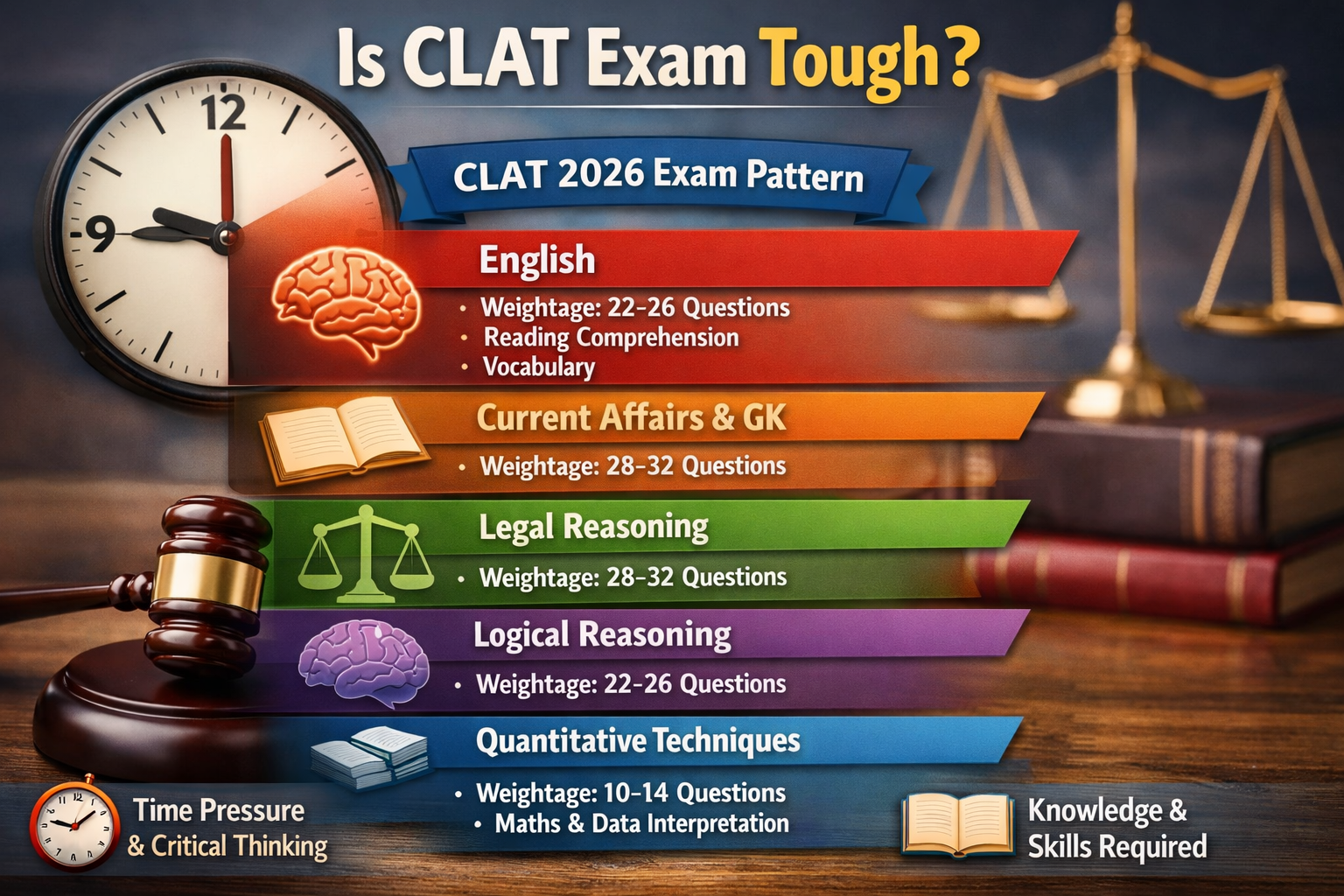
Stepping into the world of law entrance exams, particularly the CLAT, means understanding its structure inside and out. The CLAT 2026 exam pattern is designed to test a comprehensive range of skills, not just rote memorization. It’s a 2-hour online test, comprising 120 multiple-choice questions. Each question carries one mark, and there’s a negative marking of 0.25 marks for every incorrect answer. This negative marking is a significant factor contributing to why many perceive the CLAT exam tough; it punishes guesswork and demands accuracy.
Let’s break down the sections:
- English Language (22-26 questions): This section primarily assesses your reading comprehension, vocabulary, and grammar. Passages of around 450 words are followed by a series of questions.
- Current Affairs, including General Knowledge (28-32 questions): This is where many students feel the pressure. It covers current events, static GK, and historical events of significance. Passages derived from news, journalistic pieces, and non-fiction form the basis for questions. For those wondering how to tackle this, remember that consistent newspaper reading and dedicated study of high-yield topics are crucial. Want to know more about what to focus on? Check out our guide on 10 High-Yield GK Topics Every CLAT 2026 Aspirant Must Master.
- Legal Reasoning (35-39 questions): This section isn’t about prior legal knowledge, which often surprises students. Instead, it tests your ability to read factual scenarios, identify principles or rules embedded within them, and apply those principles to various situations. This critical thinking and analytical skill is a cornerstone of legal education.
- Logical Reasoning (28-32 questions): Here, you’ll encounter passages that require you to identify arguments, draw inferences, and assess the strength of reasoning. It’s all about analytical skills and understanding logical relationships.
- Quantitative Techniques (10-14 questions): Don’t let the name scare you. This section focuses on elementary mathematics, typically up to the 10th standard. It involves data interpretation, ratios, percentages, profit and loss, etc. If you’re looking for tricks and shortcuts, we have resources that can help you approach Quantitative Techniques in CLAT.
The integrated nature of the questions, where passages often weave together information from different disciplines, is another reason why some find the CLAT entrance exam challenges substantial. It requires not just knowledge, but the ability to synthesize information quickly and accurately under timed conditions.
“The CLAT isn’t just a test of what you know; it’s a marathon of how well you think under pressure. Speed and accuracy, combined with a deep understanding of concepts, are your biggest allies.” – An NLU Alumnus and Lawgic Coaching Mentor
When we talk about the CLAT exam difficulty, it’s not just the syllabus but also the exam format itself that contributes. Reading long passages and answering multiple questions based on them within tight deadlines is a skill that needs to be honed. This is why consistent practice with mock tests is non-negotiable. It helps you build stamina, improve speed, and refine your strategy for tackling each section efficiently.
How Difficult is the CLAT Exam? A Comparative Analysis
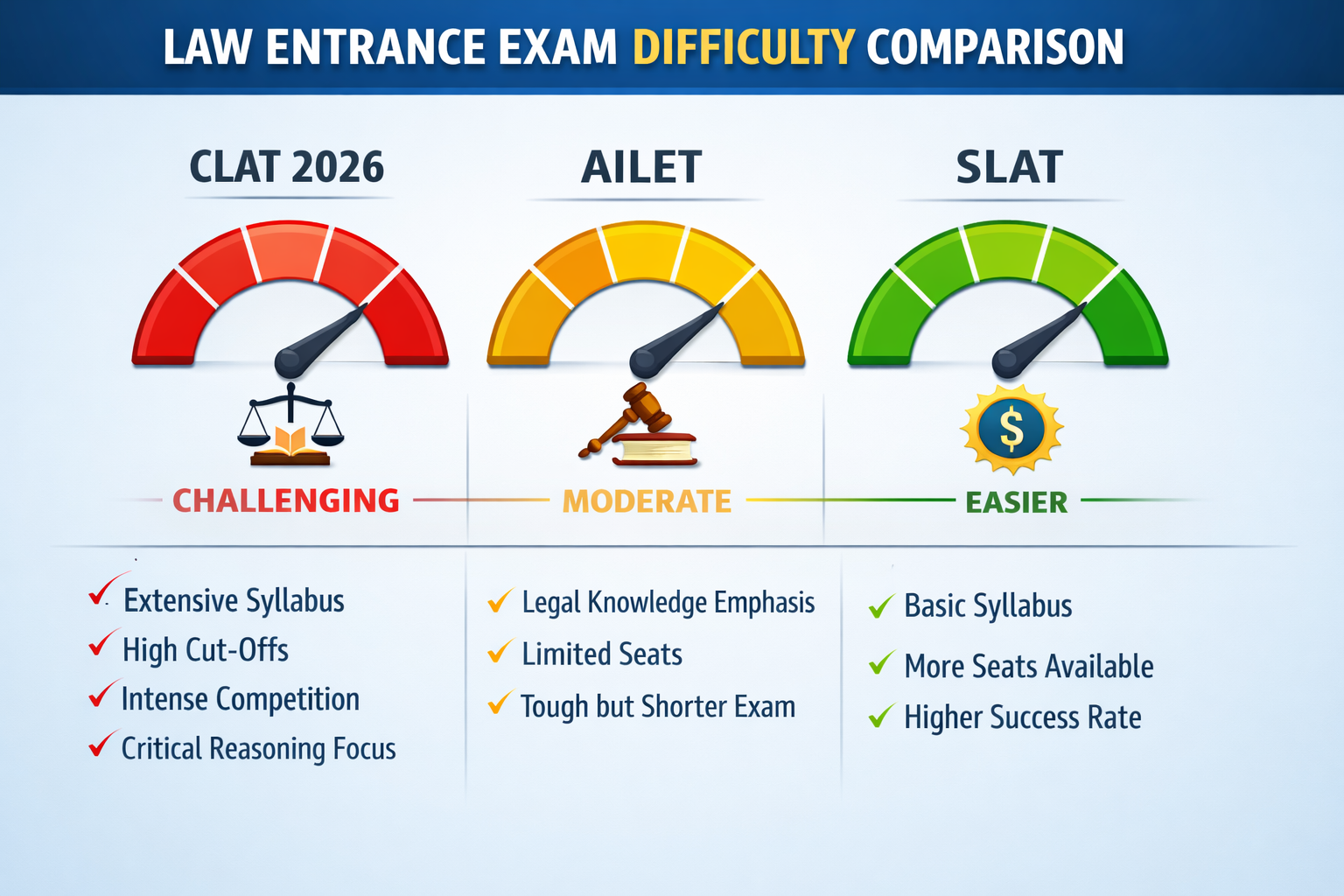
When aspirants ask “Is CLAT exam tough?”, they’re often implicitly comparing it to other competitive exams or even other law entrance exams. Let’s stack it up and see where the CLAT stands in terms of difficulty and what makes the CLAT success rate so challenging for many.
CLAT vs. Other Law Entrance Exams
While CLAT is the most sought-after law entrance exam for admission into the prestigious National Law Universities (NLUs), it’s not the only one. Exams like AILET (All India Law Entrance Test) for NLU Delhi and SLAT (Symbiosis Law Admission Test) for Symbiosis Law Schools are also significant.
- CLAT vs. AILET: Many find AILET slightly tougher due to its unpredictable nature and a smaller number of seats. While CLAT focuses on comprehension-based questions across all sections, AILET often has more direct, fact-based questions, especially in GK and Legal Aptitude. The Logical Reasoning section in AILET can also be more intricate. However, the preparation for both overlaps significantly. We even have a detailed comparison to help you understand the differences between AILET and CLAT coaching.
- CLAT vs. SLAT: SLAT is generally considered comparatively easier than CLAT and AILET. The questions are often more direct, and the competition, while still present, isn’t as fierce as for the top NLUs. It’s a good option for those seeking quality legal education outside the NLU system.
The CLAT’s difficulty stems not just from its syllabus or question pattern but also from the sheer volume of aspirants vying for a limited number of seats. In 2025, over 60,000 candidates appeared for roughly 2,600 seats across 24 NLUs [1]. This competitive law exam landscape means that even a small difference in marks can drastically change your rank and NLU admission process.
Section-wise Difficulty Analysis and Preparation Challenges
Each section of the CLAT entrance exam presents its own unique set of challenges:
- English Language: For students from non-English medium backgrounds, building strong reading comprehension and vocabulary can be a hurdle. Even for others, the nuanced nature of inferences and critical reasoning questions within passages can be tricky.
- Current Affairs including GK: This is often the most dreaded section. The vastness of the syllabus and the continuous updates in current events make it challenging. Many struggle with identifying what’s important and what’s not. This is why a curated approach to CLAT GK preparation is essential.
- Legal Reasoning: While no prior legal knowledge is required, the ability to quickly grasp abstract legal principles and apply them to new facts demands a specific type of analytical skill. It requires strong logical aptitude and the ability to differentiate between similar-sounding principles.
- Logical Reasoning: This section can be time-consuming. Puzzles and critical reasoning questions often require multiple reads and careful thought. Improving speed without sacrificing accuracy is a constant battle here.
- Quantitative Techniques: For humanities students, this can be a stumbling block. Although the math is basic, the data interpretation sets can be complex and demand quick calculations under pressure.
The overall CLAT exam difficulty is amplified by the negative marking and the tight time limit. You don’t just need to know the answers; you need to identify them quickly and accurately. This is where strategic test-taking skills come into play – knowing which questions to attempt, which to skip, and how to manage your time across sections.
“Many of our students initially find Legal Reasoning daunting because it’s a new way of thinking. But with consistent practice in applying principles, they realize it’s less about law and more about pure logic. It’s a skill you build, not just something you either have or don’t.” – Lead Faculty, Lawgic Coaching
Conquering the CLAT 2026: Strategies for Success

So, is CLAT exam tough? Yes, but with the right battle plan, it’s absolutely conquerable. At Lawgic Coaching, we believe that law school dreams shouldn’t be complicated. We focus on providing proven strategies that actually work. Here’s a holistic approach to making the CLAT less daunting and more achievable.
1. Master the CLAT Syllabus Breakdown
Your first step in CLAT qualifying strategies is a thorough understanding of the syllabus. Don’t just glance at it; internalize it.
- English: Focus on daily reading – newspapers, editorials, magazines, and non-fiction. This builds speed, comprehension, and vocabulary simultaneously. Practice identifying main ideas, author’s tone, and inferences.
- Current Affairs & GK: Make reading current events a habit. Use reliable sources, make notes, and revise regularly. For static GK, focus on high-yield topics like history, geography, and important awards. Remember, consistency is key here. We recommend exploring our insights on CLAT GK blueprint: What to read, what to skip.
- Legal Reasoning: Dive into mock passages. Understand legal maxims and principles, but more importantly, practice applying them to varying factual scenarios. This section is less about memorizing law and more about legal aptitude test skills.
- Logical Reasoning: Practice a wide variety of logical puzzles, critical reasoning, and syllogism questions. Work on identifying assumptions, conclusions, and strengthening/weakening arguments.
- Quantitative Techniques: Brush up on your 10th-grade math concepts. Focus on data interpretation, percentages, ratios, averages, and basic algebra. Speed and accuracy in calculations are paramount.
2. Strategic Preparation and Time Management
Effective CLAT preparation tips go beyond just studying. It’s about how you study.
- Create a Study Schedule: A well-structured timetable provides direction. Allocate dedicated time to each section, focusing more on your weaker areas. Balancing school and CLAT preparation can be tricky, but it’s doable with a three-month approach.
- Consistent Practice: This cannot be stressed enough. Solve previous year papers and mock tests regularly. This helps you understand the CLAT exam pattern, identify your strengths and weaknesses, and improve your time management. At Lawgic Coaching, we advocate for building exam day confidence mastering CLAT with consistent practice.
- Analyze Mock Tests: Don’t just take mocks; analyze them thoroughly. Understand where you went wrong, why you went wrong, and how to improve. This self-assessment is vital for progress.
- Revision is Key: Regular revision reinforces learning and prevents forgetting. Create short notes, flashcards, or mind maps for quick review.
3. Leveraging Technology for CLAT Preparation
In 2026, technology is your best friend in overcoming the CLAT exam difficulty.
- Online Coaching Platforms: Platforms like Lawgic Coaching offer flexible learning that fits your life. With expert guidance without the premium price tag, you can study at your own pace with real mentors from top NLUs. We provide comprehensive courses, live classes, and doubt-clearing sessions. If you’re looking for budget-conscious online CLAT coaching, we’ve got you covered.
- Practice Apps & Tools: Utilize apps for daily current affairs, vocabulary building, and logical reasoning puzzles. Many platforms offer section-wise tests and quizzes.
- Online Mock Tests: Accessing mock test series online allows you to simulate the actual exam environment, helping you build stamina and adapt to the computer-based format. You can even find best Telegram channels for free CLAT mocks.
4. Psychological Readiness and Mental Health
Addressing the question “is CLAT exam tough?” isn’t just about academics; it’s also about mental resilience. The pressure can be immense, and it’s crucial to manage it effectively.
- Stress Management: Practice mindfulness, meditation, or light exercise to cope with stress. Ensure you get adequate sleep. Burnout is real, and taking breaks is crucial to boost your CLAT prep.
- Positive Mindset: Believe in yourself. Doubt can be a huge hurdle. Surround yourself with positive influences and focus on your progress.
- Dealing with Setbacks: Don’t let a low score in a mock test demotivate you. View it as a learning opportunity. Everyone faces challenges, and it’s how you respond that defines your success. We help students with avoiding CLAT pitfalls and common misconceptions.
- Visualization: Imagine yourself cracking the exam and getting into your dream NLU. This can be a powerful motivator.
“We’ve helped thousands crack CLAT, and a common thread among successful students isn’t just their intelligence, but their ability to bounce back from setbacks and maintain a positive outlook. Mental strength is half the battle.” – Lawgic Coaching Founder
5. Personalized Mentorship and Expert Insights
One size does not fit all. This is especially true for CLAT preparation.
- Personalized Attention: A coaching platform that offers personalized mentorship can make a significant difference. Real mentors from top NLUs can provide guidance tailored to your specific needs and weaknesses.
- Expert Quotes and Strategies: Learn from those who have been there and done that. Expert faculty can offer insider insights into common traps, effective shortcuts, and advanced strategies for each section. Our approach is no cookie-cutter approach here; we focus on the personalized attention you deserve.
- Feedback and Guidance: Regular feedback on your performance, along with actionable advice, is invaluable. It helps you fine-tune your approach and stay on track.
6. Career Paths Beyond NLUs: A Broader Perspective
While NLUs are highly sought after, it’s important to remember that they are not the only path to a successful legal career. Many other excellent law schools, both private and public, offer quality legal education. Expanding your horizons can alleviate some of the pressure associated with the CLAT success rate. Your ultimate goal is a fulfilling legal career, and there are multiple routes to get there. Understanding the broader landscape of legal education admission can provide a more balanced perspective.
The CLAT entrance exam challenges are real, but with a structured approach, persistent effort, and a focus on both academic and psychological preparation, you can absolutely achieve your goal. Let’s build your law career together.
Conclusion: Making the CLAT Exam Achievable
So, when we circle back to the question, “Is CLAT exam tough?”, the answer remains nuanced. It is tough in its competitiveness, in the demanding nature of its time constraints, and in the depth of analytical skills it tests. However, it is far from impossible. Thousands of students crack it every year, and many of them started with the same doubts and fears you might have.
Your journey to a National Law University isn’t just about cramming facts; it’s a personal transformation. It’s about developing critical thinking, improving your analytical abilities, and building resilience. At Lawgic Coaching, we believe that with our flexible, accessible learning and expert guidance, you can turn this challenging journey into a triumph. We provide the proven strategies that actually work, ensuring you get the personalized attention you deserve.
Don’t let the perceived difficulty paralyze you. Instead, view it as a challenge waiting to be overcome. Start your preparation early, stay consistent, embrace technology, manage your mental well-being, and seek out mentors who genuinely care about your success. Remember, results speak louder than promises, and we are committed to helping you achieve yours.
Ready to turn your law school dreams into reality?
- Download our free study material: Get a head start on your CLAT preparation!
- Join our upcoming webinar: Learn essential strategies directly from NLU alumni.
- Get a personalized coaching consultation: Discover how Lawgic Coaching can tailor a plan just for you.
- Access our comprehensive mock test series: Practice makes perfect, and our mocks are designed to give you the edge.
Let’s embark on this journey together. Your success is our mission.