You’re in Class 11, scrolling through information about law careers, and suddenly a thought hits you: Should you start preparing for CLAT now, or is it too early?
Here’s the thing. While your friends are still figuring out what they want to do after school, you’re already thinking about your future in law. That’s not just smart planning. That’s the kind of forward thinking that separates successful CLAT aspirants from those who scramble in their final year.
Starting CLAT preparation from Class 11 isn’t just possible. It’s actually one of the smartest decisions you can make for your law career. You get two full years to build skills, develop reading habits, and master concepts without the pressure cooker environment of Class 12 boards looming over you.
But let’s be honest. You’re probably wondering if you’ll have enough time, whether it’s worth starting this early, and how you’ll manage school along with competitive exam prep. These are valid concerns, and we’re going to address every single one of them.
Key Takeaways
- Starting CLAT preparation from Class 11 gives you a significant competitive advantage with 18-24 months of focused preparation time
- Early preparation allows you to develop critical reading, analytical reasoning, and current affairs knowledge gradually without last-minute stress
- Balancing school studies with CLAT prep in Class 11 is manageable with proper time management and strategic planning
- The CLAT exam tests skills like comprehension, legal reasoning, and logical thinking that improve with consistent long-term practice
- A structured approach combining school curriculum, CLAT-specific preparation, and personal development creates well-rounded aspirants who perform better under exam pressure
Why CLAT Preparation from Class 11 Makes Perfect Sense

Let’s talk about something most coaching institutes won’t tell you upfront. The students who crack CLAT with top ranks rarely started preparing just six months before the exam. They built their foundation early, and Class 11 is the perfect time to start.
The Time Advantage You Can’t Ignore
When you begin CLAT preparation from Class 11, you’re giving yourself approximately 18 to 24 months of preparation time. Compare that to someone who starts in Class 12 with barely 8-10 months while juggling board exam pressure.
This extended timeline means you can:
Build skills gradually instead of cramming information. Reading comprehension doesn’t improve overnight. Legal reasoning requires you to think differently. These skills develop over months of consistent practice, not weeks of intense studying.
Develop a genuine reading habit. CLAT 2026 onwards heavily emphasizes reading comprehension across all sections. Students who start early have time to read newspapers daily, explore diverse topics, and actually enjoy the process rather than treating it as a chore.
Master current affairs without the backlog panic. Imagine starting your current affairs preparation in January 2026 versus July 2026. The first student covers events as they happen, makes notes systematically, and revises regularly. The second student faces a six-month backlog and spends precious time catching up instead of practicing.
Your Brain Is Ready for This Challenge
Class 11 is when your analytical and critical thinking abilities are developing rapidly. The CLAT exam tests exactly these skills. By aligning your preparation with this natural cognitive development phase, you’re working with your brain’s growth pattern, not against it.
Research shows that students who engage in analytical reasoning exercises during their mid-teens develop stronger problem-solving abilities that last a lifetime. CLAT preparation isn’t just about cracking one exam. It’s about building thinking skills that will serve you throughout law school and your legal career.
Less Pressure, Better Learning
Here’s what happens when you start CLAT preparation from Class 11. You study without the constant anxiety of “Will I have enough time?” You can experiment with different study techniques, figure out what works for you, and adjust your approach.
Class 12 brings board exam pressure, college applications, and family expectations. Starting in Class 11 means you’ve already built your foundation before this pressure wave hits. When your peers are just beginning their CLAT journey in Class 12, you’ll be revising and perfecting your skills.
The Compound Effect of Daily Practice
Think about this. If you spend just one hour daily on CLAT preparation starting from Class 11, that’s approximately 600-700 hours of focused preparation before the exam. Someone starting in Class 12 would need to study nearly 3 hours daily to match that, while also managing boards.
Small, consistent efforts compound over time. Reading one newspaper article daily for 18 months gives you exposure to thousands of topics. Solving five logical reasoning questions daily means you’ve tackled over 2,500 questions by exam time. This compound effect is the secret weapon of early starters.
Understanding the CLAT Exam: What You’re Actually Preparing For
Before diving into preparation strategies, you need to understand what CLAT actually tests. This isn’t your typical school exam where memorizing textbooks guarantees success.
The CLAT Exam Structure (2026 Pattern)
The Common Law Admission Test has evolved significantly. The current pattern focuses heavily on reading comprehension and application-based questions rather than rote learning.
Total Questions: 120 questions
Duration: 2 hours
Marking Scheme: +1 for correct answer, -0.25 for incorrect answer
The exam is divided into five sections:
| Section | Number of Questions | What It Tests |
|---|---|---|
| English Language | 22-26 questions | Reading comprehension, vocabulary in context, grammar |
| Current Affairs & General Knowledge | 28-32 questions | Contemporary events, static GK, passage-based questions |
| Legal Reasoning | 28-32 questions | Application of legal principles to factual situations |
| Logical Reasoning | 22-26 questions | Critical thinking, argument analysis, pattern recognition |
| Quantitative Techniques | 10-14 questions | Basic mathematics, data interpretation |
It’s All About Reading Comprehension Now
Here’s what changed in recent CLAT exams. Every section now includes passages followed by questions. Even current affairs questions come embedded in passages about recent events. Legal reasoning presents you with legal principles and fact scenarios. Logical reasoning gives you arguments to analyze.
What does this mean for your preparation? You need to become a strong, fast reader who can understand complex passages quickly and answer questions accurately under time pressure.
Students who start CLAT preparation from Class 11 have the luxury of developing this reading ability gradually. You can start with simpler articles and progressively move to complex legal judgments, economic analyses, and philosophical arguments.
Skills That Matter More Than Knowledge
CLAT doesn’t test how much you’ve memorized. It tests how well you can:
Comprehend and analyze information quickly. You’ll read passages on topics you’ve never encountered before and answer questions based purely on the passage content.
Apply principles to new situations. Legal reasoning gives you a legal principle and asks you to apply it to different fact patterns. This requires understanding, not memorization.
Think critically and spot logical flaws. Logical reasoning questions test whether you can identify assumptions, strengthen or weaken arguments, and recognize logical patterns.
Stay updated with the world around you. Current affairs isn’t about cramming facts. It’s about understanding issues, connecting events, and forming a comprehensive worldview.
These skills take time to develop. That’s exactly why starting your CLAT preparation journey in Class 11 gives you such a massive advantage.
Creating Your CLAT Preparation Strategy from Class 11
Now that you understand why early preparation makes sense and what CLAT actually tests, let’s build a practical strategy that works with your Class 11 schedule, not against it.
The Two-Phase Approach
When you have 18-24 months for preparation, you can’t maintain the same intensity throughout. That’s neither sustainable nor necessary. Instead, divide your CLAT preparation from Class 11 into two distinct phases.
Phase 1: Foundation Building (Class 11 – First 12 months)
This phase is about developing core skills and building knowledge gradually. The intensity is moderate, focusing on consistency over cramming.
Your priorities during this phase:
- Develop a daily reading habit
- Build vocabulary naturally through reading
- Start following current affairs systematically
- Understand basic legal concepts
- Strengthen logical reasoning fundamentals
- Keep your school academics strong
Phase 2: Intensive Preparation (Class 12 – Final 6-8 months)
This phase shifts to exam-specific preparation with higher intensity. You’ll focus on mock tests, time management, and perfecting your exam strategy.
Your priorities during this phase:
- Regular full-length mock tests
- Identifying and fixing weak areas
- Speed and accuracy improvement
- Revision of current affairs
- Exam strategy refinement
Balancing School and CLAT Preparation
Let’s address the elephant in the room. How do you manage school studies along with CLAT preparation without burning out?
The secret is integration, not addition. Many topics in your Class 11 curriculum actually help with CLAT preparation.
English class: Your literature lessons improve reading comprehension. The grammar you study applies directly to the English section of CLAT.
Mathematics: Basic math from school covers most of what you need for the Quantitative Techniques section.
History and Political Science: These subjects build the background knowledge that makes current affairs easier to understand and remember.
Economics: Understanding basic economic concepts helps you comprehend business news and economic policies in current affairs.
Instead of seeing school and CLAT prep as separate burdens, find the overlaps. When you study the Indian Constitution in your civics class, connect it to legal reasoning concepts. When you read about historical events, link them to current political situations.
Your Daily Study Schedule in Class 11
Here’s a realistic daily schedule that balances everything without overwhelming you:
Weekday Schedule (School Days):
- Morning (Before school): 30 minutes – Newspaper reading, focus on editorials and important news
- After school: 2-3 hours – School homework and revision
- Evening: 1-1.5 hours – CLAT-specific preparation (alternating between sections)
- Night: 30 minutes – Light reading (novels, articles, legal blogs)
Weekend Schedule:
- Morning: 2 hours – Focused CLAT section practice
- Afternoon: 2 hours – School studies and assignments
- Evening: 1 hour – Current affairs compilation and revision
- Flexible: 1 hour – Mock test practice (once a week)
This schedule gives you approximately 10-12 hours weekly for CLAT-specific preparation in Class 11, which is perfect for foundation building. You’re not exhausting yourself, but you’re making consistent progress.
Month-by-Month Preparation Plan
Let’s break down your Class 11 year into actionable monthly goals. This gives you clear targets without overwhelming you.
Months 1-3: Getting Started
Focus: Building basic habits and understanding CLAT structure
- Start reading one newspaper daily (The Hindu or Indian Express)
- Complete basic understanding of CLAT syllabus and exam pattern
- Begin vocabulary building through reading, not word lists
- Solve 5-10 logical reasoning questions daily
- Understand what legal reasoning questions look like
- Maintain a current affairs notebook
Months 4-6: Skill Development
Focus: Strengthening core skills across all sections
- Increase reading speed and comprehension
- Start reading legal articles and simple judgments
- Practice 10-15 questions daily from each section
- Build a systematic current affairs revision system
- Begin basic quantitative techniques practice
- Take your first diagnostic test to identify strengths and weaknesses
Months 7-9: Knowledge Expansion
Focus: Deepening understanding and building knowledge base
- Read diverse content (economics, science, international affairs)
- Study important legal concepts and landmark judgments
- Practice passage-based questions across all sections
- Strengthen weak areas identified in diagnostic tests
- Compile monthly current affairs notes
- Take sectional tests to track improvement
Months 10-12: Foundation Completion
Focus: Consolidating learning and preparing for intensive phase
- Complete first revision of all current affairs from the year
- Achieve target reading speed (450-500 words per minute)
- Solve previous year CLAT questions to understand difficulty level
- Build confidence in all five sections
- Create a personalized error log
- Take 2-3 full-length mock tests to assess readiness
This month-by-month breakdown ensures you’re never confused about what to focus on. Each phase builds on the previous one, creating a solid foundation for your intensive preparation in Class 12.
Section-Wise Preparation Strategy for Class 11 Students
Let’s get specific about how to prepare for each CLAT section when you’re starting from Class 11. Each section requires a different approach, and early starters have the advantage of mastering these approaches thoroughly.
English Language: Building Comprehension Naturally
The English section in CLAT isn’t about grammar rules you memorize. It’s about understanding complex passages quickly and answering questions accurately.
Reading Habit Development
Start with what interests you. If you enjoy sports, read sports columns. Interested in technology? Read tech articles. The topic matters less than the habit itself in the beginning.
Gradually diversify your reading:
- Week 1-4: Read topics you enjoy
- Week 5-8: Add one new topic area weekly
- Week 9-12: Include at least one challenging article daily
- Month 4 onwards: Read across diverse topics daily
Recommended Reading Sources:
- Newspapers: The Hindu, Indian Express (editorials and opinion pieces)
- Magazines: Frontline, Economic and Political Weekly
- Online: The Wire, Scroll.in, LiveLaw for legal content
- Books: Contemporary fiction and non-fiction
Vocabulary Building the Right Way
Forget those word lists with 5,000 words to memorize. That’s not how vocabulary works for CLAT.
Instead, learn words in context. When you encounter a new word while reading, note it down with the sentence it appeared in. This helps you understand usage, not just meaning.
Create a personal vocabulary journal:
- New word
- Sentence where you found it
- Meaning from context
- Dictionary definition
- Your own sentence using the word
Review this journal weekly. You’ll remember words much better when you’ve seen them in actual usage rather than isolated lists.
Grammar Through Application
The grammar tested in CLAT is practical, not theoretical. Focus on:
- Subject-verb agreement in complex sentences
- Pronoun usage and reference
- Modifier placement
- Sentence correction based on meaning
Your school English classes cover most of this. Pay attention there, and supplement with practice questions from CLAT-specific materials.
Current Affairs & General Knowledge: The Long Game
This is where starting CLAT preparation from Class 11 gives you the biggest advantage. Current affairs is cumulative. The more time you have, the better prepared you’ll be.
Daily Current Affairs Routine
Spend 30-45 minutes daily on current affairs. This isn’t negotiable if you want to score well in this section.
Morning routine:
- Read the newspaper (focus on front page, editorial, and opinion)
- Note down important events, government schemes, appointments
- Understand the context, not just the facts
Weekly routine:
- Compile your daily notes into weekly summaries
- Connect related events (how does one policy affect another?)
- Read one detailed analysis piece on the week’s major event
Monthly routine:
- Create a comprehensive monthly current affairs document
- Revise previous months’ compilations
- Take a monthly current affairs quiz to test retention
What to Cover in Current Affairs
CLAT current affairs isn’t random. Focus on these areas:
- National: Government policies, schemes, political developments
- International: Major global events, India’s foreign relations, international organizations
- Economics: Budget highlights, economic policies, banking sector news
- Environment: Climate change, environmental policies, conservation efforts
- Science & Technology: Major discoveries, space missions, technological developments
- Sports: Major tournaments, Indian achievements, sports policies
- Awards & Honors: Nobel Prizes, national awards, international recognition
- Legal Affairs: Important judgments, new laws, constitutional amendments
Static GK Foundation
While current affairs changes daily, static GK remains constant. Use your Class 11 year to build this foundation:
- Indian Constitution basics
- Important Articles and Amendments
- Fundamental Rights and Duties
- Government structure and functions
- Important historical events
- Geography basics (states, capitals, rivers, mountains)
- International organizations and their functions
Create flashcards or use spaced repetition apps for static GK. Review these regularly so they become second nature.
For a comprehensive understanding of high-yield topics, check out this guide on must-master GK topics for CLAT.
Legal Reasoning: Thinking Like a Lawyer
Legal reasoning intimidates many students because it seems completely new. But when you start in Class 11, you have time to develop legal thinking gradually.
Understanding Legal Reasoning Questions
Legal reasoning questions follow a pattern:
- A legal principle or rule is stated
- A factual situation is described
- You apply the principle to the facts and answer questions
You don’t need to know the law beforehand. The principle is given. Your job is to apply it correctly.
Developing Legal Reasoning Skills
Start by reading simple legal content:
- Legal blogs explaining recent judgments in simple language
- Landmark case summaries
- Articles on LiveLaw or Bar and Bench
Don’t try to memorize laws. Instead, understand:
- How legal principles are applied to facts
- How courts interpret laws
- How different fact patterns lead to different conclusions
Practice Strategy
Begin with 5 legal reasoning questions daily. After solving, don’t just check if you got it right. Understand why the correct answer is correct and why wrong options are wrong.
Create a legal reasoning journal:
- Important legal principles you encounter
- Interesting case scenarios
- Common question patterns
- Your mistakes and why you made them
As you progress, you’ll notice patterns. Certain types of principles appear repeatedly. Certain fact patterns are common. This pattern recognition comes from consistent practice over months.
Building Legal Awareness
Follow major Supreme Court cases. When a significant judgment comes, read simplified explanations. Understand:
- What was the legal question?
- What principle did the court apply?
- What was the reasoning?
- What was the final decision?
This builds your legal awareness and makes legal reasoning questions feel familiar rather than alien.
Logical Reasoning: Sharpening Your Analytical Mind
Logical reasoning tests your ability to think critically, analyze arguments, and spot patterns. These skills improve dramatically with practice, especially when you start early.
Types of Logical Reasoning Questions
CLAT logical reasoning includes:
- Argument analysis (assumptions, strengths, weaknesses)
- Critical reasoning (inferences, conclusions)
- Analytical reasoning (arrangements, groupings)
- Syllogisms and logical deductions
Daily Practice Routine
Solve 10-15 logical reasoning questions daily. Variety matters more than quantity in the beginning.
Monday: Assumption-based questions
Tuesday: Strengthen/weaken arguments
Wednesday: Inference questions
Thursday: Analytical reasoning puzzles
Friday: Mixed practice
Weekend: Timed section tests
Improving Logical Thinking
Beyond practice questions, develop logical thinking in daily life:
- When you read news, identify the assumptions behind arguments
- In debates or discussions, analyze the logical structure of arguments
- Play strategy games that require logical thinking
- Solve puzzles and brain teasers for fun
Common Mistakes to Avoid
Students often make these logical reasoning mistakes:
- Bringing outside knowledge instead of sticking to passage information
- Confusing assumptions with inferences
- Rushing through questions without fully understanding the argument
- Not eliminating obviously wrong options first
Starting in Class 11 gives you time to identify these patterns in your own thinking and correct them.
Quantitative Techniques: The Scoring Section
Many law aspirants fear math, but the quantitative section in CLAT is actually the easiest to score in. The math is basic, and the question count is low.
What Math You Actually Need
CLAT quantitative techniques covers:
- Basic arithmetic (percentages, ratios, averages)
- Simple algebra
- Data interpretation (tables, charts, graphs)
- Basic geometry (rarely)
Most of this is covered in your Class 10 and Class 11 math curriculum. You don’t need advanced calculus or complex trigonometry.
Preparation Strategy
If you’re comfortable with math:
- Revise Class 10 basics in the first month
- Practice 10 questions daily to maintain speed
- Focus on accuracy over speed initially
- Learn shortcuts and tricks for faster calculation
If math isn’t your strength:
- Dedicate 30 minutes daily to quantitative practice
- Start with basic concepts and build gradually
- Use your school math classes to strengthen fundamentals
- Don’t ignore this section; it’s highly scoring with practice
Data Interpretation Focus
Recent CLAT exams emphasize data interpretation. Practice reading:
- Tables with multiple variables
- Bar graphs and pie charts
- Line graphs showing trends
- Mixed data presentations
The key is extracting information quickly and accurately. This improves with regular practice.
For detailed strategies on approaching quantitative techniques, explore this comprehensive guide on CLAT quantitative methods.
Resources and Study Materials for Class 11 CLAT Preparation
Having the right resources makes your preparation efficient. But here’s the thing about starting early: you don’t need everything at once.
Essential Books for Foundation Building
For English and Reading Comprehension:
- Word Power Made Easy by Norman Lewis (vocabulary)
- High School English Grammar by Wren & Martin (grammar reference)
- Newspapers and magazines (daily reading practice)
For Legal Reasoning:
- Legal Awareness and Legal Reasoning for CLAT by A.P. Bhardwaj
- Universal’s Guide to CLAT Legal Aptitude
For Logical Reasoning:
- A Modern Approach to Logical Reasoning by R.S. Aggarwal
- Analytical Reasoning by M.K. Pandey
For General Knowledge:
- Manorama Yearbook (annual reference)
- Lucent’s General Knowledge
- Monthly current affairs magazines
For Quantitative Techniques:
- Quantitative Aptitude for Competitive Examinations by R.S. Aggarwal
- Your Class 11 mathematics textbook
You don’t need to buy all these books immediately. Start with newspapers, one logical reasoning book, and one legal reasoning book. Add others as you progress.
For a detailed comparison of the best CLAT books, check out this expert guide on CLAT preparation books.
Online Resources and Platforms
Free Resources:
- LiveLaw and Bar & Bench for legal news and judgments
- PIB (Press Information Bureau) for government updates
- PRS India for policy analysis
- YouTube channels for concept clarity
Paid Resources:
- Online coaching platforms for structured preparation
- Mock test series for practice
- Current affairs compilations
When choosing online resources, prioritize quality over quantity. It’s better to follow one good source consistently than to collect resources from everywhere and use none effectively.
The Role of Coaching in Class 11
Should you join coaching for CLAT preparation from Class 11? There’s no one-size-fits-all answer.
When coaching helps:
- You need structured guidance and can’t create a study plan independently
- You want expert mentorship from experienced faculty
- You benefit from peer learning and competitive environment
- You need regular assessment and feedback
When self-study works:
- You’re disciplined and can follow a schedule independently
- You have access to good study materials
- You can identify and fix your mistakes without external help
- Budget is a constraint
Here’s the thing. Coaching isn’t about someone teaching you everything. It’s about guidance, structure, and accountability. If you can create these for yourself, self-study works. If you need external support, coaching helps.
At Lawgic Coaching, we understand that Class 11 students need flexible preparation options. Your success is our mission, and we’ve designed programs that fit your school schedule while providing expert guidance from faculty who’ve been through top NLUs.
The key is choosing the right coaching approach. Online coaching offers flexibility that traditional classroom coaching can’t match. You can learn at your own pace, revisit concepts as needed, and access resources anytime.
Before making a decision, understand the common mistakes to avoid when choosing CLAT coaching.
Mock Tests and Self-Assessment Strategy
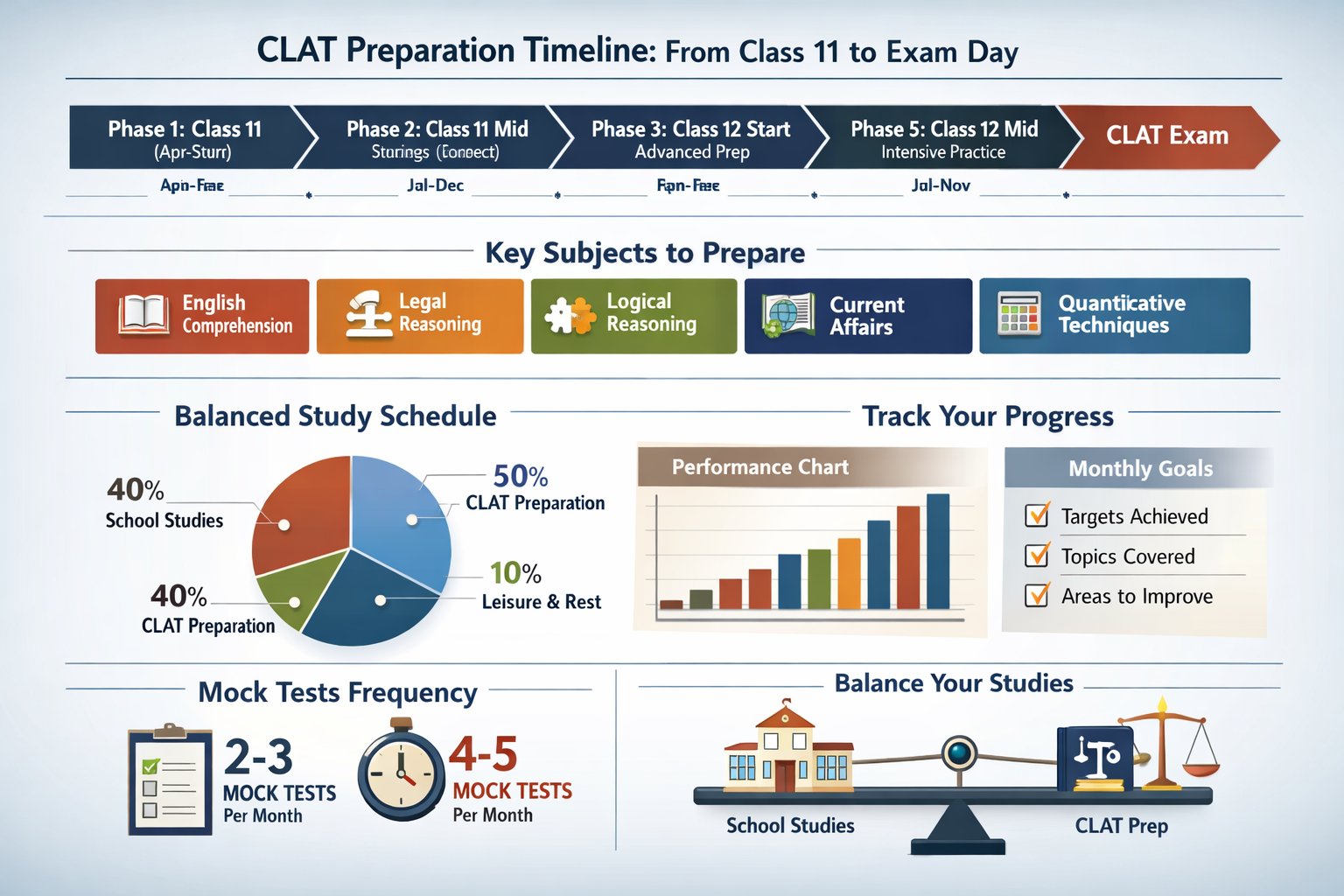
Mock tests are crucial for CLAT preparation, but their role differs in Class 11 versus Class 12.
Mock Test Strategy for Class 11
First 6 months: Focus on section-wise practice tests, not full-length mocks. You’re building skills, not testing exam readiness.
Months 7-9: Take one full-length mock test monthly. Use it to:
- Understand the exam format and pressure
- Identify which sections need more work
- Practice time management
- Build exam temperament
Months 10-12: Increase to two mock tests monthly. Start analyzing performance seriously.
How to Analyze Mock Tests Effectively
Taking mock tests without analysis is pointless. Here’s how to extract maximum value:
Immediately after the test:
- Note your initial feeling (was time sufficient? which section was hardest?)
- Don’t check answers immediately; take a 15-minute break
During analysis:
- Check answers and calculate score
- Categorize mistakes:
- Silly mistakes (knew the answer, marked wrong)
- Conceptual gaps (didn’t know how to solve)
- Time pressure errors (rushed and made mistakes)
- Guessing (completely unsure)
- Spend time understanding why correct answers are correct
- Revisit concepts for questions you got wrong
After analysis:
- Create an action plan for improvement
- Focus on fixing one weakness at a time
- Don’t get discouraged by low scores initially
- Track improvement over time, not absolute scores
Building Exam Temperament
CLAT isn’t just about knowledge. It’s about performing under pressure. Starting in Class 11 gives you time to build this mental strength.
Practice these habits:
- Timed practice sessions (even when practicing individual sections)
- Simulating exam conditions during mock tests (no phone, proper timing)
- Learning to move on from difficult questions
- Managing anxiety and staying calm under pressure
Mental preparation is as important as academic preparation. Students who start early have the advantage of building this gradually.
Common Challenges and How to Overcome Them
Let’s be real about the challenges you’ll face when starting CLAT preparation from Class 11. Awareness helps you prepare for them.
Challenge 1: Maintaining Consistency
The Problem: Initial enthusiasm fades after a few weeks. You start strong but struggle to maintain daily study habits.
The Solution:
- Start small (30 minutes daily) and increase gradually
- Link CLAT prep to existing habits (read newspaper with morning tea)
- Track your streak (even 20 minutes counts)
- Have an accountability partner (friend, parent, mentor)
- Focus on showing up, even on low-motivation days
Consistency beats intensity. Studying 1 hour daily for 12 months beats studying 4 hours daily for 2 months.
Challenge 2: Balancing School and CLAT Prep
The Problem: School assignments, tests, and projects sometimes clash with CLAT preparation. You feel torn between the two.
The Solution:
- Prioritize school during exam weeks; it’s okay to reduce CLAT prep temporarily
- Find overlaps between school curriculum and CLAT syllabus
- Use school holidays for intensive CLAT preparation
- Communicate with parents about your dual focus
- Don’t sacrifice sleep or health for either
Remember, school grades matter for some NLUs and for overall development. CLAT preparation shouldn’t come at the cost of completely neglecting school.
Challenge 3: Information Overload
The Problem: Too many books, websites, YouTube channels, coaching materials. You don’t know what to follow and end up overwhelmed.
The Solution:
- Choose one primary resource for each section
- Stick to it for at least 3 months before switching
- Limit yourself to 2-3 information sources for current affairs
- Avoid collecting resources; focus on using what you have
- Quality and consistency matter more than quantity
Challenge 4: Dealing with Self-Doubt
The Problem: You compare yourself to others, worry you’re not doing enough, or fear you won’t succeed.
The Solution:
- Avoid comparing your Chapter 1 to someone else’s Chapter 10
- Track your own progress (how much better are you than last month?)
- Celebrate small wins (finished a book, improved mock test score)
- Connect with positive, supportive people
- Remember why you chose law; reconnect with your motivation
Starting early means you have time to overcome setbacks. A bad mock test in Class 11 is a learning opportunity, not a disaster.
Challenge 5: Staying Updated Without Burnout
The Problem: Current affairs never stops. New events happen daily. You feel like you’re always behind.
The Solution:
- Accept that you can’t know everything; focus on major events
- Create a sustainable daily routine (30 minutes is enough)
- Revise regularly; revision matters more than reading everything once
- Take weekly breaks from current affairs to avoid burnout
- Focus on understanding issues, not memorizing facts
Beyond Academics: Holistic Development for Law Aspirants
CLAT preparation isn’t just about cracking an exam. You’re preparing for a career in law. Starting in Class 11 gives you time to develop as a well-rounded individual.
Developing Critical Thinking
Law school and legal practice require critical thinking. Start developing this now:
- Question assumptions in what you read
- Analyze arguments from multiple perspectives
- Engage in debates and discussions
- Write opinion pieces on current issues
- Think about the “why” behind events, not just “what”
Building Communication Skills
Lawyers need excellent communication skills. Use Class 11 to improve:
- Participate in class discussions and debates
- Join debating clubs or MUN (Model United Nations)
- Practice writing clearly and persuasively
- Read diverse content to expand your expression
- Present ideas confidently
Understanding the Legal World
Beyond CLAT preparation, understand what lawyers actually do:
- Read about different legal career paths
- Follow interesting legal cases and judgments
- Understand how courts function
- Learn about different areas of law
- Connect with lawyers or law students if possible
This broader understanding keeps you motivated and helps you make informed decisions about your legal career.
Taking Care of Mental and Physical Health
Long-term preparation requires sustained energy. Build healthy habits:
- Regular exercise or physical activity
- Adequate sleep (7-8 hours minimum)
- Healthy eating habits
- Breaks and relaxation time
- Hobbies and social connections
Burnout is real, and it’s counterproductive. Students who maintain balance perform better in the long run.
Technology and Tools for Efficient CLAT Preparation
Use technology smartly to enhance your preparation, especially when starting from Class 11.
Useful Apps and Tools
For Current Affairs:
- News aggregator apps (Inshorts for quick updates, full newspapers for depth)
- YouTube channels for weekly news analysis
- Podcast apps for listening to news while commuting
For Vocabulary:
- Anki or Quizlet for spaced repetition flashcards
- Dictionary apps with word-of-the-day features
- Reading apps to track and highlight new words
For Time Management:
- Calendar apps for scheduling study sessions
- Pomodoro technique apps for focused study
- Habit tracking apps to maintain consistency
For Practice:
- Mock test platforms for regular assessment
- Question practice apps for daily solving
- PDF readers with annotation features for making notes
Digital Note-Making Strategies
Whether you prefer physical notebooks or digital notes, have a system:
- Separate notes for each CLAT section
- Current affairs organized by month
- Vocabulary journal with regular review
- Error log for mistakes in practice questions
- Revision notes for quick review
Digital notes offer searchability and easy organization. Physical notes offer better retention for some learners. Choose what works for you.
Online Learning Advantages
Online CLAT coaching offers unique advantages for Class 11 students:
- Learn at your own pace and schedule
- Revisit recorded lectures when needed
- Access resources anytime, anywhere
- Balance school and preparation more easily
- Often more affordable than traditional coaching
The flexibility of online learning suits Class 11 students who need to balance multiple priorities.
Success Stories: Learning from Those Who Started Early
Let’s look at real patterns from successful CLAT aspirants who started their preparation from Class 11.
What Top Rankers Did Differently
Research into CLAT toppers reveals common patterns among those who started early:
They read extensively. Not just newspapers, but books, magazines, diverse content. This built comprehension skills and general awareness naturally.
They maintained consistency over intensity. Rather than marathon study sessions, they studied regularly with moderate intensity.
They stayed connected to school. Top performers didn’t neglect school studies. They found ways to integrate both.
They practiced regularly. Daily practice of questions became a habit, not a burden.
They learned from mistakes. Every mock test and practice session was analyzed for improvement.
They stayed mentally healthy. They had hobbies, social connections, and balanced lives.
The Advantage of Starting Early
Students who began CLAT preparation from Class 11 reported:
- Less stress during Class 12 boards
- Better performance in mock tests
- Stronger foundation in all sections
- More confidence on exam day
- Better understanding of legal concepts
- Higher success rates in cracking CLAT
The data is clear. Early starters have a significant advantage, not because they’re inherently smarter, but because they have time to build skills properly.
Creating Your Personalized Preparation Plan

Every student is different. Your CLAT preparation plan should reflect your strengths, weaknesses, and circumstances.
Self-Assessment: Know Your Starting Point
Before creating a plan, assess yourself honestly:
Strengths:
- Which subjects do you naturally excel in?
- What skills do you already have? (reading speed, logical thinking, math ability)
- What motivates you?
Weaknesses:
- Which areas need significant improvement?
- What challenges do you face? (time management, consistency, specific subjects)
- What distracts you from studying?
Resources:
- How much time can you realistically dedicate daily?
- What study materials do you have access to?
- Can you afford coaching, or will you self-study?
Setting Realistic Goals
Set both long-term and short-term goals:
Long-term goal: Target NLU or CLAT score
Medium-term goals (quarterly):
- Complete specific syllabus portions
- Achieve target reading speed
- Score certain percentages in sectional tests
Short-term goals (weekly):
- Read newspaper daily
- Complete X number of practice questions
- Finish one chapter of a book
- Compile weekly current affairs
Write down your goals and review them monthly. Adjust based on progress.
Flexibility and Adaptation
Your Class 11 plan should be flexible. You’ll discover what works and what doesn’t. Be willing to adapt:
- If a study technique isn’t working, try something else
- If a resource isn’t helpful, switch to a better one
- If you’re consistently missing goals, make them more realistic
- If something is working well, do more of it
The advantage of starting early is having time to experiment and find your optimal preparation strategy.
The Final Months: Transitioning from Class 11 to Class 12
As your Class 11 year ends, you’ll transition into the intensive preparation phase. Here’s how to make that transition smooth.
Consolidating Your Class 11 Preparation
In the final months of Class 11:
- Revise all current affairs from the year
- Take a comprehensive assessment to identify remaining weak areas
- Create a solid revision system for what you’ve learned
- Organize all your notes and materials
- Set clear goals for Class 12 preparation
Planning Your Class 12 Preparation Strategy
Your Class 12 strategy will be more intensive:
- Increase daily CLAT preparation time to 3-4 hours
- Take mock tests more frequently (weekly by the final months)
- Focus heavily on weak areas
- Balance board exam preparation with CLAT prep
- Start serious revision of all topics
Maintaining Momentum
The transition from foundation building to intensive preparation requires mental adjustment:
- Understand that intensity will increase, and that’s okay
- Keep your motivation strong by remembering your goals
- Stay connected with your support system
- Don’t panic if you feel unprepared; you have time
- Trust the foundation you’ve built in Class 11
Frequently Asked Questions About CLAT Preparation from Class 11
Is Class 11 too early to start CLAT preparation?
Not at all. Class 11 is actually the ideal time to start. You get 18-24 months to build skills gradually, develop reading habits, and master concepts without the pressure of boards. Early starters consistently perform better because they have time to develop genuine understanding rather than cramming.
How many hours should I study for CLAT in Class 11?
In Class 11, aim for 1-2 hours of dedicated CLAT preparation daily, plus 30 minutes for newspaper reading. This gives you approximately 10-15 hours weekly, which is sufficient for foundation building. Quality and consistency matter more than quantity at this stage.
Can I prepare for CLAT without coaching in Class 11?
Yes, self-study is definitely possible, especially in Class 11 when you’re building foundations. However, structured guidance from quality coaching can provide direction, regular assessment, and expert mentorship. Online coaching offers a middle ground with flexibility and affordability. The choice depends on your learning style and discipline level.
Should I focus more on school or CLAT in Class 11?
Balance both. Your school curriculum actually helps with CLAT preparation in many areas. Don’t sacrifice school completely for CLAT. Instead, find overlaps and manage your time efficiently. School should get priority during exam weeks, while CLAT preparation can intensify during holidays.
What if I decide later that law isn’t for me?
Starting CLAT preparation doesn’t lock you into law. The skills you develop (critical thinking, reading comprehension, analytical reasoning, current affairs knowledge) are valuable for any competitive exam or career. If you change your mind, the time isn’t wasted. Plus, starting early gives you time to explore whether law truly interests you.
How important are mock tests in Class 11?
Mock tests in Class 11 serve a different purpose than in Class 12. Take them monthly to understand the exam format, identify weak areas, and practice time management. Don’t stress about scores. Focus on learning from each test. Intensive mock test practice comes in Class 12.
Which section should I focus on first?
Start with English and current affairs because these require consistent daily effort over time. Simultaneously begin logical reasoning practice. Legal reasoning and quantitative techniques can be intensified later. However, give some attention to all sections from the beginning to understand where you stand.
Conclusion: Your Journey Starts Now
Starting CLAT preparation from Class 11 isn’t just about getting a head start. It’s about building a solid foundation, developing critical skills, and approaching your law career with thoughtfulness and preparation.
You have something that students starting in Class 12 don’t have: time. Time to read widely, think deeply, practice consistently, and develop genuinely. Time to make mistakes and learn from them without panic. Time to build not just exam-taking skills, but the intellectual abilities that will serve you throughout law school and your legal career.
Here’s what you need to remember as you begin this journey:
Start small and build gradually. You don’t need to study 5 hours daily from day one. Begin with 30 minutes of newspaper reading and 1 hour of focused preparation. Increase as you build the habit.
Consistency beats intensity. Studying regularly for 18 months will take you further than sporadic intense sessions. Show up daily, even when motivation is low.
Balance is crucial. Don’t sacrifice school, health, or personal development for CLAT preparation. The most successful students maintain balance.
Focus on understanding, not memorizing. CLAT tests application and analysis, not rote learning. Build genuine comprehension.
Stay connected to your why. Remember why you want to study law. This motivation will carry you through challenging days.
Seek guidance when needed. Whether through coaching, mentors, or online communities, don’t hesitate to ask for help. At Lawgic Coaching, we’ve helped thousands crack CLAT with personalized attention and expert guidance from top NLU faculty. We understand the unique needs of Class 11 students and offer flexible learning that fits your life.
Track your progress. Regular self-assessment helps you stay on track and adjust your strategy as needed.
Be patient with yourself. Improvement takes time. Some skills develop slowly. Trust the process.
The path from Class 11 to CLAT success is long, but it’s also rewarding. Every newspaper article you read, every logical reasoning question you solve, every current affairs note you make is building toward your goal. Small daily actions compound into significant results.
You’re not just preparing for an exam. You’re developing as a thinker, a reader, an analyst. You’re building skills that will serve you in law school, in legal practice, and in life.
Your journey to becoming a lawyer begins now, not on exam day. Starting your CLAT preparation from Class 11 means you’re taking that journey seriously, giving it the time and attention it deserves.
The question isn’t whether you can start CLAT preparation from Class 11. The question is: are you ready to commit to this journey and give yourself the best possible chance at success?
If the answer is yes, then welcome to your CLAT preparation journey. Let’s build your law career together, one day at a time, with proven strategies that actually work and expert guidance without the premium price tag.
Your success is our mission. And your journey starts today.
CLAT Preparation Readiness Calculator
Discover how ready you are to start your CLAT journey from Class 11