Picture this: You’re sitting in the exam hall, staring at a dense 450-word passage about corporate governance, and you have roughly five minutes to read it, understand the underlying argument, and answer multiple questions that test your ability to spot subtle logical flaws. Welcome to CLAT Logical Reasoning in 2026.
The game has changed completely. If you’re still preparing with old puzzle books or memorizing seating arrangement formulas, you’re preparing for the wrong exam. Since 2020, the CLAT Logical Reasoning section has undergone a fundamental transformation from straightforward formula-based puzzles to passage-based critical reasoning that demands genuine analytical thinking[6]. This isn’t about shortcuts in the traditional sense anymore. It’s about smart strategies that help you think faster and more accurately under pressure.
Here’s the thing: shortcuts still matter, but they’ve evolved. The shortcuts that work now aren’t about memorizing patterns or applying formulas. They’re about training your brain to identify logical structures quickly, eliminate wrong answers efficiently, and make precise judgments when the clock is ticking. Your success is our mission, and we’re here to show you exactly how to master this section with proven strategies that actually work.
Key Takeaways
- CLAT Logical Reasoning now focuses on passage-based critical reasoning rather than traditional puzzles, requiring comprehension and analytical skills over formula memorization
- The section contains 22-26 questions worth approximately 20% of total marks, with each question based on passages of around 450 words
- Effective shortcuts involve strategic reading techniques, systematic elimination methods, and pattern recognition in argument structures rather than mechanical formula application
- Success depends on regular practice with passage-based questions, thorough mock test analysis, and developing the ability to spot subtle logical flaws
- Time management requires balancing careful passage comprehension with efficient question solving, typically allocating 24-26 minutes for the entire section
Understanding the New CLAT Logical Reasoning Landscape
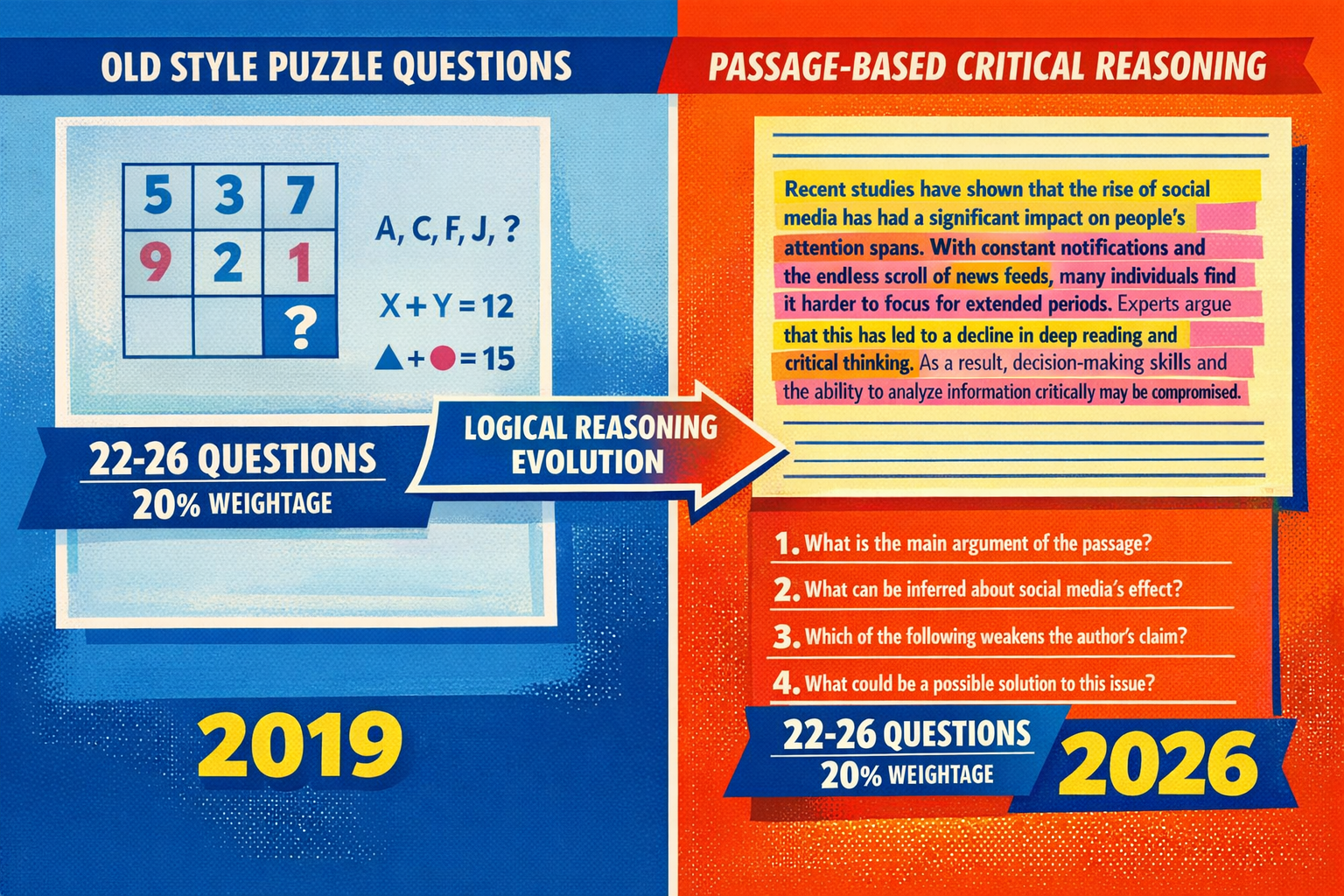
Let’s be honest: if you’re using preparation materials from before 2020, you’re wasting precious time. The CLAT Logical Reasoning section you’ll face in 2026 bears little resemblance to what students tackled just a few years ago.
What Changed and Why It Matters
The Consortium of National Law Universities completely redesigned the section to align with what law schools actually need: students who can analyze complex arguments, identify hidden assumptions, and evaluate evidence critically[6]. Traditional reasoning books focusing on series, blood relations, and directions are no longer aligned with current exam requirements.
Instead, CLAT 2026 Logical Reasoning contains approximately 22-26 questions with roughly 20% weightage, each based on passages of approximately 450 words[2][8]. These aren’t simple puzzles. They’re sophisticated critical reasoning challenges that test your ability to understand arguments in context.
The questions are now principle-driven and concept-focused rather than predictable and formulaic, requiring subject knowledge and critical thinking rather than pattern recognition[4]. You’ll encounter passages about legal principles, ethical dilemmas, policy debates, and real-world scenarios that demand nuanced analysis.
The Five Question Types You’ll Actually Face
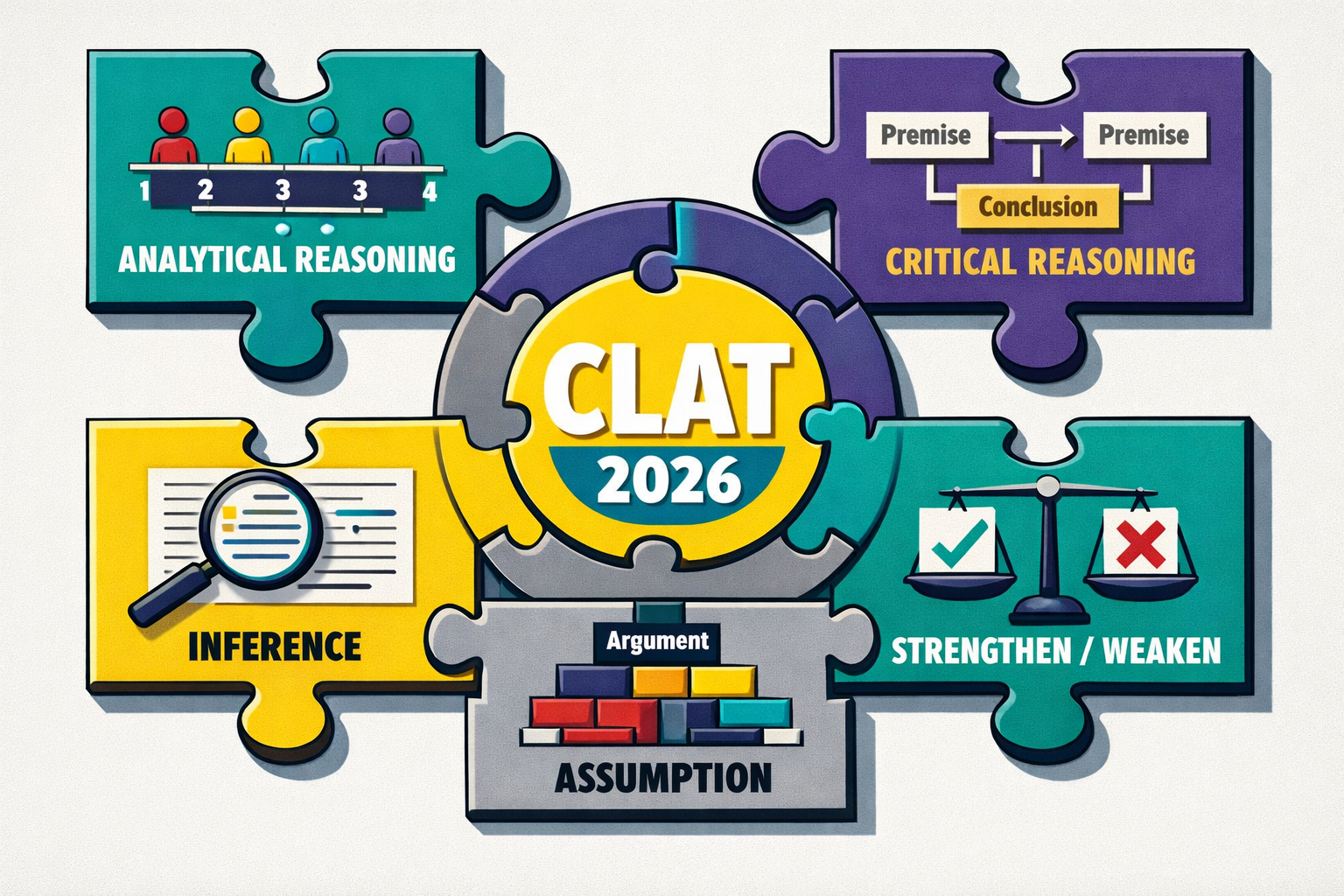
While the syllabus theoretically includes analytical topics like puzzles, seating arrangements, syllogisms, coding-decoding, and blood relations, along with critical reasoning topics like assumptions, inferences, and arguments, the emphasis has shifted dramatically toward critical reasoning[2][3].
Critical Reasoning Questions form the backbone of the section. These passages present arguments, and you need to identify assumptions, strengthen or weaken conclusions, draw inferences, or evaluate reasoning quality.
Inference-Based Questions require you to determine what logically follows from the passage without adding external information or making unsupported leaps.
Assumption Identification tests whether you can spot unstated premises that the argument depends on to reach its conclusion.
Argument Evaluation asks you to assess the strength of reasoning, identify flaws, or determine what additional information would help evaluate the argument.
Principle Application presents a general principle and asks you to apply it to specific scenarios or identify which scenario best illustrates the principle.
The compressed 120-question, 120-minute format means the margin for “almost right” has disappeared. Understanding must be precise, and shortcuts that yield approximate answers are insufficient[1].
Strategic Reading: The Foundation of All CLAT Logical Reasoning Shortcuts
You know what makes the difference between students who struggle and those who excel? It’s not reading speed. It’s comprehension under pressure.
Success depends on comprehension under pressure rather than reading speed alone. Questions test the ability to make logical choices while managing time constraints, not just speed[1]. This is where strategic reading becomes your most powerful shortcut.
The Three-Pass Reading Method
First Pass: Structure Scan (30 seconds)
Before diving into details, scan the passage to identify its structure. Is it presenting an argument? Describing a problem and solution? Comparing different viewpoints? Understanding the framework helps you know what to look for.
Look for transition words like “however,” “therefore,” “although,” and “consequently.” These signal logical relationships and argument direction. Identify the main claim early so you can evaluate everything else in relation to it.
Second Pass: Active Reading (2-3 minutes)
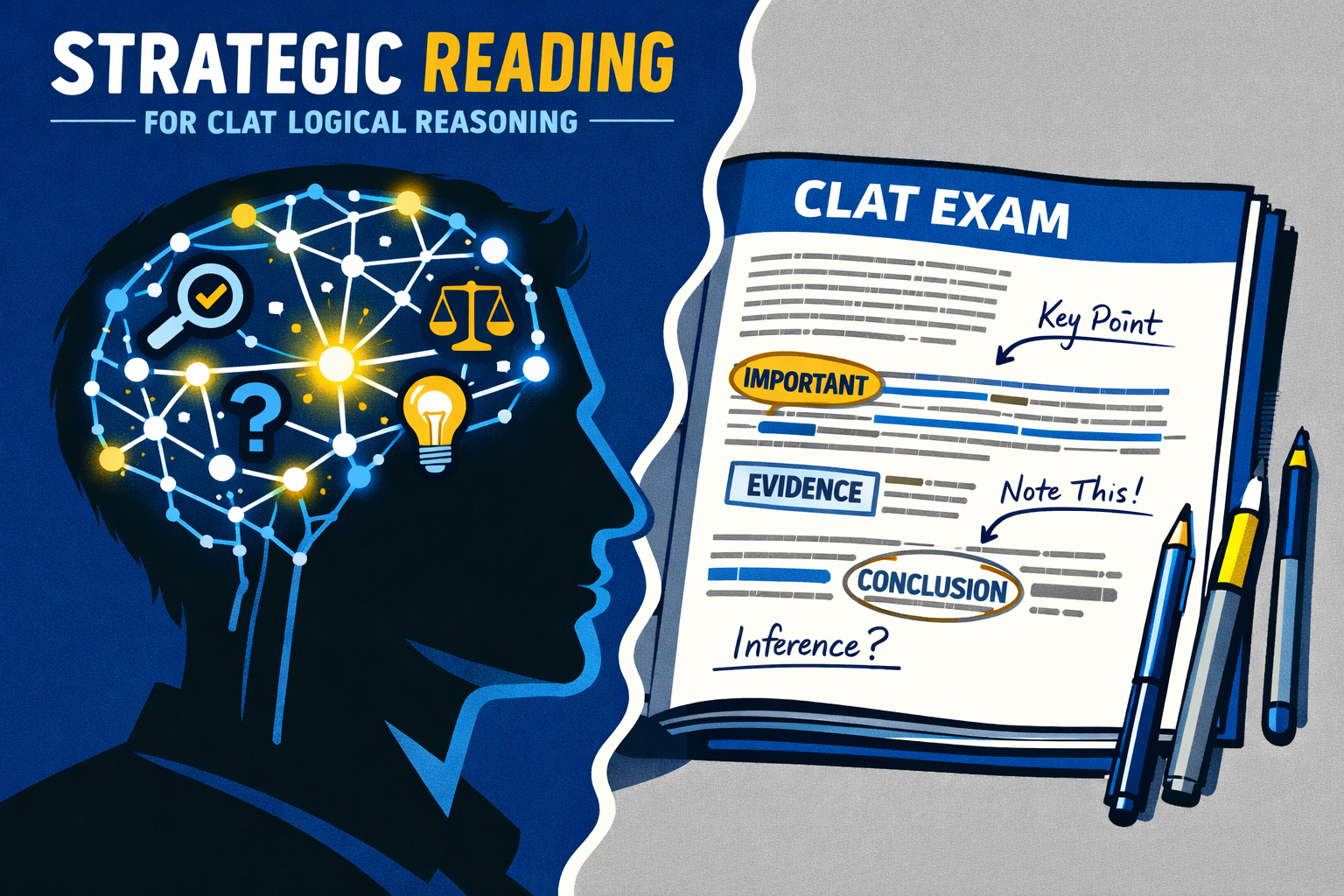
Now read carefully, but actively. This means engaging with the content, not just absorbing words. Ask yourself questions as you read: What’s the author trying to prove? What evidence supports this? What assumptions are being made?
Mark or mentally note key elements: the main conclusion, supporting premises, counterarguments mentioned, qualifiers that limit the scope, and any evidence or examples provided. Don’t just highlight everything. Be selective about what truly matters for understanding the logical structure.
Third Pass: Question-Focused Review (as needed)
After reading the question, return to the passage with laser focus. You’re not re-reading everything. You’re locating the specific portion that addresses the question and analyzing it in depth.
This targeted approach saves time while ensuring accuracy. You’ve already built a mental model of the argument, so you know exactly where to look.
Annotation Techniques That Actually Work
Physical annotation isn’t possible in the computer-based test, but mental annotation is. Train yourself to categorize information as you read:
C for Conclusion or main claim
P for Premises or supporting points
E for Evidence or examples
O for Objections or counterarguments
A for Assumptions (things taken for granted)
Practice this system until it becomes automatic. During preparation, actually write these markers. During the exam, your trained brain will automatically categorize information, making recall instant.
Identifying Argument Structure in Seconds
Most logical reasoning passages follow predictable argument structures. Recognizing these patterns is a genuine shortcut that saves precious minutes.
The Classic Argument: Premise 1 + Premise 2 → Conclusion. Look for the “therefore” moment where the author makes their main point based on earlier information.
The Problem-Solution: Issue is presented → Solution is proposed → Justification for why this solution works. Questions often ask about assumptions in the solution or alternative approaches.
The Comparison: Option A is described → Option B is described → Judgment about which is better. Watch for unstated criteria being used to make the comparison.
The Causal Claim: X happened → Y happened → Therefore X caused Y. These are goldmines for assumption questions because correlation doesn’t prove causation.
Effective preparation now requires focus on elimination of almost-correct options, catching one-word flaws, tone shifts, and overgeneralization rather than learning formulaic shortcuts[1][6].
Elimination Techniques: Your Most Powerful CLAT Logical Reasoning Shortcut
Here’s something we tell every student at Lawgic Coaching: in CLAT 2026, finding the right answer is often harder than eliminating three wrong ones. Master elimination, and you’ve mastered the section.
The Systematic Elimination Framework
Step 1: Eliminate the Extreme
Wrong answers in logical reasoning often contain extreme language that the passage doesn’t support. Words like “always,” “never,” “all,” “none,” “must,” and “impossible” should raise immediate red flags unless the passage explicitly uses such definitive language.
If the passage says “many students benefit from structured study schedules,” an answer choice saying “all students must follow structured schedules” goes too far. Eliminate it immediately.
Step 2: Spot the Scope Shift
This is where most students lose points. An answer choice might be factually true or logically sound but fall outside the passage’s scope. If the passage discusses environmental regulations in manufacturing, an answer about agricultural pollution might seem related but is actually off-topic.
Train yourself to ask: “Does this answer address exactly what the passage discusses, or has it shifted to a related but different topic?”
Step 3: Catch the Reversal
Some wrong answers cleverly reverse the passage’s logic. If the passage argues “increased funding improves educational outcomes,” a wrong answer might say “improved educational outcomes require increased funding.” The direction of causation matters.
Similarly, watch for answers that flip necessary and sufficient conditions. “All lawyers have law degrees” doesn’t mean “all people with law degrees are lawyers.”
Step 4: Identify Unsupported Inferences
The passage provides specific information. Wrong answers often make leaps beyond what’s stated or reasonably implied. If the passage mentions that “Company X’s profits increased after implementing policy Y,” an answer claiming “Policy Y is the most effective profit-increasing strategy available” makes an unsupported comparison.
Ask yourself: “Can I point to specific text that supports this, or am I assuming additional information?”
The One-Word Flaw Technique
Legal Reasoning and Logical Reasoning now lean into real-life context, subtle tone shifts, and less obvious conclusions rather than black-and-white logic[1]. This means single words can make the difference between right and wrong answers.
Practice identifying qualifier words that change meaning:
“Some” vs. “Most” vs. “All” – These create completely different logical relationships
“Can” vs. “Must” vs. “Should” – These indicate different levels of necessity
“Likely” vs. “Certainly” vs. “Possibly” – These express different confidence levels
“Primary” vs. “Contributing” vs. “Sole” – These indicate different causal roles
During mock tests, when you review wrong answers, circle the specific word that made the difference. You’ll start recognizing these patterns instinctively.
Creating Your Elimination Checklist
Before selecting an answer, run through this mental checklist:
- Does this answer stay within the passage’s scope?
- Does it avoid extreme language unsupported by the text?
- Does it maintain the correct logical direction?
- Can I point to specific passage content supporting it?
- Does it answer the actual question asked?
If an answer passes all five checks and others don’t, you’ve found your answer without necessarily being 100% certain it’s correct. You’ve eliminated the wrong ones, which is often faster and more reliable.
Question-Type Specific Shortcuts for CLAT Logical Reasoning
Different question types require different approaches. Let’s break down the strategies that work for each type you’ll encounter.
Assumption Questions: Finding the Hidden Foundation
Assumption questions ask what the argument takes for granted. The correct answer will be something that, if false, would make the argument fall apart.
The Negation Test Shortcut
This is your most reliable technique. Take each answer choice and negate it (make it false). Then ask: “If this were false, would the argument still work?”
If the argument collapses when you negate the answer choice, you’ve found the assumption. If the argument still stands, it’s not a necessary assumption.
Example: Argument says “We should hire more customer service staff because customer complaints have increased.”
Test answer: “Hiring more staff will reduce complaints.”
Negate it: “Hiring more staff will NOT reduce complaints.”
If that’s true, the argument makes no sense. So this is indeed an assumption.
The Gap-Bridge Technique
Look for gaps between the premises and conclusion. What logical jump is the author making? The assumption often bridges that gap.
If the premise discusses “student test scores” and the conclusion is about “educational quality,” the assumption likely connects these concepts, perhaps that “test scores reflect educational quality.”
Inference Questions: Staying Within the Lines
Inference questions are tricky because the correct answer often seems too obvious or too conservative. Remember: you’re looking for what must be true based on the passage, not what might be true or what seems reasonable.
The Conservative Answer Principle
When stuck between two answers that both seem supported, choose the more conservative one. The correct inference rarely goes beyond what the passage directly supports.
If the passage says “enrollment increased by 15% this year,” the safe inference is “more students enrolled this year than last year,” not “the institution is becoming more popular” (which assumes a reason for the increase).
The Combination Technique
Sometimes the correct inference requires combining two pieces of information from the passage. Practice identifying when the question requires you to put multiple facts together.
If the passage states “All scholarship recipients maintain above 3.5 GPA” and “Priya is a scholarship recipient,” you can safely infer “Priya maintains above 3.5 GPA.”
Strengthen/Weaken Questions: Manipulating Argument Force
These questions ask you to make an argument stronger or weaker by adding information.
The Relevance Filter
The correct answer must be directly relevant to the argument’s reasoning. If the argument is about economic factors, an answer about social factors probably won’t strengthen or weaken it effectively.
Ask: “Does this new information make the conclusion more or less likely to be true?”
The Alternative Explanation Strategy
To weaken an argument, look for alternative explanations for the evidence presented. If the argument claims “Sales increased because of our new marketing campaign,” pointing out that “a competitor went out of business the same month” provides an alternative explanation, weakening the original claim.
To strengthen, eliminate alternative explanations or provide additional supporting evidence.
Principle Application: Matching Abstract to Concrete
These questions present a general principle and ask you to apply it, or they present a situation and ask which principle it illustrates.
The Element-Matching Technique
Break the principle into its component parts. If the principle says “Actions are ethical when they maximize benefit for the greatest number while respecting individual rights,” you need to match both elements: maximizing collective benefit AND respecting rights.
An answer that only addresses one element is wrong. You need complete alignment.
The Counterexample Test
For each answer choice, try to think of a scenario that fits the choice but violates the principle, or vice versa. If you can find such a scenario, the answer doesn’t properly capture the principle.
Time Management Strategies for CLAT Logical Reasoning Success
You’ve got roughly 24-26 minutes for the Logical Reasoning section if you’re allocating time proportionally across CLAT 2026. That’s about one minute per question, including passage reading time. Sounds impossible? It’s not, with the right approach.
The Sectional Time Allocation Method
Don’t treat all questions equally. Some passages and questions are objectively harder than others. Your strategy should account for this.
Easy Passages (40% of section): 45 seconds per question
These are straightforward arguments with clear structure. You’ll recognize them quickly because the main point is obvious, the logic is transparent, and the questions are direct.
Spend minimal time on passage reading (90 seconds max), then move through questions quickly. These are your confidence builders and time banks.
Medium Passages (40% of section): 60 seconds per question
Most passages fall here. They require careful reading and thoughtful elimination but don’t involve highly complex reasoning.
Allocate standard time: 2-3 minutes for passage reading, 45-60 seconds per question.
Hard Passages (20% of section): 75-90 seconds per question
These involve complex arguments, multiple viewpoints, or subtle logical relationships. You’ll know them because you’ll need to reread portions to fully grasp the reasoning.
Here’s the key: if a passage is genuinely difficult, it’s difficult for everyone. Don’t panic. Allocate extra time, but also know when to make your best guess and move on.
The Two-Round Approach
Round 1: Harvest the Easy Points (15-18 minutes)
Move through the section, tackling passages that seem accessible after a quick scan. Answer all questions you’re confident about. If a passage looks complicated or a question confuses you, mark it and move on immediately.
The goal is to secure points you can definitely get without getting bogged down in difficult material.
Round 2: Strategic Problem-Solving (6-8 minutes)
Return to marked questions. Now you have a clearer picture of how much time remains and can allocate it strategically. Some questions that seemed hard initially might be clearer on second look.
For genuinely tough questions, use elimination aggressively and make educated guesses. Never leave questions blank.
The Question-First Strategy
For some students, reading the questions before the passage works better. This is controversial, but it can be effective if done right.
Quickly scan the questions to understand what you’re looking for: Are they asking about assumptions? Inferences? Argument structure? This primes your brain to notice relevant information while reading.
Then read the passage with those questions in mind. You’ll naturally pay more attention to portions that address the questions.
The risk is that you might miss important context. Test this approach in mocks to see if it works for your reading style.
Avoiding the Time Traps
Trap 1: Perfectionism
You don’t need to be 100% certain before selecting an answer. If you’ve eliminated three options and one seems most reasonable, choose it and move on. Spending an extra minute to gain 5% more certainty is poor time management.
Trap 2: The Sunk Cost Fallacy
You’ve spent two minutes on a question and still aren’t sure. Your brain says “I’ve invested this time, I need to figure it out.” Wrong. Make your best guess and move on. Those two minutes are gone regardless.
Trap 3: Reading Too Slowly
Some students read every word with equal attention, treating the passage like literature to be savored. This is an exam, not a novel. Read for structure and argument, not for aesthetic appreciation.
Practice reading faster while maintaining comprehension. Use a timer during preparation to build this skill.
Building Your CLAT Logical Reasoning Practice System
Knowledge without practice is useless. We’ve helped thousands crack CLAT, and the common thread among successful students is systematic, intelligent practice.
The Progressive Difficulty Approach
Phase 1: Concept Mastery (Weeks 1-2)
Start with isolated question types. Practice only assumption questions for a session, then only inference questions, then only strengthen/weaken questions. This builds pattern recognition for each type.
Use untimed practice initially. Focus on understanding why right answers are right and wrong answers are wrong. Quality matters more than quantity at this stage.
Phase 2: Integrated Practice (Weeks 3-6)
Move to full passages with mixed question types. This mirrors the actual exam experience where you don’t know what’s coming next.
Introduce time pressure gradually. Start with 50% extra time, then 25% extra, then actual exam timing.
Phase 3: Exam Simulation (Weeks 7-12)
Take full-length sectional tests for Logical Reasoning under strict exam conditions. This builds stamina and timing instincts.
The goal isn’t just answering questions but managing the entire section strategically: deciding which passages to attempt first, when to skip and return, how to allocate remaining time.
The Analysis Protocol That Actually Improves Performance
Most students review mocks wrong. They check which answers they got wrong, feel bad, and move on. That’s worthless.
Mastery requires regular sectional tests and full-length mocks with thorough analysis, particularly focusing on why incorrect options seemed plausible, not just identifying right answers[6].
For Every Wrong Answer:
- Identify the specific error type: Did you misread the passage? Misunderstand the question? Fall for a trap answer? Miss a key word?
- Locate the passage portion that contains the correct answer
- Understand why the right answer is right (what makes it logically necessary?)
- Understand why your chosen answer was wrong (what flaw did you miss?)
- Identify the pattern (is this an error you make repeatedly?)
For Every Right Answer You Weren’t Confident About:
Even if you got it right, if you weren’t sure, analyze it. Luck isn’t a strategy. Understand why it’s correct so you can replicate that reasoning.
Create an Error Log:
Maintain a document tracking your mistakes by category:
- Scope shift errors: X times
- Extreme language errors: Y times
- Reversal errors: Z times
- Time pressure errors: W times
This reveals your weak points. If 60% of your errors involve scope shifts, you know exactly what to work on.
Passage-Based Critical Reasoning Drills
Traditional reasoning books focusing on series, blood relations, and directions are no longer aligned with current exam requirements. Passage-based critical reasoning drills are prioritized[6].
Where to Find Quality Practice Material:
Look for materials specifically designed for post-2020 CLAT format. At Lawgic Coaching, we’ve developed passage-based practice sets that mirror actual exam difficulty and format because we know generic reasoning books won’t cut it.
LSAT (Law School Admission Test) logical reasoning sections are excellent practice. The question style is very similar to current CLAT format. Use these to supplement CLAT-specific materials.
Reading editorial articles from quality newspapers and analyzing their arguments builds the underlying skill. After reading an editorial, ask yourself: What’s the main claim? What evidence supports it? What assumptions does it make? What would strengthen or weaken it?
The Daily Practice Routine:
Consistency beats intensity. Practicing two passages daily with thorough analysis is better than doing twenty passages once a week.
Aim for:
- 2-3 passages daily during initial preparation
- 4-5 passages daily during intensive preparation
- Full sectional tests twice weekly
- One full-length mock weekly
This builds both skill and stamina without burning out.
Advanced Mental Frameworks for CLAT Logical Reasoning
Beyond specific techniques, developing mental frameworks for logical thinking accelerates your performance dramatically.
The Argument Anatomy Framework
Train yourself to automatically dissect arguments into components:
Conclusion: What is the author trying to prove?
Premises: What reasons or evidence support this conclusion?
Assumptions: What unstated beliefs must be true for the premises to support the conclusion?
Counterarguments: What objections might someone raise?
Scope: What is this argument about, and what is it NOT about?
This framework becomes automatic with practice. Eventually, you’ll read a passage and these elements will jump out at you without conscious effort.
The Logical Relationship Map
Arguments connect ideas through logical relationships. Recognizing these patterns helps you predict what comes next and spot logical flaws.
Causal Relationships: X causes Y, Y causes Z, therefore X causes Z
Watch for: correlation mistaken for causation, reversed causation, confounding variables
Conditional Relationships: If X, then Y
Watch for: confusing necessary and sufficient conditions, invalid reversal (if Y, then X)
Analogical Relationships: X is like Y in these ways, therefore X is probably like Y in this other way
Watch for: weak analogies, relevant differences ignored
Categorical Relationships: All X are Y, some Y are Z, therefore some X are Z
Watch for: invalid categorical inferences, scope errors
The Skeptical Reader Mindset
Approach every passage with healthy skepticism. Don’t accept arguments at face value. Ask critical questions:
- Is the evidence sufficient to support this conclusion?
- Are there alternative explanations for the evidence?
- What assumptions is this argument making?
- What additional information would help evaluate this argument?
- Is the reasoning logically valid?
This mindset isn’t about being negative. It’s about being analytical. The exam rewards students who think critically, not those who passively absorb information.
Pattern Recognition for Trap Answers
Over time, you’ll notice that wrong answers follow predictable patterns. Building a mental catalog of these patterns helps you spot them instantly.
The “Too Perfect” Answer: Sounds great but goes beyond what the passage supports
The “True But Irrelevant” Answer: Factually correct but doesn’t address the question
The “Extreme Makeover” Answer: Takes a moderate passage claim and makes it absolute
The “Scope Creep” Answer: Subtly shifts to a related but different topic
The “Reversal” Answer: Flips the logical direction of the passage’s reasoning
The “Partial Truth” Answer: Gets part of it right but includes a fatal flaw
When you encounter these repeatedly in practice, they become easy to eliminate in the actual exam.
Common Mistakes to Avoid in CLAT Logical Reasoning
Learning what not to do is as important as learning what to do. These mistakes cost students points every year.
Mistake 1: Relying on Outside Knowledge
The passage is your universe. Everything you need is there. Bringing in outside knowledge, even if it’s correct, leads to wrong answers.
If a passage discusses a legal principle in a specific way, answer based on that presentation, not on what you learned in your civics class. The exam tests reading comprehension and logical analysis, not subject knowledge.
Mistake 2: Choosing Based on Real-World Truth
Sometimes wrong answers are factually true in the real world but aren’t supported by the passage. Sometimes right answers seem false based on your knowledge but are what the passage supports.
Your job is to answer based on the passage’s logic, not external reality. This is hard because our brains naturally reference what we know, but it’s essential for accuracy.
Mistake 3: Overthinking Simple Questions
Not every question is a trap. Sometimes the straightforward answer is correct. If you’ve eliminated three options and one clearly fits, don’t talk yourself out of it by imagining complications that aren’t there.
Overthinking often happens when you’re tired or anxious. Recognize this tendency and consciously choose the simplest explanation that fits.
Mistake 4: Underthinking Complex Questions
Conversely, some questions genuinely require careful analysis. Rushing through a complex argument evaluation question because you’re worried about time leads to careless errors.
The key is recognizing which questions deserve extra time and which don’t. This judgment improves with practice.
Mistake 5: Ignoring Question Stems
The question stem (the actual question being asked) is crucial. Students sometimes read the passage, look at answer choices, and select one that “seems right” without carefully considering what’s being asked.
“Which of the following is an assumption?” requires a different answer than “Which of the following, if true, would weaken the argument?” even if they’re about the same passage. Read the question stem carefully every single time.
Mistake 6: Falling for Emotional Appeals
Some answer choices are designed to appeal to your values or emotions rather than logic. An argument about economic policy might have an answer choice that sounds compassionate and another that’s logically correct.
Your personal values don’t matter here. Only logical correctness matters. Train yourself to evaluate answers based on logical merit alone.
Mistake 7: Inadequate Mock Test Analysis
Taking mocks without thorough analysis is like practicing with your eyes closed. You’re going through the motions but not actually improving.
Set aside time equal to the test duration for analysis. If you spend two hours taking a mock, spend two hours analyzing it. This is where real learning happens.
Psychological Preparation for CLAT Logical Reasoning
Your mental state affects performance as much as your preparation level. Let’s talk about the psychological dimension that most coaching ignores.
Building Confidence Through Competence
Confidence isn’t something you fake until you make it. Real confidence comes from genuine competence. When you’ve practiced hundreds of passages, analyzed your errors thoroughly, and seen consistent improvement, you walk into the exam knowing you’re prepared.
This is why systematic practice matters. Every passage you master, every error pattern you eliminate, every mock test where you improve—these build authentic confidence that carries you through exam pressure.
Managing Test Anxiety
Some anxiety is normal and even helpful. It keeps you alert. But excessive anxiety impairs logical thinking, which is fatal for this section.
Breathing Techniques: When you feel panic rising, pause for three deep breaths. Inhale for four counts, hold for four, exhale for four. This activates your parasympathetic nervous system and reduces anxiety.
Positive Self-Talk: Replace “I can’t figure this out” with “I have the tools to work through this.” Replace “This is too hard” with “This is challenging, and I can handle challenges.”
Perspective: One difficult passage doesn’t determine your future. Even if you struggle with a section, you can recover. Keep perspective and don’t catastrophize.
The Growth Mindset for Logical Reasoning
Some students believe logical reasoning ability is fixed: you’re either good at it or you’re not. This is completely false.
Logical reasoning is a skill that improves with deliberate practice. Every time you analyze an argument, you’re building neural pathways that make the next analysis easier. Every error you understand and correct makes you less likely to repeat it.
Embrace challenges as opportunities to grow. When you encounter a difficult passage, your brain is being stretched, which is exactly what creates improvement.
Dealing with Difficult Passages During the Exam
You will encounter passages that confuse you. Everyone does. How you respond determines your success.
Don’t Panic: Difficult passages are often difficult for everyone. Your competitors are struggling too.
Use Your Tools: Apply the systematic reading and elimination techniques you’ve practiced. Trust your training.
Know When to Move On: If you’ve spent reasonable time and still aren’t making progress, make your best guess and move forward. You can return if time permits.
Maintain Momentum: Don’t let one hard passage derail your entire section. Reset mentally and approach the next passage fresh.
Technology and Tools for CLAT Logical Reasoning Practice
Smart use of technology can accelerate your preparation significantly.
Digital Practice Platforms
Computer-based practice is essential since CLAT is computer-based. Reading passages on screen feels different than on paper. Your eyes tire differently. Navigation works differently.
Practice on digital platforms that simulate the actual exam interface. This builds familiarity and reduces cognitive load on exam day.
At Lawgic Coaching, our digital mock tests replicate the actual CLAT interface precisely because we know that familiarity reduces anxiety and improves performance. Flexible learning that fits your life means you can practice anytime, anywhere, on any device.
Performance Analytics Tools
Good practice platforms provide detailed analytics: accuracy by question type, time spent per question, improvement trends over time, comparison with peer performance.
Use these analytics to identify patterns. If your accuracy drops significantly after the 15-minute mark, you have a stamina issue. If you consistently struggle with assumption questions, you know where to focus.
Data-driven preparation is more efficient than intuition-based preparation.
Spaced Repetition for Concept Retention
Spaced repetition software can help you retain logical reasoning concepts and error patterns. When you identify a mistake pattern, create a flashcard explaining it. Review these cards at increasing intervals.
This ensures that lessons learned don’t fade over time. The error you made in week two of preparation won’t resurface in your final mock because you’ve reinforced the correct approach repeatedly.
Reading Enhancement Tools
Browser extensions and apps that highlight logical structure words (therefore, however, because, although) can train your eye to spot these signals automatically.
Similarly, tools that adjust reading speed can help you practice reading faster while maintaining comprehension. Start at your comfortable pace, then gradually increase speed while testing comprehension with questions.
Creating Your Personalized CLAT Logical Reasoning Strategy
No cookie-cutter approach here. Different students have different strengths, weaknesses, and learning styles. Your strategy should reflect your individual profile.
Diagnostic Assessment
Before creating your strategy, understand your current position:
Take a diagnostic test covering all logical reasoning question types. Don’t worry about the score. Focus on gathering data:
- Which question types do you answer most accurately?
- Which question types take you longest?
- Do you make more errors under time pressure or when untimed?
- Are your errors concentrated in specific error types?
- How’s your reading speed and comprehension?
This diagnostic reveals where you are and what needs work.
Strength-Based vs. Weakness-Based Preparation
There are two schools of thought:
Weakness-Based: Focus most effort on your weakest areas to bring them up to acceptable levels.
Strength-Based: Focus on your strengths to make them exceptional, while maintaining weak areas at minimally acceptable levels.
The right approach depends on your starting point. If you’re consistently scoring below 50% on assumption questions, you can’t ignore that weakness. But if you’re at 65% on assumptions and 85% on inferences, doubling down on inferences might be more strategic.
Generally, a balanced approach works best: allocate 60% of practice time to weaknesses and 40% to strengthening your strengths.
Learning Style Adaptation
Visual Learners: Create diagrams and flowcharts of argument structures. Use color coding for different argument elements. Visualize logical relationships spatially.
Verbal Learners: Talk through arguments out loud. Explain reasoning to yourself or study partners. Write out your analysis in words.
Kinesthetic Learners: Use physical movement while studying. Walk while thinking through arguments. Use hand gestures to represent logical relationships.
Adapt your practice methods to your natural learning style for maximum efficiency.
The 12-Week Preparation Timeline
Weeks 1-3: Foundation Building
Focus on understanding question types and basic techniques. Untimed practice with thorough analysis. Build the argument anatomy framework.
Weeks 4-6: Skill Development
Introduce time pressure gradually. Practice integrated passages with mixed question types. Start identifying personal error patterns.
Weeks 7-9: Strategy Refinement
Take regular sectional tests. Refine time management approach. Work intensively on identified weaknesses.
Weeks 10-11: Exam Simulation
Full-length mocks under strict exam conditions. Minimal new learning, maximum consolidation. Build stamina and timing instincts.
Week 12: Final Preparation
Light practice to maintain sharpness. Review error logs and key concepts. Focus on confidence building and mental preparation.
This timeline assumes you’re starting from a reasonable baseline. Adjust based on your diagnostic results and available preparation time.
Real Success Stories: How Students Mastered CLAT Logical Reasoning
Sometimes the best learning comes from seeing how others succeeded. Here are strategies that worked for real students.
Priya’s Elimination Mastery
Priya struggled initially, scoring around 40% in Logical Reasoning. Her problem? She was looking for the perfect answer rather than eliminating wrong ones.
We taught her the systematic elimination framework. She practiced identifying specific flaws in wrong answers: scope shifts, extreme language, reversals, unsupported inferences.
Within six weeks, her accuracy jumped to 75%. She wasn’t necessarily more certain about right answers, but she became expert at spotting why answers were wrong. In the actual exam, she scored 22 out of 26 in Logical Reasoning.
Her key insight: “I stopped trying to prove answers right and started trying to prove them wrong. It’s much easier.”
Rahul’s Time Management Transformation
Rahul had strong analytical skills but terrible time management. He’d spend five minutes on a single question, getting it right but running out of time for the last third of the section.
We implemented the two-round approach with him. First round: answer everything you can confidently. Second round: return to difficult questions with remaining time.
He also started using a mental timer, estimating how long he’d spent on each question. When he hit 90 seconds, he forced himself to guess and move on.
His accuracy actually improved slightly (because he wasn’t making tired errors at the end), and his attempt rate jumped from 18 questions to all 26. His score increased by 40%.
His key insight: “Perfect answers on 18 questions score less than good answers on 26 questions.”
Ananya’s Pattern Recognition Breakthrough
Ananya was inconsistent. Some mocks she’d score 85%, others 55%, with no clear pattern.
We analyzed her errors and discovered something interesting: she was falling for the same trap answer patterns repeatedly. The “true but irrelevant” answer got her almost every time.
We created a personalized trap answer catalog for her. Before selecting any answer, she’d check it against her known traps. This simple intervention stabilized her performance at consistently 75-80%.
Her key insight: “My errors weren’t random. They were predictable patterns I could learn to avoid.”
Your Next Steps: Implementing These CLAT Logical Reasoning Strategies
You’ve absorbed a lot of information. Knowledge without action is worthless. Here’s how to actually implement what you’ve learned.
Week One Action Plan
Day 1-2: Take a diagnostic test. Analyze results to identify strengths and weaknesses. Create your error log document.
Day 3-4: Practice the three-pass reading method on five passages. Focus on identifying argument structure, not answering questions yet.
Day 5-6: Practice assumption questions exclusively. Do ten questions, analyzing each thoroughly.
Day 7: Practice inference questions exclusively. Do ten questions with thorough analysis.
This first week establishes your baseline and begins building fundamental skills.
Building Your Practice Routine
Schedule specific practice times and treat them as non-negotiable. Consistency matters more than intensity.
Ideal daily routine during intensive preparation:
- Morning: 2-3 fresh passages with questions (45-60 minutes)
- Evening: Analysis of morning practice + review of error log (30-45 minutes)
- Weekly: Two sectional tests + one full-length mock
This provides sufficient volume without burning out.
Tracking Progress Effectively
Create a simple spreadsheet tracking:
- Date
- Passages attempted
- Accuracy percentage
- Average time per question
- Error types
- Key learnings
Review this weekly to identify trends. Are you improving? In which areas? What patterns persist?
Visible progress builds motivation. Seeing your accuracy climb from 50% to 60% to 70% over weeks provides psychological fuel to continue.
When to Adjust Your Strategy
If you’re practicing consistently but not seeing improvement after three weeks, something needs to change.
Possible issues:
- Practice without analysis (you’re repeating errors, not learning from them)
- Wrong difficulty level (too easy doesn’t challenge you, too hard demoralizes you)
- Ineffective techniques (the methods you’re using don’t match your learning style)
- Insufficient volume (you need more practice to build pattern recognition)
Be honest in your self-assessment. If something isn’t working, change it. Don’t stubbornly persist with ineffective methods.
Getting Expert Guidance
Self-study takes you far, but expert guidance accelerates progress. Experienced mentors identify blind spots you can’t see yourself.
At Lawgic Coaching, we’ve helped thousands crack CLAT with personalized mentorship and proven teaching methods. Real mentors from top NLUs who understand exactly what you’re going through and know how to help you succeed. We offer expert guidance without the premium price tag because accessible education for serious aspirants is what we believe in.
Our faculty analyzes your specific error patterns, creates customized practice plans, and provides the accountability that keeps you on track. Study at your own pace with flexible learning that fits your schedule, but with the structure and support that ensures you’re actually improving.
Results speak louder than promises. Our students consistently score above 75% in Logical Reasoning because we focus on genuine skill development, not shortcuts that don’t work.
Conclusion: Your Path to CLAT Logical Reasoning Mastery
The CLAT Logical Reasoning section in 2026 is fundamentally different from what students faced just a few years ago. Memorized formulas and traditional puzzle-solving techniques won’t get you through passage-based critical reasoning that demands genuine analytical thinking.
But here’s the good news: the skills this section tests are completely learnable. Argument analysis, logical inference, assumption identification, critical evaluation—these aren’t mysterious talents some people have and others don’t. They’re skills you build through systematic practice and intelligent analysis.
The shortcuts that work now aren’t about bypassing genuine understanding. They’re about training your brain to recognize patterns faster, eliminate wrong answers more efficiently, and make accurate judgments under pressure. They’re about reading strategically, thinking systematically, and managing time effectively.
You’ve learned the three-pass reading method that builds comprehension without wasting time. You’ve discovered elimination techniques that help you find right answers by removing wrong ones. You’ve explored question-type specific strategies that give you a systematic approach to every challenge. You’ve understood time management principles that let you attempt the entire section without rushing carelessly.
Most importantly, you’ve learned that improvement comes from deliberate practice with thorough analysis. Every passage you practice, every error you understand, every pattern you recognize—these accumulate into genuine mastery.
Your success is our mission. Let’s build your law career together with proven strategies that actually work, personalized attention you deserve, and the flexible learning that fits your life.
Start today. Take that diagnostic test. Begin building your error log. Practice your first passages with the three-pass method. Analyze thoroughly. Track your progress. Adjust your approach based on results.
The path to CLAT success isn’t mysterious. It’s systematic preparation, intelligent practice, and consistent effort. You have the strategies. Now execute them.
Your dream law school is waiting. The Logical Reasoning section won’t stand in your way.
References
[1] Clat 2026 All The Latest Changes You Must Know – https://www.clatnlti.com/blog-details/164/clat-2026-all-the-latest-changes-you-must-know [2] Clat Logical Reasoning 2026 – https://www.pw.live/law/exams/clat-logical-reasoning-2026 [3] How To Prepare For Clat Logical Reasoning Blogid 57791 – https://www.shiksha.com/law/articles/how-to-prepare-for-clat-logical-reasoning-blogId-57791 [4] How To Tackle Unconventional Questions In Clat Logical Reasoning – https://www.collegedekho.com/articles/how-to-tackle-unconventional-questions-in-clat-logical-reasoning/ [6] Logical Reasoning For Clat 2026 – https://megagk.in/logical-reasoning-for-clat-2026/ [8] Ug Syllabus – https://consortiumofnlus.ac.in/clat-2026/ug-syllabus.htmlCLAT Logical Reasoning Quick Assessment
Test your current logical reasoning skills with these 5 questions based on common CLAT patterns