The English Language section of CLAT has evolved dramatically over recent years, and 2026 promises to be no different. Gone are the days when memorizing word lists and cramming grammar rules would guarantee success. Today’s English Language for CLAT 2027: Inference, Vocabulary in Context, and RC Strategies from Recent Papers demands a sophisticated understanding of contextual analysis, inferential reasoning, and strategic reading comprehension.
Let’s be honest—most aspirants still approach English like it’s a vocabulary contest. But here’s what recent papers tell us: the game has changed completely. The exam now tests your ability to think like a lawyer, analyzing complex texts and drawing logical conclusions from subtle cues.
Your success is our mission at Lawgic Coaching, and we’ve analyzed every pattern shift to bring you proven strategies that actually work. This comprehensive guide breaks down the high-weightage skills that separate top scorers from the rest: mastering inference questions, decoding vocabulary through context, and implementing time-tested RC strategies that have helped thousands crack CLAT.
Key Takeaways
• Inference questions now dominate the English section, requiring deep analytical thinking rather than surface-level comprehension
• Vocabulary in context has replaced traditional synonym-antonym questions, demanding contextual understanding over rote memorization
• Reading comprehension strategies must adapt to 450-word passages from contemporary and historical sources
• Tone analysis and argument comprehension are becoming increasingly important for scoring high marks
• Grammar integration through cloze tests and error-spotting requires practical application skills
Understanding the New CLAT English Landscape
Section Weightage and Structure Evolution
The English Language section carries 20-25% weightage with approximately 22-32 questions spread across 3-4 passages of around 450 words each [1][3][4]. But here’s what makes 2026 different: the focus has shifted dramatically toward analytical reasoning over memory-based responses [2][3].
Recent papers show a clear trend toward contemporary and historically significant fiction and non-fiction writing [1][3][4]. This means you’re not just reading random passages anymore—you’re engaging with carefully curated content that tests your ability to understand complex arguments, identify subtle implications, and analyze sophisticated writing styles.
The examination now emphasizes reading comprehension, inferences, vocabulary in context, tone analysis, and argument comprehension rather than isolated grammar drills [3][4]. This shift reflects the legal profession’s demand for professionals who can analyze complex documents, understand implied meanings, and communicate effectively in nuanced situations.
What Recent Papers Reveal About Question Patterns
Analysis of recent CLAT papers reveals fascinating insights about English Language for CLAT 2027: Inference, Vocabulary in Context, and RC Strategies from Recent Papers. The exam is moving away from straightforward comprehension questions toward more sophisticated analytical challenges.
Inference questions now require you to read between the lines, understanding what authors imply rather than explicitly state. Vocabulary questions test your ability to determine word meanings from context rather than testing memorized definitions. Tone and style analysis questions ask you to identify the author’s attitude, purpose, and rhetorical strategies.
Grammar hasn’t disappeared entirely—it’s being reintroduced through cloze tests and sentence correction exercises that test practical application rather than theoretical knowledge [2][3]. This means understanding grammar rules in context rather than memorizing isolated concepts.
For those looking to strengthen their foundation, our comprehensive CLAT English strategies guide provides detailed techniques for overcoming common weaknesses.
Mastering Inference Questions: The New CLAT Priority
Understanding Different Types of Inferences
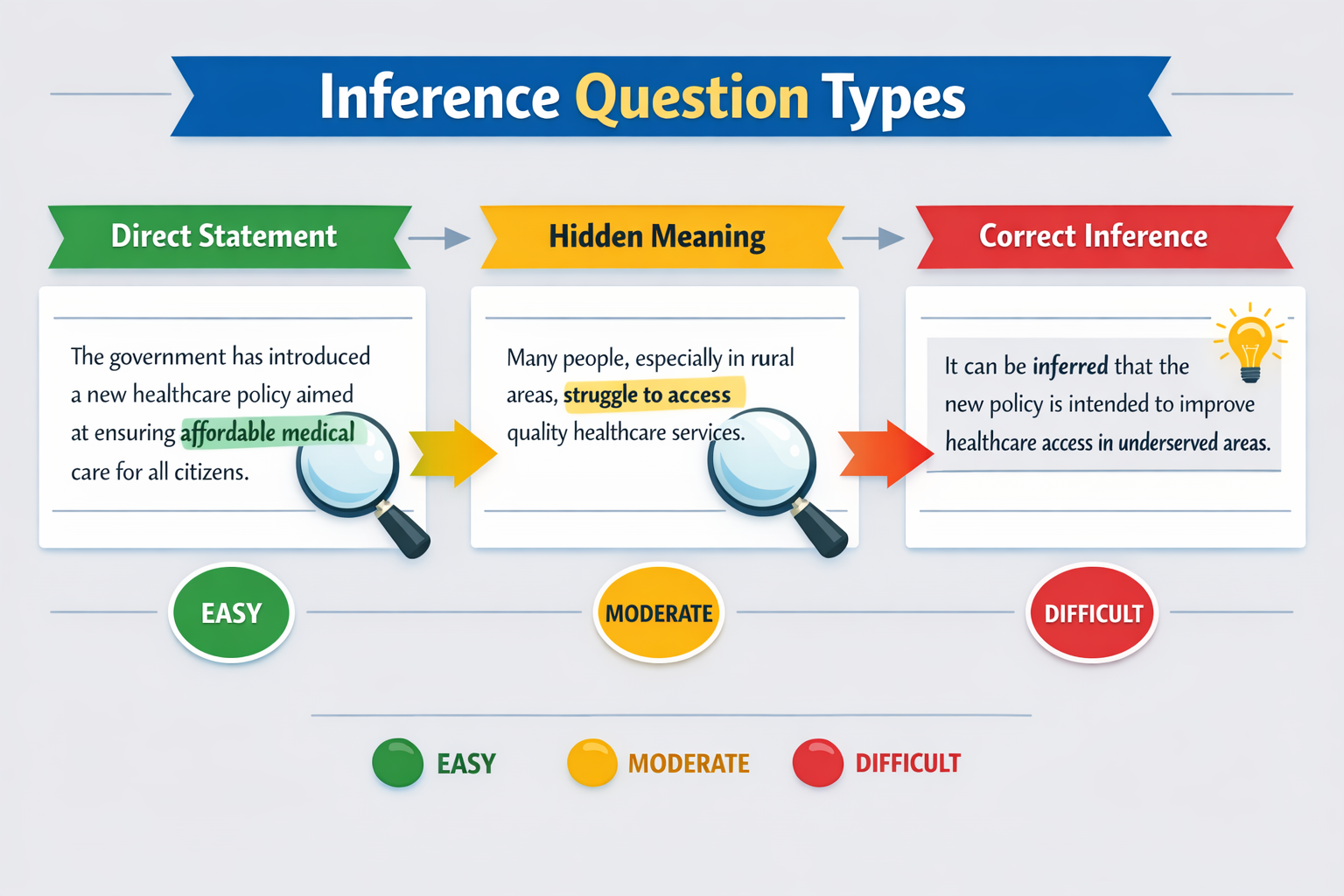
Inference questions in English Language for CLAT 2027 fall into several distinct categories, each requiring specific analytical approaches. Direct inferences ask you to identify logical conclusions that follow immediately from stated information. Implied inferences require you to understand unstated assumptions or implications. Comparative inferences ask you to draw conclusions by comparing different parts of the passage.
Consider this example from a recent paper analyzing environmental policy:
“The government’s new carbon tax policy received mixed reactions from industry leaders. While renewable energy companies praised the initiative, traditional manufacturing sectors expressed concerns about increased operational costs.”
A direct inference question might ask: “What can be inferred about renewable energy companies’ stance on carbon taxes?” The answer lies clearly in the text—they praised the initiative.
An implied inference question could ask: “What does the passage suggest about the relationship between environmental policy and economic interests?” Here, you must infer that environmental policies often create winners and losers in different economic sectors, even though this isn’t explicitly stated.
Strategic Approaches to Inference Questions
Step 1: Identify the Question Type
Before diving into answer choices, determine whether you’re dealing with a direct, implied, or comparative inference. This shapes your reading strategy and helps you focus on relevant textual evidence.
Step 2: Locate Textual Support
Every correct inference must have solid textual foundation. Look for signal words like “however,” “although,” “despite,” and “while” that often indicate contrasting ideas or subtle implications.
Step 3: Apply the Goldilocks Principle
Correct inferences are “just right”—not too obvious (directly stated) and not too speculative (unsupported by text). They require logical reasoning based on available evidence.
Step 4: Eliminate Extreme Options
Watch out for answer choices with absolute terms like “always,” “never,” “all,” or “none.” Correct inferences typically use moderate language that reflects the passage’s nuanced tone.
Common Inference Traps and How to Avoid Them
The Obvious Trap: Some answer choices simply restate information from the passage. Remember, inferences require logical reasoning beyond what’s explicitly stated.
The Speculation Trap: Other choices go too far beyond textual evidence, making claims the passage doesn’t support. Stick to what can be reasonably concluded from available information.
The Partial Truth Trap: These answers contain some accurate information but make broader claims than the passage supports. Read carefully to ensure the entire answer choice is justified.
Our expert strategies for CLAT 2027 success include detailed practice exercises for mastering these inference techniques.
Vocabulary in Context: Beyond Memorization
The Context-First Approach
Traditional vocabulary preparation focused on memorizing word lists and definitions. English Language for CLAT 2027: Inference, Vocabulary in Context, and RC Strategies from Recent Papers demands a fundamentally different approach. Modern CLAT tests your ability to determine word meanings through contextual analysis rather than rote memory.
Here’s how the context-first approach works:
Step 1: Read the Surrounding Sentences
Don’t focus solely on the sentence containing the target word. Read at least one sentence before and after to understand the broader context.
Step 2: Identify Relationship Clues
Look for words and phrases that indicate relationships: cause-and-effect, contrast, similarity, or elaboration. These provide crucial hints about the target word’s meaning.
Step 3: Consider Tone and Style
The author’s tone often constrains possible word meanings. A formal, academic passage suggests different vocabulary choices than an informal, conversational piece.
Practical Context Analysis Techniques
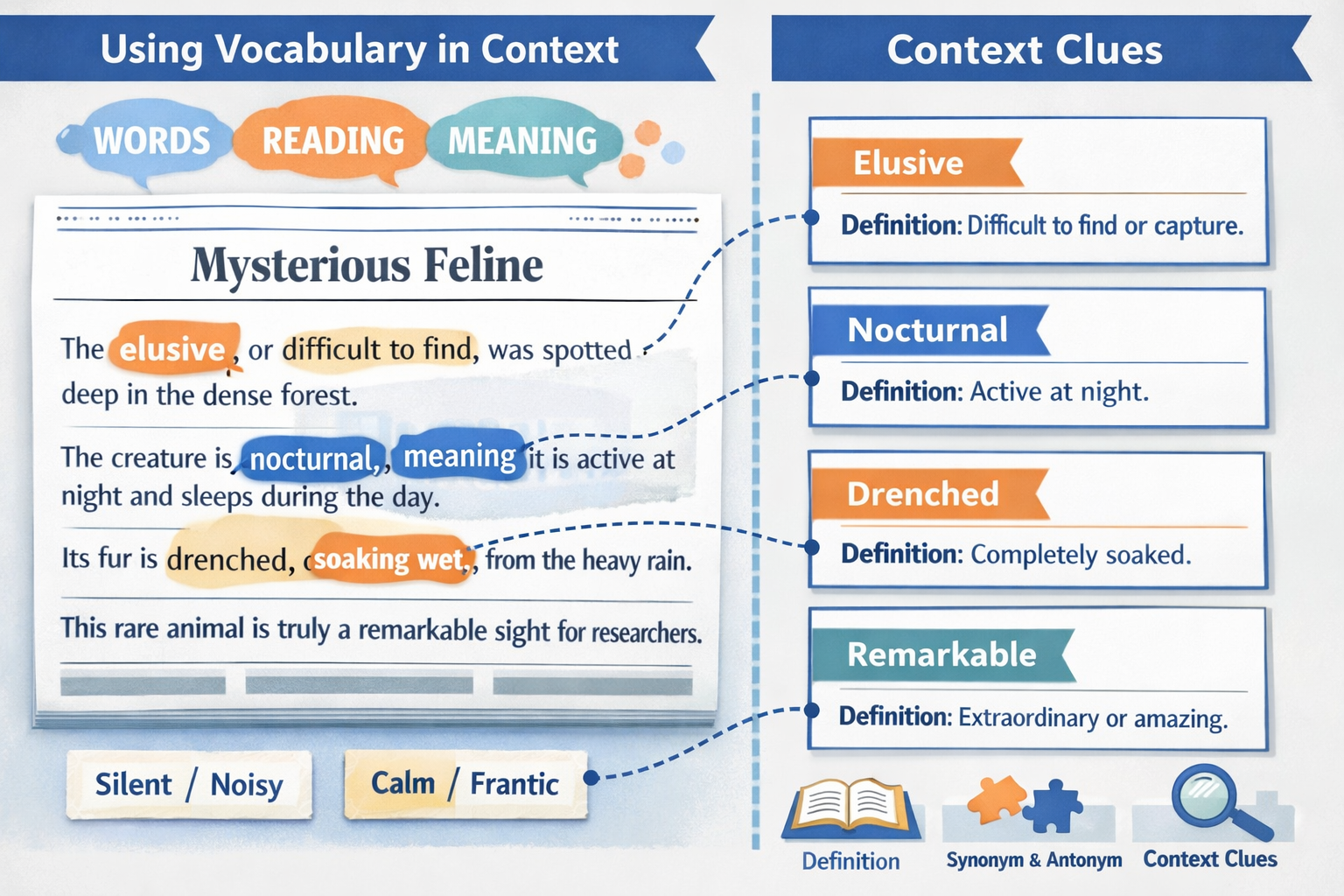
Contrast Clues: Words like “but,” “however,” “unlike,” and “although” often signal that the target word contrasts with nearby concepts.
Example: “Unlike his usually gregarious behavior at parties, John remained quiet and withdrawn at the formal dinner.”
Even without knowing “gregarious,” the contrast with “quiet and withdrawn” suggests it means sociable or outgoing.
Definition Clues: Authors sometimes provide direct or indirect definitions through phrases like “that is,” “in other words,” or “which means.”
Example Clues: Specific examples often clarify abstract or unfamiliar terms. Look for phrases like “such as,” “for instance,” or “including.”
Synonym Clues: Authors may use multiple words with similar meanings to ensure clarity, especially when introducing technical or sophisticated vocabulary.
Building Contextual Vocabulary Skills
Rather than memorizing isolated word lists, focus on reading widely from sources similar to CLAT passages. Newspapers, magazines, legal journals, and academic articles provide excellent vocabulary-building opportunities while familiarizing you with the writing styles you’ll encounter on exam day.
Active Reading Practice: When you encounter unfamiliar words, resist the urge to immediately check the dictionary. Instead, use context clues to determine meaning, then verify your understanding. This builds the analytical skills you’ll need during the actual exam.
Word Relationship Mapping: Create visual maps showing how new vocabulary relates to familiar concepts. This helps you understand words in context rather than as isolated definitions.
For students seeking structured guidance, our 90-day transformation plan includes comprehensive vocabulary-building strategies that have proven effective for serious aspirants.
Reading Comprehension Strategies from Recent Papers
Adapting to Contemporary Passage Styles
English Language for CLAT 2027: Inference, Vocabulary in Context, and RC Strategies from Recent Papers reveals significant changes in passage selection and question types. Recent papers feature more contemporary writing styles with complex argumentative structures, nuanced perspectives, and sophisticated rhetorical techniques [1][3][4].
Modern CLAT passages often present multiple viewpoints on complex issues rather than straightforward informational content. This requires you to track different perspectives, understand how they relate to each other, and analyze the author’s position among competing ideas.
Historical passages now appear alongside contemporary ones, testing your ability to adapt reading strategies across different time periods and writing styles. Victorian-era prose requires different analytical approaches than modern journalistic writing.
The Three-Pass Reading Strategy
First Pass: Structure and Main Ideas (2-3 minutes)
Read quickly to understand the passage’s overall structure, main argument, and key supporting points. Don’t worry about details—focus on the big picture.
- Identify the thesis or main argument
- Note major supporting points
- Understand the passage’s organizational pattern
- Get a sense of the author’s tone and perspective
Second Pass: Detailed Analysis (3-4 minutes)
Read more carefully, paying attention to transitions, examples, and specific details that support the main argument.
- Mark important transitions and signal words
- Note specific examples and evidence
- Identify cause-and-effect relationships
- Track different viewpoints if multiple perspectives are presented
Third Pass: Question-Focused Reading (As Needed)
Return to specific sections based on question requirements. This targeted reading helps you find precise textual support for your answers.
Question-Type Specific Strategies
Main Idea Questions: Look for thesis statements, topic sentences, and concluding remarks. The correct answer should encompass the passage’s central argument without being too broad or too narrow.
Detail Questions: Use keywords from the question to locate relevant passage sections. Be careful to distinguish between what the passage states and what it implies.
Tone and Style Questions: Pay attention to word choice, sentence structure, and rhetorical techniques. Consider how the author’s language choices reveal their attitude toward the subject.
Application Questions: These ask how passage concepts might apply to new situations. Look for underlying principles or general rules that extend beyond the specific examples discussed.
Advanced RC Techniques for High Scorers
Annotation Strategy: Develop a consistent system for marking important information as you read. Use symbols for main ideas (★), examples (ex), contrasts (vs), and cause-effect relationships (→).
Perspective Tracking: When passages present multiple viewpoints, create mental or physical notes tracking each perspective’s key points and how they relate to the author’s position.
Argument Mapping: For complex argumentative passages, identify the claim, evidence, and reasoning structure. This helps with inference questions and argument analysis.
Time Management: Allocate approximately 12-15 minutes per passage including questions. If you’re spending more time, you need to streamline your reading strategy.
Students looking to master these advanced techniques can benefit from our specialized reading comprehension exercises designed specifically for CLAT preparation.
Handling Challenging Passage Types
Legal and Constitutional Passages: These often feature formal language and complex logical structures. Focus on understanding the relationship between general principles and specific applications.
Literary Passages: Pay attention to literary devices, character development, and thematic elements. Questions often test your understanding of symbolism, irony, and narrative techniques.
Scientific and Technical Passages: Don’t get overwhelmed by specialized terminology. Focus on understanding the main argument and how evidence supports conclusions.
Historical Passages: Context is crucial for understanding historical writing. Consider the time period, audience, and cultural context that influenced the author’s perspective.
Integration with Overall CLAT Strategy
Reading comprehension skills support success across all CLAT sections. Strong RC abilities help with legal reasoning passages, current affairs analysis, and logical reasoning questions that require careful text analysis.
The analytical thinking skills developed through RC practice—identifying main ideas, understanding relationships between concepts, drawing logical inferences—are exactly the skills needed for legal education and practice.
For comprehensive preparation that integrates English skills with other CLAT sections, explore our complete CLAT exam guide that shows how strong English fundamentals support overall exam performance.
Grammar and Language Usage in Modern CLAT
The Evolution of Grammar Testing
While traditional grammar questions have decreased in prominence, English Language for CLAT 2027 still tests grammatical understanding through integrated applications rather than isolated rule-testing [2][3]. Modern questions embed grammar within reading comprehension contexts, testing your ability to identify errors, improve sentence structure, and understand how grammatical choices affect meaning.
Cloze tests now serve as primary vehicles for grammar assessment, requiring you to select appropriate words based on grammatical correctness, contextual meaning, and stylistic consistency. These questions test multiple skills simultaneously: vocabulary knowledge, grammatical understanding, and reading comprehension.
Sentence correction questions focus on clarity, conciseness, and correctness rather than obscure grammatical rules. They often involve improving awkward constructions, eliminating redundancy, and ensuring parallel structure.
High-Impact Grammar Areas
Subject-Verb Agreement: Pay special attention to complex sentences with intervening phrases, compound subjects, and collective nouns. Recent papers frequently test agreement in sophisticated sentence structures.
Pronoun Usage: Focus on pronoun-antecedent agreement, ambiguous pronoun references, and appropriate pronoun case in complex constructions.
Parallel Structure: Questions often test your ability to maintain consistency in series, comparisons, and correlative constructions.
Modifier Placement: Identify and correct misplaced modifiers, dangling participles, and unclear modifier references that affect sentence meaning.
Practical Grammar Application
Rather than memorizing rules in isolation, practice identifying grammatical issues within realistic contexts similar to CLAT passages. This approach builds the integrated skills you’ll need on exam day.
Error Pattern Recognition: Develop sensitivity to common error patterns that appear frequently in CLAT questions. This helps you quickly identify potential problems during the exam.
Style and Clarity: Modern grammar questions often test your understanding of effective writing rather than just correctness. Consider whether proposed changes improve clarity, conciseness, and overall effectiveness.
Advanced Preparation Strategies
Creating an Integrated Study Plan
Successful English Language for CLAT 2027 preparation requires integration across multiple skill areas rather than isolated practice. Your study plan should connect inference skills, vocabulary development, reading comprehension, and grammatical understanding into a cohesive preparation strategy.
Weekly Structure: Dedicate specific days to different skill areas while maintaining regular practice across all areas. Monday might focus on inference questions, Tuesday on vocabulary in context, Wednesday on challenging RC passages, and so forth.
Progressive Difficulty: Start with shorter, simpler passages and gradually work toward the 450-word passages with complex argumentative structures that characterize modern CLAT.
Timed Practice: Regular timed practice builds the speed and accuracy needed for exam success. Start with generous time limits and gradually reduce them to match actual exam conditions.
Mock Test Analysis and Improvement
Pattern Recognition: Analyze your mock test performance to identify recurring weaknesses. Are you consistently missing inference questions? Struggling with vocabulary in context? Having trouble with specific passage types?
Error Categorization: Group your mistakes into categories: careless errors, knowledge gaps, strategic mistakes, and timing issues. Each category requires different improvement approaches.
Targeted Practice: Use your error analysis to guide focused practice sessions. If tone questions consistently challenge you, dedicate extra time to understanding how authors convey attitude through word choice and rhetorical techniques.
For students seeking structured improvement, our proven CLAT preparation strategies provide systematic approaches to identifying and addressing weaknesses.
Building Exam-Day Confidence
Familiarity with Question Types: Regular practice with all question types builds confidence and reduces exam-day anxiety. You should feel comfortable with inference questions, vocabulary in context, tone analysis, and integrated grammar applications.
Strategic Flexibility: Develop multiple approaches for challenging questions. If your first strategy doesn’t work, you should have backup methods for finding correct answers.
Time Management Mastery: Practice allocating time effectively across passages and questions. Know when to move on from challenging questions and when to invest extra time in high-confidence areas.
The key to success lies in consistent, strategic practice combined with regular assessment and adjustment of your preparation approach. Your success is our mission, and with the right strategies, you can master the evolving demands of CLAT English.
Conclusion
The English Language for CLAT 2027: Inference, Vocabulary in Context, and RC Strategies from Recent Papers represents a fundamental shift toward analytical thinking and contextual understanding. Success no longer depends on memorizing vocabulary lists or cramming grammar rules—it requires developing sophisticated reading skills, inferential reasoning abilities, and strategic test-taking approaches.
The evidence is clear: recent papers prioritize inference questions that test your ability to read between the lines, vocabulary in context that demands contextual analysis over rote memorization, and reading comprehension strategies that work with complex, contemporary passages. Grammar testing has evolved toward practical application through cloze tests and error identification within meaningful contexts.
Your path to success involves mastering these interconnected skills through strategic practice, regular assessment, and continuous improvement. Focus on developing the analytical thinking skills that support not just English success, but excellence across all CLAT sections.
Actionable Next Steps:
- Assess Your Current Level: Take a diagnostic test focusing specifically on inference questions, vocabulary in context, and modern RC passages to identify your baseline abilities.
- Implement the Three-Pass Reading Strategy: Practice this systematic approach with passages from recent papers until it becomes automatic.
- Build Contextual Vocabulary Skills: Shift from memorization-based vocabulary study to context-based analysis using contemporary sources similar to CLAT passages.
- Practice Integrated Grammar: Focus on cloze tests and error identification within reading comprehension contexts rather than isolated grammar exercises.
- Develop Strategic Flexibility: Master multiple approaches for each question type so you have backup strategies when your first approach doesn’t work.
Remember, flexible learning that fits your life doesn’t mean compromising on quality. With expert guidance from experienced faculty and proven strategies that actually work, you can master these evolving demands and achieve your law school dreams.
Your CLAT success story starts with understanding these fundamental shifts and implementing the strategic approaches that separate top scorers from the rest. The 2026 exam may be challenging, but with the right preparation, it’s absolutely conquerable.
References
[1] Blog – https://knowledgenation.co.in/blog?slug=clat-2026-english-language-questions-syllabus-preparation-tips-tricks&id=27[2] Clat 2026 Syllabus Changes And New Pattern Explained – https://bharatsofttech.com/blog/clat-2026-syllabus-changes-and-new-pattern-explained.php
[3] Clat 2026 Syllabus Decoded Key Changes Trends – https://www.clatnlti.com/blog-details/211/clat-2026-syllabus-decoded-key-changes-trends
[4] Clat Syllabus – https://www.imsindia.com/blog/clat/clat-syllabus/