
Last updated: March 19, 2026
Quick Answer
The CLAT exam is for what most law aspirants ask first, and the answer is simple: CLAT is the Common Law Admission Test, a centralized law entrance exam used mainly for admission to undergraduate 5-year integrated LLB programs and postgraduate LLM programs at participating National Law Universities and some other law schools in India.[1][4] CLAT matters because it standardizes law school admission, gives students a single score for multiple colleges, and acts as a major gateway into top legal education in India.[1][6]
Key Takeaways
- CLAT is a national-level law entrance exam for UG and PG law admissions.[1][4]
- It is conducted by the Consortium of NLUs on a rotational basis through participating universities.[4][6]
- CLAT scores are used by most National Law Universities and several private institutions.[1][4]
- For UG CLAT, students generally need Class 12 completion and qualifying marks based on category, with no age limit mentioned in current eligibility guidance from cited sources.[1][9]
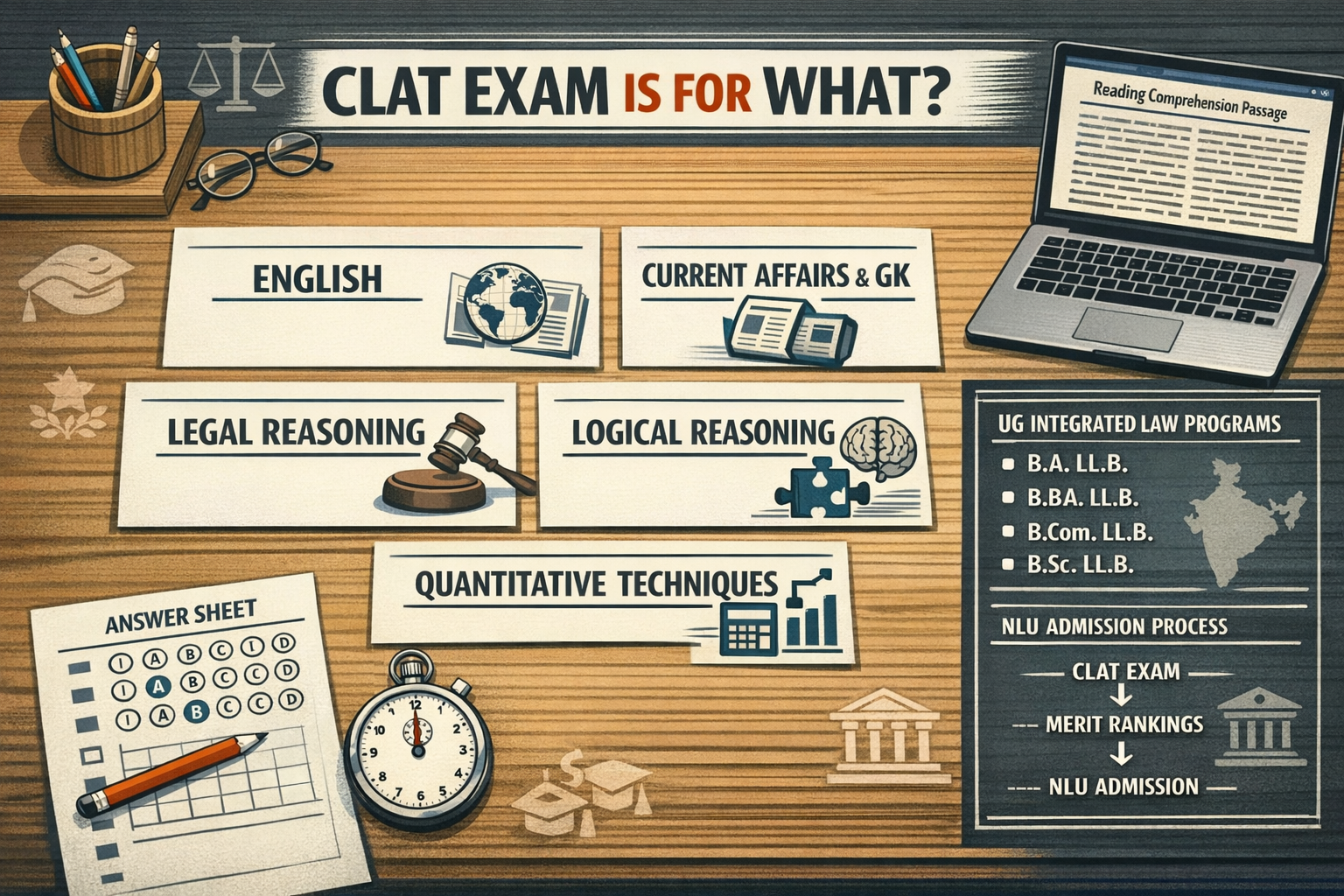
- The UG exam tests English, Current Affairs including GK, Legal Reasoning, Logical Reasoning, and Quantitative Techniques.[1][5]
- Strong reading speed, legal reasoning, and current affairs awareness often separate top rankers from average test takers.
- CLAT preparation works best with mocks, passage practice, revision cycles, and mental discipline.
- Admission is not just about marks. It also involves rank, category, preference list, counselling, and seat allotment.
- CLAT can lead to careers in litigation, law firms, public policy, judiciary preparation, academia, and legal consulting.[1][7]
- Students who do not want to depend only on CLAT should also keep backup law entrance options ready.
What is CLAT exam and who should take it?
CLAT is the Common Law Admission Test, and students should take it if they want admission to leading law universities in India through a common entrance route.[1][4] It is most relevant for students targeting 5-year integrated undergraduate law programs after Class 12 and for law graduates seeking LLM admission.[1][6]
In plain terms, CLAT solves a major problem. Instead of applying separately to many top law institutions through different tests, students can use one exam to compete for a large part of the NLU admission ecosystem.
CLAT exam overview
CLAT serves these main purposes:
- Admission to UG law programs such as BA LLB, BBA LLB, BCom LLB, BSc LLB, and similar integrated courses
- Admission to PG law programs such as LLM at participating institutions
- A common ranking mechanism for National Law Universities
- A standardized benchmark for law aspirants across India[1][4]
According to the cited source material, CLAT facilitates admission to 26 out of 27 NLUs, with broad acceptance across participating institutions and several other law schools.[4] Some private universities and non-NLU institutions also consider a CLAT score for admissions.[1]
Who should seriously consider CLAT?
Choose CLAT if the goal is any of the following:
- Study at a top NLU
- Build a strong foundation in legal education in India
- Keep open career paths in litigation, corporate law, policy, judiciary, or academia
- Access a centralized and relatively streamlined admission process
- Compete for institutions with strong alumni networks and brand value
Who may need alternatives too?
CLAT is not the only law entrance test. Students should also consider alternatives if:
- The target college does not accept CLAT
- Preparation starts late and backup options are needed
- The student wants state-specific or university-specific admission routes
For comparison, see this guide on LLB without CLAT and alternative law entrance routes and a broader law entrance exams in India guide.
“A good CLAT rank does more than secure a seat. It can shape the peer group, internship access, and first few years of a legal career.”
CLAT exam is for what in law school admission across India?
CLAT is for centralized law school admission, especially to participating National Law Universities, and for simplifying college applications through a single competitive score.[1] It helps students move from school-level education to a structured legal education pathway without juggling too many separate admission systems.
That answer matters because many aspirants think CLAT is just “another entrance test.” It is more than that. It is a gateway exam with downstream impact on college access, internships, networking, and career direction.
Why CLAT matters in the Indian legal education pathway
CLAT supports law school admission by:
- Creating a common merit list
- Reducing the burden of multiple forms and exam formats
- Giving colleges a standardized assessment mechanism[1]
- Allowing students to compare admission chances across institutions
- Supporting transparent counselling and seat allotment processes
The exam is conducted annually through the Consortium of NLUs.[4][6] That makes it a recurring national event for serious law aspirants.
Broad college acceptance
Beyond NLUs, some reputed private law schools and affiliated institutions also use CLAT scores in some form.[1] A student with a decent score may still find strong options outside the top few NLUs.
Common mistake
A common mistake is assuming that only top-3 ranks matter. In reality, the right combination of rank, category, preferences, and counselling decisions can still produce solid outcomes.
What are the CLAT eligibility rules, age limit, and basic requirements?
CLAT eligibility for UG generally requires passing Class 12 or an equivalent exam from a recognized board, subject to minimum marks criteria by category.[1][9] Based on the provided source material, the cited benchmark is 45% for General/OBC/PwD/OCI/PIO/NRI categories and 40% for SC/ST categories, and there is no age limit.[1]
Because official notices can change, students should always cross-check the latest admission notification before applying. But as a practical guide, these are the core requirements aspirants usually check first.
Basic UG eligibility snapshot
| Requirement | General guidance from cited sources |
|---|---|
| Academic qualification | Class 12 or equivalent from recognized board[1][9] |
| Minimum marks | 45% for General/OBC/PwD/OCI/PIO/NRI, 40% for SC/ST[1] |
| Age limit | No age limit mentioned in cited sources[1][9] |
| Exam level | UG for integrated law, PG for LLM[1][4] |
Edge case: students awaiting results
Students appearing for the qualifying exam may often apply provisionally, subject to final result conditions in the official notification. Always verify that year’s rules before submission.
Decision rule
- Choose UG CLAT if you are in Class 12 or have completed Class 12 and want integrated law.
- Choose PG CLAT if you already hold an LLB and want an LLM.
Students wanting step-by-step application help can read the CLAT registration guide for first-time aspirants.
What is the CLAT exam pattern and syllabus?
The CLAT exam pattern for UG is passage-based and checks reading, reasoning, awareness, and basic numeracy rather than rote legal theory alone.[1][5] The syllabus broadly includes English, Current Affairs including General Knowledge, Legal Reasoning, Logical Reasoning, and Quantitative Techniques.[1][5]
This is where many aspirants lose clarity. They ask for “the syllabus” but ignore the test style. CLAT is not only about topics. It is also about speed, comprehension, elimination, and consistency under pressure.
Core subjects tested
The cited sources identify these five areas:
- English Language
- Current Affairs including General Knowledge
- Legal Reasoning
- Logical Reasoning
- Quantitative Techniques[1][5]
What each section actually tests
English Language
- Reading comprehension
- Vocabulary in context
- Tone, argument, inference
- Grammar through usage rather than isolated rules
Current Affairs and GK
- Recent events of national and international importance
- Legal news and constitutional developments
- Awards, reports, government actions, major policy shifts
Legal Reasoning
- Application of legal principles to fact situations
- Argument analysis
- Public law and legal awareness themes
- Broad exposure to constitutional and legal concepts[1]
Logical Reasoning
- Critical reasoning
- Assumptions, conclusions, strengthen-weaken logic
- Analytical reading
Quantitative Techniques
- Short sets based on elementary mathematics
- Tables, ratios, percentages, averages, interpretation
For a deeper section-by-section breakdown, see CLAT 2027 syllabus and preparation strategy and CLAT exam pattern and previous paper focus.
Previous year trend insight
The broad trend in modern CLAT papers is clear: reading-heavy passages dominate performance. Students who rely only on memorization often struggle. Students who train for passage navigation, issue spotting, and time allocation usually perform better.
Common mistake
Many aspirants over-prepare static legal knowledge and under-prepare reading stamina. CLAT rewards readers who can stay accurate across long passages.
Which National Law Universities accept CLAT and how should students choose?
Most National Law Universities use CLAT for admission, making it the main route into India’s premier public law schools.[4] Students should choose colleges not only by brand name, but also by location, internships, faculty exposure, campus culture, fees, and long-term career fit.
Aspirants often ask for a “top NLUs” list. That helps, but rankings alone are not enough. A better question is: Which NLU is right for the kind of legal career you want?
Why NLUs matter
NLUs are often preferred because of:
- Stronger peer group quality
- Better internship pipelines
- Brand value in litigation and firms
- Wider alumni networks
- More structured mooting, debates, and legal research culture
How to compare NLUs wisely
Use these filters:
-
Placement orientation
Choose higher-placement campuses if corporate law is the goal. -
Litigation ecosystem
Choose city-linked campuses with court access if litigation exposure matters. -
Faculty and research
Choose research-active schools if academia, policy, or international law interest is strong. -
Cost and scholarship support
Choose a realistic option if budget matters more than city prestige. -
Distance from home
Choose carefully if mental comfort and family support are important in the first year.
Comparative admission reality
The admission process is centralized through CLAT counselling, but student outcomes differ by:
- rank
- reservation category
- domicile or institutional rules where applicable
- preference list strategy
- freeze, float, and upgrade decisions
Students trying to estimate realistic targets should check good marks needed for NLU admission and CLAT marks vs rank conversion strategy.
CLAT exam is for what kind of preparation, and how should students study smart?
CLAT is for students who can combine concept clarity, reading practice, current affairs revision, and mock-based self-correction. The best CLAT preparation is not random hard work. It is focused practice tied to the actual exam pattern.
This is where many coaching promises fail students. A law entrance test is not cracked by collecting endless PDFs. It is cracked by fixing weaknesses one by one.
A practical CLAT preparation roadmap
1. Build the base
- Understand the exam pattern
- Collect limited, quality resources
- Start reading editorials and legal news daily
- Learn the logic of legal reasoning passages
2. Start sectional practice
- Solve timed English passages
- Practice legal reasoning sets
- Maintain current affairs notes
- Review mistakes in quantitative techniques
3. Add mock tests
- Begin with one mock every 10 to 14 days
- Increase frequency closer to the exam
- Analyze more than you attempt
4. Create a revision loop
- Weekly current affairs revision
- Vocabulary and issue-based recap
- Error log for repeated mistakes
5. Simulate exam pressure
- Full-length mocks at exam time
- Strict timing
- OMR or digital response discipline if applicable
Psychological preparation techniques competitors usually miss
Mental readiness matters because CLAT is a time-pressure test with ranking consequences.
Useful techniques include:
- Two-minute reset routine before mocks: breathe, posture check, section plan
- Error detachment: one wrong question should not affect the next passage
- Stress labeling: say “exam pressure is normal” instead of “I am failing”
- Micro-targeting: focus on the next 10 questions, not the entire paper
- Sleep protection: performance drops fast when reading focus is damaged by fatigue
Students who struggle with stress can read the CLAT exam anxiety guide and mental wellness guide for exam success.
AI-powered preparation techniques
Used carefully, AI tools can help with:
- generating reading summaries
- creating current affairs quizzes
- simplifying difficult editorials
- checking consistency in revision plans
But AI should support, not replace, serious practice. It cannot substitute for timed mocks and independent reasoning.
Choose coaching if…
- self-discipline is weak
- feedback is missing
- score is stuck
- boards and CLAT need structured balancing
For structured support, see CLAT preparation coaching options. Lawgic Coaching’s approach is built around flexible learning that fits your life, real mentors from top NLUs, and expert guidance without the premium price tag. For many aspirants, that matters because no cookie-cutter approach works for every student.
How does the CLAT admission process work after the exam?
The CLAT admission process usually moves from score and rank to counselling, preference-based seat allotment, and final college acceptance.[1] A student does not get admission just by writing the exam well. The counselling stage is where many outcomes are won or lost.
Step-by-step college admission process
- Take the CLAT exam
- Receive score and rank
- Check cutoff trends and likely colleges
- Enter or confirm counselling choices
- Arrange NLU preferences carefully
- Participate in seat allotment rounds
- Choose whether to accept, freeze, float, or upgrade, depending on rules that year
- Complete document verification and fee payment
How preference strategy changes outcomes
Aspirants sometimes place colleges in the wrong order based on hearsay. A better method:
- Put dream colleges first
- Then add realistic colleges by likely cutoff
- Then add safe options
- Consider finances before locking preference order
Scholarship and financial aid information
Scholarship structures differ by institution. Students should check:
- merit scholarships
- need-based aid
- category-based fee support
- state scholarships
- education loan options through banks
A lower-fee public law school can sometimes be a better decision than a costlier private option, especially if finances are tight.
Quick example
A student with a mid-range rank may not get a top-three NLU but could secure a solid NLU with lower fees, good internship access, and better long-term value than an expensive private backup. That is why counselling choices matter.
You can also use Lawgic’s CLAT college predictor to estimate possible options after the exam.
CLAT exam is for what career path after law school?
CLAT is for students who want structured entry into legal careers, but the exam itself is only the first gate.[1][7] A good law school can expand access to internships, training, alumni support, and career experimentation across many fields.
Career opportunities after CLAT
Students entering law through CLAT often move into:
- Litigation
- Corporate law
- Law firms
- Judicial services preparation
- Public policy
- Academia and research
- Civil services support roles
- Legal journalism
- Compliance and consulting
- International law and arbitration[1][7]
Career path visualization
Think of CLAT as the first major branch point:
CLAT score → law school admission → internships → specialization choice → first job or chamber → long-term legal career
Emerging legal specializations
The future of legal education is changing. Students should watch fields such as:
- data privacy law
- technology law
- AI regulation
- intellectual property
- sports law
- environmental law
- international commercial arbitration
International opportunities
Indian law graduates also pursue:
- LLM abroad
- international arbitration work
- policy fellowships
- cross-border compliance and legal operations
A strong NLU record, internships, moots, and writing samples can support these paths.
Salary expectations
One cited source notes that top graduates securing placements at leading law firms may see starting salaries in the ₹10 to ₹20 lakh per annum range, with higher growth potential over time.[5] These outcomes vary heavily by college, rank in law school, internships, and market conditions, so students should treat salary talk as possible, not guaranteed.

What are the biggest mistakes CLAT aspirants make, and how can they avoid them?
Most CLAT mistakes come from poor strategy, not lack of intelligence. Students usually lose marks by reading passively, ignoring mock analysis, over-collecting study material, and underestimating mental fatigue.
Top mistakes to avoid
1. Starting mocks too late
Without mock exposure, timing breaks down.
2. Reading without analysis
Finishing passages is not enough. Accuracy matters.
3. Treating GK as last-minute work
Current affairs for law need regular revision.
4. Ignoring legal reasoning structure
Legal aptitude is about application, not just legal facts.
5. Using too many books
A small set of well-used resources beats a giant pile of untouched material.
6. No revision system
If notes are never revisited, retention falls quickly.
7. No mental recovery plan
Burnout reduces reading quality and confidence.
For more support, aspirants can explore CLAT mock test mastery, progress assessment techniques, and common legal reasoning mistakes.
How to prepare for CLAT in a realistic step-by-step plan
A realistic CLAT plan depends on how much time is left, current reading level, and whether board exams are happening at the same time. Students should pick a timeline that matches their starting point instead of copying someone else’s schedule.
12-month plan
Best for Class 11 or early Class 12 students.
- First 3 months: base building
- Next 4 months: sectional strengthening
- Next 3 months: regular mocks and revision
- Final 2 months: high-intensity test simulation
6-month plan
Best for serious Class 12 aspirants who can study consistently.
- Month 1: pattern, basics, reading habit
- Months 2 to 4: sections plus current affairs
- Months 5 to 6: mocks, weak-area repair, revision
3-month plan
Works only with disciplined effort and basic reading ability already in place.
- Daily passage practice
- Alternate-day section rotation
- Weekly mock and full analysis
- Focus on high-yield current affairs and accuracy
Students can use these detailed resources:
Mobile and digital prep tips
Students preparing on the go can:
- revise GK notes on the phone
- read one editorial daily
- maintain a digital wrong-answer notebook
- listen to current affairs summaries during travel
This matters for aspirants balancing school, tuition, and family schedules. Study at your own pace is not just a slogan. For many students, it is the only practical way to stay consistent.
Related reading
- Understanding the CLAT full form and its importance
- Is CLAT exam tough? Difficulty and success guide
- Best books for CLAT preparation
- Lawgic Coaching courses
- More Lawgic blogs for CLAT aspirants
FAQ
What is the CLAT exam for?
CLAT is for admission to undergraduate and postgraduate law programs, mainly at participating National Law Universities and some other law schools in India.[1][4]
Who should take CLAT?
Students who want 5-year integrated law programs after Class 12 or LLM admission after LLB should consider CLAT.[1][4]
Is CLAT only for NLUs?
No. CLAT is mainly for NLUs, but some private and other participating institutions also accept CLAT scores.[1]
What subjects are tested in CLAT UG?
CLAT UG tests English, Current Affairs and GK, Legal Reasoning, Logical Reasoning, and Quantitative Techniques.[1][5]
Is there an age limit for CLAT?
Based on the cited eligibility sources, there is no age limit mentioned for CLAT.[1][9]
What minimum marks are needed in Class 12 for CLAT?
The cited source notes 45% for General/OBC/PwD/OCI/PIO/NRI categories and 40% for SC/ST categories.[1]
Does CLAT guarantee a legal career?
No. CLAT opens access to law schools. Career success depends on college performance, internships, specialization, and long-term effort.
Can students prepare for CLAT without coaching?
Yes. Many students do, but coaching can help if structure, mentorship, or feedback is missing.
Is CLAT more about knowledge or reasoning?
Modern CLAT strongly rewards reasoning, reading comprehension, and application, especially in passage-based sections.
What are good backup options if CLAT does not go as planned?
Students can target AILET, state law entrance tests, university-specific law exams, and private law school admission routes.
Conclusion
The shortest honest answer to clat exam is for what is this: CLAT is for students who want a serious route into law school admission in India, especially through the National Law Universities system.[1][4] But the bigger answer is that CLAT is also for students who want a clearer legal education pathway, more college options through one score, and a stronger start to a legal career.
The exam is competitive, but it is not mysterious. Students who understand the pattern, build reading strength, revise current affairs properly, analyze mocks, and protect their mental focus give themselves a real chance. And that chance can lead to much more than a seat. It can lead to internships, mentors, confidence, and a law career with direction.
For aspirants who want proven strategies that actually work, personalized attention you deserve, and accessible education for serious aspirants, Lawgic Coaching positions itself as a practical support system rather than a one-size-fits-all course seller. Your success is our mission, and results speak louder than promises.
Start with one smart step:
- understand the exam pattern,
- map target colleges,
- build a weekly study plan,
- and take the first mock soon.
That is how law school admission becomes a process you can manage, not a dream you keep postponing.
References
[1] Clat Exam Is For What Purpose – https://www.iquanta.in/blog/clat-exam-is-for-what-purpose/[2] What Is The Clat Exam Purpose Of The Clat Entrance Exam Benefits Of Appearing In Clat 2026 – https://www.cpj.edu.in/what-is-the-clat-exam-purpose-of-the-clat-entrance-exam-benefits-of-appearing-in-clat-2026/
[3] Top 5 Reasons To Take Clat Exam Blogid 68473 – https://www.shiksha.com/law/articles/top-5-reasons-to-take-clat-exam-blogId-68473
[4] Common Law Admission Test – https://en.wikipedia.org/wiki/Common_Law_Admission_Test
[5] Clat Exam 2026 Syllabus Dates Eligibility Application – https://testfunda.com/blog/clat-exam-2026-syllabus-dates-eligibility-application/
[6] Clat 2026 Exam Overview Key Dates – https://www.lloydlawcollege.edu.in/blog/clat-2026-exam-overview-key-dates.html
[7] Benefits Of Clat Exam – https://www.toprankers.com/news/judiciary-exams/benefits-of-clat-exam
[8] Clat 2026 High Scoring Topics You Must Prepare – https://law.careers360.com/articles/clat-2026-high-scoring-topics-you-must-prepare
[9] Clat Eligibility – https://www.imsindia.com/blog/clat/clat-eligibility/
[10] Clat Exam Is For What Purpose – https://www.iquanta.in/blog/clat-exam-is-for-what-purpose/
CLAT readiness checker
Use this quick tool to estimate how prepared you are for CLAT right now. It is not a predictor of rank. It helps you see whether your current routine is strong, moderate, or needs urgent fixing.