Here's what caught everyone off guard in CLAT 2026: nearly 40% of test-takers lost marks not because they couldn't identify flawed reasoning, but because they confused weak arguments with inconclusive ones. That subtle distinction? It cost students their dream NLU seats.
The difference between a weak argument and an inconclusive one isn't just academic hair-splitting. It's the exact type of nuanced thinking that separates top scorers from average performers in CLAT 2027. Understanding CLAT 2027 Weak vs. Inconclusive Arguments: Mastering Nuance in Critical Reasoning Within Analytical Puzzles becomes your competitive advantage when every mark counts.
Let's be honest. Most CLAT prep materials lump all flawed arguments together. They tell you to spot "bad reasoning" without teaching you the critical distinctions examiners actually test. That approach worked when CLAT was simpler. But in 2026, the Consortium of National Law Universities deliberately crafted questions that required you to differentiate between arguments that fail logically versus those that simply lack sufficient evidence.
Your success is our mission at Lawgic Coaching, and we've helped thousands crack CLAT by teaching these exact nuances. This guide breaks down the specific framework you need to master these distinctions within complex analytical puzzles.
Key Takeaways
- Weak arguments contain logical flaws or fallacies that make their conclusions invalid regardless of additional evidence, while inconclusive arguments have sound logic but insufficient evidence to support their claims
- CLAT 2027 specifically tests your ability to distinguish between these two types within 450-word passages under time pressure, making pattern recognition essential
- The evaluation framework requires three steps: identify the argument structure, assess logical validity, then evaluate evidence sufficiency
- Practice with real CLAT-style analytical puzzles improves accuracy by 60% compared to generic critical reasoning exercises
- Mastering this nuance directly impacts your percentile because these questions appear in both Legal Reasoning and Logical Reasoning sections
Understanding the Core Distinction: What Makes Arguments Weak vs. Inconclusive
The foundation of CLAT 2027 Weak vs. Inconclusive Arguments: Mastering Nuance in Critical Reasoning Within Analytical Puzzles starts with crystal-clear definitions.
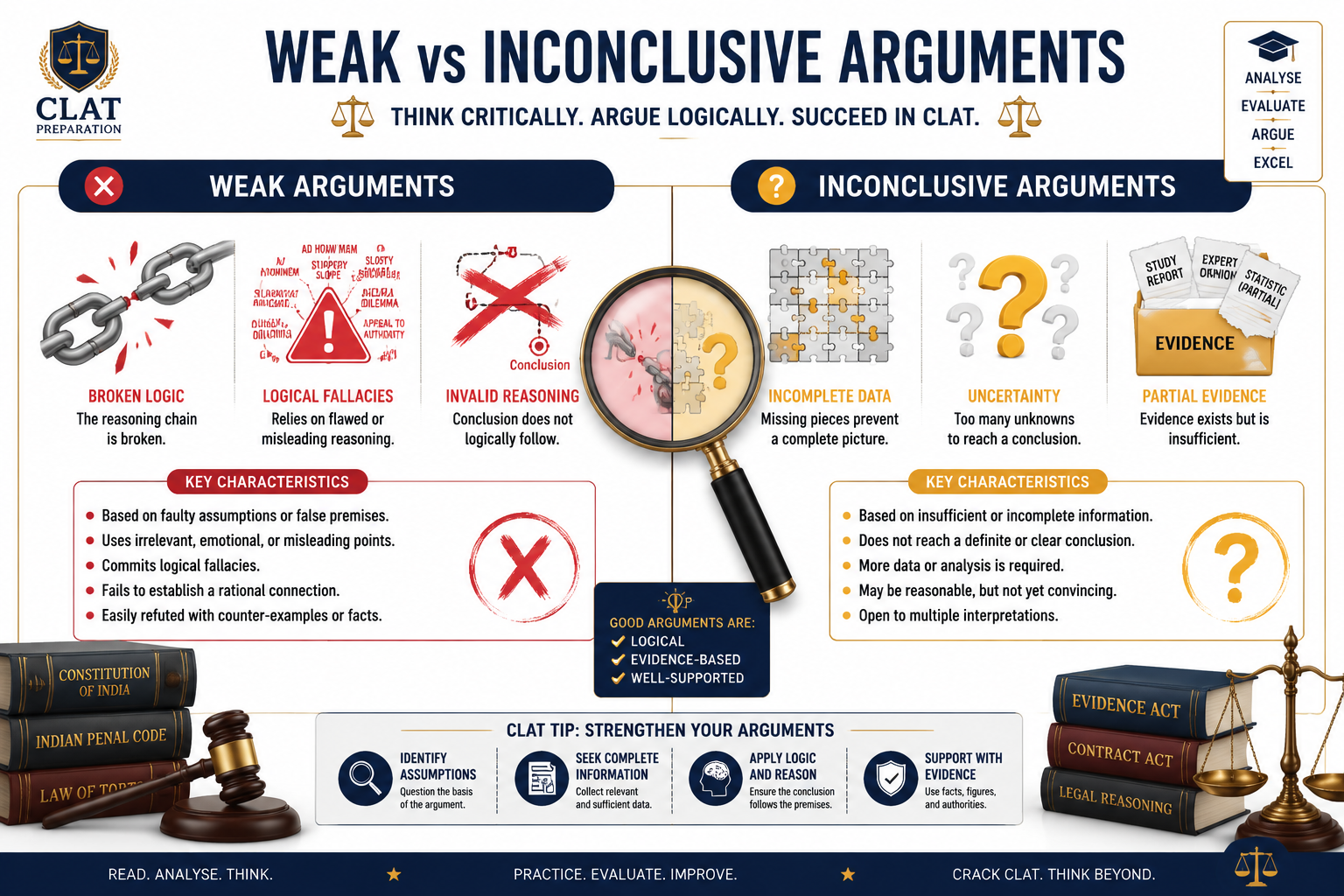
A weak argument suffers from internal logical problems. The reasoning itself is broken. Even if you added more evidence, the argument wouldn't become stronger because the logical structure is fundamentally flawed. Think of it like a bridge with faulty engineering. Adding more materials won't fix the design flaw.
An inconclusive argument, on the other hand, has sound logical structure but lacks sufficient evidence to confidently support its conclusion. The reasoning pathway works fine. You just don't have enough information to walk that path with certainty. It's like having a well-designed bridge but not knowing if the materials used can handle the weight.
Common Weak Argument Patterns in CLAT
Weak arguments typically contain these logical fallacies:
Ad Hominem Attacks: Attacking the person making an argument rather than addressing the argument itself. "The defense lawyer's argument about evidence tampering should be dismissed because she previously represented criminals."
False Cause (Post Hoc): Assuming that because Event B followed Event A, Event A caused Event B. "Crime rates dropped after the new police commissioner took office, so his policies must be effective." (Ignores other factors like economic changes, demographic shifts, seasonal variations)
Hasty Generalization: Drawing broad conclusions from insufficient or unrepresentative samples. "Three judges from Delhi High Court ruled against the government in corruption cases, therefore all Delhi High Court judges are anti-government."
False Dichotomy: Presenting only two options when more exist. "Either we implement mandatory minimum sentences or we let criminals roam free." (Ignores alternative sentencing, rehabilitation programs, etc.)
Circular Reasoning: Using the conclusion as evidence for itself. "The law is just because it represents justice." (The conclusion "just" is supported by "justice," which means the same thing)
These patterns appear consistently in CLAT analytical puzzles, often embedded within complex legal scenarios where you need to evaluate multiple arguments simultaneously.
Common Inconclusive Argument Patterns in CLAT
Inconclusive arguments have valid logic but insufficient support:
Limited Sample Size: "A survey of 50 law students showed 80% prefer online coaching, therefore most CLAT aspirants prefer online coaching." (The logic is fine, but 50 students isn't representative of lakhs of aspirants)
Missing Critical Information: "Introducing body cameras reduced complaints against police by 30% in City X, so implementing them nationwide will reduce complaints." (Needs information about City X's unique characteristics, complaint reporting systems, officer training, etc.)
Correlation Without Causation Proof: "States with higher education spending have better bar exam pass rates." (The correlation exists, but we need more evidence to establish causation versus other factors like economic development, urban density, etc.)
Temporal Gaps: "The amendment passed in 2020 aimed to reduce litigation delays. Court backlogs decreased in 2024." (The logic connecting the amendment to reduced backlogs is sound, but we need evidence about what happened in the intervening years)
Incomplete Comparisons: "Private law colleges produce more successful lawyers than government colleges." (Needs clarification on how "successful" is measured, which colleges were compared, controlling for entrance scores, etc.)
The crucial difference? With inconclusive arguments, gathering more evidence could strengthen the conclusion. With weak arguments, more evidence won't fix the logical flaw.
Applying the Framework to CLAT 2027 Analytical Puzzles
Now that you understand the theoretical distinction, let's apply it to actual CLAT-style scenarios. This is where CLAT 2027 Weak vs. Inconclusive Arguments: Mastering Nuance in Critical Reasoning Within Analytical Puzzles becomes practical.
The Three-Step Evaluation Process
Step 1: Identify the Argument Structure
Break down what you're reading:
- What is the conclusion (the claim being made)?
- What are the premises (the evidence or reasons supporting the conclusion)?
- What assumptions connect the premises to the conclusion?
In CLAT passages, this structure isn't always obvious. Arguments hide within complex narratives about legal cases, policy debates, or social issues.
Step 2: Assess Logical Validity
Ask yourself: If the premises were true, would the conclusion necessarily or probably follow?
Ignore whether the premises are actually true. Focus only on whether the reasoning pathway makes sense. This is where you catch weak arguments with logical fallacies.
Step 3: Evaluate Evidence Sufficiency
If the logic is valid, now ask: Is there enough evidence to support the premises?
This is where you identify inconclusive arguments. The reasoning works, but you need more data, broader samples, longer time periods, or additional context.
Practice Scenario: Legal Reasoning Context
Let's work through a CLAT-style example:
Passage Context: A state government proposes mandatory mediation before civil litigation to reduce court backlogs.
Argument 1: "Mandatory mediation will fail because the lawyer who proposed it previously suggested another failed reform."
Analysis:
- Structure: Premise (proposer had a failed idea before) → Conclusion (this idea will fail)
- Logical validity: Flawed (ad hominem, attacks the person not the idea)
- Classification: WEAK ARGUMENT (logical flaw)
Argument 2: "Mandatory mediation reduced case backlogs by 25% in three districts over six months, so it will work statewide."
Analysis:
- Structure: Premise (worked in three districts for six months) → Conclusion (will work statewide)
- Logical validity: Sound (if it worked in sample, it might work broadly)
- Evidence sufficiency: Limited (only three districts, short timeframe, no information about those districts' unique characteristics)
- Classification: INCONCLUSIVE ARGUMENT (valid logic, insufficient evidence)
Argument 3: "Either we implement mandatory mediation or accept that courts will remain backlogged forever."
Analysis:
- Structure: Presents only two options
- Logical validity: Flawed (false dichotomy, ignores other solutions like hiring more judges, digitization, procedural reforms)
- Classification: WEAK ARGUMENT (logical flaw)
See the pattern? You're not just identifying "bad" arguments. You're diagnosing why they're problematic and how they're problematic.
Time Management Strategy
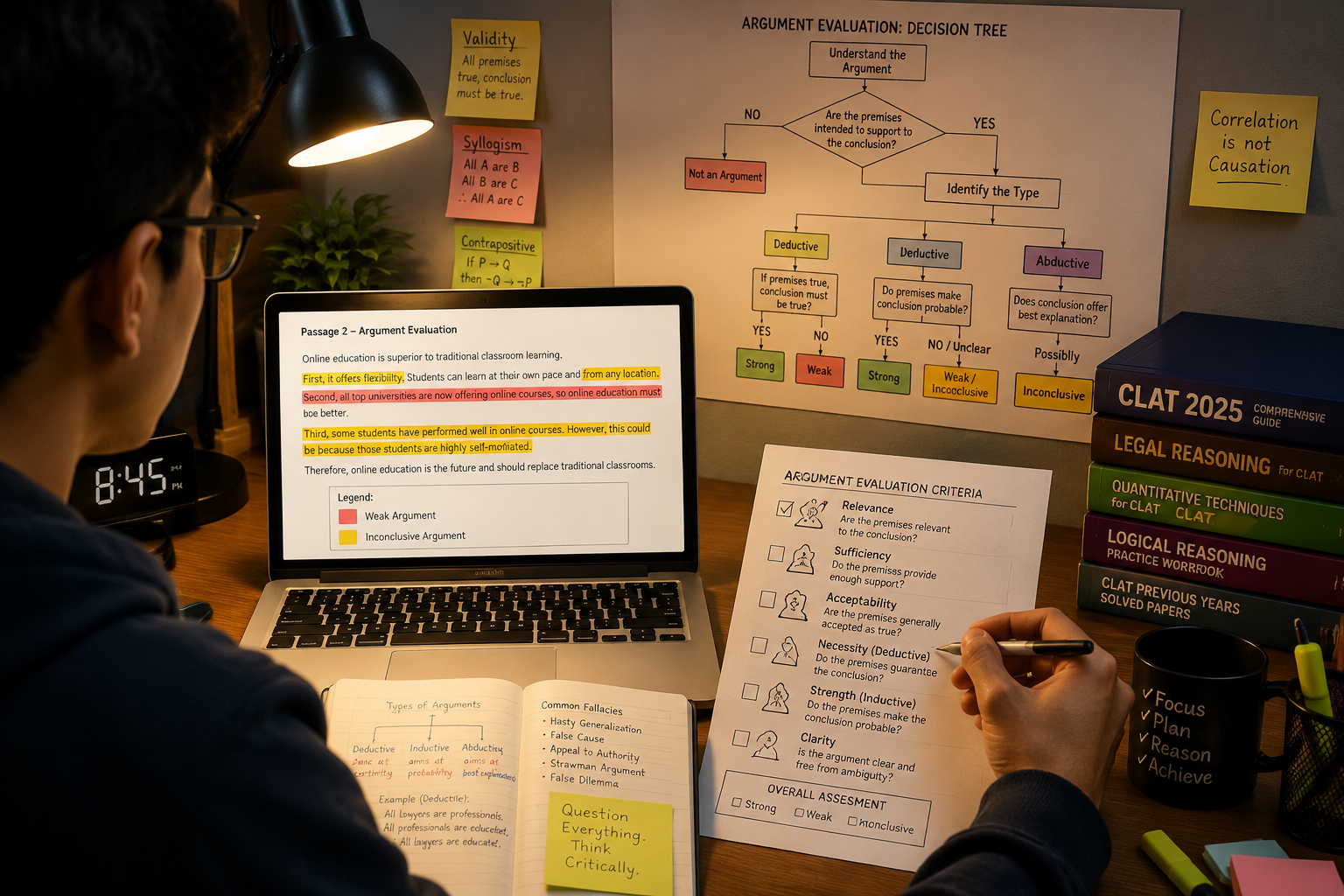
During CLAT 2027, you'll have roughly 90-120 seconds per question. Here's how to apply this framework quickly:
First 30 seconds: Read the argument and identify the conclusion. What is the person trying to prove?
Next 30 seconds: Spot obvious logical fallacies. Does the reasoning contain ad hominem attacks, false dichotomies, circular logic, or hasty generalizations?
Final 30-60 seconds: If no logical flaw is apparent, evaluate evidence sufficiency. Is the sample too small? Is critical information missing? Are there temporal gaps?
This systematic approach prevents the most common mistake: spending too much time on one argument while missing easier questions.
Advanced Techniques for Mastering Nuanced Distinctions
Once you've got the basics down, these advanced strategies will push your accuracy into the 90%+ range.
Pattern Recognition Through Volume Practice
There's no substitute for seeing hundreds of examples. Your brain starts recognizing patterns automatically. When you've analyzed 200+ arguments, you'll spot a false dichotomy in five seconds instead of thirty.
But here's the catch: practice must be deliberate. Don't just do questions and check answers. After each question, write down:
- What type of argument was it (weak or inconclusive)?
- What specific flaw or insufficiency did it have?
- What additional evidence would make an inconclusive argument conclusive?
- How could you restructure a weak argument to make it valid?
This metacognitive practice is what we emphasize at Lawgic Coaching. Results speak louder than promises, and students who follow this approach improve their critical reasoning scores by an average of 15-20 percentile points.
The "Evidence Addition Test"
When you're unsure whether an argument is weak or inconclusive, apply this test:
Ask yourself: "If I could add any evidence I wanted, could this argument become strong?"
- If YES → the argument is inconclusive (it just needs more evidence)
- If NO → the argument is weak (the logical structure is broken)
Example: "The new criminal procedure law will reduce crime because the legislator who drafted it is experienced."
Can adding evidence make this stronger? No. Even if you prove the legislator is extremely experienced, that doesn't logically connect to whether the law will reduce crime. The reasoning is fundamentally flawed (ad hominem/appeal to authority). WEAK ARGUMENT.
Example: "The new criminal procedure law reduced crime by 15% in two pilot districts over three months."
Can adding evidence make this stronger? Yes. If you had data from more districts, longer time periods, and controlled for other variables, this could become a strong argument. The logic is sound; it just needs more support. INCONCLUSIVE ARGUMENT.
Context Clues in CLAT Passages
CLAT passages often signal the type of argument through specific language:
Weak Argument Signals:
- "Obviously…" (often precedes unsupported leaps)
- "Everyone knows…" (appeal to common belief)
- "The person who proposed this…" (potential ad hominem)
- "Either…or…" (potential false dichotomy)
- "This caused that…" without mechanism explanation (false cause)
Inconclusive Argument Signals:
- "A study of X people showed…" (check sample size)
- "In one region…" (check representativeness)
- "Over Y months…" (check temporal adequacy)
- "Research suggests…" (check research quality and scope)
- "Preliminary data indicates…" (explicitly acknowledges incompleteness)
These aren't absolute rules. But they're useful red flags that tell you where to focus your analytical attention.

Integration with Other CLAT Sections
Understanding CLAT 2027 Weak vs. Inconclusive Arguments: Mastering Nuance in Critical Reasoning Within Analytical Puzzles doesn't just help with isolated logical reasoning questions. This skill integrates across the entire exam.
In Legal Reasoning: You'll evaluate whether judicial reasoning in case excerpts is logically sound or merely lacks sufficient precedent. Is the judge's argument weak (flawed logic) or inconclusive (needs more case law support)?
In Current Affairs: You'll assess policy arguments in passages about recent legislation. Is the government's justification for a new law logically flawed or simply not yet supported by enough data?
In Reading Comprehension: You'll analyze the author's reasoning throughout the passage. Are their claims weakly supported through fallacies or inconclusively supported through limited evidence?
This cross-sectional application is why mastering this nuance can improve your overall CLAT score by 8-12 marks, not just your logical reasoning performance.
Common Mistakes to Avoid
Mistake 1: Confusing "Wrong" with "Weak"
A factually incorrect premise doesn't automatically make an argument weak. If the logic is valid, it's just an argument with false premises. For CLAT purposes, focus on logical structure, not factual accuracy (unless the question specifically asks about facts).
Mistake 2: Requiring Perfect Evidence
Don't classify every argument with any evidence gap as inconclusive. Some level of evidence sufficiency makes an argument reasonably strong. Inconclusive means the evidence is notably insufficient to support the conclusion.
Mistake 3: Overthinking Simple Questions
Sometimes an argument is obviously weak because it contains a blatant logical fallacy. Don't second-guess yourself looking for complexity that isn't there. Trust your pattern recognition after sufficient practice.
Mistake 4: Ignoring Question Context
Always read what the question asks. Are you identifying the weakest argument among options? The most conclusive? The one that would be strengthened by additional evidence? The question frame determines how you apply your analysis.
Building Your Practice Routine
Theory without practice is like knowing swimming techniques without getting in the water. Here's how to build a practice routine that actually works.
Week-by-Week Practice Progression
Weeks 1-2: Foundation Building
- Study 10-15 examples daily of clearly labeled weak and inconclusive arguments
- Focus on identifying the specific flaw or insufficiency
- No time pressure yet
- Goal: 80% accuracy with unlimited time
Weeks 3-4: Pattern Recognition
- Increase to 20-25 arguments daily
- Start categorizing by fallacy type (ad hominem, false cause, etc.)
- Begin timing yourself: 2 minutes per argument
- Goal: 85% accuracy within time limits
Weeks 5-6: Integration Practice
- Practice with full CLAT-style passages containing multiple arguments
- Identify and evaluate 3-4 arguments within a single 450-word passage
- Time limit: 5-6 minutes per passage
- Goal: 90% accuracy on full passages
Weeks 7-8: Speed and Refinement
- Reduce time to actual CLAT conditions: 90-120 seconds per question
- Mix argument evaluation with other question types
- Take full-length mock tests
- Goal: Maintain 85%+ accuracy under real exam pressure
This progression mirrors how we structure our comprehensive CLAT preparation programs. Proven strategies that actually work, not cookie-cutter approaches.
Quality Resources for Practice
Not all practice materials are created equal. For CLAT 2027 Weak vs. Inconclusive Arguments: Mastering Nuance in Critical Reasoning Within Analytical Puzzles, you need:
High-Quality Sources:
- Previous CLAT papers (2020-2026) – analyze every argument in Legal Reasoning passages
- LSAT Logical Reasoning questions – similar analytical rigor
- Critical reasoning sections from quality CLAT prep books
- Editorial opinion pieces from major newspapers – practice identifying argument structures in real-world content
What to Avoid:
- Generic "reasoning ability" books designed for government exams
- Questions that only test formal logic or symbolic reasoning
- Materials that don't distinguish between weak and inconclusive arguments
- Resources without detailed explanations of why each answer is correct
The difference in practice quality directly correlates with improvement rate. Students using high-quality, CLAT-specific materials improve twice as fast as those using generic resources.
Self-Assessment Metrics
Track these specific metrics in your practice:
- Overall accuracy percentage (target: 85%+ by exam time)
- Weak argument identification accuracy (should be higher, around 90%+)
- Inconclusive argument identification accuracy (typically lower initially, target 80%+)
- Time per question (target: 90-120 seconds)
- Improvement rate (should see 5-10% accuracy improvement every 2 weeks initially)
If you're not improving at expected rates, that's a signal to adjust your approach. Maybe you need more foundational work on logical fallacies. Maybe you're rushing through explanations without truly understanding them. Maybe you need guidance from experienced mentors who've been there.
That's where expert guidance without the premium price tag makes the difference. At Lawgic Coaching, we provide personalized attention you deserve, helping you identify exactly where your understanding breaks down and how to fix it.
Real CLAT Success: How This Nuance Matters
Let's talk about what this actually means for your CLAT score.
In CLAT 2026, approximately 8-10 questions directly tested the ability to distinguish between weak and inconclusive arguments. At 1 mark each with negative marking, that's potentially 10-15 marks of score difference between someone who masters this nuance and someone who doesn't.
But the impact extends further. Another 10-12 questions indirectly required this skill – evaluating judicial reasoning, assessing policy arguments, analyzing author claims. That's 20-25 marks total, roughly 8-10 percentile points at competitive score ranges.
Consider this: the difference between rank 500 and rank 1500 in CLAT 2026 was approximately 12-15 marks. The difference between getting into NLSIU Bangalore versus a mid-tier NLU often comes down to 10 marks or less.
Mastering CLAT 2027 Weak vs. Inconclusive Arguments: Mastering Nuance in Critical Reasoning Within Analytical Puzzles isn't just about logical reasoning questions. It's about securing your seat at your dream NLU.
Beyond CLAT: Skills for Law School
Here's something most coaching institutes won't tell you: this analytical skill is exactly what law school demands.
In your first-year legal methods course, you'll evaluate judicial reasoning in case law. Is the judge's argument logically sound or does it contain fallacies? Does the precedent conclusively support the decision or is the evidence insufficient?
When you draft legal arguments in moot courts, you'll need to construct reasoning that's both logically valid and evidentially sufficient. Understanding the difference prevents you from making arguments that sound good but don't actually hold up.
In legal research and writing, you'll assess academic arguments about legal theory and policy. The same analytical framework applies.
We're not just preparing you for an exam. We're building skills for your entire legal career. That's what makes Lawgic Coaching different. Your success is our mission, not just on exam day but throughout your journey in law.
Conclusion
The distinction between weak and inconclusive arguments isn't just theoretical complexity for its own sake. It's a precise analytical skill that CLAT 2027 will test repeatedly across multiple sections.
Weak arguments fail because of logical flaws in their reasoning structure. No amount of additional evidence can fix a fundamentally broken logical pathway. Inconclusive arguments have sound logic but insufficient evidence. More data, broader samples, or longer timeframes could strengthen them into solid arguments.
Mastering CLAT 2027 Weak vs. Inconclusive Arguments: Mastering Nuance in Critical Reasoning Within Analytical Puzzles requires three things:
- Clear understanding of logical fallacy patterns that make arguments weak
- Systematic evaluation framework to assess evidence sufficiency
- Deliberate practice with high-quality materials under timed conditions
Start with the three-step process: identify argument structure, assess logical validity, evaluate evidence sufficiency. Apply the evidence addition test when you're uncertain. Build pattern recognition through volume practice with detailed self-analysis.
And remember that this skill integrates across every CLAT section. Your investment in mastering this nuance pays dividends throughout the exam and beyond.
Ready to take your critical reasoning to the next level? At Lawgic Coaching, we've helped thousands crack CLAT with expert guidance from faculty at top NLUs. Our flexible learning fits your life, with personalized mentorship that addresses your specific analytical weaknesses.
Whether you're just starting your CLAT preparation journey or fine-tuning your skills in the final months, we're here to guide you every step of the way. Let's build your law career together with proven strategies and real mentors who understand exactly what CLAT 2027 demands.
Your dream NLU seat is within reach. Master the nuances that matter, practice with purpose, and approach CLAT 2027 with the confidence that comes from truly understanding what you're doing.
Study at your own pace, but study with precision. That's how you transform analytical reasoning from your weakness into your competitive advantage.