Most CLAT aspirants hit a wall around the 60-minute mark during analytical reasoning practice. Accuracy drops. Focus wavers. Frustration builds. Sound familiar?
Here's what's really happening: you're treating AR preparation like a sprint when it's actually a marathon that requires strategic endurance training. The CLAT 2027 Practice Strategy: Building Analytical Reasoning Stamina Without Burnout – A 12-Week Periodized Plan addresses this exact challenge with a scientifically-backed approach borrowed from athletic training principles.
Athletes don't jump straight into competition-level intensity. They build capacity gradually through periodization—structured phases that develop different aspects of performance. Your analytical reasoning preparation deserves the same strategic approach. This 12-week plan moves you from low-volume accuracy work to high-volume endurance building, finally reaching competition-level intensity without burning out halfway through your preparation.
Let's be honest. Most preparation strategies push you too hard too fast, or they keep you comfortable for too long. Neither approach works when exam day demands sustained mental performance for two hours straight. Your success is our mission, and this proven strategy actually works because it respects how your brain builds stamina.
Key Takeaways
- Periodization prevents burnout: Breaking preparation into distinct phases (accuracy, volume, intensity) builds sustainable stamina rather than causing early fatigue
- Progressive overload matters: Gradually increasing practice duration by 10-15% weekly allows cognitive adaptation without overwhelming your mental capacity
- Recovery is non-negotiable: Strategic rest days and deload weeks are essential for consolidating skills and preventing declining accuracy
- Quality before quantity: The first four weeks prioritize accuracy over speed, creating the foundation for later endurance building
- Competition simulation peaks strategically: Full-length timed practice should occur only in the final phase when your stamina foundation is solid
Understanding the Periodization Model for Analytical Reasoning
Traditional coaching often recommends "practice more" when students struggle with stamina. That's like telling someone to run a marathon by just running marathons every day. You'll break down before you build up.
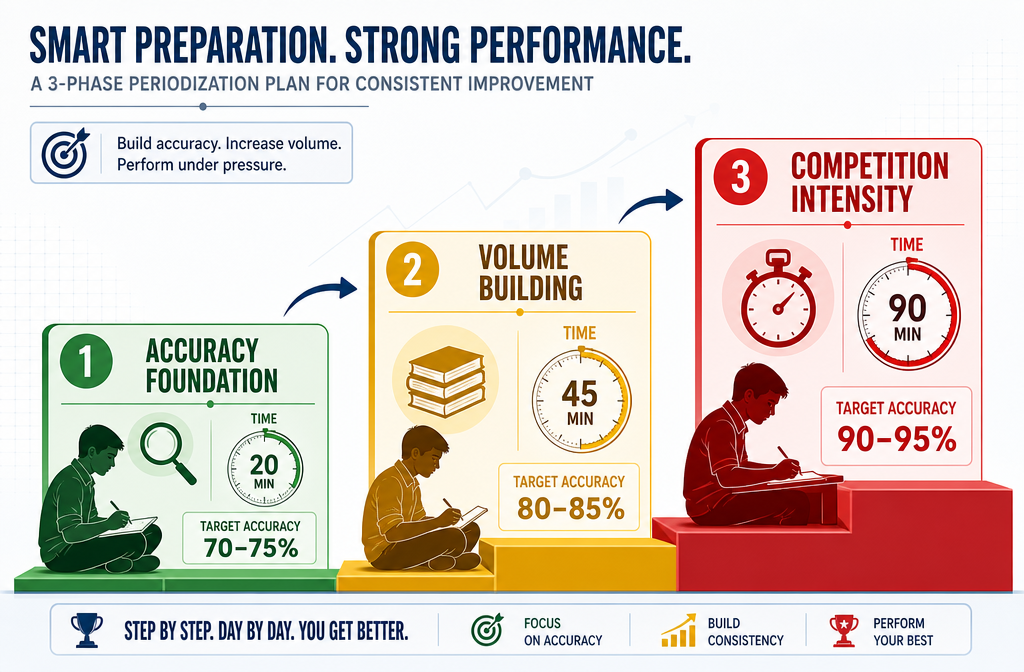
The periodization model divides your 12-week preparation into three distinct phases, each with specific goals and training volumes. Think of it as building a house—foundation first, then structure, finally the finishing touches.
Phase 1: Accuracy Foundation (Weeks 1-4)
This phase focuses exclusively on getting answers right, not getting them fast. Practice sessions stay short—20 to 30 minutes maximum. Why? Because your brain is learning pattern recognition, logical frameworks, and problem-solving approaches. Rushing this phase creates sloppy habits that become harder to fix later.
During these four weeks, you'll work on isolated AR question types: seating arrangements, blood relations, syllogisms, coding-decoding. Each session targets one specific type until your accuracy consistently hits 85% or higher. Speed doesn't matter yet. Not even a little bit.
Phase 2: Volume Building (Weeks 5-8)
Once accuracy is solid, you start extending practice duration. Sessions grow from 30 minutes to 45 minutes, then to 60 minutes by week eight. But here's the critical part: you increase volume by only 10-15% each week. This gradual progression allows your cognitive stamina to adapt without triggering mental fatigue.
You'll also start mixing question types during this phase. Real CLAT sections don't isolate AR questions by type, so your practice shouldn't either. The goal shifts from "get it right" to "get it right for longer periods." If accuracy drops below 75% during any session, you've increased volume too quickly. Scale back and consolidate before pushing forward.
Phase 3: Competition Intensity (Weeks 9-12)
The final phase introduces full exam conditions. You're now practicing 90-minute blocks that simulate the actual CLAT experience, including the mental fatigue that comes with it. This phase also incorporates strategic deload weeks where you intentionally reduce volume to allow recovery and skill consolidation.
Week 10 is typically a deload week—you drop back to 60-minute sessions at lower intensity. This isn't slacking off. It's allowing your brain to cement the patterns and stamina you've built. Athletes call this "supercompensation," and it works for cognitive training too.
By week 12, you're running full mock tests under timed conditions, and your stamina feels natural rather than forced. That's the difference between periodized training and just grinding through practice.
The 12-Week Periodized Practice Schedule
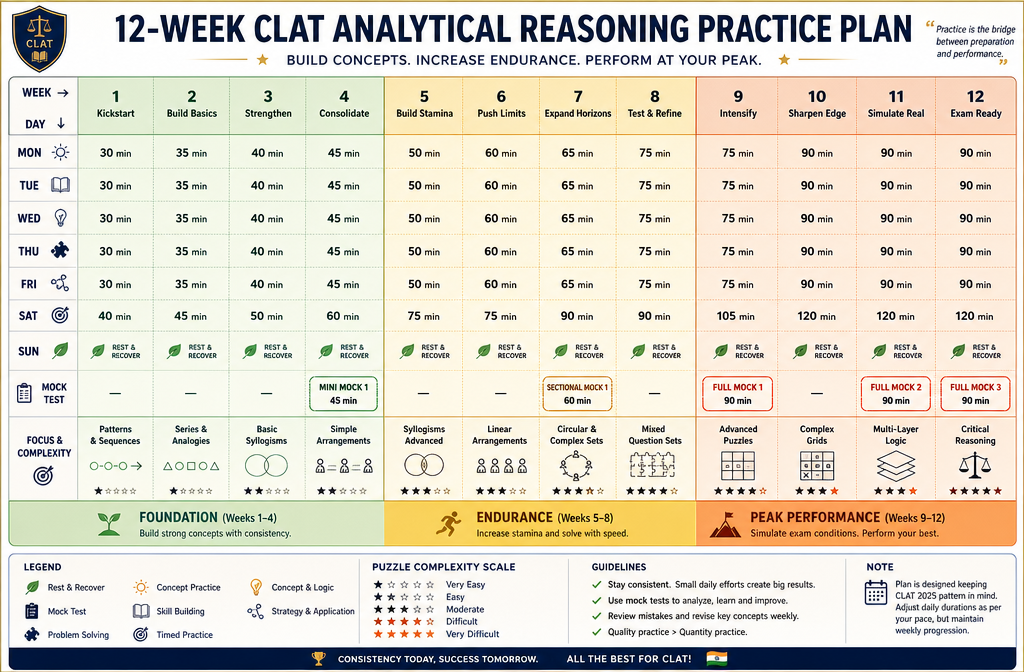
Let's break down exactly what each week looks like. This isn't a cookie-cutter approach—you'll need to adjust based on your starting point and response to training. But this framework has helped thousands crack CLAT with their mental stamina intact.
Weeks 1-4: Accuracy Foundation Phase
Week 1: Baseline Assessment and Single-Type Focus
- Monday: 20-minute seating arrangement practice (linear only)
- Tuesday: Rest day (review errors from Monday)
- Wednesday: 20-minute blood relations practice
- Thursday: Rest day (review errors from Wednesday)
- Friday: 20-minute syllogisms practice
- Saturday: 25-minute mixed practice (previous three types)
- Sunday: Complete rest (no AR practice)
Target accuracy: 80% minimum before moving forward. If you're below this threshold, repeat Week 1 structure with different questions.
Week 2: Expanding Question Types
- Monday: 25-minute circular seating arrangements
- Tuesday: Active rest (watch solution videos, no solving)
- Wednesday: 25-minute coding-decoding practice
- Thursday: Active rest
- Friday: 25-minute direction sense and ranking
- Saturday: 30-minute mixed practice (all five types)
- Sunday: Complete rest
Target accuracy: 82% minimum. Notice the slight increase in session length and the introduction of "active rest" where you're learning without the pressure of solving.
Week 3: Pattern Recognition Consolidation
- Monday: 30-minute complex seating (conditions-based)
- Tuesday: Rest day
- Wednesday: 30-minute logical deductions
- Thursday: Rest day
- Friday: 30-minute data sufficiency
- Saturday: 35-minute comprehensive mixed practice
- Sunday: Complete rest
Target accuracy: 85% minimum. You're building confidence in pattern recognition across all major AR types.
Week 4: Foundation Assessment
- Monday-Thursday: 30-minute daily practice rotating through all types
- Friday: 40-minute comprehensive mixed practice
- Saturday: Foundation phase assessment (45 minutes, all types)
- Sunday: Complete rest and phase review
You should hit 85%+ accuracy on the Saturday assessment. If not, extend the foundation phase by one more week before moving to volume building.
Weeks 5-8: Volume Building Phase
Week 5: Introducing Extended Sessions
- Monday: 35-minute mixed practice
- Tuesday: Rest day
- Wednesday: 35-minute mixed practice
- Thursday: Rest day
- Friday: 40-minute mixed practice
- Saturday: 45-minute comprehensive practice
- Sunday: Complete rest
Target accuracy: 80-85% (slight drop is normal as volume increases). Focus on maintaining form even when tired.
Week 6: Building Endurance
- Monday: 40-minute mixed practice
- Tuesday: Active rest
- Wednesday: 45-minute mixed practice
- Thursday: Active rest
- Friday: 45-minute mixed practice
- Saturday: 50-minute comprehensive practice
- Sunday: Complete rest
Target accuracy: 80-85%. If accuracy drops below 75%, you're increasing volume too quickly.
Week 7: Approaching Hour-Long Sessions
- Monday: 50-minute mixed practice
- Tuesday: Rest day
- Wednesday: 55-minute mixed practice
- Thursday: Rest day
- Friday: 55-minute mixed practice
- Saturday: 60-minute comprehensive practice (milestone session)
- Sunday: Complete rest
Target accuracy: 78-82%. The 60-minute mark is where most students previously hit their wall. Notice how gradually you've reached this point.
Week 8: Consolidating Hour-Long Capacity
- Monday: 60-minute mixed practice
- Tuesday: Active rest
- Wednesday: 60-minute mixed practice
- Thursday: Active rest
- Friday: 60-minute mixed practice
- Saturday: Volume phase assessment (60 minutes, exam-style)
- Sunday: Complete rest and phase review
Target accuracy: 80%+ consistently across the week. You've now built the capacity to maintain focus and accuracy for a full hour.
Weeks 9-12: Competition Intensity Phase
Week 9: Introducing Competition Conditions
- Monday: 70-minute practice with exam-style pressure
- Tuesday: Rest day
- Wednesday: 75-minute practice with exam-style pressure
- Thursday: Rest day
- Friday: 80-minute practice with exam-style pressure
- Saturday: 90-minute full mock test (all CLAT sections)
- Sunday: Complete rest
Target accuracy: 75-80% (pressure and length increase difficulty). Focus on maintaining composure when fatigue hits.
Week 10: Strategic Deload
- Monday: 50-minute relaxed practice (no timer pressure)
- Tuesday: Rest day
- Wednesday: 50-minute relaxed practice
- Thursday: Rest day
- Friday: 60-minute moderate practice
- Saturday: 60-minute moderate practice
- Sunday: Complete rest
This deload week allows consolidation. Many students see their best performances in Week 11 after this strategic recovery period.
Week 11: Peak Performance Building
- Monday: 90-minute full mock test
- Tuesday: Rest day
- Wednesday: 90-minute full mock test
- Thursday: Rest day
- Friday: 90-minute full mock test
- Saturday: 90-minute full mock test with added pressure simulation
- Sunday: Complete rest
Target accuracy: 78-82%. You're now operating at competition level with stamina to spare.
Week 12: Competition Readiness
- Monday: 90-minute full mock test
- Tuesday: Active rest (light review only)
- Wednesday: 90-minute full mock test
- Thursday: Complete rest
- Friday: 60-minute moderate practice (no new material)
- Saturday: Light review and mental preparation
- Sunday: Complete rest before exam week
This final week balances peak readiness with recovery. You're not building new stamina now—you're maintaining what you've built and ensuring you're fresh for exam day.
Preventing Burnout: Recovery Strategies and Warning Signs
Building stamina isn't just about pushing harder. It's about knowing when to push and when to recover. The difference between students who maintain performance through exam day and those who peak too early often comes down to recovery strategy.
The Science of Cognitive Recovery
Your brain isn't a muscle, but it follows similar adaptation principles. When you practice analytical reasoning intensely, you're depleting cognitive resources—working memory capacity, attention control, pattern recognition speed. These resources need time to replenish and strengthen.
Research on cognitive training shows that consolidation happens during rest periods, not during practice itself. That's why this plan includes structured rest days and deload weeks. You're not losing ground during recovery. You're actually cementing gains.
Essential Recovery Strategies
1. Strategic Rest Days
Notice how the plan alternates practice days with rest days, especially in the foundation and volume phases. These aren't optional. Skipping rest days to "get ahead" actually slows your progress by preventing consolidation.
On rest days, you can review errors from previous sessions, watch solution explanations, or engage with CLAT preparation strategies that don't involve active solving. But no timed practice.
2. Active Rest Sessions
Active rest means engaging with AR material without the pressure of solving under time constraints. Watch expert solutions, analyze your error patterns, or teach concepts to a study partner. This keeps your mind engaged with the material while allowing recovery from performance pressure.
3. Deload Weeks
Week 10's deload is strategically placed after you've built significant volume capacity but before the final competition intensity push. During this week, you intentionally reduce both volume and intensity. Think of it as taking two steps back to take three steps forward.
Many students resist deload weeks, fearing they'll lose their edge. But data from our coaching experience shows that students who skip the deload week typically plateau or decline in Week 11, while those who embrace it often see their best performances afterward.
4. Sleep and Nutrition
This might seem obvious, but cognitive stamina depends heavily on sleep quality and nutrition. During intensive preparation phases, aim for 7-8 hours of sleep nightly. Your brain consolidates learning during sleep, especially pattern recognition skills crucial for AR.
Nutrition matters too. Complex carbohydrates provide sustained mental energy. Protein supports neurotransmitter function. Hydration affects cognitive performance more than most students realize. These aren't minor details—they're part of your training strategy.
Warning Signs of Overtraining
Just like athletes can overtrain physically, you can overtrain cognitively. Watch for these warning signs:
Declining Accuracy Despite Consistent Practice
If your accuracy drops for three consecutive sessions despite adequate effort, you're likely overtrained. Solution: Take two full rest days, then resume at 70% of your previous volume.
Inability to Focus During Sessions
When you find yourself rereading questions multiple times or losing track of logical steps you normally handle easily, your cognitive resources are depleted. Solution: End the session early, rest completely, and reduce volume in your next session.
Increased Irritability or Anxiety About Practice
Mental fatigue often shows up as emotional changes before cognitive ones. If you're dreading practice sessions that you previously found engaging, or feeling unusually anxious about performance, you need recovery. Solution: Take a full rest day and consider whether you've been skipping scheduled recovery days.
Physical Symptoms
Headaches, eye strain, or tension in neck and shoulders during or after practice sessions indicate you're pushing too hard. Solution: Reduce session length by 25%, ensure proper ergonomics, and add more frequent breaks during practice.
Sleep Disruption
If you're having trouble falling asleep or experiencing restless sleep during intensive training phases, your nervous system is overstimulated. Solution: Move practice sessions earlier in the day, add a wind-down routine before bed, and consider a deload week.
Adjusting the Plan for Your Response
This 12-week plan provides structure, but you need to adjust based on your individual response. Some students build stamina faster and can accelerate the progression. Others need more time in each phase.
The key metric is accuracy. If you maintain target accuracy while increasing volume, you're adapting well. If accuracy drops below target ranges for two consecutive sessions, slow your progression. There's no prize for finishing the 12 weeks fastest—the goal is reaching exam day with peak stamina and accuracy.
Students working with our expert guidance from top NLUs get personalized adjustments based on their practice data. But even if you're following this plan independently, you can make intelligent adjustments by tracking your accuracy and energy levels consistently.
Integrating This Strategy With Complete CLAT Preparation
Analytical reasoning doesn't exist in isolation on the CLAT exam. You need to build AR stamina while also preparing for legal reasoning, logical reasoning, English comprehension, and current affairs. How do you balance periodized AR training with comprehensive preparation?
Scheduling AR Practice Within Full Preparation
The 12-week plan focuses specifically on AR stamina building, but it's designed to fit within a broader preparation schedule. Here's how to integrate it:
Morning Slots for AR Practice
Schedule your AR practice sessions in the morning when cognitive resources are freshest. This allows you to give full attention to stamina building without the accumulated mental fatigue from other subjects.
After your AR session, move to subjects that require different cognitive skills—perhaps current affairs reading or legal reasoning passage analysis. This variety prevents single-skill burnout while maintaining overall study volume.
Coordinate With Mock Test Schedule
The plan includes full mock tests in Weeks 9-12. These should be comprehensive CLAT mocks covering all sections, not just AR-focused tests. This is where you practice maintaining AR performance while managing the cognitive demands of switching between sections.
Our complete CLAT 2027 exam syllabus guide provides detailed strategies for integrating all sections into a cohesive preparation plan. The AR periodization plan fits as one component of that larger structure.
Adjust for Your Weak Areas
If analytical reasoning is your strongest section, you might compress this 12-week plan into 8-10 weeks, dedicating more time to weaker areas. Conversely, if AR is a significant weakness, you might extend the foundation phase or add an extra deload week.
The periodization principle applies to all CLAT sections. You can use similar progressive overload strategies for CLAT math preparation or legal reasoning stamina building.
Balancing School and CLAT Preparation
Many CLAT aspirants are managing Class 12 board preparation simultaneously. The periodized approach actually helps with this balance because it prevents the all-or-nothing mentality that leads to burnout.
During board exam periods, you might shift to maintenance mode—keeping AR sessions at 30-40 minutes three times weekly rather than following the full progression. After boards, you can resume the volume building phase.
Our article on balancing school and CLAT preparation provides detailed strategies for managing both commitments without sacrificing either.
Using Study Communities for Accountability
Following a 12-week structured plan requires discipline. Study communities provide accountability and motivation. When you're tempted to skip a rest day or push through when you should deload, having peers following similar strategies helps you stick to the plan.
Our CLAT study community includes students at various preparation stages, all working toward the same goal. Sharing your progress, challenges, and adjustments helps you stay consistent with the periodization approach.
Tracking Progress Effectively
The periodization model only works if you track your response to training. Maintain a simple practice log:
- Date and week number
- Session duration
- Question types practiced
- Accuracy percentage
- Energy level (1-10 scale)
- Notes on difficulty or observations
This log helps you identify patterns. Maybe your accuracy consistently drops on Fridays, suggesting accumulated weekly fatigue. Or perhaps seating arrangements still cause accuracy dips even in Week 8, indicating you need more targeted practice on that type.
Students in our coaching programs receive detailed analytics on their practice patterns, but even a simple spreadsheet provides valuable insights for adjusting your plan.
Advanced Techniques for Competition-Level Performance
By Week 9, you've built solid stamina foundation. Now let's talk about advanced techniques that separate good performance from exceptional performance on exam day.
Mental Conditioning for Sustained Focus
Physical stamina is only part of the equation. Mental conditioning—your ability to maintain focus despite fatigue, distraction, or difficult questions—determines whether you finish strong or fade in the final 30 minutes.
Attention Reset Technique
During long practice sessions, your attention naturally wavers. Instead of fighting through, practice deliberate attention resets. After completing a question set, close your eyes for 10 seconds, take three deep breaths, and consciously refocus before starting the next set. This micro-recovery prevents attention drift.
Difficulty Bracketing
In competition-level practice, you'll encounter questions that exceed your current skill level. Advanced performers don't waste stamina battling impossible questions. They bracket difficult questions (mark for review), maintain momentum on accessible questions, and return to difficult ones only if time permits.
This skill requires practice. In your Week 9-12 sessions, deliberately practice the decision-making process: "Is this question worth my time right now, or should I bracket it?" Getting this judgment right preserves stamina for questions you can actually solve.
Performance Under Pressure
Competition intensity isn't just about duration—it's about maintaining performance when stakes feel high. In Week 11, add pressure simulation to your practice:
- Set consequences for missing accuracy targets (not punishments, just meaningful stakes like having to redo the session)
- Practice with a timer visible, creating time pressure awareness
- Simulate exam-day conditions: no phone, no breaks, uncomfortable chair
These pressure exposures help you maintain composure on actual exam day. Your stamina training won't help if anxiety disrupts your performance.
Section Management Strategy
CLAT doesn't present AR questions in isolation. You're switching between sections, managing time across different question types, and dealing with the cognitive cost of context switching.
Strategic Section Ordering
Some students perform better tackling AR early when they're fresh. Others prefer warming up with English comprehension before hitting AR. During your full mock tests in Weeks 9-12, experiment with section ordering to find your optimal sequence.
There's no universal best order. The right strategy is the one that allows you to maintain your AR accuracy while also performing well in other sections. Our CLAT exam pattern guide breaks down section management strategies in detail.
Energy Allocation
Not all questions deserve equal energy investment. Advanced test-takers allocate energy strategically:
- High-accuracy questions: Full focus, ensure correct answers
- Medium-difficulty questions: Moderate focus, solve efficiently
- Low-probability questions: Minimal energy, educated guess and move on
This energy allocation prevents stamina depletion on low-value questions. Practice this discrimination during your Week 10-12 sessions.
Recovery Between Sections
Even within the exam, you can apply micro-recovery techniques. Between sections, take 15-20 seconds to:
- Close your eyes and reset attention
- Stretch your neck and shoulders
- Take three deep breaths
- Consciously release tension
These brief resets help maintain stamina across the full two-hour exam. Practice them during your full mock tests so they become automatic on exam day.
Conclusion
The CLAT 2027 Practice Strategy: Building Analytical Reasoning Stamina Without Burnout – A 12-Week Periodized Plan gives you a scientifically-backed framework for developing the sustained mental performance CLAT demands. By progressing systematically through accuracy foundation, volume building, and competition intensity phases, you build stamina that lasts through exam day rather than burning out weeks before.
Remember these core principles:
Start with accuracy, not speed. The foundation phase isn't wasted time—it's the base that allows everything else to work. Students who rush through foundation work inevitably hit performance ceilings later.
Increase volume gradually. The 10-15% weekly increase might feel conservative, but it allows adaptation without breakdown. Aggressive volume jumps lead to declining accuracy and eventual burnout.
Recovery is part of training, not a break from it. Rest days and deload weeks aren't optional extras. They're when your brain consolidates the patterns and stamina you're building.
Track and adjust. The 12-week plan provides structure, but your individual response determines the specifics. Monitor your accuracy and energy levels, and adjust progression speed accordingly.
Integrate with comprehensive preparation. AR stamina building is one component of CLAT success. Balance it with preparation in other sections using similar periodization principles.
Your success is our mission. This proven strategy actually works because it respects how cognitive stamina develops—gradually, with strategic recovery, and with attention to individual response patterns. Whether you're working independently or with expert guidance from experienced faculty, these principles will help you reach exam day with peak performance capacity.
Start your 12-week plan today. Track your progress. Trust the periodization process. And watch your analytical reasoning stamina grow without the burnout that derails so many aspirants.
Let's build your law career together, one strategic training session at a time.