
Last updated: June 13, 2026
Quick Answer: Several international law schools and universities, particularly in Singapore, the UK, the Netherlands, and Australia, accept CLAT scores as part of their admissions criteria for Indian students. CLAT scores are not always a direct replacement for local entrance tests, but they serve as strong academic proof of legal aptitude, English proficiency, and analytical ability. Indian students with competitive CLAT scores can use them to strengthen applications to global law programs, often alongside GPA, personal statements, and other documents.
Key Takeaways
- CLAT scores are accepted or recognized as supporting credentials by select international law schools, especially those with dedicated India outreach programs.
- Countries with the most accessible international law programs for CLAT scorers include Singapore, the UK, the Netherlands, Canada, and Australia.
- Tuition at international law schools ranges from roughly INR 15 lakhs to INR 60 lakhs per year depending on the country and institution.
- Most international law programs taught in English do not require a separate English proficiency test if your undergraduate instruction was in English.
- Scholarships specifically for Indian law students exist at institutions like the University of Edinburgh, NUS, and several Dutch universities.
- A strong student profile for international law admissions typically includes a CLAT score in the top 10-15%, a GPA above 3.0 (or equivalent), relevant internships, and a focused personal statement.
- Common mistakes Indian applicants make include underestimating the importance of the personal statement, applying too late, and not researching country-specific visa requirements.
- International law programs can lead to strong careers in corporate law, human rights, international arbitration, and cross-border litigation.
Which Top International Law Schools Accept CLAT Scores
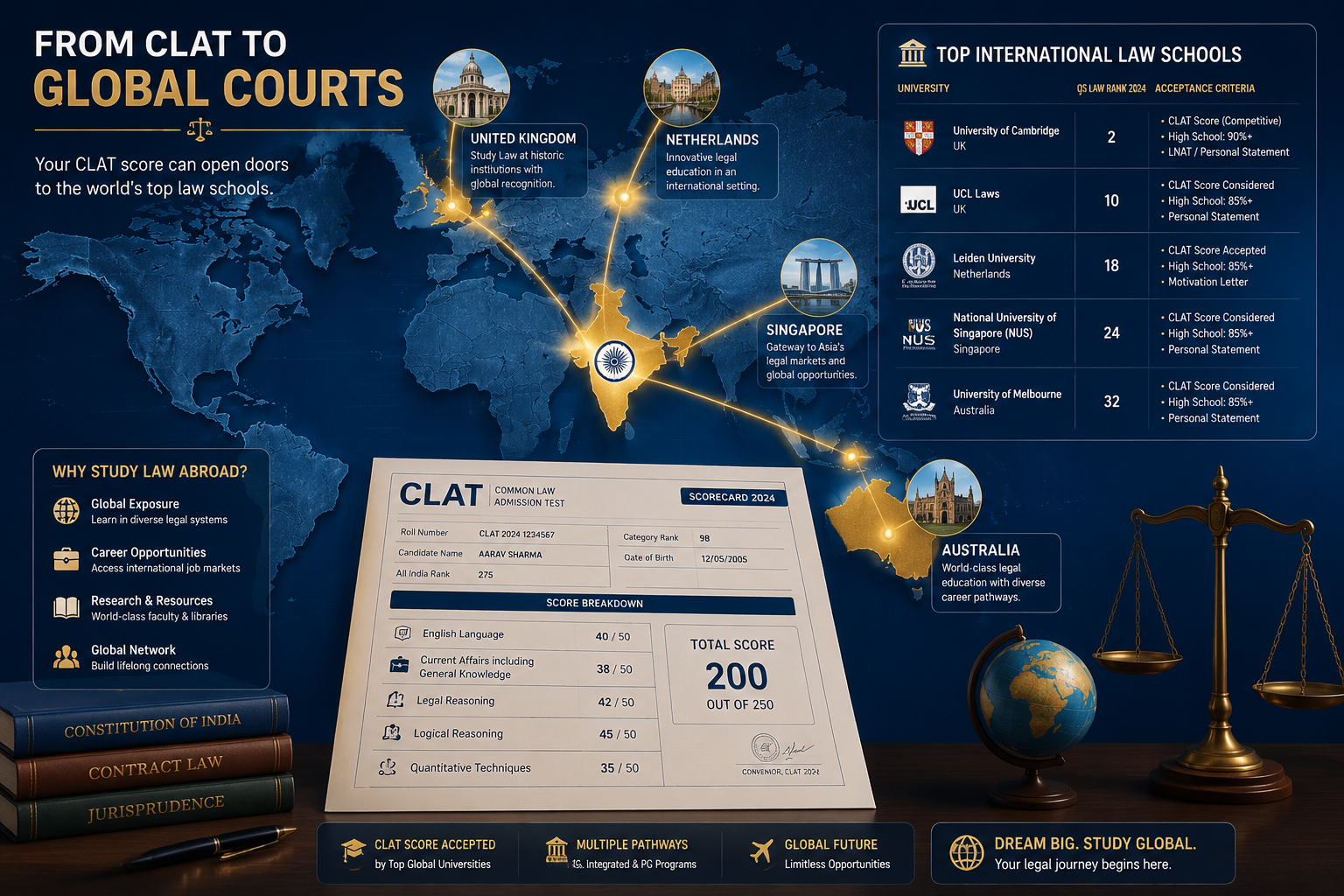
A growing number of international law schools recognize CLAT scores as a credible academic benchmark for Indian applicants. While very few institutions list CLAT as a mandatory requirement, many use it as a supporting document that demonstrates your legal reasoning ability and academic seriousness.
Here are some institutions that have shown openness to CLAT scores or have active India-specific admission pathways:
Singapore
- National University of Singapore (NUS) Faculty of Law accepts Indian applicants and considers CLAT scores as part of holistic review for LLM programs.
- Singapore Management University (SMU) School of Law has recruited Indian students and acknowledges CLAT as a law-specific aptitude indicator.
United Kingdom
- University of Law (UK) has partnerships with Indian institutions and considers CLAT performance for merit-based admissions.
- Some programs at the University of Edinburgh and King’s College London have acknowledged CLAT scores in Indian applicant dossiers, particularly for postgraduate law programs.
Netherlands
- Leiden University and Utrecht University offer English-taught LLM programs that accept Indian applicants and consider CLAT scores during holistic review.
Australia
- University of Melbourne and Australian National University (ANU) have India-specific law school outreach and accept CLAT as a supporting credential.
Canada
- University of Toronto and Osgoode Hall Law School consider CLAT scores as part of international applicant review, though they are not mandatory.
One important clarification: “accepting CLAT scores” usually means the institution treats your CLAT performance as evidence of legal aptitude, not that it replaces their own admission requirements. Always check each school’s official admission page for the current year.
For a deeper understanding of how CLAT scores translate into competitive standing, check out this guide on CLAT Marks vs Rank 2026: Score Conversion and NLU Admission Strategy.
Which Countries Have the Best International Law Programs for CLAT Scorers
The best countries for CLAT scorers pursuing global law education are Singapore, the UK, the Netherlands, and Australia. Each offers English-taught programs, strong legal job markets, and active Indian student communities.
Here’s a country-by-country breakdown:
| Country | Key Institutions | Program Type | Average Annual Cost (INR) |
|---|---|---|---|
| Singapore | NUS, SMU | LLB, LLM | 20-35 lakhs |
| United Kingdom | University of Law, Edinburgh, King’s | LLB, LLM, GDL | 25-50 lakhs |
| Netherlands | Leiden, Utrecht, Maastricht | LLM | 10-20 lakhs |
| Australia | Melbourne, ANU, Sydney | JD, LLM | 25-45 lakhs |
| Canada | Toronto, Osgoode | LLM, JD | 20-40 lakhs |
| USA | Various (LLM programs) | LLM | 35-60 lakhs |
Singapore is often the top pick for Indian law students because of geographic proximity, strong legal industry ties to India, and relatively straightforward visa processes. The UK is popular for its GDL (Graduate Diploma in Law) pathway, which lets non-law graduates pivot into law. The Netherlands is the most affordable option in Europe, with several top-ranked programs under INR 20 lakhs per year.
How Much Does It Cost to Study Law Abroad With CLAT
Studying at international law schools is a significant financial commitment. Costs vary widely based on country, institution, and program length.
Rough cost estimates for Indian students in 2026:
- Singapore: INR 20-35 lakhs per year for tuition. Living costs add roughly INR 10-15 lakhs annually.
- UK: INR 25-50 lakhs per year for tuition. London-based programs cost more for accommodation.
- Netherlands: INR 10-18 lakhs per year for tuition. One of the most affordable options in Western Europe.
- Australia: INR 25-45 lakhs per year. Living costs in Sydney and Melbourne are high.
- USA (LLM only): INR 35-60 lakhs per year. Most Indian students pursue one-year LLM programs here.
Beyond tuition, factor in:
- Health insurance (mandatory in most countries)
- Visa application fees
- Travel and relocation costs
- Study materials and bar exam prep (if applicable)
The good news is that scholarships can significantly reduce these numbers. We’ll cover that in detail below.
Are There English-Taught International Law Programs for Indian Students
Yes, the majority of international law programs designed for Indian students are taught entirely in English. This is one of the biggest advantages CLAT scorers have when applying abroad.
Countries where English-taught law programs are standard:
- United Kingdom (all programs)
- Singapore (NUS, SMU)
- Australia (all major universities)
- Canada (all major universities)
- Netherlands (most LLM programs at Leiden, Utrecht, Maastricht)
- Germany (select LLM programs at Hamburg, Frankfurt)
If your undergraduate degree was taught in English, most of these institutions will waive the IELTS or TOEFL requirement. Some may still ask for it, so verify directly with the admissions office.
One thing to keep in mind: being taught in English does not mean the legal system you study will mirror Indian law. Programs in the UK follow common law traditions, which overlap significantly with Indian law. Programs in the Netherlands or Germany may require you to engage with civil law systems, which is a different but valuable perspective.
What GPA Do You Need to Get Into International Law Schools
Most international law schools expect a minimum GPA of 3.0 on a 4.0 scale, which roughly translates to a first-class or upper second-class degree in the Indian system (60-75% and above). However, competitive programs at NUS, Edinburgh, or Melbourne often see admitted students with GPAs of 3.5 or higher.
Here’s how Indian grading typically converts:
| Indian Percentage | Approximate GPA | Admission Competitiveness |
|---|---|---|
| 75% and above | 3.7 – 4.0 | Strong for top programs |
| 65-75% | 3.0 – 3.6 | Competitive for mid-tier programs |
| 55-65% | 2.5 – 3.0 | Possible with strong other factors |
| Below 55% | Below 2.5 | Difficult without compensating factors |
A strong CLAT score can partially compensate for a lower GPA if your application also includes strong internship experience, a compelling personal statement, and relevant extracurriculars. But let’s be honest: GPA matters a lot, and no single factor fully replaces it.
If you’re still in your undergraduate program, focus on maintaining strong academic performance. And if you’re preparing for CLAT right now, a high score creates a strong foundation for your entire legal career, including international applications. Our guide on CLAT 2026 Revision Tips can help you maximize your score before the exam.
Can You Use CLAT Scores for Universities in Singapore or the UK
Yes, CLAT scores are accepted as supporting credentials at several universities in Singapore and the UK. They are not a standalone admission requirement but are treated as evidence of legal aptitude and academic seriousness.
Singapore: NUS Faculty of Law and SMU School of Law have both enrolled Indian students who included CLAT scores in their applications. NUS in particular has a well-known India outreach program. For LLM applicants, a strong CLAT score combined with a good undergraduate GPA from an NLU significantly strengthens your profile.
UK: The University of Law explicitly mentions CLAT in its India-specific admissions guidance. For LLM programs at universities like King’s College London or the University of Edinburgh, CLAT scores are included in holistic review alongside your undergraduate degree, personal statement, and references.
The key point is this: do not send your CLAT scorecard without context. Write a personal statement that explains what CLAT is, what your score means in the competitive landscape, and how it demonstrates your readiness for rigorous legal study. Admissions officers outside India may not automatically understand its significance.
How Difficult Is It to Transfer CLAT Scores to International Universities
It’s not difficult, but it requires proactive communication. CLAT scores are not part of any international standardized database, so you need to present them correctly.
Here’s a step-by-step process:
- Download your official CLAT scorecard from the Consortium of NLUs website.
- Get it attested by a gazetted officer or notary if the university requests verified documents.
- Write a brief explanatory note (one paragraph is enough) describing CLAT: what it is, how many students appear, and what your score/rank means percentile-wise.
- Include it in your application package as a supplementary document, not as a replacement for any required document.
- Follow up with the admissions office if you’re unsure whether they’ve reviewed it.
Most international law schools have seen CLAT scorecards before, especially those with active India recruitment. But if you’re applying to a less India-familiar institution, your explanatory note becomes even more important.
What Scholarship Options Exist for Indian Students in Foreign Law Programs
Scholarships for Indian law students studying abroad are more available than most people realize. The challenge is finding and applying to the right ones early enough.
Key scholarships to explore in 2026:
- Commonwealth Scholarships: Available for Indian students pursuing postgraduate study in the UK. Law programs are eligible.
- Chevening Scholarships: UK government-funded, highly competitive, covers tuition and living costs. Requires two years of work experience.
- NUS Law School Scholarships: NUS offers merit-based aid for international students, including Indians with strong academic profiles.
- Leiden University Excellence Scholarship (LExS): Covers 50-100% of tuition for non-EU students at Leiden Law School.
- Inlaks Shivdasani Foundation Scholarships: India-specific scholarships for study at top international institutions, including law schools.
- Felix Scholarship: For Indian students from specific regions pursuing postgraduate study in the UK.
- Australian Awards Scholarships: Government-funded, covers tuition, travel, and living allowance for Indian students at Australian universities.
A few practical tips: Apply for scholarships at least 12-18 months before your intended start date. Many scholarships close applications well before university admission deadlines. And always apply to multiple scholarships simultaneously since competition is high.
What Are Common Mistakes Indian Students Make Applying to Foreign Law Schools
Let’s be direct about this. Indian students applying to international law schools make a few recurring mistakes that hurt otherwise strong applications.
Mistake 1: Treating the personal statement as a formality.
Your personal statement is often the deciding factor when two candidates have similar GPAs and scores. Generic statements that list achievements without explaining motivation get rejected. Write specifically about why you want to study international law, what specific area interests you (trade law, human rights, arbitration), and why this particular school.
Mistake 2: Not explaining CLAT to foreign admissions officers.
A scorecard without context is meaningless to someone who has never heard of CLAT. Always include a brief explanation of the exam’s scale and your percentile ranking.
Mistake 3: Applying to only one or two schools.
International admissions are unpredictable. Apply to at least five to eight programs across different competitiveness tiers.
Mistake 4: Ignoring financial planning.
Many students get admission but cannot arrange funds in time. Start researching scholarships and education loans at least a year before applying.
Mistake 5: Underestimating the importance of recommendation letters.
A generic recommendation from a professor who barely knows you is a red flag. Ask faculty members or internship supervisors who can speak specifically to your legal thinking and work ethic.
Mistake 6: Not researching visa requirements early.
Student visa processes for the UK, Singapore, Australia, and Canada each have different timelines, financial proof requirements, and documentation needs. Starting late can cost you your admission slot.
What Are the Visa Requirements for Law Students Studying Internationally
Visa requirements vary by country, but most share a common set of core documents. Here’s a country-wise overview for Indian students in 2026:
United Kingdom (Student Visa)
- Confirmation of Acceptance for Studies (CAS) from your university
- Proof of English proficiency (or exemption)
- Bank statements showing funds to cover tuition and living costs for the first year
- Tuberculosis test certificate (required for Indian applicants)
- Biometric information
Singapore (Student Pass)
- Issued through the Student’s Pass Online Application and Registration (SOLAR) system
- Offer letter from NUS, SMU, or other institution
- Financial proof and passport-size photographs
- Medical examination may be required
Australia (Student Visa – Subclass 500)
- Confirmation of Enrollment (CoE)
- Genuine Temporary Entrant (GTE) statement
- Overseas Student Health Cover (OSHC)
- Financial capacity proof
Canada (Study Permit)
- Acceptance letter from a Designated Learning Institution (DLI)
- Proof of financial support
- Statement of purpose explaining your study plans
Processing times range from two weeks (Singapore) to three months (Canada, UK). Apply for your visa as soon as you receive your admission letter. Do not wait.
Are International Law Programs Good for Corporate or Human Rights Careers
Yes, international law programs are excellent preparation for both corporate law and human rights careers. The specific school and specialization you choose will shape which path opens up more naturally.
For corporate law careers:
- Programs at NUS, King’s College London, and University of Melbourne have strong ties to international law firms and financial institutions.
- Specializations in international commercial arbitration, mergers and acquisitions, and cross-border transactions are highly valued by global law firms.
- Many Indian law graduates from NUS and UK programs get recruited by Magic Circle firms (Allen and Overy, Clifford Chance, Linklaters) or their Singapore offices.
For human rights careers:
- Programs at Leiden University, Utrecht, and the University of Edinburgh have dedicated human rights law concentrations.
- The UN, UNHCR, Amnesty International, and international NGOs actively recruit from these programs.
- A degree from a recognized international institution carries significant weight in human rights advocacy and international tribunal work.
For international arbitration:
- This is one of the most sought-after career paths for Indian lawyers with international degrees. Singapore is the global hub for Asian arbitration, making NUS an especially strong choice.
The honest reality is that your career outcome depends heavily on your internships, networking, and bar qualification in your target jurisdiction. A degree alone does not guarantee placement. But the right international law program opens doors that domestic programs simply cannot.
How Do International Law School Rankings Compare to Indian Law Schools
Top international law schools consistently outrank Indian NLUs in global rankings, but this does not automatically mean they are a better choice for every student.
Global rankings context (based on QS World University Rankings by Subject: Law, 2025):
- NUS Faculty of Law: Top 15 globally
- University of Melbourne: Top 20 globally
- King’s College London: Top 25 globally
- NLSIU Bangalore (India’s top NLU): Typically ranked 200-300 globally
However, rankings tell only part of the story. NLSIU, NALSAR, and NLU Delhi have exceptional reputations within India and South Asia, strong alumni networks in Indian courts and law firms, and significantly lower costs. For students who want to practice law in India, an NLU degree often outperforms an international degree in practical terms.
Choose an international law school if:
- You want to work in international arbitration, global law firms, or international organizations.
- You plan to qualify as a lawyer in the UK, Singapore, or Australia.
- You have secured funding or scholarship support that makes the cost manageable.
Stick with an NLU if:
- You plan to practice in Indian courts or join Indian law firms.
- Cost is a significant constraint.
- You want to enter Indian civil services or judiciary.
For a clear picture of what strong CLAT performance can get you within India, read our Ultimate CLAT 2026 NLU Cutoff Predictions guide.
What Kind of Student Profile Works Best for International Law Admissions
The ideal profile for international law school admissions combines academic strength, practical experience, and a clear sense of purpose. Admissions committees at top international programs are not just looking for high scores. They want students who know why they are there.
Strong profile elements:
- CLAT score: Top 10-15 percentile (for NLU admissions context) signals strong legal aptitude.
- Undergraduate GPA: 3.3 or above on a 4.0 scale, or 65% and above in Indian percentage terms.
- Internships: At least two to three substantive legal internships, ideally at courts, law firms, or NGOs. International exposure is a bonus.
- Moot court and publications: Participation in moot courts, law reviews, or published legal writing shows genuine engagement with the discipline.
- Personal statement: Specific, focused, and honest. Admissions officers read thousands of these. Specificity stands out.
- Letters of recommendation: From professors or supervisors who can speak to your legal reasoning and work quality.
- Language skills: English proficiency is assumed. Additional languages (French, Spanish, Mandarin) are genuinely valued in international law programs.

One thing that genuinely helps: a clear career narrative. If your personal statement explains that you want to specialize in international trade law because of a specific internship experience or research interest, that is far more compelling than a generic statement about wanting to “make a difference.”
If you’re still building your CLAT preparation foundation, our 7 Expert Strategies for CLAT 2026 Success and 10 Powerful CLAT Legal Mindset Tips are great places to start building the analytical skills that international law schools value.
FAQ
Q: Do international law schools officially accept CLAT scores?
A: Several do, particularly in Singapore and the UK, though CLAT scores are typically treated as supporting credentials rather than mandatory admission requirements. Always check each school’s current admission policy.
Q: Can a good CLAT score replace LSAT or GRE for international law admissions?
A: In most cases, no. Some schools accept CLAT as an alternative to LSAT for Indian applicants, but this varies by institution. Confirm directly with the admissions office before assuming.
Q: Is it possible to get a full scholarship to study law abroad with a CLAT score?
A: Yes, though it is competitive. Scholarships like Chevening (UK), Commonwealth Scholarships, and NUS merit awards can cover significant costs. A strong CLAT score, combined with an excellent GPA and profile, improves your chances considerably.
Q: What is the minimum CLAT score needed for international law school applications?
A: There is no universal minimum. However, a score placing you in the top 10-15% of CLAT test-takers (which typically means a rank under 1,000-1,500 for UG CLAT) is generally considered competitive for international applications.
Q: Do I need to take IELTS or TOEFL if I have a CLAT score?
A: Not necessarily. If your undergraduate education was in English, most international law schools will waive the English proficiency requirement. But some still require it, so verify with each institution.
Q: Can I practice law in India after completing an international law degree?
A: Yes, but you may need to clear the Bar Council of India’s requirements for foreign-qualified lawyers. As of 2026, the BCI has specific rules for Indian nationals returning with foreign law degrees. Check current BCI regulations before enrolling abroad.
Q: How long do international LLM programs typically take?
A: Most LLM programs are one year in duration. JD programs (common in the US, Canada, and Australia) are typically three years.
Q: Is Singapore a better choice than the UK for Indian law students?
A: It depends on your goals. Singapore is better for Asian arbitration and corporate law careers in the Asia-Pacific region. The UK is better if you want to qualify as a solicitor or barrister in England and Wales, or work in London’s financial law sector.
Q: What is the typical application deadline for international law schools?
A: Most programs have rolling admissions or deadlines between November and March for the following academic year. Apply early since scholarship deadlines are often earlier than admission deadlines.
Q: Are there part-time or online international law programs that accept CLAT scores?
A: Some institutions offer hybrid or online LLM programs. However, these are less commonly recognized for visa purposes and may not carry the same career weight as full-time residential programs.
Conclusion
Your CLAT score is more than just a ticket to an NLU. For serious aspirants with global ambitions, it can be the first step toward a career in international law, arbitration, human rights, or global corporate practice.
Here’s the thing: international law schools are genuinely accessible to Indian students who prepare strategically. The combination of a strong CLAT score, a good undergraduate GPA, relevant internships, and a focused application can get you into programs at NUS, Leiden, Edinburgh, or Melbourne.
But the work starts now. If you’re still preparing for CLAT, treat every section of the exam as training for the kind of analytical thinking that international law programs demand. Your success is our mission at Lawgic Coaching, and we’ve helped thousands of students build exactly this kind of foundation.
Your next steps:
- Research two or three international law schools that match your career goals and check their India-specific admission pages.
- Start building your application profile now: internships, moot courts, and academic performance all matter.
- Look into scholarship deadlines, which are often 12-18 months before your target start date.
- Focus on maximizing your CLAT score, because a top percentile rank strengthens every application you send.
- Connect with Indian alumni at your target schools through LinkedIn or alumni networks.
If you want to explore all your options, including domestic alternatives, our Ultimate LLB Without CLAT Guide and Complete CLAT Success Guide 2027 cover the full landscape of law school pathways available to Indian students.
Let’s build your law career together. The world is a bigger place than you might think, and your CLAT journey is just the beginning.
References
- QS World University Rankings by Subject: Law. (2025). QS Top Universities. https://www.topuniversities.com/university-rankings/university-subject-rankings/2025/law
- National University of Singapore Faculty of Law. (2025). Admissions for International Students. https://law.nus.edu.sg/admissions/
- University of Law UK. (2025). International Student Admissions. https://www.law.ac.uk/international/
- Leiden University. (2025). LLM Admissions and Scholarships. https://www.universiteitleiden.nl/en/law
- Consortium of National Law Universities. (2025). CLAT 2025 Official Information. https://consortiumofnlus.ac.in/
- Chevening Scholarships. (2025). Eligibility and Application. https://www.chevening.org/scholarships/
- Commonwealth Scholarships. (2025). Indian Applicants. https://cscuk.fcdo.gov.uk/
- Australian Government Department of Home Affairs. (2025). Student Visa Subclass 500. https://immi.homeaffairs.gov.au/visas/getting-a-visa/visa-listing/student-500
- Bar Council of India. (2024). Rules for Foreign Qualified Lawyers. https://www.barcouncilofindia.org/
- Inlaks Shivdasani Foundation. (2025). Scholarship Programs. https://www.inlaksfoundation.org/scholarships/