Last updated: June 16, 2026
Quick Answer: CLAT 2027 is scheduled for December 6, 2026, conducted by the Consortium of National Law Universities. To crack it, you need a structured 6 to 8 month study plan covering five sections: English Comprehension, Current Affairs and GK, Legal Reasoning, Logical Reasoning, and Quantitative Techniques. Starting your preparation by May or June 2026 gives you enough runway to build strong fundamentals, master each section, and complete intensive mock test practice before exam day. [1]
Key Takeaways
- CLAT 2027 is confirmed for December 6, 2026. Starting preparation in May or June 2026 gives you a 30-week window. [1]
- The exam has five sections. Legal Reasoning and English Comprehension carry the most weight and deserve the most preparation time.
- Mock tests are non-negotiable. Full-length tests in the final two months build both accuracy and exam stamina. [3]
- Students from any stream, including Science and Commerce, can crack CLAT. The exam does not require prior legal knowledge.
- You can prepare effectively without expensive coaching. Free and affordable resources exist, and self-study works if you stay disciplined.
- Daily reading of quality editorials for at least 30 minutes is one of the highest-ROI habits you can build for CLAT. [1]
- Top NLUs typically require scores in the range of 95 to 105 out of 120 for general category candidates, though cutoffs shift year to year.
- Psychological preparation matters as much as academic preparation. Burnout and exam anxiety are real obstacles that a good study plan accounts for.
What Exactly Is CLAT and Why Should You Take It
CLAT, the Common Law Admission Test, is India’s national-level entrance exam for admission to undergraduate and postgraduate law programs at 24 National Law Universities (NLUs). It is conducted once a year by the Consortium of NLUs. For anyone serious about a career in law, CLAT is the single most important exam to crack.
Here’s why it matters so much. The NLUs are India’s premier law schools. Graduates from NALSAR, NLSIU Bangalore, NLU Delhi, and NUJS Kolkata consistently land positions at top-tier law firms, in the judiciary, and in corporate legal departments. The brand value of an NLU degree opens doors that most other law colleges simply cannot. If a career in law is your goal, this is the exam that changes everything.
The UG CLAT exam is open to students who have completed or are appearing in Class 12. You need a minimum of 45% aggregate marks in Class 12 (40% for SC/ST candidates). The exam is 120 minutes long, carries 120 marks, and follows a comprehension-based pattern where all questions are passage-based rather than direct knowledge recall.
For a detailed breakdown of what the exam actually looks like, check out this complete guide to CLAT 2027 exam structure and strategy.
How Hard Is CLAT Compared to Other Law Entrance Exams
CLAT is moderately difficult, but its comprehension-based format makes it different from most competitive exams. Unlike JEE or NEET, CLAT does not test rote memorization. It tests how well you read, analyze, and reason under time pressure.
Compared to AILET (conducted by NLU Delhi) and SLAT (conducted by Symbiosis), CLAT is considered more accessible because it covers a broader range of NLUs in a single attempt. AILET is generally considered tougher due to its higher difficulty level and the prestige of NLU Delhi. LSAT India is different in format and is used by private law schools.
What makes CLAT challenging is the combination of factors:
- 120 questions in 120 minutes means one question per minute, with no margin for confusion
- The passage-based format requires strong reading speed and comprehension
- Current affairs questions demand consistent preparation over months, not days
- Legal reasoning passages can be dense and require careful interpretation
But here’s the thing: CLAT rewards consistent, smart preparation more than raw intelligence. Students who build good reading habits, practice regularly, and analyze their mock tests seriously tend to do very well, regardless of their academic background.
Is CLAT Suitable for Commerce and Science Students
Yes, absolutely. CLAT does not require any prior knowledge of law, and students from Science, Commerce, and Arts streams all compete on equal footing. The exam tests reading comprehension, logical reasoning, basic mathematics, and current awareness, none of which are stream-specific skills.
In fact, many CLAT toppers come from Science and Commerce backgrounds. Science students often have an edge in logical reasoning and quantitative techniques. Commerce students tend to be comfortable with current affairs and analytical reading. Arts students may find the English and legal reasoning sections more natural.
The key is that no stream has a built-in disadvantage. What matters is how early you start, how consistently you practice, and how well you understand the exam pattern.
If you are still in Class 11 and thinking about CLAT, starting early is a genuine advantage. Read more about beginning your CLAT preparation from Class 11 to understand how to balance school and exam prep effectively.
How Many Hours Should You Study Daily for CLAT
For most students preparing over 6 to 8 months, 4 to 6 hours of focused daily study is sufficient. Quality matters far more than quantity here.
Here is a realistic daily breakdown:
| Time Block | Activity | Duration |
|---|---|---|
| Morning | Reading newspaper editorials (The Hindu, Indian Express) | 45 to 60 minutes |
| Mid-morning | Subject-specific study (one section per day) | 90 to 120 minutes |
| Afternoon | Practice questions or sectional tests | 60 to 90 minutes |
| Evening | Revision, vocabulary, current affairs notes | 45 to 60 minutes |
| Night | Light review, mock test analysis on test days | 30 to 45 minutes |
Students who are also managing board exams will need to be more strategic. Prioritize CLAT preparation on weekends and use weekday evenings efficiently. For a practical approach to balancing both, see this guide on preparing for CLAT while managing board exams.
One important note: studying for 10 hours a day and burning out by month three helps no one. Build sustainable habits. Take one half-day off per week. Sleep 7 to 8 hours. Your brain consolidates learning during sleep, and fatigue kills accuracy.
Your Month-by-Month CLAT Preparation Roadmap
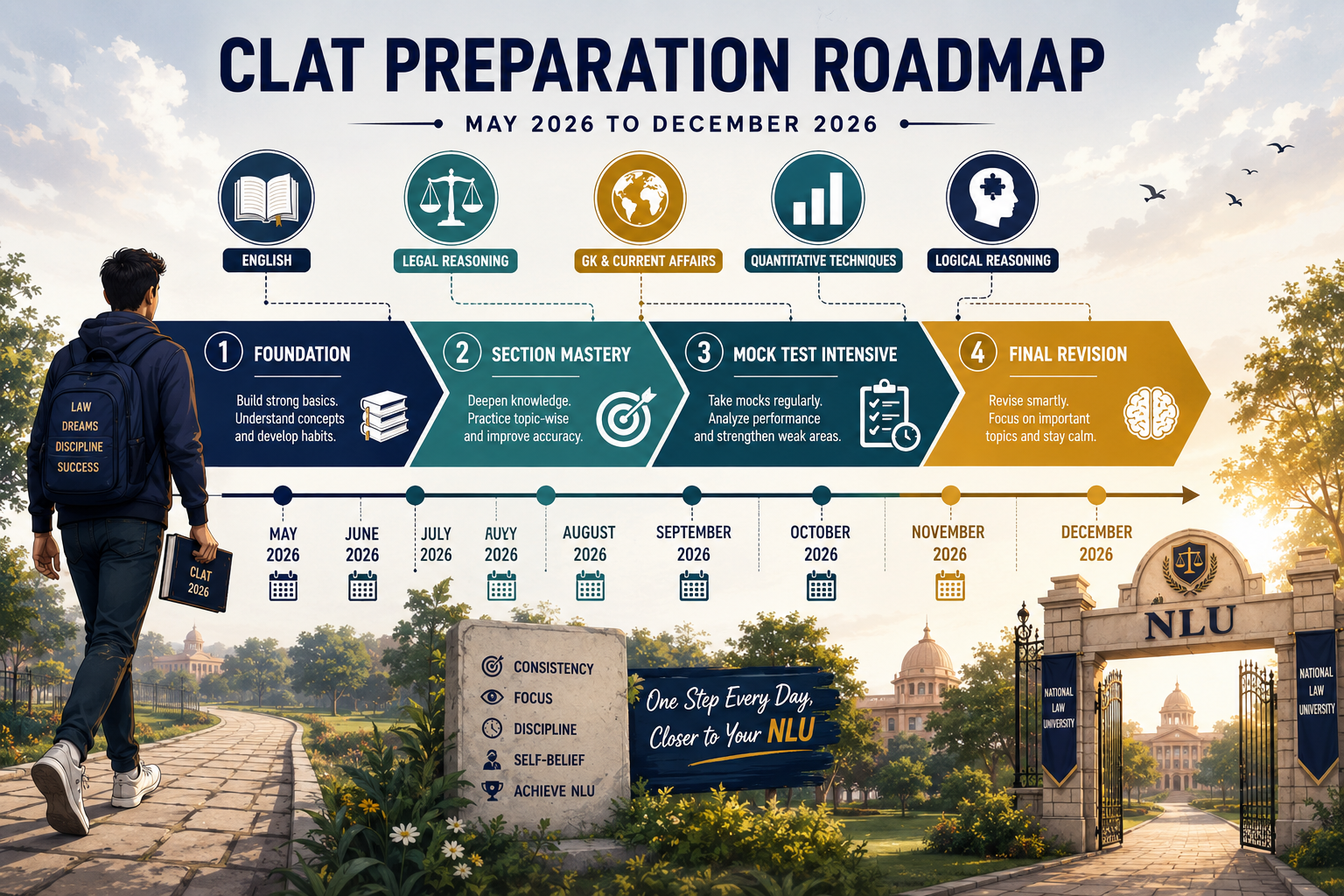
A structured 30-week plan starting in May 2026 gives you the best shot at CLAT 2027 on December 6, 2026. [1] Here is how to break it down:
Phase 1: Foundation Building (Weeks 1 to 6, May to Mid-June 2026)
This phase is about understanding the exam deeply and building core skills. Do not rush into mock tests yet.
- Read the complete CLAT syllabus and exam pattern thoroughly
- Start daily newspaper reading (The Hindu editorial is the gold standard)
- Begin building a current affairs notebook organized by topic
- Study basic grammar rules and vocabulary for English Comprehension
- Revise Class 10 level mathematics for Quantitative Techniques
- Read introductory material on the Indian Constitution for Legal Reasoning
- Take one diagnostic mock test at the end of Week 6 to establish your baseline [1]
Phase 2: Section Mastery (Weeks 7 to 18, Mid-June to September 2026)
Now you go deep into each section. Spend roughly two weeks on each major section.
- Solve one sectional test per section each week and analyze every error [2]
- For Legal Reasoning, practice passage-based questions daily and focus on identifying legal principles
- For English Comprehension, focus on inference questions and tone identification
- For Current Affairs, maintain a rolling 12-month awareness and revise weekly
- For Logical Reasoning, work through critical reasoning and argument analysis
- For Quantitative Techniques, master the five to six core topic areas (ratios, percentages, data interpretation, basic algebra, statistics)
Phase 3: Integration and Mock Tests (Weeks 19 to 26, October to Mid-November 2026)
This is where preparation shifts from learning to performing. [3]
- Take two full-length mock tests per week
- Spend as much time analyzing each mock test as you spent taking it
- Identify your three weakest areas and dedicate extra daily time to them
- Start timing yourself on individual passages to build speed
- Join a study group or online community for peer accountability
Phase 4: Final Revision (Weeks 27 to 30, Mid-November to December 6, 2026)
- Stop learning new material. Focus entirely on revision.
- Revise your current affairs notes daily
- Take one mock test every three days to stay sharp
- Review your error log from previous mock tests
- Sleep well, eat well, and manage exam-day anxiety proactively
For a detailed 6-month version of this roadmap, this CLAT 2027 six-month prep strategy for first-time aspirants is worth reading. [2]
Subject-Wise Deep Dive: Your Complete CLAT Preparation Guide for Each Section
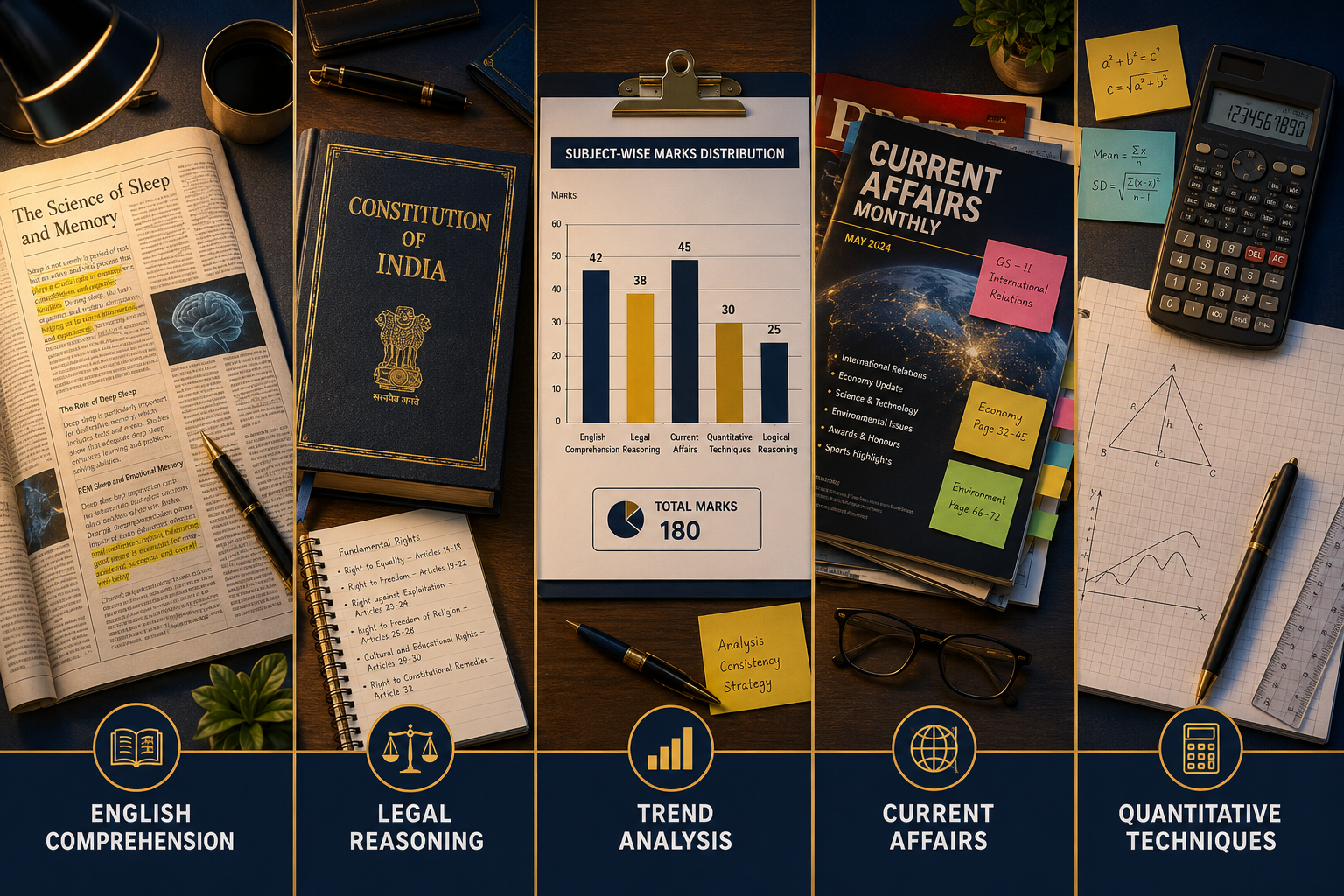
Each section in CLAT requires a different approach. Here is what actually works:
English Comprehension (28 to 32 marks)
This section is passage-based and tests inference, vocabulary in context, and author’s tone. The biggest mistake students make is reading passages slowly and carefully, which kills time. Train yourself to read fast and identify the key idea in each paragraph.
Daily habits that move the needle: reading editorials, practicing with RC passages from previous CLAT papers, and building a vocabulary list from actual CLAT questions rather than random word lists.
For a thorough strategy, read our complete CLAT English preparation guide for 2027.
Current Affairs and GK (35 to 39 marks)
This is the highest-weighted section and the one where consistent daily effort pays off the most. You cannot cram current affairs in the last month. Build a habit of reading and noting down important events, legal developments, government schemes, and international affairs every single day.
Focus areas: constitutional amendments, landmark Supreme Court judgments, government policies, international organizations, and legal news. Our CLAT GK preparation strategy breaks this down further.
Legal Reasoning (35 to 39 marks)
Legal reasoning does not test your knowledge of law. It tests your ability to apply a given legal principle to a set of facts. Read the passage carefully, identify the principle stated, and apply it logically to the situation described. Do not bring in outside legal knowledge.
Practice with previous year CLAT papers and focus on understanding why the correct answer is correct, not just what it is.
Logical Reasoning (28 to 32 marks)
Critical reasoning, argument analysis, and assumption-based questions dominate this section. Practice identifying conclusions, premises, and logical gaps in arguments. Speed matters here, so timed practice is essential.
Quantitative Techniques (13 to 17 marks)
This section carries the least marks but is a scoring opportunity for students who are comfortable with numbers. The topics are limited: ratios, percentages, averages, data interpretation, and basic statistics. If maths is not your strength, spend focused time on just these five areas rather than trying to cover everything. See our guide to CLAT maths syllabus and strategy for a targeted approach.
Which Books and Study Materials Are Best for CLAT 2027
The right books make a real difference. Here are the resources that consistently work:
English Comprehension:
- Previous year CLAT papers (most important)
- Word Power Made Easy by Norman Lewis (vocabulary)
- The Hindu and Indian Express editorials (daily reading)
Legal Reasoning:
- Legal Reasoning for CLAT by A.P. Bhardwaj
- Bare text of the Indian Constitution
- Previous year CLAT legal reasoning passages
Logical Reasoning:
- Logical Reasoning by R.S. Aggarwal
- Previous year CLAT logical reasoning sections
Current Affairs:
- Monthly current affairs magazines (Pratiyogita Darpan, Competition Success Review)
- Daily newspaper reading
- Lawgic Coaching’s current affairs notes
Quantitative Techniques:
- Quantitative Aptitude by R.S. Aggarwal (selected chapters)
- CLAT-specific maths guides
For a curated booklist with expert commentary, see our CLAT 2027 booklist guide. And if budget is a concern, our free and affordable CLAT resources guide shows you how to prepare well without spending a fortune.
What Are the Most Common Mistakes Students Make in CLAT Prep
Let’s be honest about what actually derails CLAT aspirants. These are the patterns we see most often:
Starting too late. Many students underestimate the current affairs section and start preparing only two to three months before the exam. By then, there is simply not enough time to build the reading speed and knowledge base the exam demands.
Ignoring mock test analysis. Taking mock tests without analyzing them is one of the most common and costly mistakes. The test itself is not the point. The analysis is. Every wrong answer tells you something specific about a gap in your preparation. [7]
Studying everything equally. Current Affairs and Legal Reasoning together account for roughly 60% of the paper. Students who treat all sections equally miss the opportunity to maximize their score where it matters most.
Relying on rote learning for legal reasoning. This section is not about memorizing laws. Students who try to study legal provisions without practicing application-based questions consistently underperform.
Neglecting mental health. Burnout is real. Students who push through exhaustion for months often hit a wall in October or November, right when preparation should be peaking. Building rest into your schedule is not a luxury. It is a strategy.
Skipping previous year papers. The CLAT pattern is consistent. Previous year papers are the single best predictor of what you will face on exam day. There is no substitute for working through them thoroughly.
How Do You Manage Time During CLAT Mock Tests
Time management in CLAT is about smart sequencing, not just speed. The goal is to maximize your score in 120 minutes, not to attempt every question in order.
Here is a proven approach:
- Scan all five sections in the first two minutes to get a feel for passage difficulty
- Start with your strongest section to build confidence and bank easy marks
- Allocate roughly 24 minutes per section as a baseline, adjusting based on difficulty
- Within each passage, read the questions first so you know what to look for
- Skip questions that require re-reading the passage multiple times. Mark them and return later.
- In the last 10 minutes, attempt any skipped questions and review flagged ones
The most important rule: do not spend more than 90 seconds on any single question during your first pass. Accuracy matters, but so does coverage.
Practice this approach in every full-length mock test. Treat mock tests as rehearsals for the real exam, not just diagnostic tools. [7]
What Are the Minimum Marks Needed to Get Into Top Law Schools
Based on historical trends, here are approximate score ranges for general category candidates at different NLU tiers. These are estimates based on past patterns and can vary year to year:
| NLU Tier | Approximate Score Range (out of 120) |
|---|---|
| Top 5 NLUs (NLSIU, NALSAR, NUJS, NLU Delhi via AILET, NLU Jodhpur) | 95 to 108 |
| Tier 2 NLUs (NLU Lucknow, RMLNLU, GNLU, HNLU) | 85 to 95 |
| Tier 3 NLUs | 70 to 85 |
NLU Delhi conducts its own separate exam, AILET, so it does not use CLAT scores. For the remaining NLUs, CLAT scores and ranks determine admission.
SC/ST category cutoffs are typically 15 to 25 marks lower than general category cutoffs. OBC cutoffs fall in between.
For a detailed analysis of cutoffs and what score you need for your target NLU, read our guide to good marks in CLAT for NLU admission.
Can You Crack CLAT Without Coaching
Yes. Many students crack CLAT every year through self-study alone. But it requires discipline, the right resources, and a structured plan that you actually follow.
Self-study works best when you:
- Have strong reading habits already or are willing to build them quickly
- Can stay self-motivated without external accountability
- Have access to good study materials and mock test platforms
- Are comfortable identifying and addressing your own weak areas
Where coaching genuinely helps is in providing structure, expert guidance, peer competition, and regular feedback. If you struggle with self-discipline or need someone to explain legal reasoning concepts clearly, coaching accelerates the process significantly.
The good news is that online coaching has made expert guidance accessible without the premium price tag. At Lawgic Coaching, we’ve helped thousands crack CLAT with flexible, affordable programs that fit real student schedules. No cookie-cutter approach here. We offer personalized mentorship from faculty who’ve been through the NLU system themselves.
For a realistic assessment of self-study versus coaching, read our guide on cracking CLAT without expensive coaching.
Are Online or Offline Classes Better for CLAT Preparation
Online classes are genuinely better for most CLAT aspirants in 2026, and here is why. The best faculty for CLAT preparation is not always located in your city. Online platforms give you access to experts from top NLUs regardless of where you live.
That said, the right choice depends on your learning style:
Choose online if:
- You need flexibility to study around school or college schedules
- You want access to recorded lectures you can revisit
- Budget is a concern (online is consistently more affordable)
- You live outside major metro areas
Choose offline if:
- You need in-person accountability to stay on track
- You prefer asking questions face-to-face
- You have access to a genuinely strong local coaching institute
The hybrid model, combining online structured coaching with self-study and local peer groups, often works best. For a detailed comparison, see our live classes vs recorded lectures guide.
How Much Does CLAT Coaching Cost and What Are Budget-Friendly Options
CLAT coaching costs vary widely. Offline coaching at major institutes in cities like Delhi, Jaipur, or Hyderabad can range from Rs. 50,000 to Rs. 1,50,000 per year. Online coaching programs are significantly more affordable, typically ranging from Rs. 8,000 to Rs. 40,000 for a full course.
Budget-friendly options that actually work:
- Free resources: YouTube channels run by NLU graduates, free mock tests on platforms like Outlawed (starting at Rs. 99 per test), and free current affairs resources [6]
- Affordable online coaching: Platforms like Lawgic Coaching offer expert guidance without the premium price tag. Flexible learning that fits your life is our core promise.
- Self-study with targeted paid resources: Buy only mock test series and subject-specific books. You do not need every resource available.
The most expensive coaching does not guarantee the best results. Consistency and quality of practice matter far more than how much you spend. Results speak louder than promises, and we stand by that.
What Are the Career Options After Clearing CLAT
Clearing CLAT and graduating from an NLU opens more doors than most students realize. Here are the primary paths:
- Litigation: Practicing as an advocate in district courts, High Courts, or the Supreme Court
- Corporate law: Joining top-tier law firms (Tier 1 firms actively recruit from NLUs) as an associate
- Judicial services: Appearing for state judicial service exams after graduation
- Legal academia: Pursuing LLM and PhD programs, then teaching at law schools
- Government and public sector: Joining as a legal officer in PSUs, government ministries, or the Attorney General’s office
- Alternative careers: Policy research, legal journalism, NGO work, and international organizations like the UN or WTO also value NLU graduates
The legal profession is also evolving rapidly. Technology law, data privacy, and environmental law are growing practice areas. For a broader perspective on where the profession is headed, read our piece on how the legal profession is going to change.
Psychological Preparation: The Part Most CLAT Guides Skip
Here is something most CLAT preparation guides do not talk about enough. The mental game is as important as the academic one.
CLAT preparation is a months-long marathon. Anxiety, self-doubt, and comparison with peers are real obstacles that affect performance. Students who manage these well consistently outperform those who do not, even when the latter have studied harder.
Practical strategies that work:
- Set process goals, not just outcome goals. “I will complete two passages daily” is within your control. “I will score 100 in CLAT” is not, at least not directly.
- Build a pre-exam routine. What you do the night before and the morning of the exam matters. Establish a calming routine during your mock test phase and stick to it on exam day.
- Normalize bad mock test days. Every serious CLAT aspirant has weeks where scores drop. It does not mean you are failing. It means you are identifying gaps.
- Talk about pressure. Whether it is a mentor, a friend, or a parent, verbalizing exam stress reduces it. Bottling it up does not.
- Use technology wisely. Apps like Anki for spaced repetition flashcards, Google Calendar for scheduling, and even simple timer apps for Pomodoro sessions can reduce cognitive load and keep you organized.
For more on managing exam anxiety, our CLAT mental wellness guide is a genuinely useful read.
Mock Test Strategy: How to Use Practice Tests to Actually Improve

Taking mock tests is not enough. How you use them determines whether they help or not. [7]
Before the test: Simulate real exam conditions. No phone, no breaks, same time of day as the actual exam. Treat every mock test like the real thing.
During the test: Practice your time management strategy. Do not just attempt questions. Practice the sequencing and pacing approach you have planned.
After the test (this is the most important part):
- Review every wrong answer and understand exactly why you got it wrong
- Categorize errors: Was it a concept gap? A reading error? A time pressure mistake?
- Track your accuracy and attempt rate per section over time
- Identify your three most common error types and address them specifically before the next test
CLAT Gurukul’s Siddhi Mock Test Series offers 10 full-length tests and 5 sectional tests designed to replicate the actual exam pattern. [5] Outlawed provides both free and paid mock tests starting at Rs. 99, making quality practice accessible regardless of budget. [6]
Aim for at least 15 to 20 full-length mock tests before exam day. The last 6 to 8 should be taken under strict exam conditions. [3]
For a deeper look at how mock tests can expose your weaknesses before they cost you on exam day, read our CLAT mock test mastery guide.
Frequently Asked Questions
What is CLAT 2027?
CLAT 2027 is the Common Law Admission Test scheduled for December 6, 2026, conducted by the Consortium of National Law Universities. It is a 120-minute, 120-mark exam for admission to UG and PG law programs at 24 NLUs across India. [1]
How many NLUs accept CLAT scores?
24 National Law Universities participate in the CLAT counseling process. NLU Delhi conducts its own separate exam, AILET, and does not use CLAT scores.
When should I start preparing for CLAT 2027?
Ideally, start by May or June 2026. A 6 to 8 month preparation window gives you enough time to build foundations, master sections, and complete a full mock test cycle. Starting earlier is always better. [1]
How many mock tests should I take before CLAT?
Aim for at least 15 to 20 full-length mock tests. The last 6 to 8 should be taken under strict exam conditions. Sectional tests should be taken throughout the preparation period. [3]
Is the CLAT exam negative marking?
Yes. CLAT has a negative marking of 0.25 marks for each incorrect answer. This makes accuracy as important as speed. Avoid random guessing.
Which section is hardest in CLAT?
Most students find Current Affairs and GK the most challenging because it requires consistent preparation over many months. Legal Reasoning is also considered difficult because it requires analytical application rather than memorization.
Can I prepare for CLAT while in Class 12?
Yes, and many successful CLAT aspirants do exactly this. The key is smart scheduling: use weekends heavily, maintain daily reading habits, and focus on CLAT-aligned topics in your school studies where possible.
What is a good score in CLAT?
A score above 95 out of 120 is generally considered competitive for top NLUs. Scores between 85 and 95 are competitive for Tier 2 NLUs. These are estimates based on historical patterns and can vary.
Do I need to know law before taking CLAT?
No. CLAT’s legal reasoning section provides all necessary legal principles within the passage itself. You are tested on your ability to apply those principles logically, not on prior legal knowledge.
How is CLAT different from AILET?
CLAT covers 24 NLUs through a single exam, while AILET is conducted separately by NLU Delhi for admission to its BA LLB and LLM programs. AILET is generally considered more competitive due to NLU Delhi’s prestige and smaller seat count.
What newspapers should I read for CLAT?
The Hindu and The Indian Express are the most recommended. Focus on editorials, legal news, national policy developments, and international affairs. Reading daily for 30 to 45 minutes is more effective than occasional long sessions. [1]
Is one year enough to prepare for CLAT?
Yes, one year is more than enough for most students if they study consistently and follow a structured plan. Six months is also sufficient for dedicated students. What matters is the quality and consistency of preparation, not just the duration.
Conclusion: Your Next Steps Start Today
Let’s be direct about one thing. The students who crack CLAT are not necessarily the smartest ones in the room. They are the ones who started early, stayed consistent, analyzed their mistakes honestly, and did not let pressure derail them.
Your CLAT success roadmap is clear. Start with the syllabus and a diagnostic test. Build daily reading habits immediately. Follow the phase-wise plan outlined above. Take mock tests seriously and analyze every single one. And take care of your mental health along the way, because this is a long game.
At Lawgic Coaching, your success is our mission. We combine real mentors from top NLUs with flexible, affordable learning that fits your actual life. Whether you are starting from scratch or looking to sharpen your preparation, we are here to guide you every step of the way.
Here are your immediate next steps:
- Download the complete CLAT 2027 exam syllabus and read it fully today
- Take a free diagnostic mock test to establish your baseline
- Start your daily newspaper reading habit tomorrow morning
- Build your month-by-month study schedule using the roadmap above
- Join a preparation community for accountability and peer support
Let’s build your law career together. The NLU seat you are aiming for is absolutely within reach.