Last updated: June 17, 2026
Quick Answer: The CLAT 2027 exam pattern has been officially revised by the Consortium of NLUs, reducing the total number of questions from 120 to 100 while keeping the two-hour duration the same. The exam retains its five-section structure with a stronger emphasis on Logical Reasoning and Legal Aptitude, all questions remain passage-based, and the negative marking rule of 0.25 marks per wrong answer stays in place. The official notification is expected in August 2026, with the exam scheduled for December 2026.
Key Takeaways
- Total questions reduced from 120 to 100, but exam duration stays at 2 hours, giving you more time per question
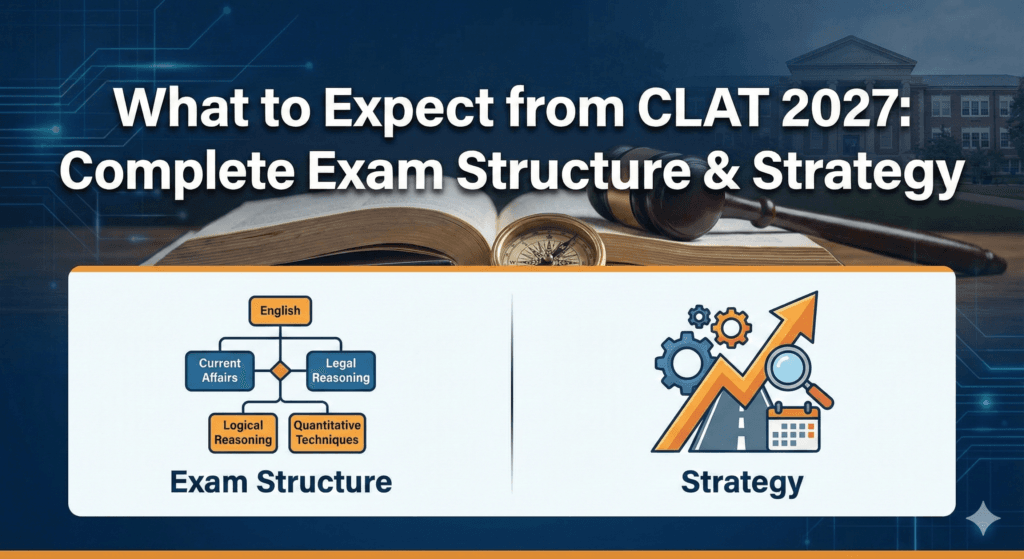
- All five sections remain: English Language, Current Affairs and GK, Legal Reasoning, Logical Reasoning, and Quantitative Techniques
- Greater weightage now placed on Logical Reasoning and Legal Aptitude sections
- Every single question is passage-based, meaning rote learning will not help you here
- Negative marking of 0.25 marks per wrong answer is still in effect
- An Expert Committee chaired by former Supreme Court judge Justice Indu Malhotra has guided these reforms
- Official notification expected August 2026; exam date is December 2026
- The shift favors critical thinkers over memorizers, which is actually good news for smart, consistent preparers
What Exactly Is Changing in the CLAT 2027 Exam Structure
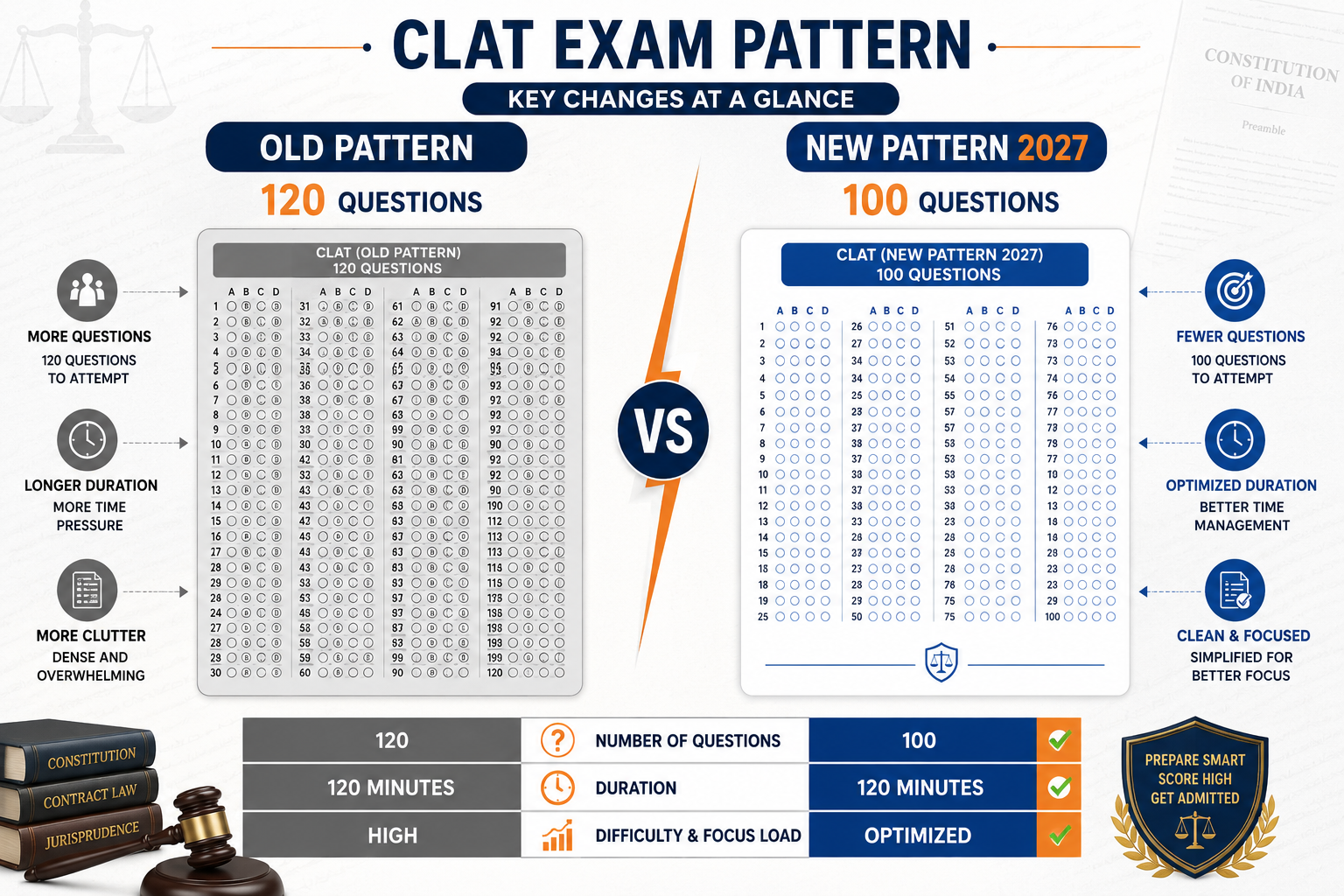
The single biggest structural change in the CLAT 2027 exam pattern is the reduction from 120 questions to 100 questions, while the two-hour exam window remains unchanged. This gives you roughly 72 seconds per question instead of 60, which sounds small but makes a real difference when you're working through dense comprehension passages.
Here's what the Consortium of NLUs has officially confirmed [1]:
- Total questions: 100 (down from 120)
- Total marks: 100
- Exam duration: 2 hours (unchanged)
- Question type: All passage-based, multiple choice
- Negative marking: 0.25 marks deducted per wrong answer
- Sections: 5 (unchanged in number, adjusted in weightage)
Beyond the numbers, the spirit of the change matters more. The Consortium wants to move CLAT away from a test of memory and speed toward a genuine assessment of analytical and legal thinking [2]. An Expert Committee chaired by former Supreme Court judge Justice Indu Malhotra has been driving these medium and long-term reforms, and their influence is clearly visible in the 2027 pattern [6].
So if you've been grinding through current affairs flashcards hoping that alone will carry you, it's time to rethink your approach.
How Different Is the New Pattern from Previous Years
The CLAT 2027 exam pattern is a meaningful evolution, not a complete overhaul. The core DNA of the exam, five sections, passage-based questions, negative marking, stays the same. But the internal balance has shifted.
What's genuinely different:
- Fewer questions means each question carries more weight. One careless wrong answer costs you more relatively than before.
- Logical Reasoning and Legal Aptitude now receive greater emphasis, while Current Affairs and GK have a slightly reduced share [1].
- The exam explicitly rewards critical thinking and the logical application of legal principles over recall-based answers [2].
- The time-per-question ratio improves, which benefits students who read carefully rather than skim aggressively.
What hasn't changed:
- The passage-based format that CLAT introduced in its earlier reforms remains fully intact [3].
- Negative marking is still 0.25 per wrong answer, so random guessing remains a bad strategy.
- The five-section structure is preserved.
For a deeper comparison of how this year's changes stack up against previous patterns, our CLAT exam pattern and syllabus vs past papers guide breaks it down section by section.
How Many Sections Are in CLAT 2027 and What Do They Cover
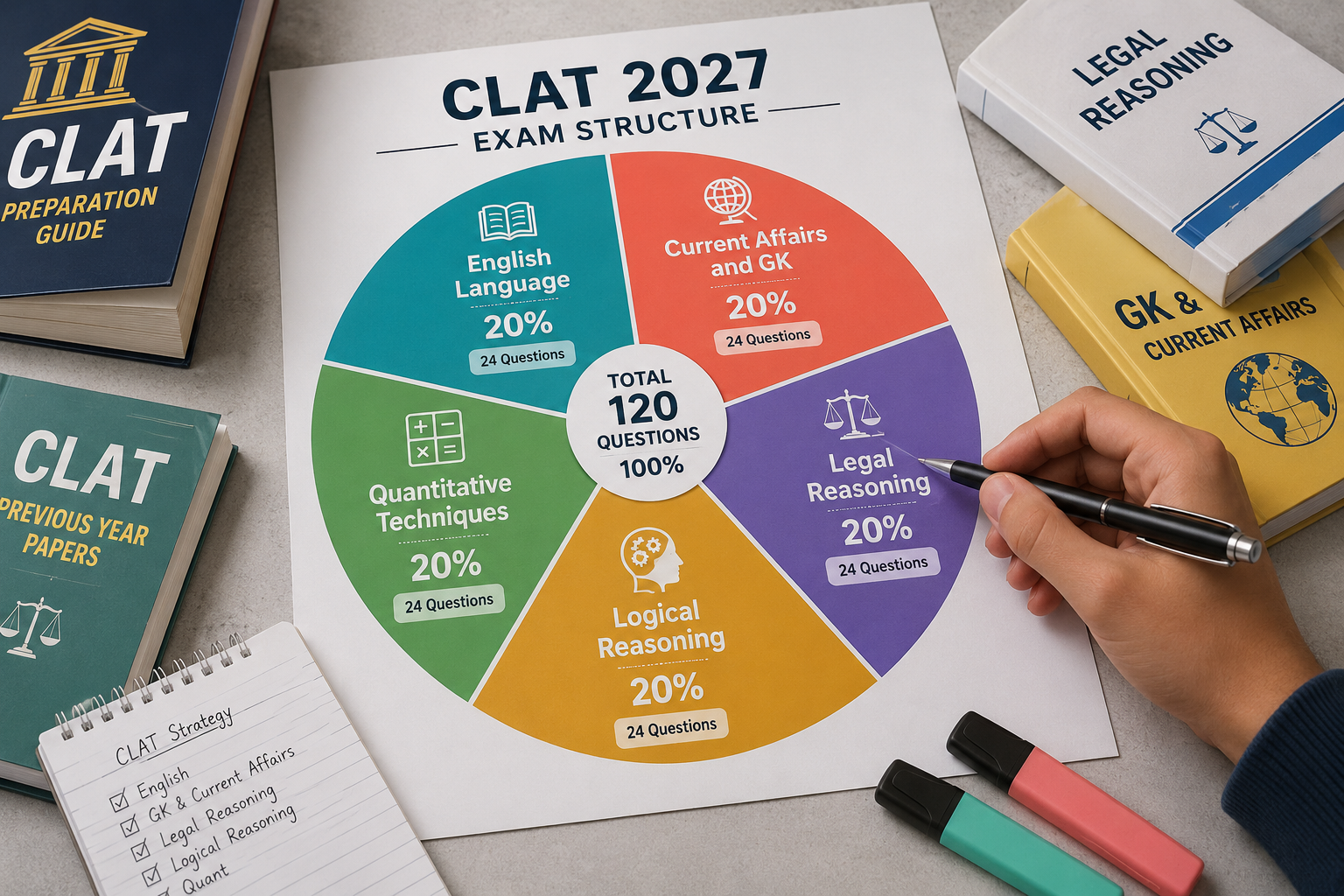
CLAT 2027 has five sections, and each one tests a distinct skill through passage-based questions. Here's the complete section-wise breakdown [5]:
| Section | Approximate Questions | Key Skills Tested |
|---|---|---|
| English Language | 22-26 | Reading comprehension, grammar inference, vocabulary in context |
| Current Affairs including GK | 28-32 | Awareness of legal, political, and social events |
| Legal Reasoning | 35-39 | Application of legal principles to given scenarios |
| Logical Reasoning | 28-32 | Argument analysis, inference, critical reasoning |
| Quantitative Techniques | 10-14 | Basic data interpretation, arithmetic from passages |
Note: The Consortium has not published exact per-section question counts for 2027 at the time of writing. The figures above are based on the announced total of 100 questions and the proportional distribution indicated in official communications [3][5]. Always verify the final split in the August 2026 official notification.
Every section uses passages of 450 to 500 words, followed by four to five questions. You're not being asked to recall a definition. You're being asked to read, understand, infer, and decide [3].
What's the Total Marks and Time Duration for CLAT 2027
CLAT 2027 carries a total of 100 marks, with one mark awarded for each correct answer and 0.25 marks deducted for each wrong answer. The exam duration is 2 hours (120 minutes) [4].
Time management breakdown (suggested):
- You have 120 minutes for 100 questions.
- That's an average of 72 seconds per question.
- But since questions come in passage clusters, think of it as roughly 8 to 10 minutes per passage set.
- Quantitative Techniques passages may need slightly more time for calculation.
- English and Legal Reasoning passages reward careful first reads, so don't rush them.
The exam is conducted in offline (pen-and-paper) mode at designated centers across India. CLAT 2027 is scheduled for December 2026, with the official notification and application form expected in August 2026 [4].
Which Subjects Will Have More Weightage in the New Pattern
Legal Reasoning and Logical Reasoning receive the most significant boost in the CLAT 2027 exam pattern. The Consortium has explicitly stated that the revised pattern places greater weight on these two sections, with a corresponding slight reduction in the Current Affairs and GK share [1].
Why this matters for your preparation:
Legal Reasoning is now clearly the backbone of the exam. It has the highest question count and tests your ability to read a legal scenario, understand the principle provided, and apply it correctly. You don't need to know case law. You need to think like a lawyer.
Logical Reasoning tests argument structure, assumptions, conclusions, and inference chains. This isn't about tricks or shortcuts. It's about reading carefully and thinking clearly.
Practical implication: If you've been spending 60% of your study time on Current Affairs and GK because it felt "safe," you need to rebalance. Legal Reasoning and Logical Reasoning together account for well over half your marks.
For a complete breakdown of what each section demands, check out our CLAT 2027 exam syllabus complete guide.
Is the New Pattern Easier or Harder for Law Entrance Aspirants
Honestly, it depends on who you are as a student. The CLAT 2027 exam pattern is easier for analytical thinkers and harder for rote learners.
If you're a strong reader and critical thinker: The new pattern actually works in your favor. Fewer questions, more time per passage, and a greater reward for genuine reasoning skills means your preparation quality matters more than your preparation volume.
If you've been relying heavily on GK cramming: You'll need to adjust. The reduced GK weightage means you can't compensate for weak reasoning skills by memorizing current affairs.
The honest take: The exam is not easier in the sense of being less demanding. It's harder in the sense that you can't fake your way through it with rote preparation. But for a student who builds real skills, it's actually a more fair and predictable exam.
Let's be honest: the old pattern sometimes rewarded students who happened to know a specific fact. This new one rewards students who can think. And thinking is something you can actually train for.
What Type of Questions Will Be in the New CLAT 2027 Exam
Every question in CLAT 2027 is passage-based and multiple choice [3]. There are no standalone factual questions, no direct definition-based questions, and no fill-in-the-blank formats.
Here's what each section's questions actually look like:
English Language: A passage from a literary, journalistic, or academic source, followed by questions on the author's tone, vocabulary in context, inference, and main idea. You won't be asked to define a word in isolation. You'll be asked what it means given how it's used in the passage.
Current Affairs including GK: A passage describing a recent event, policy, or legal development, followed by questions testing your understanding and contextual awareness. Knowing the event helps, but you must still read and interpret the passage.
Legal Reasoning: A passage that states a legal principle or rule, followed by a factual scenario. You apply the principle to the scenario. No prior legal knowledge required. Clear reading and logical application are what matter [2].
Logical Reasoning: Passages containing arguments, debates, or reasoning chains. Questions ask you to identify assumptions, strengthen or weaken arguments, draw conclusions, or spot logical flaws.
Quantitative Techniques: Short passages with embedded data, tables, or graphs, followed by arithmetic or data interpretation questions. The math itself is Class 10 level. The challenge is extracting the right numbers from the passage quickly [7].
Tips to Prepare for the New CLAT 2027 Exam Pattern
The CLAT 2027 exam pattern rewards consistent, skill-based preparation over last-minute cramming. Here are strategies that actually work, based on what the new pattern demands.
Build a reading habit first. Every section depends on your ability to read a 450-word passage quickly and accurately. Read quality newspapers, editorial columns, and legal news daily. Not to memorize facts, but to build reading speed and comprehension stamina.
Practice Legal Reasoning systematically. Work through passage sets where a principle is given and a scenario is described. Focus on not importing outside knowledge. The answer is always in the passage and the principle, never in what you already know about the law.
Treat Logical Reasoning like a skill, not a subject. Don't just read theory. Solve passages daily. Time yourself. Review every wrong answer to understand exactly where your reasoning broke down.
Don't abandon GK, but be strategic about it. Current Affairs still carries significant marks. Focus on legal, constitutional, and policy-related news rather than trying to cover everything. Our ultimate CLAT GK strategy guide can help you prioritize smartly.
Quantitative Techniques: don't fear it, manage it. Ten to fourteen questions at Class 10 math level. Spend focused time on percentages, ratios, and basic data interpretation. Don't let this section become a time sink during the exam.
For students balancing board exam preparation alongside CLAT, our guide on how to prepare for CLAT while managing board exams offers a realistic schedule.
How Much Time Should I Spend on Each Section During Preparation
There's no universal answer, but here's a practical starting framework based on the new weightage distribution:
| Section | Suggested Weekly Study Time (% of total) |
|---|---|
| Legal Reasoning | 30-35% |
| Logical Reasoning | 25-28% |
| Current Affairs and GK | 18-20% |
| English Language | 12-15% |
| Quantitative Techniques | 8-10% |
Important caveat: These percentages are starting points. If you're already a strong reader, shift time from English to Legal Reasoning. If your math is weak, give Quantitative Techniques more attention early in your preparation, then taper off once you're confident.
During the actual exam, a suggested time split across 120 minutes:
- Legal Reasoning: 35-38 minutes
- Logical Reasoning: 28-32 minutes
- Current Affairs and GK: 25-28 minutes
- English Language: 18-20 minutes
- Quantitative Techniques: 10-12 minutes
These are guidelines, not rules. Develop your own rhythm through timed mock tests.
Common Mistakes Students Make in CLAT Exam Preparation
These are the patterns we see most often, and they cost students dearly.
Treating CLAT like a GK quiz. The passage-based format means raw knowledge without reading comprehension gets you nowhere. Students who spend 70% of their time on current affairs and neglect Legal Reasoning consistently underperform.
Skipping Logical Reasoning practice. Many students find it abstract and put it off. But Logical Reasoning is now one of the highest-weightage sections. Skipping it is like skipping your most important exam subject.
Not timing their practice. Reading passages without a clock feels comfortable. But in the exam, time pressure changes everything. Always practice under timed conditions.
Guessing randomly to "cover" questions. With 0.25 negative marking, four wrong answers cancel one right answer. Random guessing is a net negative. Only attempt questions where you can reasonably eliminate at least two options.
Ignoring mock test analysis. Taking mocks without reviewing your mistakes is one of the most common and costly errors. The mock is only useful if you understand why you got something wrong.
Starting too late. CLAT 2027 is in December 2026. Students who start serious preparation in October rarely have enough time to build genuine comprehension and reasoning skills. These are not skills you can cram.
Are Mock Tests Available for the New CLAT 2027 Pattern
Yes, mock tests aligned with the CLAT 2027 exam pattern are available, and they're one of the most important preparation tools you have. The key is finding mocks that actually reflect the new 100-question, passage-based format rather than older 120-question versions.
What to look for in a CLAT 2027 mock test:
- 100 questions total, not 120
- All passage-based questions across all five sections
- Accurate negative marking (0.25 per wrong answer)
- Section-wise time tracking
- Detailed answer explanations, not just answer keys
At Lawgic Coaching, our mock tests are updated to match the confirmed CLAT 2027 pattern. We've helped thousands crack CLAT, and our test series reflects what the Consortium is actually testing, not what it tested three years ago.
You can also find some free resources through our best free resources for CLAT 2027 guide, which includes platforms offering pattern-accurate practice material.
Aim for at least two full mocks per week in the final three months before the exam. Review every single wrong answer. That review session is where the real learning happens.
Best Books and Resources for CLAT 2027 Syllabus
The right resources make a real difference, but more books does not mean better preparation. Here's what actually works for the CLAT 2027 exam pattern.
For English Language:
Focus on reading quality editorial content daily. The Hindu, Indian Express editorials, and Frontline are excellent. For structured practice, look for CLAT-specific reading comprehension workbooks that use passage-based question formats.
For Legal Reasoning:
You don't need a law textbook. You need passage sets with principles and scenarios. CLAT-specific Legal Reasoning books from publishers like Universal Law Publishing work well. Practice applying principles without importing outside knowledge.
For Logical Reasoning:
R.S. Aggarwal's logical reasoning book covers the fundamentals. But supplement it heavily with CLAT-specific passage-based logical reasoning practice, since the format differs from standalone MCQs.
For Current Affairs and GK:
Monthly current affairs magazines focused on legal and constitutional developments. Lawgic Coaching's GK modules are structured around what CLAT actually tests, not generic competitive exam GK.
For Quantitative Techniques:
Class 10 NCERT mathematics for foundational concepts. Then move to CLAT-specific data interpretation practice sets.
Our detailed CLAT 2027 booklist has specific book recommendations with honest assessments of what each one is good for. No cookie-cutter approach here. We tell you exactly which book to use for which gap.
How Will the New Pattern Impact My Law School Chances
The CLAT 2027 exam pattern change actually levels the playing field in important ways. Here's the honest picture.
Students from strong English-medium backgrounds with good reading habits have always done well in CLAT. The new pattern continues to reward them. But the reduced GK weightage means students who couldn't afford to spend months memorizing current affairs now have a more accessible path.
The increased emphasis on Legal Reasoning and Logical Reasoning means that coaching quality matters more than coaching quantity. A student with 6 months of focused, skill-based preparation can genuinely compete with someone who has been preparing for two years but using the wrong methods.
What this means for NLU admissions:
Cutoffs at top NLUs like NLSIU Bangalore, NALSAR Hyderabad, and NUJS Kolkata will still be competitive. But the nature of what gets you there has shifted. Analytical ability and reading speed now matter more than encyclopedic GK knowledge.
For a realistic picture of what scores you need for specific NLUs, our CLAT marks vs rank guide gives you category-wise data and admission strategy.
Your success is our mission, and we want you going into this exam with clear, accurate expectations, not vague reassurances.

Frequently Asked Questions
Q: When is CLAT 2027 scheduled?
CLAT 2027 is scheduled for December 2026. The official notification and application form are expected to be released in August 2026 by the Consortium of NLUs [4].
Q: How many questions are in CLAT 2027?
CLAT 2027 has 100 questions, reduced from the previous 120. The exam duration remains 2 hours, and total marks are 100 [1].
Q: What is the negative marking in CLAT 2027?
There is a deduction of 0.25 marks for every incorrect answer. Unattempted questions carry no penalty [4].
Q: Are all questions in CLAT 2027 passage-based?
Yes. Every question across all five sections is based on a reading passage. There are no standalone factual or definition-based questions [3].
Q: Which section has the most questions in CLAT 2027?
Legal Reasoning has the highest question count, followed by Current Affairs including GK and Logical Reasoning. Quantitative Techniques has the fewest questions [5].
Q: Do I need prior legal knowledge for Legal Reasoning?
No. Legal Reasoning passages provide the legal principle within the passage itself. You apply that principle to the given scenario. Prior legal knowledge is not required and can sometimes mislead you [2].
Q: Is CLAT 2027 conducted online or offline?
CLAT is conducted in offline (pen-and-paper) mode at designated exam centers across India.
Q: Who oversees the CLAT 2027 pattern changes?
The Consortium of NLUs oversees CLAT. An Expert Committee chaired by former Supreme Court judge Justice Indu Malhotra has been constituted to recommend reforms, and their recommendations are shaping the 2027 pattern [6].
Q: Can I crack CLAT 2027 without coaching?
Yes, it's possible with disciplined self-study. Our guide on cracking CLAT without expensive coaching outlines a realistic self-study plan. That said, structured guidance significantly improves your accuracy and time management.
Q: How early should I start preparing for CLAT 2027?
Ideally, 10 to 12 months before the exam. For December 2026, that means starting no later than February 2026. The skills CLAT tests, reading comprehension, legal reasoning, logical analysis, take consistent time to build.
Q: What's the best way to improve my Legal Reasoning score?
Practice passage sets daily where a principle is given and a scenario is described. Focus strictly on what the passage says. Don't bring in outside legal knowledge. Review every wrong answer to identify whether you misread the principle or misapplied it.
Q: Is CLAT 2027 the same for UG and PG aspirants?
No. The UG pattern described in this article is for BA LLB admissions. CLAT PG has a separate pattern focused on LLM admissions. For PG aspirants, our CLAT PG 2027 exam pattern guide covers everything you need.
Conclusion
The CLAT 2027 exam pattern is a well-considered shift toward testing what actually matters for a future lawyer: the ability to read carefully, reason logically, and apply principles to real situations. Fewer questions, more time per passage, and greater emphasis on Legal Reasoning and Logical Reasoning all point in the same direction.
This is good news for students who are willing to prepare the right way.
Here's what you should do right now:
- Audit your current preparation. Are you spending enough time on Legal Reasoning and Logical Reasoning? If not, rebalance your weekly schedule using the time allocation framework in this article.
- Start reading daily. Pick up a quality newspaper and read two editorials every morning. Time yourself. Aim to read a 500-word passage in under 3 minutes with full comprehension.
- Take a diagnostic mock. Find a CLAT 2027 pattern-aligned mock test and take it cold. Identify your weakest section. That's where your first month of focused work goes.
- Build a realistic study plan. Use our complete CLAT preparation coaching guide to map out your preparation from now until December 2026.
- Get personalized guidance. At Lawgic Coaching, we offer real mentors from top NLUs who understand exactly what the new pattern demands. Expert guidance without the premium price tag, flexible learning that fits your life, and proven strategies that actually work.
Results speak louder than promises. Let's build your law career together.