CLAT 2026 aspirants face a harsh reality: there's no gentle introduction once that timer starts. With 120 questions crammed into 120 minutes and every section demanding immediate peak performance, the traditional mock-taking approach of starting slow and building momentum has become obsolete. The No-Warm-Up Strategy: How CLAT 2026's Tighter Format Demands a Completely Different Mock-Taking Approach isn't just another preparation technique—it's the fundamental shift that separates successful candidates from those still clinging to outdated methods.
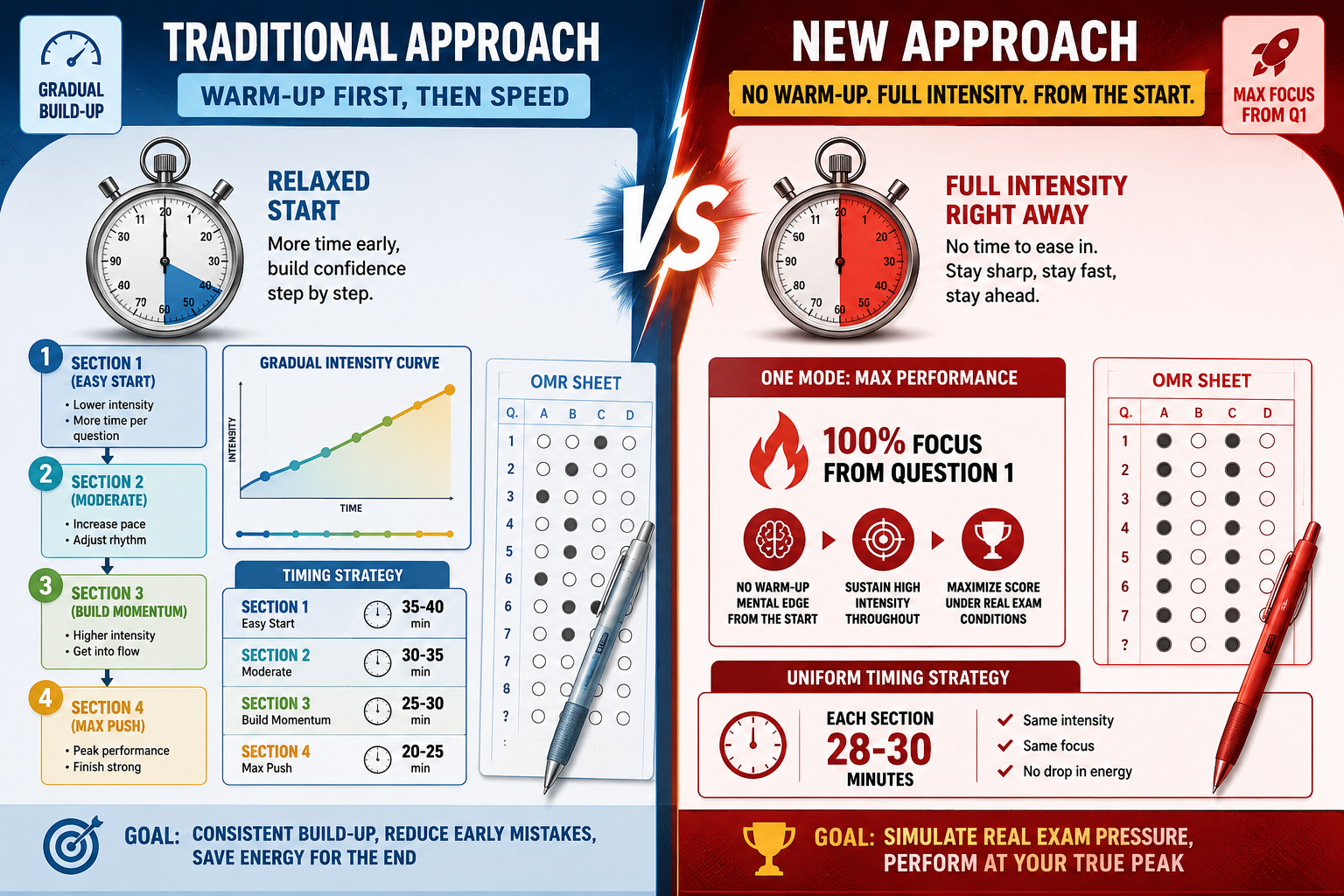
Your success is our mission, and we've seen thousands of students struggle with this exact transition. The old approach of easing into mock tests with comfortable sections first simply doesn't match what you'll face on exam day. CLAT 2026 demands razor-sharp focus from question one, and your mock practice must reflect this reality.
Key Takeaways
- CLAT 2026's 120-question format eliminates any warm-up time, requiring immediate peak performance
- Traditional mock strategies that start with easier sections fail to prepare students for real exam pressure
- The No-Warm-Up Strategy trains students to perform at maximum capacity from the first question
- Successful CLAT preparation now requires fixed section orders and strict 110-minute practice sessions
- Mock tests must replicate exact exam conditions, including OMR filling and zero pause allowances
Why CLAT 2026's Format Kills Traditional Mock Strategies
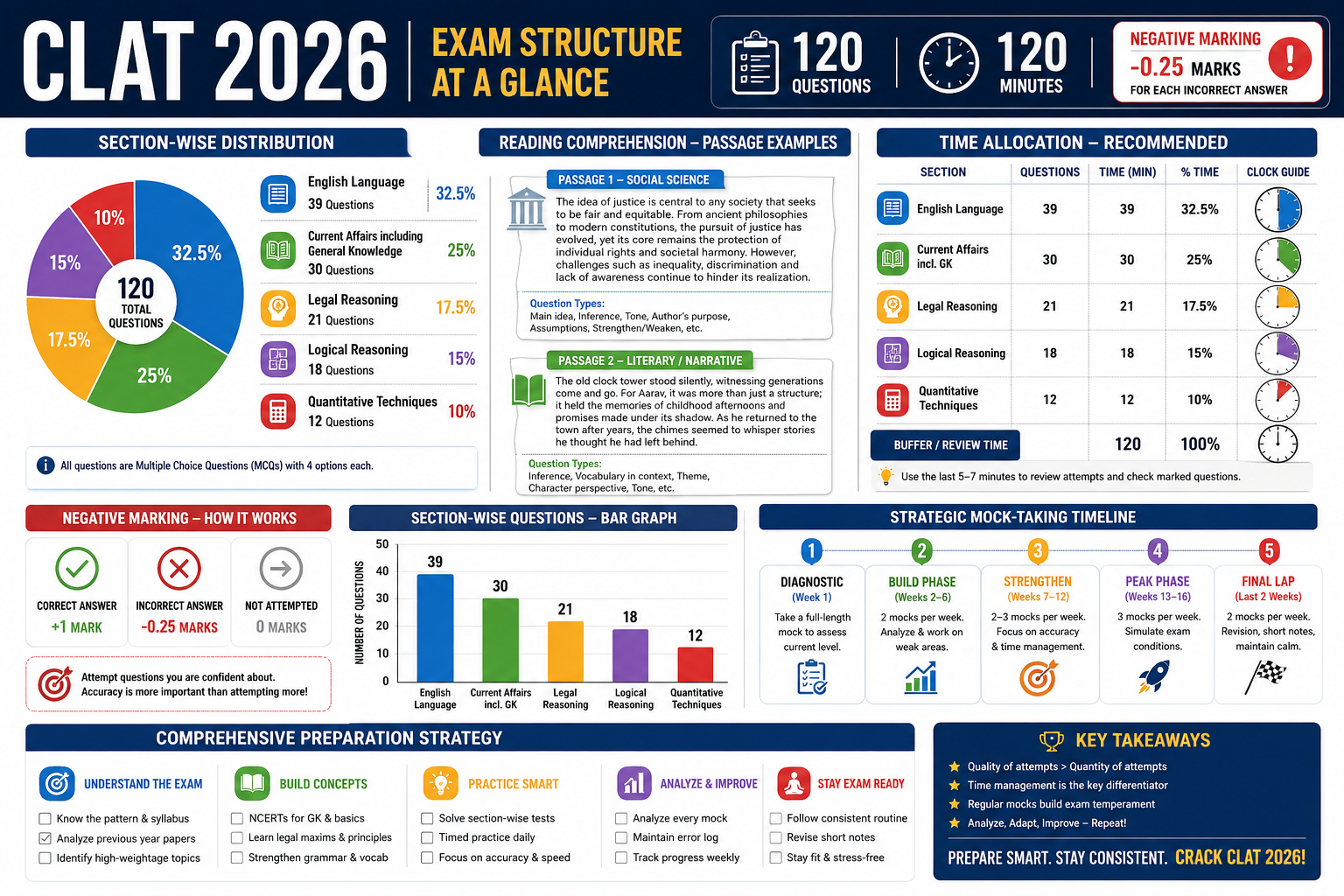
The numbers don't lie. With 120 questions in 120 minutes, you're looking at exactly one minute per question—and that's if you attempt every single one [2]. But here's what most coaching institutes won't tell you: successful candidates typically attempt 110-115 questions, not all 120. This means you need to be operating at peak efficiency from minute one.
Traditional mock strategies encouraged students to start with their strongest section to build confidence. That approach worked when exams had buffer time or when sections were clearly separated with breathing room. CLAT 2026 doesn't offer such luxuries.
The exam pattern remains unchanged from previous years: English Language (22-26 questions), Current Affairs including General Knowledge (28-32 questions), Legal Reasoning (28-32 questions), Logical Reasoning (22-26 questions), and Quantitative Techniques (10-14 questions) [3]. But the intensity has ramped up significantly.
Here's the thing: when you start a mock test by "warming up" with easier questions, you're training your brain for a scenario that doesn't exist on exam day. CLAT 2026 throws you into deep water immediately, and your preparation must match this reality.
The No-Warm-Up Strategy: How CLAT 2026's Tighter Format Demands Immediate Excellence
The No-Warm-Up Strategy: How CLAT 2026's Tighter Format Demands a Completely Different Mock-Taking Approach centers on one core principle: your first question should be as challenging as your last. This isn't about making preparation harder—it's about making it realistic.
Fixed Section Order: Your New Best Friend
Successful CLAT candidates in 2026 will have practiced the same section sequence hundreds of times. No more switching between sections based on mood or confidence levels. Pick your optimal order and stick to it religiously [4].
Most high-scorers follow this pattern:
- Start with Legal Reasoning (if it's your strength)
- Move to English Language for sustained reading
- Tackle Current Affairs when your mind is still sharp
- Handle Logical Reasoning with remaining focus
- Finish with Quantitative Techniques
The key isn't the specific order—it's the consistency. Your brain needs to know exactly what's coming next without wasting precious seconds on decision-making.
The 110-Minute Rule
Here's where most students mess up: they practice for 120 minutes but need to reserve 10 minutes for final OMR marking and review. Smart aspirants set their practice timer to 110 minutes from day one [7].
This creates the right kind of pressure. When you're used to completing your target questions in 110 minutes, the actual exam feels manageable rather than suffocating.
No Pause, No Mercy
Traditional coaching often allows students to pause mock tests for bathroom breaks or mental resets. The No-Warm-Up Strategy eliminates this completely. Once you start, you finish—just like the real exam.
This builds the mental stamina that separates top performers from average scorers. Your success is our mission, and we've seen too many capable students crash in the final hour because they never trained for sustained concentration.
Implementing the No-Warm-Up Strategy in Your Daily Practice
The transition to no-warm-up mock taking isn't instant. You'll need a systematic approach that builds this capacity over 4-6 weeks.
Week 1-2: Foundation Building
Start with 90-minute focused sessions using your fixed section order. No switching, no breaks, no exceptions. Use proper OMR sheets from day one—not just clicking on screen options.
Many students underestimate how much time OMR filling actually takes. Practice this religiously, because fumbling with bubble sheets on exam day can cost you 3-4 questions worth of time.
Week 3-4: Intensity Ramping
Move to full 110-minute sessions with your target question count. If you're aiming for 110 questions, that's your benchmark every single practice session.
Here's where the no-warm-up principle really kicks in. Your first Legal Reasoning passage should be tackled with the same intensity as your final Current Affairs question. No gentle starts, no momentum building—just consistent peak performance.
Week 5-6: Exam Simulation
Practice at your actual exam time slot daily. If your CLAT is scheduled for 2 PM, take every mock at 2 PM [7]. This trains your circadian rhythm for peak performance at the right moment.
Add real exam stressors: uncomfortable seating, background noise, suboptimal lighting. The more your practice resembles actual conditions, the better you'll perform when it matters.
The OMR Reality Check
Most students practice digitally but face OMR sheets on exam day. This disconnect has killed more CLAT dreams than difficult questions ever have.
Practice with physical OMR sheets for at least 50% of your mocks. Time yourself filling bubbles. Learn to mark clearly without overthinking. Develop a rhythm for transferring answers efficiently.
Common Mistakes That Sabotage the No-Warm-Up Strategy
Even students who understand the concept often implement it incorrectly. Let's address the biggest pitfalls:
Mistake 1: Gradual Implementation
Some students think they can ease into the no-warm-up approach. They start with 60 minutes, then 80, then 100, finally reaching 110. This defeats the entire purpose.
The No-Warm-Up Strategy: How CLAT 2026's Tighter Format Demands a Completely Different Mock-Taking Approach requires immediate full implementation. Half-measures create half-results.
Mistake 2: Section Flexibility
Students often justify switching their section order based on "how they feel" that day. This creates decision fatigue during the actual exam when every second counts.
Lock in your sequence and never deviate. Your brain should know exactly what comes next without conscious thought.
Mistake 3: Digital-Only Practice
Practicing exclusively on computers or tablets while the actual exam uses OMR sheets is preparation malpractice. The tactile difference, the time required for bubble filling, and the visual strain are all factors that can derail your performance.
Mistake 4: Perfectionism Paralysis
Some students get stuck trying to attempt all 120 questions instead of focusing on accuracy in 110-115 questions. This leads to rushed mistakes and lower overall scores.
Remember: CLAT rewards accuracy over completion. Better to nail 110 questions than fumble through all 120.
Advanced Techniques for No-Warm-Up Success
Once you've mastered the basics, these advanced strategies can give you the edge:
The Question-Type Mapping Method
Within each section, maintain a consistent approach to different question types. For Legal Reasoning, always tackle principle-based questions before case-study questions. For English, handle direct comprehension before inference questions.
This creates micro-routines within your macro-strategy, eliminating decision-making time at the granular level.
Strategic Question Skipping
Develop clear criteria for when to skip questions immediately. If a Legal Reasoning passage looks exceptionally dense, move on within 30 seconds. If a Current Affairs question requires deep recall you don't have, skip instantly.
The key is making these decisions based on pre-established criteria, not in-the-moment panic.
Energy Management Throughout Sections
Different sections drain mental energy differently. Reading-heavy sections like English and Legal Reasoning are more taxing than Current Affairs recall questions.
Plan your energy expenditure. If you start with Legal Reasoning, know that you'll need to push harder during English to maintain the same pace.
Measuring Success with the No-Warm-Up Strategy
Traditional metrics like "questions attempted" become less relevant with this approach. Focus on these indicators instead:
Consistency Across Attempts
Your mock scores should show less variation once you've mastered the no-warm-up approach. Wild swings in performance indicate you're still relying on momentum and mood rather than systematic execution.
Time Distribution Analysis
Track how much time you spend on each section across multiple mocks. Successful implementation shows consistent time allocation regardless of question difficulty or your energy levels.
Accuracy Under Pressure
Your accuracy in the first 20 questions should match your accuracy in questions 80-110. If there's a significant drop-off, you haven't fully internalized the strategy yet.
For students looking to transform their mock performance systematically, our complete 90-day transformation plan provides detailed week-by-week implementation strategies.
The Psychological Edge of No-Warm-Up Mastery
Beyond the tactical advantages, mastering The No-Warm-Up Strategy: How CLAT 2026's Tighter Format Demands a Completely Different Mock-Taking Approach provides crucial psychological benefits.
Confidence from Consistency
When you've practiced starting at peak intensity hundreds of times, exam day feels familiar rather than intimidating. There's no anxiety about "getting into the zone" because you're already there from question one.
Reduced Decision Fatigue
Every decision during the exam—which section to attempt, which questions to skip, how much time to spend—draws from your limited mental energy. The no-warm-up strategy automates these decisions through consistent practice.
Pressure Immunity
Students who practice under artificial time pressure often crumble under real exam pressure. But when your practice conditions match or exceed exam intensity, the actual test feels manageable.
This psychological preparation is what separates students who crack under pressure from those who thrive in high-stakes situations.
Integration with Overall CLAT Preparation Strategy
The no-warm-up approach doesn't exist in isolation—it must integrate with your broader preparation strategy. Here's how successful students make it work:
Content Mastery First
You can't implement peak-intensity practice until you have solid content foundations. Ensure your CLAT syllabus coverage is complete before transitioning to no-warm-up mocks.
Reading Speed Optimization
Since CLAT 2026 is heavily reading-based, your reading speed for comprehension must be optimized before implementing time pressure strategies.
Current Affairs Integration
Your GK preparation strategy must support quick recall under pressure, not just recognition during relaxed study sessions.
Technology and Tools for No-Warm-Up Practice
While the strategy emphasizes exam-like conditions, certain tools can enhance your preparation:
Timer Applications with Section Breaks
Use apps that can be programmed for your specific section timing without allowing pauses. This maintains the no-break principle while helping track section-wise performance.
OMR Sheet Generators
Print practice OMR sheets that match CLAT's format exactly. Practice transferring answers under time pressure regularly.
Performance Analytics
Track your consistency metrics across multiple dimensions: section-wise accuracy, time distribution, question-type performance, and energy levels throughout the test.
Common Questions About Implementation
How long does it take to master the no-warm-up approach?
Most students need 4-6 weeks of consistent practice to fully internalize the strategy. However, you should see improvements in consistency within 2 weeks.
Should I ever deviate from my fixed section order?
Never during practice, and rarely during the actual exam. Only if a section has unusually difficult questions across the board should you consider switching—and even then, have a predetermined backup sequence.
What if I feel tired or unfocused on exam day?
This is exactly why you practice the no-warm-up strategy. Your performance shouldn't depend on feeling fresh or motivated—it should be systematic and automatic.
Students preparing for multiple law entrance exams can find guidance on managing different formats in our comparative exam analysis.
The Future of CLAT Mock Preparation
The No-Warm-Up Strategy: How CLAT 2026's Tighter Format Demands a Completely Different Mock-Taking Approach represents the evolution of CLAT preparation. As the exam becomes more competitive and time-pressured, preparation methods must evolve accordingly.
Traditional coaching methods that worked for earlier CLAT formats are becoming obsolete. Students who adapt to this new reality early gain a significant advantage over those still using outdated approaches.
The strategy also prepares students for the broader demands of legal education and practice, where peak performance on demand is essential rather than optional.
Conclusion
The No-Warm-Up Strategy: How CLAT 2026's Tighter Format Demands a Completely Different Mock-Taking Approach isn't just a preparation technique—it's a fundamental shift toward exam-realistic practice. CLAT 2026's format leaves no room for gentle starts or momentum building. Success requires peak performance from the first question to the last.
Your success is our mission, and we've seen this strategy transform students who were struggling with traditional mock approaches. The key lies in consistent implementation: fixed section orders, strict 110-minute practice sessions, regular OMR usage, and zero tolerance for breaks or pauses.
The transition requires commitment and systematic practice, but the results speak for themselves. Students who master this approach show remarkable consistency in their mock performances and report feeling significantly more confident on exam day.
Don't wait until the last month to implement these changes. Start today with your next mock test. Set that 110-minute timer, fix your section sequence, grab an OMR sheet, and experience what peak-intensity preparation feels like.
For personalized guidance on implementing the no-warm-up strategy with expert mentorship from top NLU faculty, explore our comprehensive CLAT coaching programs designed specifically for serious aspirants who demand results, not just promises.
Remember: CLAT 2026 won't give you time to warm up. Make sure your preparation doesn't either.
References
[1] Watch – https://www.youtube.com/watch?v=DLn5KDaTzvo[2] Law Clat 2026 Exam On Dec 7 Is Clat Exam Pattern Revised Blogid 214354 – https://www.shiksha.com/news/law-clat-2026-exam-on-dec-7-is-clat-exam-pattern-revised-blogId-214354
[3] Clat Exam Pattern – https://www.careerpower.in/school/exams/clat-exam-pattern
[4] Watch – https://www.youtube.com/watch?v=N1eOMDywl98
[5] Law Clat 2026 Notification Schedule Live Updates Blogid 204852 – https://www.shiksha.com/news/law-clat-2026-notification-schedule-live-updates-blogId-204852
[6] Clat Last Minute Preparation Strategy – https://testbook.com/news/clat-last-minute-preparation-strategy/
[7] Last 15 Days Strategy For Clat – https://www.toprankers.com/last-15-days-strategy-for-clat
SEO Meta Title: No-Warm-Up Strategy: CLAT 2026's New Mock-Taking Approach