Last updated: June 24, 2026
Quick Answer: CLAT logical reasoning tricks for puzzles focus on structured reading, visual mapping, and argument layering rather than brute-force analysis. By applying the seven targeted techniques in this guide, most aspirants can cut their per-question time by roughly half while improving accuracy, especially on the arrangement and inference-based sets that now dominate the section.
Key Takeaways
- CLAT's logical reasoning section has shifted heavily toward passage-based puzzles, arrangements, and inference sets, not standalone MCQs
- Reading the questions before the passage is one of the fastest ways to filter relevant information instantly
- Visual tools like Venn diagrams, seating grids, and flowcharts reduce cognitive load and speed up deductions
- The 4-Layer Reasoning Model helps you move from surface reading to accurate inference without overthinking
- Assumptions and inferences are tested differently; confusing them is one of the most common scoring errors
- Timed mock practice (at least 2 to 3 full tests per week) is non-negotiable for building puzzle-solving speed [5]
- Categorizing your errors after every mock helps you fix the right problem, not just practice more randomly
- Reading editorial columns regularly builds the argument-spotting instinct that puzzles demand [5]
Why CLAT Logical Reasoning Puzzles Are Harder Than They Look
CLAT logical reasoning is not about memorizing rules. It's about reading carefully, thinking structurally, and not getting tricked by passages that sound logical but contain deliberate gaps.
Recent trends show a clear increase in analytical reasoning topics, specifically arrangements, puzzles, and deduction-based sets in the CLAT logical reasoning section [2]. The exam has moved away from simple syllogisms toward longer, denser passages where five to six questions hang on one complex scenario. That's a different skill set entirely.
Here's the thing most students miss: the puzzle isn't the problem. The problem is approaching it without a system. When you have no framework, every puzzle feels new and equally hard. When you have a system, you start recognizing patterns, and patterns are solvable.
If you want to understand how the exam format has evolved and why this shift matters for your prep, read this detailed breakdown of why CLAT 2026 logical reasoning changed the game.
What Are the 7 CLAT Logical Reasoning Tricks for Puzzles
These seven tricks are not generic study tips. They are specific, actionable techniques that target the exact places where CLAT aspirants lose marks in logical reasoning puzzles.
Trick 1: Read the Questions First, Then the Passage
Before you read a single line of the puzzle passage, scan all the questions attached to it. This takes about 20 to 30 seconds and it completely changes how you read the passage. You know exactly what to look for. You stop reading everything with equal attention and start filtering.
For example, if three out of five questions ask about assumptions, you read the passage looking specifically for unsupported claims and logical jumps. If two questions ask about seating arrangements, you pull out your pen immediately and start building a grid.
This one trick alone can save you 90 seconds per puzzle set.
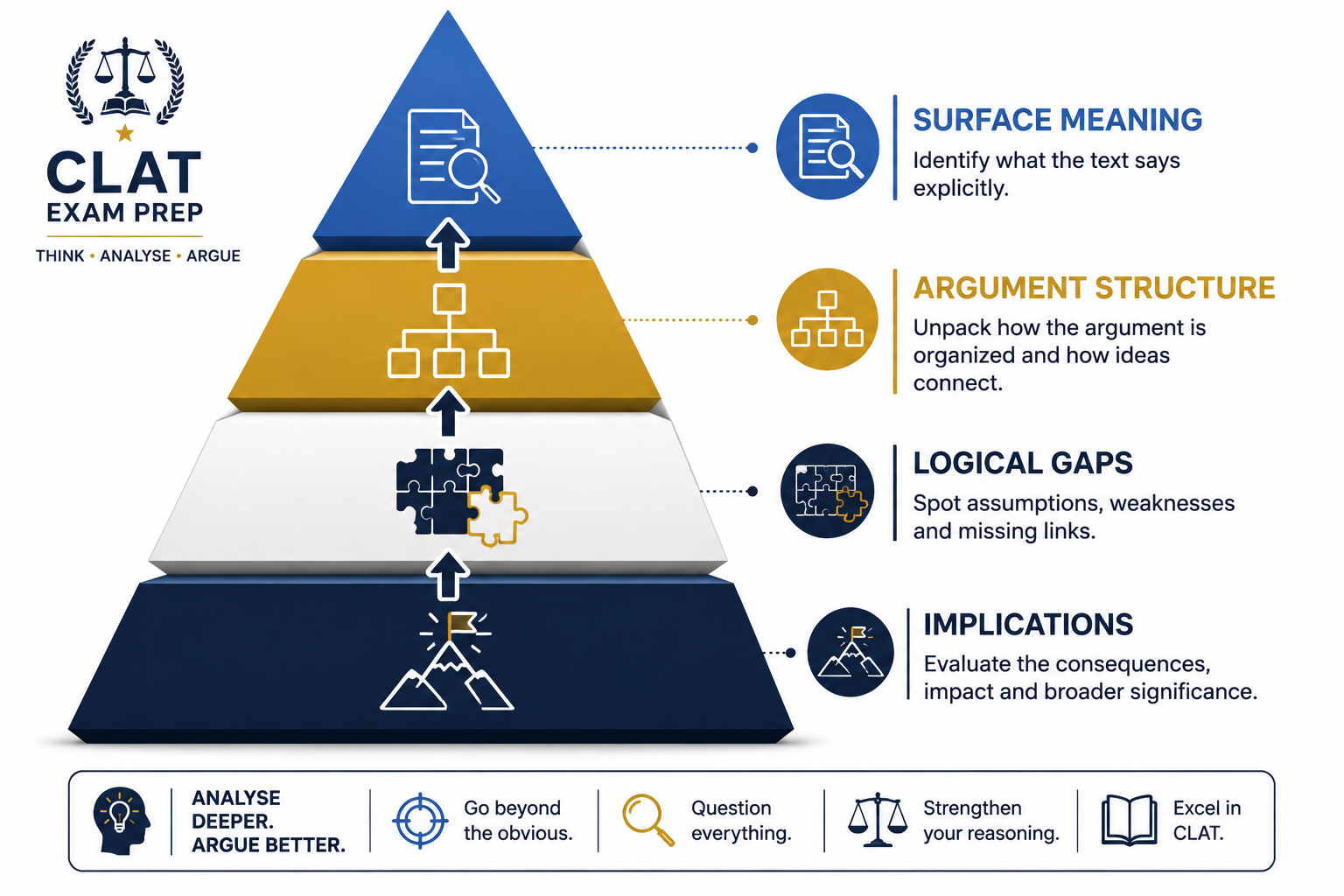
Trick 2: Use the 4-Layer Reasoning Model
The 4-Layer Reasoning Model is a structured way to process any passage-based logical reasoning question. Work through these layers in order:
- Layer 1 (Surface Meaning): What is the passage literally saying? Identify the topic and the main claim.
- Layer 2 (Argument Structure): What are the premises? What is the conclusion? Map the "because this, therefore that" chain.
- Layer 3 (Logical Gaps): Where does the argument assume something without proving it? These are your assumptions and weaknesses.
- Layer 4 (Implications): What follows logically from the argument if it's true? These are your inferences.
Moving through all four layers sounds slow, but with practice it becomes a 60-second mental scan. It stops you from jumping to answers based on gut feeling, which is where most marks are lost.
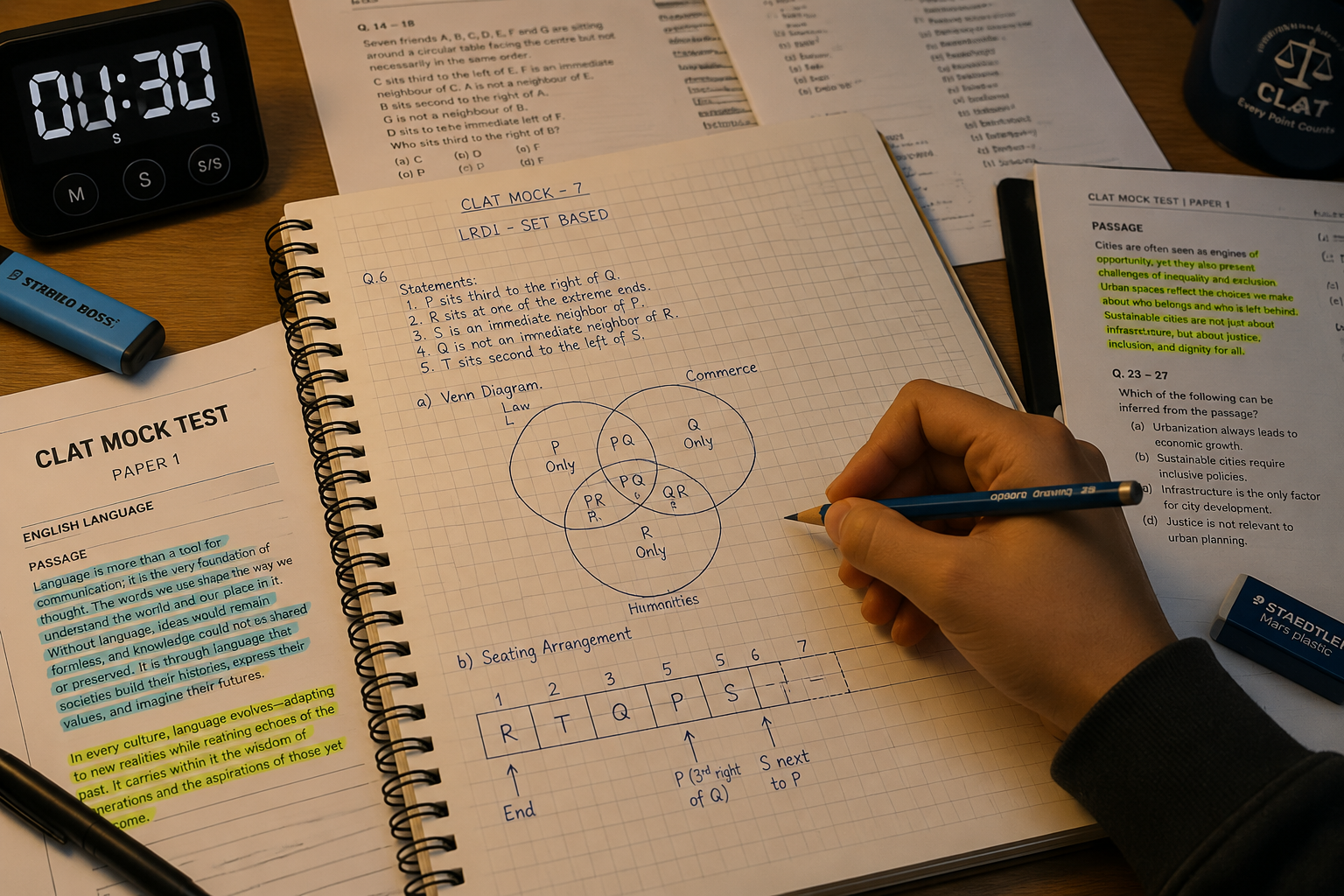
Trick 3: Draw It Out, Every Single Time
For questions involving logical sequences, relationships, or arrangements, use diagrams, flowcharts, or Venn diagrams to visualize the information [3]. This is not optional. Students who try to hold arrangement logic in their heads make errors. Students who draw it out almost always get it right.
Use a simple notation system:
- Circles or boxes for people or entities
- Arrows for relationships or directions
- A straight line for seating arrangements
- Overlapping circles for shared characteristics (Venn)
Even a rough sketch reduces your mental load significantly and makes the deductions visible rather than invisible.
Trick 4: Separate Assumptions from Inferences
This is where a huge number of marks go missing. Assumptions and inferences are tested differently in CLAT, and confusing them is one of the most costly errors you can make [6].
An assumption is something the argument takes for granted without stating it. It's a hidden premise. The argument would collapse without it.
An inference is something that logically follows from what the passage says. It's a conclusion you can draw from the stated information.
Quick test: If removing a statement makes the argument fall apart, it's an assumption. If a statement can be derived from the passage without adding new information, it's an inference.
Practice this distinction on at least 10 questions per week until it becomes automatic.
Trick 5: Use the Elimination Method on Strengthen and Weaken Questions
Strengthen and weaken questions are common in CLAT logical reasoning puzzle sets. The fastest way to handle them is not to find the right answer first. It's to eliminate the clearly wrong ones.
Start by crossing out:
- Options that are irrelevant to the main argument
- Options that do the opposite of what the question asks (strengthens when you need weakens, or vice versa)
- Options that introduce completely new information unrelated to the passage's logic
You'll usually be left with one or two choices. From there, pick the one that most directly impacts the core argument, not just a side detail.
Trick 6: Set a Hard 90-Second Warning
Time management in CLAT logical reasoning is a real problem. Puzzle sets are long, and it's easy to spend five minutes on one set and run out of time for the rest.
Set a mental (or physical, if allowed) 90-second checkpoint per question. If you're not close to an answer by then, mark your best guess and move on. You can return if time allows. Spending four minutes on one question and leaving two questions unattempted is a losing trade every time.
This connects directly to why timed mock practice matters so much. You need to build the instinct for when to push and when to move on. Aim for at least 2 to 3 full-length mock tests per week and review every wrong answer carefully [5]. For a structured approach to using mocks effectively, see this guide on how mock tests help uncover your CLAT weaknesses.
Trick 7: Build Your Argument Instinct Through Editorial Reading
This one is a long game, but it pays off fast. Reading editorials and opinion columns from reputable publications trains your brain to naturally spot arguments, identify assumptions, and notice where evidence is missing [5]. These are exactly the skills CLAT logical reasoning puzzles test.
Spend 15 to 20 minutes daily reading one editorial. As you read, mentally ask: What is the author's main claim? What evidence supports it? What is being assumed? What would weaken this argument?
After two to three weeks of this habit, you'll notice puzzle passages start feeling more familiar and less overwhelming. Your reading speed on complex texts also improves, which helps across all five CLAT sections.
How to Apply CLAT Logical Reasoning Tricks to Puzzle Sets Specifically
Applying CLAT logical reasoning tricks to puzzle sets requires a slightly different approach than applying them to standalone questions. Puzzle sets in CLAT are passage-based, meaning five to six questions share one scenario, and getting the core logic wrong costs you all of them.
Here is a step-by-step approach for puzzle sets:
- Scan all questions first (Trick 1) to understand what the set is testing.
- Read the passage once, fully, without stopping to answer anything. Get the complete picture.
- Identify the type of puzzle: Is it a seating arrangement? A logical argument with inferences? A cause-and-effect scenario? This determines which tools you use.
- Draw your diagram or map your argument structure (Tricks 2 and 3) before attempting any question.
- Answer the most straightforward questions first to secure those marks, then tackle the harder ones.
- Apply the 90-second rule (Trick 6) per question, not per set.
Common Puzzle Types You'll See in CLAT 2026
| Puzzle Type | What It Tests | Best Tool to Use |
|---|---|---|
| Seating Arrangements | Deductive logic, spatial reasoning | Linear or circular grid diagram |
| Logical Arguments | Premise-conclusion structure | 4-Layer Reasoning Model |
| Cause and Effect Sets | Identifying valid causal links | Flowchart or arrow diagram |
| Assumption-Inference Sets | Distinguishing hidden premises from conclusions | Trick 4 distinction method |
| Strengthen/Weaken Sets | Impact analysis on argument core | Elimination method (Trick 5) |
| Venn Diagram-Based Sets | Category overlaps and relationships | Venn diagram sketch |
Knowing which tool to reach for based on the puzzle type is itself a major time-saver. You stop wasting seconds deciding how to start.
What Mistakes Kill Your Score in CLAT Logical Reasoning Puzzles
Most mistakes in CLAT logical reasoning puzzles fall into predictable categories. Knowing them in advance means you can catch yourself before they cost you marks.
Overthinking the passage. Overanalyzing simple lines or adding outside knowledge can lead to incorrect inferences [4]. CLAT is strict: your answer must come from the passage, not from what you know about the world. If a passage says "all lawyers are honest," you work with that, even if you personally disagree. Base every conclusion strictly on what is stated.
Skipping the diagram. Students who try to mentally track arrangements or relationships almost always make errors on the harder questions in a set. Drawing takes 30 seconds. Getting the question wrong costs you a negative mark and the time you already spent. Draw it.
Confusing assumptions with inferences. We covered this in Trick 4, but it's worth repeating because it's the single most common error in CLAT logical reasoning [6]. Test every answer option against the definitions before selecting.
Spending too long on one question. This is a time management problem, not a knowledge problem. The 90-second rule (Trick 6) is your protection against this.
Not reviewing errors after mocks. Practicing without reviewing is like running on a treadmill and wondering why you're not moving forward. After every mock, categorize your errors: Was it a reading error? A concept confusion? A time pressure mistake? Fix the actual cause, not just the symptom. For a structured way to evaluate your progress, check out this guide on smart CLAT progress assessment techniques.
For a broader look at reasoning mistakes that aspirants commonly make, this article on five common mistakes in CLAT legal reasoning is worth your time.
How Long Does It Take to Get Faster at CLAT Logical Reasoning Puzzles
Most aspirants see measurable improvement in puzzle-solving speed within three to four weeks of consistent, structured practice. The key word is structured. Random practice without the tricks and frameworks above tends to plateau quickly.
Here's a realistic timeline:
Week 1 to 2: Focus on Tricks 1, 2, and 3. Learn to read questions first, apply the 4-Layer Model, and draw diagrams every time. Don't worry about speed yet. Build the habits.
Week 3 to 4: Add Tricks 4 and 5. Practice assumption versus inference distinction daily. Work on strengthen/weaken sets using the elimination method. Start timing yourself per question.
Week 5 onwards: Add Tricks 6 and 7. Introduce the 90-second rule in full mock conditions. Maintain the editorial reading habit daily. Review every mock error by category.
By week six, most students who follow this structure report noticeably faster puzzle processing and fewer careless errors. Your success is our mission at Lawgic Coaching, and we've seen this pattern repeat across thousands of students who've cracked CLAT with us.
If you want a complete roadmap for your preparation journey, this 90-day CLAT mock transformation plan gives you a week-by-week structure that works.
How to Practice CLAT Logical Reasoning Tricks Puzzles Effectively
Effective practice is not about volume. It's about quality and reflection.
Daily practice routine for logical reasoning:
- 20 minutes: One full puzzle set from a previous CLAT paper or quality mock (apply all 7 tricks)
- 10 minutes: Review every question you got wrong or guessed on. Identify which trick you failed to apply.
- 15 minutes: Editorial reading with active argument mapping (Trick 7)
Weekly practice routine:
- 2 to 3 full-length CLAT mock tests under timed conditions [5]
- One dedicated session reviewing all logical reasoning errors from the week
- One session focused specifically on your weakest puzzle type (use the table above to identify it)
What to practice on:
- CLAT 2024 and 2025 official papers (the best source for current pattern questions)
- Quality mock series from reputable CLAT coaching platforms
- Editorial passages from The Hindu, Indian Express, or Economic Times for Trick 7
For a detailed look at the CLAT 2025 paper pattern and what it tells you about 2026 and beyond, see this CLAT 2025 question paper analysis.
How Do These Tricks Work for Different Question Types in CLAT Logical Reasoning
Different question types in CLAT logical reasoning puzzles respond to different tricks. Here's a quick reference for which tricks to prioritize by question type.
For Inference Questions:
Use Layers 3 and 4 of the 4-Layer Model. Ask: Does this follow directly from the passage? Does it require any outside information? If yes to the second question, it's not a valid inference for CLAT purposes [4].
For Assumption Questions:
Use Trick 4. Ask: Would the argument collapse without this statement? If yes, it's the assumption. Also use the negation test: negate the option and see if the argument falls apart. If it does, that's your assumption [6].
For Strengthen/Weaken Questions:
Use Trick 5 (elimination) and Layer 2 of the 4-Layer Model. Identify the core argument first, then find what directly supports or undermines it.
For Arrangement Puzzles:
Use Trick 3 (draw it out) and Trick 1 (read questions first to know which arrangement details matter most).
For Cause-Effect Questions:
Use Trick 2 (4-Layer Model) and focus on Layer 3. Ask: Is the causal link actually proven, or is it assumed? Does the passage rule out alternative causes?
Understanding these question patterns and how to approach each one is fundamental to consistent scoring [5]. For a complete guide on how to attempt the logical reasoning section strategically, visit this resource on how to attempt CLAT 2026 logical reasoning.
FAQ
How many questions are in the CLAT logical reasoning section?
The CLAT logical reasoning section typically contains around 28 to 32 questions, organized into passage-based sets of 5 to 6 questions each. The exact number varies slightly by year.
Is logical reasoning the hardest section in CLAT?
It depends on the student. For aspirants without a structured approach, it tends to be one of the more time-consuming sections. With the right tricks and consistent practice, it becomes one of the more manageable sections because the patterns are learnable.
Can I improve my CLAT logical reasoning score in 30 days?
Yes, meaningfully. Aspirants who apply structured tricks, practice daily, and review their errors consistently typically see noticeable improvement within three to four weeks. Speed comes slightly later, around week five or six.
Should I attempt all logical reasoning questions in CLAT?
Attempt as many as you can accurately. Given the negative marking, guessing randomly is risky. If you've eliminated two or three options, a calculated guess is reasonable. If you have no idea, skip and return if time allows.
What is the difference between an assumption and an inference in CLAT?
An assumption is a hidden premise the argument needs to be valid. An inference is a conclusion that logically follows from what the passage states. Use the negation test for assumptions and the "passage-only" test for inferences.
How do I stop overthinking in CLAT logical reasoning?
Stick strictly to the passage. If your answer requires knowledge from outside the text, it's wrong for CLAT purposes. The 4-Layer Model helps because it keeps your analysis anchored to the argument structure rather than your personal views.
Is drawing diagrams allowed in CLAT?
Yes. You receive rough paper for working. Use it. Drawing arrangements, Venn diagrams, and flowcharts is one of the most effective things you can do for puzzle sets.
How many mock tests should I do for CLAT logical reasoning?
At minimum, 2 to 3 full-length mocks per week [5]. Beyond volume, the review session after each mock is equally important. Practicing without reviewing errors is the most common mistake serious aspirants make.
Which newspapers are best for building logical reasoning skills for CLAT?
The Hindu and Indian Express are the most commonly recommended for their editorial quality. Economic Times opinion columns are also useful. Focus on the editorial and opinion pages, not news reports.
Does the 4-Layer Reasoning Model work for all CLAT logical reasoning question types?
It works for all argument-based questions, which cover the majority of the section. For pure arrangement puzzles, the diagram approach (Trick 3) is more directly applicable, though Layers 1 and 2 still help you understand the scenario quickly.
Conclusion
CLAT logical reasoning puzzles are genuinely solvable. They're not designed to be impossible. They're designed to test whether you can read carefully, think structurally, and stay disciplined under time pressure. That's exactly what these seven tricks help you do.
Let's be honest: most aspirants struggle with logical reasoning not because they're not smart enough, but because they've never been given a clear system. The 4-Layer Model, the diagram habit, the assumption-inference distinction, the 90-second rule, and the editorial reading practice are not magic. They're proven strategies that actually work when applied consistently.
Here are your next steps:
- Apply Tricks 1, 2, and 3 starting today on one past CLAT puzzle set.
- Add the editorial reading habit from tomorrow. Set a 15-minute timer and stick to it.
- Take a full mock test this week and categorize every logical reasoning error you make.
- Return to this guide after your mock and identify which trick you forgot to apply.
Your success is our mission. At Lawgic Coaching, we've helped thousands crack CLAT with personalized attention and proven strategies. No cookie-cutter approach here. If you want expert guidance without the premium price tag, explore our best online CLAT coaching platform and let's build your law career together.
Results speak louder than promises. Start applying these tricks today.