Last updated: July 4, 2026
Quick Answer: For CLAT 2027 counselling, every candidate needs their admit card, scorecard, Class 10 and Class 12 marksheets, a valid photo ID, and passport photographs. If you belong to SC, ST, OBC-NCL, EWS, or PwD categories, you also need the relevant category certificate. State-quota seats at NLUs like RMLNLU Lucknow or MNLU Mumbai additionally require a domicile certificate from your home state. Start collecting these documents in October 2026, well before results day.
Key Takeaways
- CLAT 2027 is on 6 December 2026; counselling runs December 2026 through February 2027 on consortiumofnlus.ac.in
- Every candidate needs admit card, scorecard, Class 10 and 12 marksheets, photo ID, and photographs
- Category candidates (SC/ST/OBC-NCL/EWS/PwD) must carry the correct, recently issued certificate
- OBC-NCL certificates must typically be from the current financial year; an older certificate will likely be rejected
- EWS Income and Asset Certificate must be valid for the financial year of admission and show gross family income below Rs 8 lakh
- PwD candidates need a government-issued disability certificate showing 40% or more benchmark disability under the RPwD Act 2016; a UDID card is strong supporting proof
- Domicile certificates for state-quota seats must list your permanent home address, not a hostel or temporary address
- Tehsildar and SDM offices take 2 to 4 weeks to issue certificates; start in October, not after results
- Confirmation fee (based on CLAT 2026 cycle): Rs 30,000 for General category, Rs 20,000 for reserved categories
- Use our CLAT college predictor to shortlist which NLUs you’re likely to get, then check those specific NLUs’ domicile and OBC list requirements
What Documents Do You Need for CLAT 2027 Counselling?
You need a core set of identity and academic documents, plus category-specific certificates depending on your reservation status. The Consortium of NLUs processes all counselling through consortiumofnlus.ac.in, and document verification is a mandatory step before seat allotment is confirmed.
Here’s your master checklist for CLAT counselling documents:
Documents every candidate must carry:
- CLAT 2027 admit card (original printout)
- CLAT scorecard / result card (downloaded from the Consortium portal)
- Class 10 marksheet or certificate (for date of birth proof)
- Class 12 marksheet (for eligibility proof)
- Valid government-issued photo ID (Aadhaar card, passport, or voter ID)
- 6 to 10 recent passport-size photographs (white background)
- Counselling confirmation fee payment receipt
Additional documents based on category:
- SC/ST: Caste certificate issued by competent state authority
- OBC: OBC-NCL (Non-Creamy Layer) certificate, recently issued
- EWS: Income and Asset Certificate issued by tehsildar or SDM
- PwD: Disability certificate from a government medical authority; UDID card as supporting proof
- Domicile/state-quota applicants: Domicile or residence certificate from home state
💡 Mentor tip: Make three sets of photocopies of every document before you travel for counselling. Keep originals in a separate folder. Every year, students hand over their only copy by mistake and spend hours at a photocopy shop outside the NLU.
The category certificates are where most students run into trouble, so let’s go through each one carefully.
When Does CLAT 2027 Counselling Start?
CLAT 2027 counselling starts after results are declared following the exam on 6 December 2026. Based on the CLAT 2026 cycle, the counselling process typically runs from late December 2026 through February 2027, with multiple rounds of seat allotment. All activity happens through the official Consortium of NLUs portal at consortiumofnlus.ac.in.
The exact counselling schedule for CLAT 2027 will be published by the Consortium after results. Watch the official portal closely from mid-December 2026 onwards.
What Is the CLAT Counselling Confirmation Fee?
The counselling confirmation fee (based on the CLAT 2026 cycle) is Rs 30,000 for General category candidates and Rs 20,000 for SC, ST, OBC, BC, EWS, and PwD candidates. You pay this online through the Consortium portal after accepting a seat allotment. This amount is not a separate charge; it gets adjusted against your NLU’s admission fee when you formally join.
Is the CLAT Counselling Fee Refundable?
The refund depends on when you withdraw. If you withdraw before a specified deadline in the counselling notification, a portion of the fee is refunded after deducting processing charges. If you withdraw after the deadline or don’t report to the allotted NLU, the fee may be forfeited. Always read the specific counselling notification on consortiumofnlus.ac.in for exact refund rules, as these can change cycle to cycle.
The Core Documents Every Candidate Needs
Every CLAT UG and CLAT PG candidate, regardless of category, must carry these documents. No exceptions.
CLAT 2027 Admit Card and Scorecard
Your CLAT admit card is proof that you sat for the exam, and your scorecard shows your rank and marks. Both are downloaded from the Consortium portal. Print them out clearly; blurry or faded printouts cause unnecessary delays at verification counters.
For CLAT PG candidates, the same rule applies. Your scorecard is your primary identity document at the NLU counselling centre.
Class 10 and Class 12 Marksheets
Your Class 10 marksheet serves as date of birth proof, whether you’re from CBSE, ICSE, or any state board. Your Class 12 marksheet proves you meet the 45% eligibility threshold (40% for SC/ST candidates, based on previous cycles). Carry originals and attested photocopies.
If your Class 12 results are still awaited at the time of counselling, you’ll typically need a provisional certificate or bonafide letter from your school. Check the Consortium’s notification for the exact process.
Photo ID Proof and Passport Photographs
A government-issued photo ID is mandatory. Aadhaar card is the most commonly accepted. Passport and voter ID work too. Make sure the name on your ID matches your CLAT registration exactly. Even a spelling mismatch can cause a hold-up.
Bring at least 8 to 10 passport-size photographs. NLUs ask for them at multiple stages: counselling registration, hostel forms, library cards, and ID card applications.
What Is the EWS Certificate for CLAT Counselling?
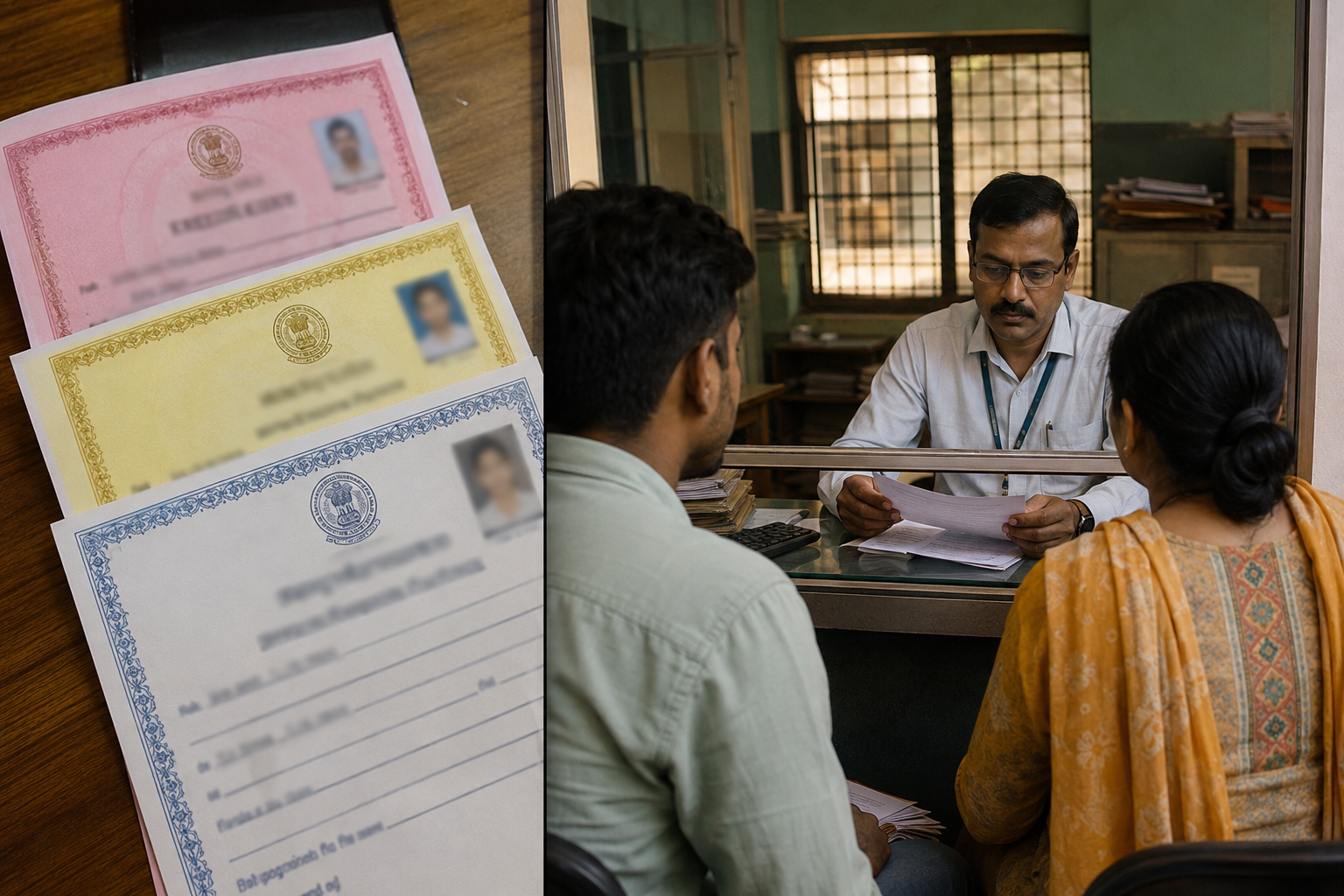
The EWS (Economically Weaker Section) certificate for CLAT counselling is an Income and Asset Certificate issued by a competent government authority, confirming that your family’s gross annual income is below Rs 8 lakh and that you don’t own significant assets as defined under the central EWS scheme.
Who Qualifies for EWS Reservation?
EWS reservation is for General-category candidates only. If you already belong to SC, ST, or OBC, you don’t apply under EWS. The central scheme requires that your gross annual family income (from all sources) is below Rs 8 lakh. There are also asset-based conditions: your family should not own more than 5 acres of agricultural land, a residential flat of 1,000 sq ft or more, or a residential plot of 100 sq yards or more in notified municipalities (200 sq yards elsewhere). If you meet all these conditions, you’re eligible.
How Do You Get an EWS Income and Asset Certificate?
You apply for the certificate at your tehsildar’s office or SDM office. Bring income proof (salary slips, ITR, or affidavit), property documents, and identity proof. The tehsildar or SDM verifies the details and issues the certificate on the official state government format.
Here’s the thing: these offices are busy, especially around exam season. Our mentors consistently advise students to apply in October, two months before the exam. A 2 to 4 week processing time is normal, and some offices take longer.
How Long Is an EWS Certificate Valid?
The EWS Income and Asset Certificate is valid for the financial year of admission. So if you’re seeking admission in the 2026-27 or 2027-28 academic year, your certificate must reflect the current financial year’s income. A certificate from a previous year will not be accepted. Get a fresh one.
What Is the OBC-NCL Certificate?
The OBC-NCL certificate is an official document confirming that you belong to the Other Backward Classes category and that your family falls below the “creamy layer” income threshold, making you eligible for OBC reservation in central institutions like NLUs.
What Does Non-Creamy Layer Actually Mean?
Non-Creamy Layer (NCL) means your family’s annual income is below Rs 8 lakh under central government rules. The “creamy layer” refers to OBC families whose income or social status is above this threshold; they’re excluded from OBC reservation in central institutions. So if your family earns more than Rs 8 lakh annually, you won’t qualify for OBC-NCL benefits at NLUs, even if you have a valid OBC caste certificate.
How Recent Must Your OBC-NCL Certificate Be?
Most NLUs expect your OBC-NCL certificate to be from the current financial year. This is the single most common document mistake we see every January. A student comes with an OBC-NCL certificate issued in 2023 or 2024, and the NLU rejects it because it doesn’t reflect current income status. Apply for a fresh certificate in October or November 2026. Don’t assume last year’s certificate will work.
Central List vs State List: Which OBC List Counts?
This is where it gets a bit tricky. NLUs are central institutions, so they generally follow the Central OBC list, not the state OBC list. Your caste may be in your state’s OBC list but not in the central list, or vice versa. Some NLUs also have their own specific rules. Always check the counselling notification of each NLU you’re targeting. Use our CLAT college predictor to identify your likely NLUs, then verify their OBC list requirements directly.
What Is the PwD Certificate for CLAT?
The PwD (Persons with Disabilities) certificate for CLAT counselling is a disability certificate issued by a competent government medical authority, confirming a benchmark disability of 40% or more as defined under the Rights of Persons with Disabilities (RPwD) Act 2016.
Which Disabilities Qualify for the PwD Quota?
The RPwD Act 2016 recognises 21 categories of disabilities, including locomotor disability, visual impairment, hearing impairment, intellectual disability, and specific learning disabilities, among others. To qualify for the PwD quota at NLUs, your disability must be certified at 40% or more. The Consortium’s counselling notification will specify any additional conditions.
Who Can Issue a Valid Disability Certificate?
Only a government medical authority can issue a valid disability certificate. This typically means a government hospital’s medical board or a designated district disability rehabilitation centre. Private hospital certificates are generally not accepted.
A UDID (Unique Disability ID) card, issued under the central UDID scheme, is excellent supporting proof and is increasingly being recognised as the primary document. If you don’t have a UDID card yet, apply for one through the Swavlamban portal. It takes time to process, so start early.
How Does the Domicile Certificate Work for State Quota Seats?
A domicile certificate for CLAT counselling is a residence proof document issued by state authorities, required specifically for state-quota seats at NLUs that reserve a portion of seats for candidates from their home state.
Which NLUs Offer Domicile or State Quota Seats?
Several NLUs reserve seats for candidates from their home state. Based on previous cycles, NLUs like RMLNLU Lucknow (Uttar Pradesh), MNLU Mumbai (Maharashtra), HNLU Raipur (Chhattisgarh), and GNLU Gandhinagar (Gujarat) have state-quota provisions. NLSIU Bangalore, NALSAR Hyderabad, and WBNUJS Kolkata also have their own state-specific seat structures. Each NLU defines its own eligibility criteria for state-quota seats, so check the specific NLU’s prospectus.
Let me share something that still bothers our team. A student we mentored last year (name withheld) qualified for a state-quota seat at a top NLU. Her domicile certificate was valid, but it listed her hostel address in another city instead of her permanent home address in her home state. The NLU rejected her state-quota claim. She eventually got a general seat, but it wasn’t the NLU she wanted. One address error cost her the seat. Please double-check your domicile certificate’s address before you submit it.
How Do You Get a Domicile Certificate?
You apply for a domicile or residence certificate at your local tehsildar’s office or SDM office in your home state. You’ll need proof of residence (ration card, Aadhaar, voter ID), proof of stay duration (as required by your state), and identity documents. Each state has its own format and eligibility criteria, so check your state government’s official website.
Again: apply in October. Tehsildar offices are not known for quick turnarounds, and the 2 to 4 week wait is standard.
Category-Wise Document Requirements at a Glance
| Category | Key Certificate | Issued By | Validity Watch-out |
|---|---|---|---|
| SC / ST | Caste certificate | State authority (tehsildar/DC) | Generally permanent; confirm format matches NLU requirement |
| OBC-NCL | OBC Non-Creamy Layer certificate | Tehsildar / SDM office | Must be from current financial year; central list vs state list matters |
| EWS | Income and Asset Certificate | Tehsildar / SDM / competent authority | Valid for financial year of admission only; renew every year |
| PwD | Disability certificate (40%+ benchmark) | Government medical authority / UDID | Must meet RPwD Act 2016 criteria; UDID card as supporting proof |
| Domicile / State Quota | Domicile / residence certificate | Tehsildar / SDM / DC office (home state) | Must show permanent home address, not hostel; each state has its own format |
What Are the 6 Most Common Document Mistakes in CLAT Counselling?
These are the mistakes our mentors have seen repeatedly across counselling cycles. Avoid them.
- OBC-NCL certificate from the wrong financial year. Every January, we see students arrive with a certificate issued 18 months ago. Most NLUs won’t accept it. Get a fresh one in October or November.
- Domicile certificate showing a hostel or rented address. Your domicile certificate must show your permanent home address in your home state. A temporary address disqualifies you from state-quota seats.
- Name mismatch across documents. If your CLAT registration has “Priya Sharma” but your Aadhaar says “Priya Kumari Sharma,” you’ll face a hold-up. Get an affidavit or correction done before counselling starts.
- EWS certificate from a previous financial year. The Income and Asset Certificate is valid only for the current financial year. A certificate from last year is not acceptable.
- PwD certificate from a private hospital. Only government-issued disability certificates are valid. Private hospital letters are rejected.
- Not checking whether your OBC caste is on the Central List. Your state OBC certificate won’t automatically make you eligible for OBC reservation at a central institution. Verify your caste’s inclusion in the Central OBC list.
How Should You Prepare Your Documents Before Results Day?
Start in October 2026, not after results. Here’s a month-by-month timeline:
October 2026
- Identify which category certificates you need (OBC-NCL, EWS, PwD, domicile)
- Apply at your tehsildar or SDM office immediately; processing takes 2 to 4 weeks
- Download your Class 10 and Class 12 marksheets from DigiLocker or your board’s portal as backup
- Check that your name is consistent across all documents
November 2026
- Collect your OBC-NCL, EWS, or domicile certificate once issued
- Verify that the certificate format matches what NLUs typically accept (check last year’s counselling notification on consortiumofnlus.ac.in as a reference)
- Apply for UDID card if you’re a PwD candidate and don’t have one yet
- Make three sets of photocopies of every document; get key copies attested
December 2026 (before and after exam on 6 December)
- Keep your CLAT admit card safe after the exam; you’ll need it for counselling
- Download your CLAT scorecard as soon as results are declared
- Use our CLAT college predictor to identify likely NLUs and check their specific document requirements
- Register on the Consortium portal and keep an eye on the counselling schedule
January to February 2027
- Participate in counselling rounds on consortiumofnlus.ac.in
- Pay the counselling confirmation fee (Rs 30,000 for General; Rs 20,000 for reserved categories) online when you accept a seat
- Report to the allotted NLU with originals and copies of all documents
- Keep digital copies of everything on DigiLocker as backup
FAQs
Can I use digital copies of documents for CLAT counselling?
Digital copies stored on DigiLocker are useful as backup, but most NLUs require original documents and attested photocopies at the time of physical reporting. Check the specific counselling notification from the Consortium of NLUs for each round’s requirements. Always carry originals; don’t rely solely on digital copies.
Is the CLAT counselling fee refundable?
The counselling confirmation fee (Rs 30,000 for General, Rs 20,000 for reserved categories, based on the CLAT 2026 cycle) is partially refundable if you withdraw before the Consortium’s specified deadline, after deducting processing charges. Withdrawing after the deadline or not reporting to your allotted NLU may result in full forfeiture. Always check the official counselling notification on consortiumofnlus.ac.in for exact refund rules.
What if I don’t have all my CLAT counselling documents ready before counselling starts?
If your documents aren’t ready, you risk losing your allotted seat. Some NLUs allow a short grace period for pending documents with an undertaking, but this varies by institution. The safest approach is to start collecting certificates in October, well before results. Don’t wait for results to begin the paperwork.
Do I need original documents at the CLAT counselling centre?
Yes. Original documents are required for verification at the NLU when you report for admission. Photocopies alone are not sufficient. Carry originals plus at least two sets of attested photocopies. Keep originals in a separate folder so you don’t accidentally hand them over permanently.
What documents do NRI candidates need for CLAT counselling?
NRI candidates typically need their passport, visa or OCI/PIO card, proof of NRI status, and the standard academic documents (Class 10 and 12 marksheets). The Consortium’s counselling notification will specify NRI-specific requirements. Check the official notification carefully, as NRI seat rules and documentation can differ from domestic candidate requirements.
How do I get duplicate documents if originals are lost?
For lost Class 10 or 12 marksheets, contact your board (CBSE, ICSE, or state board) for a duplicate certificate; most boards have an online application process. For lost government certificates (caste, domicile, EWS), apply fresh at your tehsildar or SDM office with an FIR copy and identity proof. DigiLocker often has digitally signed copies of board marksheets that are officially valid.
Which documents are mandatory vs optional for CLAT counselling?
Mandatory documents include your CLAT admit card, scorecard, Class 10 and 12 marksheets, photo ID, and passport photographs. Category certificates (SC/ST/OBC-NCL/EWS/PwD) are mandatory if you’re claiming reservation. Domicile certificates are mandatory only if you’re applying for state-quota seats. A UDID card for PwD candidates is strongly recommended but may be treated as supporting proof rather than the primary certificate at some NLUs.
Conclusion
Getting your CLAT counselling documents right is honestly half the battle after the exam. The paperwork feels tedious, but a missing or outdated certificate can cost you the seat you worked so hard for.
Here’s what to do right now, even if CLAT 2027 is still months away:
- Identify your category certificates and apply at your tehsildar or SDM office in October 2026
- Check name consistency across all your documents and fix mismatches early
- Use our CLAT college predictor to shortlist likely NLUs and verify their specific document requirements
- Bookmark consortiumofnlus.ac.in and check it regularly from December 2026 onwards
- Start your CLAT preparation with our online CLAT coaching so you’re not just document-ready but exam-ready too
Your success is our mission. We’ve helped thousands crack CLAT, and the students who do best are the ones who treat counselling prep with the same seriousness as exam prep. Let’s build your law career together. Check out our CLAT UG program, grab our free CLAT study planner, and head over to our CLAT blog for more guides like this one.