With CLAT 2025 results fresh in everyone’s minds and aspirants already gearing up for the next cycle, the pressure to crack this prestigious law entrance exam has never been more intense. Whether you’re starting your CLAT 2027 preparation journey or looking to optimize your existing study plan, understanding which topics deliver maximum returns and how to manage your time effectively can make all the difference between securing a seat at your dream NLU and missing the mark.
Here’s the reality: CLAT isn’t just about studying hard—it’s about studying smart. The exam pattern rewards strategic thinking, and certain sections offer quicker score improvements than others [1]. Your success is our mission, and that’s why we’re breaking down the most effective CLAT 2027 Last-Minute Preparation Strategy: High-Scoring Topics & Time Management Hacks that have helped thousands crack CLAT.
Key Takeaways
• English and Legal Reasoning sections offer the highest score improvement potential with focused preparation, contributing 50-60 marks combined out of 120 total marks
• Current Affairs preparation should follow the 70-30 rule: 70% focus on legal and constitutional developments, 30% on general current affairs for maximum efficiency
• Time allocation strategy should prioritize 40% English, 30% Legal Reasoning, 20% Current Affairs, and 10% Quantitative Techniques for optimal score distribution
• Mock test analysis and targeted revision in the final weeks can boost scores by 15-20 marks through pattern recognition and speed improvement
• Section-wise time management during the exam should allocate 45-50 minutes for English, 40-45 minutes for Legal Reasoning, and 25-30 minutes for remaining sections
Strategic Section-Wise Breakdown for Maximum Score Impact
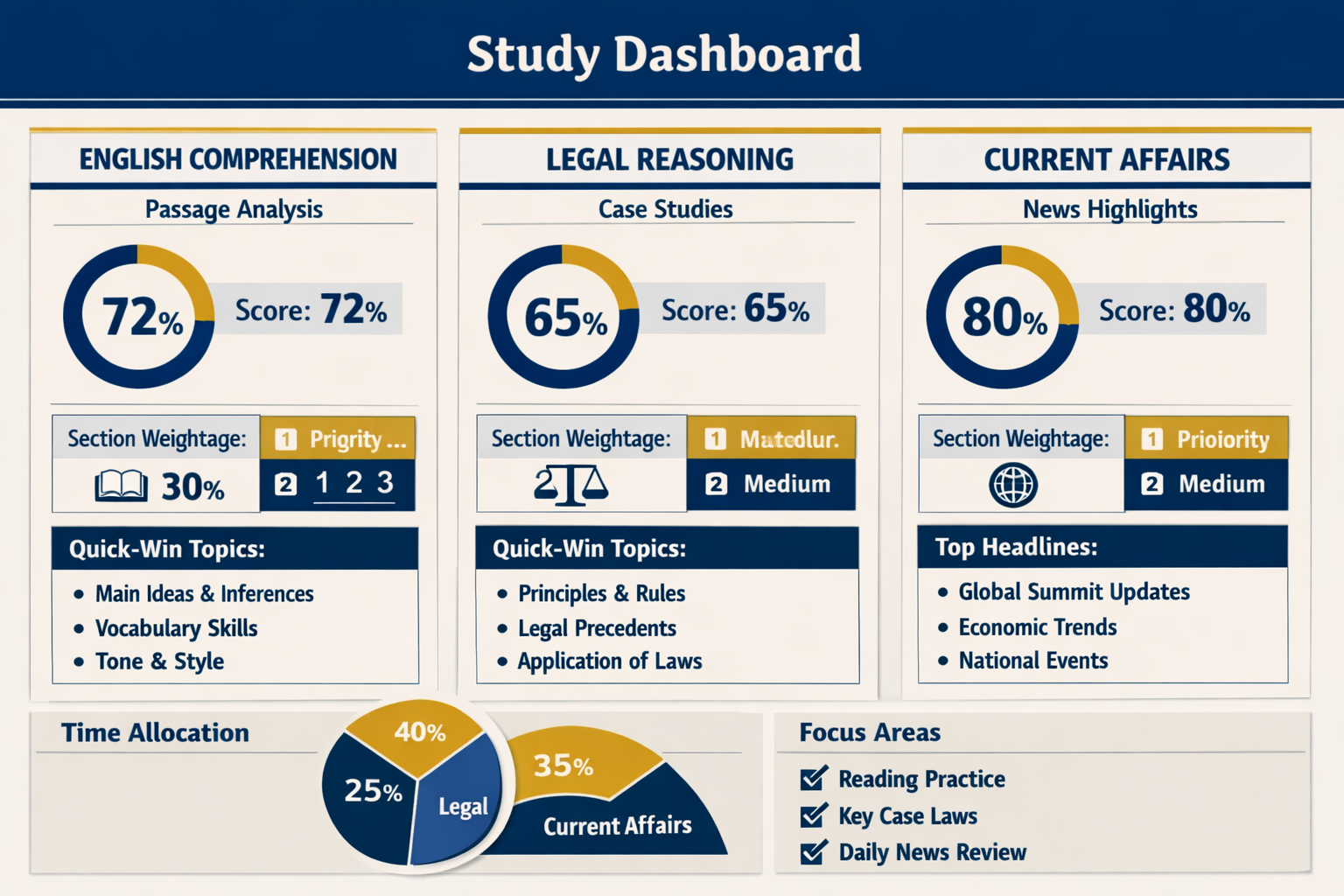
English Language: Your Foundation for CLAT Success
The English section in CLAT 2027 carries approximately 22-26 questions and forms the backbone of your overall performance [5]. What makes this section particularly valuable for score improvement is its predictable nature and the transferable skills it builds for other sections.
High-Impact English Topics That Deliver Quick Wins:
Reading Comprehension Mastery remains the cornerstone of CLAT English preparation. Focus on passages from legal journalism, constitutional debates, and socio-political commentary. These aren’t just random topics—they directly connect to Legal Reasoning and Current Affairs sections, giving you triple the return on your study investment.
The key lies in developing active reading techniques. Instead of passively consuming content, train yourself to identify the author’s tone, main arguments, and underlying assumptions within the first two minutes of reading. This skill alone can save you 8-10 minutes during the actual exam, time that can be redirected to more challenging Legal Reasoning questions.
Grammar and Vocabulary in Context has evolved significantly in recent CLAT papers. Rather than testing isolated grammar rules, the exam now emphasizes contextual usage and nuanced vocabulary. Focus on legal terminology, constitutional language, and contemporary political discourse. Words like “adjudicate,” “jurisprudence,” “precedent,” and “constitutional morality” appear frequently across multiple sections.
For those struggling with reading speed and comprehension, our comprehensive guide to improving reading speed without losing comprehension provides proven strategies that actually work.
Critical Reasoning Through Passages bridges English and Legal Reasoning beautifully. CLAT 2027 will likely continue the trend of including inference-based questions that test your ability to draw logical conclusions from given information. Practice identifying assumptions, strengthening or weakening arguments, and recognizing logical fallacies within passage contexts.
Legal Reasoning: Where Strategy Meets Substance
Legal Reasoning contributes 22-26 questions to your CLAT score and offers excellent opportunities for significant improvement with the right approach [8]. Unlike rote memorization subjects, Legal Reasoning rewards logical thinking and pattern recognition—skills that can be developed relatively quickly with focused practice.
Constitutional Law Fundamentals consistently appear in 40-50% of Legal Reasoning questions. Don’t get overwhelmed by the vastness of constitutional law. Instead, focus on these high-yield areas:
- Fundamental Rights and their limitations: Articles 12-35, with special emphasis on Articles 14, 19, and 21
- Directive Principles of State Policy: Understanding the balance between individual rights and state obligations
- Federal structure and Centre-State relations: Division of powers, emergency provisions
- Judicial review and constitutional interpretation: Landmark cases and their contemporary relevance
Contract Law and Tort Principles form another crucial cluster. These areas are particularly valuable because they involve logical problem-solving rather than pure memorization. Focus on understanding basic principles of offer and acceptance, breach of contract remedies, and common tort scenarios like negligence and defamation.
The beauty of Legal Reasoning lies in its interconnected nature. Once you grasp fundamental principles, you can apply them to novel scenarios—exactly what CLAT tests. Our detailed analysis of common Legal Reasoning mistakes reveals patterns that can immediately improve your accuracy.
Criminal Law Basics shouldn’t be ignored, especially given recent legal developments. Understanding concepts like mens rea, actus reus, and various categories of offenses provides a solid foundation for tackling criminal law passages.
Current Affairs: The Strategic 70-30 Approach
Current Affairs in CLAT 2027 demands a strategic approach rather than random news consumption [1]. With 25-30 questions typically drawn from this section, your preparation should follow the proven 70-30 rule for maximum efficiency.
70% Focus: Legal and Constitutional Current Affairs
This isn’t just about recent Supreme Court judgments—though they’re crucial. Your preparation should encompass:
- Recent Constitutional Amendments and their implications
- Significant Supreme Court and High Court judgments from the past 12-18 months
- New legislation and policy changes affecting legal framework
- Constitutional crises and their resolution through legal mechanisms
- International legal developments affecting Indian jurisprudence
30% Focus: General Current Affairs with Legal Implications
This includes political developments, economic policies, social issues, and international relations—but always with an eye toward their legal dimensions. For instance, instead of just knowing about a new economic policy, understand its constitutional validity, implementation challenges, and judicial scrutiny.
For aspirants wondering about efficient current affairs preparation without daily newspaper reading, our strategic current affairs guide offers practical alternatives that fit busy schedules.
The key to Current Affairs success lies in connecting dots rather than collecting isolated facts. When you read about a new Supreme Court judgment, consider its impact on existing legal principles, potential future implications, and connections to constitutional provisions you’ve studied.
Time Management Hacks That Actually Work
The 40-30-20-10 Study Time Allocation Formula
Based on extensive analysis of successful CLAT candidates and score improvement patterns, this allocation strategy maximizes your preparation efficiency:
40% English Language Preparation might seem excessive, but here’s why it works: English skills directly impact your performance in Legal Reasoning and Current Affairs sections. Strong reading comprehension abilities help you process legal passages faster, while vocabulary development aids in understanding complex legal terminology across all sections.
30% Legal Reasoning Focus reflects both the section’s weightage and its potential for rapid improvement. Unlike subjects requiring extensive factual knowledge, Legal Reasoning rewards logical thinking patterns that can be developed through consistent practice and analysis.
20% Current Affairs Investment emphasizes quality over quantity. Rather than trying to cover everything, focus on legal current affairs that intersect with your Legal Reasoning preparation. This creates synergistic learning where each hour of study benefits multiple sections.
10% Quantitative Techniques acknowledges this section’s limited scope in CLAT while ensuring you don’t leave easy marks on the table. For students who struggle with mathematics, our specialized guide for non-math students identifies the five must-do topics that deliver maximum returns.
Daily Schedule Optimization Techniques
Morning Hours (6:00-9:00 AM): English Intensive Sessions
Your brain’s peak performance hours should be dedicated to reading comprehension and critical reasoning. The fresh mental state helps with sustained attention required for lengthy passages.
Mid-Morning (9:30 AM-12:30 PM): Legal Reasoning Deep Dives
This period works perfectly for analytical thinking required in Legal Reasoning. Your mind is still sharp but has moved past the initial morning grogginess.
Afternoon (2:00-4:00 PM): Current Affairs Integration
Post-lunch hours are ideal for current affairs because this section requires less intensive concentration while still demanding consistent attention.
Evening (6:00-8:00 PM): Mock Tests and Analysis
Evening sessions work well for timed practice because they simulate actual exam conditions when your mental energy isn’t at its peak.
Weekly Revision Cycles for Retention
Monday-Wednesday: Content Building
Focus on learning new concepts, reading fresh material, and expanding your knowledge base across all sections.
Thursday-Friday: Application and Practice
Dedicate these days to solving previous year questions, sectional tests, and applying learned concepts to new problems.
Saturday: Full-Length Mock Tests
Weekend mock tests simulate actual exam pressure while providing comprehensive performance feedback.
Sunday: Analysis and Weak Area Targeting
Use Sundays for detailed mock test analysis, identifying patterns in mistakes, and targeted practice on weak areas.
For students wondering about optimal preparation timelines, our comprehensive guide to CLAT preparation duration provides realistic timeframes based on different starting points.
High-Yield Topics for Quick Score Improvements
English Section Quick Wins
Contextual Vocabulary Building offers immediate returns. Instead of memorizing word lists, focus on understanding words within legal and constitutional contexts. Terms like “arbitrary,” “reasonable,” “proportionate,” and “legitimate” appear across English and Legal Reasoning sections.
Create context-based vocabulary clusters:
- Constitutional terminology: Secular, sovereign, democratic, republic
- Legal procedure words: Adjudicate, litigate, appellant, respondent
- Rights and duties language: Enforceable, justiciable, directive, fundamental
Inference and Assumption Questions in reading comprehension follow predictable patterns. Practice identifying what the author explicitly states versus what can be reasonably inferred. This skill directly translates to Legal Reasoning success.
Tone and Purpose Recognition helps you quickly eliminate wrong answer choices. Authors writing about constitutional issues typically adopt analytical, critical, or explanatory tones—rarely emotional or purely descriptive ones.
Legal Reasoning Power Topics
Article 14 and Equality Jurisprudence appears in multiple forms across CLAT papers. Understanding the evolution from formal equality to substantive equality, reasonable classification tests, and contemporary applications gives you a powerful tool for tackling diverse Legal Reasoning scenarios.
Article 21 and Right to Life Expansion has been the foundation for numerous landmark judgments. Knowing how courts have expanded this right to include privacy, dignity, livelihood, and environmental protection helps you approach novel scenarios with confidence.
Basic Structure Doctrine connects constitutional law with contemporary political developments. Understanding this doctrine’s origins, applications, and limitations provides context for analyzing current constitutional debates that frequently appear in Current Affairs sections.
Contract Law Essentials focus on offer-acceptance scenarios, consideration principles, and breach remedies. These topics appear consistently and reward logical analysis over rote memorization.
Current Affairs Strategic Focus Areas
Supreme Court Landmark Judgments (2024-2026) should be studied not just for facts but for underlying legal principles. Each significant judgment typically connects to fundamental constitutional concepts you’re already studying for Legal Reasoning.
Constitutional Amendment Processes and Recent Changes help you understand the dynamic nature of constitutional law. Focus on why amendments were proposed, the legal challenges they faced, and their ultimate impact on existing legal frameworks.
Legislative Developments with Constitutional Implications include new laws, policy changes, and their judicial scrutiny. Understanding the constitutional basis for new legislation helps you connect Legal Reasoning principles with Current Affairs content.
For students seeking additional guidance on strategic preparation, our comprehensive CLAT preparation tips offer detailed roadmaps that have proven effective for thousands of successful candidates.
Mock Test Strategy and Performance Analysis
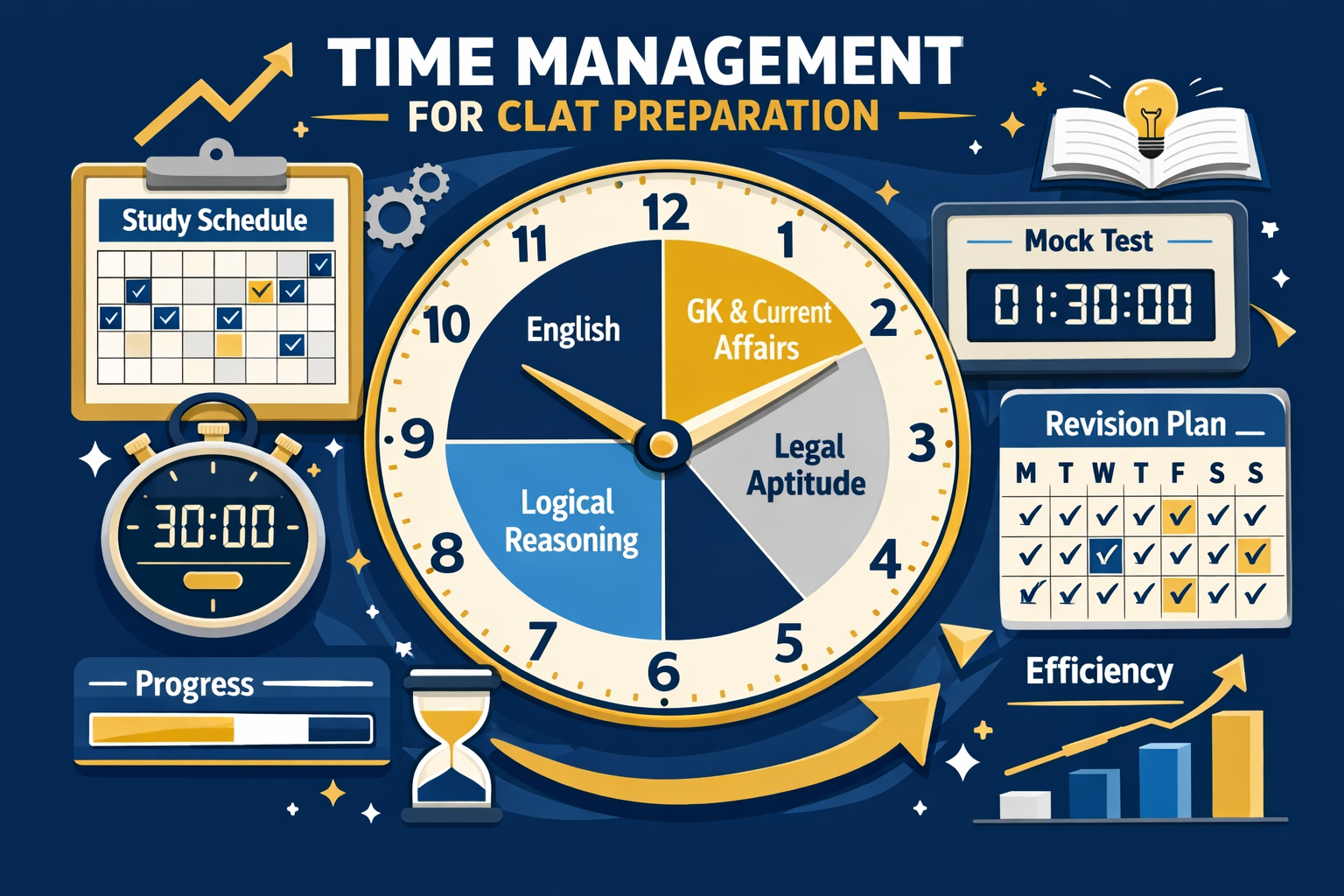
Optimal Mock Test Frequency and Timing
The final months before CLAT 2027 require a strategic approach to mock testing that goes beyond simply taking as many tests as possible. Quality analysis trumps quantity every time.
Three Months Before CLAT: Weekly Full-Length Mocks
At this stage, focus on building stamina and identifying major weak areas. Take one comprehensive mock test weekly, followed by two days of detailed analysis and targeted practice on identified weaknesses.
Two Months Before CLAT: Bi-weekly Full-Length Plus Sectional Tests
Increase frequency to two full-length mocks per week, supplemented by daily sectional tests focusing on your weakest areas. This period should emphasize speed building and accuracy improvement.
Final Month: Daily Practice with Strategic Focus
The last month should include daily timed practice—alternating between full-length tests and intensive sectional work. However, avoid taking new full-length mocks in the final week to prevent confidence issues from unexpected poor performance.
Performance Analysis Techniques That Drive Improvement
Error Pattern Recognition goes beyond simply noting wrong answers. Categorize mistakes into:
- Conceptual gaps: Fundamental understanding issues requiring content review
- Application errors: Knowing the concept but struggling with practical implementation
- Speed-related mistakes: Correct approach but insufficient time for careful execution
- Silly errors: Careless mistakes despite knowing the correct approach
Time Distribution Analysis reveals crucial insights about your test-taking strategy. Track how long you spend on each section and question type. Many students discover they’re spending too much time on difficult questions while rushing through easier ones they could answer correctly with slightly more attention.
Accuracy vs. Speed Optimization requires finding your personal sweet spot. Calculate your accuracy rates at different speed levels. Sometimes, slowing down by 10% can improve accuracy by 20%, resulting in significantly better overall scores.
Our detailed guide to mock test mastery provides specific techniques for extracting maximum value from every practice session.
Section-Wise Performance Benchmarks
English Section Targets:
- Accuracy Goal: 85-90% for reading comprehension questions
- Speed Target: 1.8-2.2 minutes per question
- Strategic Focus: Prioritize passage-based questions over standalone grammar items
Legal Reasoning Benchmarks:
- Accuracy Goal: 80-85% overall, with 90%+ on constitutional law questions
- Speed Target: 2.0-2.5 minutes per question
- Strategic Focus: Master fundamental principles rather than attempting every question
Current Affairs Standards:
- Accuracy Goal: 75-80% with strategic guessing on uncertain questions
- Speed Target: 1.5-2.0 minutes per question
- Strategic Focus: Prioritize legal current affairs over general knowledge items
Exam Day Execution Strategy
Section-Wise Time Allocation During the Exam
First 45-50 Minutes: English Language Dominance
Begin with English because it requires sustained concentration and sets the tone for your entire performance. Strong performance here builds confidence for subsequent sections.
Start with reading comprehension passages, as they typically offer the most reliable scoring opportunities. Read actively, taking 2-3 minutes per passage to understand the main argument, author’s perspective, and key supporting points.
Next 40-45 Minutes: Legal Reasoning Focus
Approach Legal Reasoning systematically. Begin with constitutional law questions, as these typically offer the highest accuracy rates for well-prepared students. Move through contract law, tort law, and criminal law in order of your comfort level.
Don’t get stuck on any single question for more than 3 minutes. Mark difficult questions for review and move forward to maintain momentum.
Final 25-30 Minutes: Current Affairs and Quantitative Techniques
Use your remaining time strategically. Quickly scan through Current Affairs questions, prioritizing those related to legal developments and constitutional issues—areas where your Legal Reasoning preparation provides additional context.
For Quantitative Techniques, focus on questions involving basic arithmetic, percentages, and simple logical reasoning. Avoid complex calculations that consume disproportionate time.
Strategic Question Selection and Elimination Techniques
The 15-Second Rule helps maintain optimal pacing. If you can’t identify the correct approach to a question within 15 seconds, mark it for review and move forward. This prevents time wastage on questions that might be beyond your current preparation level.
Elimination Strategy for Multiple Choice Questions:
- First Pass: Eliminate obviously incorrect options based on factual errors or logical inconsistencies
- Second Pass: Use context clues and related knowledge to narrow down remaining choices
- Final Decision: Choose the most reasonable option among remaining choices, avoiding overthinking
Strategic Guessing Principles can significantly impact your final score. When unsure between two options, consider:
- Legal context consistency: Choose options that align with fundamental constitutional principles
- Contemporary relevance: Recent developments often influence correct answers in Current Affairs
- Logical coherence: Select options that maintain internal consistency within the question’s framework
For comprehensive insights into CLAT exam structure and strategic approaches, refer to our complete CLAT 2027 exam structure guide that provides detailed analysis of evolving patterns.
Technology and Resources for Efficient Preparation
Digital Tools for Optimized Study Sessions
Spaced Repetition Apps help consolidate Legal Reasoning principles and Current Affairs facts through scientifically-proven memory techniques. Instead of random revision, these tools present information at optimal intervals for long-term retention.
Reading Speed Applications can significantly improve your English section performance. Apps that gradually increase reading speed while maintaining comprehension levels help you process CLAT’s lengthy passages more efficiently.
Mock Test Analytics Platforms provide detailed performance insights that manual analysis might miss. These tools track your progress over time, identify subtle patterns in mistakes, and suggest targeted improvement strategies.
Curated Resource Lists for Maximum Efficiency
Primary Legal Resources:
- Bare Acts: Constitution of India, Indian Contract Act, Indian Penal Code (focus on relevant sections rather than comprehensive reading)
- Landmark Judgment Summaries: Concentrate on constitutional bench decisions and recent Supreme Court rulings
- Legal News Platforms: Specialized legal journalism rather than general news sources
English Enhancement Materials:
- Legal Magazines and Journals: Publications that combine English language skills with legal content knowledge
- Editorial Analysis: Opinion pieces on constitutional and legal issues that model the analytical thinking CLAT rewards
- Academic Legal Writing: Law review articles that demonstrate sophisticated argumentation techniques
Current Affairs Optimization:
- Constitutional Law Updates: Specialized platforms tracking constitutional developments and judicial pronouncements
- Policy Analysis Resources: Sources that explain legal implications of government policies and legislative changes
- International Legal Developments: Selective coverage of global legal trends affecting Indian jurisprudence
For students seeking structured guidance, our flexible learning programs provide personalized attention you deserve without the premium price tag, allowing you to study at your own pace with expert guidance from top NLUs.
Building Mental Resilience for CLAT Success
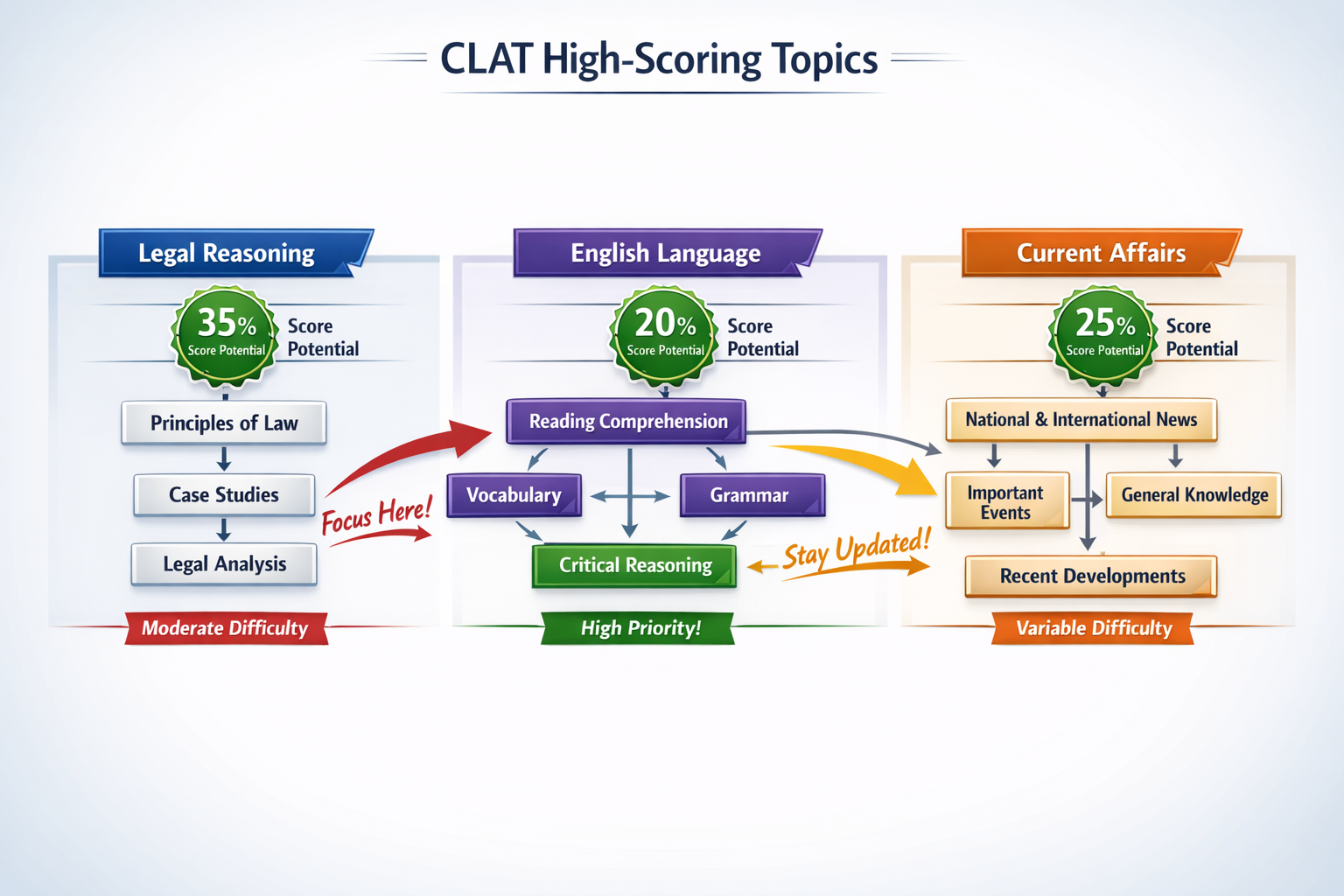
Stress Management Techniques for Peak Performance
Controlled Breathing Exercises during study sessions and mock tests help maintain optimal cognitive function under pressure. Practice the 4-7-8 breathing technique: inhale for 4 counts, hold for 7, exhale for 8. This activates your parasympathetic nervous system, reducing anxiety and improving focus.
Progressive Preparation Confidence Building involves gradually increasing the difficulty and pressure of your practice sessions. Start with untimed sectional practice, progress to timed sections, then full-length mocks under exam-like conditions.
Positive Visualization Techniques help your brain rehearse successful performance. Spend 10 minutes daily visualizing yourself calmly and confidently working through CLAT questions, making strategic decisions, and achieving your target score.
Maintaining Motivation During Intensive Preparation
Goal Segmentation Strategy breaks down your ultimate CLAT success into daily, weekly, and monthly milestones. Instead of focusing solely on the final exam, celebrate smaller victories like improving your English accuracy by 5% or mastering a challenging Legal Reasoning concept.
Progress Tracking Systems provide tangible evidence of improvement during periods when progress feels slow. Maintain detailed records of mock test scores, accuracy rates, and speed improvements across different sections.
Peer Learning Networks offer motivation and perspective during challenging preparation phases. Connect with other serious CLAT aspirants through study groups or online communities where you can share strategies, discuss difficult concepts, and maintain accountability.
For additional motivation strategies and overcoming common preparation hurdles, our comprehensive guide to staying motivated during CLAT preparation provides practical techniques that have helped thousands maintain focus throughout their preparation journey.
Conclusion
Success in CLAT 2027 isn’t about perfection—it’s about strategic optimization and consistent execution of proven techniques. The CLAT 2027 Last-Minute Preparation Strategy: High-Scoring Topics & Time Management Hacks outlined above provide a roadmap that has consistently delivered results for serious aspirants.
Remember these key principles as you finalize your preparation: prioritize sections with the highest improvement potential, focus on quality analysis over quantity of practice, and maintain strategic flexibility in your approach. English and Legal Reasoning offer the best returns on your study investment, while Current Affairs success comes from focused preparation on legal developments rather than general knowledge accumulation.
Your success is our mission, and these proven strategies that actually work have helped thousands crack CLAT. The path to your dream NLU requires dedication, strategic thinking, and consistent application of effective techniques.
Immediate Action Steps:
- Assess your current performance using the benchmarks provided and identify your highest-impact improvement areas
- Implement the 40-30-20-10 time allocation strategy starting with your next study session
- Schedule weekly mock tests with mandatory 2-day analysis periods for the remaining preparation time
- Focus your Current Affairs preparation on legal developments and constitutional issues using the 70-30 approach
- Practice exam day time management through simulated test conditions in your final month of preparation
The difference between CLAT success and disappointment often comes down to strategic preparation and efficient execution. With these techniques and your dedication, you’re well-equipped to achieve your law school dreams. Let’s build your law career together with accessible education for serious aspirants who understand that results speak louder than promises.
References
[1] Clat 2026 Dates Application Syllabus Preparation Tips Nlus – https://law.careers360.com/articles/clat-2026-dates-application-syllabus-preparation-tips-nlus
[2] Clat 2025 Entrance Exam – https://www.gngroup.org/blogdetail/CLAT-2025-Entrance-Exam
[3] Clat 2026 Latest Updates And Instructions – https://www.nls.ac.in/news-events/clat-2026-latest-updates-and-instructions/
[4] Common Law Admission Test – https://en.wikipedia.org/wiki/Common_Law_Admission_Test
[5] Clat 2026 – https://consortiumofnlus.ac.in/clat-2026/
[6] Enquiry – https://aiclet.org/enquiry.html?device=c&adgroupid=168028912741
[7] %f0%9f%93%85clat 2026 Admit Carddate Eligibility Preparation – https://infogate.org.in/%F0%9F%93%85clat-2026-admit-carddate-eligibility-preparation/
[8] Clat 2026 Guide Exam Structure Syllabus Eligibility – https://www.clatnlti.com/blog-details/319/clat-2026-guide-exam-structure-syllabus-eligibility
[9] Clat 2026 Exam Date Eligibility Syllabus Registration Pattern Tips Cutoff – https://sageuniversity.edu.in/blogs/clat-2026-exam-date-eligibility-syllabus-registration-pattern-tips-cutoff

