Staring at a pile of unread newspapers while your CLAT exam date inches closer?
You’re not alone. Thousands of CLAT aspirants struggle with the same guilt trip. The conventional wisdom says read newspapers daily without fail. But here’s the reality: most students can’t maintain that habit consistently while juggling school, coaching, and other CLAT sections.
What if there was a smarter approach to Newspaper Reading For CLAT that doesn’t demand daily commitment but still delivers results?
This comprehensive guide reveals exactly how successful CLAT candidates prepare current affairs without the pressure of daily newspaper reading. You’ll discover strategic methods, alternative resources, and proven techniques that work with your actual schedule, not some idealized study plan.
Key Takeaways
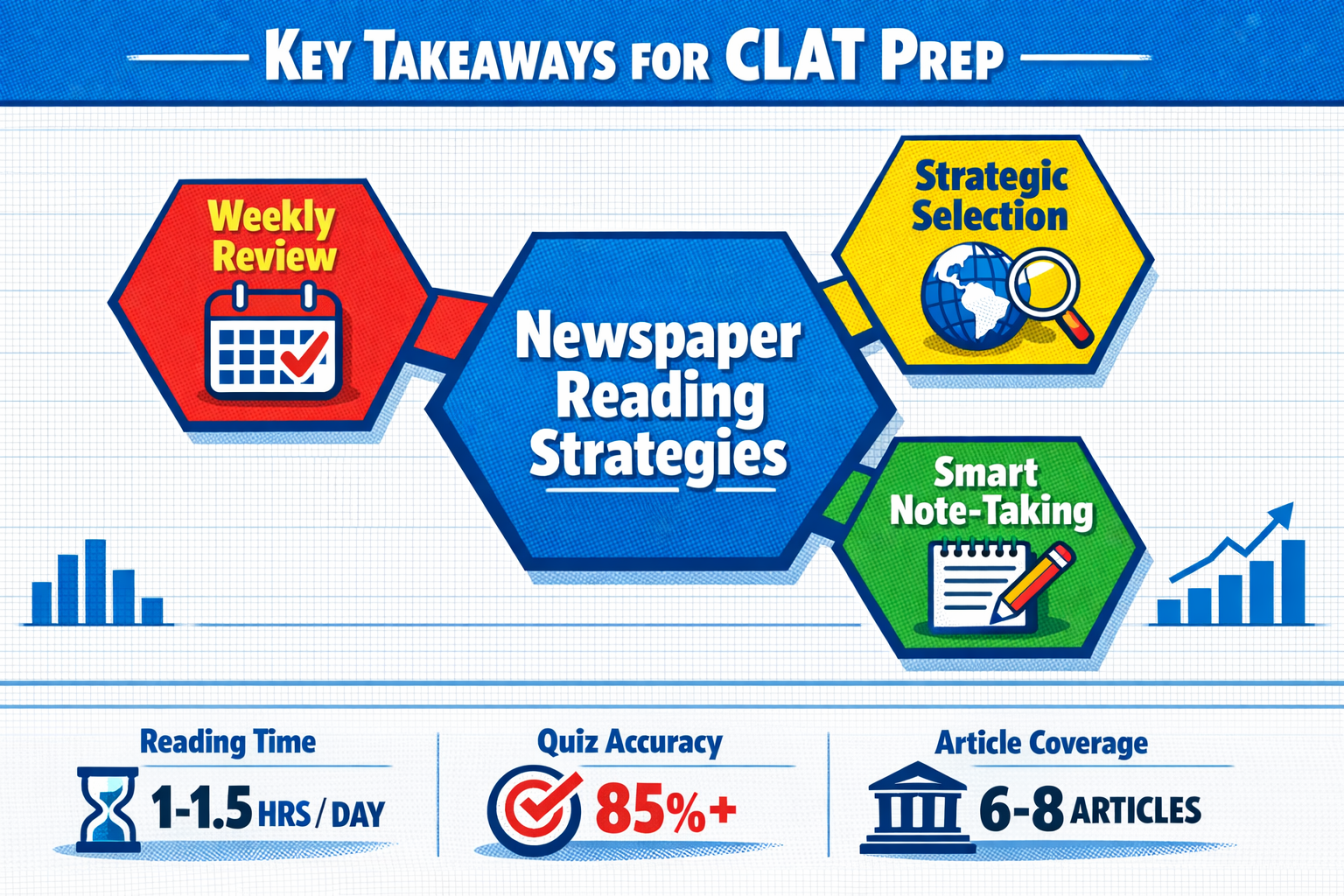
- Strategic weekly newspaper reading (2-3 focused sessions) outperforms unfocused daily skimming for CLAT preparation
- Combining newspapers with monthly compilations and digital resources creates a more comprehensive current affairs strategy
- Effective note-making systems and categorization techniques are more important than reading volume
- Technology tools and apps can significantly reduce newspaper reading time while improving retention
- Quality of engagement with current affairs content matters far more than quantity of newspapers consumed
Understanding the Real Role of Newspaper Reading For CLAT
Let’s address the elephant in the room first.
Newspapers aren’t magical documents that guarantee CLAT success. They’re tools. And like any tool, their effectiveness depends on how you use them, not how religiously you worship them.
The CLAT exam tests your ability to comprehend, analyze, and apply current knowledge. The 2026 CLAT pattern allocates significant weightage to current affairs across multiple sections, especially General Knowledge and Legal Reasoning passages based on contemporary issues.
But here’s what most coaching institutes won’t tell you: the exam doesn’t test whether you read newspapers daily. It tests whether you understand what’s happening in India and the world, can connect events to legal and constitutional frameworks, and apply that knowledge intelligently.
Why the daily newspaper myth persists:
Traditional coaching created this narrative because it’s simple advice. Read newspapers daily. Sounds disciplined. Sounds serious. But it ignores how students actually learn and retain information.
Research on spaced repetition and active recall shows that concentrated, focused study sessions with proper revision beat scattered daily exposure every single time. This applies to newspaper reading too.
The Psychological Burden of Daily Reading
Daily newspaper reading creates unnecessary stress for most CLAT aspirants. Missing even one day triggers guilt. That guilt compounds. Soon you’re three weeks behind, staring at a mountain of unread papers, feeling like you’ve already failed.
This psychological pressure actually hampers preparation. Students spend mental energy worrying about newspapers instead of focusing on strategic learning.
A smarter approach acknowledges your realistic capacity and builds a sustainable system around it. That’s what we’ll explore throughout this guide.
Best Newspapers For CLAT Preparation in 2026
Before diving into strategies, you need to know which newspapers actually matter for CLAT exam preparation.
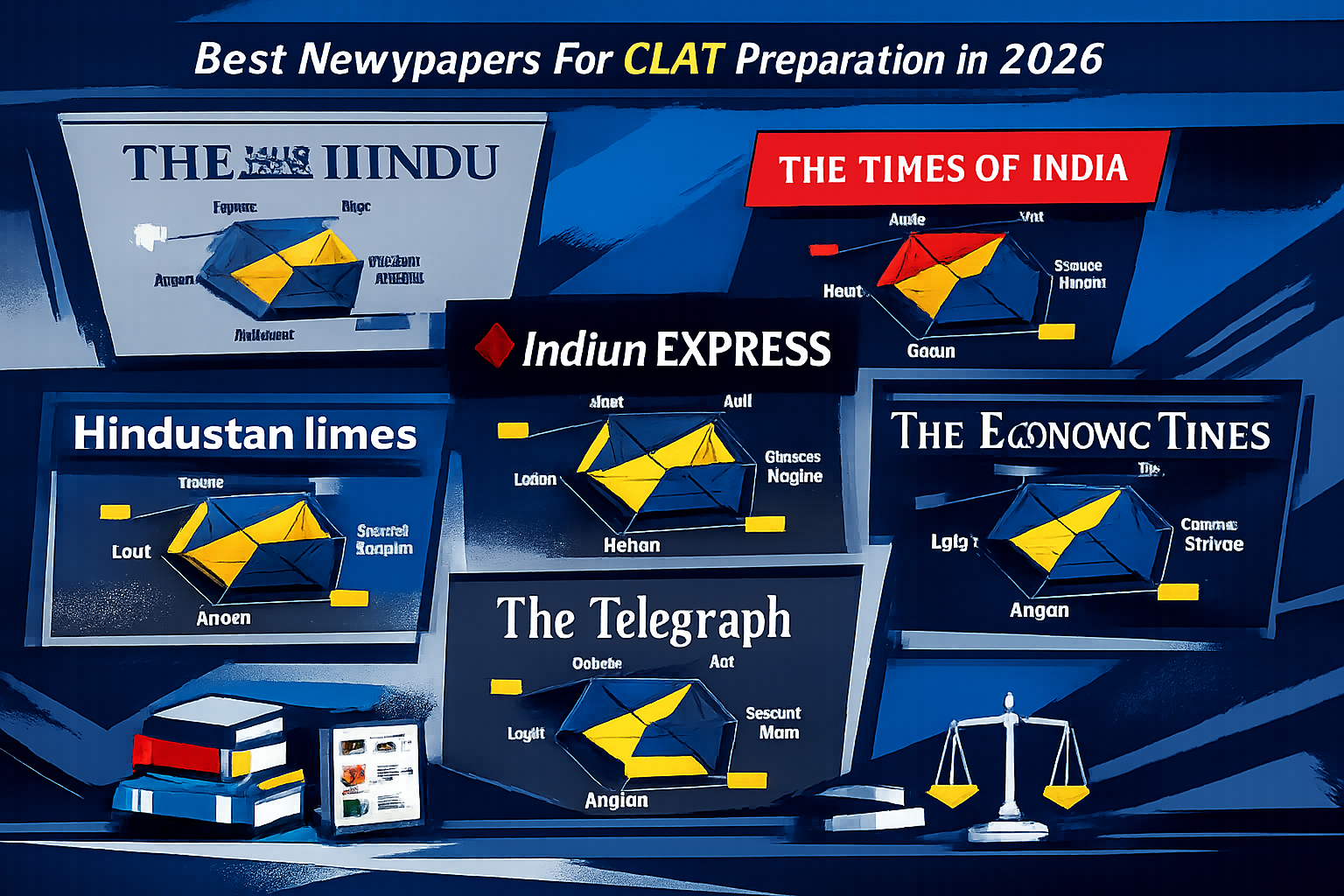
The Hindu remains the gold standard for CLAT current affairs. Its editorial quality, comprehensive coverage of legal and constitutional matters, and analytical depth make it invaluable. The language level also helps improve reading comprehension skills tested in the English section.
Indian Express offers excellent complementary coverage, especially for political developments, governance issues, and investigative journalism. Its editorial page provides diverse perspectives on current issues.
The Times of India can supplement your preparation with easier language and broader coverage, though it’s less essential than the first two.
Here’s the strategic truth: you don’t need to read all three newspapers daily. That’s information overload, not smart preparation.
| Newspaper | Primary Strength | CLAT Relevance | Reading Frequency |
|---|---|---|---|
| The Hindu | Editorial depth, legal coverage | Very High | 2-3 times weekly |
| Indian Express | Political analysis, governance | High | 2 times weekly |
| Times of India | General awareness, easy language | Moderate | Optional/weekly |
For regional context, consider one regional newspaper in your state language if you’re comfortable. This helps with state-specific current affairs that occasionally appear in CLAT.
The key insight: quality engagement with fewer newspapers beats superficial scanning of multiple sources.
Strategic Newspaper Reading For CLAT: The Weekly Approach
Now for the game-changer: the strategic weekly approach that eliminates daily reading pressure while maintaining comprehensive coverage.
The Core Framework:
Instead of reading newspapers daily, dedicate 2-3 focused sessions per week of 90-120 minutes each. This concentrated approach delivers better retention and understanding than 30 minutes of rushed daily reading.
Session 1 (Monday/Tuesday): Cover the weekend editions plus Monday/Tuesday papers. Weekend editions typically contain week-in-review sections and detailed analysis pieces that consolidate the previous week’s major events.
Session 2 (Thursday/Friday): Mid-week catch-up covering Wednesday through Friday editions. Focus on developing stories and new events.
Session 3 (Sunday – Optional): Review and consolidation. Go through your notes from the week, connect related events, and identify exam-relevant themes.
What Sections to Prioritize
Not all newspaper sections matter equally for CLAT. Strategic filtering saves massive time.
Must-read sections:
- Editorial and Opinion pages (highest priority): These develop analytical thinking and expose you to argumentative writing styles similar to CLAT passages
- National news: Political developments, policy changes, constitutional matters, Supreme Court judgments
- International news: Major global events, India’s foreign relations, international organizations
- Legal and judiciary section: Court rulings, legal reforms, constitutional amendments
- Economy page: Major economic policies, budget highlights, regulatory changes
Sections to skip or skim:
- Sports (unless major national/international events)
- Entertainment and lifestyle
- Detailed stock market reports
- Local city news (unless directly relevant to national issues)
- Advertisements and classifieds (obviously)
This filtering alone cuts your reading time by 60-70% while retaining 95% of CLAT-relevant content.
The Power of Batched Reading
Reading multiple newspapers in one sitting offers unexpected advantages. You naturally start comparing coverage of the same event across sources. This develops critical thinking and helps you understand different perspectives on issues.
When The Hindu and Indian Express cover the same Supreme Court judgment differently, you gain deeper insight than reading just one account. This comparative analysis directly helps with CLAT’s comprehension and legal reasoning sections.
Batched reading also creates natural revision cycles. When you read Tuesday’s paper on Thursday, you’re already doing spaced repetition of major ongoing stories.
Alternative Resources That Complement Newspaper Reading For CLAT
Here’s where we break free from newspaper-only thinking.
Smart CLAT aspirants in 2026 combine strategic newspaper reading with alternative resources that often deliver better ROI on time invested.
Monthly Current Affairs Compilations
Quality monthly magazines and compilations offer pre-filtered, exam-oriented current affairs coverage. They’ve already done the heavy lifting of identifying important events and presenting them in structured, memorable formats.
Top compilations for CLAT 2026:
- Pratiyogita Darpan: Comprehensive monthly coverage with good legal and constitutional focus
- Chronicle: Excellent for quick revision with categorized content
- Vision IAS Monthly Magazine: Though designed for UPSC, highly relevant for CLAT current affairs depth
These compilations work brilliantly alongside your weekly newspaper sessions. Use newspapers for depth and understanding; use compilations for breadth and revision.
Digital News Platforms and Apps
Technology has transformed current affairs preparation. Several apps aggregate, categorize, and present news in exam-friendly formats.
Recommended platforms:
- Inshorts: 60-word news summaries perfect for quick daily updates without full newspaper reading
- The Hindu app: Digital access with search functionality and archiving
- Google News: Customizable feed focusing on topics relevant to CLAT
- Flipboard: Magazine-style news aggregation with topic-based curation
Pro strategy: Use Inshorts for daily 15-minute updates on non-newspaper days. This maintains continuity without the commitment of full newspaper reading. Then go deep during your scheduled newspaper sessions.
YouTube Channels and Podcasts
Visual and audio learning can supplement text-based newspaper reading effectively.
Quality YouTube channels like Study IQ, Unacademy, and various current affairs-focused creators offer weekly news analysis. These work excellently during commute time or as study breaks.
Podcasts like “All India Radio News” or “The Hindu Audio” let you consume current affairs while doing other activities.
The key is integration, not replacement. These resources work best alongside strategic newspaper reading, not instead of it.
Weekly News Magazines
Don’t overlook traditional weekly magazines. Publications like Frontline, India Today, and The Week provide analytical depth on major events with context that daily newspapers can’t match due to space constraints.
One weekly magazine subscription can significantly reduce your newspaper reading burden while actually improving your understanding of complex issues.
Effective Note-Making Techniques For Newspaper Reading
Reading without note-making is like studying without revision. The information goes in and flows right out.
Your note-making system determines how much you actually retain from newspaper reading. Here’s what works for CLAT preparation.
The Category-Based System
Create distinct categories aligned with CLAT’s question patterns:
1. Legal and Constitutional Developments
- Supreme Court judgments
- High Court important rulings
- Constitutional amendments
- Legal reforms and new laws
- PIL (Public Interest Litigation) cases
2. National Affairs
- Government policies and schemes
- Political developments
- Governance issues
- Social issues and movements
3. International Relations
- Bilateral and multilateral agreements
- International organizations
- Global summits and conferences
- India’s foreign policy moves
4. Economy and Business
- Budget highlights
- Economic policies
- Regulatory changes
- Major corporate developments
5. Science and Technology
- Space missions
- Medical breakthroughs
- Technology policy
- Environmental issues
Maintain separate sections (physical or digital) for each category. When reading newspapers, immediately categorize information into the right bucket.
The Cornell Method Adapted for CLAT
The Cornell note-taking system works brilliantly for newspaper reading when adapted properly.
Page layout:
- Main notes area (right 2/3): Write the actual information from the newspaper
- Cue column (left 1/3): Keywords, potential question angles, connections to other topics
- Summary section (bottom): Brief 2-3 line summary of the entire page
This structure forces active engagement with content rather than passive copying. The cue column especially helps during revision by triggering memory recall.
Digital vs. Physical Notes
Both approaches work. Choose based on your learning style and practical constraints.
Physical notes advantages:
- Better retention for many learners
- No screen fatigue
- Easy to create mind maps and diagrams
- Satisfying to review
Digital notes advantages:
- Searchable and easily organized
- Can include hyperlinks and images
- Accessible anywhere
- Easy to update and reorganize
Pro tip: Many successful CLAT toppers use a hybrid system. Physical notes during initial reading for better retention, then digitize key points for easy revision and searchability.
Tools like Notion, Evernote, or OneNote work excellently for digital current affairs notes with proper categorization and tagging.
The Monthly Consolidation Practice
Here’s a game-changing habit: at the end of each month, create a one-page consolidation sheet for each category.
This sheet contains only the most important events, names, dates, and concepts from that month. It becomes your quick revision tool as the exam approaches.
This monthly practice also helps you identify patterns and connections between events that aren’t obvious during daily/weekly reading.
Time Management Strategies For Newspaper Reading
Time is your scarcest resource during CLAT preparation. Managing it effectively for newspaper reading can make or break your overall strategy.
The 90-Minute Power Session
Research shows that focused attention spans work best in 90-minute cycles with breaks. Structure your newspaper reading sessions accordingly.
Optimal session structure:
- Minutes 0-5: Quick scan of all headlines and major stories to create mental framework
- Minutes 5-65: Deep reading of prioritized sections with active note-making
- Minutes 65-70: Five-minute break (physical movement, water, eyes rest)
- Minutes 70-85: Complete remaining priority sections
- Minutes 85-90: Quick review of notes taken, highlight key points for revision
This structure maintains high engagement throughout and prevents the mental fatigue that comes from marathon reading sessions.
Balancing Newspapers With Other CLAT Sections
Current affairs is just one component of CLAT preparation. Don’t let newspaper reading cannibalize time needed for Legal Reasoning, Logical Reasoning, English, and Quantitative Techniques.
Recommended time allocation:
In a typical preparation schedule, current affairs (including newspaper reading) should consume 15-20% of your total study time. For someone studying 6 hours daily, that’s roughly 60-75 minutes.
With the strategic weekly approach, your 2-3 sessions of 90 minutes each (total 180-270 minutes per week) fit perfectly within this allocation, averaging about 40-60 minutes daily without requiring actual daily reading.
The remaining current affairs time goes to revision, monthly compilations, and practice questions.
Creating Non-Negotiable Reading Slots
Consistency matters more than intensity. Block specific time slots in your weekly schedule exclusively for newspaper reading.
Treat these slots as non-negotiable appointments. Not “I’ll read newspapers when I find time” but “Every Tuesday and Friday, 6-7:30 PM is newspaper time.”
This psychological commitment eliminates decision fatigue and builds a sustainable habit without daily pressure.
The Commute and Dead Time Strategy
If you have significant commute time to school or coaching, leverage it for supplementary current affairs consumption through apps, podcasts, or digital newspapers on your phone.
This doesn’t replace your focused sessions but adds bonus exposure without eating into dedicated study time.
Similarly, meal times, waiting periods, or other “dead time” can accommodate quick news updates through Inshorts or similar apps.
Building a Comprehensive Current Affairs Strategy Beyond Newspapers
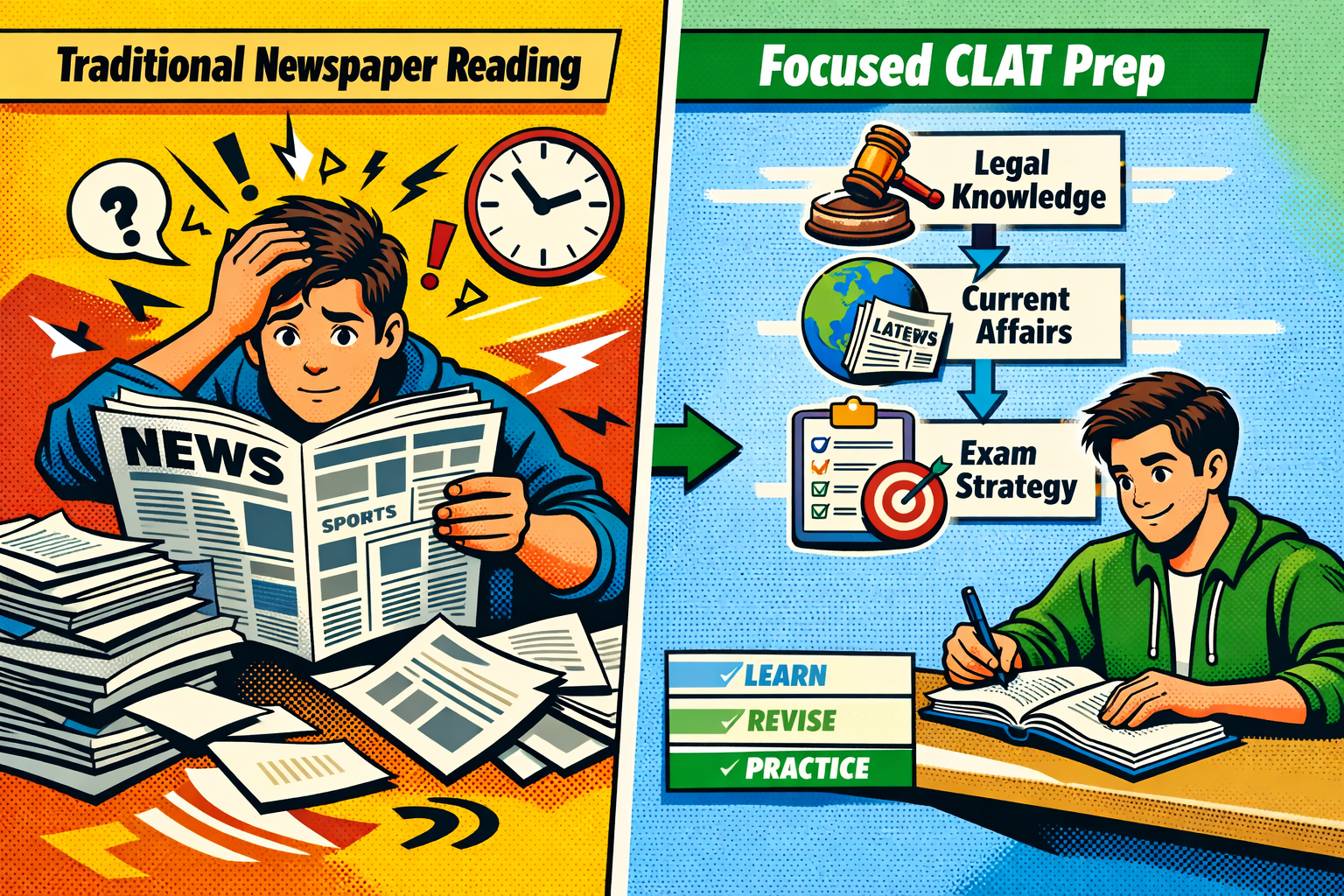
The most successful CLAT candidates don’t rely solely on newspapers. They build comprehensive current affairs systems that newspapers are just one component of.
The Three-Tier Approach
Tier 1 – Daily Awareness (15 minutes):
Quick updates through apps like Inshorts or news aggregators. Just enough to stay aware of breaking developments without deep engagement.
Tier 2 – Weekly Deep Dive (2-3 sessions):
Your strategic newspaper reading sessions as discussed earlier. This is where real learning happens.
Tier 3 – Monthly Consolidation (2-3 hours):
Review monthly compilations, create consolidation sheets, practice current affairs questions, and identify knowledge gaps.
This three-tier system ensures comprehensive coverage without overwhelming daily pressure.
Connecting Current Affairs to Legal Reasoning
Here’s an advanced strategy that separates top scorers from average performers: actively connect current affairs knowledge to legal reasoning practice.
When you read about a Supreme Court judgment in the newspaper, don’t just note the facts. Think about:
- What legal principles were applied?
- How does this relate to constitutional provisions?
- What similar cases have occurred before?
- How might this be tested in a CLAT passage?
This integrated thinking transforms newspaper reading from information collection to analytical skill development.
Many CLAT Legal Reasoning passages are based on contemporary legal issues. Students who’ve engaged deeply with these issues through newspapers have significant advantages in comprehension and analysis.
Practice Makes Permanent
Reading current affairs is useless without testing yourself. Incorporate regular practice:
Weekly quizzes: Test yourself on the week’s major events every Sunday
Monthly mock sections: Attempt GK sections from previous CLAT papers or quality mocks
Peer discussion: Form study groups to discuss and debate current issues
At Lawgic Coaching, we’ve seen students dramatically improve current affairs retention when they combine strategic reading with consistent testing. Your success is our mission, and we’ve helped thousands crack CLAT by emphasizing practice alongside preparation.
Creating a Personal Current Affairs Database
As you progress through your preparation, build a personal database of important information:
- Important personalities: Names, positions, achievements (President, CJI, Nobel laureates, etc.)
- Important dates: National days, international days, historical events
- Books and authors: Especially by Indian authors or about India
- Awards and honors: Padma awards, Nobel prizes, sports achievements
- Abbreviations and acronyms: Constantly updated list
This database becomes invaluable for quick revision in the final weeks before CLAT.
Technology Tools That Enhance Newspaper Reading For CLAT
Smart use of technology can dramatically improve your newspaper reading efficiency and retention.
News Aggregation and Curation Tools
Google Alerts: Set up alerts for CLAT-relevant keywords like “Supreme Court,” “Constitutional amendment,” “India foreign policy,” etc. Get daily emails with relevant news articles without manually searching.
Feedly: RSS feed aggregator that lets you follow specific sections of newspapers (like The Hindu’s editorial page) without reading the entire paper.
Pocket: Save articles for later reading and organize them by tags. Perfect for creating a reading list during your weekly sessions.
Digital Annotation Tools
Hypothesis: Browser extension that lets you highlight and annotate web articles. Great for digital newspaper reading with note-making.
OneNote Web Clipper: Clip entire articles or sections directly into organized notebooks with automatic source links.
Evernote: Similar functionality with excellent search and organization features.
Flashcard Apps for Revision
Anki: Spaced repetition flashcard app perfect for current affairs revision. Create cards for important events, personalities, dates, etc.
Quizlet: User-friendly alternative with pre-made current affairs decks available from other students.
The key is using these tools to enhance, not complicate, your preparation. Start with one or two that address your specific challenges.
Productivity and Focus Tools
Forest: App that helps maintain focus during reading sessions by gamifying concentration.
RescueTime: Tracks how you spend time on devices, helping identify and eliminate distractions during study sessions.
Notion: All-in-one workspace for notes, databases, and organization. Many CLAT toppers swear by Notion for comprehensive current affairs management.
Common Mistakes to Avoid in Newspaper Reading For CLAT
Learning what NOT to do is as important as knowing the right strategies.
Mistake 1: Reading Everything Indiscriminately
The biggest waste of time is reading newspapers cover to cover without filtering. Sports results, entertainment gossip, and local crime reports rarely contribute to CLAT preparation.
Solution: Stick to the prioritized sections outlined earlier. Be ruthless about skipping irrelevant content.
Mistake 2: Passive Reading Without Engagement
Reading newspapers like novels—just letting words flow past your eyes—achieves nothing. Information goes in one eye and out the other.
Solution: Active reading with note-making, questioning, and connecting to existing knowledge. Every important piece of information should be processed, not just consumed.
Mistake 3: Inconsistent Reading Patterns
Reading newspapers intensively for two weeks, then not touching them for a month creates knowledge gaps and poor retention.
Solution: Maintain your weekly schedule consistently. Two focused sessions every single week beat irregular intensive reading.
Mistake 4: Neglecting Revision
Collecting notes without reviewing them is like buying books without reading them. The notes become decorative, not functional.
Solution: Build revision into your system. Weekly reviews of the week’s notes, monthly consolidation, and regular testing.
Mistake 5: Ignoring the Connection to CLAT Question Patterns
Reading current affairs in isolation without understanding how CLAT tests this knowledge leads to poor exam performance despite extensive reading.
Solution: Regularly attempt GK sections from previous CLAT papers and quality mocks. Understand question patterns and adjust your reading focus accordingly.
Mistake 6: Over-Reliance on Shortcuts
Some students try to completely skip newspapers and rely only on compilations or YouTube summaries. This creates superficial knowledge that crumbles under CLAT’s analytical questions.
Solution: Use shortcuts and alternatives as supplements, not replacements. Newspapers provide depth and analytical thinking that compilations can’t match.
Developing Long-Term Skills Beyond CLAT Through Newspaper Reading
Here’s something most coaching institutes won’t tell you: the real value of newspaper reading extends far beyond CLAT.
Building Reading Comprehension Skills
Regular newspaper reading, especially of quality publications like The Hindu, significantly improves your reading speed and comprehension ability. These skills directly benefit CLAT’s English section and passage-based questions across all sections.
The complex sentence structures, varied vocabulary, and analytical writing style in editorials train your brain to process sophisticated text quickly and accurately.
Developing Analytical Thinking
Engaging with editorial opinions, understanding different perspectives on issues, and critically evaluating arguments develops analytical thinking skills essential for law school and legal practice.
When you read opposing editorials on the same issue and form your own reasoned opinion, you’re practicing the kind of critical thinking that makes good lawyers.
Building General Awareness for Law School
CLAT is just the entrance. Law school itself demands broad awareness of current affairs, especially for subjects like Constitutional Law, International Law, and Legal Studies.
Students who’ve built strong current affairs foundations during CLAT preparation find law school discussions and case studies much easier to engage with.
Vocabulary and Language Enhancement
Consistent exposure to quality English writing naturally enhances vocabulary, grammar understanding, and writing skills. These benefits extend to your legal writing in law school and professional practice.
Many successful lawyers attribute their language skills to the newspaper reading habit developed during competitive exam preparation.
Creating Your Personalized Newspaper Reading Plan For CLAT
Generic advice only goes so far. Here’s how to create a personalized plan that works for YOUR specific situation.
Step 1: Honest Self-Assessment
Answer these questions honestly:
- How much time can you realistically dedicate to current affairs weekly?
- Do you prefer physical newspapers or digital reading?
- Are you stronger in retention through reading or through audio/visual content?
- What’s your current level of current affairs knowledge?
- How many months until your CLAT exam?
Your answers determine your specific strategy.
Step 2: Choose Your Primary Resources
Based on your assessment, select:
- Primary newspaper (The Hindu for most students)
- Secondary newspaper (Indian Express or none, depending on time availability)
- Monthly compilation (choose one that fits your budget and style)
- Digital supplements (select 1-2 apps or platforms)
Don’t try to use everything. More resources don’t mean better preparation.
Step 3: Design Your Weekly Schedule
Block specific time slots for:
- 2-3 newspaper reading sessions (90 minutes each)
- Daily quick updates if desired (15 minutes)
- Weekly review and consolidation (30-45 minutes)
- Monthly deep review (2-3 hours)
Write this schedule down and commit to it for at least 4 weeks before making adjustments.
Step 4: Set Up Your Note-Making System
Decide on:
- Physical notebook or digital tool
- Categorization system
- Review and consolidation process
Prepare your system before you start reading. Having a clear system eliminates decision fatigue during actual study time.
Step 5: Build in Accountability and Tracking
Create simple tracking mechanisms:
- Weekly checklist for reading sessions completed
- Monthly score tracking on current affairs practice questions
- Study group or partner for discussion and accountability
What gets measured gets improved. Simple tracking keeps you honest and motivated.
Step 6: Plan for Iteration and Improvement
Your initial plan won’t be perfect. Schedule monthly reviews of your system:
- What’s working well?
- What’s not delivering results?
- What needs adjustment?
Successful CLAT preparation requires flexibility and continuous improvement, not rigid adherence to a flawed plan.
Maintaining Motivation and Consistency in Newspaper Reading
The best strategy fails without consistent execution. Here’s how to maintain motivation for newspaper reading throughout your CLAT preparation journey.
Understanding Your “Why”
Connect newspaper reading to your larger goal. You’re not reading newspapers because some coaching institute said so. You’re building the knowledge and skills needed to crack CLAT and get into your dream NLU.
When motivation wanes, reconnect with your ultimate goal. Visualize yourself at NLSIU Bangalore or NALSAR Hyderabad. That vision fuels consistent action.
The Two-Minute Rule
On days when you absolutely don’t feel like reading, commit to just two minutes. Open the newspaper or app and read for just two minutes.
Usually, starting is the hardest part. Once you begin, you’ll often continue beyond two minutes. And even if you don’t, two minutes is better than zero.
Habit Stacking
Attach newspaper reading to an existing strong habit. For example:
- “After my morning tea, I’ll spend 15 minutes on Inshorts”
- “After dinner on Tuesday and Friday, I’ll do my 90-minute newspaper session”
Piggybacking on established habits makes new habits stick faster.
Celebrating Small Wins
Track and celebrate progress:
- Completed all scheduled reading sessions this week? Acknowledge it.
- Scored well on a current affairs quiz? Celebrate it.
- Successfully explained a complex issue to a friend? That’s a win.
Positive reinforcement strengthens habits better than guilt and pressure.
Finding the Interesting Angle
Current affairs isn’t inherently boring. If you’re finding it tedious, you’re approaching it wrong.
Look for stories that genuinely interest you. Geopolitics fascinating? Focus on international relations coverage. Interested in technology? Pay attention to tech policy and innovation news.
Finding personal interest within current affairs transforms it from obligation to engagement.
Learning From Setbacks
You’ll miss reading sessions. You’ll fall behind. You’ll forget important events. This happens to everyone.
The difference between successful and unsuccessful students isn’t perfection—it’s recovery. When you miss a session, don’t spiral into guilt. Just get back on track with the next scheduled session.
At Lawgic Coaching, we emphasize this resilience mindset. We’ve helped thousands crack CLAT not because they were perfect, but because they knew how to recover from setbacks and maintain forward momentum.
Integrating Newspaper Reading With Overall CLAT Preparation
Current affairs preparation doesn’t exist in isolation. Smart integration with other CLAT sections multiplies effectiveness.
Connecting to Legal Reasoning
As mentioned earlier, many legal reasoning passages draw from contemporary legal issues. Your newspaper reading directly feeds this section.
Create explicit connections:
- When reading about a Supreme Court judgment, think: “How would this be presented as a CLAT passage?”
- Practice summarizing complex legal news in simple language
- Identify the legal principles underlying news stories
This integrated thinking serves double duty—current affairs knowledge AND legal reasoning practice.
Enhancing English Comprehension
The Hindu’s editorials are excellent practice material for CLAT’s English section. The vocabulary level, sentence complexity, and argumentative structure mirror CLAT passages.
Pro strategy: After reading an editorial, practice:
- Summarizing the main argument in one sentence
- Identifying the author’s tone and perspective
- Listing new vocabulary words with context
- Answering comprehension questions you create
This transforms editorial reading from passive consumption to active English practice.
Building Logical Reasoning Skills
Critical analysis of news and opinions develops logical reasoning abilities. When you evaluate arguments in editorials or analyze political developments, you’re practicing logical thinking.
Explicitly practice:
- Identifying assumptions in news articles
- Spotting logical fallacies in opinion pieces
- Drawing inferences from reported facts
- Evaluating the strength of evidence presented
These skills directly transfer to CLAT’s Logical Reasoning section.
Time-Sharing Strategies
Efficient students find ways to serve multiple preparation goals simultaneously. Newspaper reading offers this opportunity.
For example:
- Read The Hindu editorials aloud to practice reading speed and pronunciation (English benefit)
- Create logical reasoning questions based on news stories (LR practice)
- Write brief analytical summaries of complex issues (writing practice for law school)
This integrated approach maximizes ROI on time invested in newspaper reading.
Special Strategies For Different CLAT Preparation Timelines
Your newspaper reading strategy should adapt based on how much time you have until CLAT.
For Students With 12+ Months
You have the luxury of building comprehensive knowledge gradually.
Strategy:
- Start with 1-2 newspaper sessions weekly to build the habit
- Gradually increase to 2-3 sessions as comfort grows
- Experiment with different resources and find what works best
- Build extensive notes and databases
- Focus on understanding depth, not just coverage
Don’t rush. Use this time to develop genuine interest and understanding in current affairs, not just exam-oriented cramming.
For Students With 6-12 Months
This is the sweet spot for implementing the full strategic approach outlined in this guide.
Strategy:
- Implement the 2-3 weekly newspaper sessions immediately
- Combine with monthly compilations for comprehensive coverage
- Build robust note-making and revision systems
- Regular testing and practice questions
- Balance depth and breadth
This timeline allows building strong foundations while maintaining exam focus.
For Students With 3-6 Months
Time pressure increases. Strategy must become more selective.
Strategy:
- Focus on one primary newspaper (The Hindu) with 2 weekly sessions
- Rely more heavily on monthly compilations for breadth
- Prioritize revision and testing over extensive new reading
- Focus on high-yield topics and recurring themes
- Use digital tools for efficiency
Quality over quantity becomes even more critical with limited time.
For Students With Less Than 3 Months
Crisis mode requires maximum efficiency.
Strategy:
- Reduce newspaper reading to 1 focused weekly session
- Rely primarily on monthly compilations and revision materials
- Focus exclusively on previous 6 months’ major events
- Intensive practice questions and mock tests
- Use shortcuts like Inshorts for daily updates
At this stage, strategic topic selection matters more than comprehensive coverage. Focus on high-probability areas based on previous CLAT patterns.
Sample Weekly Schedule: Newspaper Reading For CLAT
Here’s a concrete example of how to structure your week with the strategic approach:
Monday:
- Morning: 15-minute Inshorts update during breakfast
- Evening: No dedicated newspaper time
Tuesday:
- Evening: 90-minute newspaper session (Weekend + Monday/Tuesday papers)
- The Hindu: Editorial page, National news, International news, Legal section
- Quick scan of Indian Express editorials
- Note-making in categorized notebook
- 5-minute review of notes taken
Wednesday:
- Morning: 15-minute Inshorts update
- Evening: No dedicated newspaper time
Thursday:
- Morning: 15-minute Inshorts update
- Evening: No dedicated newspaper time
Friday:
- Evening: 90-minute newspaper session (Wednesday-Friday papers)
- Same structure as Tuesday
- Focus on developing stories and new events
- Cross-reference with Tuesday’s notes for ongoing issues
Saturday:
- Morning: 15-minute Inshorts update
- Afternoon: 30-minute review of the week’s notes
- Highlight key points
- Create connections between related events
- Add to monthly consolidation sheet
Sunday:
- Morning: Monthly compilation reading (1-2 hours)
- Evening: Current affairs quiz/practice questions (30 minutes)
Total time investment: Approximately 5-6 hours weekly for comprehensive current affairs preparation, with only 3 hours in actual newspaper reading.
This schedule is flexible. Adjust days and times based on your school, coaching, and personal commitments. The principle remains: focused, scheduled sessions beat random daily attempts.
Measuring Progress and Adjusting Strategy
You can’t improve what you don’t measure. Here’s how to track your newspaper reading effectiveness.
Quantitative Metrics
Weekly completion rate: Did you complete your scheduled newspaper sessions? Track percentage completion monthly.
Practice test scores: Monthly tracking of current affairs section scores in mock tests. Look for upward trends.
Note volume: Pages of notes created monthly. This should stabilize after initial months, not keep growing indefinitely.
Revision frequency: How many times did you review each month’s notes? Aim for at least 2-3 reviews before the exam.
Qualitative Indicators
Comprehension depth: Can you explain major issues in your own words, or just regurgitate facts?
Connection ability: Can you connect related events across time and categories?
Question anticipation: When reading news, can you predict how it might be tested in CLAT?
Discussion confidence: Can you discuss current issues intelligently with peers or family?
These qualitative indicators often matter more than quantitative metrics for actual exam performance.
Monthly Review Process
At the end of each month, spend 30 minutes reviewing:
What worked well:
- Which resources provided best value?
- Which note-making techniques helped retention?
- Which topics did you master?
What needs improvement:
- Where are knowledge gaps?
- Which habits aren’t sticking?
- What’s consuming time without delivering results?
Adjustments for next month:
- What specific changes will you make?
- What will you stop doing?
- What will you start doing?
This iterative improvement process ensures your strategy evolves with your preparation journey.
Getting Expert Feedback
Sometimes you need external perspective on your preparation strategy. Quality coaching provides this.
At Lawgic Coaching, our mentors from top NLUs review students’ current affairs preparation strategies and provide personalized guidance. We’ve helped thousands crack CLAT with proven strategies that actually work, not generic advice that sounds good but delivers poor results.
Expert guidance from those who’ve been there can save months of trial and error. Real mentors from top NLUs understand exactly what works because they’ve done it themselves.
Frequently Asked Questions About Newspaper Reading For CLAT
Q: Is it really possible to prepare CLAT current affairs without reading newspapers daily?
Absolutely. The strategic weekly approach outlined in this guide has been successfully used by numerous CLAT toppers. What matters is quality of engagement, not daily frequency. Focused weekly sessions with proper note-making and revision often deliver better results than unfocused daily skimming.
Q: Which is better for CLAT—The Hindu or Indian Express?
The Hindu is generally considered superior for CLAT due to its editorial depth, comprehensive legal coverage, and language quality that helps with English preparation. However, Indian Express offers excellent complementary coverage, especially for political analysis. Ideally, use The Hindu as primary and Indian Express as secondary resource.
Q: How far back should I read newspapers for CLAT 2026?
Focus primarily on the previous 12 months from your exam date. Occasionally, questions come from earlier events, but the bulk of current affairs questions draw from the most recent year. For CLAT 2026, concentrate on January 2025 onwards, with awareness of major 2024 events.
Q: Can I rely completely on monthly compilations instead of newspapers?
Not recommended. Monthly compilations provide excellent breadth and revision material, but they lack the depth and analytical perspective that quality newspapers offer. Compilations work best as supplements to newspaper reading, not replacements. The combination delivers optimal results.
Q: How should I prepare current affairs in the last month before CLAT?
In the final month, shift from extensive reading to intensive revision. Focus on your existing notes and monthly consolidation sheets. Use compilations for quick review of major events. Practice current affairs questions extensively. Reduce new newspaper reading to once weekly for very recent events only.
Q: Do I need to remember exact dates for CLAT current affairs?
Not usually. CLAT rarely tests exact dates except for very major events. Focus on understanding what happened, why it’s important, and how it connects to other developments. Month and year are usually sufficient for most events. Exact dates matter for constitutional amendments, major international days, and landmark judgments.
Q: How can I improve retention from newspaper reading?
Active engagement is key. Take notes while reading, don’t just read passively. Categorize information immediately. Review notes within 24 hours of taking them. Create connections between related events. Test yourself regularly through quizzes. Discuss current affairs with peers. Spaced repetition through monthly reviews. All these techniques dramatically improve retention.
Q: Should I read newspapers in English or my regional language for CLAT?
English newspapers are strongly recommended for CLAT preparation. They help with English language skills needed for the exam while building current affairs knowledge. Regional newspapers can supplement for state-specific awareness but shouldn’t be your primary resource.
Q: How do I stay motivated to read newspapers consistently?
Connect newspaper reading to your larger CLAT goal. Use habit stacking by attaching reading to existing routines. Find topics that genuinely interest you. Track progress and celebrate small wins. Study with peers for accountability. Remember that consistency, not perfection, is the goal. Missing occasional sessions is normal; just get back on track.
Q: Are digital newspapers as effective as physical newspapers for CLAT preparation?
Both work well; choose based on your learning style and practical constraints. Physical newspapers may offer better retention for some students and reduce screen time. Digital newspapers provide searchability, easy archiving, and accessibility anywhere. Many successful students use a hybrid approach—digital for reading, physical notes for retention.
Conclusion: Your Path to CLAT Current Affairs Mastery
Let’s bring it all together.
You don’t need to read newspapers daily to excel at CLAT current affairs. That’s the liberating truth this guide has demonstrated through strategic approaches, alternative resources, and proven techniques.
What you need is a smart, sustainable system that fits your actual life and learning style.
The core principles to remember:
Strategic weekly newspaper reading with focused 90-minute sessions beats unfocused daily attempts. Quality engagement with fewer newspapers delivers better results than superficial scanning of multiple sources.
Effective note-making and regular revision matter more than reading volume. Information you process and review becomes knowledge; information you just read disappears.
Integration with other CLAT sections multiplies effectiveness. Newspaper reading that enhances legal reasoning, English comprehension, and logical thinking serves multiple preparation goals simultaneously.
Technology and alternative resources complement newspapers beautifully. Monthly compilations, news apps, and digital tools reduce time pressure while maintaining comprehensive coverage.
Consistency trumps intensity. Two focused sessions every week for six months beats irregular intensive reading. Build sustainable habits, not unsustainable bursts of effort.
Your action steps starting today:
- Choose your primary newspaper (The Hindu for most students)
- Block two specific weekly time slots for 90-minute reading sessions
- Set up your note-making system (physical or digital)
- Select one monthly compilation and 1-2 digital supplements
- Create your monthly review and consolidation process
- Start this week, not next week
The difference between CLAT success and disappointment often comes down to execution, not knowledge of strategies. You now have the complete blueprint for newspaper reading that works without daily pressure.
The question is: will you implement it?
At Lawgic Coaching, we believe law school dreams shouldn’t be complicated or expensive. We’ve helped thousands crack CLAT with flexible learning that fits your life and proven strategies that actually work. Your success is our mission.
Whether you choose to prepare independently or with expert guidance, the strategic approach outlined in this guide will serve you well. Newspaper reading for CLAT doesn’t have to be a daily burden. Make it a focused, strategic component of comprehensive preparation, and watch your current affairs knowledge—and confidence—grow steadily toward exam day.
Your dream NLU is within reach. Smart preparation, not just hard work, gets you there.
Start your strategic newspaper reading journey today. Your future lawyer self will thank you.
Weekly Newspaper Reading Tracker
Track your strategic CLAT newspaper reading sessions
Consistency beats intensity. Keep going!

