{"cover":"Professional landscape format (1536×1024) editorial hero image featuring bold centered text overlay 'CLAT 2027 Validity Testing: Assessing Invalid Arguments in Critical Passages' in extra large 72pt white sans-serif font with subtle dark shadow for depth. Background shows split composition: left side displays critical thinking concept with magnifying glass examining legal document with highlighted fallacies and crossed-out invalid premises, right side shows confident Indian law student analyzing passage with pen marking logical flaws. Color scheme: deep navy blue, gold accents, crisp white text. High contrast magazine cover quality with professional lighting, sharp focus on analytical elements, modern educational aesthetic representing logical reasoning mastery for CLAT aspirants.","content":["Detailed landscape format (1536×1024) image showing comprehensive validity testing framework diagram with central flowchart displaying premise evaluation process. Visual elements include: checkboxes for valid/invalid arguments, magnifying glass icons highlighting logical fallacies, color-coded boxes (green for sound arguments, red for flawed reasoning), arrows connecting premises to conclusions. Background features subtle CLAT exam paper texture with sample critical reasoning passages. Annotations showing common validity errors: hasty generalization, false cause, circular reasoning. Professional infographic style with clean typography, educational color palette of teal, coral, and charcoal gray, optimized for student comprehension and quick reference during CLAT preparation.","Landscape format (1536×1024) visual representation of argument flaw identification techniques showing split-screen comparison. Left panel displays passage excerpt with highlighted premises in yellow and conclusion in blue, with red strike-through marks on invalid logical jumps. Right panel shows evaluation checklist with checkmarks and X marks: evidence sufficiency, premise relevance, causal relationship validity, assumption identification. Include visual icons: broken chain for logical gaps, question mark for unsupported claims, shield for strong evidence. Background features stack of CLAT previous year question papers from 2021-2025. Modern educational design with clean sans-serif typography, professional color scheme of navy, burgundy, and cream, optimized for teaching logical reasoning skills.","Detailed landscape format (1536×1024) practice exercise visualization showing interactive validity testing workout. Central focus on sample CLAT critical passage with numbered premises (1-4) and conclusion marked clearly. Surrounding the passage are four analytical boxes showing: premise evaluation matrix, evidence strength meter (weak to strong gradient), logical connection assessment, and common fallacy detector with icons for ad hominem, straw man, false dichotomy. Include student hand holding highlighter marking text, sticky notes with validity questions, and score tracker showing improvement graph. Professional study guide aesthetic with warm lighting, organized layout, color coding system using purple, orange, and forest green, designed to simulate actual CLAT exam preparation environment with motivational and practical learning focus."]"}
You know what separates top scorers from average performers in CLAT? It's not just reading comprehension or vocabulary. It's the ability to spot flawed reasoning in a passage within seconds.
Here's the thing. The CLAT 2027 exam, scheduled for December 6, 2026, will test your critical thinking through passages that deliberately contain invalid arguments[1]. The Consortium of NLUs has made it clear through their Expert Committee review that question quality and modern analytical standards are priorities[2][5]. This means you'll face sophisticated passages where conclusions don't always follow from premises, where evidence gets twisted, and where logical fallacies hide in plain sight.
CLAT 2027 Validity Testing: Assessing Invalid Arguments in Critical Passages isn't just another skill to master. It's the foundation of legal reasoning itself. And with 25% of your exam dedicated to Legal Reasoning and 20% to Logical Reasoning[2], your ability to assess argument validity directly impacts 54 out of 120 questions.
Let's be honest. Most aspirants can identify obvious flaws. But CLAT doesn't test the obvious. It tests your ability to evaluate subtle premise shifts, recognize when evidence doesn't support conclusions, and spot assumptions masquerading as facts.
Key Takeaways
- Validity testing examines logical structure: An argument can have true premises but still be invalid if the conclusion doesn't logically follow, a distinction that appears in 40-50% of CLAT reasoning questions
- Premise evaluation is systematic: Using structured checklists to assess relevance, sufficiency, and connection strength helps identify flawed reasoning in under 90 seconds per passage
- Pattern recognition accelerates accuracy: CLAT 2021-2025 papers reveal recurring fallacy types (hasty generalization, false cause, circular reasoning) that appear in predictable contexts
- Evidence changes invalidate arguments: Understanding how altered or additional evidence impacts argument strength is crucial for the 15-20 inference-based questions in each CLAT paper
- Practice with real examples builds instinct: Working through previous year passages with validity checklists transforms theoretical knowledge into exam-ready analytical reflexes
Understanding Argument Validity in CLAT Context
Validity isn't about truth. That's the first misconception to clear.
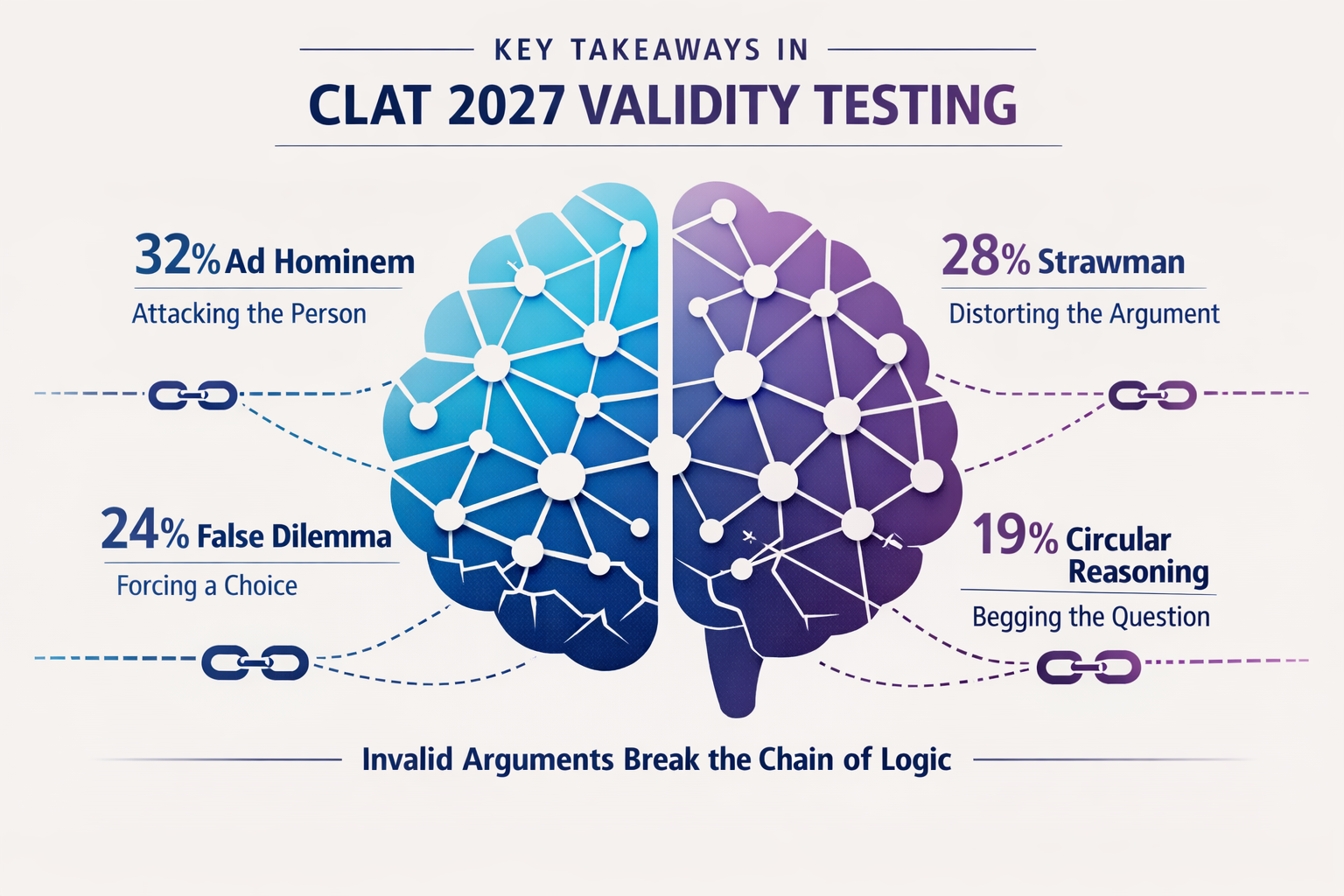
An argument is valid when its conclusion logically follows from its premises, regardless of whether those premises are actually true. CLAT tests this distinction relentlessly because legal reasoning demands it. You'll encounter passages where every fact presented is accurate, yet the conclusion drawn is completely invalid.
Consider this structure from CLAT 2023: "All successful lawyers have excellent communication skills. Rajesh has excellent communication skills. Therefore, Rajesh will be a successful lawyer." The premises might be true, but the conclusion doesn't necessarily follow. This is a classic case of affirming the consequent, a logical fallacy that invalidates the argument structure.
The Three Pillars of Validity Testing
Premise Evaluation comes first. You need to identify what claims the passage presents as foundational truths. Are these premises:
- Clearly stated or hidden assumptions?
- Supported by evidence or presented as given?
- Relevant to the conclusion being drawn?
- Sufficient to support the weight of the conclusion?
Logical Connection Assessment follows. This examines whether the reasoning pathway from premises to conclusion holds water. Does the author make logical jumps? Are there missing steps in the reasoning chain? Do alternative explanations exist that the passage ignores?
Evidence Scrutiny completes the framework. CLAT passages often include data, statistics, expert opinions, or case examples. Your job is determining whether this evidence actually strengthens the argument or just creates an illusion of support.
The CLAT 2027 exam syllabus emphasizes critical evaluation of arguments, making this skill non-negotiable for serious aspirants.
How CLAT 2027 Validity Testing Differs From Basic Logic
Basic logic courses teach you formal validity through symbolic representation. CLAT doesn't care about symbols. It tests applied validity through real-world legal, social, and political contexts.
You won't see "If P then Q" statements. Instead, you'll read about judicial precedents, policy decisions, or social phenomena, then answer questions about whether the conclusions drawn are valid based on the information provided.
This contextual validity testing requires:
- Domain awareness: Understanding legal principles, current affairs, and social dynamics helps you spot when arguments violate established norms
- Speed reading with purpose: You have roughly 60 seconds per question, meaning validity assessment must become instinctive
- Elimination through invalidity: Often, identifying which answer choices present invalid reasoning is faster than finding the perfectly valid one
The marking scheme awards +1 for correct answers but deducts 0.25 for wrong ones[1][2]. This penalty structure makes validity testing even more crucial because guessing on questions where you can't assess argument validity costs you points.
CLAT 2027 Validity Testing: Recognizing Common Logical Fallacies
Let's talk about the fallacies that show up repeatedly in CLAT papers. These aren't academic exercises. They're point-scoring opportunities disguised as tricky passages.
Hasty Generalization in Legal Contexts
This fallacy draws broad conclusions from insufficient evidence. CLAT 2022 featured a passage about judicial appointments where the author concluded that "the entire appointment system is flawed" based on three controversial cases. The sample size was too small to support such a sweeping claim.
Spotting technique: Look for quantifiers like "all," "every," "always," or "never" paired with limited supporting evidence. Ask yourself: "Does the evidence presented justify this broad claim?"
In legal reasoning passages, hasty generalization often appears when:
- Court decisions are generalized from single precedents
- Social policies are judged based on isolated incidents
- Trends are declared based on short-term data
Your evaluation checklist should include:
✅ Sample size adequate for the claim?
✅ Evidence representative of the broader population?
✅ Alternative explanations considered?
✅ Exceptions acknowledged?
False Cause Fallacies
Just because Event A happened before Event B doesn't mean A caused B. CLAT loves testing this through passages about policy impacts and social changes.
CLAT 2024 included a passage arguing that increased legal education enrollment caused rising litigation rates. The passage ignored multiple confounding variables: greater legal awareness, economic development, and improved access to courts. The correlation existed, but the causal claim was invalid.
Red flags for false cause reasoning:
- "This led to" without establishing mechanism
- Temporal sequence presented as causal relationship
- Ignoring alternative explanations
- Confusing correlation with causation
The best approach? When you see causal claims, immediately ask: "What else could explain this outcome?" If the passage doesn't address obvious alternatives, the argument likely contains a false cause fallacy.
Circular Reasoning and Question-Begging
This sneaky fallacy uses the conclusion as a premise. It's particularly common in passages about legal principles and rights.
Example from CLAT 2021: "Freedom of speech is fundamental because it's a basic right, and basic rights are fundamental." The argument goes in circles without providing independent justification.
Detection strategy:
- Identify the main conclusion
- Examine each premise
- Check if any premise is just a restatement of the conclusion
- Look for genuine supporting evidence versus circular definitions
Circular reasoning often hides behind sophisticated language and complex sentence structures. Don't let verbose passages fool you. Strip the argument down to its core structure.
Ad Hominem and Straw Man Tactics
Ad hominem attacks the person making an argument rather than addressing the argument itself. Straw man misrepresents an opponent's position to make it easier to attack.
CLAT passages testing these fallacies typically involve debates, dissenting opinions, or policy disagreements. A 2023 passage about environmental regulations featured a politician dismissing an expert's recommendations by highlighting the expert's past political affiliations rather than addressing the scientific merit of the proposals.
Validity test questions:
- Does the passage address the argument or the arguer?
- Is the opposing view accurately represented?
- Are personal characteristics presented as relevant to argument validity?
- Does the rebuttal engage with the actual claims made?
Understanding these patterns helps you navigate the logical reasoning challenges that distinguish CLAT from other entrance exams.
Systematic Approach to CLAT 2027 Validity Testing: Assessing Invalid Arguments
Theory only gets you so far. You need a repeatable system that works under exam pressure.
The 90-Second Validity Assessment Framework
Step 1: Conclusion Identification (15 seconds)
Find what the passage wants you to believe. Usually, it's in the opening or closing sentences, but CLAT sometimes buries it mid-passage. Underline it.
Step 2: Premise Mapping (30 seconds)
Identify every claim presented as support for that conclusion. Number them mentally or with quick margin marks. Distinguish between:
- Main premises (directly support conclusion)
- Sub-premises (support main premises)
- Background information (provides context but doesn't support)
Step 3: Logical Connection Testing (25 seconds)
For each premise, ask: "If this is true, does it make the conclusion more likely?" If yes, the connection holds. If no, you've found a validity gap.
Use this quick mental test: "Even if all premises are true, could the conclusion still be false?" If yes, the argument is invalid.
Step 4: Evidence Evaluation (20 seconds)
Check whether data, examples, or expert opinions actually strengthen the argument or just create an appearance of support. Look for:
- Relevant evidence (connects to the specific claim)
- Sufficient evidence (adequate to support the conclusion's scope)
- Reliable evidence (from credible sources or sound methodology)
This framework isn't rigid. With practice, these steps become simultaneous rather than sequential. Your success is our mission, and this systematic approach is how we've helped thousands crack CLAT.
The Validity Checklist for Critical Passages
Print this checklist and use it during practice until it becomes automatic:
Premise Quality
- Are all premises clearly stated?
- Are hidden assumptions identified?
- Do premises contradict each other?
- Are premises relevant to the conclusion?
Logical Structure
- Does the conclusion logically follow?
- Are there logical gaps or jumps?
- Could the premises be true but conclusion false?
- Does the argument commit known fallacies?
Evidence Assessment
- Is evidence sufficient for the claim's scope?
- Are sources credible and relevant?
- Are alternative explanations considered?
- Does evidence actually support the specific conclusion?
Scope and Limitations
- Does the conclusion overreach the evidence?
- Are qualifiers (some, many, most) used appropriately?
- Are exceptions acknowledged?
- Is the argument's scope clearly defined?
This checklist transforms vague "something seems wrong" feelings into precise validity assessments. It's the difference between guessing and knowing.
Handling Premise Changes and Evidence Modifications
CLAT loves asking: "Which of the following, if true, would most weaken/strengthen the argument?" These questions directly test your understanding of how additional information affects validity.
Strengthening scenarios add:
- Evidence that closes logical gaps
- Support for unstated assumptions
- Data that increases sample size or representativeness
- Expert consensus that validates causal claims
Weakening scenarios introduce:
- Alternative explanations for observed phenomena
- Counter-examples to universal claims
- Evidence of confounding variables
- Data showing correlation without causation
Practice this with real examples. Take any CLAT passage and ask yourself: "What single piece of information would completely invalidate this argument?" Then: "What would make it bulletproof?"
The CLAT 2027 booklist includes resources specifically designed for validity testing practice, but nothing beats working through actual previous year papers with this systematic approach.
Practical Exercises for Mastering Validity Testing
Knowledge without application is just trivia. Let's put these concepts to work.
Exercise Set 1: Fallacy Identification Drills
Passage A: "The Supreme Court's recent judgment on environmental protection was delivered by a bench of three judges. All three judges have previously shown concern for environmental issues in their judgments. Therefore, this judgment must be correct and should be implemented without debate."
Your task: Identify the fallacy and explain why the argument is invalid.
Analysis: This commits an appeal to authority fallacy combined with hasty generalization. The judges' past concerns don't automatically validate the current judgment's legal reasoning. Correctness in law depends on constitutional interpretation, precedent, and legal principles, not the predispositions of the bench.
Passage B: "After the government implemented the new education policy, literacy rates increased by 3%. This proves that the new policy is effective and should be continued."
Your task: What validity issues exist here?
Analysis: Multiple problems: false cause (post hoc ergo propter hoc), insufficient timeframe, no control for confounding variables (economic growth, NGO initiatives, demographic changes), and hasty generalization from a single metric.
Exercise Set 2: Premise Evaluation Practice
Passage C: "Legal education in India needs reform. Many law graduates struggle to find employment. Corporate law firms prefer candidates from top NLUs. Therefore, we should close down all non-NLU law schools."
Your task: Evaluate each premise and the logical connection to the conclusion.
Premise 1: "Legal education needs reform" – This is a value judgment that requires supporting evidence about what's wrong and what reform means.
Premise 2: "Many law graduates struggle to find employment" – This could be true but needs context. How many is "many"? What's the unemployment rate compared to other fields?
Premise 3: "Corporate law firms prefer top NLU candidates" – Likely true but limited scope. Corporate law firms aren't the only employment avenue for lawyers.
Logical connection: The conclusion is a massive overreach. The premises don't support such a drastic measure. Alternative solutions (improving non-NLU education quality, diversifying career paths, addressing market saturation) aren't considered.
Validity assessment: Invalid argument. The conclusion doesn't follow from the premises, and the premises themselves need strengthening.
Exercise Set 3: Real CLAT Pattern Questions
Passage D (Based on CLAT 2022 pattern): "Studies show that students who participate in moot court competitions perform better in legal reasoning sections of entrance exams. Rajiv participated in three moot courts during his college years. Therefore, Rajiv will definitely score high in the CLAT legal reasoning section."
Question: Which of the following, if true, most weakens the argument?
A) Moot court participation improves public speaking skills
B) The correlation between moot courts and exam performance is 0.3, indicating weak association
C) Rajiv also reads extensively on legal topics
D) Many successful lawyers participated in moot courts during their education
Answer: B. This directly challenges the strength of the relationship that the argument depends on. A weak correlation (0.3) means moot court participation explains only a small portion of exam performance variance, invalidating the "definitely score high" conclusion.
Passage E: "The legal profession is becoming increasingly competitive. Five years ago, there were 100 applicants for every corporate law position. Today, there are 150 applicants for the same positions. This trend will continue, and by 2030, there will be 300 applicants per position."
Question: The argument's validity depends on which unstated assumption?
A) Corporate law is the most lucrative legal career path
B) The rate of increase in applicants will remain constant
C) Law school enrollments are increasing
D) Economic conditions will remain stable
Answer: B. The projection assumes linear growth at the current rate. Without this assumption, the 2030 prediction has no basis.
These exercises mirror actual CLAT patterns. The more you practice with this analytical framework, the faster your validity assessment becomes.
Building Your Validity Testing Workout Routine
Consistent practice beats cramming. Here's your weekly workout:
Monday & Thursday: 10 passages with fallacy identification (30 minutes each session)
Tuesday & Friday: 15 premise evaluation exercises (25 minutes each)
Wednesday: 20 "strengthen/weaken" questions (40 minutes)
Saturday: Full-length mock section with 25 critical reasoning questions (45 minutes)
Sunday: Review all mistakes from the week, identify patterns in your errors
Track your accuracy and speed. You should see measurable improvement within three weeks if you're following this consistently.
The best free resources for CLAT 2027 include validity testing practice materials, but structured coaching provides the personalized feedback that accelerates improvement.
Advanced Validity Testing Strategies for Top Scores
You've mastered the basics. Now let's talk about the techniques that separate AIR 50 from AIR 500.
Pattern Recognition Across Question Types
CLAT doesn't create entirely new question types each year. It recombines familiar patterns in new contexts. Once you've solved 200+ validity testing questions, you'll notice:
The "Scope Shift" Pattern: Premises discuss a specific subset (e.g., "corporate lawyers in metropolitan cities") but the conclusion generalizes to all lawyers. This appears in 15-20% of critical reasoning questions.
The "Temporal Fallacy" Pattern: Evidence from one time period used to draw conclusions about a different period without establishing continuity. Common in current affairs-based passages.
The "Authority Misuse" Pattern: Expert opinion in one domain used to validate claims in an unrelated domain. A constitutional law expert's views on economic policy, for instance.
The "False Dichotomy" Pattern: Presenting two options as exhaustive when other alternatives exist. "Either we implement strict regulations or businesses will destroy the environment" ignores moderate regulatory approaches.
Recognizing these patterns lets you anticipate validity issues before fully processing the passage. It's like pattern recognition in chess – grandmasters see the position and instantly know the threats because they've seen similar structures hundreds of times.
Speed Reading for Validity Assessment
Traditional speed reading advice doesn't work for validity testing. You can't skim premises and expect to catch logical flaws.
Instead, practice targeted reading:
- First pass (20 seconds): Identify the conclusion and main claim
- Second pass (30 seconds): Map the logical structure and premises
- Third pass (20 seconds): Evaluate connections and spot weaknesses
This structured approach is faster than reading linearly because you're looking for specific elements each time, not trying to absorb everything at once.
Annotation strategy: Develop a personal shorthand system:
- C = Conclusion
- P1, P2, P3 = Premises
- ? = Questionable claim
- ✗ = Logical gap
- → = Causal claim (check for validity)
These quick marks create a visual map of the argument's structure, making validity assessment almost instantaneous.
Integrating Validity Testing With Other CLAT Skills
Validity testing doesn't exist in isolation. The best scorers integrate it with:
Current Affairs Knowledge: Understanding real-world context helps you spot when arguments ignore relevant information. If a passage about judicial reforms doesn't mention recent Supreme Court judgments on the topic, that's a red flag.
Legal Principles: Familiarity with basic legal concepts helps you identify when arguments violate established legal reasoning. The CLAT exam pattern emphasizes this integration.
Quantitative Reasoning: Statistical claims in passages require basic numeracy to evaluate. "Crime rates decreased by 50%" sounds impressive until you realize the baseline was only 10 incidents.
This integrated approach is what we emphasize at Lawgic Coaching. Real mentors from top NLUs don't teach skills in silos. They show you how everything connects, because that's how CLAT tests you.
Common Mistakes Even Good Students Make
Mistake 1: Confusing validity with truth
Students often reject arguments with true premises, not realizing the logical structure is what matters. An argument can have all true premises and a true conclusion but still be invalid if the conclusion doesn't follow logically.
Mistake 2: Overthinking simple passages
Not every passage contains sophisticated fallacies. Sometimes the invalidity is straightforward: missing evidence, scope overreach, or simple non sequitur. Don't create complexity where none exists.
Mistake 3: Ignoring answer choice language
CLAT answer choices use precise language. "Must be true" requires certainty. "Could be true" requires mere possibility. "Most weakens" requires comparison. Missing these distinctions costs points.
Mistake 4: Failing to eliminate systematically
Even if you can't identify the correct answer immediately, eliminating clearly invalid options increases your odds. With the 0.25 negative marking[1][2], educated elimination is better than random guessing.
Mistake 5: Not practicing under time pressure
Validity assessment feels different when you have unlimited time versus 60 seconds per question. Timed practice is non-negotiable.
Conclusion
CLAT 2027 Validity Testing: Assessing Invalid Arguments in Critical Passages isn't just an exam skill. It's the foundation of legal thinking that will serve you throughout law school and your career.
But here's what matters right now: mastering this skill is completely within your reach. You don't need to be a logic genius. You need a systematic approach, consistent practice, and the right guidance.
Start with the 90-second validity assessment framework. Use the evaluation checklist until it becomes automatic. Practice with real CLAT passages from 2021-2025, focusing on the recurring fallacy patterns. Build your weekly workout routine and stick to it.
Track your progress. You should see accuracy improvements within three weeks and speed improvements within six weeks. If you're not seeing progress, you're either practicing without feedback or using the wrong materials.
Your success is our mission at Lawgic Coaching. We've helped thousands crack CLAT with proven strategies that actually work, and validity testing is a cornerstone of our curriculum. Our expert guidance without the premium price tag means you get real mentors from top NLUs who understand exactly how to teach this skill because they've mastered it themselves.
The CLAT 2027 registration window opens August 1, 2026[1][2]. That gives you months to transform validity testing from a weakness into a strength. But only if you start with the right approach today.
Don't wait for the perfect moment. Start with one exercise set from this guide. Work through it systematically. Then do another tomorrow. And another the day after.
Because here's the truth: the students who score in the top 100 aren't necessarily smarter than you. They just practiced validity testing until it became instinct. And now you have the same framework they used.
Let's build your law career together. Your CLAT success starts with mastering the fundamentals, and validity testing is as fundamental as it gets.
Ready to take your preparation to the next level? Explore our complete CLAT preparation resources and discover how personalized attention you deserve can transform your CLAT journey. Results speak louder than promises, and our track record proves that accessible education for serious aspirants works.
References
[1] Clat 2027 – https://www.bmu.edu.in/social/clat-2027/
[2] 2027 Details – https://www.lawpreptutorial.com/blog/clat/2027-details/
[5] Clat 2027 Notification Update 3 Things You Must Not Miss – https://law.careers360.com/articles/clat-2027-notification-update-3-things-you-must-not-miss

