Master CLAT Blood Relation Questions: Your Complete 2025 Guide to Relationship Reasoning
Picture this: You’re sitting in the CLAT exam hall, and a question asks you to figure out how A is related to Z through a chain of six different people. Your heart races. But here’s the thing. Blood relation questions in CLAT aren’t designed to trick you. They’re testing something far more valuable for your legal career: your ability to process complex information, identify patterns, and reach logical conclusions.
CLAT Blood Relation Questions form a crucial component of the logical reasoning section, and they’re actually more predictable than you might think. Once you understand the underlying patterns and develop a systematic approach, these questions become scoring opportunities rather than time drains.
Let’s be honest. Most students either love blood relation questions or dread them completely. The difference? Those who love them have cracked the code. They’ve learned to see these puzzles not as confusing word problems but as structured logical challenges with clear solving methods.
Key Takeaways
- Blood relation questions test logical deduction and relationship mapping skills essential for legal reasoning
- Two main question types appear in CLAT: direct relationship questions and coded symbol problems
- Family tree diagramming provides the most reliable solving strategy for complex relationship puzzles
- Understanding gender-neutral language and avoiding assumptions prevents common mistakes
- Regular practice with diverse question patterns builds speed and accuracy for exam day
Understanding Blood Relations Reasoning in CLAT
Blood relations reasoning evaluates your ability to decode family relationships and determine how different people connect within a family structure. Think of it as genealogy mapping meets logical deduction.
The CLAT logical reasoning section includes blood relation questions because they mirror the kind of analytical thinking you’ll need in law school and legal practice. When you’re analyzing case precedents or tracing property inheritance disputes, you’re essentially doing the same thing: following chains of relationships to reach accurate conclusions.
Why Blood Relations Matter for CLAT Success
Here’s what makes blood relations valuable for your CLAT preparation. These questions test multiple cognitive skills simultaneously:
Pattern Recognition: You identify how relationships connect and form patterns within family structures.
Logical Deduction: You draw conclusions based on given information without making unsupported assumptions.
Information Processing: You manage multiple pieces of relationship data and organize them coherently.
Attention to Detail: You notice subtle language cues that determine exact relationships.
These aren’t just exam skills. They’re the same analytical abilities you’ll use when reviewing contracts, analyzing case law, or building legal arguments. That’s why CLAT includes them.
The Scope of Blood Relation Questions in CLAT 2025
Blood relations typically appear as part of the broader logical reasoning section in CLAT. While the exact number varies each year, you can expect 3-5 questions testing relationship reasoning in various formats.
The difficulty level ranges from straightforward direct questions to complex multi-step coded relationship problems. Recent CLAT papers have shown a trend toward more application-based questions that combine blood relations with other logical reasoning concepts.
Understanding this scope helps you allocate appropriate preparation time. Blood relations deserve focused practice, but they shouldn’t dominate your entire logical reasoning preparation strategy.
Types of CLAT Blood Relation Questions You’ll Encounter
Not all blood relation questions follow the same format. Recognizing the different types helps you apply the right solving strategy immediately.
Direct Relationship Questions
These questions explicitly state relationships between family members and ask you to determine how one person relates to another.
Example: “A is the mother of B. C is the father of A. D is the brother of B. How is C related to D?”
Direct questions seem simple, but they require careful tracking of each relationship. The key is building your family tree systematically rather than trying to solve it mentally.
What makes direct questions tricky? They often include extra information designed to distract you or test whether you’re paying attention to relevant details only.
Coded Blood Relation Questions
Coded questions use symbols or mathematical operators to represent relationships. You need to decode the symbols and then determine the final relationship.
Common coding symbols in CLAT:
- × or $ = father/husband
-
- or @ = mother/wife
- ÷ or # = sister
-
- = brother
Example: “If A + B means A is the mother of B, and A × B means A is the father of B, what does P + Q × R mean?”
These questions test your ability to translate symbolic language into meaningful relationships. The solving process requires two steps: first decode the symbols, then map the relationships.
Puzzle-Based Relationship Questions
Puzzle-based questions present a complex scenario with multiple family members and relationships. You need to organize the information and answer specific questions about the family structure.
Example: “In a family of six members A, B, C, D, E, and F, there are two married couples. A is a doctor and the father of C. F is the grandfather of C and is a contractor. D is the grandmother of C and is a housewife. There is one doctor, one contractor, one nurse, one housewife, and two students in the family. Which of the following is definitely a group of male members?”
These questions combine blood relations with additional logical constraints. They appear more frequently in competitive exams and require systematic information organization.
Conversation-Based Questions
These questions present a conversation or statement about family relationships, often using indirect or roundabout language.
Example: “Pointing to a photograph, a man said, ‘I have no brother or sister, but this man’s father is my father’s son.’ Whose photograph was it?”
Conversation-based questions test your ability to parse complex language and translate it into clear relationships. The phrase “my father’s son” when you have no brothers means “me,” making the person in the photograph your son.
Essential Relationship Terminology for CLAT
Understanding relationship terminology prevents confusion and speeds up your solving process. Let’s clarify the terms that appear most frequently.
Immediate Family Terms
Parents and Children:
- Father, Mother (parents)
- Son, Daughter (children)
- Siblings: Brother, Sister
Spouse:
- Husband, Wife
These basic terms seem obvious, but questions often use them in combinations that create confusion if you’re not careful about gender and generation.
Extended Family Relationships
Grandparents:
- Grandfather: Father’s father or Mother’s father
- Grandmother: Father’s mother or Mother’s mother
Grandchildren:
- Grandson: Son’s son or Daughter’s son
- Granddaughter: Son’s daughter or Daughter’s daughter
Aunts and Uncles:
- Uncle: Father’s brother, Mother’s brother, or parent’s sister’s husband
- Aunt: Father’s sister, Mother’s sister, or parent’s brother’s wife
Cousins:
- Children of your parents’ siblings
Maternal vs. Paternal Relationships
CLAT questions sometimes specify whether relationships are maternal (mother’s side) or paternal (father’s side).
Maternal relationships:
- Maternal grandfather: Mother’s father
- Maternal uncle: Mother’s brother
- Maternal aunt: Mother’s sister
Paternal relationships:
- Paternal grandfather: Father’s father
- Paternal uncle: Father’s brother
- Paternal aunt: Father’s sister
This distinction matters when questions ask about specific family branches.
In-Law Relationships
Common in-law terms:
- Father-in-law: Spouse’s father
- Mother-in-law: Spouse’s mother
- Brother-in-law: Spouse’s brother or sister’s husband
- Sister-in-law: Spouse’s sister or brother’s wife
- Son-in-law: Daughter’s husband
- Daughter-in-law: Son’s wife
In-law relationships often create complexity in blood relation puzzles because they introduce connections through marriage rather than birth.
Step-by-Step Strategy for Solving CLAT Blood Relation Questions
Having a systematic approach transforms blood relation questions from confusing puzzles into manageable problems. Here’s the proven strategy that works.
Step 1: Read the Question Carefully
This sounds basic, but rushing through the question causes most mistakes. Read every word, noting:
- Who is being asked about
- What relationship you need to determine
- Any gender specifications
- Coded symbols or special notation
Underline or circle key relationship words as you read. This active reading prevents you from missing crucial details.
Step 2: Identify the Reference Point
Determine who serves as your reference point (usually the person whose perspective the question takes). All relationships will be mapped relative to this person.
If the question says “A is B’s father,” then B becomes your reference point, and you map A above B in your family tree.
Step 3: Create a Family Tree Diagram
This is the most critical step. Don’t try to solve complex blood relation questions mentally. Draw it out.
Family tree conventions:
- Males: Represent with squares or the symbol =
- Females: Represent with circles or the symbol +
- Marriages: Connect with horizontal lines
- Parent-child: Connect with vertical lines
- Siblings: Connect to the same parent line
Start with the reference person in the middle of your workspace. Add each relationship one at a time, building outward.
Step 4: Process Information Sequentially
Add each piece of information to your diagram in the order presented. Don’t skip ahead or try to solve before you’ve mapped everything.
If the question states: “A is the mother of B. C is the father of A. D is the brother of B.”
Map it step by step:
- Draw B (reference point)
- Add A above B as mother (A is female, parent of B)
- Add C above A as father (C is male, parent of A, making C the grandfather of B)
- Add D at the same level as B, connected to A (D is B’s sibling)
Step 5: Decode Symbols (for Coded Questions)
If the question uses coded symbols, write out what each symbol means before you start mapping.
Create a quick reference key:
- A + B = A is mother of B
- A × B = A is father of B
- A ÷ B = A is sister of B
Then translate the coded statement into plain language before creating your family tree.
Step 6: Determine the Final Relationship
Once your family tree is complete, trace the path from the starting person to the target person. Count generations and note gender to determine the exact relationship.
If you need to find how C relates to D, trace from C to their common ancestor, then down to D. This path reveals the relationship.
Step 7: Verify Your Answer
Before selecting your answer, double-check:
- Did you map all relationships correctly?
- Does your answer match the gender specified?
- Have you counted generations accurately?
This verification step takes 5-10 seconds but prevents careless errors.
Common Symbols and Coding Patterns in CLAT Blood Relations
Coded blood relation questions require you to understand symbolic representation of relationships. Let’s decode the most common patterns.
Standard Mathematical Symbols
CLAT questions frequently use mathematical operators to represent relationships:
Addition (+):
- Often represents: Mother, Sister, or female relationships
- Example: A + B means A is the mother of B
Subtraction (-):
- Often represents: Brother or male sibling relationships
- Example: A – B means A is the brother of B
Multiplication (×):
- Often represents: Father or male parent relationships
- Example: A × B means A is the father of B
Division (÷):
- Often represents: Sister or female sibling relationships
- Example: A ÷ B means A is the sister of B
Special Character Symbols
Some questions use special characters instead of mathematical symbols:
@ symbol: Mother or wife
$ symbol: Father or husband
# symbol: Sister
% symbol: Brother
The specific meaning always appears in the question. Never assume a symbol’s meaning based on previous questions.
Directional Symbols
Less common but occasionally appearing:
→: Indicates direction of relationship (A → B means A is related to B in a specific way)
↔: Indicates mutual relationship (spouse, sibling)
Decoding Strategy for Symbol Questions
When you encounter a coded question:
- Write out the symbol key: Create a quick reference showing what each symbol means
- Translate the statement: Convert the symbolic statement into plain English
- Draw the family tree: Use your standard family tree method with the translated information
- Solve normally: Proceed with your regular solving strategy
Example walkthrough:
Question: “If A + B means A is the mother of B, A – B means A is the brother of B, and A × B means A is the father of B, then what does P + Q – R mean?”
Step 1 – Symbol key:
-
- = mother of
-
- = brother of
- × = father of
Step 2 – Translation:
P + Q – R translates to: “P is the mother of Q, and Q is the brother of R”
Step 3 – Family tree:
- P (female) is parent of Q (male)
- Q and R are siblings (Q is male, R’s gender unknown from this statement)
- Therefore P is also the mother of R
Step 4 – Answer:
P is the mother of R
Advanced Techniques for Complex Blood Relation Puzzles
Once you’ve mastered basic blood relation questions, these advanced techniques help you tackle the toughest puzzles efficiently.
The Generation Counting Method
Complex questions often involve multiple generations. Tracking generations prevents confusion.
Generation levels:
- Generation 0: Reference person
- Generation +1: Parents level
- Generation +2: Grandparents level
- Generation -1: Children level
- Generation -2: Grandchildren level
When determining relationships, count the generation gap first. This immediately narrows down possible relationships.
If someone is two generations above you, they’re either a grandparent or a grandparent’s sibling. If they’re one generation above and same side as your parent, they’re an aunt or uncle.
The Gender Elimination Technique
Many questions deliberately avoid specifying gender to increase difficulty. Use elimination to determine gender when necessary.
Gender clues:
- Relationship terms: Father, mother, brother, sister, uncle, aunt specify gender
- Spouse relationships: If A is the husband of B, then A is male and B is female
- Parent relationships: If A is the father of B, A is male (B’s gender still unknown)
When gender isn’t specified, note “gender unknown” in your diagram. Often, the answer choices help you eliminate impossible options.
The Common Ancestor Method
For finding relationships between two people who aren’t directly connected, identify their common ancestor.
Process:
- Trace from Person A upward until you find a common ancestor with Person B
- Trace from Person B upward to that same ancestor
- Count the path: generations up from A + generations down to B
- Apply the relationship based on that path
This method works especially well for cousin relationships and extended family connections.
The Reverse Engineering Technique
Some questions describe a relationship and ask you to work backward to find who someone is.
Example: “A man pointing to a photograph says, ‘The person in the photograph is the daughter of my father’s only son.’ Who is in the photograph?”
Reverse engineering:
- “My father’s only son” = me (if the speaker has no brothers)
- “The daughter of me” = my daughter
- Answer: His daughter is in the photograph
Work from the inside out, replacing complex phrases with simpler equivalents.
The Constraint Satisfaction Method
Puzzle-based questions often include multiple constraints (number of males, professions, age order, etc.). List all constraints and check each against your diagram.
Process:
- List all given constraints
- Build your family tree with relationship information
- Check each constraint against your diagram
- If a constraint isn’t satisfied, revise your diagram
- Repeat until all constraints are satisfied
This systematic checking prevents errors in complex puzzles with multiple conditions.
Common Mistakes to Avoid in CLAT Blood Relation Questions
Knowing what trips up most students helps you avoid these pitfalls. Here are the mistakes that cost marks and how to prevent them.
Mistake 1: Assuming Gender Without Confirmation
The problem: Students often assume a person’s gender based on their name or relationship context when it’s not explicitly stated.
Example: “A is the parent of B” doesn’t tell you if A is the father or mother.
Solution: Mark gender as unknown unless the question explicitly states it. Use neutral symbols in your family tree until you can confirm gender through other clues.
Mistake 2: Confusing “Only” with “One”
The problem: The words “only” and “one” have different implications in blood relation questions.
“My father’s only son” means there are no other sons (it’s me if I’m male).
“My father’s one son” could mean there are multiple sons, and this refers to one of them.
Solution: Pay careful attention to the word “only.” It’s often the key to solving conversation-based questions correctly.
Mistake 3: Mental Solving Without Diagrams
The problem: Trying to solve complex blood relation questions mentally leads to confusion and errors, especially under exam pressure.
Solution: Always draw a family tree for questions involving more than two relationships. The 15 seconds you spend drawing saves you from 2 minutes of confused mental calculation and potential wrong answers.
Mistake 4: Ignoring Relationship Direction
The problem: “A is the brother of B” and “B is the brother of A” mean different things if you’re determining gender.
If A is the brother of B, A is male (B’s gender unknown).
If B is the brother of A, B is male (A’s gender unknown).
Solution: Note who the subject of each relationship statement is. The person described (brother, sister, father, mother) has their gender confirmed, not necessarily the other person.
Mistake 5: Overlooking Multiple Possibilities
The problem: Some relationships have multiple valid interpretations.
“Uncle” could be father’s brother, mother’s brother, or parent’s sister’s husband.
Solution: If the question asks for a definite answer, look for the relationship that’s certain regardless of which interpretation applies. If multiple answers seem possible, reread the question for additional constraints.
Mistake 6: Misinterpreting “In-Law” Relationships
The problem: Students sometimes confuse blood relations with in-law relations, especially in complex family structures.
Solution: Remember that in-law relationships come through marriage, not birth. Draw marriage connections clearly in your family tree to distinguish them from parent-child relationships.
Mistake 7: Rushing Through Coded Questions
The problem: Students decode symbols incorrectly or inconsistently when rushing.
Solution: Always write out your symbol key before attempting to solve. Refer back to it for each symbol to ensure consistency.
Practice Problems with Detailed Solutions
Let’s work through actual CLAT-style blood relation questions using our systematic approach. These examples cover different question types you’ll encounter.
Problem 1: Direct Relationship Question
Question: A is the mother of B. C is the father of A. D is the brother of B. E is the daughter of D. How is C related to E?
Solution:
Step 1 – Identify reference point: Let’s use B as our reference.
Step 2 – Build family tree:
- A is B’s mother (A = female, parent of B)
- C is A’s father (C = male, parent of A, making C the grandfather of B)
- D is B’s brother (D = male, sibling of B, both children of A)
- E is D’s daughter (E = female, child of D)
Step 3 – Determine relationship:
- C is the grandfather of B
- D is B’s brother, so D is also C’s grandchild
- E is D’s daughter, making E C’s great-granddaughter
Answer: C is the great-grandfather of E.
Problem 2: Coded Symbol Question
Question: If P + Q means P is the father of Q, P – Q means P is the mother of Q, P × Q means P is the brother of Q, and P ÷ Q means P is the sister of Q, then what does A + B – C mean?
Solution:
Step 1 – Write symbol key:
-
- = father of
-
- = mother of
- × = brother of
- ÷ = sister of
Step 2 – Translate: A + B – C means “A is the father of B, and B is the mother of C”
Step 3 – Build family tree:
- A (male) is parent of B
- B (female) is parent of C
- Therefore A is the grandfather of C
Step 4 – Determine relationship: A is C’s grandfather (specifically paternal grandfather since A is B’s father)
Answer: A is the grandfather of C.
Problem 3: Conversation-Based Question
Question: Pointing to a woman in a photograph, a man said, “Her mother’s only daughter is my wife.” How is the man related to the woman in the photograph?
Solution:
Step 1 – Decode the statement: “Her mother’s only daughter”
- If the woman’s mother has only one daughter, that daughter must be the woman herself
- So “her mother’s only daughter” = the woman in the photograph
Step 2 – Complete the statement:
- The woman in the photograph = my wife
- Therefore, the woman is the man’s wife
Answer: The man is the husband of the woman in the photograph.
Problem 4: Complex Puzzle Question
Question: In a family of six people A, B, C, D, E, and F:
- There are two married couples
- A is the grandmother of C
- D is the father of E
- B is the mother of F
- F is the granddaughter of A
- C and E are siblings
Who is definitely male in this family?
Solution:
Step 1 – List what we know:
- A = grandmother (female)
- B = mother (female)
- F = granddaughter (female)
- D = father (male)
- C and E are siblings
- Two married couples exist
Step 2 – Build relationships:
- A is grandmother of C, so A is parent of C’s parent
- F is granddaughter of A, so A is also parent of F’s parent
- B is mother of F
- D is father of E
- C and E are siblings
Step 3 – Determine family structure:
- If C and E are siblings, they share the same parents
- D is father of E, so D is also father of C
- A is grandmother of C, so A must be the mother of D (or D’s wife, but D is male, so A is mother of D)
- B is mother of F, and F is granddaughter of A
- This means B is married to someone who is A’s child
Step 4 – Identify the males:
- D is definitely male (father of E)
- There must be another male (B’s husband and A’s son, who is F’s father)
Answer: D is definitely male. The other male is B’s husband (F’s father).
Time Management Tips for Blood Relation Questions in CLAT
Speed matters in CLAT, but accuracy matters more. Here’s how to balance both for blood relation questions.
Allocate Time Based on Question Complexity
Simple direct questions: 45-60 seconds
- Quick family tree with 2-3 relationships
- Straightforward relationship determination
Coded symbol questions: 60-90 seconds
- Time to decode symbols
- Build family tree
- Determine relationship
Complex puzzle questions: 90-120 seconds
- Multiple constraints to track
- Larger family structure
- Verification of answer
Don’t spend more than 2 minutes on any single blood relation question. If you’re stuck, mark it for review and move on.
The “Quick Scan” Technique
Before diving into solving, spend 5 seconds scanning the question to assess complexity:
- Count how many people are mentioned
- Note if symbols are used
- Check if multiple constraints exist
- Identify the question type
This quick assessment helps you decide whether to solve immediately or save for later if you’re running short on time.
Practice Speed Building
Your CLAT preparation strategy should include timed practice for blood relation questions.
Week 1-2: Focus on accuracy without time pressure. Master the solving technique.
Week 3-4: Introduce time limits. Start with generous time, gradually reducing it.
Week 5+: Practice under exam conditions. Aim to solve blood relation questions at the target speed.
Track your accuracy at different speeds. If your accuracy drops below 80% when you speed up, you’re going too fast.
The Strategic Skip Method
Not all questions deserve equal time investment. If a blood relation question appears exceptionally complex:
- Mark it for review
- Solve easier questions first
- Return to it if time permits
This strategy ensures you capture all the easy marks before investing time in difficult questions. Your success is our mission at Lawgic Coaching, and we’ve seen this approach improve scores consistently.
Tools and Resources for Practicing Blood Relations
The right practice resources make a significant difference in your preparation efficiency.
Recommended Practice Sources
Previous Year CLAT Papers: Start here. They show you exactly what to expect in terms of difficulty and question patterns. Understanding actual exam questions beats practicing from random sources.
Standard Logical Reasoning Books: Books specifically designed for law entrance exams contain dedicated sections on blood relations with progressive difficulty levels.
Online Mock Tests: Regular mock tests help you practice under timed conditions and identify your weak areas.
Daily Practice Sets: Consistency matters more than volume. Solving 5-7 blood relation questions daily builds stronger skills than solving 50 questions once a week.
Digital Tools for Family Tree Creation
While you’ll draw family trees by hand in the exam, digital tools help you understand complex relationships during practice:
Family tree software: Programs like Lucidchart or draw.io let you create clean, organized family trees for complex practice problems.
Mobile apps: Several logical reasoning apps include blood relation sections with instant feedback.
Online relationship calculators: These tools verify your answers for complex relationship chains, helping you identify where your logic went wrong.
Use digital tools during practice to verify your understanding, but always practice hand-drawing family trees since that’s what you’ll do in the actual exam.
Creating Your Own Practice Questions
Once you understand the patterns, creating your own questions reinforces your learning:
- Start with a family structure you know (your own family, a friend’s family)
- Write out relationships in different formats
- Create coded versions using symbols
- Test yourself later to solve your own questions
This exercise deepens your understanding of how relationships connect and makes you faster at recognizing patterns.
Blood Relations in Context: Connection to Legal Reasoning
Understanding why blood relations matter for law students provides motivation and helps you see the broader application.
Inheritance and Property Law
Blood relations directly impact legal practice, especially in inheritance cases. Indian succession laws depend heavily on establishing family relationships:
- Who inherits property when someone dies intestate?
- What are the rights of different family members?
- How do you trace legal heirs in complex family structures?
The same logical mapping you use for CLAT blood relation questions applies when lawyers trace inheritance rights through multiple generations.
Family Law Applications
Family law cases often require establishing relationships:
- Determining custody rights
- Establishing paternity or maternity
- Resolving family disputes
- Understanding marital relationships and their legal implications
Your ability to quickly map family structures helps you analyze these cases efficiently.
Evidence and Witness Credibility
In criminal and civil cases, understanding relationships between parties helps assess:
- Potential bias in witness testimony
- Conflicts of interest
- Standing to file certain types of cases
- Relationship-based privileges in evidence law
These real-world applications make blood relation reasoning more than just an exam topic. They’re foundational skills for legal practice.
Psychological Strategies for Quick Problem-Solving
Your mental approach impacts your solving speed and accuracy as much as your technical knowledge.
The Visualization Technique
Train your brain to visualize family structures quickly. When you read “A is the mother of B,” immediately picture that relationship in your mind before drawing it.
Practice exercise: Read relationship statements and close your eyes, visualizing the family structure. Then open your eyes and draw what you visualized. This builds the mental-to-visual translation skill.
Pattern Recognition Training
Your brain naturally recognizes patterns. Leverage this by exposing yourself to many blood relation questions. Over time, you’ll recognize common patterns instantly:
- “Father’s only son” patterns
- Grandfather relationship chains
- Cousin relationship structures
- In-law relationship combinations
When you see a familiar pattern, you can solve it almost automatically, saving precious time.
The Confidence Building Approach
Many students psychologically freeze when they see blood relation questions because they’ve convinced themselves these questions are “hard.”
Reframe your mindset: Blood relation questions are systematic puzzles with clear solving methods. They’re actually more predictable than many other logical reasoning question types.
Build confidence through:
- Starting with easier questions and progressively increasing difficulty
- Tracking your improvement over time
- Celebrating when you solve questions correctly
- Analyzing mistakes without self-criticism
Stress Management During Problem-Solving
If you feel confused while solving a blood relation question during the exam:
- Take a deep breath
- Reread the question slowly
- Start fresh with your family tree
- Process one relationship at a time
- Trust your systematic method
Panic leads to mistakes. Calm, methodical solving leads to correct answers.
Cultural Nuances in Indian Family Relationships
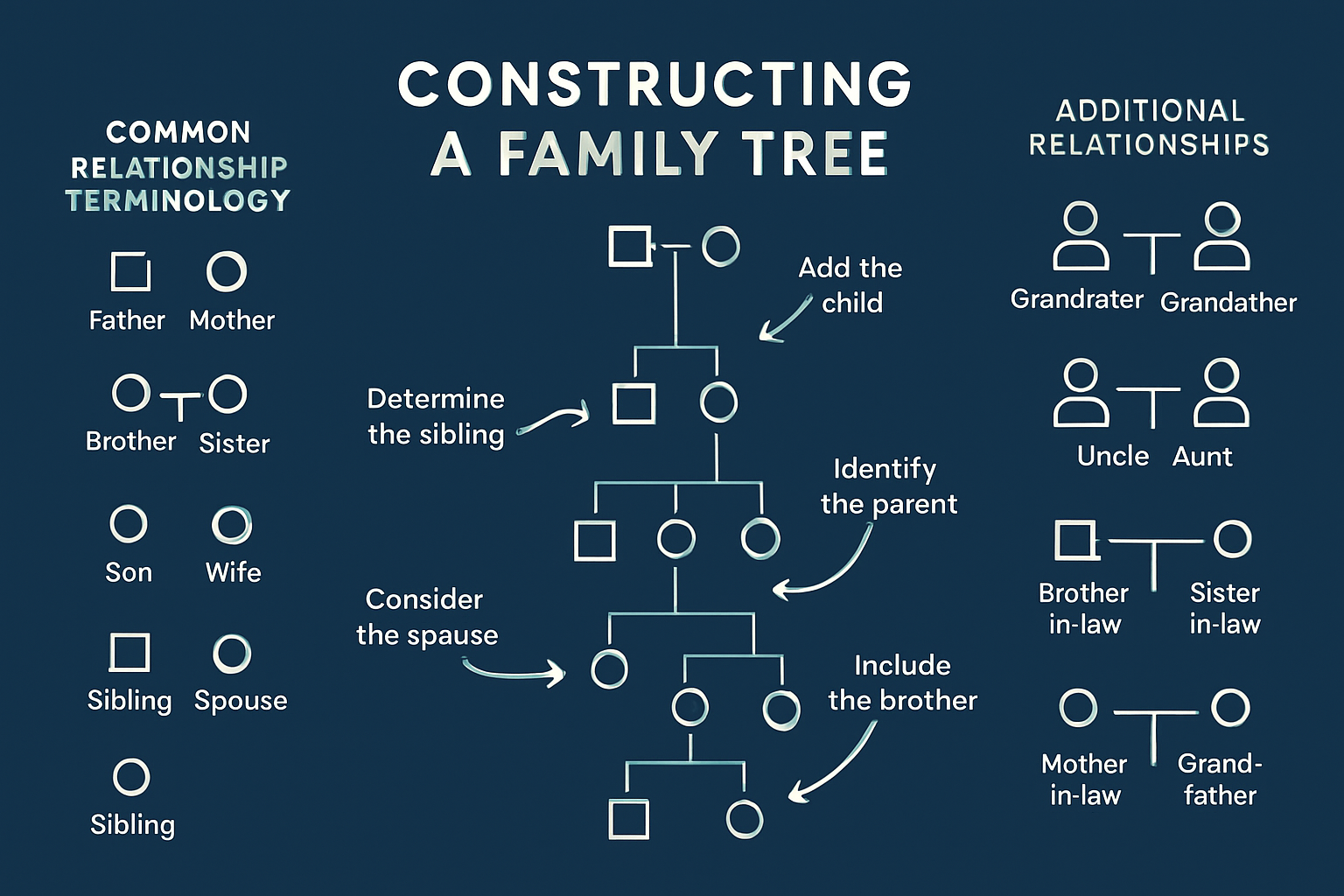
Indian family structures include relationships that might not appear in Western logical reasoning materials. Understanding these nuances helps with CLAT-specific questions.
Extended Family Terms
Indian families often include extended family members in daily life:
Chacha/Tau: Father’s younger/elder brother
Chachi/Tai: Father’s younger/elder brother’s wife
Mama: Mother’s brother
Mami: Mother’s brother’s wife
Mausi: Mother’s sister
Mausa: Mother’s sister’s husband
Bua: Father’s sister
Phupha: Father’s sister’s husband
While CLAT questions typically use English terms (uncle, aunt), understanding the specific Indian relationships helps you process complex family structures more naturally.
Joint Family Structures
Indian joint families can include multiple generations and married siblings living together. Questions reflecting these structures might include:
- Multiple married couples in one household
- Three or four generations
- Complex cousin relationships
- Multiple branches of the same family
Your family tree method handles these structures easily, but being familiar with joint family patterns helps you organize information faster.
Relationship Respect Hierarchies
Indian culture emphasizes respect based on age and generation. While this doesn’t directly impact solving blood relation questions, it helps you understand why certain relationships are mentioned in specific ways in questions designed for Indian students.
Integration with Other CLAT Logical Reasoning Topics
Blood relations don’t exist in isolation. They often combine with other logical reasoning concepts in CLAT questions.
Blood Relations + Seating Arrangements
Some questions combine family relationships with seating arrangement puzzles:
Example: “Six family members are sitting around a circular table. A sits opposite to his father. B sits to the right of her mother…”
Solving approach:
- First map the family relationships
- Then apply seating arrangement constraints
- Use both diagrams together to answer questions
Blood Relations + Coding-Decoding
Questions might combine relationship coding with other types of coding:
Example: “In a certain code, ‘mother’ is written as ‘npuifs’ and ‘father’ is written as ‘gbuifs’. If A npuifs B, how is A related to B?”
Solving approach:
- Decode the relationship terms first
- Then solve the blood relation normally
Blood Relations + Logical Deduction
Complex questions might require you to deduce relationships based on logical constraints rather than direct statements:
Example: “In a family, there are six members. There are two married couples. A is the teacher and is married to a doctor. B is the lawyer and married to C. D is the grandfather of F. There are two teachers in the family…”
These questions require careful constraint satisfaction and logical deduction combined with relationship mapping.
Understanding how blood relations integrate with other topics prepares you for the most challenging CLAT logical reasoning questions. Our comprehensive approach at Lawgic Coaching ensures you’re ready for all question variations.
Advanced Practice: Challenge Problems
Ready to test your skills? Try these advanced blood relation questions that mirror the difficulty level of tough CLAT questions.
Challenge Problem 1
Question: A family consists of six members P, Q, R, S, T, and U. There are two married couples. Q is a teacher married to a doctor. R is the grandmother of U and is a lawyer. S is the father of T and is a doctor. P is the mother of U. How many male members are there in the family?
Hint: Start by identifying the two married couples, then map the parent-child relationships.
Challenge Problem 2
Question: If A $ B means A is the father of B, A # B means A is the mother of B, A @ B means A is the husband of B, and A % B means A is the daughter of B, then which of the following indicates that M is the grandmother of T?
Options:
a) M # R $ T
b) M # R % T
c) M % R $ T
d) M @ R # T
Hint: Grandmother means female, two generations above. Work backward from the answer choices.
Challenge Problem 3
Question: Pointing to a man, a woman said, “His mother is the only daughter of my mother.” How is the woman related to the man?
Hint: “Only daughter of my mother” is the key phrase. Who is the only daughter of the woman’s mother?
Solutions are available at the end of this article for self-verification.
Creating a Blood Relations Practice Schedule
Structured practice yields better results than random practice. Here’s how to organize your blood relation preparation.
Week 1-2: Foundation Building
Goals:
- Understand all relationship terms
- Master family tree creation
- Solve basic direct relationship questions
Daily practice:
- 15 minutes theory review
- 10 simple questions with no time limit
- Review and understand every mistake
Success metric: 90%+ accuracy on simple questions
Week 3-4: Skill Development
Goals:
- Handle coded symbol questions
- Increase solving speed
- Tackle conversation-based questions
Daily practice:
- 20 minutes mixed question practice
- 12-15 questions with gentle time limits
- Focus on systematic method application
Success metric: 80%+ accuracy with improving speed
Week 5-6: Speed and Complexity
Goals:
- Solve complex puzzle questions
- Achieve target solving speed
- Handle combined concept questions
Daily practice:
- 25 minutes timed practice
- 15-20 questions at exam speed
- Analyze time spent per question
Success metric: 85%+ accuracy at target speed
Week 7+: Maintenance and Refinement
Goals:
- Maintain skills while focusing on other topics
- Handle the toughest question variations
- Build exam-day confidence
Daily practice:
- 15 minutes focused practice
- 8-10 questions including challenge problems
- Weekly full-length mock tests
Success metric: Consistent 85-90% accuracy under exam conditions
This progressive schedule ensures you build strong foundations before adding speed and complexity. Adjust the timeline based on your current skill level and overall CLAT preparation schedule.
Technology-Assisted Learning for Blood Relations
While the exam requires manual solving, technology can enhance your practice and understanding.
Mobile Apps for Daily Practice
Several apps provide daily logical reasoning practice including blood relations:
Benefits:
- Practice anywhere, anytime
- Instant feedback on answers
- Progress tracking
- Adaptive difficulty based on performance
Recommended approach: Use apps for supplementary practice, not as your primary resource. Apps work well for filling small time gaps (commute, breaks between classes).
Online Video Tutorials
Visual learners benefit from watching solved examples:
What to look for:
- Step-by-step solving demonstrations
- Multiple question types covered
- Clear explanation of reasoning
- Tips for avoiding common mistakes
Caution: Don’t just watch passively. Pause videos, try solving yourself, then watch the solution. Active engagement beats passive watching.
Digital Flashcards for Relationship Terms
Create digital flashcards (using Anki or similar tools) for:
- Relationship terminology
- Symbol meanings
- Common patterns
- Tricky phrases
Spaced repetition ensures you remember key concepts long-term, not just for tomorrow’s practice session.
Virtual Study Groups
Online study groups let you:
- Discuss challenging questions
- Learn different solving approaches
- Stay motivated through peer support
- Share resources and tips
Best practice: Explain solutions to others. Teaching reinforces your own understanding and reveals gaps in your knowledge.
Mental Mapping Strategies for Quick Reasoning
Developing strong mental mapping skills speeds up your solving process significantly.
The Chunking Technique
Break complex relationship chains into smaller chunks:
Instead of processing “A is the mother of B who is the father of C who is the brother of D” as one long chain, chunk it:
- Chunk 1: A is mother of B (A→B, parent relationship)
- Chunk 2: B is father of C (B→C, parent relationship)
- Chunk 3: C is brother of D (C and D siblings)
Process each chunk, then combine them in your family tree.
The Anchor Method
Choose one person as your anchor (usually the reference person in the question). Map everyone else relative to this anchor.
Benefits:
- Prevents confusion about perspective
- Creates consistent organization
- Makes relationship determination clearer
All relationships flow from or to your anchor point, creating a clear structure.
The Layer Approach
Visualize your family tree in layers by generation:
- Layer 1 (top): Grandparents
- Layer 2: Parents, aunts, uncles
- Layer 3: You and siblings, cousins
- Layer 4: Children, nieces, nephews
- Layer 5: Grandchildren
When you add a person to your tree, immediately identify which layer they belong to. This prevents generation confusion.
The Elimination Shortcut
For multiple-choice questions, sometimes eliminating wrong answers is faster than solving completely:
- Eliminate answers with wrong gender
- Eliminate answers with wrong generation
- Eliminate answers inconsistent with stated relationships
If only one answer remains, you’ve solved it without complete mapping.
Exam Day Strategies for Blood Relation Questions
Your preparation culminates in exam performance. These strategies help you execute effectively on CLAT day.
The Question Selection Strategy
When you reach the logical reasoning section:
- Quickly scan all blood relation questions
- Identify the easiest ones (simple direct relationships)
- Solve those first to build confidence and secure marks
- Return to complex questions afterward
This approach ensures you don’t miss easy marks by getting stuck on hard questions first.
The Workspace Management Technique
CLAT provides limited workspace for rough work. Use it efficiently:
For blood relations:
- Draw compact family trees
- Use abbreviations for names
- Keep diagrams organized and clear
- Erase completed questions to free space
Pro tip: Practice with the same amount of space you’ll have in the exam. This builds the habit of compact, organized diagramming.
The Verification Checklist
Before marking your final answer, verify:
- Did I map all stated relationships?
- Is the gender correct?
- Is the generation correct?
- Does my answer match the question asked?
This 5-second checklist prevents careless errors that cost marks.
The Time Monitoring Approach
Keep track of time spent on blood relation questions:
- If you’ve spent 90 seconds and aren’t close to the answer, mark for review
- Don’t let blood relations consume disproportionate time
- Remember that all questions carry equal marks
Your overall CLAT exam strategy should guide your time allocation, not just the difficulty of individual questions.
The Confidence Maintenance Mindset
If you encounter a particularly difficult blood relation question:
- Don’t let it shake your confidence
- Remember you’ve prepared for this
- Trust your systematic method
- Stay calm and methodical
One difficult question doesn’t determine your CLAT result. Move forward with confidence.
Frequently Asked Questions
How many blood relation questions typically appear in CLAT?
CLAT typically includes 3-5 blood relation questions as part of the logical reasoning section. The exact number varies each year, but blood relations consistently appear as a tested topic. Focus on mastering the concept rather than worrying about the exact count.
Are blood relation questions in CLAT getting harder over time?
Recent CLAT papers show a trend toward more application-based and integrated questions rather than purely theoretical blood relation problems. However, the core concepts remain the same. Questions might combine blood relations with other logical reasoning topics or present information in less straightforward ways, but your systematic solving method handles these variations effectively.
Should I memorize all possible relationship combinations?
No. Memorization isn’t necessary or effective for blood relations. Instead, master the systematic solving method using family trees. Understanding how relationships connect and practicing diverse question types builds the skill you need. Your brain will naturally recognize common patterns through practice without forced memorization.
What if I can’t determine gender from the given information?
If gender isn’t specified and isn’t necessary to answer the question, note “gender unknown” in your diagram. Often, the answer doesn’t depend on knowing everyone’s gender. If the answer choices require gender specification, look for additional clues in the question or use elimination to rule out impossible options.
How do I improve speed without sacrificing accuracy?
Build speed gradually through progressive practice. Start with untimed practice focusing on accuracy and systematic method. Once you achieve 90%+ accuracy, introduce time limits and gradually reduce them. Track both speed and accuracy. If accuracy drops below 80% when you speed up, slow down slightly. Speed comes naturally with practice and pattern recognition.
Can I use different symbols for family tree diagrams?
Yes. Use whatever symbols work for you, as long as they’re consistent and clear. Common approaches include squares for males and circles for females, or simply using = for males and + for females. The specific symbols matter less than consistency and clarity in your diagrams.
What should I do if I make a mistake in my family tree halfway through?
If you realize you’ve made an error, don’t panic. Quickly redraw the correct portion rather than trying to fix it with confusing corrections. A clear, correct diagram is worth the 10-15 seconds it takes to redraw. Messy corrections lead to more errors.
Are there any blood relation questions that can’t be solved with family trees?
No. Family tree diagramming works for all blood relation question types. Some very simple questions might be solvable mentally, but drawing the tree remains the most reliable method, especially under exam pressure. Even for coded questions, translate the symbols and then use your family tree method.
How important are blood relations compared to other logical reasoning topics?
Blood relations represent one component of CLAT logical reasoning. While important, they shouldn’t dominate your preparation at the expense of other topics. Allocate preparation time proportional to the topic’s weight in the exam. A balanced approach to all logical reasoning topics yields better overall results.
Should I practice blood relation questions from non-CLAT sources?
Yes, with caution. Blood relation concepts are universal across competitive exams, so practice from CAT, GMAT, or other exam sources can help. However, ensure you’re also practicing with CLAT-specific materials to understand the exact difficulty level and question patterns you’ll face. Previous year CLAT papers remain your most valuable resource.
Challenge Problem Solutions
Here are the solutions to the challenge problems presented earlier:
Challenge Problem 1 Solution
Given information:
- Six members: P, Q, R, S, T, U
- Two married couples
- Q is teacher married to doctor
- R is grandmother of U and is lawyer
- S is father of T and is doctor
- P is mother of U
Family tree construction:
- S is doctor and father of T
- Q is teacher married to doctor, so Q is married to S
- Therefore Q and S are one married couple
- R is grandmother of U, so R is parent of U’s parent
- P is mother of U
- R must be mother of P (making R and P’s father the second married couple)
- U is child of P
Gender determination:
- S = male (father)
- Q = female (married to S, and S is male)
- R = female (grandmother)
- P = female (mother)
- T = gender unknown from given info
- U = gender unknown from given info
Males in family:
- S (confirmed male)
- P’s father (R’s husband, must be male)
- Possibly T or U
Answer: At least 2 males are confirmed (S and R’s husband). If we assume traditional family structure, there are likely 3 males.
Challenge Problem 2 Solution
Symbol key:
- $ = father of
-
= mother of
- @ = husband of
- % = daughter of
Requirement: M is grandmother of T (M is female, two generations above T)
Checking options:
a) M # R $ T = M is mother of R, R is father of T
- M is female (mother)
- M is two generations above T (grandparent)
- This works: M is grandmother of T ✓
b) M # R % T = M is mother of R, R is daughter of T
- This makes M the great-grandmother, not grandmother ✗
c) M % R $ T = M is daughter of R, R is father of T
- This makes M the sister of T, not grandmother ✗
d) M @ R # T = M is husband of R, R is mother of T
- M is husband, so M is male, cannot be grandmother ✗
Answer: Option (a) M # R $ T
Challenge Problem 3 Solution
Statement: “His mother is the only daughter of my mother”
Decoding:
- “My mother’s only daughter” = if the woman’s mother has only one daughter, that must be the woman herself
- So “the only daughter of my mother” = me (the woman speaking)
- Therefore: “His mother” = me
- If his mother is me, then he is my son
Answer: The woman is the mother of the man.
Conclusion: Your Path to Blood Relations Mastery
Blood relation questions in CLAT test fundamental logical reasoning skills that extend far beyond the exam hall. They develop your ability to process complex information, identify patterns, and reach accurate conclusions through systematic analysis.
Here’s what you need to remember. Blood relations aren’t about memorizing relationship terms or trying to solve puzzles mentally. They’re about applying a consistent, systematic method that works every time.
Your action plan:
Start with the basics. Master relationship terminology and family tree creation before moving to complex questions.
Build your skills progressively. Follow a structured practice schedule that gradually increases difficulty and speed.
Practice regularly. Consistency beats intensity. Solving 5-7 questions daily builds stronger skills than marathon practice sessions.
Use the systematic method. Always draw family trees for complex questions. Trust the process, especially under exam pressure.
Learn from mistakes. Every error teaches you something. Analyze what went wrong and adjust your approach.
Integrate with other topics. Understand how blood relations combine with other logical reasoning concepts in CLAT.
Stay confident. You’ve got the tools and strategies. Blood relation questions are scoring opportunities when you approach them systematically.
Your success is our mission at Lawgic Coaching. We’ve helped thousands crack CLAT with proven strategies that actually work, and blood relations is one area where focused practice yields immediate results.
The difference between students who excel at blood relations and those who struggle isn’t intelligence or natural ability. It’s systematic preparation and consistent practice. You now have the complete framework for mastering this topic.
Start your practice today. Begin with simple questions, apply the family tree method, and gradually build your speed and confidence. Track your progress, celebrate improvements, and stay consistent.
Blood relations might seem challenging now, but with the strategies and techniques covered in this guide, they’ll become one of your strongest areas in CLAT logical reasoning. Let’s build your law career together, one well-solved blood relation question at a time.
Your CLAT success story starts with mastering fundamentals like blood relations. You’ve got this. Now go practice and prove it to yourself.
References
[1] Coded blood relation symbols and question types in CLAT logical reasoning section
[2] Blood relations reasoning strategies and common mistakes in CLAT preparation
[3] Direct and indirect blood relation question formats in competitive law entrance exams
[4] CLAT 2025 exam pattern and logical reasoning section structure
Blood Relations Practice Quiz
Test your understanding of blood relation concepts with these practice questions

