Here’s the thing about the CLAT English section: it’s not testing whether you can recite grammar rules or define obscure vocabulary. It’s testing something far more valuable for a future lawyer—your ability to read critically, understand complex arguments, and extract precise information under pressure. And that’s exactly what makes CLAT English preparation different from any other exam you’ve tackled before.
Most aspirants walk into the exam hall thinking they’ve got English covered because they scored well in school. Then they face dense passages on constitutional law, economic policy, or philosophical debates, and suddenly those 22-28 questions feel like solving a puzzle blindfolded. The difference between a top NLU and a lower-ranked college often comes down to how well you’ve prepared for this section.
Your success is our mission at Lawgic Coaching, and we’ve seen thousands crack CLAT by mastering the English section with proven strategies that actually work. Let’s build your law career together with a preparation approach that transforms reading comprehension from your worry into your strength.
Key Takeaways
- The CLAT English section now focuses entirely on reading comprehension with 4-5 passages of 450+ words each, testing critical reading and inference skills rather than isolated grammar or vocabulary
- Effective CLAT English preparation requires daily reading practice across diverse topics (legal, philosophical, political, economic) combined with active annotation and passage analysis techniques
- Time management is critical—allocate 13-15 minutes per passage and develop a systematic approach: skim first, identify the main argument, then tackle questions strategically
- Building contextual vocabulary through reading rather than rote memorization creates sustainable improvement and helps with inference-based questions
- Regular mock tests with detailed error analysis reveal patterns in mistakes and help refine your reading strategy for maximum accuracy under exam pressure
Understanding the CLAT English Section: What You’re Really Up Against
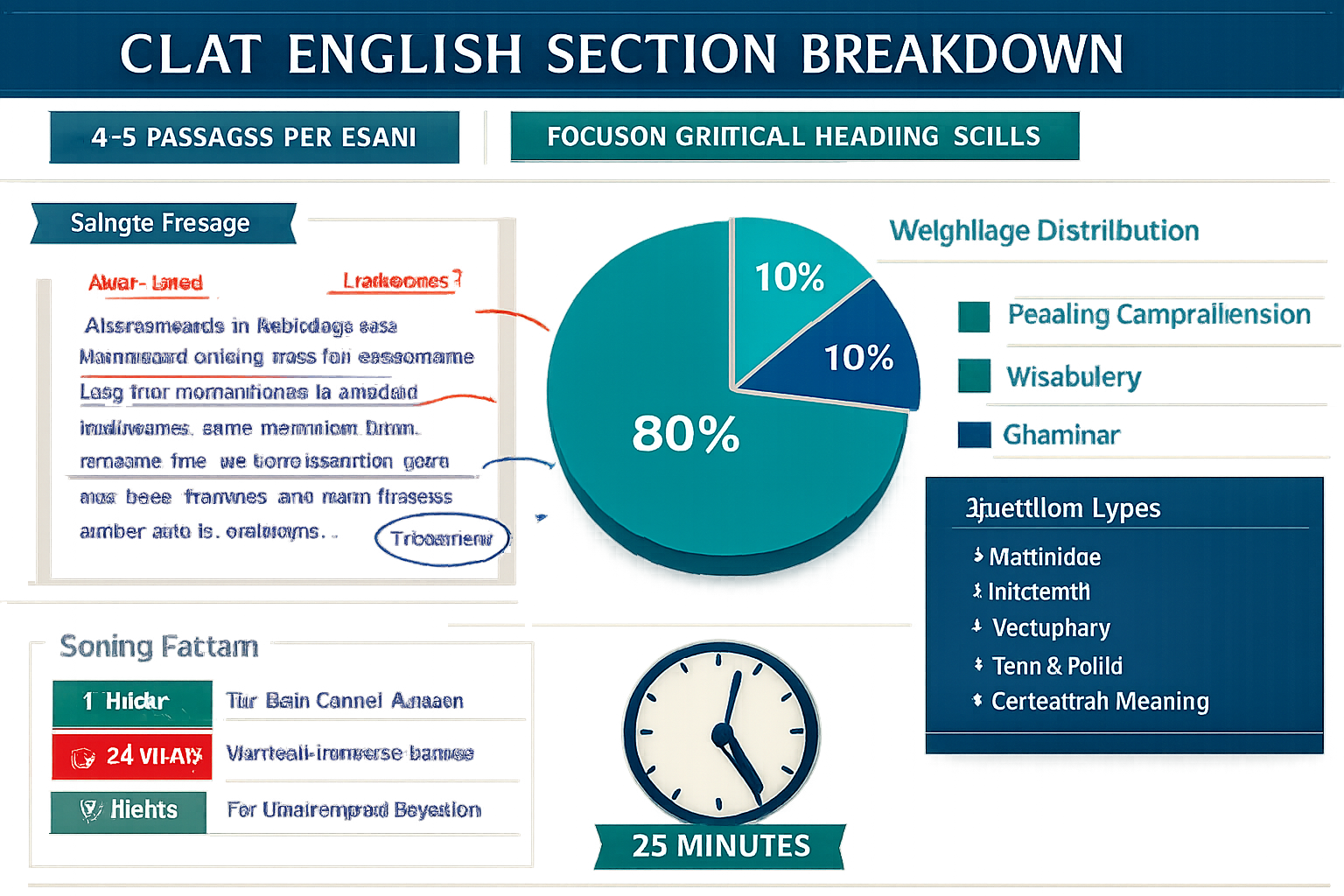
The CLAT English section underwent a massive transformation. Gone are the days of fill-in-the-blanks and direct grammar questions. The current format is laser-focused on one thing: your ability to comprehend and analyze written text.
Section Structure and Weightage
The English section carries 22-26% of the total CLAT paper, which translates to approximately 22-28 questions out of 120. Each passage comes with 4-5 questions, and you’re looking at 4-5 passages total. These aren’t your standard comprehension passages from school textbooks. They’re excerpts from contemporary and classical fiction, legal writing, political commentary, and philosophical texts.
| Component | Details |
|---|---|
| Total Questions | 22-28 questions |
| Number of Passages | 4-5 passages |
| Passage Length | 450+ words each |
| Questions per Passage | 4-5 questions |
| Time Allocation | 13-15 minutes per passage |
| Question Types | Inference, main idea, tone, vocabulary in context, logical flow |
What makes this challenging is the academic rigor of the passages. You’ll encounter dense writing styles, complex sentence structures, and nuanced arguments that require active engagement, not passive reading.
Types of Questions You’ll Face
The questions test multiple layers of comprehension:
Inference Questions: These ask you to draw conclusions not explicitly stated in the passage. You need to read between the lines while staying grounded in textual evidence.
Main Idea Questions: Identifying the central argument or theme requires distinguishing between main points and supporting details.
Tone and Attitude Questions: Understanding the author’s perspective, whether critical, supportive, neutral, or ironic.
Vocabulary in Context: Rather than testing isolated word meanings, these questions assess whether you understand how a word functions within a specific sentence or paragraph.
Logical Flow Questions: Sometimes you’ll need to identify which sentence disrupts the passage’s coherence or where a new sentence would best fit.
The shift toward passage-based questions means your CLAT English preparation must prioritize reading comprehension skills over memorizing grammar rules. This is actually good news because it levels the playing field—anyone can develop strong reading skills with the right practice methods.
Building Your Foundation: Core Skills for CLAT English Preparation
Before diving into advanced strategies, let’s address the fundamental skills that underpin success in the English section. These aren’t glamorous, but they’re non-negotiable.
Developing Critical Reading Skills
Critical reading means engaging with text actively rather than letting words wash over you. It’s the difference between reading and understanding.
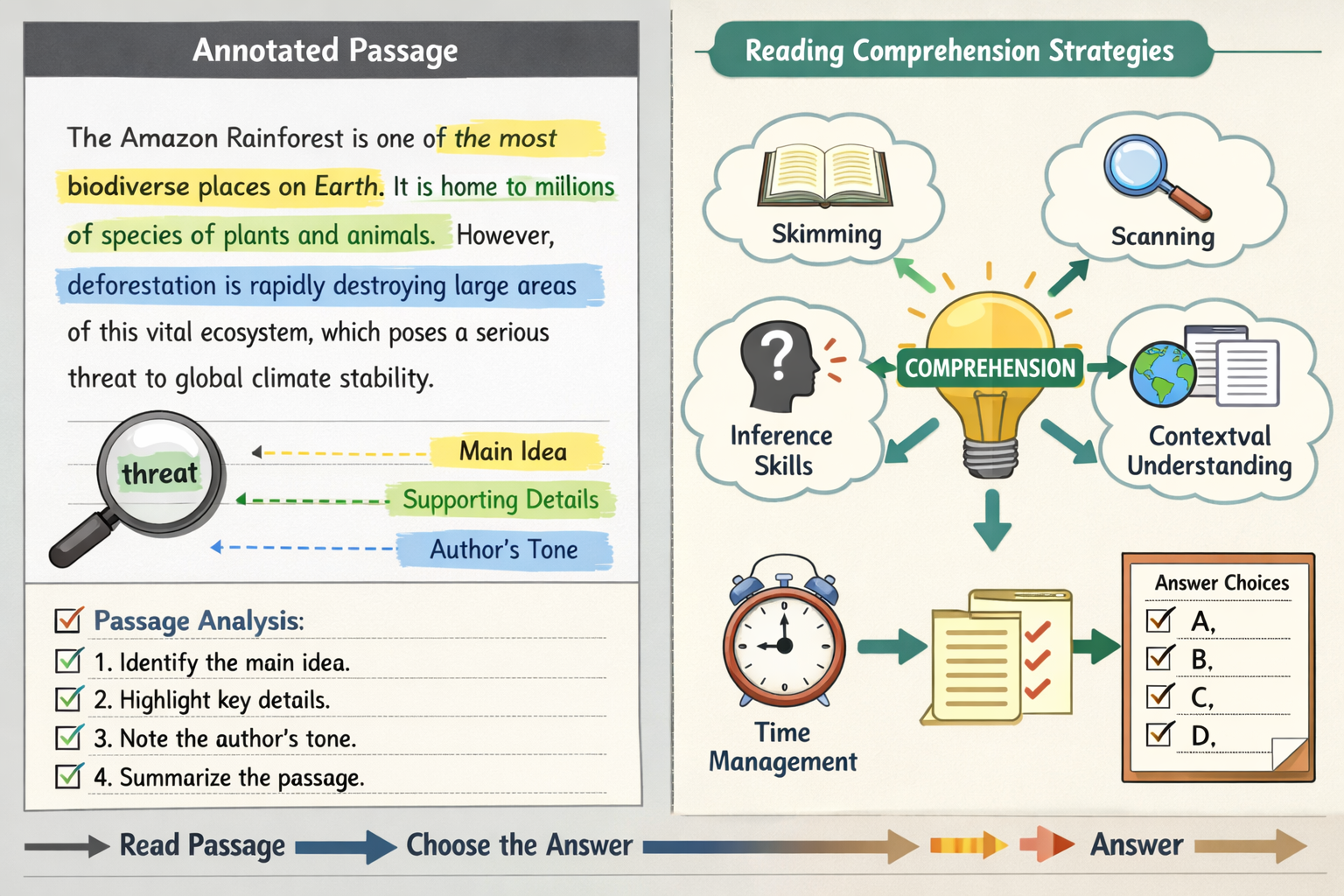
Active Annotation: As you read practice passages, develop a system for marking key information. Underline the main argument. Circle transition words like “however,” “moreover,” or “conversely” that signal shifts in reasoning. Put brackets around examples that support the main point.
This physical engagement keeps your brain alert and creates a visual map of the passage’s structure. When you return to answer questions, you’re not re-reading blindly—you’re navigating a marked territory.
Identifying Argument Structure: Legal passages especially follow logical structures: premise, evidence, conclusion. Train yourself to spot these components quickly. Ask yourself while reading: What claim is the author making? What evidence supports it? Are there counterarguments addressed?
Distinguishing Fact from Opinion: The CLAT loves passages that blend factual reporting with editorial commentary. Being able to separate what the author presents as fact versus what they argue as opinion is crucial for tone and inference questions.
Expanding Contextual Vocabulary
Here’s what doesn’t work: memorizing word lists. Here’s what does: building vocabulary through reading.
When you encounter unfamiliar words in passages, don’t immediately reach for a dictionary. First, try to infer meaning from context. What type of word is it—positive or negative? What role does it play in the sentence? This practice mirrors exactly what you’ll do in the exam.
After attempting inference, then look up the word. But don’t just note the definition. Write down the entire sentence where you found it. This contextual anchoring helps retention far better than isolated definitions.
High-Value Reading Sources:
- Editorial sections of The Hindu, Indian Express, and Livemint
- Legal commentary from Bar and Bench or LiveLaw
- Long-form journalism from The Caravan or Scroll.in
- Classic and contemporary fiction excerpts
The vocabulary you build through diverse reading becomes functional vocabulary—words you understand in various contexts, not just definitions you’ve crammed.
Grammar Through Application
While grammar isn’t directly tested anymore, grammatical understanding helps you parse complex sentences and understand logical relationships within passages.
Focus on:
Sentence Structure: Understanding how clauses connect helps you follow complicated arguments. Practice breaking down long sentences into their core components.
Modifiers and Qualifiers: Words like “although,” “despite,” “merely,” and “primarily” significantly alter meaning. Noticing these prevents misinterpretation.
Pronoun Reference: In dense passages, tracking what “it,” “this,” or “they” refers to is essential for maintaining comprehension.
Rather than studying grammar rules in isolation, analyze them within the passages you read. When you encounter a confusing sentence, diagram it. Understand why it’s structured that way. This applied approach builds practical skills.
Strategic CLAT English Preparation: Your Month-by-Month Roadmap
Effective preparation isn’t about studying harder—it’s about studying smarter with a structured timeline. Let’s break down what your CLAT English preparation should look like across different timeframes.
6-Month Preparation Strategy
If you’re starting six months out, you have the luxury of building skills gradually and sustainably.
Months 1-2: Foundation Building
Dedicate this phase to developing reading habits and baseline comprehension skills.
- Read one long-form article daily (800+ words) from quality sources
- Spend 30 minutes on vocabulary building through contextual reading
- Practice summarizing passages in 2-3 sentences to identify main ideas
- Start a reading journal noting unfamiliar words and interesting arguments
Months 3-4: Skill Development
Now introduce timed practice and strategic techniques.
- Attempt 2-3 practice passages daily under timed conditions
- Focus on different question types each week (inference, tone, main idea)
- Analyze errors systematically—why did you choose the wrong answer?
- Expand reading diversity—include legal, philosophical, and economic texts
- Take weekly sectional tests for English
Months 5-6: Refinement and Speed
This phase is about optimizing performance and building exam temperament.
- Complete full-length mock tests regularly
- Reduce time per passage from 15 to 13 minutes
- Review all English questions from previous CLAT papers
- Identify your weak passage types and target practice
- Develop your personal passage approach system
3-Month Intensive Preparation
Starting with three months? You’ll need focused intensity. We’ve covered detailed strategies for balancing school and CLAT preparation in a three-month timeframe that can help you manage this compressed timeline.
Month 1: Rapid Skill Acquisition
- Read 2-3 quality articles daily, focusing on comprehension over speed
- Practice 3-4 passages daily with immediate error review
- Build a core vocabulary list from your reading (aim for 500 words)
- Study passage types from previous CLAT exams
Month 2: Practice and Pattern Recognition
- Attempt one full-length mock test every 3 days
- Dedicate specific days to specific passage types
- Analyze your accuracy patterns—which question types trip you up?
- Time yourself strictly—build speed without sacrificing accuracy
- Review common trap answer patterns
Month 3: Exam Simulation
- Full-length mocks every alternate day
- Focus on maintaining accuracy under pressure
- Fine-tune time allocation across all sections
- Revise vocabulary and common passage themes
- Practice mental conditioning for exam day
Last-Month Revision Strategy
The final month isn’t for learning new things—it’s for consolidating and optimizing what you know.
Week 1-2: Take mocks, analyze thoroughly, and address specific weaknesses. If inference questions are your problem, do focused practice on just those.
Week 3: Reduce new practice. Review your error log from all previous mocks. What patterns emerge? Fix those specific issues.
Week 4: Light practice only. Read for pleasure to keep your mind engaged but not stressed. Review your personal strategy checklist. Get adequate rest.
Advanced Reading Comprehension Techniques for CLAT Success
Let’s get into the techniques that separate top scorers from average performers. These are strategies we teach at Lawgic Coaching that have helped thousands crack CLAT with strong English scores.
The Two-Pass Reading Method
Most students either read too carefully the first time (wasting time) or skim too superficially (missing crucial details). The two-pass method balances speed and comprehension.
First Pass – Strategic Skimming (2-3 minutes):
Read the first paragraph carefully—it usually introduces the topic and main argument. Then read the first sentence of each subsequent paragraph. This gives you the passage’s structure and flow. Read the last paragraph carefully—it often contains the conclusion or synthesis.
During this pass, you’re building a mental framework: What is this passage about? What’s the author’s main point? How is the argument organized?
Second Pass – Targeted Reading:
Now tackle the questions. For each question, return to the relevant part of the passage and read that section carefully. This targeted approach ensures you’re spending detailed reading time only where it matters.
This method prevents the common trap of reading the entire passage carefully, forgetting details, and then re-reading everything for each question.
Annotation Strategies That Actually Work
Effective annotation isn’t about highlighting everything—it’s about marking strategically.
The Three-Color System:
Use three markers or underlining styles:
- Main argument/thesis: Mark in one color
- Supporting evidence/examples: Mark in another color
- Contrasting views/counterarguments: Mark in a third color
This visual coding lets you quickly locate information when answering questions.
Marginal Notes:
Write brief notes in margins: “author’s view,” “example,” “criticism,” “conclusion.” These one-word markers create a roadmap.
Symbol System:
Develop personal symbols:
- “?” for confusing sections you might need to re-read
- “!” for surprising or emphatic points
- “=” for definitions or equivalences
- “≠” for contrasts or contradictions
The key is consistency. Use the same system every time so it becomes automatic.
Question-First vs Passage-First Approach
There’s debate about whether to read questions before the passage. Here’s the truth: it depends on your reading speed and retention.
Passage-First Approach (recommended for most students):
Read the passage using the two-pass method, then tackle questions. This works well if you have decent reading speed and can retain information. It prevents the confusion of trying to track multiple question details while reading.
Question-First Approach:
Quickly scan questions (not answer choices) before reading. This primes your brain for what to look for. Works well for slower readers who benefit from knowing what information matters.
Hybrid Approach:
Read the first question, then read the passage with that question in mind. After finishing the passage, answer all questions. This gives you a purpose while reading without overwhelming you with multiple questions.
Experiment during practice to find what works for your brain. There’s no universal right answer—only what’s right for you.
Tackling Different Passage Types
CLAT passages fall into distinct categories, each requiring slightly different approaches.
Legal/Constitutional Passages:
These often present case details, legal principles, or constitutional commentary. Focus on:
- Identifying the legal principle or precedent discussed
- Understanding how the principle applies to specific situations
- Noting any exceptions or qualifications mentioned
Political/Social Commentary:
These passages present arguments about policy, society, or governance. Focus on:
- The author’s stance (supportive, critical, neutral)
- Evidence used to support the argument
- Counterarguments addressed or ignored
Philosophical/Abstract Passages:
These explore ideas, ethics, or theoretical concepts. They’re often the trickiest. Focus on:
- Concrete examples that illustrate abstract ideas
- Logical progression of the argument
- Definitions of key terms
Literary/Fiction Passages:
These test your ability to understand narrative, character, and literary devices. Focus on:
- Character motivations and development
- Tone and mood
- Symbolic or metaphorical language
Knowing the passage type helps you activate the right reading lens. During practice, label each passage by type and track which types challenge you most.
Vocabulary Building for Law Entrance Exams: Beyond Memorization
Vocabulary questions in CLAT aren’t about knowing dictionary definitions—they’re about understanding words in context. This requires a fundamentally different approach than traditional vocabulary preparation.
Reading-Based Vocabulary Development
The most effective vocabulary building happens through extensive reading. When you encounter words repeatedly in various contexts, they become part of your active vocabulary naturally.
The Contextual Learning Method:
When you encounter an unfamiliar word:
-
Attempt inference first: Based on the sentence and paragraph, what might this word mean? Is it positive or negative? Does it describe an action, quality, or thing?
-
Check your inference: Look up the actual definition. How close was your guess?
-
Record contextually: Write the full sentence containing the word, not just the definition.
-
Create variations: Write 2-3 new sentences using the word in different contexts.
-
Review in context: When reviewing, read your example sentences, don’t just read definitions.
This method mirrors how you’ll encounter vocabulary in the exam—embedded in passages, not isolated.
High-Frequency CLAT Vocabulary Themes
Certain vocabulary themes appear repeatedly in CLAT passages. Prioritize these areas:
Legal and Judicial Terms:
Precedent, jurisdiction, litigation, adjudication, statute, ordinance, constitutional, judicial review, due process, jurisprudence
Political and Governance Terms:
Sovereignty, federalism, bureaucracy, legislation, amendment, ratification, coalition, constituency, mandate, autonomy
Economic and Policy Terms:
Fiscal, monetary, subsidy, tariff, inflation, recession, equity, allocation, privatization, regulation
Philosophical and Abstract Terms:
Ethics, morality, virtue, pragmatic, empirical, theoretical, rational, subjective, objective, paradigm
Academic and Formal Language:
Substantiate, corroborate, refute, postulate, hypothesis, methodology, criterion, comprehensive, inherent, intrinsic
Rather than memorizing isolated words, read articles where these terms appear naturally. Legal editorials, policy analyses, and academic writing will expose you to these words in authentic contexts.
Using Root Words and Etymology
Understanding word roots helps you decode unfamiliar words during the exam when you can’t look anything up.
Common Latin and Greek roots that appear frequently:
“Bene” (good): Beneficial, benevolent, beneficiary
“Mal” (bad): Malicious, malady, malevolent
“Dict” (say): Dictate, predict, contradict, verdict
“Jur/Jus” (law): Jurisdiction, justice, jurisprudence
“Cred” (believe): Credible, incredible, credence
“Spec” (see): Perspective, spectator, introspection
When you encounter an unknown word like “malfeasance,” knowing that “mal” means bad and “feasance” relates to doing or performing helps you infer it means wrongdoing.
Create a root word reference sheet with 20-30 common roots. This small investment yields returns across hundreds of words.
Time Management and Exam Strategy for CLAT English Section
Knowing the content is only half the battle. Executing under time pressure requires strategic planning and mental discipline.
Optimal Time Allocation
You have approximately 120 minutes for 120 questions across all CLAT sections. For the English section with 22-28 questions across 4-5 passages, allocate 60-75 minutes total.
Per Passage Breakdown:
- First reading (skim): 2-3 minutes
- Answering questions: 10-12 minutes (including targeted re-reading)
- Total per passage: 13-15 minutes
This gives you a small buffer for particularly challenging passages while maintaining overall pace.
The 2-Minute Rule: If you’re stuck on a question for more than 2 minutes, mark it and move on. Return to it if time permits. Spending 5 minutes on one question while leaving easier questions unattempted is poor strategy.
The Strategic Passage Selection
Not all passages are equally difficult. Scanning all passages before diving in can help you tackle them in optimal order.
Quick Scan Strategy (3-4 minutes for all passages):
Spend 30-40 seconds on each passage reading just the first paragraph. This tells you:
- The topic (legal, political, literary, etc.)
- The approximate difficulty level
- Whether it’s a topic you’re comfortable with
Then tackle passages in this order:
-
Your strength area: Start with the passage type you’re most confident with. This builds momentum and secures easy marks.
-
Medium difficulty: Move to passages that are neither too easy nor too hard.
-
Challenging passages: Save the most difficult for last when you’ve already secured marks elsewhere.
This strategic sequencing prevents you from getting bogged down early and losing confidence.
Accuracy vs Speed: Finding Your Balance
There’s a common misconception that speed is everything. Wrong. Accuracy is everything. Speed is just a constraint you work within.
The 80% Accuracy Threshold:
If your accuracy in practice is below 80%, you’re going too fast. Slow down. Missing 5 questions because you rushed costs more than attempting 2 fewer questions but getting everything else right.
Building Speed Gradually:
Start practice with no time limits. Focus purely on accuracy. Once you’re consistently hitting 85-90% accuracy, introduce time constraints. Gradually reduce time until you’re at exam pace while maintaining accuracy above 80%.
The Confidence Marker System:
As you answer questions, mark them:
- ✓ = Confident in this answer
- ? = Unsure, might need review
- ?? = Complete guess
If time remains, review “?” questions first, then “??” questions. Never waste time second-guessing “✓” answers unless you spot a clear error.
Common Mistakes in CLAT English Preparation and How to Avoid Them
Learning from others’ mistakes is cheaper than making them yourself. Here are the pitfalls we see repeatedly at Lawgic Coaching.
Mistake 1: Neglecting English Because “I’m Already Good at It”
Many students who performed well in school English assume CLAT English will be similar. It’s not. School English tests grammar and basic comprehension. CLAT tests critical reading, inference, and analytical skills with complex, dense passages.
Solution: Treat CLAT English as a distinct skill requiring specific preparation. Even if you’re naturally strong in English, dedicate focused practice time to CLAT-style passages and questions.
Mistake 2: Passive Reading Without Engagement
Reading without actively processing information is like watching a movie while scrolling through your phone—you see it but don’t absorb it.
Solution: Implement active reading techniques. Annotate passages. Pause after each paragraph to mentally summarize. Ask yourself questions about the author’s purpose and argument structure.
Mistake 3: Vocabulary Cramming
Students waste hours memorizing word lists that they forget within days and can’t apply in context anyway.
Solution: Build vocabulary through reading. When you encounter words in meaningful contexts repeatedly, they stick. Use the contextual learning method described earlier.
Mistake 4: Ignoring Error Analysis
Taking mock tests without analyzing errors is like going to the gym and lifting weights randomly without a program. You’re busy but not improving strategically.
Solution: After every practice passage or mock test, spend equal time analyzing errors. For each wrong answer:
- Why did you choose the wrong option?
- What made the right answer correct?
- What pattern of thinking led to the error?
- How can you avoid this mistake type in future?
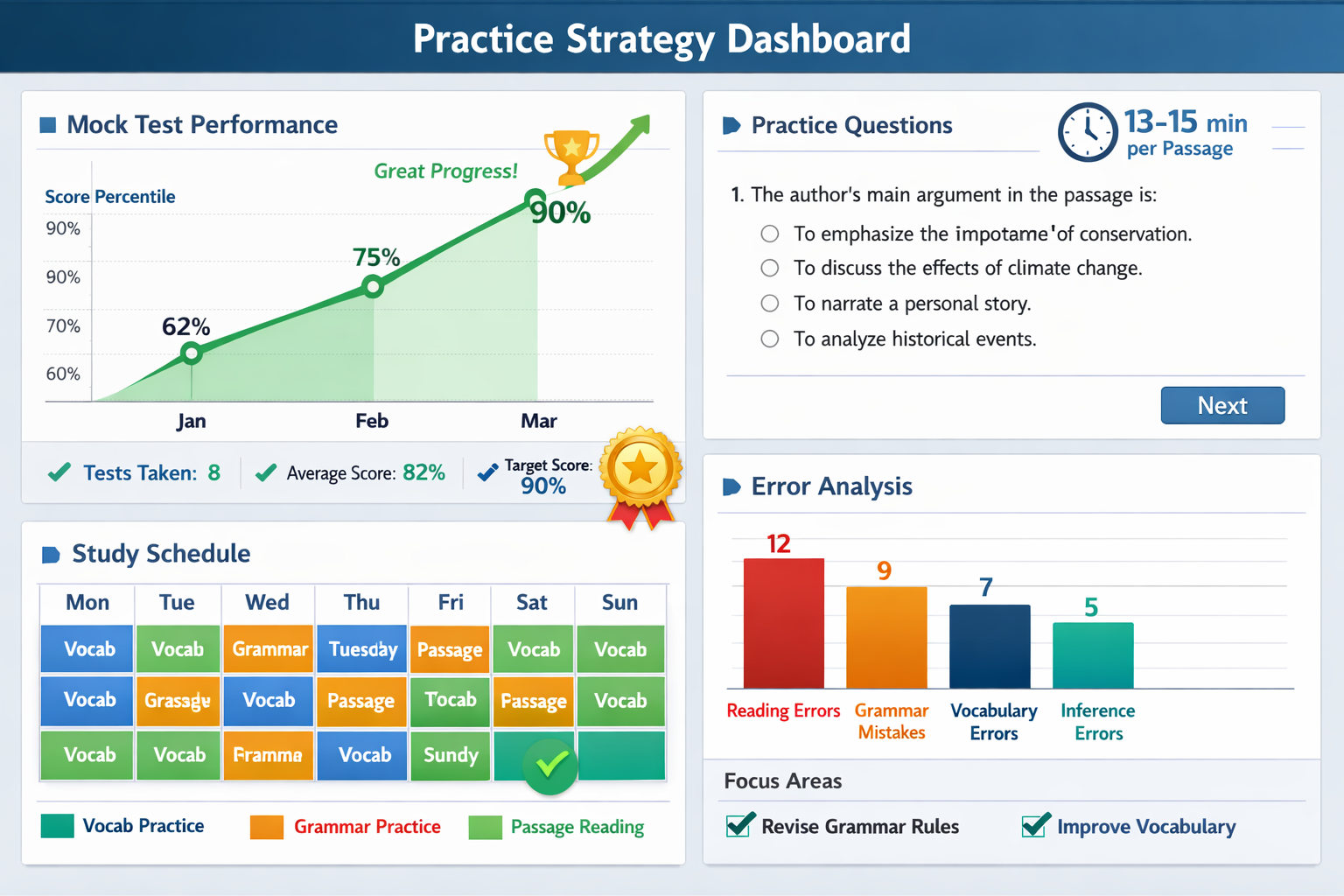
Create an error log categorizing mistakes: inference errors, main idea confusion, vocabulary misunderstanding, time pressure mistakes, careless reading. Patterns will emerge showing you exactly what to work on.
Mistake 5: Inconsistent Practice
Studying English intensively for three days then ignoring it for a week doesn’t build skills. Reading comprehension improves through consistent, daily engagement.
Solution: Commit to daily practice even if it’s just 30-45 minutes. Two passages daily with thorough analysis beats ten passages once a week.
Mistake 6: Not Adapting to Different Passage Types
Approaching every passage with the same reading strategy is inefficient. Legal passages need different attention than literary ones.
Solution: During practice, consciously identify passage types and adjust your reading approach. Build familiarity with the specific challenges each type presents.
Mock Tests and Practice Resources for CLAT English Excellence
Practice doesn’t make perfect. Perfect practice makes perfect. The quality and variety of your practice materials matter enormously.
Structuring Your Mock Test Practice
Mock tests serve multiple purposes: skill assessment, time management practice, and building exam temperament. But they need to be used strategically.
Full-Length Mocks:
Take a complete CLAT mock test every week during the last 2-3 months of preparation. This builds stamina for the 2-hour exam and helps you practice section-switching and time allocation across all subjects.
Sectional Mocks:
Between full-length tests, take English-only sectional mocks. These let you focus specifically on reading strategies without the mental fatigue of a full test.
Post-Mock Analysis Routine:
Spend at least as much time analyzing a mock as you spent taking it:
-
Immediate Review (within 1 hour): Go through all questions while the test is fresh in memory. Understand why each wrong answer was wrong and each right answer was right.
-
Pattern Analysis (same day): Categorize errors. Were they inference mistakes? Time pressure? Careless reading? Vocabulary gaps?
-
Skill Gaps Identification (next day): Based on patterns, identify 2-3 specific skills to work on before the next mock.
-
Targeted Practice (throughout the week): Address those specific weaknesses with focused practice.
This systematic approach ensures each mock test drives actual improvement rather than just giving you a score.
Quality Practice Resources
Official CLAT Resources:
Previous year CLAT question papers are gold. They show you exactly the difficulty level, passage types, and question patterns you’ll face. Analyze every English passage from the last 5 years of CLAT papers.
Recommended Reading Sources:
For daily reading practice that mirrors CLAT passage complexity:
- The Hindu Editorial Page: Daily editorials on legal, political, and social issues
- Indian Express Opinion Section: Diverse viewpoints on current affairs
- LiveLaw and Bar & Bench: Legal analysis and commentary
- The Caravan: Long-form journalism with complex narrative structures
- Economic and Political Weekly: Academic-style analysis
- Project Gutenberg: Classic literature passages
Quality Mock Test Platforms:
Look for platforms that provide:
- Detailed explanations for all answers
- Performance analytics showing your strengths and weaknesses
- Adaptive difficulty that challenges you appropriately
- Passage variety covering all types you’ll encounter
At Lawgic Coaching, we provide comprehensive mock tests designed specifically for CLAT patterns with detailed video explanations and personalized performance tracking. Our students consistently report that the quality of explanations matters more than the quantity of tests.
Creating Your Own Practice Passages
As you advance in preparation, try this powerful exercise: create your own comprehension questions from articles you read.
Pick an article, read it carefully, then write 4-5 questions:
- One main idea question
- One inference question
- One tone/attitude question
- One vocabulary in context question
- One detail-based question
This exercise forces you to think like a question-setter, which dramatically improves your ability to anticipate what questions might be asked about any passage. It’s like learning chess by studying how grandmasters think, not just memorizing moves.
Mental Conditioning and Exam Day Strategy
The psychological dimension of exam preparation is often overlooked but critically important. Your mental state on exam day can swing your performance by 10-15 marks.
Building Exam Temperament
Pressure Simulation:
Take at least 5-6 mocks under exam-like conditions:
- Same time of day as the actual exam
- Timed strictly with no pauses
- In a quiet room without distractions
- Using the same type of materials (computer-based if CLAT is online)
This conditions your brain to perform under pressure. The exam environment won’t feel foreign because you’ve simulated it repeatedly.
Handling Difficult Passages:
You will encounter at least one passage that feels incomprehensible. This is normal. Top scorers don’t panic—they have a protocol.
The Difficult Passage Protocol:
- Acknowledge: “This passage is tough. That’s okay.”
- Slow down slightly: Read more carefully, don’t speed up in panic
- Focus on structure: Even if content is confusing, identify the argument structure
- Answer what you can: Some questions might be answerable even if you don’t fully grasp the passage
- Move on: Don’t let one passage destroy your confidence for the rest
Practice this protocol during mocks so it becomes automatic.
Exam Day Execution Strategy
The Night Before:
Don’t study new material. Do light revision of your personal strategy notes. Get 7-8 hours of sleep. Prepare everything you need for the exam (admit card, ID, stationery) to avoid morning stress.
Morning Routine:
Eat a proper breakfast with protein and complex carbs—not just coffee and nerves. Arrive at the exam center 30-40 minutes early to settle in calmly. Avoid discussing preparation with other candidates—it only increases anxiety.
First 5 Minutes of the Exam:
Don’t rush into questions. Take 2-3 deep breaths. Quickly scan the entire paper to understand the layout. Remind yourself of your time allocation strategy. Then begin systematically.
During the English Section:
Stick to your practiced approach. If a passage feels unusually difficult, remember your protocol. Trust your preparation. Don’t second-guess excessively—your first instinct is usually correct if you’ve prepared well.
If You’re Running Out of Time:
Stay calm. Quickly scan remaining questions and prioritize those that seem most straightforward. Make educated guesses on others rather than leaving blanks (if there’s no negative marking, or if the negative marking is less than the probability of guessing correctly).
Integrating English Preparation with Overall CLAT Strategy
English doesn’t exist in isolation. Your preparation across all CLAT sections should be integrated and balanced.
Time Distribution Across Sections
While English is important, don’t neglect other sections. A balanced approach typically allocates:
- Quantitative Techniques: 15-20% of daily study time
- Legal Reasoning: 25-30%
- Logical Reasoning: 20-25%
- Current Affairs & GK: 25-30%
- English: 15-20%
These percentages should adjust based on your strengths and weaknesses. If English is your weak point, increase allocation. If it’s your strength, maintain it while focusing more on weaker areas.
For comprehensive guidance on overall CLAT preparation strategy, check out our CLAT 2026 study strategy guide.
Cross-Section Skill Transfer
Skills you build for English benefit other sections:
Reading Comprehension → Legal Reasoning: Legal reasoning passages require the same critical reading skills. The comprehension techniques you practice for English apply directly.
Vocabulary → Current Affairs: Many current affairs passages use sophisticated vocabulary. Your English preparation helps here.
Time Management → All Sections: The time discipline you develop for English passages transfers to managing time across the entire paper.
This synergy means your English preparation has compound benefits across your overall CLAT performance.
Avoiding Common Pitfalls
We’ve discussed mistakes to avoid when choosing online CLAT coaching, and similar principles apply to self-study. Don’t fall for:
- Magic shortcuts: There’s no substitute for consistent reading practice
- One-size-fits-all approaches: Adapt strategies to your learning style
- Neglecting fundamentals: Advanced techniques don’t help if basic comprehension is weak
- Comparison paralysis: Focus on your improvement, not others’ scores
Advanced Tips from Top Scorers and Expert Faculty
Let’s conclude with insights from students who’ve scored 95+ percentile in CLAT and faculty members from top NLUs who’ve guided hundreds of successful candidates.
Reading Beyond Exam Requirements
Top scorers consistently report that they read for pleasure, not just exam prep. Reading novels, non-fiction, and long-form journalism builds reading stamina and makes CLAT passages feel manageable by comparison.
Recommended Reading:
Fiction: Classics like George Orwell, Aldous Huxley, and contemporary Indian authors like Arundhati Roy expose you to varied writing styles.
Non-fiction: Books on law, politics, economics, and philosophy build background knowledge that makes passages more accessible.
Magazines: The Economist, Frontline, and similar publications offer passage-length articles on diverse topics.
The goal isn’t to study these—it’s to make reading a natural part of your daily routine so that processing complex text becomes effortless.
The 30-Day Intensive Vocabulary Sprint
If you’re in the final month and feel your vocabulary is weak, try this intensive method:
Week 1-2: Read one editorial daily and note every unfamiliar word. Create contextual flashcards (full sentence on one side, definition on the other). Review daily.
Week 3: Read two editorials daily. Add new words but also try to spot previously learned words in new contexts.
Week 4: Focus on review. Go through all flashcards. Write practice sentences using the words. Take vocabulary-focused practice passages.
This sprint can add 200-300 words to your active vocabulary, enough to make a noticeable difference.
Developing Your Personal Reading Rhythm
Every reader has an optimal pace—fast enough to finish on time but slow enough to comprehend accurately. Finding yours is crucial.
During practice, experiment with different reading speeds. Time yourself and track accuracy at each speed. You’ll find a sweet spot where accuracy remains high (85%+) while speed is sufficient to complete passages in 13-15 minutes.
Once you find this rhythm, practice maintaining it consistently. Your brain will adapt, and this pace will feel natural during the exam.
The Power of Visualization
Before the exam, visualize yourself successfully completing the English section. See yourself reading passages calmly, understanding content, selecting correct answers confidently. This mental rehearsal creates neural pathways that support actual performance.
Athletes use this technique extensively. It works for exams too. Spend 5 minutes daily in the final week visualizing exam success.
Learning from Every Practice Session
The difference between average and excellent preparation is reflection. After each practice session, ask yourself:
- What did I do well today?
- What challenged me?
- What specific technique will I try differently next time?
- What did I learn about my reading process?
This metacognitive awareness—thinking about your thinking—accelerates improvement dramatically.
Your Personalized CLAT English Preparation Checklist
Let’s consolidate everything into an actionable checklist you can use to track your preparation.
Daily Practice Checklist
- Read one quality editorial or long-form article (800+ words)
- Practice 2-3 CLAT-style passages with questions
- Note and review 5-10 new vocabulary words in context
- Analyze errors from today’s practice
- Review previous vocabulary and concepts for 15 minutes
Weekly Practice Checklist
- Take one full-length CLAT mock test
- Take one English sectional mock
- Thoroughly analyze all mock test errors
- Read one long-form magazine article or book chapter
- Review and update error log with patterns identified
- Practice one weak area identified from mocks
Monthly Assessment Checklist
- Review accuracy trends—is it improving?
- Assess time management—are you finishing passages on time?
- Evaluate vocabulary growth—are you encountering fewer unknown words?
- Check passage type performance—which types need more work?
- Adjust study plan based on performance data
- Set specific goals for the next month
Final Month Checklist
- Complete 8-10 full-length mocks
- Review all previous year CLAT English passages
- Consolidate vocabulary—review all words learned
- Practice exam-day routine (timing, breaks, mental conditioning)
- Prepare exam-day materials and logistics
- Get adequate rest and maintain health
Conclusion: Your Path to CLAT English Excellence
Mastering the CLAT English section isn’t about innate talent or luck. It’s about systematic preparation, consistent practice, and strategic execution. The techniques and strategies outlined in this guide have helped thousands of students transform their reading comprehension skills and achieve top scores.
Remember these core principles:
Consistency beats intensity: Daily practice for 45 minutes is more effective than weekend marathons. Build reading into your routine until it becomes as natural as breathing.
Active engagement beats passive reading: Annotate, question, analyze. Make every reading session an active workout for your brain, not a passive scroll through words.
Quality beats quantity: Two passages analyzed thoroughly teach more than ten passages skimmed carelessly. Focus on understanding your errors and improving your process.
Strategy beats panic: When you encounter difficult passages in the exam, your practiced protocols will guide you through. Trust your preparation.
Balance beats obsession: English is one section of CLAT. Prepare it well, but maintain perspective and balance across all sections.
Your CLAT English preparation journey is unique to you. Some strategies in this guide will resonate immediately; others might need adaptation. Experiment during practice, find what works for your learning style, and commit to it consistently.
At Lawgic Coaching, we’ve built our entire approach around personalized attention and proven strategies that actually work. We understand that every student’s journey is different, and we’re here to guide you through yours with expert faculty from top NLUs and flexible learning that fits your life.
The English section is your opportunity to showcase skills that will serve you throughout law school and your legal career—critical reading, analytical thinking, and precise interpretation. Master these now, and you’re not just preparing for an exam; you’re building the foundation for legal excellence.
Start today. Read one quality article. Practice one passage with full attention. Analyze your approach. Tomorrow, do it again. Small, consistent steps compound into remarkable results.
Your law school dream is within reach. Let’s build your CLAT success together, one passage at a time.
Ready to take your CLAT preparation to the next level? Explore our comprehensive CLAT preparation resources and discover how personalized mentorship can transform your exam strategy. Your success is our mission, and we’re here to make your law school dreams a reality.
CLAT English Preparation Tracker
Track your daily progress across key English skills

