Imagine walking into the CLAT exam hall, confident and prepared, knowing exactly what to expect from each legal reasoning passage. For thousands of aspiring law students in 2026, understanding CLAT legal reasoning passage types is the difference between securing admission to their dream National Law University and falling short of their goals.
The legal reasoning section carries significant weightage in CLAT, testing not just your knowledge but your ability to apply legal principles to real-world scenarios. This comprehensive guide will transform you from a confused beginner into a confident test-taker who can tackle any legal reasoning passage with precision and speed.
Key Takeaways
• Five core passage types dominate CLAT legal reasoning: Constitutional Law, Tort Law, Contract Law, Criminal Law, and Legal Principles Application
• Systematic approach to reading and analyzing passages significantly improves accuracy and speed
• Practice with authentic materials and understanding question patterns are crucial for success
• Time management strategies specific to legal reasoning can boost your overall CLAT score
• Contemporary legal developments and current affairs integration enhances passage comprehension
Understanding CLAT Legal Reasoning: Foundation for Success
What Makes Legal Reasoning Unique in CLAT
Legal reasoning in CLAT differs fundamentally from other competitive exams. Unlike traditional law school assessments that test memorized legal provisions, CLAT focuses on analytical thinking and practical application. The exam presents factual scenarios followed by questions that require you to apply legal principles, identify violations, or predict legal outcomes.
The 2026 CLAT format emphasizes passage-based questions where each passage contains 450-500 words describing legal situations, followed by 4-5 multiple-choice questions. These passages don’t require prior legal knowledge but test your ability to understand, analyze, and apply given legal principles to specific circumstances.
Core Components of Legal Reasoning Assessment
Comprehension Skills: Reading complex legal scenarios and extracting relevant facts
Analytical Thinking: Identifying relationships between facts and legal principles
Application Ability: Applying legal rules to determine outcomes
Critical Evaluation: Distinguishing between valid and invalid legal arguments
Understanding these components helps you approach each passage systematically, improving both accuracy and speed. Master the art of reading 450-word CLAT passages effectively to build this foundation.
Comprehensive Guide to CLAT Legal Reasoning Passage Types
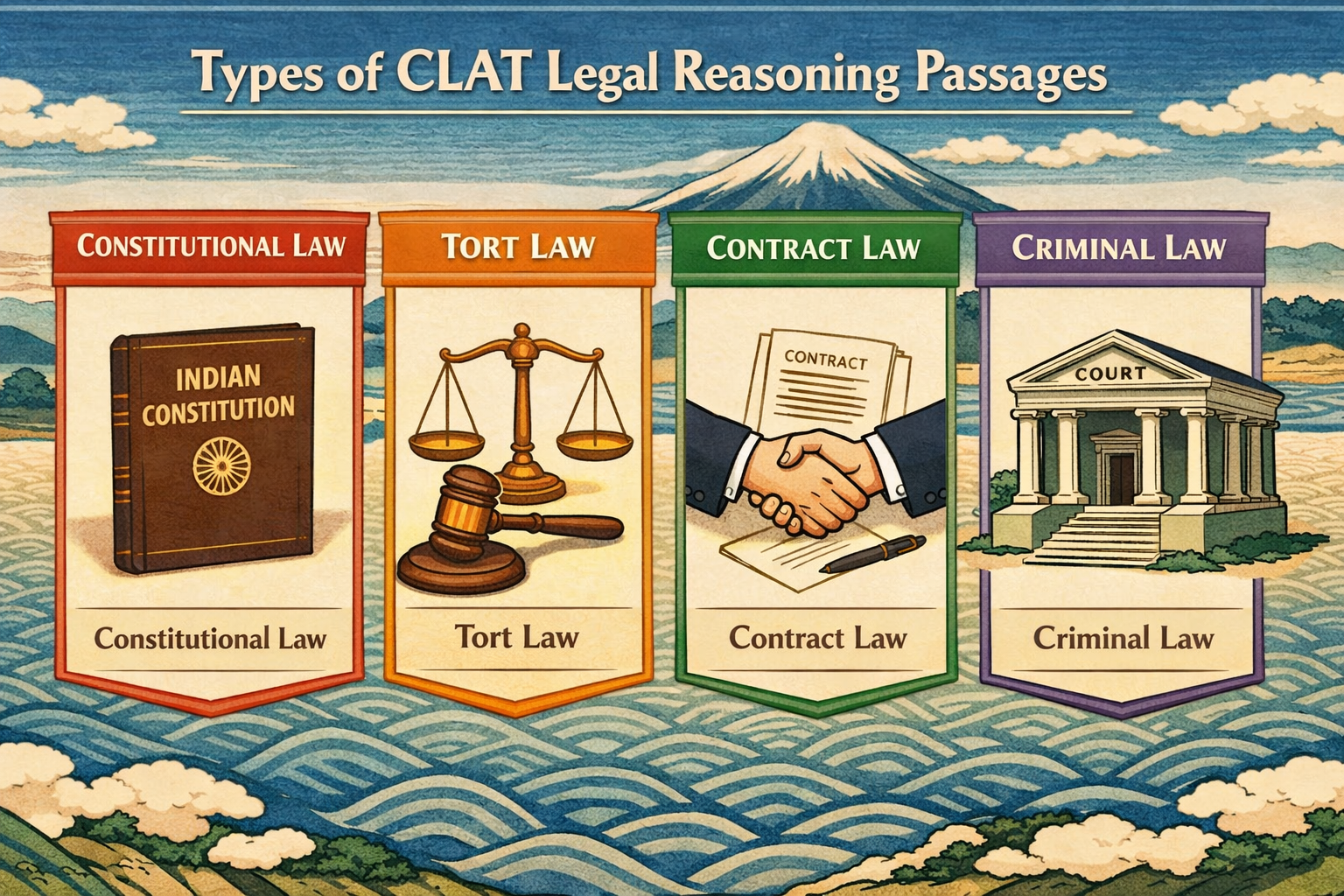
Constitutional Law Passages: Fundamental Rights and Governance
Constitutional law passages form the backbone of CLAT legal reasoning, typically comprising 25-30% of legal reasoning questions. These passages explore fundamental rights, directive principles, constitutional amendments, and separation of powers.
Common Constitutional Topics:
- Fundamental Rights violations and their remedies
- Article 14 (Right to Equality) applications in discrimination cases
- Article 19 (Freedom of Speech) limitations and reasonable restrictions
- Article 21 (Right to Life) expansive interpretations
- Emergency provisions and their constitutional validity
Sample Scenario Analysis:
A typical constitutional passage might describe a government policy affecting citizens’ fundamental rights. For example, a passage about mandatory Aadhaar linking could test your understanding of privacy rights under Article 21, the balance between individual liberty and state security, and the doctrine of proportionality.
Key Success Strategies:
- Identify the constitutional provision involved in the scenario
- Analyze the balance between individual rights and state interests
- Apply precedent-based reasoning using established constitutional principles
- Consider contemporary interpretations of constitutional provisions
Constitutional law passages require understanding the dynamic nature of constitutional interpretation. The Supreme Court’s evolving jurisprudence means that rigid rule-based thinking won’t suffice. Instead, focus on understanding the underlying constitutional philosophy and how courts balance competing interests.
Tort Law Passages: Civil Wrongs and Remedies
Tort law passages test your understanding of civil wrongs, negligence, liability, and damages. These passages often involve everyday situations where one party’s actions cause harm to another, requiring you to determine liability and appropriate remedies.
Essential Tort Concepts:
- Negligence: Duty of care, breach, causation, and damages
- Strict Liability: Liability without fault in specific circumstances
- Vicarious Liability: Employer responsibility for employee actions
- Defamation: Libel, slander, and defenses
- Nuisance: Private and public nuisance distinctions
Real-World Application Examples:
Medical malpractice scenarios testing negligence standards, product liability cases involving manufacturing defects, or defamation cases involving social media posts. These passages require you to identify the specific tort, analyze the elements, and determine liability.
Analytical Framework for Tort Passages:
- Identify the alleged wrong and potential tort category
- Analyze each element of the tort systematically
- Consider available defenses and their applicability
- Evaluate damages and appropriate remedies
Tort law passages often involve factual complexity requiring careful analysis. Success depends on methodically working through each element rather than jumping to conclusions based on initial impressions.
Contract Law Passages: Agreements and Obligations
Contract law passages explore agreement formation, performance, breach, and remedies. These passages typically involve business transactions, employment relationships, or consumer contracts, testing your understanding of contractual obligations and dispute resolution.
Core Contract Principles:
- Offer and Acceptance: Valid contract formation requirements
- Consideration: Mutual exchange of value
- Capacity: Legal ability to enter contracts
- Legality: Lawful purpose and object
- Performance and Breach: Contractual obligations and violations
Common Contract Scenarios:
E-commerce disputes, employment contract violations, real estate transactions, or service agreements. These passages require analyzing whether valid contracts exist, identifying breaches, and determining appropriate remedies.
Strategic Approach to Contract Analysis:
- Determine contract validity using formation elements
- Identify specific obligations of each party
- Analyze performance and potential breaches
- Evaluate remedies including damages, specific performance, or rescission
Contract law passages demand precise legal reasoning. Small factual details often determine outcomes, making careful reading and systematic analysis essential for success.
Criminal Law Passages: Offenses and Punishments
Criminal law passages examine criminal offenses, defenses, and punishment principles. These passages involve scenarios where individuals allegedly violate criminal laws, requiring you to analyze guilt, innocence, and appropriate legal consequences.
Key Criminal Law Areas:
- Elements of Crime: Actus reus (guilty act) and mens rea (guilty mind)
- Specific Offenses: Theft, fraud, assault, murder, and white-collar crimes
- Defenses: Self-defense, necessity, duress, and insanity
- Punishment Principles: Deterrence, retribution, rehabilitation, and proportionality
Typical Criminal Scenarios:
Corporate fraud cases, domestic violence situations, cybercrime incidents, or public order offenses. These passages test your ability to analyze criminal liability, evaluate defenses, and understand punishment rationales.
Criminal Law Analysis Method:
- Identify potential offenses and their elements
- Analyze intent and mental state requirements
- Consider available defenses and their validity
- Evaluate evidence and burden of proof issues
Criminal law passages often involve moral and ethical dimensions alongside legal analysis. Understanding the balance between individual rights and societal protection enhances your analytical capability.
Advanced Strategies for Mastering Legal Reasoning Passages
Developing Legal Reasoning Methodology
Successful CLAT legal reasoning requires a systematic methodology that combines legal thinking with efficient test-taking strategies. This approach ensures consistent performance across different passage types while maximizing accuracy under time pressure.
The IRAC Method Adaptation for CLAT:
- Issue: Identify the legal question or problem
- Rule: Determine applicable legal principles
- Application: Apply rules to given facts
- Conclusion: Reach logical legal conclusions
This structured approach prevents confusion and ensures you address all relevant aspects of each question. Develop a comprehensive CLAT legal reasoning approach that incorporates these systematic thinking patterns.
Time Management Strategies for Legal Reasoning
Effective time allocation significantly impacts legal reasoning performance. With approximately 35 questions to answer in 40 minutes, you need efficient strategies that balance speed with accuracy.
Optimal Time Distribution:
- Passage Reading: 2-3 minutes per passage
- Question Analysis: 30-45 seconds per question
- Answer Selection: 15-30 seconds per question
- Review Time: 2-3 minutes for difficult questions
Speed Enhancement Techniques:
- Preview questions before reading passages to focus attention
- Identify key facts while reading rather than re-reading
- Eliminate obviously wrong answers quickly
- Mark difficult questions for later review
Psychological Preparation and Mindset Development
Legal reasoning success requires the right psychological approach and mindset. Many students struggle not because they lack knowledge but because they approach legal problems with anxiety or inappropriate thinking patterns.
Developing Legal Thinking Patterns:
- Analytical Objectivity: Separate emotions from legal analysis
- Systematic Reasoning: Follow logical steps rather than intuitive jumps
- Evidence-Based Conclusions: Base decisions on given facts, not assumptions
- Multiple Perspective Analysis: Consider different viewpoints and interpretations
Cultivate a powerful legal mindset that enhances your analytical capabilities and reduces test anxiety.
Common Question Types and Solution Strategies
Principle-Application Questions
These questions provide a legal principle followed by a factual situation, asking you to apply the principle to determine the correct legal outcome. Success requires precise application of given rules without adding external legal knowledge.
Solution Strategy:
- Understand the principle completely before reading facts
- Identify relevant facts that trigger the principle
- Apply the principle mechanically to given circumstances
- Select the answer that best reflects this application
Fact-Pattern Analysis Questions
These questions present complex factual scenarios and ask you to identify legal issues, determine liability, or predict outcomes based on legal reasoning principles.
Analytical Approach:
- Extract key facts systematically
- Identify legal relationships between parties
- Determine applicable legal standards
- Reason through to logical conclusions
Comparative Analysis Questions
These questions require comparing different legal scenarios, identifying similarities and differences, or determining which situation best illustrates a particular legal principle.
Comparison Strategy:
- Identify comparison criteria from the question
- Analyze each scenario against these criteria
- Note similarities and differences systematically
- Select the best match based on legal reasoning
Building Strong Foundation Through Practice
Essential Practice Materials and Resources
Quality practice materials form the foundation of effective CLAT legal reasoning preparation. Focus on authentic materials that reflect current exam patterns and difficulty levels.
Recommended Practice Sources:
- Previous year CLAT papers for authentic question patterns
- High-quality mock tests from reputable coaching institutes
- Legal reasoning workbooks with detailed explanations
- Current legal affairs integration for contemporary relevance
Avoid common preparation mistakes that can derail your progress despite extensive practice.
Progressive Skill Development Approach
Systematic skill building ensures steady improvement in legal reasoning capabilities. Start with fundamental concepts and gradually progress to complex applications.
Skill Development Stages:
- Concept Understanding: Master basic legal principles
- Application Practice: Apply principles to simple scenarios
- Complex Analysis: Handle multi-layered legal problems
- Speed Development: Increase efficiency while maintaining accuracy
- Integration: Combine all skills for exam performance
Mock Test Strategy and Performance Analysis
Strategic mock test practice accelerates improvement by identifying weaknesses and building exam temperament. Regular testing with proper analysis creates significant performance gains.
Effective Mock Test Protocol:
- Weekly full-length tests to build stamina
- Section-wise practice for focused improvement
- Detailed performance analysis after each test
- Weakness identification and targeted practice
- Progress tracking to maintain motivation
Contemporary Legal Developments and Current Affairs Integration
Staying Updated with Legal News and Developments
Current legal affairs increasingly influence CLAT legal reasoning passages. Understanding contemporary legal developments enhances passage comprehension and provides contextual knowledge for better analysis.
Key Areas to Monitor:
- Supreme Court landmark judgments and their implications
- Legislative changes and new law implementations
- Constitutional amendments and their impact
- Legal policy developments affecting citizens’ rights
- International legal developments with Indian relevance
Develop an effective legal news strategy that keeps you informed without overwhelming your preparation schedule.
Connecting Current Events with Legal Principles
Integration of current affairs with legal reasoning demonstrates sophisticated understanding and enhances analytical depth. This approach helps you see legal principles in action rather than as abstract concepts.
Integration Strategies:
- Analyze recent judgments using legal reasoning principles
- Connect news events with relevant legal concepts
- Understand policy implications of legal developments
- Practice application of principles to current scenarios
Technology-Enhanced Learning Methods
Digital Tools for Legal Reasoning Mastery
Technology integration can significantly enhance legal reasoning preparation through personalized learning, adaptive practice, and comprehensive performance tracking.
Effective Digital Learning Tools:
- Adaptive learning platforms that adjust to your skill level
- Mobile apps for convenient practice sessions
- Online discussion forums for doubt clarification
- Video explanations for complex legal concepts
- Performance analytics for data-driven improvement
Neuroscience-Backed Learning Techniques
Scientific learning methods based on cognitive research can accelerate legal reasoning skill development and improve retention of complex legal concepts.
Evidence-Based Learning Strategies:
- Spaced repetition for long-term concept retention
- Active recall techniques for better understanding
- Interleaving practice across different legal topics
- Elaborative interrogation for deeper comprehension
- Self-explanation for enhanced analytical thinking
Expert Tips from Successful CLAT Toppers
Insights from High Scorers
Successful CLAT candidates consistently employ specific strategies that distinguish them from average performers. These insights provide practical guidance for optimizing your preparation approach.
Topper Strategies:
- Consistent daily practice rather than intensive cramming
- Quality over quantity in practice material selection
- Systematic error analysis and improvement planning
- Stress management and psychological preparation
- Balanced preparation across all CLAT sections
Common Pitfalls and How to Avoid Them
Understanding common mistakes helps you avoid preparation pitfalls that derail many aspirants despite their hard work and dedication.
Frequent Preparation Errors:
- Overemphasis on memorization instead of understanding
- Neglecting time management during practice
- Inadequate mock test practice and analysis
- Ignoring current affairs integration
- Poor stress management affecting performance
Focus on essential legal topics that provide maximum return on your preparation investment.
Creating Your Personalized Study Plan
Customized Preparation Timeline
Individualized study planning ensures optimal preparation efficiency by aligning your study schedule with your strengths, weaknesses, and available time.
6-Month Preparation Framework:
- Months 1-2: Foundation building and concept understanding
- Months 3-4: Intensive practice and skill development
- Months 5-6: Mock tests, revision, and fine-tuning
3-Month Intensive Preparation:
- Month 1: Rapid concept coverage and basic practice
- Month 2: Intensive practice and mock testing
- Month 3: Revision, weak area improvement, and exam preparation
Balancing Legal Reasoning with Other CLAT Sections
Integrated preparation ensures balanced development across all CLAT sections while maintaining focus on legal reasoning excellence.
Section Integration Strategies:
- Daily time allocation for each CLAT section
- Cross-section skill transfer where applicable
- Comprehensive mock tests for integrated practice
- Weakness prioritization based on score impact
- Revision scheduling for optimal retention
Conclusion
Mastering CLAT legal reasoning passage types requires systematic preparation, consistent practice, and strategic thinking. The five core passage types—Constitutional Law, Tort Law, Contract Law, Criminal Law, and Legal Principles Application—each demand specific analytical approaches while sharing common reasoning methodologies.
Success in legal reasoning extends beyond memorizing legal provisions to developing analytical thinking patterns that mirror how legal professionals approach complex problems. The systematic methodology outlined in this guide, combined with regular practice and performance analysis, creates a foundation for consistent high performance.
Your journey to CLAT success begins with understanding these passage types and implementing the strategies discussed. Remember that legal reasoning skills develop gradually through consistent practice and reflection. Stay committed to your preparation plan, regularly assess your progress, and adjust your strategies based on performance feedback.
The path to your dream National Law University admission is challenging but achievable with proper preparation and dedication. Use this comprehensive guide as your roadmap, supplement it with quality practice materials, and maintain the persistence necessary for CLAT success.
Next Steps:
- Assess your current level through diagnostic tests
- Create a personalized study plan based on your timeline
- Begin systematic practice with authentic materials
- Track progress regularly and adjust strategies accordingly
- Maintain consistent effort while managing stress effectively
Your legal career begins with mastering these fundamental skills. Start today, stay consistent, and transform your CLAT legal reasoning performance from uncertainty to confidence.
CLAT Legal Reasoning Self-Assessment
Test your understanding of legal reasoning passage types and get personalized feedback

