Last updated: May 7, 2026
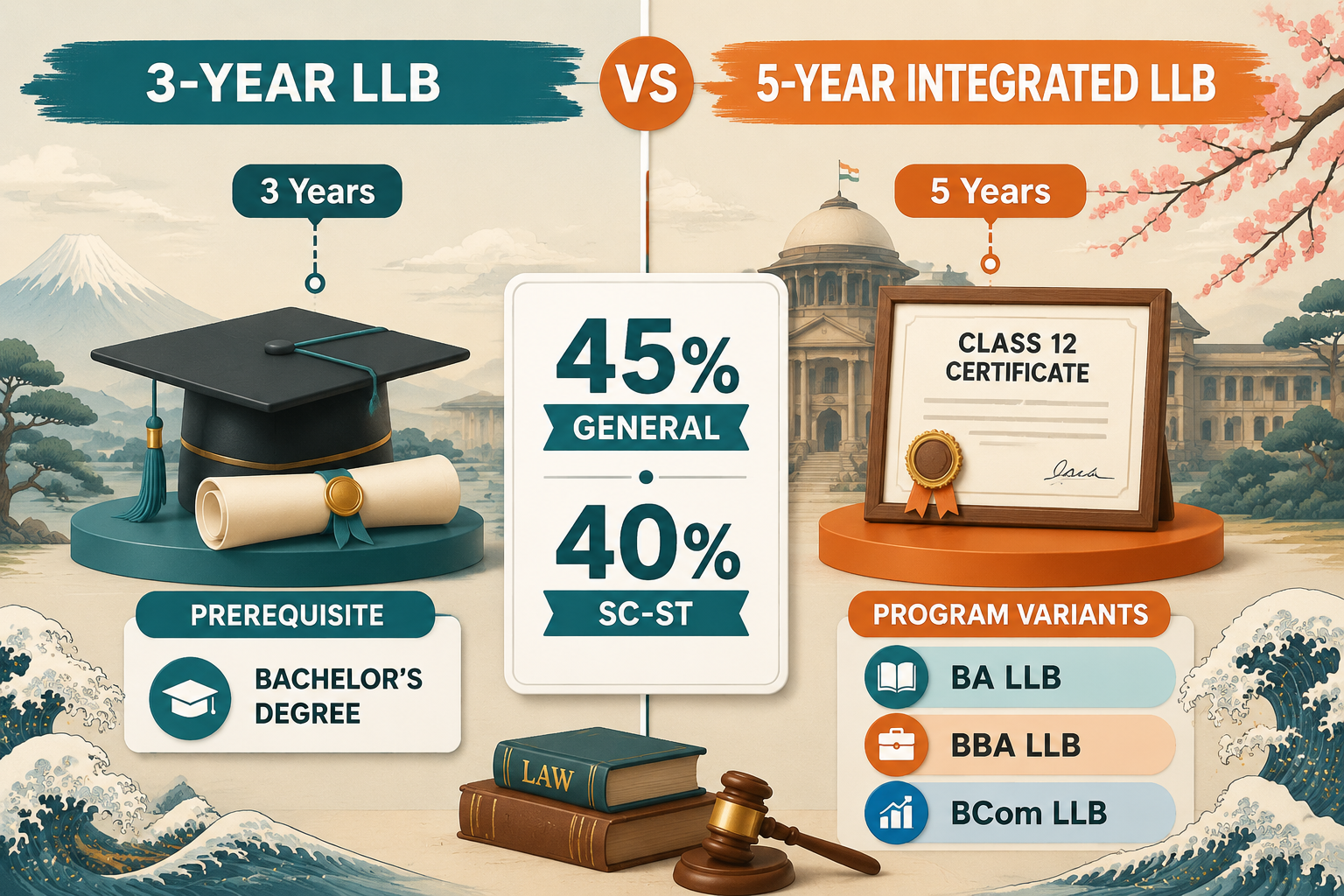
Quick Answer: The minimum percentage required for LLB after 12th is 45% aggregate marks in Class 12 for General category students, and 40% for SC/ST candidates. This applies to 5-year integrated LLB programs (like BA LLB, BBA LLB, BCom LLB) which are the only law route available directly after 12th. Marks alone won't get you in — most colleges also require a qualifying entrance exam score, with CLAT being the most prominent.
Key Takeaways
- 45% in Class 12 is the standard minimum for General category students seeking LLB admission after 12th [1][2][3]
- 40% for SC/ST candidates — a 5% relaxation applied across most institutions [1][2]
- Students from any stream (Science, Commerce, Arts) can apply for 5-year integrated LLB programs [1]
- The 3-year LLB is NOT available after 12th — it requires a prior bachelor's degree [2]
- Entrance exams like CLAT, AILET, and CUET LLB are mandatory for admission to top law colleges [2][4]
- Top NLUs and private colleges often set higher internal cutoffs than the 45% baseline [3]
- Program options include BA LLB, BBA LLB, BCom LLB, BSc LLB, BSW LLB, and BLS LLB [1]
- Some colleges admit students directly based on Class 12 scores without separate entrance tests [1]
- The 5-year program is structured across 10 semesters, combining undergraduate and legal education [1][2]
- Competitive NLUs typically look at CLAT rank more than board marks once the 45% threshold is cleared
What Is the Minimum Percentage Required for LLB After 12th?
The minimum percentage required for LLB after 12th is 45% aggregate marks in your Class 12 board examination for General category students. SC/ST candidates get a relaxation, with the minimum set at 40% [1][2][3].
Here's the thing — 45% is the floor, not the destination. Clearing that threshold makes you eligible to apply. Actually getting into a good law college depends heavily on your entrance exam performance.
| Category | Minimum % Required (Class 12) |
|---|---|
| General / OBC | 45% |
| SC / ST | 40% |
| Some private colleges | 50% (institution-specific) |
A few important clarifications:
- "Aggregate" means all subjects combined, not just your best five or your core subjects. Always check whether a college calculates aggregate differently.
- Some institutions set 50% as their minimum, especially private law colleges with competitive programs [3].
- Appearing candidates (those in their Class 12 final exams) can also apply provisionally, provided they meet the percentage requirement when results are declared.
"Clearing 45% gets you to the starting line. Your CLAT score determines where you finish."
3-Year LLB vs 5-Year Integrated LLB: Which One Applies After 12th?
After 12th, only the 5-year integrated LLB is available to you. Full stop. The 3-year LLB requires a completed bachelor's degree first [2].
This is one of the most common points of confusion among new aspirants. So let's clear it up properly.
5-Year Integrated LLB (After 12th)
- Eligibility: Class 12 pass with 45% (General) or 40% (SC/ST) [1]
- Duration: 5 years, divided into 10 semesters [1][2]
- Streams eligible: Science, Commerce, Arts — all streams welcome [1]
- Entry route: Entrance exam (CLAT, AILET, CUET LLB, etc.) + Class 12 marks
- Programs available: BA LLB, BBA LLB, BCom LLB, BSc LLB, BSW LLB, BLS LLB [1]
3-Year LLB (After Graduation)
- Eligibility: Bachelor's degree in any discipline (minimum 45-50% depending on college)
- Duration: 3 years, 6 semesters
- Entry route: DU LLB entrance, state bar council exams, or direct admission
- Who it's for: Working professionals, graduates who decided on law later
Choose 5-year integrated if: You're coming straight from Class 12 and want to start your legal career as early as possible. You'll graduate at roughly the same age as your peers who took a general graduation route.
Choose 3-year LLB if: You already have a bachelor's degree and want to add legal qualifications to an existing academic background.
The 5-year route is also strategically smarter for NLU aspirants — National Law Universities only offer the 5-year program, and getting into one through CLAT is the gold standard of legal education in India. For a deeper look at how CLAT scores translate to NLU admissions, check out this CLAT Marks vs Rank guide.
What Are the Different Types of 5-Year Law Programs Available After 12th?
The 5-year integrated LLB isn't a single program — it comes in several combinations, each pairing legal education with a different undergraduate discipline [1].
Program Variants and What They Mean
| Program | Undergraduate Component | Best For |
|---|---|---|
| BA LLB | Arts / Humanities | Students with interest in political science, history, sociology |
| BBA LLB | Business Administration | Students eyeing corporate law, mergers, commercial litigation |
| BCom LLB | Commerce | Tax law, financial regulations, banking law aspirants |
| BSc LLB | Science | IP law, environmental law, pharmaceutical law |
| BSW LLB | Social Work | Public interest law, human rights, NGO sector |
| BLS LLB | Legal Studies | Pure legal education focus |
Important note on BSc LLB: Some institutions require you to have studied Science in Class 12 to be eligible for this specific variant [1]. So if you're from Arts or Commerce, BSc LLB may not be an option for you at certain colleges.
BA LLB and BBA LLB are the most widely offered programs across NLUs and private law colleges. If you're unsure which to pick, BA LLB gives you broader exposure to social sciences that are genuinely useful in legal reasoning and advocacy.
How Do Top Law Colleges Actually Calculate Eligibility Beyond the 45% Baseline?
This is where it gets nuanced. The 45% minimum percentage required for LLB after 12th is a Bar Council of India (BCI) standard [7] — but individual colleges layer their own criteria on top of it.
Here's how the admission calculation typically works at different types of institutions:
National Law Universities (NLUs)
NLUs admit students almost entirely through CLAT rank. Your Class 12 percentage just needs to clear the 45% minimum. After that, your CLAT rank determines everything — which NLU you get, which program, which campus.
A student with 95% in boards but a poor CLAT rank will lose out to a student with 60% in boards and a strong CLAT score. That's the reality.
Private Law Colleges (Top Tier)
Many reputed private institutions use a combined merit formula:
- Class 12 marks (typically 30-40% weightage)
- Entrance exam score (CLAT, CUET LLB, or their own exam) (60-70% weightage)
Some institutions set their own minimum at 50% in Class 12, higher than the BCI baseline [3].
State Universities and Affiliated Colleges
Many state-level institutions admit based on:
- Class 12 marks only (no separate entrance exam required) [1]
- State-level law entrance exams (like MH CET Law for Maharashtra)
- Combined merit lists
Edge case: If you're applying to a college that uses only Class 12 marks, your board percentage becomes critically important. A student with 85% in boards will rank significantly higher than someone with 50%, even if both clear the 45% minimum.
For students exploring routes beyond CLAT, this Ultimate LLB Without CLAT Guide covers 15+ alternative admission paths in detail.
Which Entrance Exams Are Required for LLB Admission After 12th?
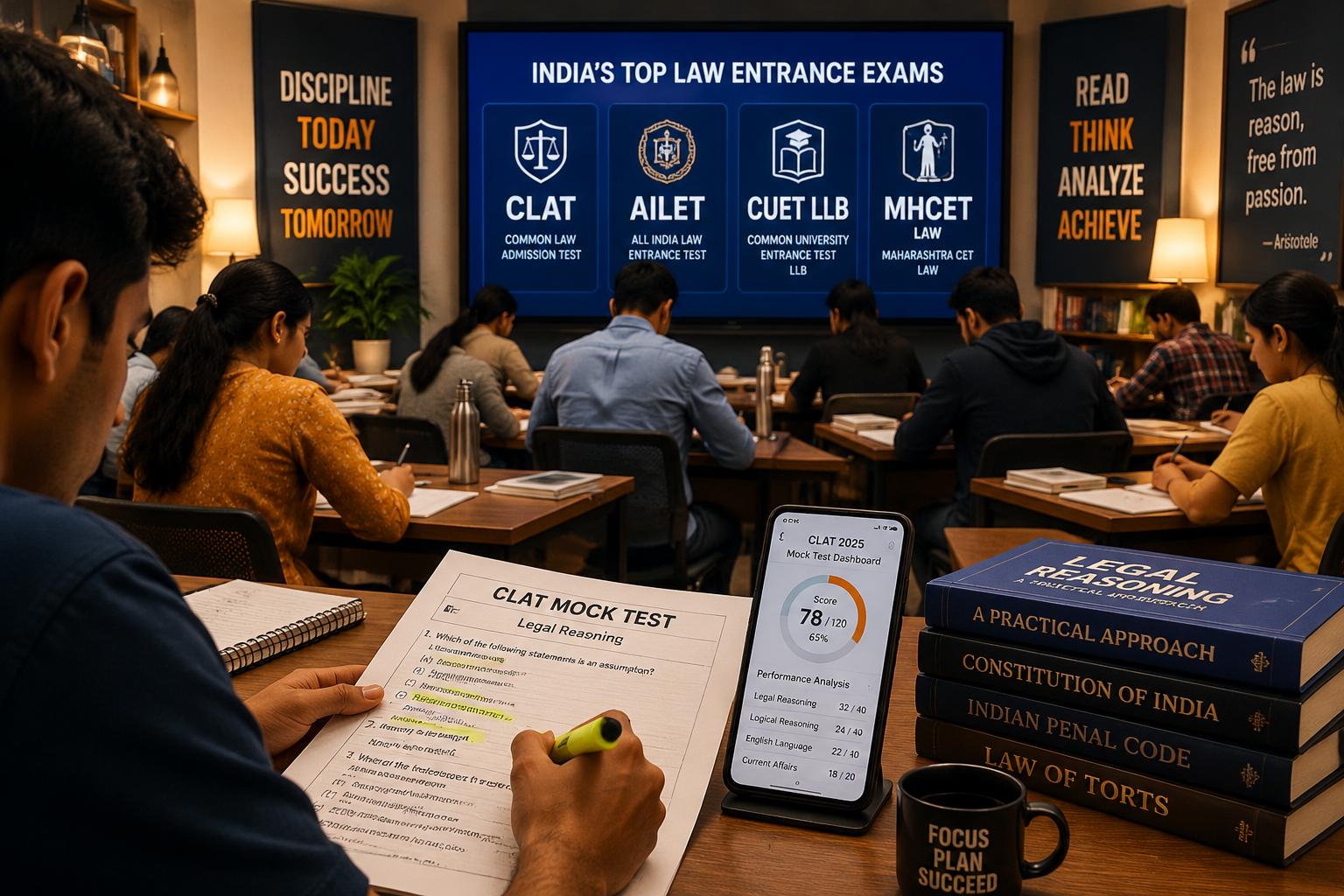
Most top law colleges require a qualifying entrance exam score in addition to your Class 12 marks [2][4]. Here's a breakdown of the major ones:
Major National Entrance Exams
| Exam | Conducting Body | Colleges Covered |
|---|---|---|
| CLAT | Consortium of NLUs | 24 NLUs + 50+ private colleges |
| AILET | NLU Delhi | NLU Delhi exclusively |
| CUET LLB | NTA | Central Universities |
| MHCET Law | State CET Cell, Maharashtra | Maharashtra law colleges |
| PU Law Entrance | Panjab University | Panjab University campuses |
Institution-Specific Exams
Some private universities conduct their own tests:
- UPESEAT (UPES, Dehradun)
- UL-SAT (University of Law)
- JMI BA LLB (Jamia Millia Islamia)
- DU LLB (Delhi University — for 3-year program only)
CLAT is the most important exam for NLU aspirants. It tests English language, current affairs and GK, legal reasoning, logical reasoning, and quantitative techniques. Getting your CLAT prep right is non-negotiable if you're aiming for a top NLU.
Our complete CLAT preparation coaching guide walks you through everything from exam structure to subject-wise strategy.
Also worth knowing: if you're targeting Panjab University specifically, the Complete PU Law Entrance Exam 2026 Guide has institution-specific prep advice.
Can Students With Average Grades Still Get Into Law School?
Yes — and this is genuinely good news for students who didn't score 90%+ in boards.
Let's be honest about how this works. Once you clear the 45% minimum (or 40% for SC/ST), your board percentage becomes much less important at NLUs and top private colleges. What matters far more is your CLAT rank.
Here's a realistic scenario:
- Student A: 92% in boards, CLAT score of 55/120
- Student B: 62% in boards, CLAT score of 95/120
Student B gets into a better NLU. Every time.
So if you're sitting at 60-65% in your boards and worried about your law school prospects, shift your energy entirely to CLAT preparation. That's where the game is won.
Where board percentage matters more:
- State university admissions based on merit lists
- Some private colleges that use combined scoring
- Colleges without entrance exams
Where board percentage matters less:
- NLU admissions via CLAT
- Most top private law colleges with their own entrance exams
Common mistake: Students with average board marks assume they can't get into good law colleges and don't attempt CLAT seriously. Don't make that mistake. Your CLAT score can open doors that board marks alone never could.
If you're wondering whether you can even crack CLAT without expensive coaching, read this honest self-study plan guide — results speak louder than promises, and plenty of students have done it.
What Are the Top Law Colleges and Their Specific Requirements?
Here's a practical overview of leading institutions and what they typically look for:
National Law Universities (NLUs) — CLAT Route
| NLU | Location | Admission Basis |
|---|---|---|
| NLSIU Bangalore | Karnataka | CLAT rank (top ~80 ranks) |
| NALSAR Hyderabad | Telangana | CLAT rank (top ~200 ranks) |
| NUJS Kolkata | West Bengal | CLAT rank (top ~300 ranks) |
| NLU Delhi | Delhi | AILET (separate exam) |
| NLU Jodhpur | Rajasthan | CLAT rank |
| HNLU Raipur | Chhattisgarh | CLAT rank |
| GNLU Gandhinagar | Gujarat | CLAT rank |
All NLUs require minimum 45% in Class 12 (40% for SC/ST) [1][7].
For a detailed breakdown of CLAT cutoffs and rank predictions, the CLAT 2026 NLU Cutoff Predictions guide is worth bookmarking.
Top Private Law Colleges
| College | Admission Basis | Min % Typically |
|---|---|---|
| Symbiosis Law School, Pune | SLAT score | 45-50% |
| Jindal Global Law School | JET / CLAT | 50% |
| UPES School of Law | UPESEAT / CLAT | 50% |
| Amity Law School | CLAT / Direct | 45% |
| Christ University Law School | CLAT / Direct | 45% |
State-Level Institutions
State universities like Panjab University, Mumbai University, and Osmania University conduct their own entrance exams or use merit-based admission. Requirements typically mirror the 45% baseline but vary by state reservation policies.
What Career Paths Open Up After a 5-Year LLB?
Completing a 5-year integrated LLB from a good institution opens up a genuinely wide range of career options. This is one area where legal education in India is seriously underrated.
Traditional Legal Careers
- Litigation Advocate: Practice in district courts, High Courts, or the Supreme Court
- Corporate Lawyer: Work with law firms or in-house legal teams at corporations
- Judicial Services: Appear for state judicial exams to become a civil judge or magistrate
- Public Prosecutor: Work with the government in criminal prosecution
Growing Specialization Areas
- Technology and Cyber Law: Data privacy, AI regulation, cybercrime — one of the fastest-growing legal fields globally
- Intellectual Property (IP) Law: Patents, trademarks, copyrights — especially relevant with India's expanding startup ecosystem
- Environmental Law: Climate litigation and environmental compliance are gaining serious traction
- International Trade Law: WTO disputes, cross-border transactions, international arbitration
- Alternative Dispute Resolution (ADR): Mediation and arbitration are increasingly preferred over litigation
Non-Litigation Careers
- Legal journalism and policy research
- Legal process outsourcing (LPO) — a major industry in India
- Academia and legal education
- Government advisory roles and civil services (UPSC)
- NGOs and human rights organizations
Technology's Impact on Legal Careers
This deserves its own mention. AI tools are already changing how legal research, contract drafting, and due diligence work. Law graduates who understand both law and technology will have a significant edge in the next decade. For more on this, the Ultimate Tech Tips for Tomorrow's Lawyers guide covers what law students need to know about the digital future of legal practice.
Emerging Specializations, Scholarships, and What Competitors Won't Tell You
Scholarship and Financial Aid Options
Law school can be expensive, but financial support exists:
- NLU Merit Scholarships: Several NLUs offer merit-based fee waivers for top CLAT rankers
- State Government Scholarships: SC/ST/OBC students can access central and state scholarship schemes
- Post-Matric Scholarship Scheme: Central government scholarship for students from economically weaker sections
- Private College Scholarships: Jindal Global Law School and Symbiosis offer need-based and merit-based aid
- Bar Council of India Trust Scholarships: Available for meritorious students in financial need [7]
Always check the official scholarship portal (scholarships.gov.in) and individual college financial aid pages during the application process.
Psychological and Skill Requirements for Law Students
Law school isn't just about marks. Successful law students typically share some common traits:
- Strong reading stamina: You'll read dense legal texts daily. Building reading speed and comprehension before law school is genuinely useful.
- Analytical thinking: The ability to break down complex arguments and spot logical flaws.
- Written communication: Legal writing is a distinct skill. Moot court competitions, legal aid clinics, and internships help develop it.
- Resilience: Law school is competitive and demanding. Mental health matters — and it's okay to acknowledge that.
Emerging Niche Specializations Worth Knowing About
- Space Law: India's growing space economy (ISRO, private space startups) is creating demand for legal expertise in space regulations
- Sports Law: Player contracts, doping disputes, broadcasting rights
- Fintech and Blockchain Law: Cryptocurrency regulation, digital assets, payment systems compliance
- Healthcare and Bioethics Law: Medical negligence, clinical trial regulations, organ transplant laws
International Law Education Opportunities
If you're aiming beyond India, a 5-year LLB from a top NLU can be a strong foundation for:
- LLM programs abroad (Harvard, Oxford, LSE, NYU all have Indian NLU alumni)
- Bar qualification in other jurisdictions (New York Bar, Solicitors Qualifying Exam in the UK)
- International arbitration careers in Singapore, London, or Geneva
The interdisciplinary nature of Indian 5-year programs — combining social sciences with law — is actually well-regarded internationally.
Practical Skills Beyond the Classroom: What Actually Builds Your Legal Career
Academic marks get you into law school. What you do inside law school builds your career. Here's what actually matters:
Moot Court Competitions: Participating in moots builds oral advocacy, research skills, and the ability to argue under pressure. Top firms actively recruit from moot court winners.
Internships: Start early. Even first and second-year students should intern with advocates, law firms, or legal aid organizations. Real exposure to legal practice is irreplaceable.
Legal Research and Writing: Publishing in law journals, contributing to legal blogs, or writing case commentaries builds your academic profile for postgraduate opportunities.
Networking: Law is a relationship-driven profession. Alumni networks from NLUs are powerful. Attend legal conferences, seminars, and bar association events.
Language Skills: Strong English is non-negotiable. A second language (Hindi, regional language, or even French for international law) is a genuine advantage.
Frequently Asked Questions
Q: What is the exact minimum percentage required for LLB after 12th?
The minimum is 45% aggregate in Class 12 for General category students, and 40% for SC/ST candidates. This is the BCI-mandated standard followed by most institutions [1][2][3].
Q: Does stream (Science/Commerce/Arts) matter for LLB eligibility?
Generally no — all streams are eligible for 5-year integrated LLB programs [1]. Exception: BSc LLB at some colleges requires a Science background in Class 12.
Q: Can I pursue LLB if I scored exactly 45% in Class 12?
Yes, 45% meets the minimum eligibility. However, admission to competitive colleges also depends on your entrance exam score. You'll likely qualify for state universities or private colleges with direct admission.
Q: Is CLAT mandatory for all law colleges?
No. CLAT is required for NLU admissions and accepted by many private colleges. Some institutions conduct their own exams (AILET, SLAT, MHCET Law), and some state colleges admit based on Class 12 marks alone [2][4].
Q: What if I'm appearing for Class 12 exams — can I still apply?
Yes. Appearing candidates can apply provisionally. Admission is confirmed once you submit your final marksheet showing the required percentage.
Q: Are there age limits for 5-year LLB programs?
The Bar Council of India previously had an age cap of 20 years (General) and 22 years (SC/ST/PwD) for UG law programs, but this has been a subject of legal challenge. Always check the current BCI guidelines and specific college notifications before applying [7].
Q: Which is better — BA LLB or BBA LLB?
It depends on your career goal. BA LLB suits those interested in litigation, constitutional law, or public policy. BBA LLB is better for corporate law, business transactions, and commercial litigation.
Q: Can students with 50-60% in boards get into top NLUs?
Yes, if their CLAT score is strong enough. NLUs primarily rank candidates by CLAT performance, not board marks (as long as the 45% minimum is met).
Q: How many NLUs are there in India?
As of 2026, there are 24 National Law Universities in India, all admitting through CLAT (except NLU Delhi, which uses AILET).
Q: What is the fee structure for 5-year LLB programs?
NLU fees typically range from approximately Rs. 1.5 lakh to Rs. 3 lakh per year. Private law colleges can range from Rs. 2 lakh to Rs. 8 lakh or more per year. Scholarship options can significantly reduce these costs.
Q: Is it possible to switch from a 5-year LLB to another field?
Yes. Law graduates regularly move into civil services, corporate roles, policy research, academia, and journalism. The analytical skills developed in law school are transferable.
Q: How competitive is CLAT compared to other entrance exams?
CLAT is one of India's most competitive law entrance exams, with roughly 70,000-80,000+ applicants competing for approximately 2,500 NLU seats annually. Preparation typically requires 6-12 months of focused study. Our 10 Essential CLAT Tips guide is a great starting point.
Conclusion: Your Next Steps Toward Law School
Let's bring this together. The percentage required for LLB after 12th is 45% for General category and 40% for SC/ST — that's your eligibility floor, set by the Bar Council of India. But clearing that threshold is just the beginning.
Here's what your action plan should look like:
- Confirm your Class 12 percentage meets the minimum for the colleges you're targeting
- Choose your program (BA LLB, BBA LLB, BCom LLB) based on your career interests
- Register for CLAT (or AILET/CUET LLB depending on your target colleges) — don't delay this
- Start structured preparation at least 6-12 months before the exam
- Research scholarship options early — financial planning matters
- Build skills beyond academics — reading, legal reasoning, current affairs
Your success is our mission at Lawgic Coaching. We've helped thousands crack CLAT with real mentors from top NLUs, flexible learning that fits your life, and expert guidance without the premium price tag. No cookie-cutter approach here — personalized attention you deserve, whether you're starting from scratch or fine-tuning your strategy.
Let's build your law career together. The 45% question is answered. Now it's time to focus on what actually gets you into the college you want.
Ready to take the next step? Explore our proven CLAT preparation strategies and start your journey with guidance that actually works.