Last updated: May 9, 2026
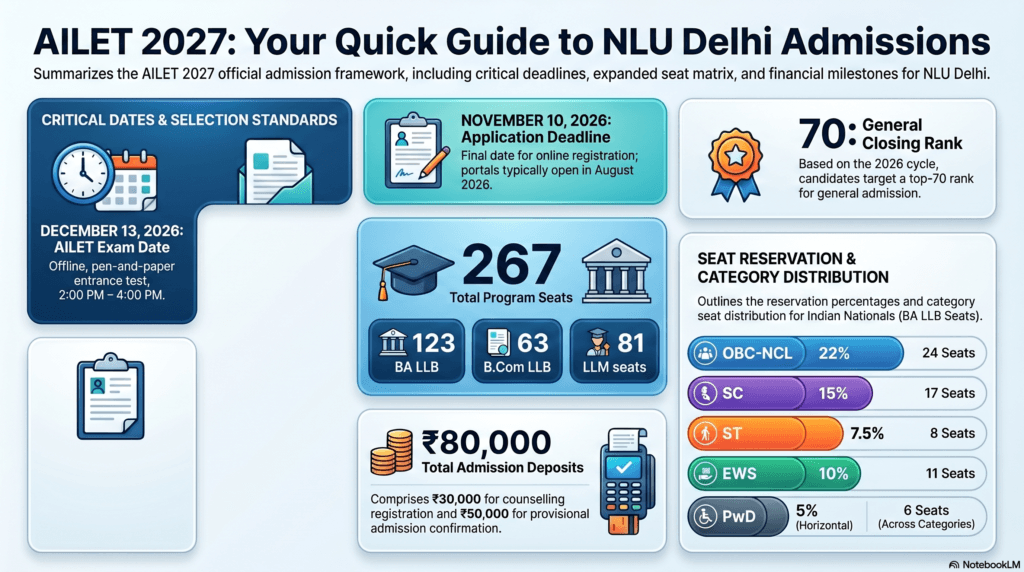
Quick Answer: NLU Delhi admits students through its own entrance exam — the All India Law Entrance Test (AILET), not CLAT. For 2027, the exam is scheduled for December 13, 2026, registration opens August 7, 2026, and the deadline is November 10, 2026. The university offers 123 BA LLB seats, 63 B.Com LLB seats, and 81 LLM seats. General category candidates need a closing rank inside the top 70 to secure a BA LLB seat. There is no Delhi domicile quota — 100% of seats are open to candidates from across India.
Key Takeaways
- NLU Delhi is the only National Law University that admits through AILET, not CLAT [1][2][3]
- AILET 2027 exam date is December 13, 2026, with registration opening on August 7, 2026 [1][7][8]
- BA LLB intake for 2027-28 is 123 seats; the new B.Com LLB programme adds 63 more seats [7][27][34]
- The Delhi domicile quota was removed — all 123 BA LLB seats are now national [7]
- BA LLB paper is 150 questions in 120 minutes, weighted heavily toward Logical Reasoning (47% of marks) [4][5][6]
- Negative marking is -0.25 per wrong answer [4][6][8]
- General category 2026 Round 2 closing rank was 70 — admissions effectively cap at the top 0.5% of applicants [1][39][40][41]
- Counselling registration fee is ₹30,000 for General/OBC/EWS and ₹20,000 for SC/ST/PwD; provisional admission costs another ₹50,000 [16][44][45]
- Reserved category eligibility: 45% in Class 12 for General, 42% for OBC-NCL, 40% for SC/ST/PwD [7][8][18][19]
- There is no upper age limit for any AILET programme — UG, PG, or PhD [3][17][18]
What Is NLU Delhi and Why Is Its Admission Different?
National Law University Delhi is one of India’s top three law schools, alongside NLSIU Bangalore and NALSAR Hyderabad. It opened in 2008 and has built its reputation on small batch sizes, a research-heavy faculty, and consistently strong placements at top-tier law firms and judicial clerkships.
Here’s the thing — NLU Delhi runs its own entrance exam called AILET (All India Law Entrance Test). The other 25 NLUs in India admit through CLAT, the Common Law Admission Test administered by the Consortium of NLUs. NLU Delhi sits outside that consortium [1][2].
This means two things if you want admission:
- AILET preparation is separate from CLAT preparation. The syllabus overlaps but the paper structure differs.
- AILET dates run on a different calendar. AILET happens in December every year, while CLAT happens later. You can attempt both — many serious aspirants do.
| Feature | NLU Delhi (AILET) | Other 25 NLUs (CLAT) |
|---|---|---|
| Conducting body | NLU Delhi itself | Consortium of NLUs |
| Exam mode | Offline, pen-and-paper | Offline, pen-and-paper |
| Total questions | 150 (UG) | 120 (UG) |
| Exam duration | 120 minutes | 120 minutes |
| Negative marking | -0.25 | -0.25 |
| Sections | English, GK, Logical Reasoning | English, GK, Legal Reasoning, Logical Reasoning, Quant |
If you’re new to law entrance exams, our What is CLAT? Full Form, Meaning, Eligibility & Why It Matters guide covers the broader landscape.
AILET 2027 Timeline: Dates That Matter
The AILET 2027 cycle follows a fixed administrative rhythm. Mark these dates because the application window is non-negotiable — late submissions are rejected.
| Event | Date |
|---|---|
| Notification release | August 7, 2026 |
| Registration opens | August 7, 2026 |
| Last date to apply | November 10, 2026 |
| Application correction window | Mid-November 2026 |
| Admit card release | 4th week of November 2026 |
| AILET 2027 exam | December 13, 2026 (2:00 PM – 4:00 PM) |
| Provisional answer key | December 14-15, 2026 |
| Result declaration | 3rd week of December 2026 |
| Counselling commences | Last week of December 2026 |
The university has historically extended the deadline by 2-3 days when technical issues come up at the portal. Don’t bank on it. Submit a week before the deadline.
Eligibility for NLU Delhi Admission
Eligibility depends on which programme you’re applying for. NLU Delhi runs four entrance routes through AILET — BA LLB, B.Com LLB, LLM, and PhD. Each has its own threshold.
BA LLB (Hons.) – 5-Year Integrated Programme
This is the flagship undergraduate programme. You’re eligible if:
- You have passed (or are appearing in) the 10+2 examination or equivalent [7][9][18]
- Your aggregate marks meet the category cutoff:
| Category | Minimum % in Class 12 |
|---|---|
| General | 45% |
| OBC (Non-Creamy Layer) | 42% |
| SC / ST / PwD | 40% |
Class 12 students appearing for the March/April 2027 board exams can apply provisionally. Final admission depends on producing the required marks at the time of joining (typically by early June 2027) [3][7][11][19].
There is no upper age limit. Droppers, working professionals, and career-switchers are all eligible — a deliberate inclusivity choice that distinguishes NLU Delhi from some other entrance exams [3][17][18][19][20].
B.Com LLB (Hons.) – New 5-Year Non-Residential Programme
NLU Delhi launched the B.Com LLB stream recently as a non-residential alternative to the BA LLB. Eligibility criteria mirror BA LLB. Total seats: 63 [7].
LLM – 1-Year Postgraduate Programme
For LLM, you need:
- An LLB or equivalent degree from a Bar Council of India recognised university
- 50% aggregate marks for General/OBC, 45% for SC/ST/PwD [1][3][18][19][22]
Final-year LLB students are allowed to apply on a provisional basis.
PhD in Law
PhD eligibility is the most demanding:
- LLM with 55% marks (50% for SC/ST/PwD/EWS) [7][20][23][24]
- Or a Bachelor’s in Law combined with a Master’s in Social Sciences/Humanities, where the research connects to legal public policy [23][24][25][26]
The PhD entrance is called AIET — All India Entrance Test for PhD — and follows a 70:30 weightage between the written test and a research proposal defence.
AILET 2027 Exam Pattern: What You’re Actually Sitting For
The undergraduate AILET paper has been simplified in recent years. The standalone “Legal Aptitude” section was removed, shifting the emphasis toward raw analytical and logical capability over rote legal knowledge [4][6][21].
BA LLB Pattern (UG)
| Section | Questions | Marks | Weightage |
|---|---|---|---|
| English Language | 50 | 50 | 33.3% |
| Current Affairs & General Knowledge | 30 | 30 | 20.0% |
| Logical Reasoning | 70 | 70 | 46.7% |
| Total | 150 | 150 | 100% |
Duration: 120 minutes. Marking: +1 correct, -0.25 incorrect [4][5][6][8][29].
“Logical Reasoning carries 47% of the paper. If you treat it as just another section, you’re already on the back foot. NLU Delhi rewards candidates who can apply rules to factual scenarios under time pressure — not those who memorise.”
LLM Pattern (PG)
The LLM entrance is 100 MCQs covering Jurisprudence, Constitutional Law, Public/Private International Law, and other branches of substantive law [21][30][31].
Tie-Breaking Rules
If two candidates have identical scores, NLU Delhi resolves the tie in this order:
- Logical Reasoning score (higher rank wins)
- Age seniority (older candidate ranks higher)
- Computer-generated draw of lots as the final fallback [12][15][29][44]
This is worth knowing because it confirms exactly how heavily Logical Reasoning is weighted — even after the marks are tied, it’s the first tiebreaker.
NLU Delhi Cutoffs: Closing Ranks 2025 and 2026
The closing rank for the General category at NLU Delhi is brutally tight. Two cycles of recent data:
BA LLB Closing Ranks
| Category | 2025 Closing Rank | 2026 Closing Rank (Round 2) |
|---|---|---|
| General | 61 | 70 |
| EWS | 290 | 298 |
| OBC (Non-Creamy Layer) | 522 | 369 |
| Scheduled Caste (SC) | 1,400 | 1,602 |
| Scheduled Tribe (ST) | 2,889 | 2,888 |
What that means in practice:
- For General category, a score of 120-135 marks typically lands you inside the cutoff in an average-difficulty year [42][43]. Anything below 120 is borderline.
- EWS and OBC-NCL candidates get more breathing room — scores in the 100-120 range are usually competitive.
- SC and ST ranks suggest scores in the 80-100 zone can still get an offer.
LLM Closing Ranks
The LLM programme is even more competitive in proportion to its 81 seats. General category closed at rank 58 in 2025 and rank 41 in 2026 Round 2 [1][40][41]. PG aspirants need to aim for an All India Rank inside the top 50 to be confident of admission in the early rounds.
Seat Matrix: Where the 123 BA LLB Seats Go
A major shift in recent cycles: the 50% Delhi domicile reservation was removed. All 123 BA LLB seats are now open to candidates nationally. This makes NLU Delhi harder to crack for Delhi-region students who previously had a structural advantage [7].
BA LLB Seat Distribution (2027-28)
| Category | Vertical Seats | PwD Horizontal (5%) | Effective Seats |
|---|---|---|---|
| General | 50 | 3 | 47 |
| OBC (Non-Creamy Layer) – 22% | 24 | 1 | 23 |
| Scheduled Caste – 15% | 17 | 1 | 16 |
| Scheduled Tribe – 7.5% | 8 | 0 | 8 |
| EWS – 10% | 11 | 1 | 10 |
| Subtotal (Indian Nationals) | 110 | 6 | 104 |
| Foreign Nationals / OCI / PIO | 10 | – | 10 |
| Kashmiri Migrants (supernumerary) | 1 | – | 1 |
| J&K Residents | 2 | – | 2 |
| Total | 123 | 6 | 123 |
NLU Delhi also applies a 30% horizontal reservation for women within each vertical category. This isn’t an additional seat block — it cuts across the existing vertical reservations.
LLM Seat Distribution
| Category | Total Seats |
|---|---|
| General | 32 |
| OBC-NCL | 15 |
| SC | 11 |
| ST | 5 |
| EWS | 7 |
| Foreign Nationals / OCI / PIO | 10 |
| Kashmiri Migrant | 1 |
| Total LLM | 81 |
Registration and Application Process
The application is fully online at NLU Delhi’s official portal. The category you select at registration is final — corrections are rarely allowed and inconsistencies can lead to disqualification [3][11][17][19].
Step-by-Step Application
- Create an account with email and mobile (OTP verification) [1][3][11]
- Select your programme — BA LLB, B.Com LLB, LLM, or PhD
- Fill personal and academic details
- Choose three preferred exam cities — allotment depends on preference and centre capacity. Cities with under 100 applicants may not get a centre, in which case you’re moved to your second or third preference [13][14][55]
- Upload documents:
– Recent passport-style photo (white background, face occupies 75% of frame, 15 KB-1 MB)
– Signature (black or blue ink on white)
– Category certificates (must be issued on or after April 1, 2026 to be valid for the 2027 cycle) [18][19][34]
- Pay the application fee online
Application Fee
| Category | Fee |
|---|---|
| General / OBC-NCL / EWS / Foreign Nationals | ₹3,000 – ₹3,500 |
| SC / ST / PwD | ₹1,000 – ₹1,500 |
| SC/ST Women (BPL) | Exempt |
A common mistake: candidates leave the application until the last week and then run into payment gateway timeouts or document-upload errors. Don’t do that.
Counselling and Final Admission
Counselling is where actual seats get allocated. The process runs entirely through the AILET portal and works on a 1:3 invitation ratio — three candidates are invited for every seat to make sure no seat goes unfilled [15][16][44][45].
Counselling Steps
- Receive the invitation via email/SMS based on your AILET rank
- Pay the counselling registration fee:
– ₹30,000 for General/OBC/EWS [16][44][45]
– ₹20,000 for SC/ST/PwD
- First Provisional Merit List is published — selected candidates must act fast
- Pay the Provisional Admission Confirmation Fee of ₹50,000 (non-refundable, but adjusted against final fees) [16][44][47]
- Document verification — digital first, then physical at the campus
- Sign undertakings — the offer letter, anti-ragging declaration, and conduct adherence
- Pay the final admission fee by the cutoff date (typically late April or early May 2027)
Refund Rules
If you register for counselling but never receive a seat offer, the registration fee is fully refunded after admissions close (usually around March-June of the following year) [45][47].
If you’re offered a seat and either don’t complete formalities or withdraw after the deadline, both the registration fee and the ₹50,000 confirmation fee are forfeited [19][44][45][47][48].
How to Prepare for AILET: Realistic Plans
Your preparation depends on how much time you have left. Below are three timelines that match what we’ve seen work for our students.
12+ Months (Class 11 / 1st Year UG / Early Dropper)
This is the ideal runway. Use it to build base reading speed, master the AILET-specific Logical Reasoning patterns, and develop a current affairs habit you can sustain.
- Months 1-3: Foundations. Daily newspaper reading. Basic logical reasoning concepts. Vocabulary building.
- Months 4-7: Section-wise practice. Full focus on Logical Reasoning since it’s 47% of the paper.
- Months 8-10: Mock test cycle. One full AILET mock per week, error analysis the next day.
- Months 11-12: Revision, mock-density increase, and exam-day simulation.
6 Months (Class 12 / Late Starter)
Tight but workable if you commit ~5-6 focused hours daily.
- Months 1-2: Skip foundations and go straight to topic-wise practice. Get hold of last 5 years of AILET papers.
- Months 3-4: Sectional mocks twice a week. Build up to full mocks.
- Months 5-6: Full mocks weekly + revision.
3 Months (Last-Minute Sprint)
This is hard but not impossible if you’ve already done some CLAT prep. Treat it as exam strategy, not concept learning.
- Month 1: Last 5 years of AILET papers, untimed first, then timed.
- Month 2: Full mocks, focus on Logical Reasoning weak spots
- Month 3: Revision and high-frequency mocks (every 2-3 days)
If you’re preparing for both CLAT and AILET, our Best CLAT Coaching in Chandigarh programme covers both exams in parallel.
“AILET candidates who score 130+ are almost always doing two things differently: they’re treating Logical Reasoning as the centrepiece of their prep, and they’re sitting full-length mocks under exam conditions at least 8-10 weeks before the actual paper.”
Common Mistakes Candidates Make
A few patterns we see repeatedly among students who miss the cutoff by 2-5 marks:
- Treating AILET prep as CLAT prep with extra steps. It’s not. The papers have different weights and different reasoning styles.
- Skipping Logical Reasoning practice. It’s almost half the paper. Skimping on it is the single fastest way to drop 30 marks.
- Memorising static GK without reading current affairs daily. The GK section is increasingly current-affairs heavy.
- Filing the application in the last week. Portal slowdowns, payment failures, document-upload errors — all real, all preventable.
- Choosing exam cities without checking centre capacity. If the city you want has fewer than 100 applicants, you’ll be redirected to the second preference. Pick three realistic cities.
- Submitting expired or wrong-dated category certificates. OBC-NCL and EWS certificates must be dated on or after April 1, 2026, for the 2027 cycle.
Frequently Asked Questions
Is NLU Delhi part of the CLAT consortium?
No. NLU Delhi runs its own entrance exam (AILET) and admits independently of the 25 NLUs that go through CLAT. You can attempt both AILET and CLAT in the same year.
Can I apply for NLU Delhi without taking AILET?
For Indian nationals, no — AILET is mandatory for BA LLB, B.Com LLB, LLM, and PhD. Foreign Nationals, OCI, and PIO candidates have a separate route based on academic merit.
What is the minimum percentage for AILET 2027?
For BA LLB and B.Com LLB: 45% in Class 12 for General category, 42% for OBC-NCL, 40% for SC/ST/PwD. For LLM: 50% in LLB for General/OBC, 45% for SC/ST/PwD. For PhD: 55% in LLM (50% for reserved categories).
How many attempts can I take at AILET?
There is no cap on the number of attempts. The university has no upper age limit either — you can keep applying as long as you meet the educational eligibility.
Is there any reservation for Delhi residents at NLU Delhi?
No. The 50% Delhi domicile quota was removed in recent cycles. All BA LLB seats are now open nationally on merit.
What’s the difference between AILET and CLAT?
AILET is conducted by NLU Delhi for admission to NLU Delhi only. CLAT is conducted by the Consortium of NLUs for admission to the other 25 NLUs. AILET has 150 questions in 120 minutes; CLAT has 120 questions in 120 minutes. The sections and weightage differ.
When will AILET 2027 results be announced?
Results are typically declared in the third week of December 2026, within 7-10 days of the exam. The provisional answer key comes out within 24-48 hours of the paper.
How much does NLU Delhi cost in total?
Beyond AILET application fees and counselling fees, the BA LLB programme has annual tuition in the ₹2.5-3 lakh range (residential), plus hostel and mess charges. Final fees are confirmed in the offer letter.
Begin Your AILET Preparation with Lawgic
Lawgic Coaching runs a structured AILET preparation track alongside our CLAT programme. Live classes, weekly mocks, dedicated Logical Reasoning drills, and one-on-one mentor calls — built specifically for the AILET paper, not generic law-entrance content.
If you want a free strategy session to plan your AILET 2027 timeline, book a call with a mentor or message us on WhatsApp.
Sources
- AILET 2027: Notification, Exam Date, Registration, Eligibility, Syllabus & Pattern — Careers360 (law.careers360.com)
- CLAT 2027 NLU List & Seat Matrix Guide — NLTI (clatnlti.com)
- What is AILET? All About NLU Delhi Law Entrance Exam — Law Prep Tutorial (lawpreptutorial.com)
- AILET UG Syllabus 2027 — LawEntrance (lawentrance.com)
- AILET 2027 Eligibility Criteria, Exam Pattern and Marking Scheme — Physics Wallah (pw.live)
- AILET 2027 Exam Pattern: Section-Wise Marks, Duration & Marking Scheme (lawentrance.com)
- AILET 2027 Notification | NLU Delhi Admission (rankersbuzz.com)
- AILET 2027 Notification PDF: Date, Registration, Official Details (lawpreptutorialkolkata.com)
- AILET Notification 2027: Exam Date, Application Form — Careers360 (law.careers360.com)
- NLU Delhi Cut-Off 2026: AILET Cut-off Rank 2026 — Law Prep Tutorial (lawpreptutorial.com)
- AILET 2026 Counselling Process — CollegeDekho (collegedekho.com)
- NLU Delhi Counselling Notification PDF (nationallawuniversitydelhi.in)