You’re staring at your screen, comparing CLAT online coaching options. One platform promises interactive live sessions. Another boasts unlimited access to recorded lectures. Both claim they’ll get you into your dream NLU.
Here’s the thing. This decision isn’t just about picking a format. It’s about matching your learning style, schedule, and preparation strategy with the right coaching method. The wrong choice could mean wasted months and missed opportunities.
When you’re figuring out how to choose between live classes vs recorded lectures for CLAT online coaching, you’re essentially deciding how you’ll spend the next several months of your life. That’s not a small decision.
Let’s be honest. Both formats work. Students crack CLAT through live classes. Others ace it with recorded lectures. The question isn’t which is better overall. It’s which is better for you.
Key Takeaways
- Live classes offer real-time interaction and structured schedules but require fixed time commitments
- Recorded lectures provide flexibility and unlimited revision opportunities but demand strong self-discipline
- Your choice should align with your learning style, daily schedule, and preparation timeline
- Hybrid models combining both formats often deliver the best results for CLAT preparation
- Success depends more on consistent effort than the format itself
Understanding the Two Primary CLAT Online Coaching Formats
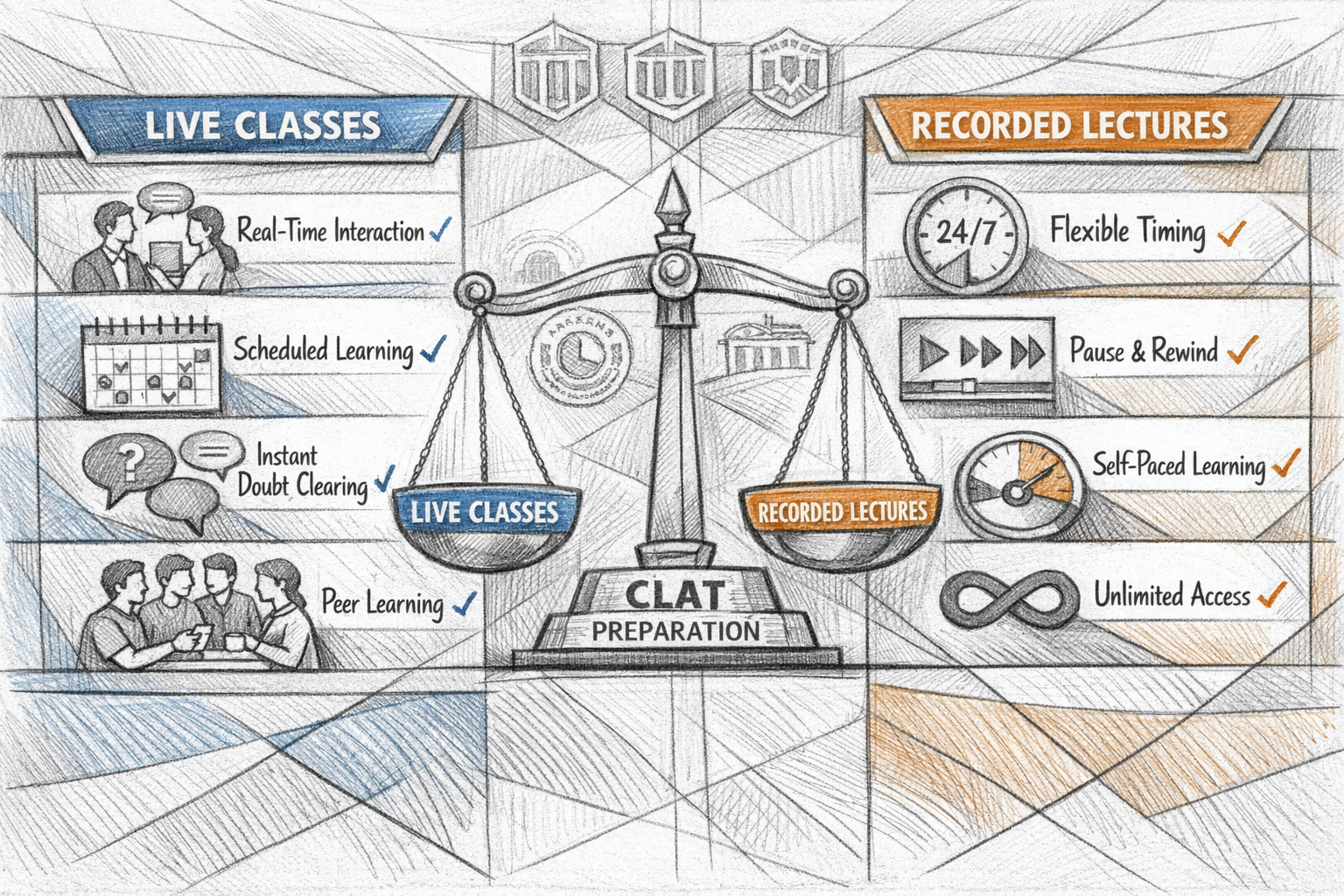
CLAT online coaching has evolved significantly in 2026. Gone are the days when you had only one option. Now, platforms like Lawgic Coaching offer multiple learning formats designed for different student needs.
Live classes happen in real time. You join at a scheduled hour, see your instructor teaching, ask questions through chat or audio, and learn alongside other aspirants. Think of it as a traditional classroom that moved online.
Recorded lectures are pre-recorded video sessions. You access them anytime, watch at your preferred speed, pause when needed, and revisit difficult concepts multiple times. It’s like having a personal tutor available 24/7.
Both formats aim for the same goal: getting you through that CLAT exam successfully. But they take different paths to get there.
The coaching industry has seen a 67% shift toward online platforms since 2024[1]. This isn’t just a trend. It reflects how seriously coaching institutes now take digital learning.
What Makes Live Classes Different
Live sessions create urgency. When class starts at 7 PM, you need to be there. That structure helps many students stay consistent.
The interaction is immediate. Doubt in legal reasoning? Raise your hand virtually. Confused about a quantitative technique? Ask right then. Your instructor responds within minutes, not days.
You’re learning with peers. Seeing others struggle with the same concepts makes preparation less lonely. Sometimes another student’s question clarifies something you didn’t even realize you didn’t understand.
What Makes Recorded Lectures Stand Out
Flexibility is the biggest advantage. Studying at 2 AM because that’s when you focus best? No problem. Need to skip a day for school exams? Your lectures wait for you.
You control the pace. Complex legal principle? Rewind and watch again. Easy topic? Speed through at 1.5x. This personalization is impossible in live settings.
The content stays consistent. Every student gets the same quality lecture from the same experienced faculty. No bad days, no rushed explanations because time ran out.
How Do I Choose Between Live Classes vs Recorded Lectures Based on My Learning Style?
Your brain doesn’t work like everyone else’s. Some people absorb information better through interaction. Others need quiet, focused study time.
Interactive learners thrive in live classes. If you learn best by asking questions, discussing concepts, and getting immediate feedback, live sessions match your style perfectly.
Independent learners excel with recorded lectures. If you prefer studying alone, taking notes at your own pace, and revisiting concepts multiple times, recordings give you that freedom.
Here’s something most coaching platforms won’t tell you. Your learning style isn’t fixed. It can change based on the subject. You might need live classes for tricky legal reasoning but do fine with recorded lectures for current affairs.
Assessing Your Self-Discipline Level
Let’s talk about something uncomfortable. Self-discipline.
Recorded lectures require serious self-control. Nobody checks if you watched today’s lecture. No attendance system tracks your progress. You’re completely responsible for staying on schedule.
One student at Lawgic Coaching shared how he initially chose recorded lectures for flexibility. Three weeks in, he’d fallen behind by 15 lectures. He switched to live classes and the structure saved his preparation[2].
Live classes provide external accountability. Scheduled sessions create routine. Your instructor notices if you’re missing classes. That external pressure keeps many students consistent.
But here’s the flip side. If you’re already disciplined, recorded lectures let you move faster. Why wait for Monday’s class when you could finish the entire week’s content by Wednesday?
Matching Format to Subject Requirements
Different CLAT sections benefit from different formats.
Legal reasoning and logical reasoning often work better in live classes. These sections involve problem-solving approaches that benefit from real-time discussion. When your instructor walks through a complex legal principle and takes questions, understanding deepens.
Current affairs and general knowledge suit recorded lectures well. You need to cover massive content. Recorded sessions let you speed through familiar topics and slow down for new information. You can also supplement with high-yield GK topics that need extra attention.
English comprehension works with both formats. But if you struggle with reading speed or vocabulary, live classes provide immediate clarification when you hit confusing passages.
Quantitative techniques often need repeated practice. Recorded lectures let you pause, solve problems yourself, then continue. This active learning approach builds stronger skills than passively watching someone solve problems live.
Evaluating Flexibility and Time Management Factors
Your daily schedule matters more than you think.
School students preparing for CLAT face different constraints than droppers. Working professionals pursuing CLAT PG have completely different availability. Your coaching format needs to fit your life, not the other way around.
Schedule Compatibility Analysis
Live classes demand fixed time slots. If your school ends at 3 PM and live classes start at 4 PM, that might work. But what about sports practice? Tuition classes? Family commitments?
One major advantage of online CLAT coaching is location independence. But live classes still need time commitment.
Recorded lectures eliminate scheduling conflicts. Your class happens when you decide. Morning person? Study at 6 AM. Night owl? Start at 10 PM. School event? Study later that day.
But this flexibility can backfire. Without fixed schedules, preparation often gets postponed. “I’ll watch it later” becomes “I’ll watch it tomorrow” becomes “I’m three weeks behind.”
Balancing School and CLAT Preparation
Most CLAT aspirants are in Class 11 or 12. School isn’t optional. Board exams matter.
Live classes during school hours obviously won’t work. Evening live sessions might clash with school homework or tuition. This is where recorded lectures shine.
You can balance school and CLAT preparation more effectively when you control your study timing. Watch lectures during free periods, weekends, or after completing school work.
However, some students need the structure of live classes precisely because they’re juggling multiple commitments. The fixed schedule forces them to allocate specific CLAT preparation time that otherwise gets consumed by other activities.
Handling Unexpected Disruptions
Life happens. You get sick. Family emergencies arise. School suddenly announces extra classes.
With live classes, you miss that session. Some platforms provide recordings of live sessions, which helps. But you lose the interactive element that made live classes valuable in the first place.
Recorded lectures handle disruptions gracefully. Miss a day? Start where you left off. Need a week off? Your lectures wait patiently.
This reliability matters during the long CLAT preparation journey. Consistency beats intensity, and recorded lectures make consistency easier to maintain through life’s unpredictability.
Comparing Access to Quality Educators and Doubt Resolution
Faculty quality matters enormously. The best CLAT coaching method means nothing if instructors can’t teach effectively.
Faculty Interaction Opportunities
Live classes create direct connections with instructors. You’re not just watching someone teach. You’re participating in their class.
Questions get answered immediately. Concepts get clarified on the spot. Good instructors adjust their teaching based on student responses during live sessions.
At Lawgic Coaching, faculty from top NLUs conduct both live and recorded sessions. But the interaction level differs dramatically.
Recorded lectures limit interaction to scheduled doubt-clearing sessions. You watch the lecture, note your questions, then ask them later through chat, email, or separate doubt sessions.
This delayed feedback loop frustrates some students. When you’re confused about a legal principle at 11 PM while watching a recorded lecture, you can’t get immediate help.
Doubt Clearing Mechanisms
How quickly you resolve doubts impacts preparation quality.
Live class doubt clearing happens during or immediately after sessions. Raise your hand virtually. Ask through chat. Get answers within minutes. This immediate resolution prevents confusion from compounding.
Recorded lecture doubt clearing typically involves:
- Discussion forums where you post questions
- Scheduled doubt sessions with faculty
- Email support with 24-48 hour response times
- Peer discussion groups
The delay can be frustrating. But it also encourages independent problem-solving. Often, by the time you articulate your question clearly enough to post it, you’ve figured out the answer yourself.
Some platforms now offer hybrid models. You watch recorded lectures but attend live doubt-clearing sessions. This combines flexibility with interaction.
Personalized Attention and Feedback
Here’s an uncomfortable truth. In a live class with 200 students, how much personal attention do you really get?
Large live classes offer limited personalization. Your question might get answered, but detailed feedback on your specific weaknesses? Unlikely.
Smaller live batches provide better personalization but cost more. You’re paying for that instructor’s limited time.
Recorded lectures democratize access to top faculty. Thousands of students can learn from the same expert instructor. But personalized feedback requires separate mechanisms like one-on-one mentoring sessions or detailed test analysis.
The best CLAT coaching platforms combine recorded lectures from top faculty with personalized mentorship from dedicated mentors. You get quality instruction plus individual attention.
Analyzing Cost-Effectiveness and Value for Money
Let’s talk money. CLAT preparation is an investment in your future. But not everyone has unlimited budgets.
Pricing Structure Differences
Live classes typically cost more. You’re paying for:
- Real-time instructor availability
- Limited batch sizes for better interaction
- Scheduled infrastructure and support staff
- Live doubt resolution
Recorded lectures often cost less because:
- One recording serves unlimited students
- No real-time infrastructure needed
- Scalability reduces per-student costs
- Fewer support staff required
At Lawgic Coaching, we believe law school dreams shouldn’t be expensive. That’s why our recorded lecture programs provide expert guidance without the premium price tag.
But price alone doesn’t determine value. A cheaper program that doesn’t get you through CLAT costs more in the long run than a pricier program that does.
Hidden Costs to Consider
Beyond course fees, consider:
Time costs: Live classes might require 2-3 hours daily at fixed times. If that timing doesn’t suit you, you’re wasting time adjusting your schedule.
Opportunity costs: Can you study other subjects or take mock tests during the time you’re attending live classes? Recorded lectures let you optimize your entire preparation schedule.
Supplementary material costs: Some live class programs include everything. Others charge extra for test series, study materials, or doubt sessions. Check what’s actually included.
Repeat costs: Failed CLAT and need another year? Some recorded lecture programs offer multi-year access. Live class programs typically require repayment for the next year.
Return on Investment Perspective
The best investment is the one that gets you into a top NLU.
Success rates matter more than price. A program costing 50,000 rupees with a 40% success rate delivers better ROI than a 30,000 rupee program with 15% success rate.
Unfortunately, most coaching institutes don’t publish verified success rates. They showcase toppers but hide overall statistics.
Ask specific questions:
- How many students enrolled last year?
- How many scored above 100 in CLAT?
- What percentage got into top 10 NLUs?
Your success is our mission at Lawgic Coaching. We’ve helped thousands crack CLAT through proven strategies that actually work, not just marketing promises.
Examining Study Materials and Resource Accessibility
Content quality and accessibility determine how effectively you prepare.
Material Comprehensiveness
Both formats should provide:
- Complete syllabus coverage
- Updated current affairs
- Practice questions
- Mock tests
- Previous year papers
Live classes often provide materials progressively. You receive this week’s content during this week’s classes. This prevents overwhelm but limits advance planning.
Recorded lecture programs typically provide all materials upfront. You can see the entire curriculum, plan your preparation, and even study ahead if you’re moving fast.
The best books for CLAT preparation supplement your coaching materials. Neither live nor recorded classes eliminate the need for good reference books.
Resource Availability and Downloads
Can you download videos for offline viewing? This matters if you have unreliable internet or want to study while traveling.
Live classes rarely offer downloads. You might get recordings, but streaming-only access limits flexibility.
Recorded lectures often allow downloads. Watch on your phone during commute. Study in areas with poor connectivity. This accessibility extends your study opportunities.
Study materials should be downloadable regardless of format. PDFs of notes, question banks, and current affairs compilations let you study even when devices aren’t available.
Updates and Current Affairs Integration
CLAT heavily tests current affairs. Your coaching must provide regular updates.
Live classes integrate current affairs naturally. Instructors discuss recent developments during sessions. This keeps content fresh and relevant.
Recorded lectures face an update challenge. A lecture recorded in January might miss important February events. Quality platforms address this through:
- Regular current affairs supplements
- Monthly update sessions
- Downloadable current affairs PDFs
- Dedicated GK update modules
Check how your chosen platform handles current affairs. Static content won’t cut it for CLAT 2026.
Understanding Practice and Mock Test Integration
Preparation without practice is like learning to swim without entering water.
Mock Test Frequency and Quality
How many mock tests does the program provide? How closely do they match actual CLAT difficulty and pattern?
Live class programs often integrate tests with the teaching schedule. Complete a module, take a test. This structured approach ensures regular practice.
Recorded lecture programs might provide all tests upfront. You decide when to take them. This flexibility helps if you want to complete content before starting intensive testing.
Test quality matters more than quantity. Ten well-designed tests beat fifty random question compilations. Look for tests that:
- Match current CLAT pattern
- Reflect actual difficulty level
- Provide detailed solutions
- Offer performance analysis
The CLAT mock test experience should simulate actual exam conditions. Time pressure, question variety, and difficulty should prepare you for the real thing.
Performance Analysis and Improvement Tracking
Taking tests means nothing without analyzing performance.
Good coaching platforms provide:
- Detailed score reports
- Section-wise analysis
- Comparison with peer performance
- Weakness identification
- Improvement tracking over time
Live class programs might discuss test performance during sessions. Instructors highlight common mistakes and explain difficult questions.
Recorded lecture programs typically provide automated analysis. You access detailed reports showing exactly where you’re strong and where you need work.
Some platforms offer personalized improvement plans based on test performance. This data-driven approach helps you focus effort where it matters most.
Practice Question Integration
Beyond full-length mocks, daily practice matters.
Live classes might assign homework questions. You solve them, submit answers, and get feedback during the next session.
Recorded lecture programs often include practice questions within or after each lecture. Solve them immediately while concepts are fresh.
The best approach includes:
- Topic-wise practice after each module
- Weekly mixed-topic tests
- Monthly full-length mocks
- Previous year paper practice
Your coaching format should support this layered practice approach. Whether live or recorded, consistent practice opportunities are non-negotiable.
Weighing the Psychological and Motivational Aspects

Preparation is a mental game as much as an academic one.
Peer Learning and Competition
Humans are social creatures. We learn from and compete with peers.
Live classes create community naturally. You see other students in the virtual classroom. You notice who asks smart questions. You feel motivated when peers perform well.
This peer pressure can be positive. Healthy competition pushes you to work harder. Seeing others succeed makes success feel achievable.
But peer pressure can also overwhelm. Constantly comparing yourself to toppers creates anxiety. Some students perform better without the competitive atmosphere.
Recorded lectures offer solitude. You study alone, at your pace, without comparison. This suits students who find competition stressful.
However, isolation can reduce motivation. Without peers, you might not realize you’re falling behind. You miss the motivational boost of group energy.
Many platforms now create peer communities even for recorded lecture students. Discussion forums, study groups, and social media communities provide connection without requiring synchronized learning.
Accountability and Discipline Systems
Who keeps you accountable when motivation fades?
Live classes build accountability through:
- Attendance tracking
- Regular assignments with deadlines
- Instructor check-ins
- Peer awareness of your participation
This external accountability helps when self-motivation fails. You attend class not just because you want to, but because someone notices if you don’t.
Recorded lectures demand internal accountability. You’re responsible for:
- Watching lectures on schedule
- Completing practice questions
- Taking mock tests regularly
- Staying on track with syllabus
Some students thrive with this independence. Others struggle without external pressure.
Quality recorded lecture programs build accountability through:
- Progress tracking dashboards
- Mentor check-ins
- Deadline reminders
- Completion certificates for modules
At Lawgic Coaching, we provide personalized attention you deserve even in recorded lecture programs. Regular mentor interactions keep you accountable without requiring synchronized class attendance.
Managing Exam Stress and Anxiety
CLAT preparation is stressful. Your coaching format can either help or hurt your mental health.
Live classes provide emotional support. Seeing your instructor regularly creates connection. Hearing peers share struggles normalizes your own anxiety. This community reduces isolation.
But live classes can also increase stress. Falling behind feels more obvious. Struggling with concepts in front of peers feels embarrassing. Performance pressure intensifies.
Recorded lectures offer privacy. You can struggle with concepts without anyone watching. You can take mental health breaks without explaining absences.
However, isolation can worsen anxiety. Without community support, stress feels overwhelming. You might not realize that everyone struggles with certain topics.
The CLAT exam anxiety guide provides strategies regardless of your coaching format. But consider which format naturally reduces your stress level.
Making Your Decision: A Practical Framework
You’ve absorbed a lot of information. Now let’s make this practical.
Creating Your Personal Decision Matrix
Grab paper or open a document. Create two columns: Live Classes and Recorded Lectures.
List factors that matter to you:
- Schedule flexibility
- Budget constraints
- Learning style
- Self-discipline level
- Need for interaction
- Preparation timeline
- Subject-specific needs
Rate each format on each factor from 1-10. Be honest. This isn’t about which format sounds better. It’s about which fits your actual situation.
Add up the scores. The higher number indicates your better fit.
But don’t stop there. Some factors matter more than others. If budget is a dealbreaker, weight that factor more heavily.
Trial Periods and Sample Classes
Don’t commit blindly. Test before investing.
Most quality platforms offer:
- Free trial periods
- Sample lectures
- Demo live classes
- Money-back guarantees
Use these opportunities. Watch a few recorded lectures. Attend a live class. Notice how you feel.
Do recorded lectures make you feel lost without interaction? Do live classes feel restrictive with fixed schedules? Your gut reaction matters.
At Lawgic Coaching, we encourage trying both formats. Some students start with recorded lectures for flexibility, then add live doubt sessions for interaction. Others begin with live classes, then access recordings for revision.
The Hybrid Approach Advantage
Here’s what most articles won’t tell you. You don’t have to choose just one.
The most effective CLAT preparation often combines both formats:
- Recorded lectures for content coverage
- Live doubt-clearing sessions for interaction
- Recorded lectures for revision before exams
- Live mock test discussions for strategy
This hybrid model provides:
- Flexibility of recorded content
- Interaction of live sessions
- Comprehensive coverage
- Multiple revision opportunities
Many students at Lawgic Coaching use this approach. They watch recorded lectures at their convenience, attend live doubt sessions weekly, and join live strategy sessions before major mock tests.
The hybrid approach costs more than pure recorded lectures but less than pure live classes. It delivers benefits of both formats while minimizing drawbacks.
Common Mistakes to Avoid When Choosing CLAT Coaching Formats
Learn from others’ mistakes.
Choosing Based on Popularity Alone
Your friend cracked CLAT through live classes. Therefore, you should too. Right?
Wrong.
What works for someone else might not work for you. Your friend might be naturally disciplined, making recorded lectures unnecessary. You might need that structure.
Similarly, just because recorded lectures are trending doesn’t mean they suit everyone. Some students genuinely learn better through real-time interaction.
Make your decision based on your needs, not others’ experiences. The mistakes to avoid when choosing CLAT coaching include following the crowd without self-assessment.
Ignoring Your Actual Daily Schedule
You plan to wake up at 5 AM daily to watch recorded lectures. You’ve never woken up at 5 AM in your life, but CLAT motivation will change that.
It won’t.
Be realistic about your schedule and habits. If you’re not a morning person, don’t plan morning study sessions. If you struggle with self-discipline, recorded lectures might not work despite their flexibility.
Choose a format that fits your actual life, not your idealized version of yourself.
Overlooking Technical Requirements
Live classes need stable internet during specific hours. Can your internet handle video streaming reliably? What happens when it fails during an important session?
Recorded lectures need storage space if you’re downloading videos. Does your device have enough space? Can you stream without data concerns?
Technical limitations can derail even the best coaching choice. Assess your technical setup before committing.
Focusing Only on Price
The cheapest option isn’t always the best value. A low-cost program that doesn’t prepare you adequately wastes money and time.
Similarly, the most expensive program isn’t automatically the best. High prices sometimes reflect marketing costs, not teaching quality.
Evaluate value, not just price. What do you get for your investment? Does it match your needs? Will it realistically help you crack CLAT?
Real Student Experiences and Success Stories
Theory is helpful. Real experiences are better.
Success with Live Classes
Priya from Delhi joined live classes in 2025. She struggled with self-discipline and needed structure. The fixed schedule forced her to study daily. She scored 118 in CLAT 2026 and got into NLSIU Bangalore.
Her key insight: “Live classes kept me accountable. On days I didn’t feel like studying, the scheduled class made me show up anyway. That consistency made the difference.”
Priya’s learning style matched live classes perfectly. She learned best through discussion and needed external accountability.
Success with Recorded Lectures
Rahul from Mumbai chose recorded lectures because of his school schedule. He studied late nights and weekends, completing the curriculum faster than the standard pace. He scored 122 in CLAT 2026 and joined NALSAR Hyderabad.
His key insight: “Recorded lectures let me study when I was most focused. I could pause and take notes properly. I could rewatch complex topics until I understood completely.”
Rahul’s self-discipline and preference for independent learning made recorded lectures ideal for him.
Success with Hybrid Approach
Ananya from Pune used both formats. She watched recorded lectures for content coverage, attended live doubt sessions weekly, and joined live strategy sessions before tests. She scored 115 in CLAT 2026 and got into NLUD Delhi.
Her key insight: “The hybrid approach gave me flexibility plus support. I didn’t feel isolated like pure recorded lectures, but I wasn’t restricted by fixed schedules either.”
Ananya’s balanced approach shows that combining formats often delivers the best results.
Your Next Steps: Taking Action on Your Decision
You’ve read this entire guide. You understand both formats. Now what?
Immediate Action Items
This week:
- Complete the personal decision matrix above
- List your top three priorities for CLAT coaching
- Check your budget and available study time
- Research platforms offering your preferred format
Next week:
- Sign up for free trials of 2-3 platforms
- Attend sample live classes
- Watch sample recorded lectures
- Read reviews from actual students
Within two weeks:
- Make your decision
- Enroll in your chosen program
- Create a study schedule
- Start your CLAT preparation journey
Questions to Ask Coaching Platforms
Before enrolling, ask:
- What is your actual success rate, not just topper stories?
- Can I switch between live and recorded formats if needed?
- What doubt-clearing mechanisms do you provide?
- How frequently do you update current affairs content?
- What happens if I need to pause my preparation temporarily?
- Do you provide personalized mentorship beyond lectures?
- What is your refund policy if the format doesn’t work for me?
Quality platforms answer these questions transparently. Evasive answers signal problems.
Setting Realistic Expectations
Neither format guarantees success. Both require consistent effort.
Expect to spend 4-6 hours daily on CLAT preparation regardless of format. Expect to struggle with some concepts. Expect to feel overwhelmed occasionally.
The format just determines how you engage with the content. Your effort determines your result.
Results speak louder than promises. At Lawgic Coaching, we’ve helped thousands crack CLAT because we combine quality teaching with realistic preparation strategies.
Building Your Support System
Regardless of format, build support systems:
Academic support:
- Mentors for guidance
- Peer groups for discussion
- Faculty for doubt clearing
Emotional support:
- Family understanding your preparation demands
- Friends who encourage rather than distract
- Counselors if anxiety becomes overwhelming
Practical support:
- Quiet study space
- Reliable internet and devices
- Access to study materials
Your coaching format is one piece of a larger preparation ecosystem. Build the entire system for best results.
Conclusion: The Right Choice is Personal
So, how do you choose between live classes vs recorded lectures for CLAT online coaching?
The honest answer: it depends on you.
Live classes work brilliantly for students who need structure, thrive on interaction, and have compatible schedules. Recorded lectures excel for self-disciplined students who value flexibility and prefer independent learning.
Most importantly, both formats can get you into top NLUs if you use them consistently and effectively.
The format matters less than your commitment. Students fail with live classes when they don’t engage. Students fail with recorded lectures when they don’t maintain discipline. Students succeed with both formats when they show up consistently and work hard.
Your success is our mission. Whether you choose live classes, recorded lectures, or a hybrid approach, we’re here to guide you every step of the way with expert guidance without the premium price tag.
Start by honestly assessing your learning style, schedule, and discipline level. Try sample classes from both formats. Trust your gut about what feels right.
Then commit fully to your chosen format. Don’t second-guess. Don’t keep switching. Give it your best effort for at least a month before evaluating.
The right CLAT coaching format is the one you’ll actually use consistently. Make your choice, start preparing, and let’s build your law career together.
Your dream NLU is waiting. The only question is: are you ready to put in the work to get there
References
[1] Online Education Market Research Report, Indian EdTech Industry Analysis 2024-2026
[2] Student testimonials and success stories, Lawgic Coaching Internal Data 2025-2026
Find Your Perfect CLAT Coaching Format
Answer these questions to discover whether live classes, recorded lectures, or a hybrid approach suits you best

