The CLAT 2027 preparation landscape has shifted dramatically, and smart aspirants know that current affairs isn’t just about memorizing random facts anymore. With the exam pattern emphasizing passage-based questions worth 25% of your total score, you need a strategic approach to tackle the Top 100 GK & Current Affairs Topics for CLAT 2027: Bills, Judgments, and Space Missions that are most likely to appear in your exam.
Here’s the reality: CLAT examiners draw from events spanning the past 12-18 months, focusing heavily on legislative developments, landmark judicial decisions, and significant space achievements. Your success depends not just on knowing these topics, but understanding how they connect to broader legal and constitutional principles.
Key Takeaways
• Legislative Focus: Recent bills like the Waqf (Amendment) Bill 2024, Broadcasting Services (Regulation) Bill, and Telecommunications Act 2023 are high-priority topics
• Judicial Milestones: Supreme Court decisions on women’s representation, electoral bonds, and constitutional bench rulings dominate the judicial landscape
• Space Achievements: Gaganyaan mission updates, Chandrayaan-3 success, and international space collaborations feature prominently
• Passage Strategy: Practice with 450-word passages from journalistic sources covering these topics for optimal exam performance
• Timeline Approach: Focus on events from July 2024 to February 2026 for maximum relevance to CLAT 2026
Understanding CLAT 2027 Current Affairs Pattern and Weightage
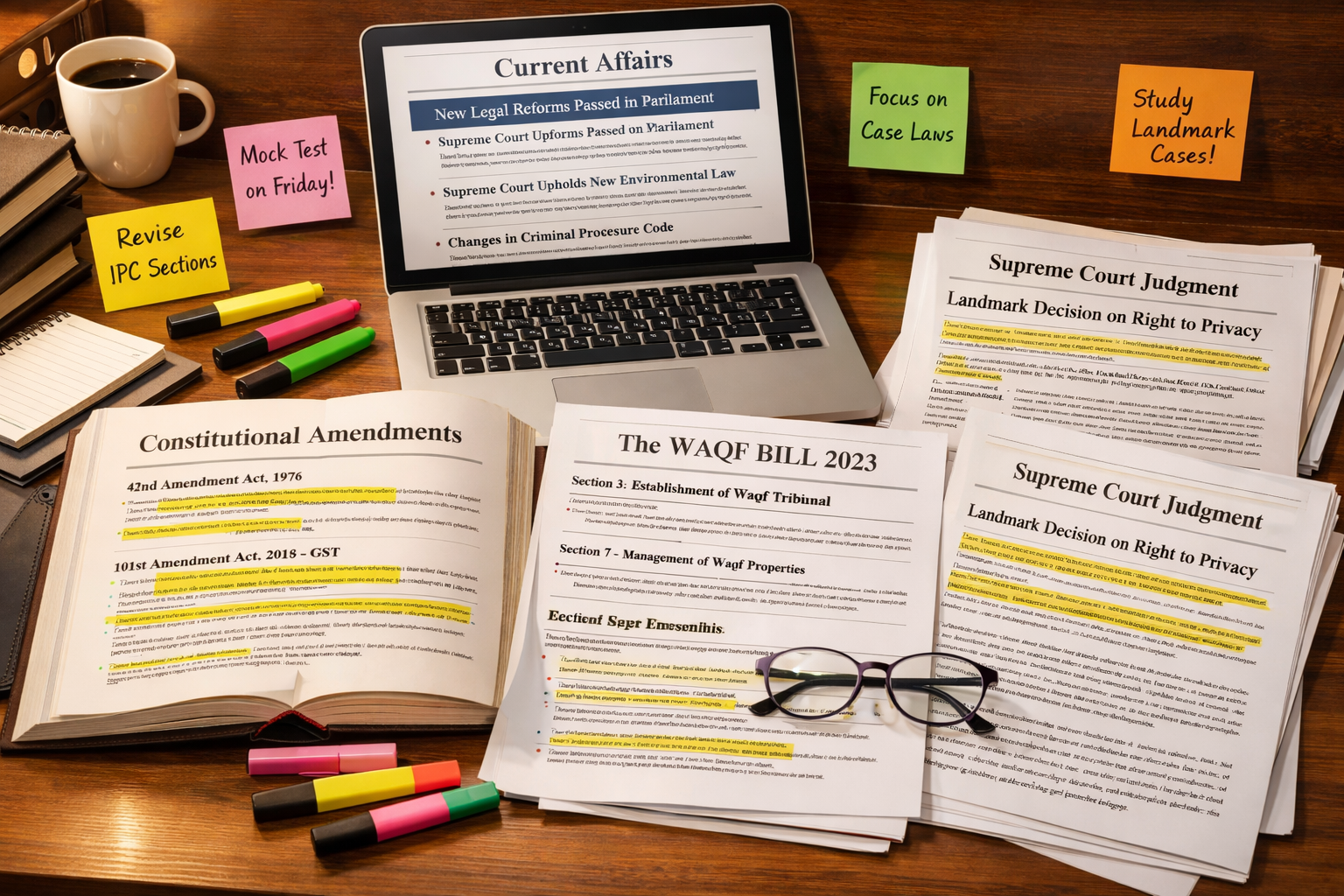
The current affairs section in CLAT has evolved into something far more sophisticated than traditional GK questions. According to the official CLAT syllabus, this section carries 28-32 questions representing approximately 25% of the total exam weightage [1].
What makes this section particularly challenging is its passage-based format. You’ll encounter 400-450 word passages sourced from contemporary news articles and journalistic content [2]. These passages don’t just test your memory—they evaluate your ability to comprehend, analyze, and apply current knowledge to legal reasoning.
The content focus spans events from the past 12-18 months at the time of the exam, which means for CLAT 2026, you’re looking at developments from approximately July 2024 through February 2026 [3]. This timeline is crucial because it helps you prioritize your preparation and avoid wasting time on outdated information.
Breaking Down the Question Types
Current affairs questions in CLAT 2027 fall into several distinct categories:
Legal & Political Developments form the backbone of this section. Recent constitutional amendments, important bills passed by Parliament, and significant policy changes feature prominently. The examiners particularly favor topics that have broader constitutional or legal implications.
National & International Events cover everything from major awards and appointments to government schemes, international summits, and bilateral agreements. These questions often test your understanding of India’s position in global affairs.
Science & Technology has gained increased importance, especially developments in space exploration, defense technology, environmental innovations, and health sector breakthroughs.
The remaining questions touch on History, Geography, Economics, Polity, Art & Culture, and Miscellaneous GK, but always with a contemporary angle [4].
For aspirants looking to strengthen their foundation, our comprehensive guide to CLAT legal topics provides essential background knowledge that complements current affairs preparation.
Essential Legislative Bills and Parliamentary Developments for CLAT 2027
Legislative developments have dominated the Indian political landscape over the past 18 months, making them prime candidates for CLAT 2027 questions. Understanding these bills isn’t just about knowing their names—you need to grasp their constitutional significance, implementation challenges, and broader legal implications.
Priority Legislative Bills
The Waqf (Amendment) Bill 2024 stands as one of the most significant legislative proposals affecting religious and property rights. This bill proposes substantial changes to the Waqf Act of 1995, including mandatory registration of waqf properties, enhanced transparency in waqf board operations, and stricter audit requirements. The constitutional implications touch on federalism, religious freedom under Article 25-26, and property rights.
The Broadcasting Services (Regulation) Bill 2024 represents a comprehensive overhaul of India’s media regulation framework. This legislation aims to replace the outdated Cable Television Networks Act and addresses digital broadcasting, OTT platform regulation, and content classification standards. For CLAT aspirants, this bill connects to fundamental rights under Article 19, media ethics, and the balance between free speech and reasonable restrictions.
The Telecommunications Act 2023 has already been enacted and represents one of the most significant updates to India’s telecom regulatory framework in decades. This act consolidates multiple previous laws, addresses 5G spectrum allocation, cybersecurity provisions, and digital infrastructure development. Its implications for privacy rights, digital governance, and economic policy make it a high-probability CLAT topic.
Parliamentary Proceedings and Constitutional Amendments
The Women’s Reservation Act implementation has seen significant developments in 2024-2025, with the delimitation process and constituency reorganization creating substantial legal and political discussions. This topic connects directly to constitutional law, federalism, and gender justice—all core CLAT themes.
The Uniform Civil Code debates in various state assemblies, particularly Uttarakhand’s implementation efforts, have created a rich source of current affairs content. These developments touch on Article 44 (Directive Principles), personal law, and the secular character of the Indian state.
Recent GST Council decisions and amendments to tax structures have economic and federal implications that frequently appear in CLAT questions. The 50th GST Council meeting’s decisions on tax rationalization and compliance simplification are particularly relevant.
For students who find legislative topics challenging, our strategies for overcoming CLAT preparation hurdles can help break down complex political developments into manageable study units.
State-Level Legislative Developments
Several state-level bills have gained national attention and constitutional scrutiny. Karnataka’s Anti-Conversion Bill, Maharashtra’s Maratha Reservation Act, and Tamil Nadu’s NEET exemption attempts all represent the ongoing tension between state autonomy and central oversight.
These state-level developments are particularly important because they often lead to Supreme Court challenges, creating a perfect bridge between legislative and judicial current affairs topics.
Landmark Supreme Court Judgments and Judicial Milestones
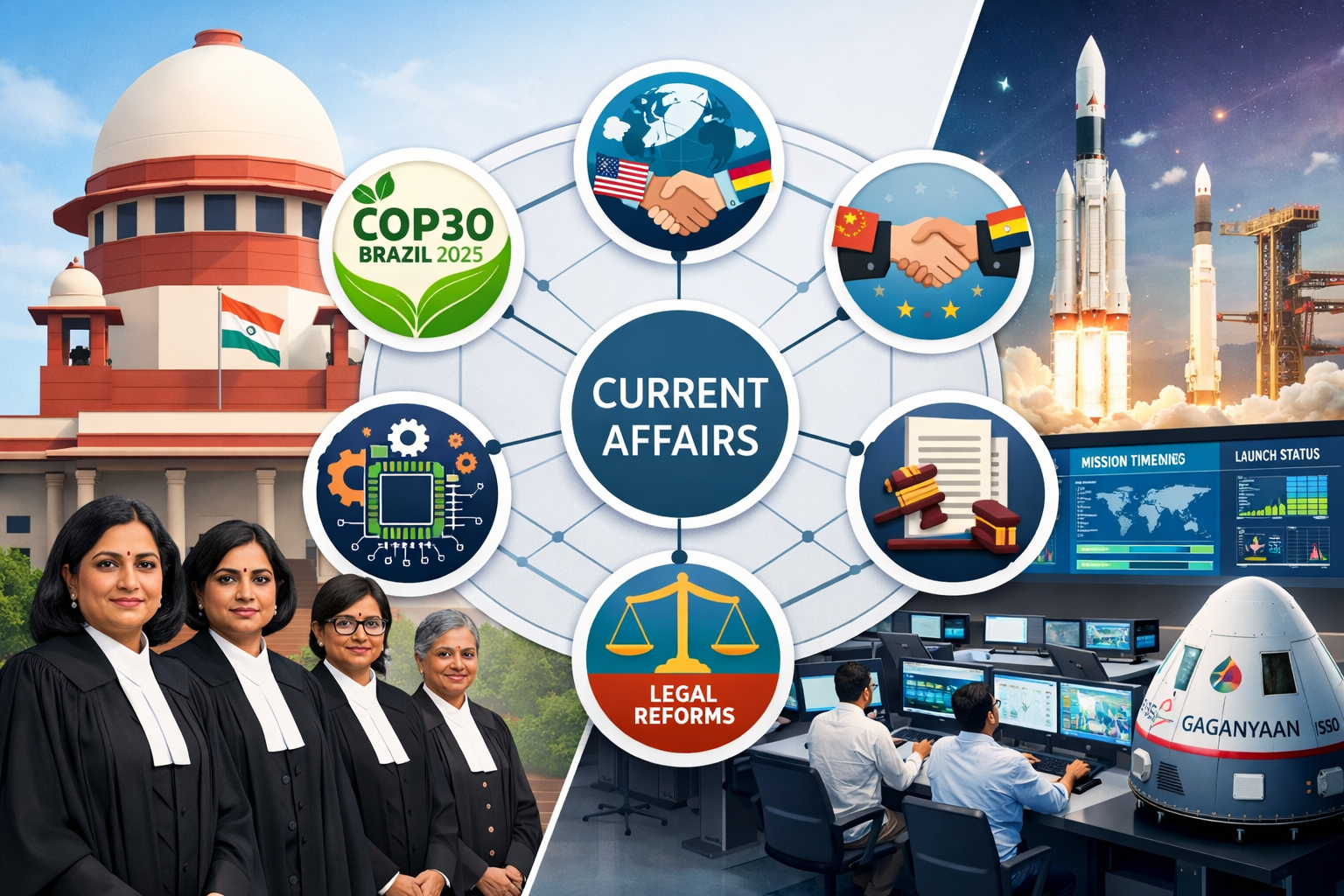
The Indian judiciary has delivered several groundbreaking decisions over the past 18 months that are almost certain to feature in CLAT 2027. These judgments don’t just represent legal precedents—they reflect evolving interpretations of constitutional principles that form the foundation of legal education.
Constitutional Bench Decisions
The Electoral Bonds Case (2024) stands as perhaps the most significant Supreme Court judgment affecting democratic governance and transparency. The Court’s decision to strike down the electoral bonds scheme as unconstitutional has far-reaching implications for political funding, transparency in democracy, and the right to information under Article 19(1)(a).
The judgment addressed several crucial constitutional questions: whether anonymous political funding violates the fundamental right to information, the balance between donor privacy and democratic transparency, and the role of the Election Commission in ensuring free and fair elections. For CLAT preparation, this case connects constitutional law, administrative law, and democratic theory.
Women Judges in the Supreme Court has become a significant milestone with the appointment of Justice B.V. Nagarathna and other women judges to constitutional benches. The discussions around gender representation in the higher judiciary, the collegium system’s approach to diversity, and the impact of women judges on judicial decision-making have created substantial current affairs content.
This topic intersects with gender justice, judicial reforms, and constitutional interpretation—all areas that CLAT examiners frequently explore through passage-based questions.
Landmark Civil Rights Decisions
The Same-Sex Marriage Cases heard by the Supreme Court in 2024 have generated extensive legal and social commentary. While the Court’s decision maintained the traditional definition of marriage, the judgment’s reasoning about LGBTQ+ rights, the scope of Article 21 (right to life and liberty), and the distinction between legal recognition and social acceptance provides rich material for CLAT questions.
Privacy and Digital Rights cases have gained prominence with the Court’s decisions on Aadhaar linking, data protection, and surveillance powers. The balance between national security and individual privacy, the evolving interpretation of the right to privacy as a fundamental right, and the regulation of digital platforms all feature prominently in contemporary judicial discourse.
High Court Innovations
Several High Court judgments have gained national attention and Supreme Court consideration. The Delhi High Court’s air pollution directives, Bombay High Court’s housing rights decisions, and Madras High Court’s environmental protection orders represent the judiciary’s increasing role in policy implementation and environmental governance.
These cases demonstrate the judiciary’s evolving role from dispute resolution to governance oversight, a trend that CLAT examiners often explore through questions about separation of powers and judicial activism.
Students struggling with legal reasoning concepts can benefit from our guide to developing a legal mindset, which helps connect current judicial developments to fundamental legal principles.
International Law and Cross-Border Issues
The Kulbhushan Jadhav case developments and ongoing India-Pakistan legal disputes at international forums have created current affairs content that bridges domestic and international law. These cases help CLAT aspirants understand how international legal principles interact with domestic constitutional law.
Extradition cases involving high-profile economic offenders and the legal challenges around bringing them back to India have highlighted issues of international cooperation, diplomatic immunity, and the extraterritorial application of Indian laws.
Space Missions and Scientific Achievements: ISRO’s Recent Milestones
India’s space program has achieved remarkable milestones over the past 18 months, making space-related current affairs a high-priority area for CLAT 2027 preparation. These achievements aren’t just scientific accomplishments—they represent India’s growing technological capabilities, international partnerships, and strategic positioning in the global space economy.
Gaganyaan Mission Progress
The Gaganyaan Human Spaceflight Program has reached critical milestones in 2024-2025, with successful test flights and astronaut training programs. This mission represents India’s entry into the exclusive club of nations capable of human spaceflight, joining the United States, Russia, and China.
The program’s development involves multiple international collaborations, including training partnerships with Russia and technology sharing with France. For CLAT aspirants, this connects to topics of international cooperation, technology transfer agreements, and India’s strategic autonomy in critical technologies.
The mission’s timeline, with planned crewed flights in 2025-2026, makes it particularly relevant for current affairs questions. The selection and training of Indian astronauts, the development of indigenous life support systems, and the mission’s scientific objectives all provide rich content for passage-based questions.
Chandrayaan-3 Legacy and Follow-up Missions
Building on Chandrayaan-3’s successful lunar landing in 2023, ISRO has announced several follow-up missions that have dominated space news in 2024. Chandrayaan-4, planned as a sample return mission, represents the next phase of India’s lunar exploration program.
The international recognition of Chandrayaan-3’s achievements, including NASA’s acknowledgment and potential collaboration opportunities, has elevated India’s status in the global space community. This success has also led to increased private sector participation in India’s space program, with several startups receiving government support for space technology development.
Mars and Venus Exploration Programs
Mangalyaan-2 (Mars Orbiter Mission-2) has progressed through critical design phases in 2024, with ISRO announcing enhanced scientific payloads and improved orbital capabilities. This mission builds on India’s successful Mars Orbiter Mission, which made India the first country to reach Mars orbit on its first attempt.
Shukrayaan-1, India’s planned Venus mission, has received final approval and funding in 2024. This mission represents India’s expanding planetary exploration capabilities and its commitment to understanding planetary science and climate change through space exploration.
Commercial Space Initiatives
ISRO’s commercial arm, NewSpace India Limited (NSIL), has secured several international satellite launch contracts in 2024, demonstrating India’s competitive position in the global commercial space market. These contracts include launches for European, American, and Asian clients, showcasing the reliability and cost-effectiveness of Indian space technology.
The Indian National Space Promotion and Authorization Centre (IN-SPACe) has approved several private space ventures in 2024, marking a significant shift toward commercial space activities. This regulatory development connects to topics of economic policy, technology regulation, and public-private partnerships.
For students interested in how technology intersects with legal careers, our guide to essential tech knowledge for lawyers provides valuable context for understanding these developments.
International Space Collaborations
The Artemis Accords and India’s participation in international lunar exploration programs have created significant diplomatic and technological partnerships. India’s collaboration with NASA on the NISAR (NASA-ISRO Synthetic Aperture Radar) mission represents one of the most advanced space partnerships between the two countries.
BRICS space cooperation initiatives and India’s role in developing space technologies for emerging economies have positioned the country as a leader in South-South cooperation in space technology.
These international partnerships often involve complex legal frameworks, technology transfer agreements, and diplomatic negotiations—all areas that connect space achievements to broader themes of international law and diplomacy that appear in CLAT current affairs questions.
Strategic Study Approach: Mastering Passage-Based Current Affairs

Success in CLAT 2027 current affairs requires more than just memorizing facts about the Top 100 GK & Current Affairs Topics for CLAT 2027: Bills, Judgments, and Space Missions. You need a systematic approach that prepares you for the unique challenge of passage-based questions drawn from journalistic sources.
The Passage-Based Challenge
CLAT current affairs passages typically run 400-450 words and are sourced directly from newspapers, magazines, and online news platforms [5]. These passages don’t simply test whether you know a fact—they evaluate your ability to comprehend complex information quickly, identify key relationships, and apply your background knowledge to answer analytical questions.
The questions following these passages often require you to:
- Identify the main argument or central theme
- Understand cause-and-effect relationships
- Connect the passage content to broader constitutional or legal principles
- Analyze the implications of events or policies described
- Distinguish between facts and opinions presented
Building Your Current Affairs Knowledge Base
Create Topic-Specific Notebooks: Organize your current affairs preparation around major themes like Legislative Developments, Judicial Decisions, Space & Technology, International Relations, and Economic Policies. This thematic approach helps you see connections between different events and understand broader trends.
For each major topic in our Top 100 GK & Current Affairs Topics for CLAT 2027: Bills, Judgments, and Space Missions, maintain detailed notes that include:
- Basic facts and timeline
- Key stakeholders and institutions involved
- Constitutional or legal principles at stake
- Broader implications for policy or society
- Connections to other current events
Practice with Authentic Sources: Regularly read passages from The Hindu, Indian Express, Livemint, and other quality newspapers. Focus on editorial and opinion pieces that provide analytical depth rather than just factual reporting. This practice familiarizes you with the writing style and complexity level you’ll encounter in the actual exam.
Time Management and Reading Strategies
The 3-Minute Rule: Allocate approximately 3 minutes per current affairs passage—1.5 minutes for reading and understanding, 1.5 minutes for answering questions. This timing requires efficient reading strategies and quick comprehension skills.
Active Reading Techniques:
- Identify the main topic in the first paragraph
- Look for transition words that signal important relationships
- Pay attention to dates, names, and specific details that often become question focal points
- Note any constitutional articles, legal principles, or institutional references
Question-First Strategy: For complex passages, quickly scan the questions before reading the passage. This approach helps you identify what information to prioritize during your reading.
Students who struggle with reading comprehension can benefit from our specialized strategies for improving CLAT English performance, which includes techniques directly applicable to current affairs passages.
Monthly Review and Revision Cycles
Weekly Compilation: Every week, create a summary of the most significant events in each major category. Focus particularly on developments related to bills, judgments, and space missions that align with our priority topics.
Monthly Deep Dives: Once a month, select 3-4 major events and research them thoroughly. Understand not just what happened, but why it matters, what legal or constitutional principles are involved, and how it connects to broader trends in governance, law, or policy.
Mock Test Integration: Regularly practice with current affairs passages in timed conditions. Many coaching platforms now offer passage-based current affairs questions that mirror the actual CLAT format. For comprehensive preparation support, explore our flexible learning programs designed specifically for serious CLAT aspirants.
Connecting Current Affairs to Legal Reasoning
One of the most effective strategies for CLAT current affairs preparation is understanding how contemporary events connect to fundamental legal and constitutional principles. This approach not only helps with current affairs questions but also strengthens your performance in the legal reasoning section.
Constitutional Connections: For every major bill or judgment you study, identify which constitutional articles, fundamental rights, or directive principles are involved. This practice helps you see current events as applications of constitutional law rather than isolated facts.
Precedent and Policy: Understand how current judicial decisions build on previous precedents and how new legislation addresses existing policy challenges. This analytical approach prepares you for questions that require deeper understanding rather than surface-level knowledge.
The key to mastering current affairs for CLAT 2027 lies in treating it as an extension of your legal studies rather than a separate subject. When you understand the legal and constitutional framework underlying current events, you’ll find that both comprehension and retention become significantly easier.
Conclusion
Mastering the Top 100 GK & Current Affairs Topics for CLAT 2027: Bills, Judgments, and Space Missions requires a strategic, systematic approach that goes far beyond traditional memorization techniques. The shift toward passage-based questions means your success depends on developing strong analytical reading skills, building comprehensive knowledge of interconnected topics, and understanding the constitutional and legal frameworks underlying contemporary events.
Your preparation should prioritize the high-impact areas we’ve discussed: recent legislative developments like the Waqf Amendment Bill and Telecommunications Act, landmark Supreme Court decisions on electoral bonds and women’s representation, and India’s space achievements including Gaganyaan mission progress and commercial space initiatives. These topics represent the intersection of law, policy, and current events that CLAT examiners consistently favor.
Remember that current affairs preparation for CLAT isn’t just about scoring well in one section—it’s about developing the analytical mindset and broad knowledge base that will serve you throughout your legal career. The events you study today will shape the legal landscape you’ll practice in tomorrow.
Your next steps should include:
- Implement the notebook strategy for organizing topics thematically around bills, judgments, and space missions
- Practice daily with 450-word passages from quality newspapers and magazines
- Focus your preparation timeline on events from July 2024 through February 2026
- Connect current events to constitutional principles to strengthen both current affairs and legal reasoning performance
- Take regular mock tests with passage-based current affairs questions to build speed and accuracy
The path to CLAT success isn’t just about individual preparation—it’s about having the right guidance and support system. At Lawgic Coaching, we understand that your success is our mission, and we’re committed to providing expert guidance without the premium price tag. Our flexible learning programs are designed to fit your life while ensuring you master every aspect of CLAT preparation, from current affairs to legal reasoning.
Ready to transform your CLAT preparation with proven strategies that actually work? Explore our comprehensive CLAT coaching programs and discover how personalized attention and expert mentorship can accelerate your journey to your dream NLU. Your legal career starts with the right preparation—let’s build it together.
References
[1] Clat Syllabus – https://www.imsindia.com/blog/clat/clat-syllabus/
[2] Clat Syllabus 2026 Subject Wise Breakdown Important Tips – https://www.clatnlti.com/blog-details/86/clat-syllabus-2026-subject-wise-breakdown-important-tips
[3] Clat Gk Syllabus 7ad71f7873df2297b6cce125aa0f64aa – https://image-static.collegedunia.com/public/image/CLAT_GK_Syllabus_7ad71f7873df2297b6cce125aa0f64aa.pdf
[4] Ug Syllabus – https://consortiumofnlus.ac.in/clat-2026/ug-syllabus.html
[5] Clat Current Affairs And Gk Section Preparation 2026 Syllabus Important Topics Books Tips Blogid 57105 – https://www.shiksha.com/law/articles/clat-current-affairs-and-gk-section-preparation-2026-syllabus-important-topics-books-tips-blogId-57105