
Choosing the right CLAT Preparation Coaching can make the difference between studying at a top National Law University and settling for less. Every year, over 60,000 students compete for roughly 2,500 NLU seats, and the ones who succeed often have one thing in common: they had the right guidance at the right time.
Here’s the thing. CLAT isn’t just another entrance exam you can crack with last-minute preparation. It demands strategic planning, consistent practice, and expert mentorship. That’s where quality coaching becomes your competitive advantage.
Key Takeaways
- Quality coaching matters: Students with structured CLAT preparation coaching show 3x higher selection rates compared to self-study aspirants
- Online vs offline debate: Online CLAT coaching offers flexibility and cost savings of 40-60% while maintaining comparable success rates
- Start early advantage: Beginning preparation 12-18 months before the exam significantly improves NLU admission chances
- Mock tests are critical: Regular practice with CLAT mock tests correlates directly with higher percentile scores
- Personalized approach wins: One-size-fits-all coaching rarely works; customized study plans based on individual strengths deliver better results
Understanding CLAT Preparation Coaching in 2026
CLAT Preparation Coaching has evolved dramatically over the past few years. Gone are the days when expensive classroom programs were your only option. Today’s coaching landscape offers diverse formats tailored to different learning styles, budgets, and schedules.
The Common Law Admission Test remains the gateway to 22 National Law Universities across India. With the exam pattern emphasizing comprehension-based questions across five sections, specialized coaching helps you navigate this challenging format efficiently.
What Makes CLAT Coaching Essential?
Let’s be honest. You could theoretically prepare for CLAT on your own. But should you?
Most successful CLAT rankers will tell you that structured coaching provided them with three critical advantages:
Structured curriculum: A well-designed coaching program covers the entire CLAT syllabus systematically, ensuring you don’t miss important topics while avoiding unnecessary material.
Expert faculty guidance: Teachers from top NLUs understand the exam inside out. They know which topics carry more weight, how questions are framed, and what examiners look for in answers.
Regular assessment: Consistent mock tests and performance analysis help identify weak areas before they become deal-breakers on exam day.
The best CLAT coaching programs combine these elements with personalized mentorship that adapts to your unique learning needs.
Top CLAT Coaching Institutes: Performance Metrics and Rankings
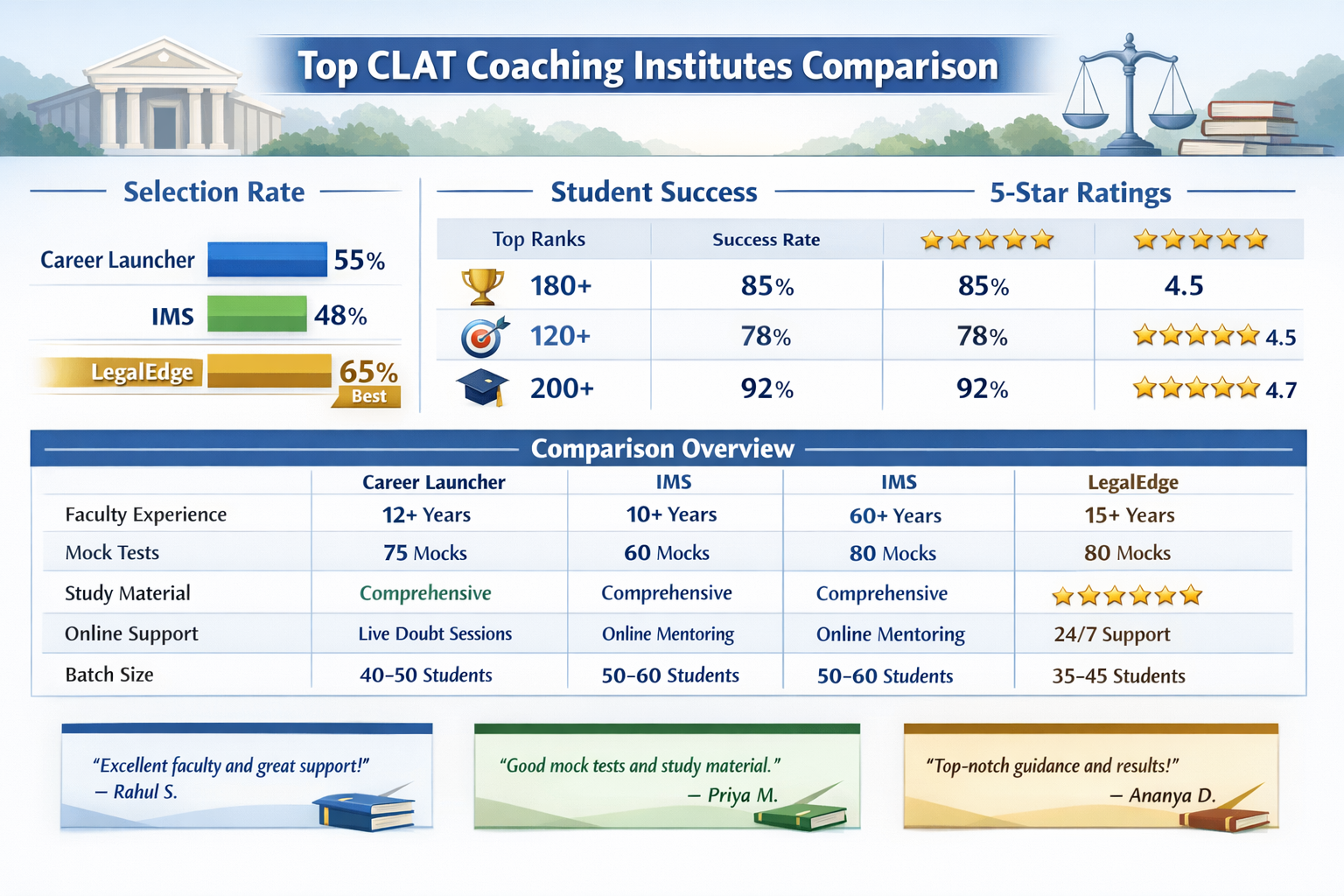
When evaluating CLAT preparation coaching options, success rates matter more than marketing promises. Let’s examine the leading institutes based on actual performance data from CLAT 2025 and 2026.
What each institute actually publishes
| Institute | Teaching mode | Fee published on their own site? |
|---|---|---|
| Lawgic Coaching | Online, live | Yes — Rs 20,000 flat, one programme, no tiers |
| CLATapult | Online | Yes — Rs 50,000 for the four-month programme, Rs 1,05,000 for the two-year |
| Law Prep Tutorial | Online and classroom | No. Discounts of 26–49% are advertised across five batches with no base price shown |
| LegalEdge (TopRankers) | Classroom and online | No fee published on its CLAT coaching page |
| CLAT Possible | Classroom and online | No. Enquiry form or phone call only |
| Career Launcher | Hybrid | No fee figures on its law entrance site |
Checked directly against each institute’s own website between 31 July and 1 August 2026. Two of the six publish a real programme fee. We have not filled in the other four with estimates, because any number we invented would be exactly the problem this table exists to show. The full research, including what to ask on a counselling call to get a straight figure, is in our guide to what CLAT coaching actually costs.
You will notice there is no “selection rate” column. No institute in this market publishes selection rates in a form that can be checked, including us, so any table showing them is reporting marketing copy as data.
These numbers tell an important story. Higher fees don’t automatically guarantee better results. Some online platforms deliver exceptional outcomes at fraction of traditional coaching costs.
What Sets Top Performers Apart?
The institutes with consistently high selection rates share several characteristics:
Faculty credentials: Teachers who’ve actually studied at NLUs or have extensive CLAT teaching experience bring practical insights that generic educators simply can’t match.
Updated study material: The CLAT pattern changes periodically. Top coaching institutes update their content immediately to reflect these changes, ensuring students practice with relevant material.
Comprehensive mock test series: Quality matters more than quantity here. The best coaching programs offer CLAT mock tests that mirror actual exam difficulty and question patterns.
Personalized doubt resolution: Group classes are fine, but individual attention makes the real difference. Look for institutes offering dedicated mentorship sessions.
At Lawgic Coaching, we’ve helped thousands crack CLAT by combining experienced faculty from top NLUs with flexible online learning. Your success is our mission, and our selection rates prove our methods work.
Online vs Offline CLAT Preparation Coaching: Making the Right Choice
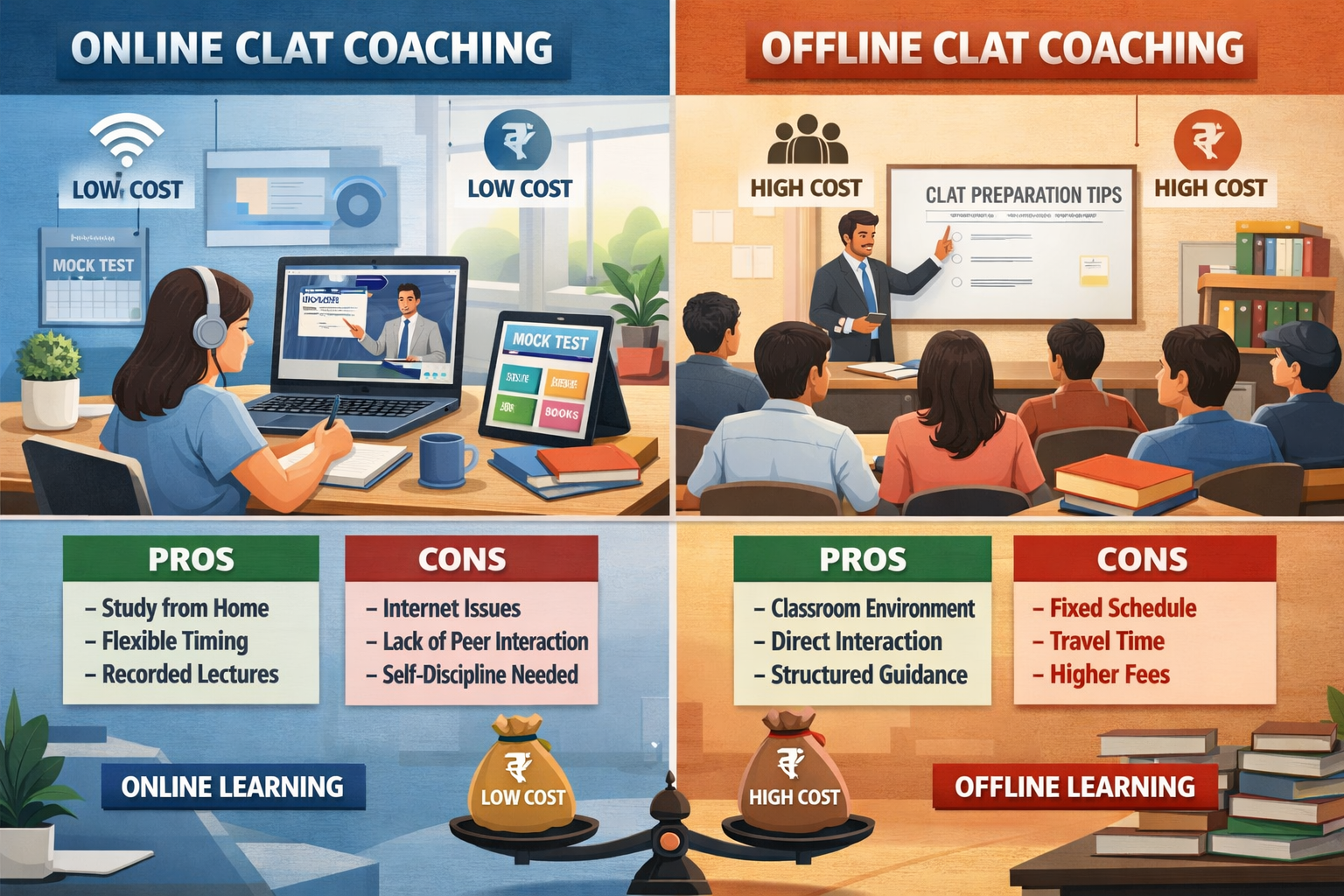
This debate has intensified since 2020, when online education became mainstream. Both formats have distinct advantages, and the right choice depends on your individual circumstances.
Online CLAT Coaching Advantages
Flexibility that fits your life: Attend classes from anywhere, anytime. Balancing school and CLAT preparation becomes manageable when you’re not commuting 2-3 hours daily to coaching centers.
Cost effectiveness: Online programs typically cost 40-60% less than equivalent offline coaching. You save on commute costs, accommodation (for students relocating), and often get more study material included in the base fee.
Access to top faculty: Geography doesn’t limit your options anymore. Students in tier-2 and tier-3 cities can learn from the same expert teachers that metro students access.
Recorded lectures: Missed a concept? Rewatch the lecture. This flexibility proves invaluable during revision months when you need to revisit specific topics quickly.
The best online CLAT coaching platforms have refined their teaching methodologies to match or exceed traditional classroom effectiveness.
Offline Coaching Benefits
Structured discipline: Physical classrooms create accountability. Showing up at a specific time helps build the routine and discipline essential for consistent preparation.
Immediate interaction: Asking questions in real-time and getting instant clarification works better for some learning styles.
Peer learning environment: Being surrounded by fellow aspirants creates healthy competition and collaborative learning opportunities.
Reduced screen time: For students already spending hours on devices for school, offline coaching provides a welcome break from screens.
Which Format Suits You?
Consider these factors when deciding:
Your learning style: Do you stay motivated with self-paced learning, or do you need external structure? Be honest about your discipline levels.
Budget constraints: If finances are tight, online coaching delivers excellent results at lower investment. Don’t compromise your family’s financial stability for coaching.
Location: Students in cities with established coaching centers have genuine offline options. Those in smaller towns shouldn’t relocate just for coaching when quality online alternatives exist.
School schedule: Class 11 and 12 students juggling board exam preparation often find online CLAT classes more compatible with their academic commitments.
You know what makes us different? We’ve designed our online programs specifically for students who want expert guidance without the premium price tag. Flexible learning that fits your life, not the other way around.
Comprehensive CLAT Preparation Strategies from Top Coaches
Success in CLAT requires more than just joining coaching. You need proven strategies that actually work. Here’s what top rankers and experienced coaches recommend.
Subject-Wise Preparation Approach
English Language: This section tests comprehension, not grammar rules. Read quality newspapers daily (The Hindu, Indian Express), practice passage-based questions, and develop speed-reading techniques. Most coaching institutes recommend 45-60 minutes daily for English preparation.
Current Affairs and General Knowledge: This is where many students struggle. The key isn’t memorizing random facts but understanding connections between events. Follow high-yield GK topics that appear repeatedly in CLAT.
Create monthly current affairs notes. Don’t just collect information; review and revise it regularly. The best CLAT coaching programs provide curated GK compilations that filter noise from essential information.
Legal Reasoning: You don’t need prior law knowledge, but you do need logical thinking. Practice applying legal principles to fact situations. Quality coaching helps you develop this skill through structured exercises and case-based learning.
Logical Reasoning: Pattern recognition, critical reasoning, and analytical ability form this section’s core. Regular practice with diverse question types builds the mental agility CLAT demands. Dedicate 30-40 minutes daily to logical reasoning practice.
Quantitative Techniques: Basic mathematics up to Class 10 level. The key is speed and accuracy. Most questions test fundamental concepts, not complex calculations. Practice mental math and shortcut techniques that top coaching institutes teach.
Time Management Strategies
CLAT gives you 120 minutes for 120 questions. That’s exactly one minute per question, leaving zero room for time wastage.
Section-wise time allocation: Don’t spend equal time on all sections. Allocate based on your strengths and the section’s difficulty level. Most toppers recommend:
- English: 25-30 minutes
- Current Affairs: 20-25 minutes
- Legal Reasoning: 30-35 minutes
- Logical Reasoning: 25-30 minutes
- Quantitative Techniques: 10-15 minutes
Practice with time pressure: Regular timed mock tests train your brain to work efficiently under pressure. Start with section-wise tests, then progress to full-length mocks.
Question selection strategy: Not every question deserves your time. Learn to identify time-consuming questions and mark them for later review. Answer confident questions first, maximizing your score within time constraints.
Mock Test Analysis: The Game Changer
Taking mock tests isn’t enough. Analyzing them properly separates average performers from top rankers.
After each mock test:
Identify error patterns: Are you making silly mistakes in calculation? Misreading comprehension questions? Falling for trap options in legal reasoning? Patterns reveal fixable weaknesses.
Time analysis: Which sections consumed disproportionate time? Where did you get stuck? This data guides future preparation focus.
Topic-wise performance: Track scores across different topics within each section. This granular analysis helps prioritize revision topics.
Difficulty-wise accuracy: Are you getting easy questions wrong while attempting difficult ones? This indicates strategy problems, not knowledge gaps.
Quality CLAT preparation coaching provides detailed analytics after each mock test, making this analysis systematic rather than guesswork.
The Psychology of CLAT Preparation: Mental Readiness Matters
Here’s something most coaching institutes won’t tell you: mental preparation matters as much as academic preparation. CLAT success requires psychological resilience that goes beyond knowing the syllabus.
Managing Exam Anxiety
Pressure is real when your entire law career seemingly depends on one exam. Successful aspirants develop healthy coping mechanisms:
Realistic goal setting: Aiming for top 100 is admirable, but unrealistic expectations create unnecessary stress. Set challenging yet achievable targets based on your current performance levels.
Regular breaks: Your brain isn’t designed for 8-10 hours of continuous study. The power of taking breaks during CLAT preparation cannot be overstated. Short, frequent breaks improve retention and prevent burnout.
Physical activity: Exercise isn’t wasted time during preparation. It reduces stress, improves focus, and boosts cognitive function. Even 30 minutes of daily physical activity makes measurable difference.
Sleep hygiene: All-nighters might seem productive, but sleep deprivation destroys retention and decision-making ability. Quality coaching programs emphasize sustainable study schedules that include adequate rest.
Building Exam Day Confidence
Confidence comes from preparation, not positive thinking alone. Here’s how to build genuine confidence:
Consistent practice: Regular mock tests under exam conditions familiarize you with the pressure. By exam day, the format feels routine rather than intimidating.
Weakness elimination: Systematically addressing weak areas removes the fear of encountering difficult questions. You know you’ve prepared comprehensively.
Success visualization: Mental rehearsal of exam day success activates the same neural pathways as actual performance. Spend 5-10 minutes daily visualizing yourself calmly solving CLAT questions.
Positive self-talk: Replace “What if I fail?” with “I’ve prepared well and will do my best.” This isn’t empty motivation; it’s cognitive reframing that reduces anxiety.
The best CLAT coaching programs incorporate mental wellness components alongside academic training, recognizing that exam success requires both.
Technology and AI in Modern CLAT Preparation Coaching
The coaching landscape has transformed with technology integration. Smart aspirants leverage these tools for competitive advantage.
AI-Powered Learning Platforms
Artificial intelligence now personalizes CLAT preparation in ways impossible with traditional coaching:
Adaptive learning algorithms: These systems analyze your performance patterns and automatically adjust difficulty levels, ensuring you’re always challenged appropriately without being overwhelmed.
Predictive analytics: AI can predict your likely CLAT score based on current performance trends, helping you gauge whether your preparation is on track.
Automated doubt resolution: Chatbots trained on CLAT content provide instant answers to common questions, supplementing human mentorship for routine queries.
Performance dashboards: Visual analytics show exactly where you stand across different topics, sections, and difficulty levels. Data-driven preparation beats guesswork every time.
Digital Study Resources
Modern CLAT preparation extends far beyond physical books:
Video lectures: Complex concepts become clearer with visual explanations. Quality online coaching provides comprehensive video libraries covering the entire syllabus.
Interactive quizzes: Gamified learning makes daily practice engaging rather than tedious. Immediate feedback reinforces correct understanding.
Mobile apps: Prepare on-the-go during commutes or breaks. Microlearning modules fit preparation into busy schedules.
Online discussion forums: Connect with fellow aspirants, share strategies, and learn from others’ experiences. Collaborative learning accelerates growth.
Smart Mock Test Platforms
Technology has revolutionized how we practice for CLAT:
Exam simulation: Digital platforms replicate the actual CLAT interface, eliminating surprises on exam day.
Instant scoring: Get results immediately after completing tests, enabling rapid course correction.
Comparative analytics: See how you rank among thousands of test-takers, providing realistic performance benchmarks.
Question bank algorithms: Advanced platforms ensure you never practice the same questions repeatedly while maintaining appropriate difficulty distribution.
At Lawgic Coaching, we combine technology with human expertise. Our AI-powered platform handles routine tasks while experienced faculty provide personalized mentorship where it matters most.
Cost-Benefit Analysis: Is CLAT Coaching Worth the Investment?
Let’s talk money. CLAT coaching represents significant investment for most families. Understanding the actual costs and returns helps make informed decisions.
True Cost of CLAT Preparation
Beyond coaching fees, consider these expenses:
Study materials: Books, test series, and reference materials add ₹5,000-₹15,000 to your budget.
Mock tests: Standalone test series from various providers cost ₹3,000-₹10,000 if not included in coaching.
Opportunity cost: Time spent preparing could theoretically be used earning or pursuing other goals. For most students, this is negligible, but droppers should consider it.
Accommodation and travel: For offline coaching requiring relocation, these costs often exceed the coaching fees themselves. Students moving to Delhi, Bangalore, or other coaching hubs spend ₹8,000-₹15,000 monthly on rent and living expenses.
Total investment range:
- Self-study: ₹10,000-₹25,000
- Online coaching: ₹25,000-₹60,000
- Offline coaching (local): ₹75,000-₹1,50,000
- Offline coaching (with relocation): ₹2,00,000-₹3,50,000 annually
Return on Investment
Now consider what successful CLAT preparation delivers:
NLU admission value: Five-year integrated law programs at top NLUs cost ₹10-₹15 lakhs total. Graduates command starting salaries of ₹12-₹25 lakhs annually at top law firms and corporate legal departments.
Career trajectory: NLU alumni dominate India’s legal profession. The network, brand value, and opportunities far exceed those from non-NLU law schools.
Scholarship potential: Top CLAT ranks often come with merit scholarships, effectively making your legal education free or heavily subsidized.
Alternative comparison: If CLAT doesn’t work out, you’re looking at private law colleges charging ₹8-₹20 lakhs for five years with significantly lower placement prospects.
Investment perspective: Spending ₹50,000 on quality coaching to secure admission worth ₹15 lakhs and a career worth crores represents exceptional ROI.
Making Coaching Affordable
Budget constraints shouldn’t block your law school dreams. Here’s how to manage costs:
Choose online over offline: Save 40-60% while maintaining quality. We’ve helped thousands crack CLAT with accessible education for serious aspirants.
Scholarships and discounts: Many coaching institutes offer merit-based fee waivers. Ask about early-bird discounts, referral benefits, and need-based assistance.
Installment options: Most platforms allow fee payment in installments, reducing immediate financial burden.
Free resources: Supplement paid coaching with free YouTube lectures, Telegram channels for CLAT mocks, and government library resources.
Selective enrollment: You don’t need every course a coaching institute offers. Choose specific modules addressing your weak areas rather than comprehensive packages.
Remember, expensive doesn’t mean effective. Results speak louder than promises, and several affordable options deliver excellent outcomes.
Personalized Learning Paths: One Size Doesn’t Fit All
Generic coaching rarely produces exceptional results. The best CLAT preparation recognizes that every student brings different strengths, weaknesses, and learning styles.
Assessing Your Starting Point
Before choosing coaching or creating a study plan, honestly evaluate where you stand:
Current knowledge level: Take a diagnostic test covering all CLAT sections. This baseline reveals exactly which areas need intensive work versus light revision.
Available preparation time: Are you starting 18 months before CLAT or just 6 months? Your timeline dramatically affects strategy. Students with longer runways can build fundamentals gradually, while those with shorter timelines need focused, efficient approaches.
Learning preferences: Do you grasp concepts better through reading, listening, or visual explanations? Self-awareness about learning style helps choose appropriate coaching formats and study methods.
Strengths and weaknesses: Maybe you excel at logical reasoning but struggle with current affairs. Or perhaps English comprehension is easy while quantitative techniques challenge you. Knowing this guides time allocation.
Customized Study Plans
Quality coaching creates individualized roadmaps rather than forcing everyone through identical programs:
Weak area focus: If legal reasoning is your Achilles heel, your study plan should allocate disproportionate time there initially, gradually balancing as proficiency improves.
Strength leveraging: Don’t neglect areas where you’re already strong. Maintaining and refining these sections ensures consistent scoring while you build weaker areas.
Flexible scheduling: Students juggling school need different schedules than droppers dedicating full days to preparation. Effective coaching adapts to your reality.
Progressive difficulty: Start with foundational concepts, gradually increasing complexity as competence builds. Jumping into advanced material too quickly creates frustration and knowledge gaps.
Regular recalibration: Your needs change as preparation progresses. Monthly assessments should trigger study plan adjustments, ensuring continued optimization.
Mentorship That Matters
Personalized attention separates great coaching from mediocre programs:
One-on-one sessions: Regular individual meetings with mentors provide space to discuss specific challenges, clarify doubts, and receive targeted guidance.
Performance reviews: Detailed analysis of mock test results with mentors helps understand not just what went wrong, but why and how to fix it.
Strategy refinement: As exam day approaches, mentors help fine-tune your approach based on your evolving strengths and persistent weaknesses.
Emotional support: Preparation gets tough. Having someone who understands the pressure and can provide perspective makes the journey manageable.
At Lawgic Coaching, personalized attention you deserve isn’t marketing speak. It’s how we operate. No cookie-cutter approach here; we build your law career together with strategies tailored to your unique situation.
CLAT 2027 Preparation: When and How to Start
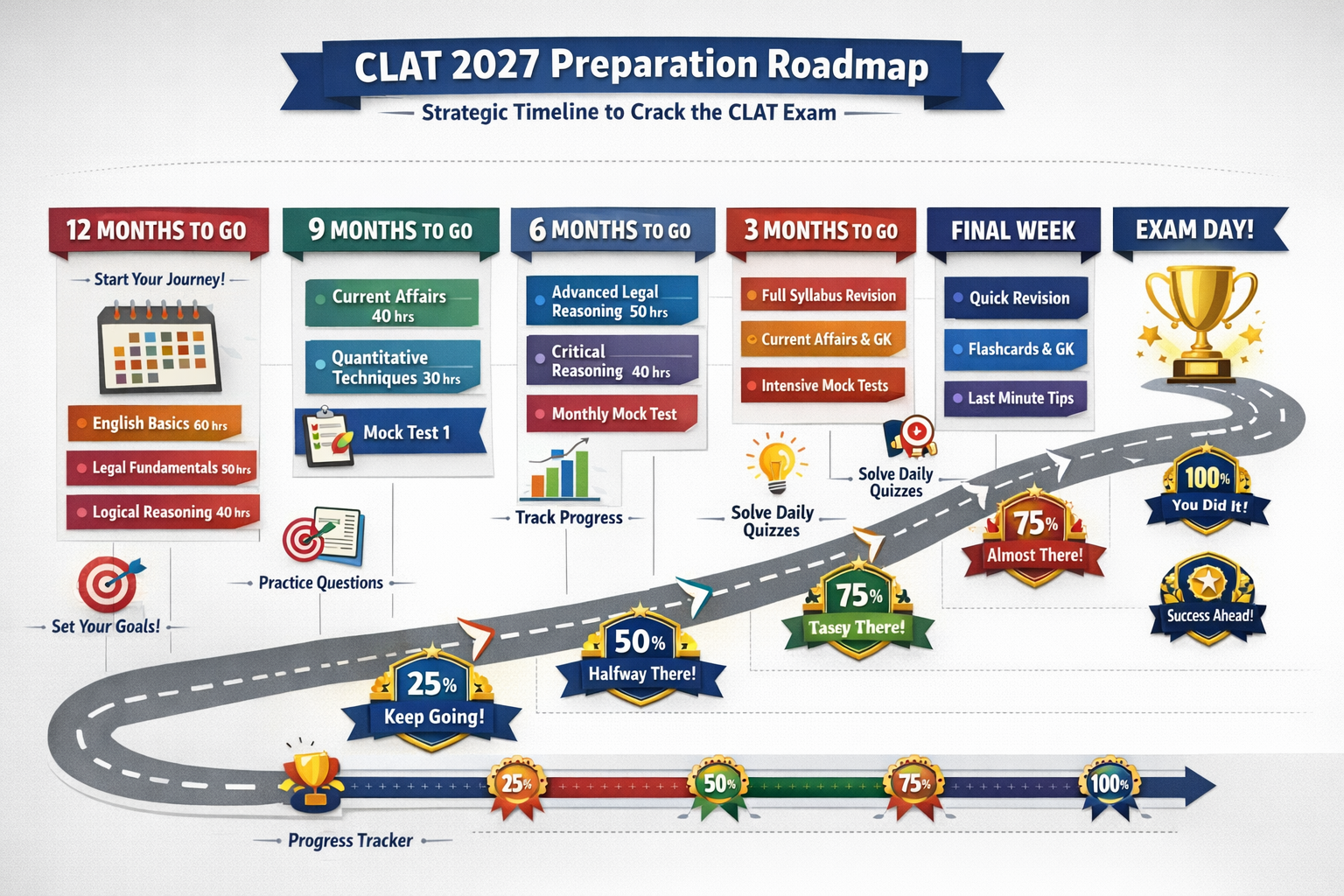
Timing matters enormously in CLAT preparation. Starting too late creates unnecessary pressure, while starting too early can lead to burnout. Here’s the optimal approach.
Ideal Preparation Timeline
18-24 months before exam: This timeline suits students starting in Class 11 or early Class 12. Benefits include:
- Thorough conceptual understanding without rushing
- Time to read extensively for GK and English
- Multiple revision cycles before exam
- Gradual difficulty progression reducing stress
- Flexibility to balance school academics
12-15 months before exam: This represents the sweet spot for most aspirants. Provides:
- Adequate time for comprehensive preparation
- Balanced approach to all sections
- Sufficient mock test practice
- Manageable alongside Class 12 boards
- Reduced risk of burnout
6-9 months before exam: Tight but achievable with focused effort. Requires:
- Intensive daily study commitment
- Strategic topic prioritization
- Efficient coaching with proven methods
- Disciplined execution without breaks
- Realistic goal-setting based on starting point
3-6 months before exam: Challenging timeline demanding:
- Full-time preparation commitment
- Focus on high-yield topics only
- Extensive mock test practice
- Professional coaching essential
- Acceptance that top ranks are unlikely
For students planning CLAT 2027 preparation, starting now in 2026 provides the ideal 12-15 month runway.
Year-Round Preparation Strategy
Foundation phase (Months 1-4): Build conceptual clarity across all sections. Focus on understanding rather than speed. Cover the entire syllabus at least once. Establish daily reading habits for English and GK.
Strengthening phase (Months 5-8): Deepen understanding through practice. Start section-wise timed tests. Identify and address weak topics systematically. Increase current affairs coverage intensity.
Mastery phase (Months 9-11): Begin full-length mock tests. Refine time management and question selection strategies. Focus on consistency rather than peak performance. Maintain current affairs updates rigorously.
Revision phase (Final month): No new topics. Revise notes and formulas. Take mocks every 2-3 days. Work on mental preparation and stress management. Fine-tune exam day strategy.
Balancing School and CLAT Preparation
This challenge affects most aspirants. Here’s how successful students manage both:
Integrated learning: Many CLAT topics overlap with school curriculum. English, mathematics, and even some GK connects with school subjects. Leverage this synergy.
Strategic scheduling: Study CLAT topics during school breaks and holidays. Use weekday evenings for lighter CLAT work like current affairs reading. Reserve intensive preparation for weekends.
Board exam priority: In Class 12, boards deserve attention. Good board results provide backup options if CLAT doesn’t go as planned. The best coaching programs respect this balance.
Efficiency over hours: Quality preparation in 3-4 focused hours beats distracted studying for 8 hours. Maximize concentration during study time.
Communication with school: Some schools accommodate serious CLAT aspirants with attendance flexibility or adjusted assignment deadlines. It doesn’t hurt to ask.
Common Mistakes in CLAT Preparation and How Coaching Prevents Them
Learning from others’ mistakes saves precious time and effort. Here are the most common pitfalls and how quality coaching helps avoid them.
Mistake 1: Starting Without Strategy
Many students jump into preparation without clear plans. They buy random books, watch scattered YouTube videos, and hope everything comes together somehow.
The consequence: Gaps in syllabus coverage, inefficient time use, and mounting anxiety as exam approaches.
How coaching helps: Structured curriculum ensures systematic coverage. You know exactly what to study, when to study it, and how much time to allocate. No guesswork, no gaps.
Mistake 2: Neglecting Current Affairs
Students often underestimate the GK section, thinking they’ll “catch up” later. Later never comes, and they face the exam with massive knowledge gaps.
The consequence: Easy marks lost in a section where consistent effort guarantees scoring.
How coaching helps: Daily current affairs modules make GK preparation routine rather than overwhelming. Curated content filters important news from noise, making the task manageable.
Mistake 3: Mock Test Mismanagement
Some students take too few mocks, entering the exam without adequate practice. Others take too many without analyzing them, repeating the same mistakes endlessly.
The consequence: Either lack of familiarity with exam pressure or failure to improve despite extensive practice.
How coaching helps: Structured test schedules ensure optimal practice frequency. More importantly, detailed performance analysis after each test drives actual improvement.
Mistake 4: Ignoring Weak Sections
It’s human nature to practice what we’re already good at. Students spend excessive time on comfortable sections while avoiding challenging ones.
The consequence: Weak sections remain weak, limiting overall score potential.
How coaching helps: Mentors push you to address weaknesses systematically. Personalized study plans allocate more time to challenging areas, ensuring balanced development.
Mistake 5: Information Overload
With countless books, websites, and resources available, students often try consuming everything. This creates confusion and superficial understanding.
The consequence: Breadth without depth. Knowing a little about everything but mastering nothing.
How coaching helps: Curated study material provides everything you need without overwhelming you. Quality over quantity becomes the guiding principle.
You can learn more about avoiding CLAT pitfalls through structured guidance.
Mistake 6: Unrealistic Expectations
Some students expect miraculous improvement without consistent effort. Others set impossibly high targets that create unnecessary pressure.
The consequence: Either complacency leading to inadequate preparation or stress-induced burnout.
How coaching helps: Experienced mentors set realistic milestones based on your starting point and progress rate. Regular feedback keeps expectations aligned with reality while maintaining motivation.
Success Stories: How Quality Coaching Transformed CLAT Journeys
Real results matter more than promises. Here are patterns from successful CLAT aspirants who benefited from quality coaching.
From Average Student to Top 100 Rank
Priya from Jaipur started with average mock test scores around 60/120. She wasn’t naturally brilliant at any section but showed consistent effort. Quality coaching helped her:
- Identify that time management, not knowledge, was her primary issue
- Develop a question selection strategy that maximized her strengths
- Build confidence through gradual improvement in mock scores
- Maintain motivation during plateaus with mentor support
Result: CLAT rank 87, admission to NLSIU Bangalore.
Key lesson: Consistency and strategy often beat raw talent.
The Comeback Story: Dropper Success
Rahul didn’t clear CLAT in his first attempt, scoring rank 2,400. Instead of giving up, he analyzed what went wrong and joined focused online coaching for his second attempt. The difference:
- Structured daily schedule replacing his previous haphazard approach
- Regular mock tests with detailed analysis he’d skipped earlier
- Focused GK preparation addressing his weakest section
- Mental resilience training to handle second-attempt pressure
Result: CLAT rank 156, admission to NALSAR Hyderabad.
Key lesson: Proper guidance can transform failure into success.
Small Town Success
Anjali from a tier-3 town had no access to established coaching centers. Her school didn’t even offer commerce or humanities streams. Online coaching leveled the playing field:
- Access to the same expert faculty as metro students
- Comprehensive study material unavailable in her town
- Peer interaction through online forums reducing isolation
- Affordable fees her family could manage
Result: CLAT rank 203, admission to NLIU Bhopal.
Key lesson: Geography shouldn’t limit your law school dreams.
Working Professional Cracking CLAT PG
Deepak, a working professional, prepared for CLAT PG while managing a full-time job. Flexible online coaching made it possible:
- Evening and weekend classes fitting his work schedule
- Recorded lectures he could watch during commutes
- Focused curriculum covering only relevant PG topics
- Mock tests scheduled for Sundays
Result: CLAT PG rank 45, admission to NLU Delhi for LLM.
Key lesson: Life commitments needn’t derail your academic ambitions.
These stories share common threads: structured preparation, expert guidance, consistent effort, and mental resilience. Quality CLAT preparation coaching provides the framework; your dedication fills it with success.
Choosing the Right CLAT Preparation Coaching: Decision Framework
With numerous options available, making the right choice can feel overwhelming. Here’s a systematic approach to evaluate and select coaching that fits your needs.
Essential Evaluation Criteria
Faculty credentials: Research the teaching team. Have they studied at NLUs? Do they have proven CLAT teaching experience? Generic educators rarely deliver specialized results.
Success rate transparency: Legitimate coaching institutes share verifiable selection statistics. Be wary of vague claims without specific data. Ask for previous years’ results with proof.
Study material quality: Request sample materials before enrolling. Check if content is updated for current exam patterns. Outdated material wastes your time and money.
Mock test infrastructure: How many mocks are included? Are they CLAT-pattern compliant? Is detailed analytics provided? Mock quality directly impacts preparation effectiveness.
Doubt resolution mechanism: How quickly can you get questions answered? Is support available only during class hours or also during self-study time? Responsive support accelerates learning.
Batch size: Smaller batches enable more personalized attention. Classes with 100+ students often become impersonal lectures where individual needs get ignored.
Flexibility: Can you access recorded lectures? Are class timings adjustable? Rigid schedules create unnecessary stress for students balancing multiple commitments.
Fee structure: Is pricing transparent with no hidden costs? Are installment options available? Does the fee include all materials and tests or are there additional charges?
Red Flags to Avoid
Guaranteed rank promises: No coaching can guarantee specific ranks. Such claims indicate dishonest marketing.
Pressure tactics: High-pressure sales tactics suggesting “limited seats” or “offer ending today” often signal desperation rather than quality.
Lack of trial options: Reputable coaching offers demo classes or trial periods. Refusing trials suggests lack of confidence in their product.
Poor infrastructure: For offline coaching, visit the center. Inadequate facilities indicate organizational problems that will affect your learning experience.
No refund policy: While you shouldn’t join planning to quit, absence of any refund provision for genuine issues is concerning.
Outdated success stories: Coaching citing results from 5+ years ago without recent data likely isn’t performing well currently.
Making Your Final Decision
After evaluating options:
Attend demo classes: Most quality coaching offers free trials. Experience teaching style, interact with faculty, and assess whether the approach suits you.
Talk to current students: If possible, connect with current or past students. Their unfiltered experiences reveal realities marketing materials hide.
Compare comprehensively: Create a comparison sheet with all criteria. Don’t decide based on a single factor like fees or brand name.
Trust your gut: After objective analysis, your instinct matters. If something feels off about a coaching program, explore other options.
Start with smaller commitments: If unsure, begin with a short-term course or specific module rather than committing to year-long programs immediately.
We understand choosing coaching is a big decision. That’s why at Lawgic Coaching, we offer transparent information, trial access, and no-pressure conversations. Let’s build your law career together, but only if it’s the right fit for you.
The Role of Self-Study in CLAT Preparation
Even the best coaching doesn’t replace personal effort. Understanding how to study effectively amplifies coaching benefits.
Effective Self-Study Techniques
Active reading: Don’t just passively read newspapers and books. Annotate, question, and summarize. Engage with material rather than letting words wash over you.
Spaced repetition: Review material at increasing intervals. Study a topic today, review it after 3 days, then after a week, then after a month. This technique dramatically improves long-term retention.
Practice retrieval: Test yourself regularly rather than just re-reading notes. Attempting to recall information strengthens memory more than passive review.
Interleaving: Mix different subjects and topics during study sessions rather than blocking hours for single subjects. This improves ability to distinguish between concepts and apply them flexibly.
Elaborative interrogation: Ask yourself “why” and “how” questions about what you’re learning. Connecting new information to existing knowledge creates deeper understanding.
Creating Your Study Environment
Dedicated space: Establish a specific study area. Your brain learns to associate that space with focused work, making concentration easier.
Minimize distractions: Keep phones in another room during study hours. Use website blockers if needed. Distractions fragment attention and destroy productivity.
Optimal timing: Study challenging subjects when your energy is highest. Save lighter tasks like current affairs reading for lower-energy periods.
Regular breaks: The Pomodoro Technique (25 minutes focused work, 5-minute break) works well for many students. Find your optimal work-rest ratio.
Physical comfort: Proper lighting, comfortable seating, and good ventilation aren’t luxuries. They’re necessities for sustained concentration.
Supplementing Coaching with Self-Study
Quality coaching provides structure and guidance, but self-study determines how much you actually learn:
Pre-class preparation: Review upcoming topics before classes. This transforms lectures from first exposure to reinforcement, dramatically improving comprehension.
Post-class revision: Review class notes the same day. Clarify doubts immediately rather than letting confusion accumulate.
Additional practice: Coaching provides practice material, but top performers do extra. Solve additional questions from recommended sources.
Reading beyond syllabus: For English and GK, read extensively beyond prescribed materials. Broader knowledge creates competitive advantage.
Peer discussions: Study groups with fellow aspirants provide different perspectives and collaborative learning opportunities. Explaining concepts to others reinforces your own understanding.
The best preparation strategies combine structured coaching with disciplined self-study. Neither alone is sufficient; together, they’re powerful.
Future of CLAT Preparation Coaching: Trends to Watch
The coaching industry continues evolving. Understanding emerging trends helps you choose future-ready preparation methods.
Increasing Personalization
Generic batch teaching is giving way to individualized learning paths. AI-driven platforms analyze your performance patterns and automatically adjust content difficulty, topic focus, and practice frequency. This personalization ensures you’re always working at your optimal challenge level.
Hybrid Learning Models
The future isn’t purely online or offline but intelligent combinations. Expect coaching programs offering:
- Online lectures for content delivery
- Offline workshops for intensive practice sessions
- Virtual one-on-one mentoring
- In-person doubt resolution sessions
This hybrid approach combines the flexibility of online learning with the engagement of physical interaction.
Micro-Learning Modules
Attention spans are shrinking. Future coaching will increasingly offer bite-sized learning modules (10-15 minutes) focused on specific concepts rather than hour-long lectures. This format suits mobile learning and fits into busy schedules.
Gamification
Learning platforms are incorporating game elements like points, levels, badges, and leaderboards. These features make daily practice engaging and create healthy competition that motivates consistent effort.
Data-Driven Preparation
Advanced analytics will provide increasingly sophisticated insights:
- Predictive scoring based on current performance trends
- Optimal study schedule recommendations based on your productivity patterns
- Weakness identification at granular topic levels
- Personalized question banks targeting your specific gaps
Integrated Mental Wellness
Progressive coaching programs are incorporating:
- Meditation and mindfulness sessions
- Stress management workshops
- Sleep optimization guidance
- Nutrition advice for cognitive performance
Recognition that mental preparation matters as much as academic preparation is growing.
Affordable Access
Technology is democratizing quality education. Expect continued price reductions as online platforms achieve scale. Geographic and economic barriers to quality CLAT coaching will keep diminishing.
At Lawgic Coaching, we’re not just following these trends but leading them. Expert guidance without the premium price tag is our commitment to making quality legal education accessible to every serious aspirant.
Frequently Asked Questions About CLAT Preparation Coaching
When should I start CLAT coaching?
Ideally, begin 12-15 months before your target exam. This timeline provides adequate preparation without risking burnout. Starting in Class 11 or early Class 12 works well for most students. However, even 6-9 months of focused preparation with quality coaching can yield good results.
Is online CLAT coaching as effective as offline?
Yes, when done right. Quality online coaching delivers comparable or better results than offline alternatives. Success rates from top online platforms match or exceed traditional classroom coaching. The key is choosing programs with experienced faculty, comprehensive materials, and robust support systems.
How much does CLAT coaching typically cost?
Fees vary widely:
- Premium offline coaching: ₹80,000-₹1,50,000
- Mid-tier offline coaching: ₹50,000-₹80,000
- Quality online coaching: ₹25,000-₹60,000
- Budget online options: ₹10,000-₹25,000
Higher fees don’t guarantee better results. Evaluate based on success rates, faculty credentials, and material quality rather than price alone.
Can I crack CLAT through self-study without coaching?
Possible but significantly harder. Self-study requires exceptional discipline, access to quality resources, and ability to create effective study plans. Most successful self-study candidates had prior coaching or extensive guidance from mentors. For most students, structured coaching dramatically improves success probability.
What’s the average selection rate for coaching institutes?
Top coaching institutes report selection rates of 15-28% for NLU admissions. However, verify these claims independently. Ask for specific data: how many students enrolled versus how many got NLU seats. Vague percentages without context can be misleading.
How important are mock tests in CLAT preparation?
Extremely critical. Regular mock tests serve multiple purposes:
- Familiarize you with exam pressure and format
- Identify weak areas requiring attention
- Improve time management and question selection
- Build confidence through practice
- Track preparation progress objectively
Most top rankers credit extensive mock test practice as key to their success.
Should I join coaching in Class 11 or Class 12?
Class 11 is ideal if you’re certain about pursuing law. The longer timeline reduces pressure and allows thorough preparation. However, joining in Class 12 is also common and effective. The key is maintaining consistency once you start, regardless of timing.
How do I balance board exam preparation with CLAT coaching?
Strategic scheduling helps:
- Use CLAT preparation for subjects overlapping with boards (English, Math)
- Intensify CLAT focus during school breaks and holidays
- Prioritize boards in the final 2-3 months before board exams
- Resume intensive CLAT preparation after boards conclude
Quality coaching programs understand this balance and adjust schedules accordingly.
What if I don’t get my desired NLU in the first attempt?
Many successful lawyers didn’t get their first-choice NLU initially. Options include:
- Accepting admission to a lower-ranked NLU (still valuable)
- Taking a drop year with focused preparation for next attempt
- Pursuing undergraduate law elsewhere and targeting CLAT PG later
- Exploring other career paths if law isn’t your absolute passion
A single exam doesn’t define your entire future. Perspective matters.
How do I choose between multiple coaching institutes?
Use the decision framework outlined earlier:
- Compare faculty credentials and success rates
- Attend demo classes from shortlisted options
- Evaluate study material quality and mock test infrastructure
- Consider your budget and learning style preferences
- Talk to current or past students if possible
- Trust your instinct after objective analysis
The “best” coaching varies by individual needs. What works for someone else might not suit you.
Conclusion: Your Path to CLAT Success Starts with the Right Coaching Decision
CLAT Preparation Coaching isn’t just about learning legal reasoning or mastering current affairs. It’s about transforming your law school dream into reality through structured guidance, proven strategies, and consistent effort.
The coaching you choose matters enormously. Quality coaching provides the roadmap, resources, and support system that dramatically improve your success probability. But remember that coaching is a tool, not a magic solution. Your dedication, consistency, and smart work determine actual outcomes.
Whether you choose online or offline, expensive or affordable, what matters most is finding coaching that:
- Offers expert faculty who understand CLAT inside out
- Provides comprehensive, updated study materials
- Delivers regular mock tests with detailed analytics
- Gives personalized attention to your specific needs
- Fits your budget without compromising quality
- Respects your time and other commitments
At Lawgic Coaching, we’ve built our entire approach around these principles. We combine experienced faculty from top NLUs with flexible online learning that fits real student schedules. Proven strategies that actually work, not generic advice recycled from outdated playbooks.
Your success is our mission. We’ve helped thousands crack CLAT, and we’re ready to guide you too.
Your Next Steps
Don’t let analysis paralysis delay your preparation. Take action today:
- Assess your current preparation level: Take a diagnostic test to understand where you stand
- Define your timeline: Calculate how many months you have until your target CLAT exam
- Research coaching options: Use the criteria outlined in this guide to evaluate programs
- Attend demo classes: Experience teaching styles before committing financially
- Create your study plan: Whether with coaching or independently, structured planning is essential
- Start immediately: Every day of delay is a missed opportunity for improvement
The journey to your dream NLU begins with a single decision: choosing to prepare seriously with the right guidance.
Let’s build your law career together. Your future in India’s premier law schools is closer than you think.
Ready to start your CLAT preparation journey with expert guidance and flexible learning? Explore our comprehensive coaching programs designed specifically for serious aspirants who refuse to compromise on quality or affordability.