Reading a 450-word passage in under two minutes while retaining enough information to answer four to five questions correctly sounds impossible. But here’s the thing: thousands of CLAT toppers do exactly this every year. The difference between scoring 90 and 120 in CLAT often comes down to how efficiently you tackle those dense passages in the English and Legal Reasoning sections.
Learning how to read 450-word CLAT passages effectively isn’t about reading faster. It’s about reading smarter. The 2026 CLAT pattern continues to emphasize comprehension-based questions across all sections, making passage reading skills absolutely critical for your success.
Most aspirants approach CLAT passages the same way they read textbooks. That’s a mistake. CLAT passages demand a completely different reading strategy, one that balances speed with accuracy, skimming with deep comprehension, and quick decision-making with careful analysis.
Key Takeaways
- Speed without comprehension is useless: Aim for 300-350 words per minute with 80% retention rather than 500 words per minute with poor understanding
- Active reading techniques like chunking, strategic skimming, and question-first approaches can cut your reading time by 30-40%
- Reducing subvocalization and training your peripheral vision are neurologically proven methods to increase reading efficiency
- Consistent practice with timed drills builds the muscle memory needed to perform under exam pressure
- Personalized strategies matter: Identify your specific reading weaknesses through diagnostic practice before applying generic techniques
Understanding the CLAT Reading Challenge
The CLAT exam throws a unique challenge at aspirants. Unlike school exams where you have ample time to ponder over questions, CLAT demands that you process approximately 7,000-8,000 words across 28-32 passages in just two hours. That’s roughly 120 seconds per passage, including reading and answering questions.
Let’s be honest. Most students read at about 200-250 words per minute with decent comprehension. At that pace, you’d need 108 seconds just to read a 450-word passage once, leaving barely 12 seconds to tackle four questions. The math simply doesn’t work.
The CLAT 2026 exam pattern has made this challenge even more pronounced. Passages have become denser, questions more inference-based, and distractors more cunningly crafted. You can’t afford to read every word with equal attention.
Why Traditional Reading Methods Fail in CLAT
School taught you to read linearly, word by word, sentence by sentence. That method prioritizes 100% comprehension over speed. But CLAT doesn’t test whether you understood every nuance of a passage. It tests whether you grasped the main idea, identified key details, and can make reasonable inferences.
Traditional reading also encourages subvocalization. That’s the little voice in your head that “speaks” each word as you read it. While subvocalization aids comprehension for complex material, it caps your reading speed at your speaking speed, typically 150-200 words per minute.
CLAT passages cover diverse topics: legal principles, current affairs, economics, literature, and more. You can’t be an expert in everything. The exam tests your ability to quickly extract relevant information from unfamiliar content, not your pre-existing knowledge.
The Science Behind How to Read 450-Word CLAT Passages Faster
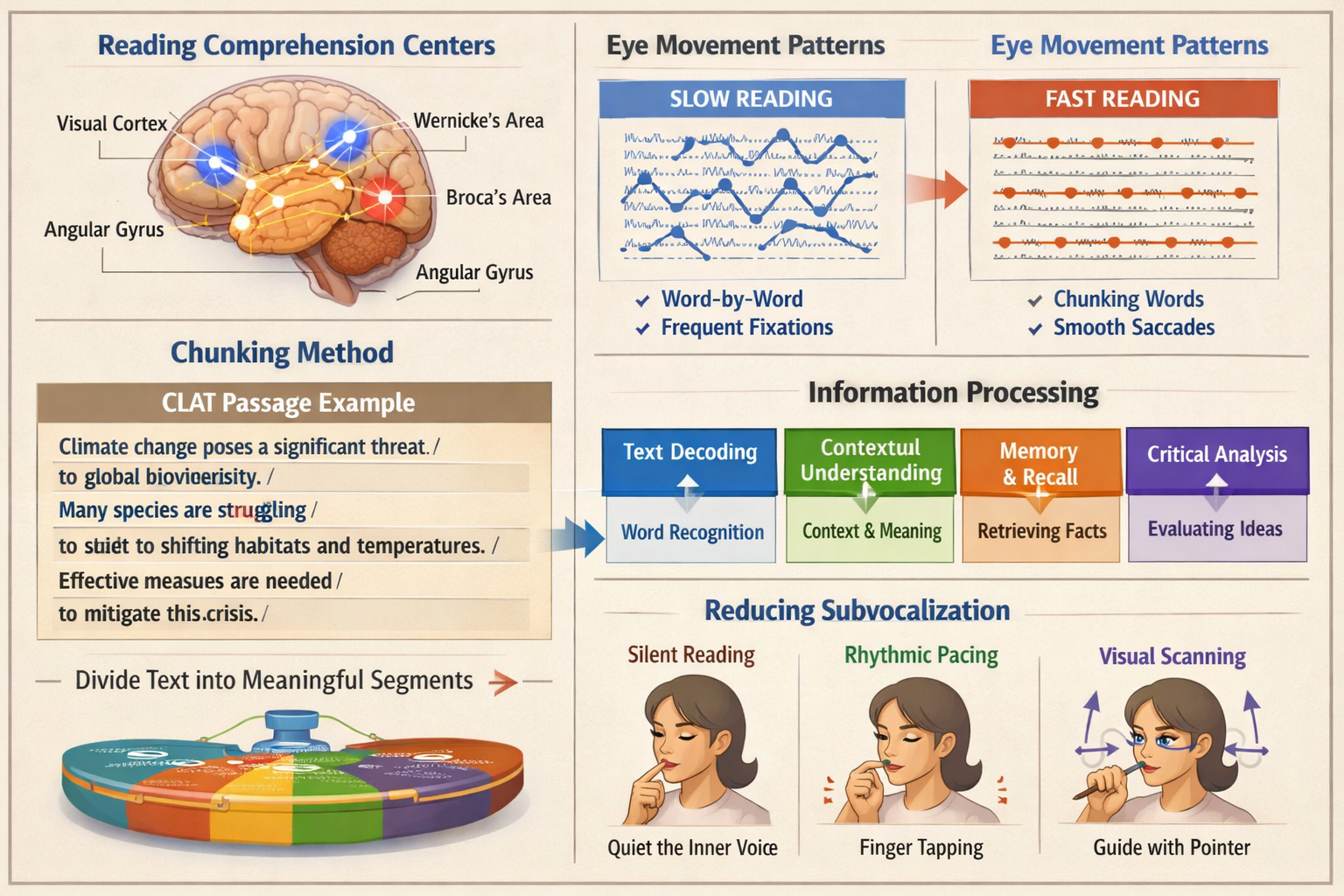
Understanding the neuroscience of reading helps you improve systematically rather than randomly trying different techniques. Your brain processes visual information much faster than you can vocalize words. When you read, your eyes make quick movements called saccades, jumping from one fixation point to another.
Average readers make 4-5 fixations per line, processing 1-2 words per fixation. Speed readers expand their perceptual span to capture 3-5 words per fixation and reduce the number of fixations per line. This isn’t magic. It’s trainable.
How Your Brain Processes Text
Your brain has two reading pathways. The ventral stream handles word recognition and meaning, while the dorsal stream manages attention and eye movements. Efficient CLAT reading requires optimizing both pathways simultaneously.
Research shows that comprehension doesn’t drop significantly until reading speeds exceed 400 words per minute for moderately complex text. CLAT passages fall into this category. You have room to increase speed without sacrificing the understanding you need to answer questions correctly.
The prefrontal cortex, responsible for working memory, can only hold 4-7 chunks of information at once. This is why chunking works. By grouping related words into meaningful units, you process more information per mental “slot.”
Neuroplasticity means your brain can rewire itself with practice. The more you practice strategic reading techniques, the more automatic they become. What feels awkward initially becomes second nature after 4-6 weeks of consistent practice.
Essential Techniques for How to Read 450-Word CLAT Passages
Mastering CLAT passages requires a toolkit of techniques. Different passages and question types demand different approaches. Here’s your comprehensive strategy guide.
The Question-First Approach
Before diving into the passage, quickly scan the questions. This takes 10-15 seconds but provides a mental framework for what information matters. When you know you’ll be asked about “the author’s main argument” or “the exception to the legal principle,” your brain automatically flags relevant information while reading.
This technique transforms passive reading into active hunting. You’re not just absorbing information; you’re searching for specific details. This focused attention improves both speed and retention.
However, don’t read questions too carefully at this stage. A quick glance to understand what’s being asked is sufficient. Detailed question analysis comes after reading the passage.
Strategic Skimming vs. Deep Reading
Not all parts of a passage deserve equal attention. The opening paragraph typically introduces the topic and sets context. The concluding paragraph often contains the author’s main argument or summary. Middle paragraphs provide supporting details, examples, and elaboration.
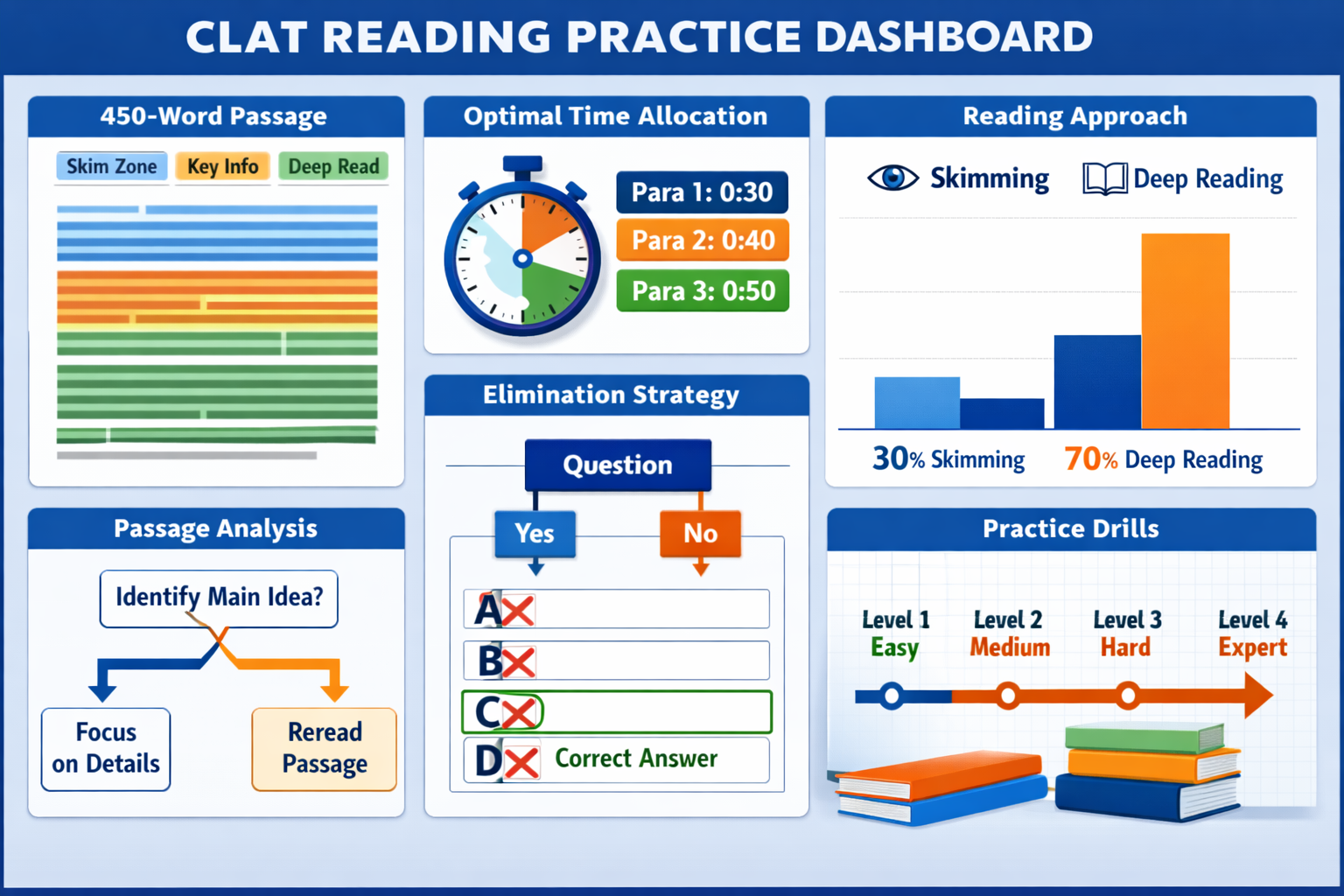
Strategic skimming means reading the first and last sentences of each paragraph carefully while moving quickly through middle sentences. This gives you the passage’s skeleton. You can always return to specific paragraphs when answering questions.
For legal reasoning passages following the principle-facts-question format, read the principle with 100% attention. That’s your rulebook. Skim the facts to understand the scenario, then carefully match facts to the principle.
Current affairs and literary passages often hide key information in the middle. For these, adjust your strategy. Skim less, read more carefully, but still maintain pace.
The Chunking Method
Instead of reading “The Supreme Court of India delivered a landmark judgment,” process it as three chunks: “The Supreme Court” + “of India” + “delivered a landmark judgment.” Your eyes should move in three jumps, not seven.
Chunking reduces the number of eye fixations per line, automatically increasing reading speed. It also mirrors how we process spoken language, making comprehension more natural.
Practice chunking by using your finger or a pen to guide your eyes. Move it in smooth jumps across the line, forcing your eyes to capture multiple words per fixation. This feels uncomfortable initially but becomes fluid with practice.
Visual markers help. Some students mentally draw boxes around phrases. Others use their peripheral vision to capture words on either side of their focal point. Experiment to find what works for you.
Reducing Subvocalization
Complete elimination of subvocalization is neither possible nor desirable for CLAT-level comprehension. But reducing it from 100% to 30-40% can boost your reading speed significantly.
Try reading while humming or counting. This occupies your vocalization mechanism, forcing your brain to process words visually. Initially, comprehension drops, but with practice, your brain adapts.
Another technique: consciously read faster than you can speak. Push your reading pace to 350-400 words per minute. Your inner voice can’t keep up, so your brain learns to process meaning without full vocalization.
Pacing tools help. Use a metronome app set to 300 beats per minute. Try to move your eyes to a new fixation point with each beat. This external rhythm overrides your internal speaking rhythm.
Advanced Strategies for How to Read 450-Word CLAT Passages Under Pressure
Basic techniques get you to competent. Advanced strategies get you to exceptional. These methods separate the 95th percentile from the 99th percentile.
The Layered Reading Approach
Read the passage in two passes. The first pass takes 60-70 seconds and focuses on grasping the main idea, structure, and tone. You’re building a mental map. The second pass, done while answering questions, involves targeted re-reading of specific sections.
This approach reduces the pressure to catch everything in one reading. You’re not trying to memorize the passage; you’re trying to understand its architecture so you can navigate it efficiently when answering questions.
For the first pass, focus on:
- Topic and scope (what is this about?)
- Author’s purpose (why was this written?)
- Passage structure (how is information organized?)
- Tone and perspective (is the author neutral, critical, supportive?)
The second pass is question-driven. Each question sends you back to a specific part of the passage. Because you have a mental map, you know exactly where to look.
Active Reading Markers
Develop a simple annotation system. Circle key terms. Underline main ideas. Put a star next to the author’s opinion. Draw arrows to show cause-effect relationships.
These physical markers create visual anchors. When a question asks about “the primary reason for X,” your eyes immediately jump to the section you underlined, saving precious seconds.
Keep annotations minimal. Excessive highlighting defeats the purpose. Mark only what’s truly important: definitions, main arguments, exceptions, examples that illustrate key points, and transition words indicating logical flow.
In computer-based CLAT, you can’t physically mark the passage, but you can use the highlight feature sparingly. Alternatively, train your visual memory to create mental markers. This takes more practice but is equally effective.
The Elimination Strategy for Comprehension Questions
CLAT comprehension questions often have two clearly wrong answers, one tempting distractor, and one correct answer. Your job isn’t to find the right answer immediately. It’s to eliminate wrong answers efficiently.
Read each option and ask: “Does the passage actually say this, or am I making assumptions?” Many wrong answers contain information that sounds plausible but isn’t stated in the passage.
Watch for extreme language in options: “always,” “never,” “only,” “must.” Passages rarely make absolute claims. Options with extreme language are often incorrect unless the passage explicitly uses similar language.
Comparative options are tricky. “X is more important than Y” might sound right, but unless the passage explicitly compares X and Y, it’s an inference too far.
The correct answer in comprehension questions is almost always a paraphrase of something directly stated in the passage. It won’t use identical language, but the meaning will be unmistakably present in the text.
Diagnostic Approach: Identifying Your Reading Weaknesses
Generic advice helps, but personalized strategy wins. Before applying techniques randomly, diagnose your specific weaknesses. This targeted approach yields faster improvement.
Self-Assessment Framework
Take three timed practice passages. For each, track:
- Reading time: How long to read the passage once?
- Question time: How long to answer all questions?
- Accuracy: How many questions did you get right?
- Return rate: How many times did you re-read parts of the passage?
If your reading time exceeds 90 seconds but accuracy is high (80%+), your issue is speed, not comprehension. Focus on techniques like chunking and reducing subvocalization.
If your reading time is under 70 seconds but accuracy is below 60%, you’re reading too fast without adequate comprehension. Slow down slightly and practice active reading techniques.
High return rate (re-reading the same section 3+ times) indicates poor retention. Work on creating mental summaries after each paragraph and using the question-first approach.
Common Reading Weakness Patterns
Pattern 1: The Slow Comprehender
Reads carefully but slowly (250-300 seconds per passage). High accuracy but can’t finish the exam. Solution: Gradual speed increase through timed drills, starting at comfortable pace and reducing by 10 seconds weekly.
Pattern 2: The Hasty Skimmer
Reads very fast (40-50 seconds) but misses crucial details. Low accuracy on inference questions. Solution: Layered reading approach, strategic skimming only for middle paragraphs, careful reading of opening and closing.
Pattern 3: The Vocabulary Struggler
Gets stuck on unfamiliar words, losing flow and time. Solution: Contextual vocabulary building, learning to infer word meaning from context, building a CLAT-specific word list through regular GK and current affairs reading.
Pattern 4: The Distracted Reader
Starts strong but attention wanes mid-passage. Misses information in paragraphs 3-4. Solution: Mindfulness training, shorter practice sessions with full focus, active reading markers to maintain engagement.
Practical Exercises and Drills for How to Read 450-Word CLAT Passages
Knowledge without practice is useless. These drills, done consistently for 30-45 days, will transform your reading ability.
The 30-Day Reading Speed Progression
Week 1-2: Baseline and Technique Introduction
- Days 1-3: Establish baseline. Read 5 passages at natural pace, track time and accuracy
- Days 4-7: Practice chunking with easy passages (newspapers, magazines)
- Days 8-14: Apply chunking to CLAT-style passages, aim for 10% speed increase
Week 3-4: Speed Building
- Days 15-21: Timed drills. Set timer for 80 seconds, practice reading passages within time limit
- Days 22-28: Introduce question-first approach, practice with full question sets
- Days 29-30: Full-length mock tests focusing on reading sections
Track progress in a simple spreadsheet. Seeing improvement motivates continued practice.
Daily Reading Workout
Morning (15 minutes): Read one challenging editorial or essay at your fastest comfortable pace. Focus on grasping main idea and structure, not every detail. This builds speed.
Afternoon (20 minutes): Read two CLAT-style passages with questions. Apply techniques learned: question-first approach, strategic skimming, chunking. Time yourself. Review wrong answers to understand comprehension gaps.
Evening (10 minutes): Vocabulary building. Read one current affairs article, note unfamiliar words, learn meanings from context before checking dictionary. This builds the vocabulary foundation essential for efficient reading.
Consistency matters more than intensity. Fifteen minutes daily beats a three-hour weekend marathon.
The Peripheral Vision Expansion Exercise
Place a passage on your screen or paper. Focus on the center word of each line. Without moving your eyes, try to read the words on either side using peripheral vision. This expands your perceptual span.
Start with short lines (8-10 words). Gradually progress to longer lines. With practice, you’ll capture entire lines in 2-3 fixations instead of 5-6.
Use a finger or pen to guide your eyes down the center of the passage. Move it smoothly downward while your eyes follow, capturing words on both sides. This forces your brain to process information peripherally.
This exercise feels strange initially. Your comprehension will be poor. That’s normal. After 10-15 practice sessions, your brain adapts, and comprehension improves while speed increases dramatically.
Technology-Assisted Reading Improvement Methods
Technology can accelerate your reading improvement when used strategically. These tools provide structured practice and objective feedback.
Speed Reading Apps and Tools
Spreeder and similar apps display text word-by-word or phrase-by-phrase at controlled speeds. Start at 250 words per minute, gradually increase to 350-400. This trains your brain to process information at higher speeds.
ReadMe! offers CLAT-specific passages with built-in timers and analytics. It tracks your reading speed, comprehension accuracy, and improvement over time, providing data-driven insights into your progress.
Eye training software like Reedy uses rapid serial visual presentation (RSVP) to reduce eye movement and improve focus. Words appear in the same screen location, eliminating the need for saccades.
However, don’t become dependent on these tools. They’re training wheels. Your goal is to internalize these skills and apply them to actual CLAT passages on exam day.
Digital vs. Paper Reading
Research shows people read slightly faster on paper but comprehend similarly on both mediums. Since CLAT 2026 is computer-based, practice primarily on screens to build familiarity.
Adjust screen brightness to comfortable levels. Eye strain slows reading and reduces concentration. Use blue light filters during evening practice sessions.
Learn to use the scroll function efficiently. Smooth scrolling is faster than clicking “next page” repeatedly. Practice scrolling at a steady pace that matches your reading speed.
The CLAT 2026 interface allows highlighting and note-taking. Practice using these features during mocks so they become automatic during the actual exam.
Psychological Preparation for Reading Under Exam Pressure
Technical skills matter, but mental preparation determines whether you execute those skills under pressure. Exam anxiety can reduce reading efficiency by 30-40%.
Building Reading Stamina
CLAT requires sustained concentration for 120 minutes. Most students practice with individual passages (5-10 minutes of focus) but struggle to maintain that intensity for two hours.
Build stamina gradually. Start with 30-minute practice sessions. Weekly, add 10-15 minutes until you can maintain full concentration for 150 minutes (slightly longer than the actual exam).
Take strategic micro-breaks during practice. After every 5-6 passages, close your eyes for 10 seconds, take three deep breaths, then continue. This prevents mental fatigue without breaking momentum.
Simulate exam conditions during practice. Same time of day, same environment noise level, same screen setup. Familiarity reduces anxiety and improves performance.
Managing Reading Anxiety
Some students panic when they encounter an unfamiliar topic or difficult passage. This anxiety triggers shallow breathing, reduced focus, and slower processing.
Practice the “accept and move on” mindset. Not every passage will make perfect sense. That’s okay. CLAT questions are designed to be answerable even with 70-80% comprehension.
When you feel panic rising during a passage, pause for three seconds. Take one deep breath. Remind yourself: “I don’t need to understand everything. I need to answer four questions.” This reframe reduces pressure.
Develop a skip strategy. If a passage feels exceptionally difficult, mark it and move on. Return to it later with fresh eyes. Sometimes, reading other passages primes your brain, making the difficult one easier on second attempt.
Mindfulness and Focus Training
Five minutes of daily mindfulness meditation improves sustained attention and reading comprehension. Apps like Headspace or Calm offer guided sessions specifically for focus and concentration.
Practice focused attention by reading a passage while consciously noting when your mind wanders. Don’t judge yourself; simply bring attention back to the text. This metacognitive awareness improves over time.
The “Pomodoro Technique” works well for CLAT preparation. Study for 25 minutes with complete focus, take a 5-minute break, repeat. This structured approach prevents burnout while building concentration capacity.
Nutrition and Cognitive Performance for Reading Speed
Your brain consumes 20% of your body’s energy despite being only 2% of body weight. Proper nutrition directly impacts reading efficiency and cognitive performance.
Brain-Boosting Foods for CLAT Preparation
Omega-3 fatty acids (found in walnuts, flaxseeds, fish) improve neural connectivity and processing speed. Include these in your daily diet, especially during the final two months before CLAT.
Complex carbohydrates (oats, brown rice, whole wheat) provide steady glucose release, maintaining concentration for longer periods. Avoid simple sugars that cause energy spikes and crashes.
Antioxidant-rich foods (blueberries, dark chocolate, green tea) protect brain cells from oxidative stress caused by intense mental work. A handful of berries or a small piece of dark chocolate during study breaks helps.
Hydration is critical. Even mild dehydration (1-2% body water loss) reduces cognitive performance by 10-15%. Keep water nearby during practice sessions and sip regularly.
Pre-Exam and Exam-Day Nutrition
The night before CLAT, eat a balanced dinner with protein, complex carbs, and vegetables. Avoid heavy, greasy foods that disrupt sleep. Quality sleep matters more than last-minute cramming.
On exam morning, eat a substantial breakfast 2-3 hours before the test. Include protein (eggs, paneer, yogurt) for sustained energy and complex carbs (whole wheat toast, oats) for glucose. Avoid excessive caffeine, which can increase anxiety.
During the exam, if permitted, keep a small piece of dark chocolate or a few nuts. A tiny amount of glucose during the test can provide a mental boost when fatigue sets in.
Common Mistakes to Avoid When Learning How to Read 450-Word CLAT Passages
Knowing what not to do is as important as knowing what to do. These mistakes sabotage reading improvement despite sincere effort.
Mistake 1: Prioritizing Speed Over Comprehension Too Early
Many students, desperate to improve speed, start skimming aggressively before building comprehension skills. This creates bad habits. Speed should increase gradually as a byproduct of efficient techniques, not as a forced goal.
Start with accuracy. Once you consistently score 80%+ on passages (even if reading slowly), then focus on speed improvement. Trying to do both simultaneously often results in neither.
Mistake 2: Practicing Without Time Tracking
Reading passages without timing yourself provides no feedback on improvement. You might feel faster, but feelings are unreliable. Data isn’t.
Use a stopwatch for every practice passage. Record reading time, question-answering time, and accuracy in a simple log. Review weekly to identify trends and adjust strategies.
Mistake 3: Ignoring Passage Variety
Practicing only legal reasoning passages or only current affairs passages creates a false sense of competence. CLAT throws diverse topics at you. Practice across all categories: legal, current affairs, literature, economics, science, philosophy.
Different passage types demand different reading strategies. Legal passages require careful attention to principles and exceptions. Literary passages need sensitivity to tone and style. Current affairs passages demand connecting information to your existing knowledge.
Mistake 4: Passive Re-reading
When comprehension fails, most students simply re-read the passage the same way. This rarely helps. If you didn’t understand something the first time, doing the exact same thing again won’t magically create understanding.
Instead, try active re-reading. Ask specific questions: “What’s the main point here? How does this paragraph connect to the previous one? What example illustrates this concept?” Engage with the text, don’t just pass your eyes over it again.
Mistake 5: Neglecting Vocabulary Building
Strong vocabulary isn’t just about answering vocabulary questions. It directly impacts reading speed and comprehension. When you encounter unfamiliar words, you slow down, lose flow, and sometimes misunderstand the passage’s meaning.
Build vocabulary contextually through reading, not through random word lists. When you encounter an unfamiliar word in practice passages, try to infer its meaning from context before checking the dictionary. This builds the skill you’ll need on exam day.
The CLAT English section heavily rewards strong vocabulary, making this investment doubly valuable.
Creating Your Personalized Reading Improvement Plan
Generic plans produce generic results. Your reading improvement plan should address your specific weaknesses, leverage your strengths, and fit your schedule.
Step 1: Baseline Assessment (Week 1)
Take three full-length reading section tests (28-30 passages) under timed conditions. For each test, record:
- Total time taken
- Number of passages completed
- Overall accuracy
- Specific passage types where accuracy dropped
- Subjective difficulty rating for each passage
Analyze this data to identify patterns. Are you consistently weak in legal passages? Do you run out of time in the last 10 passages? Does accuracy drop after 60 minutes?
Step 2: Targeted Technique Selection (Week 2)
Based on your baseline assessment, select 2-3 techniques to focus on. Don’t try to implement everything at once. Master a few techniques thoroughly rather than applying many techniques superficially.
If speed is your primary issue: Focus on chunking, reducing subvocalization, and peripheral vision expansion.
If comprehension is your primary issue: Focus on active reading, question-first approach, and creating mental summaries.
If stamina is your primary issue: Focus on building concentration through mindfulness, progressive practice session lengthening, and strategic breaks.
Step 3: Structured Practice Schedule (Weeks 3-8)
Design a weekly practice schedule that includes:
- Daily technique drills (15-20 minutes): Focused practice of specific techniques
- Timed passage practice (30 minutes, 4-5 days/week): Full passages with questions under time pressure
- Weekly full-length tests (120 minutes): Simulate complete exam conditions
- Review and analysis (20 minutes after each practice): Understand mistakes, identify patterns, adjust strategy
Consistency matters more than volume. Practicing 30 minutes daily for 6 weeks beats cramming 10 hours into a weekend.
Step 4: Progressive Difficulty Increase (Weeks 9-12)
As your skills improve, increase difficulty:
- Reduce time limits by 10-15 seconds per passage
- Practice with more complex, academic passages
- Attempt passages from previous years’ actual CLAT papers
- Mix passage types within practice sessions to simulate exam unpredictability
Track improvement metrics weekly. You should see reading speed increase by 50-100 words per minute and accuracy improve by 10-15% over 12 weeks of dedicated practice.
Leveraging Expert Guidance for How to Read 450-Word CLAT Passages
Self-study takes you far, but expert guidance accelerates progress and prevents costly mistakes. At Lawgic Coaching, we’ve helped thousands of students transform their reading efficiency through personalized mentorship.
Why Structured Coaching Matters
Reading improvement isn’t linear. You’ll hit plateaus where progress stalls despite consistent effort. Expert coaches identify the specific bottleneck holding you back and provide targeted interventions.
Our faculty from top NLUs understand exactly what CLAT demands because they’ve been through it themselves. They don’t teach generic speed reading; they teach CLAT-specific reading strategies that balance speed with the precision needed to score.
We provide personalized reading diagnostics that pinpoint your exact weaknesses. Generic advice says “read faster.” We tell you specifically whether your issue is eye fixation rate, working memory capacity, vocabulary gaps, or anxiety-induced regression.
Flexible Learning That Fits Your Life
Balancing school, CLAT preparation, and life is tough. We get it. That’s why our online CLAT coaching offers flexible scheduling, recorded sessions, and self-paced modules for reading improvement.
You can access our reading speed drills, comprehension workshops, and passage practice libraries anytime, anywhere. Study at your own pace, but with expert guidance just a message away.
We’ve helped students improve reading speed from 200 to 350+ words per minute while maintaining 85%+ accuracy. These aren’t exceptional cases; they’re typical results when you combine proven techniques with consistent practice and expert feedback.
Your success is our mission. We don’t just teach techniques; we mentor you through the entire improvement journey, celebrating small wins and troubleshooting setbacks until you’re exam-ready.
Integration with Overall CLAT Preparation Strategy

Reading skills don’t exist in isolation. They integrate with every section of CLAT. Strong reading ability improves performance across Legal Reasoning, Current Affairs, Logical Reasoning, and even Quantitative Techniques.
Cross-Section Benefits of Improved Reading
Legal Reasoning: Faster reading means more time to analyze facts against principles. You can attempt more questions and handle complex multi-principle passages confidently.
Current Affairs: Efficient reading allows you to process more daily news in less time during preparation. On exam day, you quickly extract relevant information from current affairs passages.
Logical Reasoning: Many logical reasoning questions are embedded in short passages. Quick comprehension of the setup leaves more time for actual logical analysis.
Even Quantitative Techniques benefits. Word problems require extracting numerical information from text. Strong reading skills help you identify relevant data quickly.
Balancing Reading Practice with Other Sections
Don’t obsess over reading to the exclusion of other sections. A balanced approach works best. Dedicate 20-25% of your daily CLAT preparation time to reading improvement during the first 2-3 months. As skills solidify, reduce to 10-15% and increase focus on content-heavy sections like Current Affairs and Legal Reasoning.
Integrate reading practice with content learning. When studying current affairs, practice reading news articles with the same techniques you use for passages. When learning legal principles, read case summaries using strategic skimming and active reading.
Our comprehensive CLAT preparation strategy shows you exactly how to balance skill development (like reading) with content mastery (like GK) for optimal results.
Final Month Strategy: Refining How to Read 450-Word CLAT Passages
The last 30 days before CLAT aren’t for learning new techniques. They’re for refining, automating, and building unshakeable confidence in your reading ability.
Week 1-2: Automation Through Repetition
Practice passages daily, but focus on making techniques automatic rather than conscious. You shouldn’t be thinking “Now I’ll use chunking, now I’ll skim this paragraph.” These decisions should happen instinctively.
Take full-length mocks every 2-3 days. Analyze not just accuracy but also reading patterns. Are you still re-reading excessively? Are you managing time well across all passages?
Week 3: Weakness Elimination
Identify your remaining weak spots. Maybe you still struggle with literary passages or get nervous with legal jargon. Dedicate focused practice to these specific areas.
Do targeted drills. If literary passages are weak, practice 10 literary passages daily for a week. Focused intensity on weaknesses yields rapid improvement.
Week 4: Confidence Building and Maintenance
The final week is about confidence, not improvement. Practice enough to maintain sharpness but not so much that you burn out. Quality over quantity.
Visualize success. Spend 5-10 minutes daily visualizing yourself reading CLAT passages calmly, efficiently, answering questions confidently. Mental rehearsal improves actual performance.
Review your progress journey. Look at your week-1 baseline and compare it to your current performance. Recognize how far you’ve come. This builds the confidence you need to perform under pressure.
Trust your preparation. You’ve put in the work. Your brain has rewired itself. The techniques are automatic. You’re ready.
Conclusion: Your Path to Mastering How to Read 450-Word CLAT Passages
Reading 450-word CLAT passages efficiently is a learnable skill, not an innate talent. Every CLAT topper you admire developed this skill through deliberate practice, strategic techniques, and consistent effort. You can too.
Start with accurate self-diagnosis. Understand your specific reading weaknesses before applying generic techniques. Personalized strategy always beats one-size-fits-all advice.
Implement techniques systematically. Master chunking and question-first approach before moving to advanced strategies like layered reading and peripheral vision expansion. Build your skill foundation solidly.
Practice consistently with time tracking and analysis. Fifteen minutes of focused daily practice beats weekend marathons. Track your metrics, celebrate improvements, and adjust strategies based on data.
Balance speed with comprehension. CLAT rewards efficient reading that maintains accuracy, not reckless skimming that sacrifices understanding. Aim for 300-350 words per minute with 80%+ accuracy.
Prepare psychologically for exam pressure. Technical skills matter, but mental preparation determines whether you execute those skills when it counts. Build stamina, manage anxiety, and develop unshakeable confidence.
Integrate reading improvement with overall CLAT preparation. Strong reading skills enhance performance across all sections, making this investment multiply its returns.
Remember, you’re not just preparing for an exam. You’re building cognitive skills that will serve you throughout law school and your legal career. Efficient reading, critical analysis, and quick comprehension are foundational lawyering skills.
At Lawgic Coaching, we’re committed to your success. Our expert mentors, flexible learning platform, and proven strategies have helped thousands of students achieve their CLAT dreams. We’d love to be part of your journey too.
Your law school dream is within reach. Master how to read 450-word CLAT passages, and you’ve conquered one of the exam’s biggest challenges. The path is clear. The techniques are proven. The only question is: are you ready to commit to the practice?
Start today. Track your progress. Trust the process. Your CLAT success story begins with this single skill.
Additional Resources and Next Steps
Ready to take your CLAT preparation to the next level? Here are concrete next steps:
Immediate Actions:
- Take a baseline reading assessment today using three full passages
- Identify your primary weakness: speed, comprehension, or stamina
- Select two techniques from this guide to practice this week
- Set up a simple tracking spreadsheet for reading metrics
Weekly Goals:
- Practice 5-7 timed passages daily with full question sets
- Complete one full-length reading section mock test
- Review and analyze all mistakes to identify patterns
- Adjust techniques based on what’s working and what isn’t
Long-term Strategy:
- Follow the 12-week improvement plan outlined in this guide
- Join a structured coaching program for personalized guidance and accountability
- Build reading habits beyond CLAT practice through newspapers, magazines, and books
- Integrate reading skills with comprehensive CLAT preparation across all sections
Recommended Reading:
- Daily: One editorial from The Hindu or Indian Express
- Weekly: Two long-form articles from magazines like Frontline or EPW
- Monthly: One complete book (fiction or non-fiction) to build reading stamina
Expert Support:
If you’re serious about CLAT success, consider joining our comprehensive coaching program. We offer:
- Personalized reading diagnostics and improvement plans
- Weekly live workshops on comprehension strategies
- Extensive passage practice libraries with detailed solutions
- One-on-one mentorship from NLU faculty
- Full-length mocks with comparative performance analytics
Visit Lawgic Coaching to explore our programs, or check out our detailed guides on CLAT preparation strategies and avoiding common CLAT pitfalls.
Your CLAT journey is unique, but you don’t have to walk it alone. Let’s build your law career together with expert guidance, flexible learning, and proven strategies that actually work.
CLAT Reading Speed Calculator
Measure your current reading speed and get personalized improvement tips