Here’s something most CLAT aspirants don’t realize until it’s too late. The quantitative techniques section might seem small with just 13-17 questions, but choosing the wrong maths book for CLAT preparation can cost you those crucial marks that separate an NLU admission from a near miss.
The math section in CLAT isn’t about complex calculus or advanced trigonometry. It tests your ability to solve practical problems quickly and accurately under pressure. And that requires the right preparation strategy backed by the right books.
Let’s be honest. Walk into any bookstore and you’ll find dozens of quantitative aptitude books claiming to be perfect for law entrance exams. But which ones actually match the CLAT pattern? Which books waste your time with irrelevant topics? And more importantly, which maths book for CLAT preparation will give you the edge you need?
This guide breaks down everything you need to know about selecting and using mathematics books for CLAT 2027. We’ve analyzed the exam pattern, consulted with toppers, and identified exactly what works.
Key Takeaways
- CLAT quantitative techniques section contains 13-17 questions worth approximately 13-17% of total marks, making proper preparation essential
- The best maths books for CLAT focus on basic arithmetic, percentages, ratios, averages, and data interpretation rather than advanced mathematics
- Topic-specific practice books combined with comprehensive guides provide better results than single textbook approaches
- Previous year papers and mock tests are equally important as theory books for understanding question patterns
- Budget-friendly preparation is possible by combining free resources with 2-3 carefully selected core books
Understanding CLAT Quantitative Techniques Section
What the Exam Actually Tests
The CLAT quantitative techniques section doesn’t require you to be a math genius. The exam tests your ability to apply basic mathematical concepts to solve practical problems.
You’ll face questions on percentages, profit and loss, simple and compound interest, ratios and proportions, averages, time and work, speed and distance, and basic data interpretation. That’s it. No calculus, no trigonometry, no complex algebra.
The difficulty level stays at Class 10 standard. But here’s the catch. You need to solve these problems quickly because time management makes or breaks your CLAT score.
Section Weightage and Question Pattern
CLAT 2026 brought some changes to the exam pattern. The quantitative techniques section now carries 13-17 questions out of 120 total questions. Each correct answer gives you one mark, while each wrong answer deducts 0.25 marks.
This section typically appears as short passages or data sets followed by questions. You might see a paragraph about business statistics, sales data, or survey results, and then answer questions based on calculations derived from that information.
The questions test both your calculation speed and your ability to identify what the question actually asks for. Many students lose marks not because they can’t do the math, but because they misread what’s being asked.
Common Topics and Their Frequency
Based on analysis of CLAT papers from 2020 to 2026, certain topics appear more frequently than others.
Data interpretation questions show up in almost every exam. You’ll need to read tables, bar graphs, pie charts, and line graphs to extract information and perform calculations.
Percentages and ratios form the backbone of most questions. Whether it’s profit-loss, simple interest, or mixture problems, these concepts appear repeatedly.
Time-speed-distance and time-work problems appear regularly but usually in straightforward formats. The exam doesn’t throw complex multi-step problems at you.
Averages and basic statistics questions appear moderately. You should know how to calculate mean, median, and weighted averages.
What rarely appears? Complex number systems, advanced algebra, geometry theorems, and trigonometric identities. Skip books that focus heavily on these topics.
Criteria for Selecting the Best Maths Book for CLAT Preparation
CLAT-Specific Content Alignment
Not every quantitative aptitude book suits CLAT preparation. Many books designed for banking exams or MBA entrances include topics you’ll never see in CLAT.
Your chosen maths book for CLAT preparation should focus exclusively on Class 10 level arithmetic and data interpretation. Check the table of contents before buying. If you see chapters on logarithms, complex equations, or advanced geometry, that book will waste your time.
Look for books that explicitly mention CLAT or law entrance exams on the cover. These books understand the exam pattern and difficulty level you’ll actually face.
The best books include CLAT-style passage-based questions rather than just standalone math problems. This format matches what you’ll encounter in the actual exam.
Explanation Quality and Solution Methods
A good maths book doesn’t just provide answers. It shows you multiple methods to reach those answers.
When evaluating books, check if solutions include step-by-step explanations. Can you understand why each step was taken? Does the book explain the logic behind the solution approach?
The best books also include shortcut methods and tricks for faster calculation. In a time-bound exam like CLAT, knowing that 12.5% equals 1/8 can save you precious seconds.
Look for books that explain common mistakes students make. Understanding what not to do often helps as much as knowing the correct method.
Some books include difficulty level indicators for each question. This feature helps you progressively build your skills from basic to advanced problems.
Practice Question Volume and Variety
Practice makes perfect, especially in quantitative techniques. Your chosen book should offer enough questions to build genuine competency.
A good maths book for CLAT preparation includes at least 1000-1500 practice questions across all topics. This volume ensures you encounter different question variations and develop pattern recognition.
Question variety matters as much as quantity. The book should include basic concept-building questions, moderate difficulty problems, and challenging questions that push your limits.
Check if the book provides topic-wise practice sets as well as mixed topic tests. Topic-wise practice builds foundational skills, while mixed tests simulate actual exam conditions.
Previous year CLAT questions should be included or clearly marked if adapted. These questions give you the best sense of actual exam difficulty and pattern.
Price and Accessibility Factors
Quality CLAT preparation doesn’t require breaking the bank. Several excellent books are available at reasonable prices.
Most good quantitative aptitude books for CLAT cost between Rs. 300 to Rs. 600. Books priced significantly higher aren’t necessarily better. You’re paying for content quality and relevance, not fancy packaging.
Consider whether you prefer physical books or digital versions. E-books and PDFs often cost less and offer search functionality. But many students retain information better when studying from physical books.
Check if the book is easily available in your city or online. Some highly recommended books go out of stock during peak preparation season. Having backup options prevents preparation delays.
Used books from seniors can save money if they’re in good condition. Math books don’t become outdated quickly since basic arithmetic concepts remain constant.
Top Recommended Maths Books for CLAT 2027
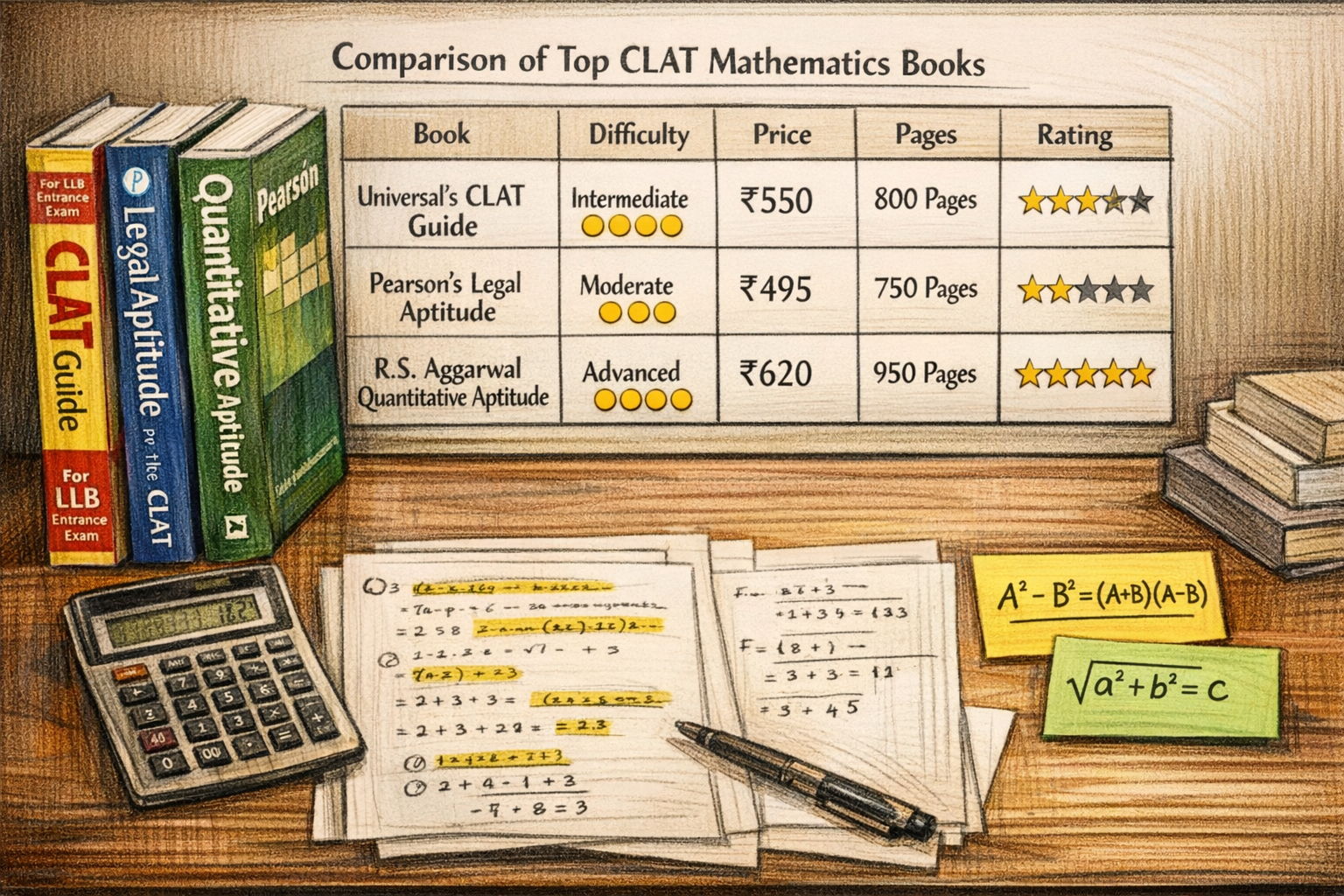
Universal’s Guide to CLAT
Universal’s CLAT preparation guide includes a dedicated quantitative techniques section that aligns perfectly with the exam pattern. This book covers all topics tested in CLAT without including irrelevant advanced mathematics.
The quantitative section includes approximately 800 practice questions with detailed solutions. Questions are organized by difficulty level, allowing you to progress systematically from basic to challenging problems.
What sets this book apart is its integration of all CLAT sections. You can prepare for math alongside legal reasoning, logical reasoning, and other sections using a single comprehensive resource.
The book includes five full-length mock tests that simulate actual CLAT exam conditions. These tests help you practice time management across all sections together.
Price ranges from Rs. 450 to Rs. 550 depending on the edition and seller. The book is widely available both online and in bookstores across India.
One limitation is that the quantitative section isn’t as extensive as dedicated math books. If you need intensive practice in specific weak areas, you’ll need supplementary resources.
Pearson’s Guide to Quantitative Aptitude for Competitive Examinations
Pearson’s quantitative aptitude guide by Edgar Thorpe is a comprehensive resource that covers all mathematical topics relevant to CLAT and other law entrance exams.
The book includes over 2000 practice questions spanning basic arithmetic to data interpretation. Each chapter starts with concept explanations followed by solved examples and practice exercises.
Shortcut methods and quick calculation techniques are highlighted throughout the book. These tricks prove invaluable during the actual exam when every second counts.
The difficulty level ranges from easy to moderate, which matches CLAT requirements perfectly. You won’t waste time on unnecessarily complex problems that never appear in law entrance exams.
Solutions are provided for all questions with step-by-step explanations. The book also includes common error analysis, helping you avoid typical mistakes.
At approximately Rs. 400-500, this book offers excellent value for the content volume provided. It’s available in both paperback and e-book formats.
The main drawback is that it’s not exclusively designed for CLAT. Some topics receive more emphasis than necessary for law entrance exams. You’ll need to be selective about which sections to prioritize.
R.S. Aggarwal’s Quantitative Aptitude
R.S. Aggarwal’s Quantitative Aptitude is a classic choice that has helped millions of students prepare for competitive exams. While not specifically designed for CLAT, it covers all relevant topics comprehensively.
The book’s strength lies in its systematic approach to building mathematical skills. Each chapter includes theory, solved examples, and extensive practice questions organized by difficulty level.
With over 3000 questions across all topics, this book provides more than enough practice material for thorough CLAT preparation. The sheer volume ensures you encounter every possible question variation.
Explanations are clear and easy to understand even for students who struggle with mathematics. The book assumes no advanced prior knowledge and builds concepts from the ground up.
Price ranges from Rs. 500-600 for the latest edition. Given the comprehensive content, this represents good value for money.
However, the book includes many topics irrelevant to CLAT like advanced algebra, trigonometry, and complex geometry. You’ll need to identify which chapters align with the CLAT syllabus and skip the rest.
The book’s size can be overwhelming. At over 1000 pages, it requires discipline to focus only on CLAT-relevant sections without getting distracted by unnecessary topics.
Arihant’s Quantitative Aptitude for All Competitive Examinations
Arihant’s quantitative aptitude book strikes a good balance between comprehensiveness and CLAT-specific relevance. The book covers all arithmetic and data interpretation topics tested in law entrance exams.
Each chapter includes concept summaries, solved examples with multiple solution methods, and practice exercises with varying difficulty levels. This structure helps build skills progressively.
The book includes specific sections on shortcuts and time-saving techniques. These methods prove particularly useful in CLAT where speed matters as much as accuracy.
Approximately 1500 practice questions are spread across all topics. While not as extensive as R.S. Aggarwal, the question selection is more relevant to CLAT’s difficulty level and pattern.
Solutions include detailed step-by-step explanations with alternative approaches where applicable. This helps you understand multiple ways to solve the same problem.
Priced around Rs. 350-450, this book offers good value for CLAT aspirants who want focused preparation without unnecessary topics.
The limitation is that data interpretation coverage could be more extensive. CLAT increasingly includes DI questions, so you might need supplementary practice material for this specific area.
Disha’s Quantitative Aptitude for CLAT
Disha Publications offers a quantitative aptitude book specifically designed for CLAT and other law entrance exams. This focused approach makes it highly relevant for your preparation needs.
The book covers only those topics that actually appear in CLAT, eliminating time wasted on irrelevant mathematics. Each chapter aligns directly with the CLAT syllabus and exam pattern.
Practice questions follow the CLAT format, including passage-based problems and data interpretation sets. This format familiarity helps during the actual exam.
The book includes previous year CLAT questions and analysis of question trends. Understanding what has been asked before helps predict future question patterns.
At approximately Rs. 300-400, this book is one of the most affordable options while maintaining good content quality.
Solutions are provided for all questions, though explanations could be more detailed in some sections. Students comfortable with basic math will find the solutions adequate.
The main limitation is question volume. With around 800-1000 questions, it provides less practice than comprehensive guides. You might need additional practice material if you want extensive question exposure.
Section-Wise Book Recommendations for CLAT Maths
Basic Arithmetic and Number Systems
For building strong foundations in basic arithmetic, start with NCERT Class 6-10 Mathematics textbooks. These free resources cover all fundamental concepts tested in CLAT.
NCERT books explain concepts clearly with solved examples and practice exercises. The difficulty level matches CLAT requirements perfectly since the exam tests Class 10 standard mathematics.
For additional practice in arithmetic, Quantum CAT by Sarvesh Kumar Verma includes excellent chapters on number systems, percentages, and basic arithmetic. While designed for CAT, these chapters are equally useful for CLAT.
Fast Track Objective Arithmetic by Rajesh Verma focuses specifically on quick calculation methods and shortcuts. This book helps you solve arithmetic problems faster, which is crucial for CLAT’s time constraints.
Practice basic arithmetic daily even after mastering concepts. Speed and accuracy in fundamental operations form the foundation for solving complex problems quickly.
Percentages, Profit-Loss, and Interest Calculations
These topics appear frequently in CLAT and require thorough practice. R.S. Aggarwal’s Quantitative Aptitude dedicates comprehensive chapters to each of these topics with extensive practice questions.
The chapters on percentages, profit-loss, simple interest, and compound interest in R.S. Aggarwal include hundreds of questions organized by difficulty level. This volume ensures you encounter every possible question variation.
Pearson’s Guide to Quantitative Aptitude offers excellent shortcut methods for percentage calculations and interest problems. Learning these shortcuts can save valuable time during the exam.
For CLAT-specific practice, Universal’s CLAT Guide includes passage-based questions on these topics that match the actual exam format. Practice these questions after building foundational skills.
Create a formula sheet for quick reference. Write down all important formulas for simple interest, compound interest, and profit-loss calculations. Regular revision of this sheet prevents formula confusion during the exam.
Ratios, Proportions, and Mixtures
Ratio and proportion questions appear regularly in CLAT, often combined with other topics like percentages or averages. Arihant’s Quantitative Aptitude provides excellent coverage of these topics with clear explanations.
The book includes various question types from basic ratio problems to complex mixture and alligation questions. Step-by-step solutions help you understand the logical approach to these problems.
Quantum CAT’s chapters on ratios and mixtures include useful tricks for solving problems mentally. These mental math techniques prove invaluable during time-bound exams.
For additional practice, Disha’s CLAT Quantitative Aptitude includes CLAT-pattern questions on ratios and proportions. These questions help you apply ratio concepts in the passage-based format used in CLAT.
Practice converting between fractions, percentages, and ratios fluently. Many CLAT questions require quick conversions between these formats.
Time-Speed-Distance and Time-Work Problems
These topics require understanding relationships between variables and applying formulas correctly. R.S. Aggarwal’s Quantitative Aptitude dedicates separate chapters to time-speed-distance and time-work with extensive practice material.
Each chapter includes basic concept questions, moderate difficulty problems, and challenging questions. This progression helps build skills systematically.
Pearson’s Guide offers excellent shortcut methods for solving these problems quickly. Learning to use the distance-speed-time triangle and work-rate formulas efficiently saves significant time.
Universal’s CLAT Guide includes these topics in its quantitative section with CLAT-pattern questions. Practice these after mastering basic concepts from dedicated quantitative aptitude books.
Create a separate notebook for these topics. Write down all formulas, draw diagrams for complex problems, and note down tricks for quick calculation. Regular revision of this notebook reinforces learning.
Data Interpretation and Analysis
Data interpretation is increasingly important in CLAT. You’ll need to read and analyze tables, bar graphs, pie charts, and line graphs quickly and accurately.
Arun Sharma’s How to Prepare for Data Interpretation for CAT is the gold standard for DI preparation. While designed for CAT, the book’s systematic approach to different chart types applies perfectly to CLAT.
The book teaches you how to read data quickly, identify relevant information, and perform calculations efficiently. These skills directly transfer to CLAT’s data interpretation questions.
Pearson’s Guide to Quantitative Aptitude includes good chapters on data interpretation with various chart types and difficulty levels. Practice these questions after learning basic techniques from Arun Sharma’s book.
For CLAT-specific DI practice, previous year CLAT question papers provide the best resource. Analyze how DI questions are framed in CLAT and what types of calculations are typically required.
Practice reading graphs and tables from newspapers and magazines daily. This habit improves your ability to extract information quickly from visual data representations.
Creating Your Personalized Study Plan with These Books
Assessing Your Current Math Level
Before diving into books, honestly assess your current mathematical abilities. This assessment determines which books you need and how much time to allocate to quantitative techniques.
Take a diagnostic test covering all CLAT math topics. You can find these tests in comprehensive CLAT guides or online platforms like Lawgic Coaching. Your performance reveals which topics need more attention.
If you score below 40% on the diagnostic test, you need to start with basic concept building using NCERT textbooks before moving to competitive exam books. Rushing into advanced books without solid foundations leads to confusion and frustration.
Scoring between 40-70% indicates moderate proficiency. You understand basic concepts but need extensive practice and shortcut learning. Focus on books like Pearson’s or Arihant’s that balance concept explanation with practice questions.
Scoring above 70% means you have strong foundational skills. Focus on CLAT-specific practice material, data interpretation, and time management. Books like Universal’s CLAT Guide and previous year papers should be your priority.
Identify your three weakest topics from the diagnostic test. Allocate extra time and resources to these topics during your preparation plan.
Allocating Time Across Different Topics
Not all topics deserve equal time investment. Allocate your study time based on topic frequency in CLAT and your current proficiency level.
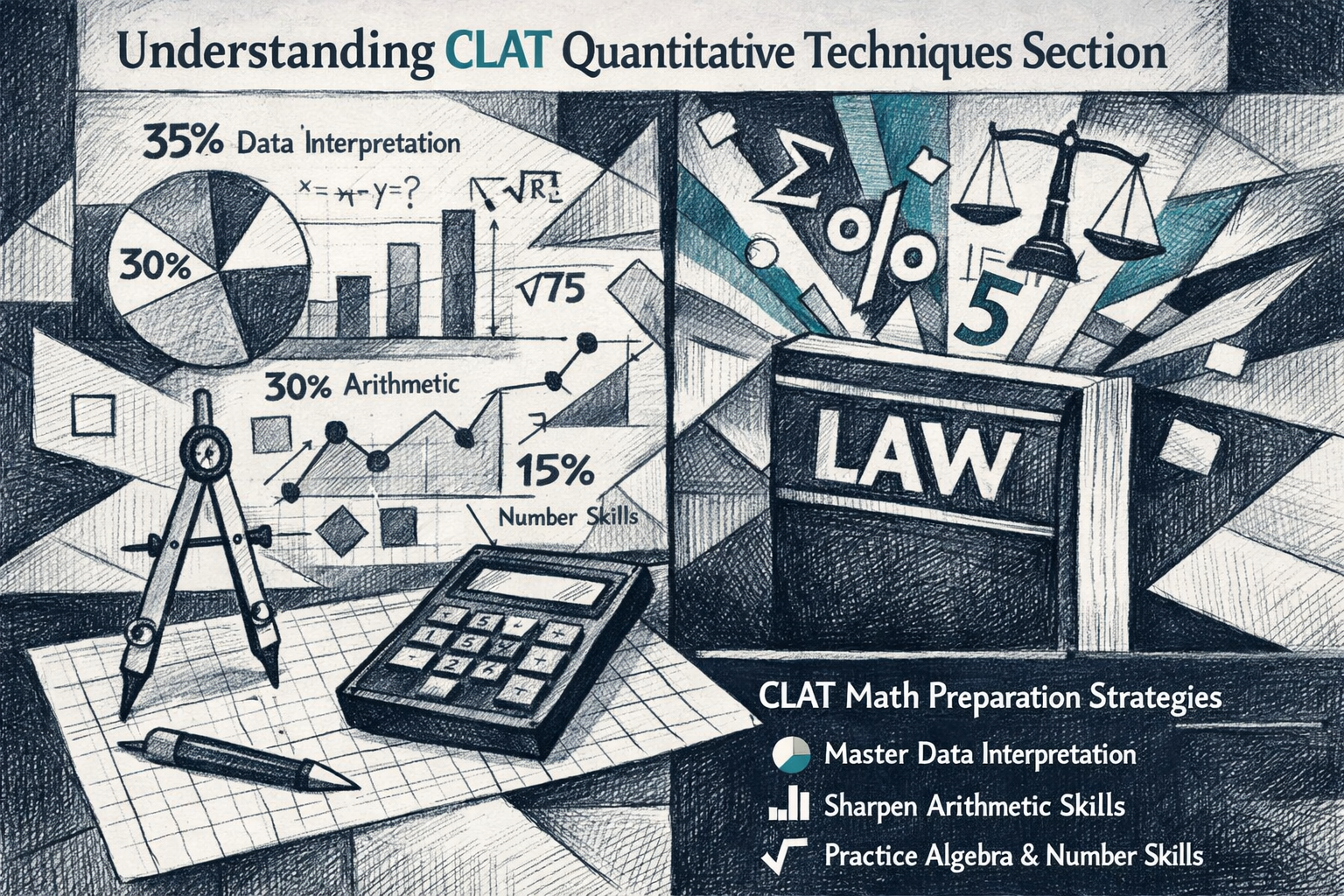
Data interpretation should receive the most attention, approximately 25-30% of your quantitative techniques study time. This topic appears consistently and requires significant practice to build speed.
Percentages, ratios, and averages together should receive another 30-35% of your time. These fundamental concepts form the basis for many other question types.
Time-speed-distance, time-work, and profit-loss problems should receive 20-25% of your time. These topics appear regularly but follow predictable patterns once you master the formulas.
Simple and compound interest, mixtures, and other miscellaneous topics should receive the remaining 15-20% of your time. These topics appear less frequently but still require adequate preparation.
Adjust these percentages based on your diagnostic test results. If you’re particularly weak in data interpretation, increase its time allocation to 35-40% until you reach competency.
Integrating Books with Mock Tests
Books provide knowledge and practice, but mock tests develop exam-taking skills. Your study plan should integrate both elements strategically.
Spend the first 60-70% of your preparation time on concept learning and topic-wise practice from books. Master each topic individually before attempting mixed topic tests.
After covering all topics, shift focus to full-length mock tests that include all CLAT sections together. This transition typically happens 2-3 months before the exam.
Take at least one full-length CLAT mock test every week during the final three months. Analyze each test thoroughly, identifying which math topics caused problems and reviewing those concepts in your books.
Use mock test performance to guide your book-based revision. If you consistently make mistakes in data interpretation, return to Arun Sharma’s book for additional practice.
Mock tests help you understand time management better than any book can teach. Track how much time you spend on quantitative techniques questions and work on improving your speed.
Maintain a mock test analysis journal. Record your scores, topic-wise performance, time spent per section, and areas needing improvement. This journal guides your final weeks of preparation.
Revision Strategy for Mathematics
Mathematics requires regular revision to maintain speed and accuracy. Your revision strategy should include both concept review and problem-solving practice.
Create topic-wise summary sheets while studying from books. These one-page summaries should include key formulas, shortcut methods, and common mistake reminders. Review these sheets weekly.
Solve at least 20-30 quantitative techniques questions daily even after completing your initial preparation. This daily practice maintains your calculation speed and prevents skill deterioration.
One month before CLAT, create a formula booklet containing all important formulas from every math topic. Review this booklet daily during the final weeks.
Revisit questions you got wrong during practice sessions. Understanding why you made mistakes prevents repeating them in the actual exam. Mark these questions in your books for easy identification during revision.
The final week before CLAT should focus on quick revision rather than learning new concepts. Review your formula booklet, summary sheets, and previously solved mock tests.
Common Mistakes When Choosing CLAT Maths Books
Selecting Books Designed for Other Exams
One of the biggest mistakes CLAT aspirants make is using books designed for banking exams, SSC, or MBA entrance tests without considering the differences in syllabus and difficulty level.
Banking exam books often include advanced topics like data sufficiency, complex number series, and advanced DI that never appear in CLAT. Studying these topics wastes precious preparation time.
CAT preparation books cover topics at a much higher difficulty level than CLAT requires. While some CAT books like Arun Sharma’s DI guide are useful, attempting CAT-level quantitative aptitude books can overwhelm you unnecessarily.
SSC books focus heavily on arithmetic but often lack the data interpretation and passage-based format that CLAT uses. The question style differs significantly from CLAT’s approach.
Always check if a book explicitly mentions CLAT or law entrance exams. If it doesn’t, carefully evaluate the table of contents to ensure topic alignment before purchasing.
When using books designed for other exams, be selective. Use only those chapters that align with CLAT syllabus and skip irrelevant sections. This selective approach requires discipline but prevents time wastage.
Buying Too Many Books Without Completing Any
Book hoarding is a common trap. Many students buy five or six quantitative aptitude books thinking more books equal better preparation. This approach usually backfires.
Having multiple books creates confusion about which book to follow. You end up jumping between books without completing any single resource thoroughly.
Each book has a different explanation style and solution methodology. Constantly switching between books prevents you from developing a consistent problem-solving approach.
Most comprehensive quantitative aptitude books cover the same topics with similar question types. Buying multiple books gives you redundant content rather than additional value.
The optimal approach is selecting 2-3 complementary books: one comprehensive guide for concept learning and practice, one CLAT-specific book for exam pattern familiarity, and one specialized book for your weakest area.
Complete each book thoroughly before considering additional resources. Depth of practice matters more than breadth of resources in mathematics preparation.
Ignoring Previous Year Papers
Many students focus exclusively on preparation books while neglecting previous year CLAT papers. This mistake prevents you from understanding actual exam difficulty and question patterns.
Previous year papers show you exactly how CLAT frames quantitative techniques questions. The passage-based format and question style differ from standard textbook problems.
Analyzing previous year papers reveals which topics appear most frequently and which rarely show up. This information helps you prioritize your study time effectively.
Previous year papers also indicate the difficulty level you should aim for during practice. If you’re solving extremely difficult problems from comprehensive books but CLAT asks moderate difficulty questions, you’re over-preparing.
The best preparation strategy combines book-based learning with regular previous year paper practice. Solve at least 5-7 years of CLAT quantitative techniques questions before the exam.
Use previous year papers as benchmarks. After completing each topic from your books, solve previous year questions on that topic to test your readiness.
Neglecting Speed and Accuracy Balance
Many students focus on solving problems correctly while ignoring the time factor. In CLAT, solving questions correctly but slowly won’t give you a competitive score.
Books provide unlimited time for practice, but CLAT gives you approximately 1-1.5 minutes per question. Your preparation must include timed practice to build speed.
Some students rush through questions to improve speed, making careless mistakes. Remember that wrong answers carry negative marking. Speed without accuracy reduces your score.
The optimal approach is building speed gradually. Start by solving questions without time pressure, focusing on accuracy. Once you achieve 90%+ accuracy, introduce time constraints progressively.
Use a timer during practice sessions. Track how long you take to solve each question type. Identify which topics slow you down and practice those specifically for speed improvement.
Learn and practice shortcut methods from books like Pearson’s or Quantum CAT. These techniques significantly improve solving speed without compromising accuracy.
Budget-Friendly Preparation Strategies
Free and Low-Cost Resources
Quality CLAT math preparation doesn’t require spending thousands of rupees. Several excellent free and low-cost resources can supplement or even replace expensive books.
NCERT textbooks from Class 6-10 are available free online on the NCERT website. These books cover all fundamental concepts tested in CLAT with clear explanations and practice questions.
YouTube channels like Unacademy, Khan Academy, and various CLAT preparation channels offer free video lessons on all quantitative techniques topics. Video lessons help clarify concepts that seem confusing in textbooks.
Government websites like the CLAT Consortium website provide previous year question papers free of cost. These papers are the most valuable resource for understanding exam patterns.
Telegram channels dedicated to CLAT preparation share free study material, practice questions, and daily current affairs. Join these channels for regular free content.
Public libraries often have competitive exam preparation books including quantitative aptitude guides. Borrowing books from libraries eliminates purchase costs entirely.
Senior students who have cleared CLAT often sell their used books at significant discounts. Connect with CLAT alumni through social media groups to find these opportunities.
Using Library Resources Effectively
Most cities have public or coaching institute libraries with extensive collections of competitive exam books. Using these libraries strategically can save significant money.
Visit the library during your initial preparation phase to explore different quantitative aptitude books. This exploration helps you identify which books suit your learning style before purchasing.
Many libraries allow borrowing books for 15-30 days. Borrow one book at a time, complete the relevant chapters, and return it before borrowing another. This approach gives you access to multiple books without buying them.
Use library time for focused study sessions. Libraries provide a distraction-free environment that improves concentration and productivity compared to studying at home.
Photocopy or photograph important pages like formula sheets, shortcut techniques, and summary sections. This practice gives you permanent access to key content even after returning the book.
Some coaching institutes allow non-students to access their libraries for a nominal monthly fee. This arrangement costs much less than buying books while providing access to extensive resources.
Combining Online and Offline Materials
A hybrid approach using both online and offline resources often provides the most cost-effective and comprehensive preparation.
Use free online resources for concept learning through video lectures and tutorials. Visual explanations often clarify concepts faster than reading textbooks.
Purchase one comprehensive physical book like R.S. Aggarwal or Pearson’s Guide for structured practice. Physical books work better for solving problems as you can write directly on pages and bookmark important sections.
Use online platforms for mock tests and timed practice. Digital tests automatically calculate scores, identify weak areas, and track progress over time. Many platforms offer free mock tests regularly.
Download free PDF study materials available on various educational websites. These PDFs often include topic summaries, formula sheets, and practice questions that supplement your main book.
Join online study groups on WhatsApp or Telegram where students share resources and discuss problem-solving approaches. Collaborative learning helps clarify doubts without expensive coaching.
Use free mobile apps for daily practice. Apps like CLAT Preparation, Legal Edge, and others offer daily practice questions and mini-tests that you can solve during commute time or breaks.
Second-Hand Book Markets
Buying used books from students who have completed CLAT can save 40-60% compared to new book prices while providing the same content.
Online platforms like OLX, Quikr, and Facebook Marketplace have dedicated sections for competitive exam books. Search for “CLAT books” or “quantitative aptitude books” in your city.
College notice boards often have advertisements from seniors selling their preparation materials. Check notice boards at nearby colleges or post your own “wanted” advertisement.
Coaching institute notice boards serve similar purposes. Students who joined coaching after self-preparation often sell their books to recover some costs.
WhatsApp groups for CLAT aspirants frequently have members selling or exchanging books. Join multiple CLAT preparation groups to access these opportunities.
When buying used books, check for excessive highlighting or margin notes that might distract you. Some marking is acceptable and even helpful, but heavily annotated books can be confusing.
Verify the book edition and publication year. Mathematics concepts don’t change, but CLAT-specific books should be recent editions to reflect current exam patterns.
Supplementing Books with Other Resources
Online Video Lectures and Tutorials
Video lectures complement textbook learning by providing visual explanations and alternative teaching approaches that clarify difficult concepts.
YouTube channels like Unacademy CLAT, LegalEdge, and Career Launcher offer free video lessons on all quantitative techniques topics. These channels feature experienced faculty explaining concepts with solved examples.
Video lectures work particularly well for visual learners who struggle to grasp concepts from text alone. Seeing problems solved step-by-step on screen often makes the process clearer.
Watch videos at 1.25x or 1.5x speed to save time while maintaining comprehension. This technique lets you cover more content in less time.
Take notes while watching videos just as you would during physical classes. Writing down key points and formulas reinforces learning and creates a reference for later revision.
Use videos for initial concept learning, then immediately practice related problems from your books. This combination of visual learning and hands-on practice solidifies understanding.
Paid platforms like Unacademy Plus, Lawgic Coaching, and others offer structured video courses with doubt-clearing sessions. These platforms provide more comprehensive coverage than free resources but require investment.
Mobile Apps for Daily Practice
Mobile apps provide convenient opportunities for daily practice without carrying heavy books everywhere. Several apps specifically target CLAT preparation.
CLAT Preparation apps like Legal Edge, CLAT Possible, and CLAT Gurukul offer daily practice questions, mini-tests, and full-length mocks. Most provide free basic features with premium options for advanced content.
Apps enable micro-learning during short breaks. Solve 5-10 questions during your commute, lunch break, or while waiting. These small practice sessions accumulate into significant preparation over time.
Many apps include performance analytics showing your strengths and weaknesses across different topics. This data-driven feedback helps you focus on areas needing improvement.
Flashcard apps like Anki or Quizlet work well for memorizing formulas and shortcut methods. Create digital flashcards for all important formulas and review them daily.
Calculator practice apps help improve mental math and calculation speed. Since CLAT doesn’t allow calculators, strong mental math skills provide a significant advantage.
Set daily practice goals on apps like solving 20 questions or spending 30 minutes on quantitative techniques. Apps with streak features gamify practice, increasing motivation and consistency.
Joining Study Groups and Forums
Collaborative learning through study groups and online forums provides benefits that individual book study cannot offer.
WhatsApp study groups connect you with fellow CLAT aspirants. Members share resources, discuss difficult problems, and motivate each other during challenging preparation phases.
In study groups, you can ask doubts about specific problems from your books. Often, peer explanations using different approaches clarify concepts better than textbook explanations.
Online forums like Reddit’s r/lawschooladmissions, Pagalguy, and dedicated CLAT preparation forums have active communities discussing preparation strategies and resources.
Teaching concepts to other group members reinforces your own understanding. When you explain a problem-solving approach to someone else, you internalize the methodology more deeply.
Study groups provide accountability. When you commit to completing certain chapters or solving specific questions by group deadlines, you’re more likely to follow through.
However, choose study groups carefully. Groups with too many members or off-topic discussions become distractions rather than assets. Ideal groups have 5-10 serious aspirants with similar preparation timelines.
Doubt-clearing sessions offered by coaching platforms supplement book learning effectively. When you’re stuck on a problem despite reading the solution, expert guidance resolves confusion quickly.
Mock Test Series and Analysis
Mock tests bridge the gap between book-based preparation and actual exam performance. They’re essential supplements to your book study.
Free mock tests are available on various websites and apps. Take advantage of these to practice without financial investment. Quality varies, so use multiple sources.
Paid mock test series from reputed coaching institutes typically offer better quality questions and more detailed analysis. Consider investing in one good test series during your final preparation months.
Take mock tests under exam conditions. Sit in a quiet room, set a timer for 2 hours, and attempt all sections without breaks. This simulation builds exam temperament and time management skills.
Detailed analysis after each mock test is more important than the test itself. Spend 2-3 hours analyzing each test, understanding why you got questions wrong, and identifying patterns in your mistakes.
Track your quantitative techniques performance across multiple mocks. Are you improving? Which topics consistently cause problems? Use this data to guide your book-based revision.
Don’t get discouraged by low mock test scores initially. Mock tests are learning tools, not judgments of your abilities. Each test reveals areas needing improvement, guiding your preparation effectively.
Review incorrect questions from mocks in your quantitative aptitude books. Find similar problems and practice them until you master that question type.
Expert Tips from CLAT Toppers
Time Management During Book Practice
CLAT toppers emphasize that how you practice from books matters as much as which books you use. Effective practice builds both accuracy and speed.
Start practice sessions without time pressure. Focus on understanding concepts and solving problems correctly. Accuracy must come before speed.
After achieving 90% accuracy on a topic, introduce time constraints. Set a timer and attempt to solve problems within CLAT’s time limits of 1-1.5 minutes per question.
Track your solving time for each question type. Maintain a practice journal noting how long you take for different problem types. This data reveals which areas need speed improvement.
Practice mental calculations regularly. Avoid using calculators even during practice. CLAT doesn’t allow calculators, so your mental math must be strong.
Learn to identify question difficulty quickly. In the actual exam, if a question seems too time-consuming, mark it for review and move on. Practice this strategy during book practice too.
Toppers recommend solving problems in multiple ways. After solving a problem using one method, try finding alternative approaches. This flexibility helps when your first approach doesn’t work during the exam.
Creating Effective Formula Sheets
Every CLAT topper maintains a formula sheet for quantitative techniques. This single-page reference becomes invaluable during final revision.
Create your formula sheet while studying from books, not at the end of preparation. Add formulas as you learn them, building the sheet progressively.
Include not just formulas but also shortcut methods and tricks you learn from books like Pearson’s or Quantum CAT. These shortcuts often prove more useful than standard formulas.
Organize formulas by topic: percentages, ratios, time-speed-distance, interest calculations, etc. Clear organization makes quick reference easy.
Use color coding for different topics. Visual differentiation helps your brain quickly locate the formula you need during revision.
Write formulas in your own handwriting rather than printing typed sheets. The act of writing reinforces memory better than passive reading.
Review your formula sheet daily during the final month before CLAT. This regular revision ensures you recall formulas instantly during the exam without wasting time.
Test yourself by covering the formula sheet and trying to write all formulas from memory. This active recall practice strengthens retention.
Dealing with Weak Areas
Every student has topics they find particularly challenging. Toppers don’t ignore these weak areas but address them strategically.
Identify your three weakest topics through diagnostic tests or mock test analysis. These topics deserve extra time and attention in your study plan.
For weak areas, start with the most basic resources. If data interpretation troubles you, begin with NCERT Class 8-9 statistics chapters before moving to competitive exam books.
Solve more problems in weak areas than in strong areas. If you’re comfortable with percentages but struggle with time-speed-distance, allocate 70% of your practice time to time-speed-distance.
Use multiple resources for weak topics. If one book’s explanation doesn’t click, try another book or watch video lectures. Different teaching approaches work for different students.
Don’t avoid weak areas hoping they won’t appear in the exam. CLAT covers all quantitative techniques topics, and questions from your weak areas will appear.
Seek help when stuck. Join online coaching programs where you can ask doubts to experienced faculty. Struggling alone with weak areas wastes time and causes frustration.
Track improvement in weak areas through regular testing. Solve topic-wise tests every two weeks to measure progress. Visible improvement motivates continued effort.
Balancing Math with Other CLAT Sections
Quantitative techniques is just one of five CLAT sections. Toppers emphasize balanced preparation across all sections rather than over-focusing on any single area.
Allocate study time proportionally to section weightage. Since quantitative techniques carries approximately 13-17% of marks, it should receive roughly 15-20% of your total CLAT preparation time.
Don’t neglect other sections to perfect your math. A perfect score in quantitative techniques but poor performance in legal reasoning won’t secure admission to top NLUs.
Integrate quantitative techniques practice into your daily routine rather than dedicating entire days to math. Solve 30-40 math questions daily while also covering other sections.
Use math practice as a mental break from reading-heavy sections. After hours of reading legal or logical reasoning passages, solving math problems provides a different type of mental engagement.
The final month before CLAT should focus on integrated practice through full-length mocks rather than section-wise preparation. This approach builds the stamina and section-switching skills needed during the actual exam.
Monitor your performance across all sections in mock tests. If math is your strongest section but legal reasoning is weak, reallocate time accordingly. Your goal is maximizing total score, not perfecting individual sections.
Remember that CLAT preparation requires holistic development across all skills tested. Books provide knowledge, but balanced practice across sections delivers results.
Conclusion: Your Path to CLAT Math Success
Choosing the right maths book for CLAT preparation sets the foundation for your quantitative techniques success. But remember that books alone don’t guarantee results. Your approach to using these books matters just as much as which books you select.
Start by honestly assessing your current math level and identifying your weak areas. This assessment guides your book selection and time allocation decisions.
Select 2-3 complementary books rather than hoarding multiple resources. One comprehensive guide like R.S. Aggarwal or Pearson’s for concept learning and practice, one CLAT-specific book like Universal’s Guide for exam pattern familiarity, and optionally one specialized book for your weakest area creates an optimal combination.
Create a structured study plan that covers all topics systematically while allocating extra time to your weak areas. Consistency matters more than intensity in mathematics preparation.
Supplement your book-based preparation with mock tests, previous year papers, and online resources. This multi-resource approach builds comprehensive skills that books alone cannot develop.
Focus on building both accuracy and speed progressively. Start with accuracy, then gradually introduce time constraints as your confidence grows.
Maintain formula sheets, practice journals, and error logs throughout your preparation. These tools facilitate effective revision and prevent repeating mistakes.
Don’t compare your preparation with others. Every student has different strengths, weaknesses, and learning speeds. Focus on your own progress and improvement.
Remember that quantitative techniques is just one component of CLAT. Balance your math preparation with other sections to maximize your total score.
The journey from selecting your first maths book for CLAT preparation to confidently solving quantitative techniques questions in the actual exam takes time, effort, and patience. But with the right resources and consistent practice, you can master this section and move closer to your NLU admission dream.
Your success is our mission at Lawgic Coaching. We’ve helped thousands crack CLAT with proven strategies that actually work. Whether you need guidance on book selection, doubt clearing, or comprehensive preparation support, we’re here to help you every step of the way.
Ready to start your CLAT math preparation? Choose your books wisely, practice consistently, and trust the process. Your hard work today builds the legal career you envision tomorrow.
References
[1] CLAT Consortium Official Website – Exam Pattern and Syllabus (2026) [2] National Law University Admission Statistics (2020-2026) [3] Analysis of CLAT Question Papers (2020-2026) – Quantitative Techniques Section [4] Student Performance Data from Leading CLAT Coaching Institutes [5] Book Sales and Recommendation Data from Major Educational Publishers [6] CLAT Topper Interviews and Preparation Strategy Analysis (2024-2026)Find Your Perfect CLAT Maths Book
Answer a few questions to get personalized book recommendations