Reading faster while maintaining comprehension feels impossible when you’re staring at dense legal passages with the clock ticking. But here’s the reality: CLAT 2026 demands both speed and accuracy, and you can’t sacrifice one for the other. Every year, thousands of aspirants lose marks not because they lack knowledge, but because they couldn’t finish reading all passages in time.
The good news? Reading speed isn’t a fixed trait you’re born with. It’s a skill you can develop systematically. And when you improve reading speed for CLAT without losing comprehension, you’re not just saving minutes during the exam. You’re gaining the confidence to tackle every passage methodically, extract key information efficiently, and answer questions with precision.
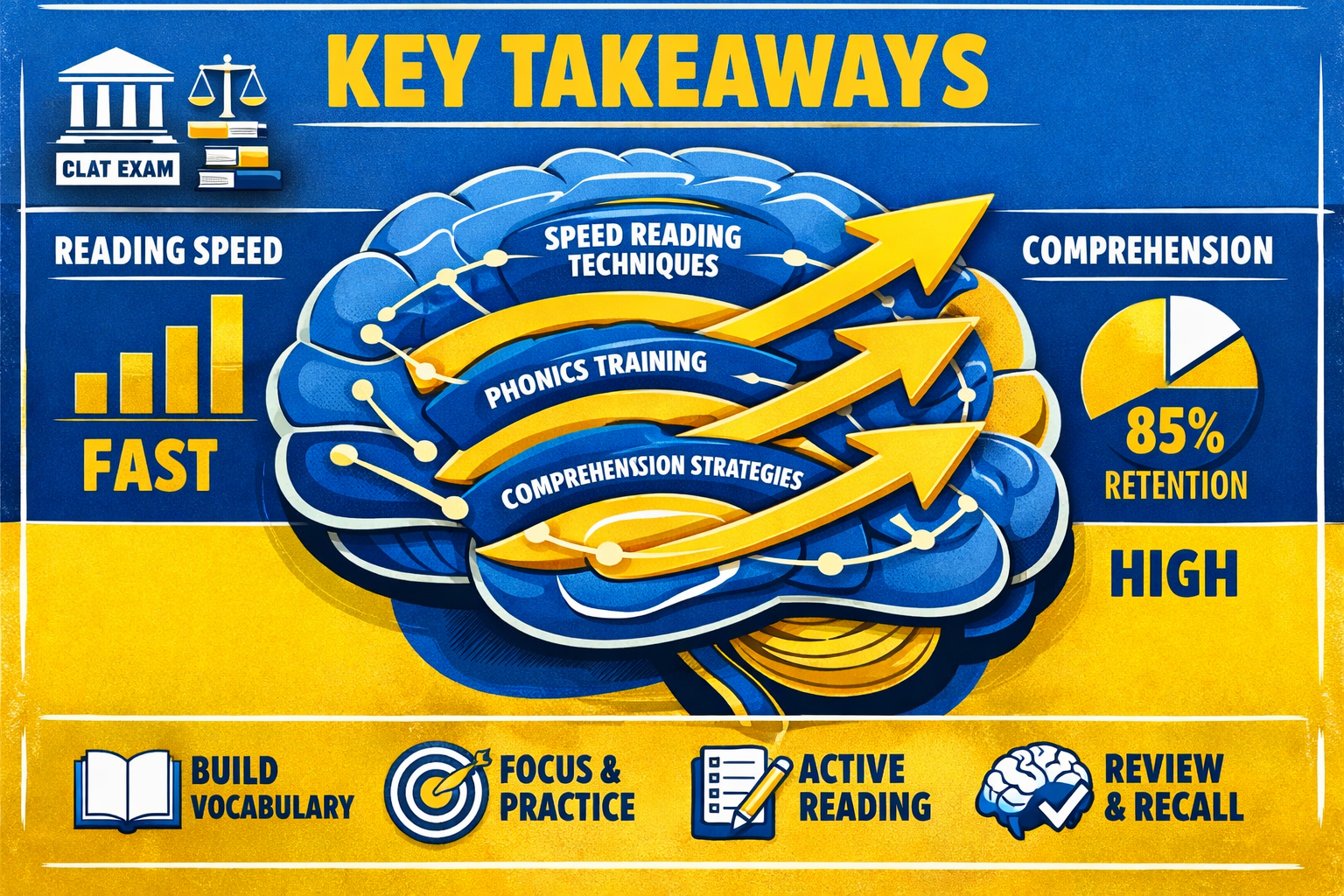
Key Takeaways
- Reading speed for CLAT can be improved from 200 to 400+ words per minute through structured practice without compromising comprehension accuracy
- Active reading techniques like chunking, reducing subvocalization, and strategic skimming help process legal passages faster while retaining critical details
- Different passage types in CLAT require adaptive reading strategies rather than a one-size-fits-all approach
- Regular timed practice with diverse reading materials builds both speed and comprehension simultaneously
- Mental conditioning and exam psychology play crucial roles in maintaining reading efficiency under pressure
Understanding the CLAT Reading Challenge
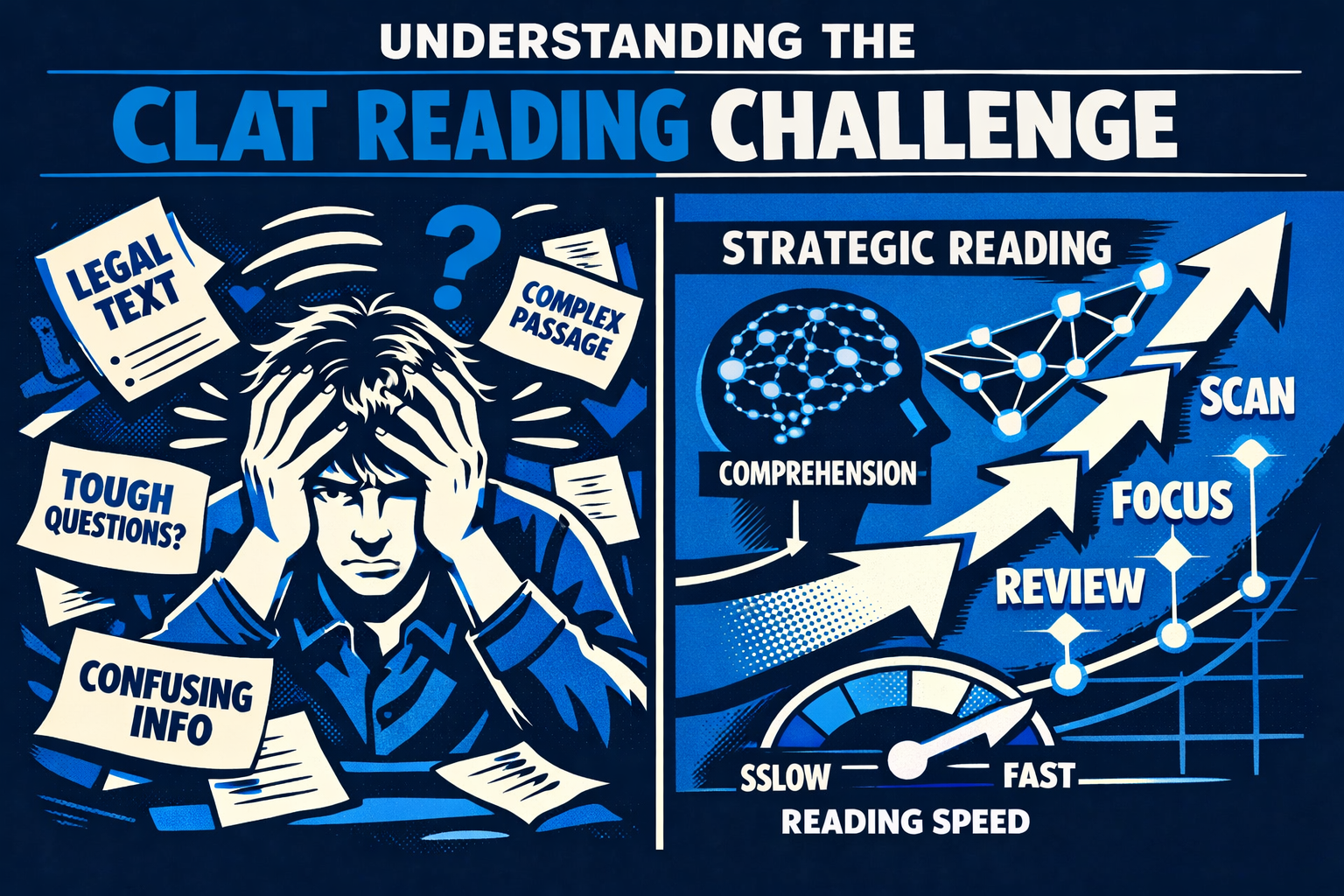
Let’s be honest. CLAT isn’t testing whether you can read. It’s testing whether you can read complex passages under extreme time pressure while maintaining near-perfect comprehension.
The numbers tell the story. You get approximately 120 minutes for the exam. With passages ranging from 450 to 500 words each, and roughly 28-32 passages to cover, you’re looking at about 3.5 to 4 minutes per passage including question-solving time. That leaves barely 2 minutes for reading the passage itself.
The average student reads at 200-250 words per minute. At that pace, you’ll struggle to even finish reading all passages, let alone answer questions thoughtfully.
But speed alone won’t save you. CLAT passages are deliberately dense. They contain legal principles, factual scenarios, current affairs details, and logical reasoning puzzles. Miss one crucial detail while speed reading, and you’ll get the question wrong even if you finish on time.
This creates what we call the “CLAT reading paradox.” You need to read faster to finish the exam, but you also need to read carefully to maintain accuracy. Most students try to solve this by either rushing through passages and making careless mistakes, or reading too slowly and leaving questions unattempted.
Neither approach works. What you need is a systematic method to improve reading speed for CLAT without losing comprehension. And that’s exactly what we’re going to build together.
Why Reading Speed Matters for CLAT Success
Time management determines your CLAT score more than you might realize. Research on standardized testing shows that students who finish exams have significantly higher scores than those who don’t, even when controlling for ability levels [1].
Think about your CLAT preparation strategy. You’ve probably spent months mastering legal reasoning, building your GK foundation, and practicing logical reasoning. But if you can’t read passages fast enough to attempt all questions, that preparation becomes partially wasted.
Here’s what improved reading speed gives you:
- Complete exam coverage: Attempt every single question instead of leaving 8-10 questions blank
- Better accuracy: When you’re not rushing in panic mode during the last 20 minutes, you make fewer silly mistakes
- Multiple attempts: Fast readers can revisit difficult questions they marked for review
- Reduced stress: Knowing you can finish comfortably eliminates exam anxiety
- Competitive edge: While others struggle with time, you’re calmly selecting the right answers
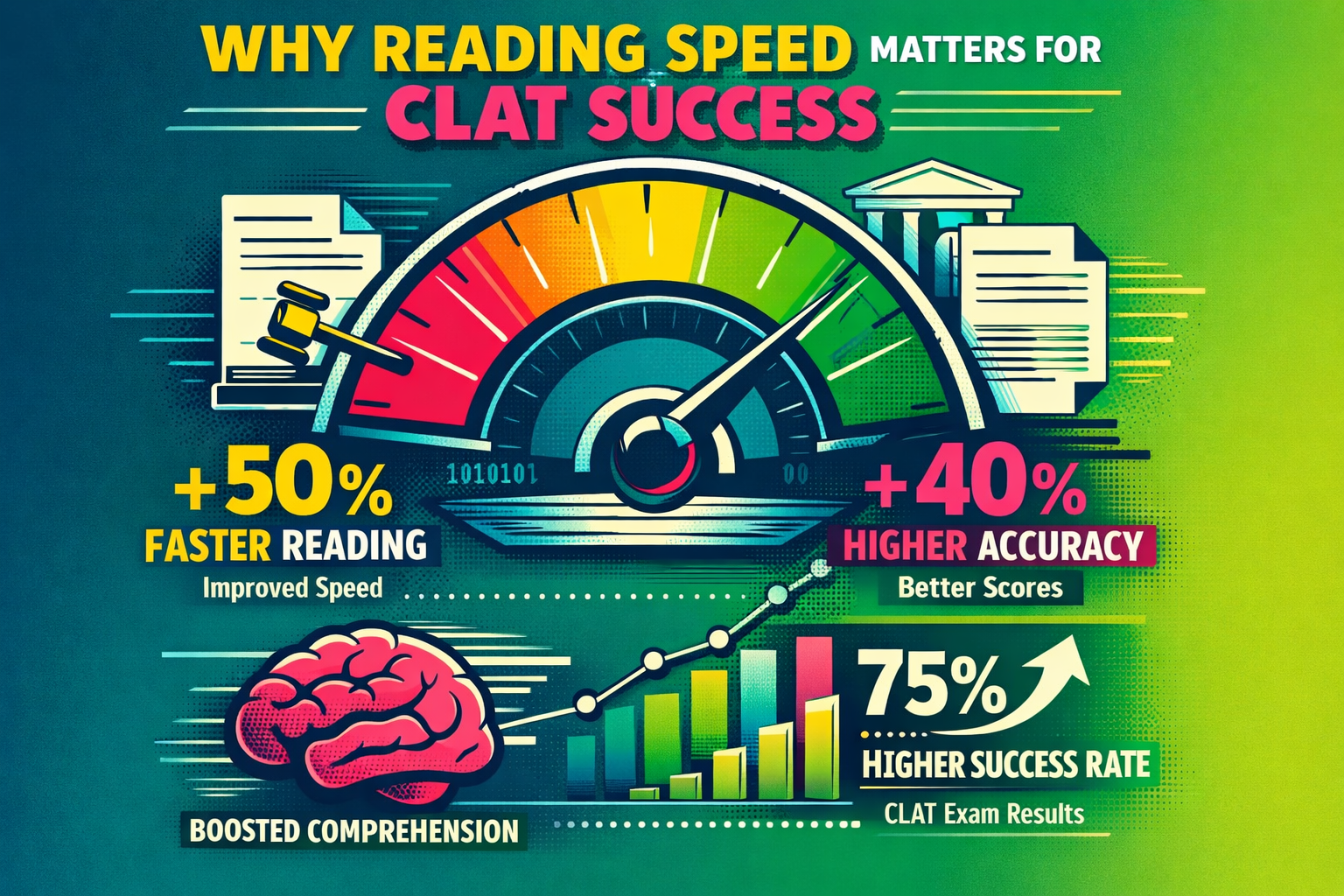
The data backs this up. Analysis of CLAT toppers consistently shows they complete the exam with 10-15 minutes to spare. That buffer time allows them to review marked questions and catch errors that would have cost them ranks.
But speed without comprehension is useless. A student who reads at 500 words per minute but only retains 60% of the information will score lower than someone reading at 300 words per minute with 95% retention.
The goal isn’t maximum speed. It’s optimal speed with maximum comprehension. For CLAT, that sweet spot typically falls between 350-450 words per minute with 90-95% comprehension accuracy.
The Science Behind Speed Reading and Comprehension
Understanding how your brain processes text changes everything about how you approach reading improvement. Let’s break down the neuroscience in simple terms.
When you read, your eyes don’t move smoothly across the page. They jump in quick movements called saccades, stopping briefly at fixation points to capture words. The average reader makes 4-5 fixations per line, processing 1-2 words per fixation [2].
Your brain has three bottlenecks that slow reading:
- Subvocalization: Silently pronouncing words in your mind
- Narrow fixation span: Processing too few words per eye stop
- Regression: Re-reading words or sentences you’ve already covered
Subvocalization is the biggest culprit. When you mentally “hear” each word, you’re limited to speaking speed, around 250 words per minute maximum. But your brain can actually process visual information much faster than speech, potentially 500-700 words per minute or more.
The key insight? Your brain doesn’t need to hear words to understand them. Visual processing and linguistic comprehension happen in different neural pathways. You can train your brain to extract meaning directly from visual word patterns without the intermediate step of internal speech.
Comprehension works through multiple cognitive processes:
- Pattern recognition: Identifying familiar word shapes and phrases
- Contextual prediction: Anticipating what comes next based on context
- Information extraction: Pulling relevant details while filtering noise
- Schema activation: Connecting new information to existing knowledge frameworks
When you improve reading speed for CLAT without losing comprehension, you’re essentially training these processes to work more efficiently. You’re not skipping information. You’re processing it through faster, more direct neural pathways.
Research in cognitive psychology shows that comprehension doesn’t automatically decrease with speed until you cross certain thresholds. In fact, moderate speed increases can actually improve comprehension by maintaining focus and preventing mind-wandering [3].
The challenge with CLAT passages is their complexity. Legal language, technical terminology, and dense factual content require active cognitive processing. You can’t just skim mindlessly. You need what researchers call “adaptive reading,” where you adjust your speed and attention based on passage difficulty and question requirements.
Core Speed Reading Techniques for CLAT Aspirants
Now we get practical. These techniques form the foundation of faster reading without comprehension loss. Master them systematically, and you’ll see measurable improvement within weeks.
Chunking: Reading Word Groups Instead of Individual Words
Stop reading one word at a time. Your peripheral vision can capture 3-5 words in a single fixation. Train your eyes to absorb word groups as meaningful units.
How to practice chunking:
Start with simple sentences divided into natural phrase boundaries. For example:
“The Supreme Court / held that / the fundamental right / to freedom of speech / includes commercial speech.”
Read each chunk as a single unit. Your eyes should fixate once per chunk, not once per word. As you improve, expand chunk sizes to 4-6 words.
Practice daily with newspaper editorials. Draw vertical lines to mark chunk boundaries initially. After a week, remove the visual guides and maintain the chunking mentally.
For CLAT legal passages, chunk around legal concepts. “The doctrine of promissory estoppel” becomes one visual unit, not five separate words.
Eliminating Subvocalization
You don’t need to completely eliminate internal speech. That’s nearly impossible and unnecessary. But you can reduce it significantly.
Practical subvocalization reduction methods:
- Humming technique: Hum quietly while reading to occupy the speech centers of your brain
- Counting method: Count “1-2-3-4” repeatedly while your eyes move across text
- Pacing yourself faster: Deliberately read faster than you can mentally pronounce words
- Focus on meaning: Consciously think about concepts, not word sounds
Start with non-critical reading material. Practice these techniques for 10-15 minutes daily with magazine articles or blog posts. Once comfortable, apply them to CLAT practice passages.
Warning: This feels uncomfortable initially. Your comprehension might temporarily drop. That’s normal. Your brain is building new processing pathways. Within 2-3 weeks, comprehension returns to baseline while speed increases.
Strategic Skimming and Scanning
Skimming isn’t careless reading. It’s strategic information extraction. For CLAT, you need to know when to skim and when to read carefully.
Skim these elements:
- Introductory context in passages
- Examples that illustrate already-understood principles
- Descriptive details not relevant to questions
- Transitional phrases and connective text
Read carefully:
- Legal principles and rules
- Factual specifics (dates, names, numbers)
- Contrasts and comparisons
- Conclusions and holdings
- Anything that seems question-worthy
Develop question anticipation skills. As you read, predict what questions might be asked. This focuses your attention on relevant details while allowing faster processing of background information.
Practice with previous year CLAT papers. Read a passage, then check which details actually appeared in questions. You’ll start recognizing patterns of what matters.
Reducing Regression and Backtracking
Constantly re-reading wastes enormous time. Most regression happens from lack of confidence, not actual comprehension failure.
Techniques to minimize regression:
- Pointer method: Use your finger or pen to pace your reading forward, preventing backward eye movement
- Confidence building: Trust your first reading and resist the urge to double-check
- Note-taking: Jot quick margin notes instead of re-reading
- Progressive practice: Deliberately practice reading passages once without going back, then answering questions
For CLAT specifically, develop the skill of marking uncertainty. If you’re unsure about a detail, make a mental note and continue. Only return if a question specifically asks about that detail.
Expanding Peripheral Vision
Your eyes can capture more words per fixation than you currently use. Peripheral vision training expands your effective reading width.
Peripheral vision exercises:
- Column reading: Practice reading narrow newspaper columns, taking in the entire width in one fixation
- Center focus: Place your fixation point in the middle of lines, using peripheral vision to capture words on both sides
- Pyramid reading: Start with short lines, gradually increase width while maintaining single-fixation reading
- Margin technique: Don’t fixate on the first and last words of lines; start and end slightly inward, using peripheral vision for edge words
These exercises feel strange initially but produce significant results. Practice 10 minutes daily for three weeks. You’ll notice your eyes making fewer stops per line, directly increasing reading speed.
Adaptive Reading Strategies for Different CLAT Passage Types
Not all passages deserve the same reading approach. CLAT tests you across multiple domains, each requiring slightly different strategies. Understanding these differences helps you improve reading speed for CLAT without losing comprehension across all sections.
Legal Reasoning Passages
These passages present legal principles followed by factual scenarios. They’re typically the most dense and technical.
Optimal reading strategy:
Read the principle statement slowly and carefully. This is your foundation. Underline or mentally note key elements: who, what, when, conditions, exceptions.
Read the factual scenario slightly faster. You’re looking for how facts map to the principle. Identify relevant details and ignore decorative description.
Speed allocation: 40% of time on principle, 60% on facts and questions.
Many students do the opposite, rushing through principles and getting confused in application. The principle is your compass. Understand it thoroughly, and the rest becomes easier.
For complex legal terminology, don’t get stuck. Extract the functional meaning. “Doctrine of frustration” might sound intimidating, but if the passage explains it means “contract becomes impossible to perform,” that’s all you need.
Current Affairs and GK Passages
These passages test comprehension of contemporary issues, policies, and events. They’re usually more readable than legal passages but packed with specific details.
Optimal reading strategy:
Skim the first paragraph quickly to identify the topic. If you’re already familiar with the issue, you can read faster throughout.
Focus intensely on specific details: dates, names, statistics, policy names, outcomes. These become question material.
Read concluding paragraphs carefully. They often contain implications, significance, or future predictions that spawn questions.
Speed allocation: Faster overall pace, but slow down for factual specifics.
Your GK preparation directly impacts reading speed here. Familiar topics allow faster processing because you’re activating existing knowledge schemas rather than building new ones from scratch.
Logical Reasoning Passages
These present arguments, premises, and conclusions. They test your ability to identify logical structures, assumptions, and flaws.
Optimal reading strategy:
Read at moderate pace with high attention to logical connectors: “therefore,” “because,” “however,” “although,” “unless.”
Identify the conclusion first. Everything else is either supporting it or qualifying it.
Map the argument structure mentally: Premise 1 + Premise 2 → Conclusion. Notice assumptions (unstated connections between premises and conclusion).
Speed allocation: Moderate, consistent pace. Logical reasoning rewards careful reading more than speed.
Don’t rush through logical reasoning passages trying to save time. The time you “save” gets wasted on questions when you haven’t properly understood the argument structure.
English Comprehension Passages
These test vocabulary, grammar, and reading comprehension through literary or editorial passages.
Optimal reading strategy:
Read for main idea and tone first. Understanding the author’s purpose and attitude helps answer many questions.
Pay attention to transitional paragraphs where ideas shift.
Note vocabulary in context. If a word is used in an unusual way or emphasized, it’s likely question material.
Speed allocation: Can be read fastest among all passage types, but maintain comprehension of nuance and tone.
Your general reading habit directly impacts performance here. Students who read regularly outside CLAT preparation naturally perform better and read faster on these passages.
Quantitative Techniques Passages
These combine reading with data interpretation, requiring you to extract numerical information and perform calculations.
Optimal reading strategy:
Skim the text quickly to understand context.
Focus intensely on numbers, percentages, comparisons, and trends.
Identify what’s being measured and how different data points relate.
Speed allocation: Fast reading, slow data processing.
For these passages, reading speed matters less than data extraction speed. Practice quantitative techniques separately to improve overall section performance.
Building a Systematic Practice Routine
Knowing techniques means nothing without consistent practice. Here’s how to build reading speed systematically over 8-12 weeks.
Week 1-2: Baseline Assessment and Foundation
Start by measuring your current reading speed and comprehension accurately.
Baseline test protocol:
- Select a 500-word passage at CLAT difficulty level
- Time yourself reading it once without rushing
- Immediately answer 5 comprehension questions without referring back
- Calculate: (500 ÷ time in minutes) = words per minute
- Calculate: (correct answers ÷ 5) × 100 = comprehension percentage
Your baseline might be 220 words per minute with 80% comprehension. That’s your starting point, not a judgment.
During these two weeks, focus on eliminating bad habits:
- Practice reading without subvocalization for 15 minutes daily
- Use pointer method to prevent regression
- Practice chunking with newspaper editorials
Don’t worry about speed yet. Focus on technique correctness.
Week 3-4: Gradual Speed Increase
Now deliberately push your reading pace 10-15% faster than comfortable.
Progressive pacing practice:
- Set a metronome or timer to pace yourself
- Read slightly faster than feels natural
- Accept temporary comprehension dips
- Your brain is adapting to new processing speeds
Practice with varied materials: legal articles, editorials, policy documents, argumentative essays. Variety builds adaptable reading skills.
Test weekly: Measure speed and comprehension every Sunday. You should see speed increasing while comprehension stabilizes back toward baseline.
Target: 270-300 words per minute with 75-80% comprehension by end of week 4.
Week 5-8: Consolidation and Adaptation
Your brain has built new processing pathways. Now refine them.
Advanced practice methods:
- Timed passage practice: Give yourself 2 minutes per 500-word passage, strict timing
- Question-first reading: Read questions first, then passage with targeted focus
- Comparative reading: Read two passages on similar topics back-to-back, noting differences
- Pressure simulation: Practice under mild stress (background noise, time pressure, multiple passages in sequence)
Introduce full-length mock tests. Don’t just take them; analyze your reading performance. Which passage types slow you down? Where do you lose comprehension? Adjust practice accordingly.
Target: 320-350 words per minute with 85-90% comprehension.
Week 9-12: Exam Simulation and Peak Performance
You’re in the final stretch. Practice should now mirror exam conditions exactly.
Exam-realistic practice:
- Complete 5-6 passages in one sitting
- Maintain consistent pace across all passages
- Practice decision-making: when to skip difficult passages and return later
- Build stamina for 120 minutes of sustained reading
Take full-length CLAT mock tests weekly. Your reading speed should now feel natural, not forced.
Target: 350-400+ words per minute with 90-95% comprehension.
At this level, you’ll complete CLAT reading comfortably with time for review. That’s when you know you’ve successfully learned to improve reading speed for CLAT without losing comprehension.
Vocabulary Building for Faster Comprehension
Reading speed and vocabulary have a direct relationship. When you encounter unfamiliar words, you slow down, lose context, and waste time puzzling over meanings.
Strong vocabulary allows faster processing because:
- You recognize words instantly without decoding
- You understand nuances and connotations immediately
- You grasp complex sentences in one reading
- You maintain reading flow without interruption
CLAT-specific vocabulary categories:
- Legal terminology: Jurisdiction, precedent, plaintiff, defendant, tort, liability, jurisprudence, statute, ordinance
- Formal academic vocabulary: Substantiate, corroborate, mitigate, exacerbate, comprehensive, pragmatic, paradigm
- Current affairs terminology: Bilateral, multilateral, sanctions, sovereignty, fiscal, monetary, inflation
- Logical reasoning terms: Premise, conclusion, assumption, inference, fallacy, correlation, causation
Build vocabulary actively, not passively. Reading alone isn’t enough.
Effective vocabulary building methods:
- Contextual learning: Learn words in sentence context, not isolation
- Root word analysis: Understand Latin and Greek roots common in legal and academic language
- Daily word targets: Learn 5-7 new words daily with example sentences
- Active usage: Use new words in writing and speaking within 24 hours
- Spaced repetition: Review words at increasing intervals (1 day, 3 days, 7 days, 14 days)
Create a CLAT-specific vocabulary journal. Every time you encounter an unfamiliar word in practice passages, note it with context. Review weekly.
For English comprehension preparation, vocabulary isn’t optional. It’s foundational.
Mental Conditioning and Exam Psychology
Reading speed isn’t purely mechanical. Your psychological state dramatically impacts reading efficiency.
Psychological factors affecting reading speed:
- Anxiety: Stress narrows attention and slows processing
- Fatigue: Mental tiredness reduces comprehension and forces re-reading
- Confidence: Self-doubt causes excessive checking and regression
- Focus: Distractions fragment attention and reduce reading efficiency
The student who panics during CLAT will read slower, comprehend less, and make more mistakes than the same student in a calm state. Mental conditioning matters.
Building Reading Stamina
Reading 28-32 passages in 120 minutes requires sustained mental endurance. Most students haven’t built this stamina.
Stamina building protocol:
- Progressive duration: Start with 30-minute reading sessions, gradually extend to 90-120 minutes
- Minimal breaks: Practice reading multiple passages consecutively without breaks
- Varied difficulty: Mix easy and hard passages to simulate exam variability
- Energy management: Notice when your focus drops; practice refocusing techniques
Physical factors matter too. Sleep, nutrition, and hydration affect cognitive performance. Students who sleep 7-8 hours consistently perform better on reading comprehension tests than those who don’t [4].
Managing Exam Day Pressure
Even with perfect preparation, exam day pressure can sabotage reading performance.
Pressure management techniques:
- Breathing regulation: Practice 4-7-8 breathing (inhale 4 counts, hold 7, exhale 8) before starting each passage
- Positive self-talk: Replace “I’m running out of time” with “I’m reading efficiently and answering accurately”
- Process focus: Concentrate on executing your reading technique, not on outcomes or ranks
- Acceptance: Accept that some passages will be harder; that’s normal and expected
Practice these techniques during mock tests, not for the first time on exam day. Psychological skills require training just like reading skills.
Understanding exam anxiety and developing coping strategies can make the difference between performing at your potential and underperforming despite solid preparation.
Technology Tools and Resources
Modern technology offers powerful tools to accelerate reading improvement. Use them strategically.
Speed Reading Apps and Software
Several apps specifically train speed reading skills:
- Spreeder: Displays text at controlled speeds, forcing your brain to process faster
- ReadMe: Uses rapid serial visual presentation (RSVP) to eliminate eye movement
- Accelerator: Gradually increases text speed while tracking comprehension
- Reedy: Browser extension for speed reading web articles
How to use these effectively:
Start at your comfortable reading speed. Increase by 10-20 words per minute weekly. Practice 10-15 minutes daily.
Don’t rely solely on apps. They build processing speed but don’t replicate the exam experience of reading full passages and answering questions.
Reading Tracking and Analytics
Measure what you want to improve. Several tools help track reading progress:
- Reading speed calculators: Online tools that time your reading and calculate WPM
- Comprehension test platforms: Websites offering passages with questions and automatic scoring
- Progress tracking spreadsheets: Create your own to log daily reading speed and comprehension scores
Data reveals patterns. You might discover you read legal passages 30% slower than current affairs passages. That insight directs your practice focus.
Digital vs. Physical Reading
CLAT 2026 uses computer-based testing. Your practice should match the exam format.
Screen reading considerations:
- Screen reading is typically 20-30% slower than paper reading initially
- Eye strain from screens reduces sustained reading performance
- Screen scrolling interrupts reading flow differently than page turning
Adaptation strategies:
- Practice 70-80% of your reading on screens
- Adjust screen brightness and contrast for comfortable reading
- Use blue light filters during extended practice sessions
- Practice scrolling efficiently without losing your place
If you’ve been practicing primarily with physical books, transition to digital practice at least 6-8 weeks before the exam.
Common Mistakes That Slow Reading Speed
Avoid these pitfalls that sabotage reading improvement efforts.
Mistake 1: Prioritizing Speed Over Comprehension
The biggest error is reading faster while comprehension drops below 85%. You’ll answer questions incorrectly, negating any time saved.
The fix: Always measure both speed and comprehension together. If comprehension drops below 85%, slow down slightly. Sustainable speed with high comprehension beats unsustainable speed with poor comprehension.
Mistake 2: Inconsistent Practice
Reading improvement requires consistent daily practice. Practicing intensely for three days, then skipping four days, produces minimal results.
The fix: Commit to 30 minutes daily minimum. Consistency matters more than duration. Daily 30-minute practice outperforms weekly 3-hour sessions.
Mistake 3: Practicing Only Easy Material
Reading comfortable material at high speed doesn’t prepare you for CLAT’s challenging passages.
The fix: Practice with material slightly above your current comfort level. Include legal journals, policy documents, and complex argumentative essays in your practice rotation.
Mistake 4: Ignoring Passage Type Differences
Trying to read all passages at the same speed ignores their varying complexity and question patterns.
The fix: Develop adaptive reading strategies. Legal reasoning passages deserve slower, more careful reading than current affairs passages. Adjust your approach based on passage type.
Mistake 5: No Systematic Progress Tracking
Practicing without measuring progress leaves you guessing whether techniques are working.
The fix: Test yourself weekly with standardized passages. Record speed and comprehension scores. Track trends over time. Adjust techniques based on data, not feelings.
Mistake 6: Last-Minute Speed Reading Attempts
Trying to suddenly read faster two weeks before CLAT creates panic and confusion.
The fix: Start reading improvement at least 12 weeks before the exam. Reading speed development requires time for neural pathway formation. There are no shortcuts.
Understanding common CLAT preparation mistakes helps you avoid wasting time on ineffective strategies.
Advanced Techniques for Peak Performance
Once you’ve mastered foundational techniques, these advanced strategies push you toward peak reading efficiency.
Meta-Cognitive Reading Awareness
Develop awareness of your own reading process. Notice when comprehension drops, when you’re reading without processing, when anxiety increases.
Meta-cognitive practice:
While reading, periodically ask yourself: “What did I just read? What’s the main point? Am I understanding or just moving my eyes?”
This self-monitoring prevents mindless reading and maintains active engagement.
Predictive Reading
Skilled readers constantly predict what’s coming next based on context. This accelerates processing because your brain is pre-activated for expected information.
Prediction practice:
Pause mid-passage and predict: What will the author discuss next? What conclusion are they building toward? What example might they provide?
Check your predictions. Over time, your accuracy improves, and reading becomes faster because you’re anticipating rather than just receiving information.
Information Hierarchy Recognition
Not all information in a passage has equal importance. Skilled readers instantly recognize information hierarchy.
Hierarchy levels:
- Critical: Main principles, key facts, conclusions
- Important: Supporting details, examples that clarify
- Supplementary: Background context, tangential information
- Decorative: Descriptive language, stylistic elements
Read level 1 carefully, level 2 moderately, level 3 quickly, level 4 can be skimmed.
Practice identifying these levels in passages. Mark passages with different colors for each level. This trains your brain to automatically allocate appropriate attention.
Cross-Domain Reading Practice
CLAT passages span multiple domains. Build reading efficiency across all of them.
Diverse reading routine:
- Monday: Legal articles and case summaries
- Tuesday: Current affairs editorials and policy analyses
- Wednesday: Logical reasoning and philosophical arguments
- Thursday: Scientific and technical articles
- Friday: Literary and cultural essays
- Weekend: Mixed practice with full-length tests
This variety prevents domain-specific reading weaknesses and builds adaptable reading skills.
Question Pattern Recognition
After solving 50-100 passages, you’ll notice question patterns. Certain passage elements consistently spawn questions.
Common question triggers:
- Contrasts and comparisons
- Exceptions to general rules
- Specific numbers and dates
- Causal relationships
- Author’s opinion or conclusion
- Definitions of technical terms
Train yourself to flag these elements while reading. This focused attention improves both speed (you’re not reading everything equally) and accuracy (you’re noting question-worthy details).
Integrating Reading Practice with Overall CLAT Preparation
Reading improvement doesn’t exist in isolation. It integrates with your complete CLAT preparation strategy.
Balancing Skills Development
Your preparation includes multiple components: legal reasoning, logical reasoning, GK, quantitative techniques, and English. Reading speed improvement supports all of them.
Integration approach:
- Use legal reasoning passages for reading practice
- Build GK while practicing current affairs reading
- Develop logical analysis while reading argumentative passages
- Improve vocabulary through English comprehension practice
This integrated approach maximizes efficiency. You’re simultaneously building reading speed and domain knowledge.
Time Allocation in Study Schedule
Dedicate specific time blocks to reading improvement, separate from content learning.
Sample daily schedule:
- Morning (30 min): Speed reading practice with technique focus
- Afternoon (2 hours): Content learning (GK, legal concepts, etc.)
- Evening (1 hour): Full passage practice with questions
- Night (30 min): Vocabulary building and review
This structure ensures consistent reading practice without neglecting other preparation areas.
Mock Test Strategy
Mock tests serve dual purposes: performance assessment and reading practice.
Effective mock test approach:
- Take full-length mocks weekly
- Analyze reading performance separately from content knowledge
- Identify passage types where reading slows down
- Practice targeted reading improvement for weak areas
- Gradually improve reading efficiency across all sections
Your mock test scores should show improvement in two dimensions: accuracy and completion rate. Both matter.
When to Seek Guidance
Self-study works for many students, but personalized guidance accelerates improvement.
Consider coaching when:
- Your reading speed plateaus despite consistent practice
- Comprehension drops as you try to read faster
- You struggle with specific passage types consistently
- You need structured accountability and progress tracking
Quality coaching provides customized strategies based on your specific reading challenges. At Lawgic Coaching, we’ve helped thousands of students systematically improve their reading efficiency through personalized mentorship and proven techniques.
Creating Your Personalized Reading Improvement Plan
Generic advice helps, but personalized plans produce results. Here’s how to create yours.
Step 1: Comprehensive Self-Assessment
Beyond basic speed and comprehension testing, assess:
- Passage type performance: Which types do you read fastest/slowest?
- Time of day effects: When is your reading most efficient?
- Comprehension patterns: What types of questions do you miss most?
- Physical factors: How does sleep, nutrition, environment affect your reading?
Document everything. Patterns emerge from data.
Step 2: Set Specific, Measurable Goals
Vague goals like “read faster” don’t work. Specific goals drive progress.
Effective goal structure:
- Current state: 230 WPM with 82% comprehension
- Target state: 360 WPM with 90% comprehension
- Timeline: 10 weeks
- Milestones: Increase 13 WPM weekly while maintaining 85%+ comprehension
Break the goal into weekly targets. Celebrate milestone achievements.
Step 3: Design Your Practice Protocol
Based on your assessment and goals, create a specific practice routine.
Protocol components:
- Daily technique practice: 20 minutes on specific skills (chunking, subvocalization reduction, etc.)
- Passage practice: 30 minutes reading full passages with questions
- Weekly testing: Standardized assessment every Sunday
- Review and adjustment: Analyze weekly results and adjust techniques
Write this down. Vague intentions don’t drive behavior. Specific protocols do.
Step 4: Implementation and Tracking
Execute your plan consistently. Track everything.
Tracking metrics:
- Daily reading speed (WPM)
- Daily comprehension percentage
- Passage type performance
- Technique effectiveness
- Subjective difficulty ratings
- Time spent practicing
Use a spreadsheet or journal. Quantified progress motivates continued effort.
Step 5: Regular Review and Adjustment
Every two weeks, review your data and adjust your approach.
Review questions:
- Is speed increasing consistently?
- Is comprehension maintaining at 85%+?
- Which techniques produce best results?
- What obstacles are slowing progress?
- Do I need to adjust practice focus?
Flexibility matters. If something isn’t working after two weeks, change it.
Maintaining Reading Speed Under Exam Pressure
You’ve built impressive reading speed in practice. Now ensure it transfers to exam day.
Pressure Inoculation Training
Gradually expose yourself to exam-like pressure during practice.
Progressive pressure exposure:
- Week 1-2: Comfortable practice, no time pressure
- Week 3-4: Mild time pressure, 10% faster than comfortable
- Week 5-6: Moderate pressure, strict timing per passage
- Week 7-8: High pressure, full mock tests with consequences (track scores publicly, practice with peers watching)
This gradual exposure builds pressure resistance. By exam day, pressure feels normal, not overwhelming.
Pre-Exam Reading Warm-Up
Athletes warm up before competition. Your brain needs warm-up too.
Exam morning routine:
- 60 minutes before exam: Read 2-3 practice passages at comfortable pace
- 30 minutes before: Review key techniques mentally
- 15 minutes before: Deep breathing and positive visualization
- 5 minutes before: Quick confidence affirmation
This routine activates reading neural pathways and reduces cold-start sluggishness.
In-Exam Reading Strategy
Have a clear strategy before entering the exam hall.
Effective exam reading approach:
- Quick survey: Spend 2 minutes surveying all passages, noting difficulty levels
- Strategic sequencing: Start with moderately difficult passages, not easiest or hardest
- Consistent pacing: Maintain steady reading speed across passages
- No panic adaptation: If a passage is unusually difficult, mark questions and move on
- Time checkpoints: Check time after every 5-6 passages, adjust pace if needed
Strategy eliminates in-exam decision paralysis. You know exactly what to do.
Recovery from Reading Mistakes
You’ll make mistakes during the exam. How you recover matters.
Mistake recovery protocol:
- Don’t dwell: Spending 30 seconds upset about one wrong answer wastes time
- Don’t second-guess: Trust your reading and move forward
- Maintain technique: Stress causes regression to old habits; consciously maintain good techniques
- Breathing reset: If anxiety spikes, take three deep breaths before the next passage
Mental resilience during the exam often separates top performers from the rest.
Building Long-Term Reading Excellence
The reading skills you develop for CLAT serve you far beyond the exam. Law school involves massive reading loads. Legal practice requires efficient document analysis.
Long-term reading development:
Continue practicing even after CLAT. Make reading a daily habit, not just exam preparation.
Read widely across domains. Legal texts, literature, science, philosophy, current affairs. Diverse reading builds flexible cognitive skills.
Join reading communities. Discuss what you read. Articulating ideas deepens comprehension.
Challenge yourself progressively. As current reading becomes comfortable, seek more complex material.
The goal isn’t just to improve reading speed for CLAT without losing comprehension. It’s to become a skilled, efficient reader for life. That skill will serve you throughout your legal career and beyond.
Conclusion
Reading faster while maintaining comprehension isn’t magic. It’s a trainable skill built through systematic practice, proper techniques, and consistent effort.
You’ve learned the science behind reading speed, practical techniques to implement immediately, adaptive strategies for different passage types, and how to build a personalized improvement plan.
Your action steps starting today:
- Assess your baseline: Test your current reading speed and comprehension with a timed passage
- Choose two techniques: Start with chunking and subvocalization reduction
- Practice daily: Commit to 30 minutes minimum, every single day
- Track progress: Measure speed and comprehension weekly
- Adjust and improve: Review data every two weeks and refine your approach
Remember, improvement isn’t linear. Some weeks you’ll see dramatic progress. Other weeks you’ll plateau. That’s normal. Consistent practice over 10-12 weeks produces reliable results.
The students who successfully improve reading speed for CLAT without losing comprehension aren’t necessarily the most talented. They’re the most consistent and systematic in their approach.
Your success is our mission at Lawgic Coaching. We’ve guided thousands of aspirants through this exact journey, providing personalized strategies and expert mentorship from faculty who’ve been exactly where you are now.
Start today. Not tomorrow, not next week. Take one practice passage right now and apply the chunking technique. That’s how transformation begins—one passage, one technique, one day at a time.
Your CLAT success story starts with the decision to improve. Make that decision now, and let’s build your reading excellence together.
References
[1] Educational Testing Service. (2024). “Time Management and Test Performance: A Meta-Analysis of Standardized Testing Research.” ETS Research Report Series. [2] Rayner, K., Schotter, E. R., Masson, M. E., Potter, M. C., & Treiman, R. (2016). “So much to read, so little time: How do we read, and can speed reading help?” Psychological Science in the Public Interest, 17(1), 4-34. [3] Carver, R. P. (1992). “Reading rate: Theory, research, and practical implications.” Journal of Reading, 36(2), 84-95. [4] Walker, M. P., & Stickgold, R. (2006). “Sleep, memory, and plasticity.” Annual Review of Psychology, 57, 139-166.CLAT Reading Speed Calculator
Measure your current reading efficiency and track your progress