Last updated: January 15, 2026
CLAT 2027 Logical Reasoning has evolved into a sophisticated test of analytical thinking rather than simple pattern recognition. The exam now features contextual traps designed to catch aspirants who rely on surface-level reading or rote preparation strategies. Understanding how to navigate these traps separates successful candidates from those who struggle despite strong preparation.
The shift toward analytical reasoning through puzzles and multi-condition deduction sets means you cannot approach CLAT 2027 Logical Reasoning the same way students prepared for earlier iterations[1]. The Consortium deliberately designs passages to test reasoning control rather than recall, with unpredictability built into every question type.
Key Takeaways
- CLAT 2027 Logical Reasoning combines analytical puzzles with critical reasoning, requiring dual preparation strategies for both formats
- Contextual traps exploit common reading patterns like assumption-making, scope confusion, and premise misidentification
- The section comprises 22-26 questions worth approximately 20% of total marks, presented through 450-word passages[2]
- Success depends on active reading techniques that identify argument structure before attempting questions
- Multi-condition deduction sets test your ability to process multiple variables simultaneously without losing track of constraints[1]
What Makes CLAT 2027 Logical Reasoning Different from Previous Years?
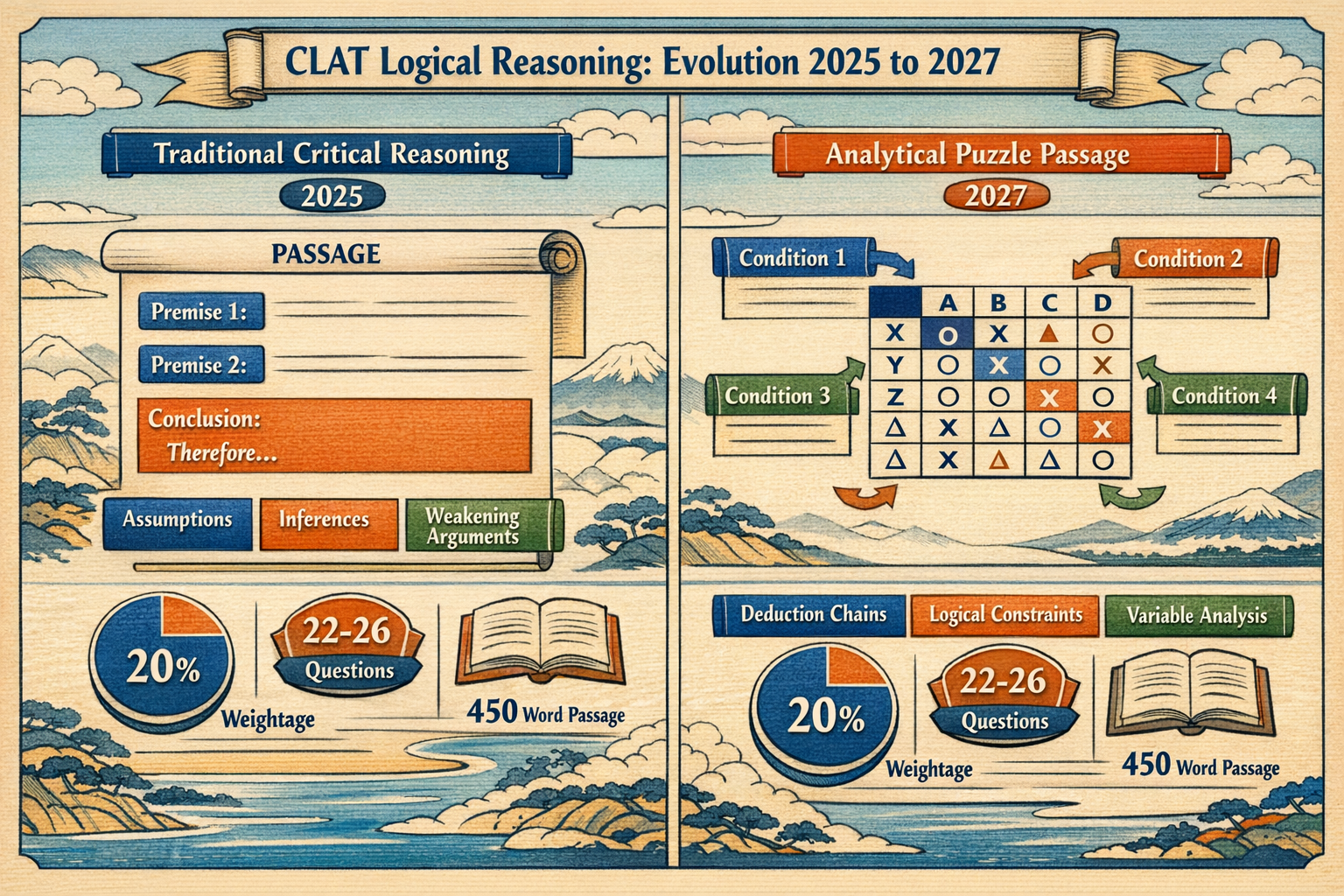
CLAT 2027 Logical Reasoning represents a fundamental shift from the critical reasoning format that dominated earlier exams. The 2026 exam introduced analytical reasoning through puzzles as the primary testing mechanism, moving away from traditional argument-based questions[1][6].
This change creates a hybrid structure where you need preparation strategies for both analytical and critical reasoning. The Consortium wants to test how well you apply reasoning skills to unfamiliar situations rather than how many question patterns you’ve memorized.
Here’s what changed:
Format Evolution: Earlier CLAT exams relied heavily on straightforward critical reasoning passages with clear argument structures. You could identify premises, conclusions, and assumptions using standard frameworks. CLAT 2026 disrupted this pattern by introducing complex analytical puzzles requiring multi-step deduction[1].
Reduced Predictability: The exam now deliberately avoids predictable patterns. Legal reasoning moved away from simple principle-fact application, and logical reasoning passages increasingly blend with current affairs and legal-journalistic material[3]. This overlap creates contextual confusion about what skills are being tested.
Comprehension Integration: Logical reasoning and legal reasoning sections have become nearly indistinguishable, with logical reasoning featuring comprehension paragraphs on contemporary issues[3]. This makes the exam extremely challenging for students who struggle with reading comprehension.
Question Distribution: The section contains 22-26 questions (some sources indicate 28-32 questions) accounting for roughly 20% of your total marks[2][4]. Each passage runs approximately 450 words, followed by multiple-choice objective questions[2].
The bottom line? You cannot rely on pattern recognition alone. CLAT 2027 Logical Reasoning demands genuine analytical thinking applied to diverse passage types.
Understanding the Core Structure of CLAT 2027 Logical Reasoning Passages
Before you can avoid contextual traps, you need to understand how logical reasoning passages are constructed in CLAT 2027. The exam uses two primary formats that require different reading approaches.
Analytical Reasoning Passages: These present scenarios with multiple variables, conditions, and constraints. Think seating arrangements, scheduling problems, grouping exercises, or relationship puzzles. You receive a set of rules and must deduce valid arrangements or identify what must be true given the constraints.
Example structure:
- Initial scenario (who/what is being arranged)
- 4-6 conditional rules governing the arrangement
- Questions testing deductions from those rules
Critical Reasoning Passages: These present arguments, claims, or positions on contemporary issues. Questions test your ability to identify assumptions, strengthen or weaken arguments, draw inferences, or identify logical flaws.
Example structure:
- Context or background information
- Main argument or claim
- Supporting evidence or reasoning
- Questions about logical structure
The passages run approximately 450 words, which sounds manageable until you realize that every sentence potentially contains information relevant to answering questions[2]. This creates the first major contextual trap: information overload leading to passive reading.
Multi-Condition Testing: CLAT 2027 emphasizes multi-condition and deduction-based sets that require processing multiple variables simultaneously[1]. You might need to track:
- Who can sit where based on three different rules
- What happens when two conditions conflict
- Which arrangement satisfies all constraints
- What must be true versus what could be true
This complexity is intentional. The exam tests whether you can maintain reasoning control when managing multiple pieces of information, not whether you can solve simple puzzles.
Integration with Legal Context: Logical reasoning now requires integration of static constitutional and institutional knowledge with application-based reasoning[1]. You might encounter passages about legal procedures, constitutional provisions, or institutional frameworks where understanding the context enhances your ability to reason through the questions.
For a detailed breakdown of how CLAT’s structure has evolved, check out our complete guide to CLAT 2027 exam structure.
What Are the Most Common Contextual Traps in Logical Reasoning Passages?
Contextual traps are deliberate design elements that exploit common reading and reasoning errors. Understanding these traps helps you develop defensive reading strategies.
Trap 1: Assumption Substitution
You read a passage and unconsciously substitute what you assume must be true for what the passage actually states. This happens most often when passages discuss familiar topics or use everyday scenarios.
Example: A passage states “Most lawyers prefer written contracts.” The trap question asks what can be inferred. The wrong answer says “Lawyers generally distrust verbal agreements.” You assumed the preference for written contracts implies distrust of verbal ones, but the passage never stated this.
Defense strategy: Read literally. Only accept what the passage explicitly states or what logically must follow from those statements.
Trap 2: Scope Confusion
The passage makes a limited claim, but answer choices expand or contract that scope. You select an answer that sounds reasonable but doesn’t match the passage’s actual scope.
Example: A passage discusses “some constitutional experts” but the answer choice references “constitutional experts” generally. The scope shifted from “some” to “all.”
Defense strategy: Pay attention to qualifiers like some, most, all, always, never, typically, often, rarely. These words define scope and are frequently manipulated in wrong answers.
Trap 3: Premise-Conclusion Reversal
In critical reasoning passages, you confuse what’s offered as evidence (premise) with what’s being argued (conclusion). This leads to selecting answers that strengthen the wrong part of the argument.
Example: Passage argues “We should reform the jury system (conclusion) because jury verdicts are often inconsistent (premise).” A trap answer strengthens the claim about inconsistent verdicts when the question asks what strengthens the argument for reform.
Defense strategy: Actively identify the conclusion before reading answer choices. Ask “What is this passage trying to convince me of?”
Trap 4: Conditional Logic Reversal
Analytical reasoning passages use conditional statements (if X then Y). Trap answers reverse these conditions or confuse necessary versus sufficient conditions.
Example: Rule states “If someone sits in seat 1, they must be a senior advocate.” Trap answer claims “All senior advocates sit in seat 1.” This reverses the logic.
Defense strategy: Diagram conditional statements. “If A then B” does not mean “If B then A.”
Trap 5: Time-Pressure Skimming
Under time pressure, you skim the passage looking for keywords rather than understanding the logical structure. This causes you to miss crucial qualifiers, exceptions, or conditional relationships.
Defense strategy: Invest 60-90 seconds in active reading before attempting questions. This upfront investment saves time by reducing re-reading.
Trap 6: Answer Choice Familiarity Bias
You select an answer because it uses familiar language or concepts from the passage, even though it doesn’t actually answer the question or follow logically from the passage.
Example: The passage discusses “judicial independence” extensively. An answer choice mentions “judicial independence” but in a way that doesn’t address the specific question asked.
Defense strategy: Cover answer choices while formulating your own answer to the question. Then compare your answer to the options.
These traps appear consistently across CLAT logical reasoning passages because they exploit natural cognitive shortcuts. Awareness alone doesn’t eliminate them. You need deliberate practice identifying these patterns.
If you’re also preparing for legal reasoning, our guide on common mistakes in CLAT legal reasoning covers similar trap patterns in that section.
How Do You Develop Active Reading Strategies for CLAT 2027 Logical Reasoning?
Active reading means engaging with the passage structure rather than passively absorbing information. This approach directly counters the contextual traps designed into CLAT 2027 Logical Reasoning passages.
Step 1: Identify Passage Type Immediately
Spend the first 10-15 seconds determining whether you’re reading an analytical reasoning puzzle or a critical reasoning argument. This determines your reading strategy.
For analytical passages, look for:
- Scenario descriptions (seating, scheduling, grouping)
- Lists of rules or conditions
- Variables that need arrangement
For critical reasoning passages, look for:
- Claims or positions being argued
- Evidence supporting those claims
- Contextual background information
Step 2: Map the Argument Structure (Critical Reasoning)
As you read critical reasoning passages, actively identify:
- Main Conclusion: What is the author trying to convince you of? Underline or mentally note this.
- Premises: What evidence or reasons support the conclusion? Number these mentally.
- Assumptions: What unstated beliefs must be true for the argument to work? Identify gaps between premises and conclusion.
- Counterarguments: Does the passage acknowledge opposing views? How does it address them?
This structural understanding makes you immune to trap answers that target surface-level comprehension.
Step 3: Diagram Conditions (Analytical Reasoning)
For analytical passages, create quick visual representations:
- Use initials for variables (A, B, C for people; 1, 2, 3 for positions)
- Draw simple grids, lines, or groupings
- Mark conditional rules with arrows (A → B means “if A then B”)
- Note restrictions with X or slash marks
This external representation prevents you from losing track of multiple conditions.
Step 4: Annotate as You Read
Develop a simple annotation system:
- Circle qualifiers (some, most, all, never)
- Underline key claims
- Put question marks next to confusing sections
- Star crucial conditions or rules
Physical engagement with the text increases retention and understanding. Even if you’re reading on screen, you can use provided annotation tools or maintain mental markers.
Step 5: Pause Before Questions
After reading the passage, pause for 5-10 seconds. Ask yourself:
- What was the main point?
- What were the key conditions or rules?
- What seemed most important?
This brief consolidation improves accuracy significantly.
Step 6: Predict Answers Before Reading Choices
For each question, formulate your own answer before looking at the options. This prevents answer choice familiarity bias.
Question: “Which of the following strengthens the argument?”
Your process: “The argument claims X because of Y. It assumes Z. Something that supports assumption Z would strengthen it.”
Then look at choices and find the one matching your prediction.
Step 7: Eliminate Systematically
Use active elimination rather than passive selection:
- Cross out answers that fall outside the passage scope
- Eliminate answers that reverse conditional logic
- Remove answers that introduce new assumptions
- Discard answers that confuse premises with conclusions
Often you can eliminate 2-3 answers quickly, leaving a focused choice between remaining options.
These active reading strategies require practice to become automatic. Start applying them to practice passages immediately, even if they slow you down initially. Speed develops naturally as the techniques become habitual.
For broader reading strategies across all CLAT sections, see our guide on reading 450-word CLAT passages efficiently.
What Specific Techniques Help You Avoid Inference Traps?
Inference questions are particularly trap-heavy in CLAT 2027 Logical Reasoning because they test the boundary between what’s stated and what can be concluded. The exam exploits the natural tendency to over-infer or under-infer from passage information.
The “Must Be True” Standard
Valid inferences must be true based on passage information. They cannot be possibly true or probably true. This strict standard eliminates most trap answers.
Test each inference:
- Can you point to specific passage sentences supporting it?
- Could the inference be false while the passage remains true?
- Does the inference require additional assumptions beyond passage content?
If you answer yes to the second or third question, it’s not a valid inference.
Common Inference Traps
Trap: Extreme Language
Wrong answers often use extreme qualifiers (always, never, all, none, only, must) when the passage uses moderate language (often, typically, many, some, usually).
Passage: “Judicial reforms often face political resistance.”
Invalid inference: “Judicial reforms always face political resistance.”
The shift from “often” to “always” makes this invalid.
Trap: Temporal Shifts
Wrong answers change timeframes mentioned in the passage.
Passage: “The 2024 amendment addressed privacy concerns.”
Invalid inference: “Privacy concerns have been addressed.” (This implies ongoing or permanent status, while the passage refers to a specific past action)
Trap: Causal Assumptions
Wrong answers introduce causal relationships not stated in the passage.
Passage: “Crime rates fell after the new policing policy was implemented.”
Invalid inference: “The new policing policy caused crime rates to fall.”
Correlation doesn’t establish causation. The passage doesn’t state the policy caused the decrease.
Trap: Comparative Claims
Wrong answers make comparisons not supported by passage information.
Passage: “Contract law is complex.”
Invalid inference: “Contract law is more complex than tort law.”
The passage makes no comparison between different legal areas.
The Negation Test for Inferences
A valid inference cannot be negated without contradicting the passage. Test potential inferences by negating them:
Passage: “All Supreme Court judges have legal training.”
Inference to test: “Some Supreme Court judges have legal training.”
Negation: “No Supreme Court judges have legal training.”
The negation contradicts the passage, so the inference is valid (though unnecessarily weak given the passage states “all”).
The Specificity Principle
Valid inferences are often more specific than the passage claims, not more general.
Passage: “The defendant was found guilty of fraud.”
Valid inference: “The defendant was found guilty of a crime.” (More general, still valid)
Valid inference: “The defendant was convicted.” (More specific description of the same fact)
Invalid inference: “The defendant committed fraud.” (Adds assumption that the verdict was correct)
Dealing with “Could Be True” vs “Must Be True”
Some questions ask what “could be true” rather than what “must be true.” This changes your standard:
- “Must be true”: Cannot be false given passage information
- “Could be true”: Not contradicted by passage information, might be true
For “could be true” questions, eliminate only answers that directly contradict passage facts. Everything else remains possible.
Practice Exercise Framework
For every practice passage:
- Identify one valid inference and explain why it’s valid
- Identify one trap answer and explain what makes it invalid
- Note which trap type it represents
This deliberate practice builds pattern recognition for inference traps.
Understanding how to handle different question types is crucial. Our guide on approaching the logical reasoning section provides additional question-type strategies.
How Should You Handle Multi-Condition Analytical Reasoning Sets?
Multi-condition analytical reasoning sets are the most complex question type in CLAT 2027 Logical Reasoning. These passages present scenarios with multiple variables and conditional rules, then ask questions requiring multi-step deduction[1].
Understanding the Challenge
These sets test your ability to:
- Track multiple variables simultaneously
- Apply conditional rules accurately
- Recognize when conditions conflict or combine
- Deduce what must be true from multiple constraints
The contextual trap here is losing track of conditions or misapplying rules under time pressure.
The GRID Method for Analytical Sets
G – Gather all variables and constraints
Before attempting questions, list:
- All variables (people, items, positions, time slots)
- All rules or conditions
- Any fixed positions or definite facts
R – Represent visually
Create appropriate diagrams:
For seating arrangements: Draw the seating configuration (line, circle, table)
For scheduling: Create a timeline or grid
For grouping: Draw separate boxes for each group
For ordering: Create a numbered sequence
I – Identify deductions
Before looking at questions, make all possible deductions:
- What must be true given the rules?
- What cannot be true?
- Which variables have limited options?
Mark these deductions on your diagram.
D – Deploy systematic testing
For questions asking “which could be true,” test each answer against your rules. For questions asking “which must be true,” identify what follows necessarily from your deductions.
Common Multi-Condition Traps
Trap: Incomplete Rule Application
You apply some conditions but forget others when testing answer choices.
Defense: Check each answer against every rule systematically. Use your fingers to track which rules you’ve verified.
Trap: Conditional Logic Errors
You confuse “if A then B” with “if B then A” or “if not A then not B.”
Defense: Write conditional rules with arrows. “If A then B” becomes “A → B.” Remember this does not mean “B → A.”
Trap: Possibility vs Necessity Confusion
You select an answer that could be true when the question asks what must be true, or vice versa.
Defense: Underline the question word (must, could, cannot). Test each answer specifically against this standard.
Trap: Rule Combination Oversight
You miss that two rules combine to create additional constraints.
Defense: After listing all rules, ask “What happens when rule 1 and rule 2 both apply?”
Example Walkthrough
Passage scenario: Six lawyers (A, B, C, D, E, F) present arguments in sequence.
Rules:
- A presents before B
- C presents immediately after D
- E does not present first or last
- F presents sometime after C
Question: Which of the following could be the presentation order?
Wrong approach: Quickly scanning answers looking for one that “looks right.”
Right approach:
- Draw six positions: ___ ___ ___ ___ ___ ___
- Mark Rule 3: E cannot be in position 1 or 6
- Mark Rule 2: D and C must be consecutive with C after D
- Mark Rule 1: A comes before B (but not necessarily immediately)
- Mark Rule 4: F comes after C (but not necessarily immediately)
Now test each answer systematically against all four rules.
Time Management for Analytical Sets
These sets are time-intensive. Budget appropriately:
- 60-90 seconds reading and diagramming
- 30-45 seconds per question
- Total: 3-4 minutes for a 4-question set
This seems slow, but systematic work prevents errors that cost more time through re-reading.
When to Skip
If an analytical set seems exceptionally complex or confusing after 90 seconds of reading, mark it and move on. Return after completing easier questions. Not every question is worth the same points, so maximize your score by answering questions you can solve confidently.
For additional practice strategies, see our guide on CLAT blood relation questions, which covers similar analytical reasoning techniques.
What Role Does Background Knowledge Play in Avoiding Contextual Traps?
CLAT 2027 Logical Reasoning increasingly integrates passages with legal, constitutional, and current affairs content[1][3]. This creates a unique challenge: how much should you rely on background knowledge versus passage information alone?
The Knowledge Integration Paradox
The exam tests reasoning skills, not knowledge recall. Yet passages often discuss legal procedures, constitutional provisions, or contemporary issues where background knowledge provides context that enhances comprehension.
This creates contextual traps for two groups:
Students with extensive background knowledge who import information not in the passage
Students with limited background knowledge who miss contextual cues that would aid comprehension
The Passage-First Principle
Always prioritize passage information over background knowledge. If the passage states something that conflicts with your understanding, the passage is correct for purposes of answering questions.
Example: A passage might simplify a legal procedure or present a hypothetical scenario that doesn’t match actual practice. Answer based on the passage version, not real-world knowledge.
When Background Knowledge Helps
Background knowledge legitimately aids comprehension in these situations:
Understanding terminology: If a passage mentions “judicial review” or “federalism,” knowing what these terms mean helps you understand the passage faster. But answer questions based on how the passage uses these terms, not your general knowledge.
Recognizing context: If a passage discusses a recent Supreme Court case or constitutional amendment, background knowledge helps you understand why the issue matters. But again, answer based on passage content.
Identifying argument types: Legal and constitutional knowledge helps you recognize common argument structures in legal reasoning, making it easier to identify premises, conclusions, and assumptions.
When Background Knowledge Hurts
Background knowledge becomes a trap when:
You assume unstated facts: The passage discusses contract law, and you assume elements of contract formation not mentioned in the passage.
You correct the passage: The passage simplifies a legal concept, and you answer based on the complex real-world version rather than the passage version.
You import controversies: The passage presents one perspective on a legal issue, and you introduce counterarguments or complications from your background knowledge that aren’t in the passage.
The Bracket Technique
When you notice background knowledge influencing your thinking:
- Mentally bracket that knowledge: “I know X about this topic, but I’m setting that aside.”
- Reread the relevant passage section focusing only on what’s stated.
- Answer based solely on passage information.
- After selecting your answer, verify it doesn’t require assumptions from background knowledge.
Building Useful Background Knowledge
Strategic background knowledge for CLAT 2027 Logical Reasoning includes:
Constitutional basics: Fundamental rights, directive principles, amendment procedures, federal structure
Legal terminology: Common legal terms that appear in passages
Current legal issues: Major Supreme Court cases, legal reforms, constitutional debates from the past year
Institutional knowledge: How courts function, legislative procedures, executive powers
This knowledge aids comprehension without creating dependency. You understand passages faster, but you still answer based on passage content.
The Integration Sweet Spot
The ideal approach:
- Use background knowledge to understand passage context quickly
- Rely exclusively on passage information to answer questions
- Verify your answer doesn’t require assumptions beyond the passage
This balanced approach leverages knowledge without falling into contextual traps.
For building relevant current affairs knowledge, check our guide on CLAT GK and current affairs strategy.
How Do You Build Trap Recognition Through Deliberate Practice?
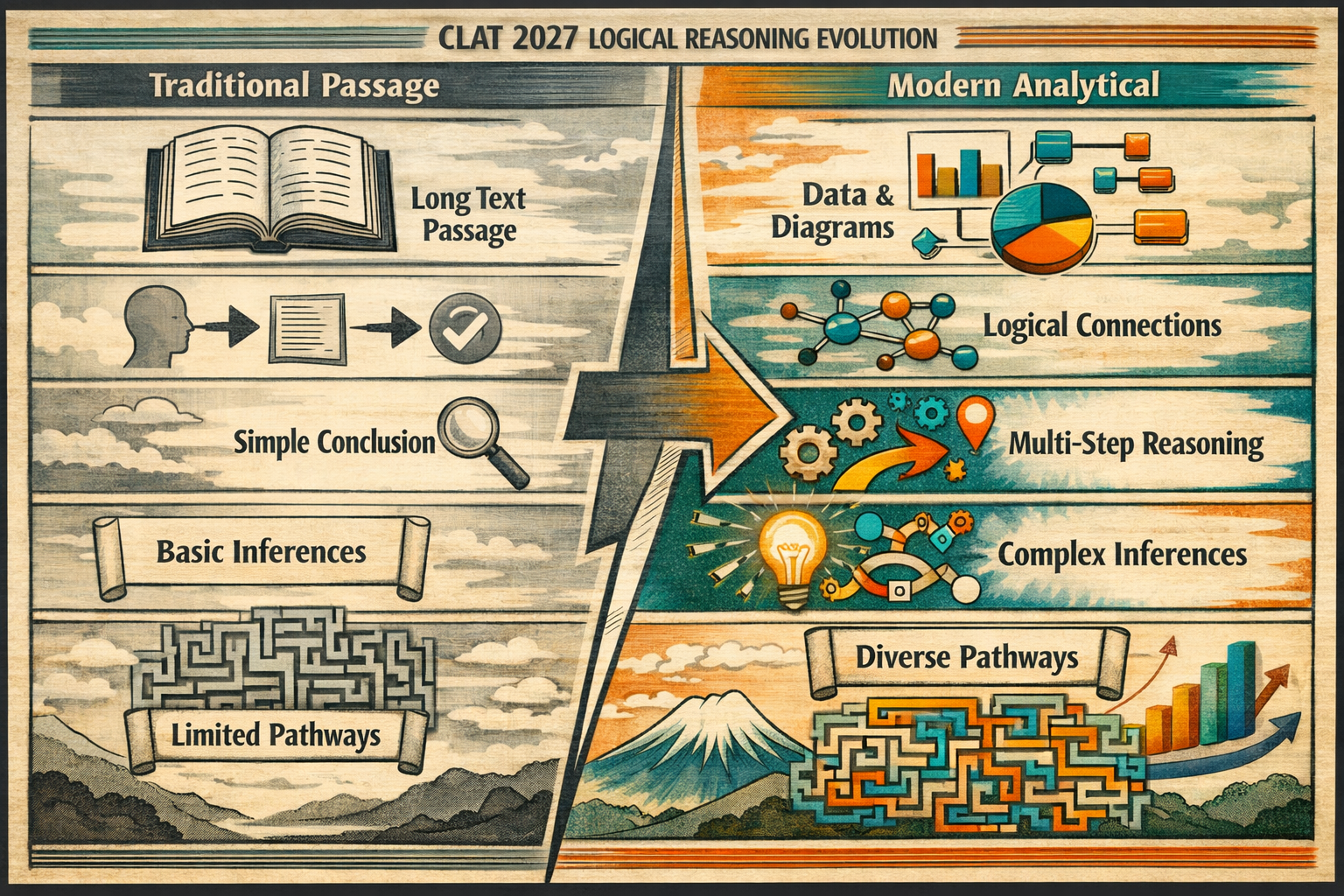
Recognizing contextual traps requires pattern exposure. You need to see enough trap variations that your brain automatically flags them during the exam. This doesn’t happen through passive practice. It requires deliberate, analytical practice focused on trap identification.
The Trap Analysis Protocol
For every practice passage, complete this protocol:
Phase 1: Attempt Normally
- Read the passage using active reading techniques
- Answer all questions
- Note your confidence level for each answer (high, medium, low)
Phase 2: Identify Traps
- Review each question, especially ones you got wrong or felt uncertain about
- For wrong answers: Identify which trap type caused the error
- For correct answers with low confidence: Identify what made you uncertain
- For correct answers with high confidence: Verify you didn’t just get lucky
Phase 3: Categorize Traps
Create a trap log with categories:
- Assumption substitution
- Scope confusion
- Premise-conclusion reversal
- Conditional logic errors
- Inference overreach
- Time-pressure skimming
- Familiarity bias
Mark which trap affected you in each question.
Phase 4: Pattern Recognition
After 10-15 passages, review your trap log:
- Which traps affect you most frequently?
- Are certain question types more trap-prone for you?
- Do analytical or critical reasoning passages cause more errors?
Phase 5: Targeted Practice
Focus additional practice on your most common trap types. If scope confusion causes frequent errors, specifically practice identifying scope qualifiers in passages.
The Wrong Answer Analysis Technique
For each wrong answer you selected, write a brief explanation of why it’s wrong. This forces you to understand the trap mechanism rather than just noting you got it wrong.
Example:
Question: What can be inferred from the passage?
Your answer: “Legal reforms always face resistance.”
Correct answer: “Some legal reforms face resistance.”
Your analysis: “I selected an answer with extreme language (‘always’) when the passage used moderate language (‘often’). This is a scope confusion trap. I need to pay closer attention to qualifiers.”
This analysis builds conscious awareness of trap patterns.
The Prediction Accuracy Metric
Track not just whether you got questions right, but whether your predicted answer matched the correct answer before you looked at choices.
High prediction accuracy (70%+): You’re understanding passages well and avoiding traps
Low prediction accuracy (below 50%): You’re either misunderstanding passages or falling for trap answers
This metric reveals whether your errors come from comprehension or trap susceptibility.
Timed vs Untimed Practice Balance
Allocate practice time strategically:
60% untimed practice: Focus on accuracy and trap recognition without time pressure. Build good habits.
40% timed practice: Apply techniques under realistic time constraints. Identify which techniques break down under pressure.
Progressive timing: Start with generous time limits, then gradually reduce to match actual exam conditions (roughly 2 minutes per question including passage reading).
The Explanation Requirement
Never move to the next practice passage until you can explain:
- Why the correct answer is correct
- Why each wrong answer is wrong
- Which trap types appeared in the passage
- What you would do differently next time
This requirement prevents mindless practice where you complete passages without learning from them.
Peer Discussion for Trap Exposure
Discuss practice passages with other aspirants. Different people fall for different traps. Hearing someone explain why they selected a wrong answer exposes you to trap patterns you might not have encountered personally.
Questions to discuss:
- “Why did you select that answer?”
- “What in the passage made you think that?”
- “Did you notice the qualifier in line 3?”
- “How did you interpret that conditional rule?”
The Plateau Breakthrough Strategy
If your accuracy plateaus despite practice:
- Take a diagnostic: Complete 5 passages and analyze every error systematically
- Identify your primary trap type (the one causing 50%+ of errors)
- Study that trap type specifically for 3-4 days
- Complete focused practice targeting that trap
- Retest to measure improvement
Plateaus usually indicate you’re making the same error repeatedly. Targeted intervention breaks the pattern.
Building Speed Without Sacrificing Accuracy
Speed develops naturally from pattern recognition. As you become familiar with trap types, you identify them faster. Don’t force speed by skimming or rushing. Instead:
- Perfect your technique at comfortable pace
- Gradually reduce time limits
- Track both speed and accuracy
- Accept that some passages legitimately take longer
Your goal is sustainable speed where you maintain 80%+ accuracy while completing passages within time limits.
For comprehensive practice resources, explore our collection of free CLAT preparation resources.
What Mental Frameworks Help You Stay Focused During Complex Passages?
Mental fatigue and cognitive overload are major causes of contextual trap susceptibility. When your working memory gets overwhelmed, you default to shortcuts and assumptions that lead directly into traps. Effective mental frameworks help you maintain reasoning control even through complex passages.
The Chunking Strategy
Your working memory can hold roughly 4-7 pieces of information simultaneously. Complex passages exceed this capacity, causing information loss. Chunking groups related information into single units, expanding effective capacity.
For analytical passages:
- Chunk related rules together (“seating rules” vs “timing rules”)
- Chunk variables by category (seniors vs juniors, morning vs afternoon)
- Create mental labels for chunks rather than remembering every detail
For critical reasoning passages:
- Chunk background context separately from main argument
- Group all premises together as “evidence”
- Separate counterarguments from main position
This organization prevents cognitive overload.
The Attention Reset Technique
If you notice your attention drifting or realize you’ve read a paragraph without comprehension:
- Stop immediately (don’t continue reading)
- Close your eyes for 3 seconds
- Take one deep breath
- Reread the last paragraph you fully understood
- Continue with renewed focus
This 10-second reset prevents the cascade effect where poor comprehension compounds across the passage.
The Confidence Calibration Check
After reading a passage but before attempting questions, rate your comprehension:
- High: I understood the structure and main points clearly
- Medium: I got the general idea but some parts were unclear
- Low: I’m confused about the passage structure or main point
If you rate low or medium, reread before attempting questions. Attempting questions with poor comprehension guarantees trap susceptibility.
The Question-Type Energy Allocation
Different question types require different cognitive resources:
High energy required:
- Multi-condition analytical sets
- Complex inference questions
- Strengthen/weaken questions with subtle distinctions
Medium energy required:
- Standard analytical questions with clear rules
- Main point identification
- Straightforward inference questions
Low energy required:
- Fact-checking questions
- Definition questions
- Simple rule application
Attempt high-energy questions when your focus is sharpest (typically early in the section or after a brief mental reset). Save low-energy questions for when fatigue sets in.
The Metacognitive Monitoring Loop
Periodically check your mental state:
- Am I reading actively or passively?
- Am I making assumptions or sticking to passage content?
- Am I rushing due to time pressure?
- Is fatigue affecting my reasoning?
This self-monitoring catches deteriorating performance before it causes multiple errors.
The Simplification Principle
When a passage seems overwhelmingly complex:
- Identify the core question: What is this passage fundamentally about?
- Strip away secondary details: What information is essential vs supplementary?
- Restate the core in simple terms: “This is about X trying to do Y under conditions Z”
- Build back complexity gradually: Now add the details back onto this simple framework
This prevents the paralysis that comes from confronting complexity all at once.
The Trap Awareness Trigger
Train yourself to heighten awareness when you encounter trap indicators:
Trigger phrases in questions:
- “Must be true” (expect extreme language traps in wrong answers)
- “Can be inferred” (expect scope and assumption traps)
- “Strengthens the argument” (expect premise-conclusion confusion)
- “Which could be true” (expect necessity-possibility confusion)
When you see these phrases, mentally shift into high-alert mode for the associated trap types.
The Energy Management Strategy
Logical reasoning appears at a specific point in the CLAT exam. Plan your energy management:
Before the section:
- If permitted, take a 30-second mental break between sections
- Do a brief attention reset
- Remind yourself of your primary trap vulnerabilities
During the section:
- Start with a passage that looks manageable to build confidence
- If you hit an extremely difficult passage, mark it and move on
- Take micro-breaks (3-5 seconds) between passages to reset attention
After difficult passages:
- Acknowledge the difficulty without dwelling on it
- Consciously reset before starting the next passage
- Maintain confidence in your preparation
The Perspective Maintenance Framework
Under exam pressure, it’s easy to catastrophize after difficult questions. Maintain perspective:
- One difficult passage doesn’t determine your score
- Trap recognition prevents errors on other passages
- Your preparation has equipped you to handle complexity
- The exam tests reasoning control, which you’ve practiced extensively
This psychological framework prevents the confidence collapse that leads to cascading errors.
For additional mental preparation strategies, see our guide on CLAT exam anxiety management.
How Should You Adapt Your Preparation Based on the 2026 Pattern Changes?
The CLAT 2026 exam introduced significant pattern changes that will likely continue in 2027[1][6]. Your preparation must adapt to these changes rather than relying on strategies that worked for earlier exam iterations.
Understanding the 2026 Shift
CLAT 2026 marked a decisive move toward analytical reasoning through puzzles, departing from the traditional critical reasoning dominance[1]. This wasn’t a minor adjustment but a fundamental restructuring of what the section tests.
Key changes:
- Increased emphasis on multi-condition analytical sets
- Reduced reliance on straightforward argument analysis
- Integration of legal-journalistic material into logical reasoning
- Blurred boundaries between logical and legal reasoning sections[3]
- Unpredictability designed to discourage pattern memorization[1]
The Hybrid Preparation Approach
Given the likelihood of a hybrid structure combining analytical and critical reasoning[1], your preparation must cover both formats equally.
Analytical Reasoning Preparation (50% of practice time):
- Seating arrangements (linear, circular, complex)
- Scheduling and sequencing problems
- Grouping and distribution sets
- Blood relations and family trees
- Logical puzzles with multiple variables
Focus on developing systematic diagramming techniques and rule application accuracy.
Critical Reasoning Preparation (50% of practice time):
- Argument structure identification
- Assumption recognition
- Strengthen/weaken questions
- Inference and conclusion questions
- Paradox resolution
Focus on understanding logical relationships and avoiding inference traps.
Adapting to Reduced Predictability
The Consortium deliberately designs passages to test reasoning control rather than pattern recall[1]. This means:
Don’t: Memorize question types and standard solutions
Do: Develop flexible reasoning frameworks applicable to novel situations
Don’t: Rely on topic-specific preparation (expecting certain puzzle types)
Do: Build general analytical and critical reasoning skills
Don’t: Practice only CLAT-specific materials
Do: Include diverse reasoning materials from other exams (LSAT, GMAT logical reasoning)
Integrating Legal-Journalistic Content
Logical reasoning increasingly features comprehension paragraphs on current issues and analytical news articles[3]. This requires:
Current affairs awareness: Not for recall, but for contextual understanding when passages discuss contemporary issues
Legal terminology familiarity: Understanding common legal terms that appear in passages without needing to memorize legal principles
Critical reading of news: Practice analyzing news articles for argument structure, not just information gathering
For current affairs preparation, see our guide on preparing CLAT current affairs without daily newspapers.
The Comprehension-Heavy Format Challenge
The exam’s comprehension-heavy format makes it extremely difficult for students who struggle with reading comprehension[3]. If this describes you:
Priority 1: Improve general reading speed and comprehension through daily practice with complex texts
Priority 2: Develop active reading techniques specifically for CLAT passage structures
Priority 3: Practice extracting relevant information quickly from dense passages
This is foundational. No amount of logical reasoning technique mastery compensates for poor reading comprehension.
Our comprehensive guide on CLAT English preparation covers reading comprehension improvement strategies.
Addressing the Section Overlap Problem
Logical and legal reasoning sections have become nearly indistinguishable[3]. This creates preparation efficiency:
Integrated practice: Don’t treat these as completely separate sections. Skills developed for one transfer to the other.
Unified approach: Use similar active reading and trap recognition techniques for both sections.
Contextual flexibility: Practice switching between legal principle application and pure logical reasoning within single practice sessions.
The Mock Test Reality Check
Your mock test strategy must reflect actual exam conditions:
Use 2026-pattern mocks: Older mock tests following pre-2026 patterns don’t prepare you for current exam reality
Analyze pattern alignment: After each mock, verify the logical reasoning section matched the analytical-heavy pattern seen in 2026
Adjust based on performance: If you consistently struggle with analytical sets, increase that component of your preparation
Time allocation practice: The 22-26 question section with 450-word passages requires specific time management[2]
For detailed mock test strategies, see our guide on using mock tests to identify weaknesses.
Building Adaptive Reasoning Skills
Since unpredictability is built into the exam design[1], develop adaptive skills:
Scenario 1: If you encounter an unfamiliar puzzle type, can you apply general analytical reasoning principles to solve it?
Scenario 2: If a passage structure differs from anything you’ve practiced, can you identify the core logical relationships anyway?
Scenario 3: If time pressure forces you to skip a passage, can you quickly identify which passage to skip based on complexity assessment?
These adaptive skills matter more than memorizing specific question types.
The Technology-Enhanced Practice Approach
Use technology strategically to enhance preparation:
Spaced repetition software: For learning common logical fallacies, conditional logic rules, and trap patterns
Timed practice platforms: For building speed under realistic conditions
Video explanations: For understanding complex reasoning pathways in difficult questions
Performance analytics: For identifying specific weakness areas requiring targeted practice
The Realistic Timeline
Adapting to the new pattern requires time:
6+ months before exam: Build foundational analytical and critical reasoning skills with equal emphasis
3-6 months before exam: Increase practice volume, focus on trap recognition, integrate timed practice
1-3 months before exam: Primarily full-length mocks under exam conditions, targeted weakness remediation
Final month: Maintain skills, build confidence, fine-tune time management
Trying to adapt to the new pattern in the final 2-3 months rarely succeeds. Start early.
Frequently Asked Questions About CLAT 2027 Logical Reasoning
What percentage of CLAT 2027 is logical reasoning?
Logical reasoning comprises approximately 20% of the total CLAT exam, consisting of 22-26 questions (some sources indicate 28-32 questions)[2][4]. Each question carries equal marks, making this section a significant score determinant. The section uses passage-based questions with approximately 450-word passages followed by multiple-choice questions[2].
How is CLAT 2027 logical reasoning different from previous years?
CLAT 2027 logical reasoning emphasizes analytical reasoning through puzzles rather than traditional critical reasoning formats[1][6]. The exam now features multi-condition deduction sets, reduced predictability in question patterns, and integration of legal-journalistic content[3]. The Consortium deliberately designs passages to test reasoning control rather than pattern recall[1].
Can I prepare for logical reasoning without coaching?
Yes, self-preparation is possible with structured practice and the right resources. Focus on developing systematic approaches to analytical and critical reasoning, practice trap recognition through deliberate analysis, and use quality mock tests following the 2026 pattern. However, expert guidance can accelerate learning and help identify blind spots in your reasoning. For self-study strategies, see our guide on cracking CLAT without expensive coaching.
How much time should I spend on each logical reasoning passage?
Budget approximately 2 minutes per question including passage reading time. For a passage with 4-5 questions, allocate 8-10 minutes total: 60-90 seconds for active reading and passage analysis, then 30-45 seconds per question. This timing allows systematic work without rushing, which reduces trap susceptibility.
What are the most common mistakes in CLAT logical reasoning?
The most frequent errors include assumption substitution (importing information not in the passage), scope confusion (missing qualifiers like “some” vs “all”), conditional logic reversal (confusing “if A then B” with “if B then A”), inference overreach (concluding more than the passage supports), and time-pressure skimming (missing crucial details due to rushing).
Should I attempt all logical reasoning questions or skip difficult ones?
Attempt questions strategically based on difficulty and your confidence. If a passage seems exceptionally complex after 90 seconds of reading, mark it and move on. Return to skipped passages after completing questions you can solve confidently. Not every question is worth the same points, so maximize your score by answering questions within your capability first.
How important is background knowledge for logical reasoning?
Background knowledge in legal concepts, constitutional provisions, and current affairs helps with comprehension but should never override passage information. Use background knowledge to understand context quickly, but answer questions based exclusively on passage content. The exam tests reasoning skills, not knowledge recall.
What’s the best way to improve logical reasoning accuracy?
Implement deliberate practice with trap analysis: complete practice passages, identify which trap types caused errors, categorize your mistakes, and focus additional practice on your most common trap vulnerabilities. Track both accuracy and the reasoning process that led to your answers. Accuracy improves when you understand why wrong answers are wrong, not just which answer is correct.
How do I handle time pressure in logical reasoning?
Build time management through progressive timing in practice: start with generous time limits focusing on accuracy, gradually reduce time to match exam conditions, and track which techniques break down under pressure. During the exam, use active reading to reduce re-reading time, skip exceptionally difficult passages to return to later, and maintain confidence rather than panicking when time gets tight.
Are CLAT logical reasoning passages getting harder?
The passages are becoming more sophisticated rather than simply harder. The 2026 exam introduced analytical complexity and reduced predictability[1], which feels harder if you’re prepared for traditional patterns. However, with appropriate preparation focused on reasoning control and trap recognition, the passages remain manageable. The key is adapting your preparation to match the current exam pattern.
What resources should I use for logical reasoning practice?
Use CLAT-specific materials following the 2026 pattern, analytical reasoning questions from other exams like LSAT and GMAT, critical reasoning passages from diverse sources, and quality mock tests that reflect current exam structure. Avoid outdated materials following pre-2026 patterns. For comprehensive resource recommendations, see our guide to CLAT 2027 resources.
How can I avoid silly mistakes in logical reasoning?
Silly mistakes typically result from rushing, misreading questions, or failing to check answers against all conditions. Prevent these by reading questions carefully (underline key words like “must,” “could,” “cannot”), systematically checking each answer against all passage rules, predicting answers before looking at choices, and maintaining sustainable pace rather than rushing. If you consistently make careless errors, slow down slightly and verify your accuracy improves.
Conclusion: Building Your Contextual Trap Defense System
Avoiding contextual traps in CLAT 2027 Logical Reasoning requires more than understanding trap types. You need a comprehensive defense system combining active reading techniques, trap recognition patterns, mental frameworks for focus maintenance, and adaptive reasoning skills.
The exam has evolved significantly. The 2026 pattern shift toward analytical reasoning and reduced predictability means traditional preparation approaches no longer suffice[1]. Your success depends on developing genuine reasoning control rather than memorizing question patterns.
Here’s your action plan:
Immediate Actions (This Week)
Start implementing active reading techniques on every practice passage. Don’t just answer questions; analyze the passage structure, identify argument components, and diagram analytical conditions before attempting questions.
Create your trap log. For the next 10 practice passages, categorize every error by trap type. This reveals your vulnerability pattern.
Assess your current preparation materials. Are they following the 2026 analytical-heavy pattern, or are they based on outdated critical reasoning formats? Adjust your resources accordingly.
Short-Term Development (Next Month)
Build systematic approaches for both analytical and critical reasoning. Allocate equal practice time to both formats since CLAT 2027 will likely feature a hybrid structure[1].
Implement the wrong answer analysis technique. For every error, write a brief explanation of the trap mechanism. This builds conscious awareness faster than passive practice.
Start progressive timing. Begin with untimed practice focused on accuracy and trap recognition, then gradually introduce time constraints approaching exam conditions.
Long-Term Mastery (Next 3-6 Months)
Develop adaptive reasoning skills through exposure to diverse passage types. Include LSAT and GMAT logical reasoning materials alongside CLAT-specific practice.
Integrate legal-journalistic content into your preparation. Practice analyzing news articles for argument structure and logical relationships, not just information gathering.
Complete regular full-length mocks under exam conditions. Analyze performance not just by accuracy but by identifying which trap types still affect you under pressure.
Your Competitive Advantage
Most aspirants practice logical reasoning passively: they complete passages, check answers, note their score, and move on. This approach doesn’t build trap recognition or reasoning control.
Your advantage comes from deliberate, analytical practice focused on understanding why wrong answers are wrong and which cognitive patterns lead you into traps. This metacognitive awareness separates top scorers from average performers.
The CLAT 2027 Logical Reasoning section will test your ability to maintain reasoning control under time pressure, process complex multi-condition scenarios, avoid inference traps, and apply analytical thinking to unfamiliar situations. These skills develop through focused practice with the right techniques.
Getting Expert Guidance
While self-preparation is possible, expert guidance accelerates your learning by identifying blind spots in your reasoning and providing targeted feedback on your approach. At Lawgic Coaching, we’ve helped thousands crack CLAT through personalized mentorship and proven teaching methods.
Our faculty from top NLUs understand exactly how the exam has evolved and what it takes to avoid contextual traps consistently. We offer flexible learning that fits your schedule, with focused attention on developing genuine reasoning skills rather than rote pattern memorization.
Your success is our mission. If you’re serious about cracking CLAT 2027, let’s build your law career together with strategies that actually work.
Ready to master logical reasoning and avoid every contextual trap the exam throws at you? Explore our comprehensive CLAT preparation programs designed specifically for the current exam pattern. Your law school dreams deserve expert guidance without the premium price tag.