The CLAT 2027 battlefield is heating up, and every mark counts more than ever. With over 70,000 aspirants competing for roughly 2,500 seats across 24 NLUs, understanding CLAT 2027 Cut-Off Predictions: Safe Scores for Top NLUs by Category and How to Hit Them isn’t just helpful—it’s absolutely crucial for your law school dreams.
Here’s the reality: cutoff predictions have become more complex with seat expansions at newer NLUs and shifting competition patterns. But here’s what makes this different from other prediction articles floating around—we’re diving deep into category-wise safe score formulas, analyzing 2024-2025 closing rank trends, and giving you actionable strategies to not just meet but exceed these cutoffs.
Your success is our mission, and that means no sugar-coating the numbers or giving you false hope. Let’s break down exactly what scores you need and how to achieve them.
Key Takeaways
• Top 3 NLUs require 95+ marks with NLSIU demanding 101-105 marks for General category in 2026
• Category-wise variations range from 3-25 marks lower than General cutoffs, with SC/ST having the most significant reductions
• Mid-tier NLUs offer realistic targets at 78-90 marks for General category aspirants
• Mock test performance correlation shows students scoring 85+ consistently in quality mocks typically achieve their target NLU
• Strategic preparation in final months can boost scores by 8-12 marks through targeted weak area improvement
Understanding CLAT 2027 Cutoff Landscape: What’s Changed
The CLAT cutoff game has evolved significantly since 2024. Let’s be honest—the competition isn’t getting easier, but understanding the patterns gives you a massive advantage.
Top-Tier NLU Predictions for 2026
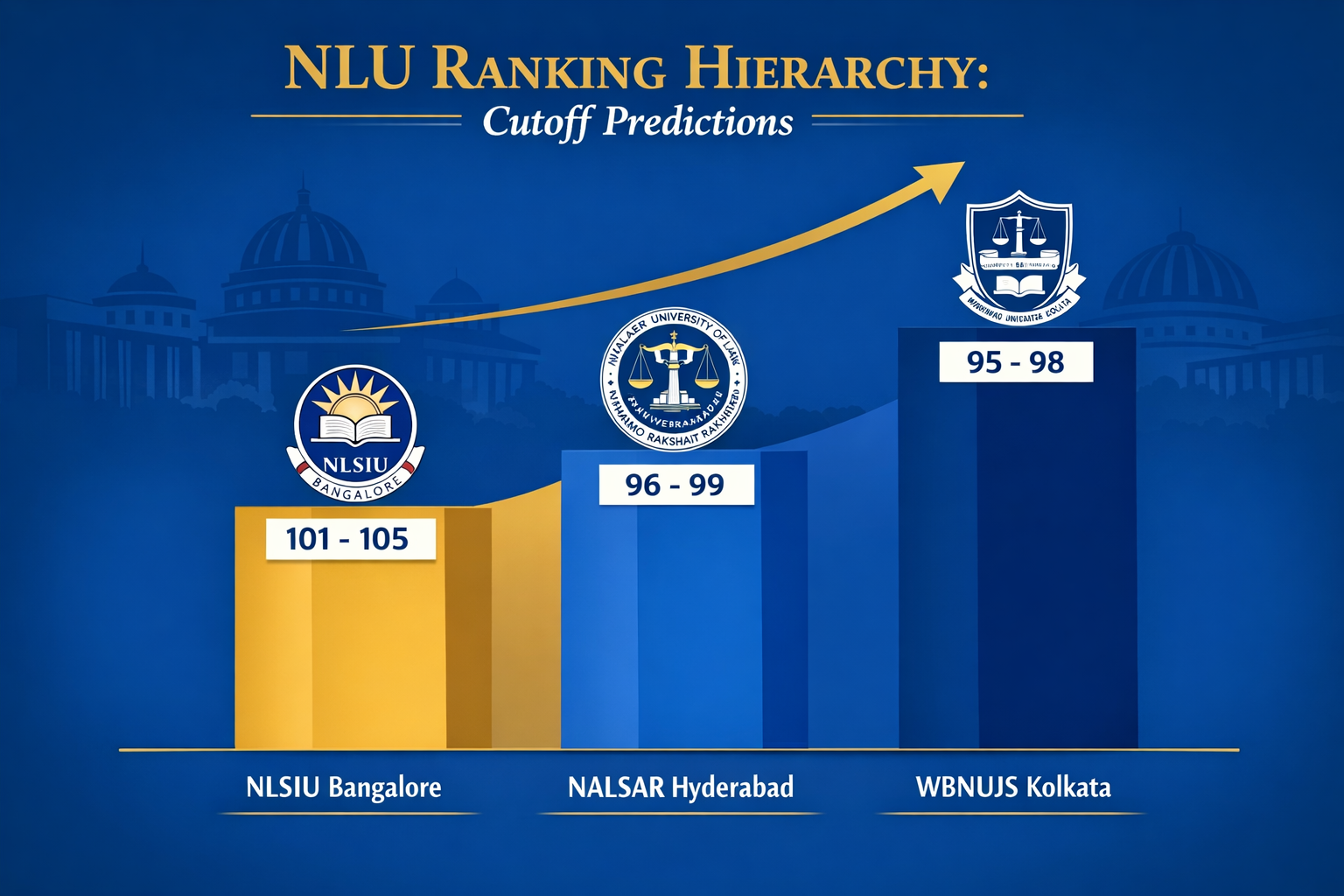
NLSIU Bangalore continues its reign as the most coveted law school, with expected cutoffs ranging between 101-105 marks for General category[3]. This represents a slight increase from previous years, reflecting the institute’s premium positioning and limited seat availability.
NALSAR Hyderabad follows closely with predicted cutoffs of 96-99 marks[3], while WBNUJS Kolkata rounds out the top three with 95-98 marks[3]. These numbers aren’t arbitrary—they’re based on detailed analysis of previous year trends and current competition levels.
The Mid-Tier Sweet Spot
Here’s where things get interesting for most aspirants. The top 5 NLUs overall are expected to maintain cutoffs of 90+ marks[1], but mid-tier NLUs present more achievable targets with safe scores ranging from 78-90 marks for General category[2].
This is where strategic thinking pays off. Instead of fixating solely on the top 3, smart aspirants are identifying excellent mid-tier NLUs that offer outstanding legal education without the cutthroat competition.
Newer NLUs: The Hidden Opportunities
The newer NLUs are creating interesting opportunities with safe scores ranging from 65-78 marks for General category[2]. These institutions are rapidly improving their infrastructure and faculty, making them excellent choices for serious law aspirants.
What’s particularly noteworthy is how some newer NLUs are outperforming older ones in placement statistics and academic quality. This shift means that focusing purely on establishment date might not be the smartest strategy anymore.
For those looking to understand the complete picture of CLAT marks vs rank correlation, the relationship between your score and final rank has become more predictable with larger data sets.
Category-Wise Safe Score Predictions for CLAT 2027 Cut-Off Success
Understanding category-wise variations in CLAT 2027 Cut-Off Predictions: Safe Scores for Top NLUs by Category and How to Hit Them can make or break your NLU selection strategy. The differences aren’t just about a few marks—they represent entirely different competition landscapes.
General Category: The Benchmark Numbers
General category aspirants face the steepest competition, with top NLUs demanding exceptional performance. For NLSIU, you’re looking at 101-105 marks as a safe score[3], which translates to roughly 85-88% accuracy across all sections.
The challenge for General category students isn’t just achieving high scores—it’s maintaining consistency across all five sections. One poor section can derail your entire attempt, making comprehensive preparation non-negotiable.
OBC Category: Strategic Advantage
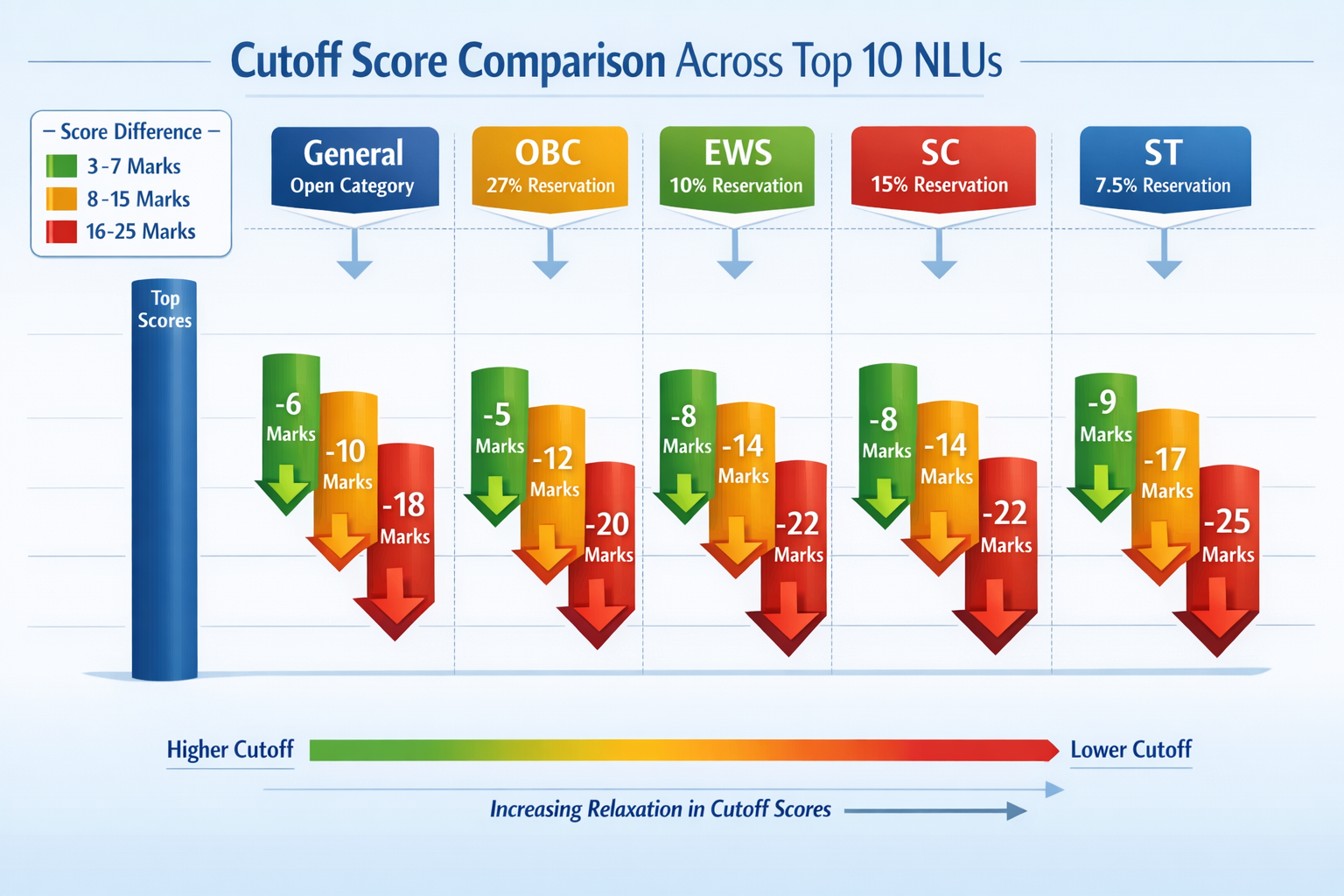
OBC category aspirants enjoy a meaningful advantage with cutoffs approximately 3-6 marks lower than General category for top NLUs[4]. This might seem small, but in CLAT’s competitive landscape, these marks can mean the difference between your dream NLU and a backup option.
For NALSAR, OBC aspirants can target 90-93 marks as a safe score, while WBNUJS becomes accessible at 89-92 marks. The key is not getting complacent—these advantages disappear quickly if your preparation lacks rigor.
EWS Category: Emerging Patterns
The EWS category presents an interesting dynamic. While cutoffs are slightly lower than General category, the demand remains high, making the actual score difference smaller than other reserved categories[3].
Smart EWS aspirants are treating their preparation as if they’re in the General category, using any score advantage as a safety buffer rather than a primary strategy.
SC Category: Significant Opportunities
SC category aspirants have substantial advantages with cutoffs showing 18-25 mark differences below General category in many cases[3][4]. This opens up realistic possibilities for top NLUs that might otherwise seem out of reach.
For NLSIU, SC category aspirants can target 76-83 marks as a safe score, while NALSAR becomes accessible at 71-78 marks. These aren’t easy scores, but they’re significantly more achievable with focused preparation.
ST Category: Variable Landscape
ST category cutoffs show 15-25 marks lower than General category, but with significant variation across state NLUs[3][4]. The competition is generally lower, but state-specific preferences can create unexpected variations.
The strategy here involves understanding which NLUs have historically shown more favorable patterns for ST aspirants and planning your preferences accordingly.
Creating Your Category-Specific Target
Here’s a practical formula for setting your target score:
- Identify your dream NLU’s General category cutoff
- Apply your category’s historical reduction
- Add 5-8 marks as a safety buffer
- Set this as your minimum target
This approach ensures you’re not just hoping to scrape through but positioning yourself comfortably above the cutoff line.
For aspirants wondering about preparation timelines, understanding these category-wise targets early helps optimize your study schedule and resource allocation.
Strategic Action Plan: How to Hit Your CLAT 2027 Cut-Off Target

Knowing the cutoffs is just the beginning. The real question is: how do you systematically build the capability to achieve these scores? This isn’t about generic study tips—it’s about proven strategies that actually work.
The 100+ Marks Blueprint
Achieving 100+ marks positions you for a rank within the top 50[2], virtually guaranteeing admission to your preferred NLU. But this level requires a different approach than conventional CLAT preparation.
Students who consistently hit 100+ marks follow a specific pattern:
- 90%+ accuracy in English and Legal Reasoning (their strongest sections)
- 85%+ accuracy in Logical Reasoning and Current Affairs
- 75%+ accuracy in Mathematics (damage control approach)
The key insight? You don’t need to be excellent at everything. You need to be exceptional at 2-3 sections and competent at the rest.
The 95-100 Marks Strategy
This score range typically yields ranks between 50-150[2], opening doors to top 5 NLUs comfortably. The strategy here focuses on consistency over brilliance.
Successful students in this range master the art of avoiding negative marking. They develop strong elimination techniques and know when to skip questions. This conservative approach often outperforms aggressive attempts that result in higher negative scores.
Mock Test Performance Correlation
Here’s something most coaching institutes won’t tell you: there’s a strong correlation between mock test performance and actual CLAT scores. Students who consistently score 85+ in quality mocks typically achieve their target NLU.
But not all mocks are created equal. The mocks that matter are those that:
- Match actual CLAT difficulty levels
- Provide detailed performance analytics
- Include passage-based questions similar to recent patterns
For comprehensive mock test strategies, check out our guide on mastering mock tests to uncover weaknesses.
Section-Specific Score Optimization
English Language: The Consistency Builder
Target 85%+ accuracy by focusing on:
- Reading speed improvement (aim for 200+ words per minute)
- Vocabulary building through legal and contemporary contexts
- Grammar rule mastery for error detection questions
Legal Reasoning: The Score Multiplier
This section often determines your final rank. Target 80%+ accuracy through:
- Principle-based reasoning practice
- Case study analysis techniques
- Legal maxim familiarity
Logical Reasoning: The Differentiator
Consistent 75%+ accuracy requires:
- Pattern recognition speed
- Assumption identification skills
- Logical sequence mastery
Current Affairs: The Preparation Challenge
Target 70%+ accuracy through:
- Daily legal news consumption
- Monthly current affairs compilation
- Static GK foundation building
For those struggling with specific sections, our common legal reasoning mistakes guide addresses the most frequent pitfalls.
The Final 60-Day Sprint Strategy
If you’re in the final stretch, here’s how to maximize score improvement:
Week 1-2: Diagnostic and Gap Analysis
- Take 3 full-length mocks under exam conditions
- Identify your weakest subsections within each subject
- Calculate your current projected score based on performance
Week 3-6: Targeted Improvement
- Focus 60% time on weakest areas that offer maximum score improvement
- Maintain 40% time on strong areas to prevent skill degradation
- Take 2 mocks per week to track progress
Week 7-8: Consolidation and Confidence Building
- Daily mock tests to build exam stamina
- Review all previous mistakes systematically
- Practice time management strategies
This approach typically yields 8-12 mark improvements in the final two months when executed consistently.
For students looking for structured preparation guidance, having a clear roadmap makes all the difference between scattered effort and focused improvement.
Flexible Learning That Fits Your Life
At Lawgic Coaching, we understand that every aspirant’s situation is different. Whether you’re balancing school, working, or dealing with other commitments, our flexible learning approach ensures you can access expert guidance without the premium price tag.
Our real mentors from top NLUs provide personalized attention you deserve, helping you study at your own pace while maintaining the rigor needed for CLAT success. No cookie-cutter approach here—we’ve helped thousands crack CLAT with proven strategies that actually work.
Conclusion
The path to CLAT 2026 success isn’t about hoping for the best—it’s about strategic preparation based on realistic cutoff predictions. With NLSIU requiring 101-105 marks, NALSAR demanding 96-99, and mid-tier NLUs offering opportunities at 78-90 marks, your target should be clear and category-specific.
Remember, category-wise advantages can provide crucial breathing room, but they’re not substitutes for thorough preparation. Whether you’re targeting the top 3 NLUs or identifying excellent opportunities among newer institutions, the fundamentals remain the same: consistent mock performance, section-specific optimization, and strategic time management.
The next few months will determine your law school destiny. Start with a realistic assessment of your current performance, set category-appropriate targets, and execute a systematic improvement plan. Results speak louder than promises, and with the right approach, your CLAT 2027 dreams are absolutely achievable.
Your law career journey starts with making smart preparation decisions today. Let’s build your success together with accessible education that delivers results without compromise.
References
[1] Clat Cutoffs For Nlus Blogid 200722 – https://www.shiksha.com/law/articles/clat-cutoffs-for-nlus-blogId-200722
[2] economictimes – https://economictimes.com/jobs/exams-results/clat-2026-cut-off-expected-previous-year-nlu-wise-cut-off-marks-clat-2025-analysis-law-colleges-cut-off-list/articleshow/125828048.cms
[3] Clat 2026 Expected Cutoffs – https://www.lawentrance.com/blogs/clat-2026-expected-cutoffs/
[4] Top 10 Nlus Cut Off For Clat 2026 Marks Rank Trends – https://www.clatnlti.com/blog-details/413/top-10-nlus-cut-off-for-clat-2026-marks-rank-trends

