The official CLAT sample paper exists. Most students never find it.
Around 1,900 people search for a CLAT sample paper every month, and thousands more for past papers. Most type it into Google, download the first PDF they find, and spend weeks practising on material that has nothing to do with how the exam actually works today. That is not a small problem, and it is entirely avoidable.
Here's what most students don't know: the Consortium of National Law Universities, the body that conducts CLAT, releases an official sample paper with a full answer key. But it's not sitting on any public website. It's behind a login. You only get it after you register.
So if you haven't registered yet and you're downloading "CLAT sample papers" from third-party sites, there's a real chance you're practising on the wrong format entirely.
This page fixes that.
Key takeaways
- The Consortium of NLUs releases an official CLAT sample paper with an answer key, but only to registered candidates via their login on consortiumofnlus.ac.in.
- Most "CLAT sample papers" circulating on third-party sites are either old past papers or independently created material, not official Consortium releases.
- The current CLAT format (120 questions, fully passage-based) has been in place since CLAT 2024. Any sample paper built on the pre-2024 pattern will teach you the wrong skills.
- The Consortium has confirmed no change to the pattern or syllabus for CLAT 2027.
- Practising smart matters more than practising a lot. How you review a sample paper is what actually builds your score.
What an official CLAT sample paper actually is, and who releases it
The official CLAT sample paper is a document released by the Consortium of National Law Universities, the body that runs CLAT on behalf of 26 participating NLUs. It is not a past question paper. It's a purpose-built practice paper designed to show candidates exactly what the real exam looks and feels like.
The Consortium releases it along with an official answer key. That combination is important. Without the answer key, a sample paper is just a guessing exercise.
What makes this official paper different from everything else out there is that it's created by the same body that sets the actual exam. The question style, the passage length, the difficulty calibration, the section structure. All of it reflects what you'll actually face on exam day.
The Consortium holds copyright over all CLAT question papers and sample papers. That means reproducing or redistributing them without permission is not permitted, which is also why legitimate coaching platforms, including Lawgic, do not host or reproduce these papers.
Where the official sample papers come from, and why most people never see them
This is the part that trips up most students.
The official sample paper is available only to candidates who have completed their CLAT registration. You log into your account on consortiumofnlus.ac.in using your registration credentials, and the sample paper is accessible from there.
That's it. There's no public download link. There's no press release with a PDF attachment. If you haven't registered, you don't get access.
CLAT 2027 registration opens on 3 August 2026 and closes on 31 October 2026. The exam itself is on Sunday, 6 December 2026, from 2:00 pm to 4:00 pm (2:00 to 4:40 pm for PwD candidates). Application fees are Rs 4,000 for General and OBC candidates, and Rs 3,500 for SC, ST, BPL, and PwD candidates.
So here's the situation most aspirants are in: they start preparing months before registration opens, they search for sample papers, they land on third-party sites, and they never circle back to the official source once they've registered. The official paper sits in their login portal, unused.
Official sample paper, past paper, third-party sample paper: the difference
These three things are not interchangeable, and treating them as if they are is a genuine preparation mistake.
| Type | Source | Answer Key Included | Reflects Current Format |
|---|---|---|---|
| Official Sample Paper | Consortium of NLUs | Yes (official) | Yes |
| Past Question Paper | Consortium, via your registration login | Sometimes | Only if post-2024 |
| Third-Party Sample Paper | Coaching institutes, websites | Usually | Varies, often no |
Official sample paper: Released by the Consortium to registered candidates. Reflects the exact current format. Comes with a verified answer key.
Past question papers: These are actual papers from previous CLAT exams. Papers from CLAT 2024 onwards reflect the current 120-question, passage-based format. Papers from before 2024 do not.
Third-party sample papers: Created by coaching institutes, test prep websites, or individual educators. Quality varies enormously. Some are well-designed. Many are based on outdated formats or include question types that no longer appear in CLAT. None of them carry the Consortium's authority.
The safest starting point is always the official sample paper. Use third-party material to supplement your practice volume, not to define your understanding of the exam.
What the current CLAT sample paper looks like
The current CLAT format has been in place since CLAT 2024, following a decision by the Consortium's Governing Body on 20 May 2023. The Consortium has confirmed there is no change to the pattern or syllabus for CLAT 2027.
Paper structure at a glance:
- 120 multiple-choice questions
- 2 hours total
- 1 mark for each correct answer
- 0.25 marks deducted for each wrong answer
- No deduction for unattempted questions
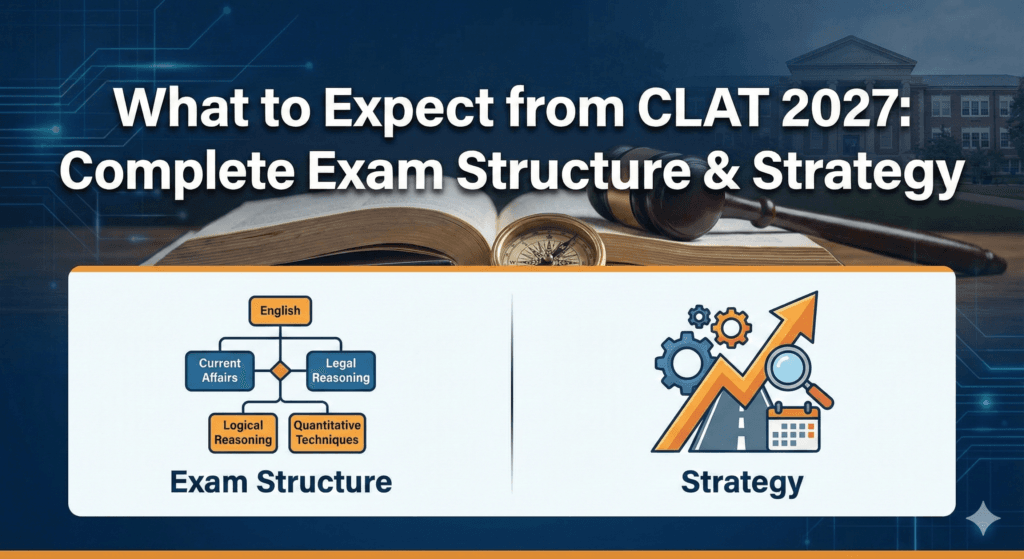
Five sections:
- English Language
- Current Affairs including General Knowledge
- Legal Reasoning
- Logical Reasoning
- Quantitative Techniques
All sections are passage-based. Each passage runs to roughly 450 words, and the questions that follow test your ability to read, analyse, and reason from that passage. The only partial exception is the data component within Quantitative Techniques, which may involve data sets rather than prose passages.
This is a fundamentally different skill set from what older CLAT papers tested. The exam is not testing what you've memorised. It's testing how well you read and reason under time pressure.
Why sample papers from before 2024 will mislead you
Let's be honest about what the old format looked like, because this is where a lot of aspirants waste serious preparation time.
From 2008 to 2019, CLAT had 200 questions. Most were standalone. The Legal Aptitude section tested legal knowledge you were expected to have memorised. There was a static General Knowledge section that rewarded rote learning.
From 2020, the paper dropped to 150 questions. Comprehension passages came in. Static GK and memorised legal knowledge questions were removed. Legal Aptitude became Legal Reasoning.
From CLAT 2024, the paper dropped again to 120 questions, and the format became fully passage-based across all sections.
If you practise on a 2018 CLAT paper, you're drilling skills the exam no longer tests. You're memorising legal definitions that won't appear. You're practising standalone questions when the real exam gives you passages. You're training the wrong muscle.
Worse, you might feel confident because you're scoring well on old-format material. That confidence won't survive contact with the actual exam.
The only formats worth practising seriously are CLAT 2024, CLAT 2025, CLAT 2026, and the official sample paper. Everything before that is historical context, not preparation material.
Quick check
Is the paper you have actually worth solving?
Three questions. It tells you whether the file on your desktop matches CLAT 2027 or an
exam that stopped existing years ago.
Not registered yet, so no official paper?
Registration for CLAT 2027 runs to 31 October 2026, and the official sample paper only unlocks after that. In the meantime, leave a number and Priyanka will send you a full-length paper built on the current 120-question pattern with worked solutions.
One message from Priyanka, not a sequence.
How to actually use a CLAT sample paper
Most students use a sample paper like this: sit down, attempt it, check the score, feel good or bad, move on.
That's the wrong approach entirely.
Your score on a sample paper is almost meaningless in isolation. What matters is what that score tells you about your reading speed, your reasoning patterns, and your specific weak points. The review is where the actual learning happens.
Here's a more useful method:
Step 1: Attempt under real conditions. Set a timer for exactly 2 hours. No phone, no breaks, no looking things up. Simulate the exam as closely as possible.
Step 2: Mark every question honestly. Before checking the answer key, mark each question as: confident and answered, uncertain and answered, or skipped. This tells you later whether your confident answers were actually right.
Step 3: Review wrong answers by category. Don't just note that you got a question wrong. Ask why. Was it a reading error? Did you misunderstand the passage? Did you rush? Did you not understand what the question was asking? Each wrong answer is a data point.
Step 4: Review skipped questions too. If you skipped something, ask whether that was a smart time management call or avoidance. There's no penalty for unattempted questions, so skipping genuinely hard questions is a valid strategy. But skipping easy ones because you panicked is a different problem.
Step 5: Track patterns across multiple papers. One sample paper tells you something. Five papers tell you a pattern. Are you consistently losing time in Legal Reasoning? Are you misreading Quantitative Techniques passages? That pattern is your preparation priority.
The score you get on a sample paper today is not the score you'll get in December. But the patterns you identify and fix today absolutely will change your December score.
Common questions
Where can I download the official CLAT sample paper?
The official CLAT sample paper is available only to registered candidates. After completing your CLAT registration on consortiumofnlus.ac.in, you can log in with your credentials and access the sample paper from your account. It is not available as a public download.
Is the official sample paper the same as a past question paper?
No. The official sample paper is a purpose-built practice paper released by the Consortium. Past question papers are actual papers from previous CLAT exams. Both are useful, but only past papers from CLAT 2024 onwards reflect the current 120-question, passage-based format.
Can I use CLAT papers from 2018 or 2019 for practice?
You can use them to understand how the exam has evolved, but they should not form the core of your practice. The format changed significantly in 2020 and again in 2024. Papers from 2018 and 2019 had 200 standalone questions and tested memorised legal knowledge, neither of which applies to CLAT 2027.
Will the CLAT 2027 format be different from CLAT 2026?
No. The Consortium has confirmed there is no change to the pattern or syllabus for CLAT 2027. The exam remains 120 questions, five sections, fully passage-based, with the same marking scheme.
Is there a penalty for wrong answers in CLAT 2027?
Yes. Each correct answer earns 1 mark. Each wrong answer results in a deduction of 0.25 marks. There is no deduction for questions you leave unattempted, so thoughtful skipping is a legitimate strategy.
Are third-party CLAT sample papers worth using?
They can supplement your practice volume, especially if you've already exhausted official and post-2024 papers. But they should never replace official material, and you should always check whether the format matches the current 120-question, passage-based pattern before spending time on them.
What to do next
The single most important thing you can do right now, if you haven't already, is register for CLAT 2027 once the window opens on 3 August 2026. That registration is what unlocks the official sample paper from the Consortium, the one resource that most students searching for a "clat sample paper" never actually find.
Once you have it, use it properly. Attempt it under real exam conditions. Review it question by question. Identify your patterns. Then build your preparation around what the data tells you, not around what feels comfortable.
At Lawgic Coaching, we work with aspirants on exactly this kind of structured, evidence-based preparation. Our live online CLAT programme is Rs 20,000 flat, no tiers, no hidden fees, with faculty who teach the current pattern rather than the one they sat. Flexible learning that fits your life, whether you're in Class 11, Class 12, or preparing as a dropper.
Want a current-pattern paper to work from now?
A full 120-question paper on the 2024–27 format with worked solutions. Free, and the only thing we will send unless you ask for more.
One message from Priyanka, not a sequence.
Related reading on this site
If you want to measure yourself in the next half hour rather than sit a full paper, our free CLAT mock test runs in the browser, is marked on the real scheme and shows a worked solution for every question. If you are weighing up which past papers are worth solving, we have gone through all nineteen CLAT previous year question papers and which three actually match your format. Registering this cycle? The CLAT 2027 registration guide has the dates and steps.
- Consortium of National Law Universities, CLAT 2027 UG syllabus — 120 questions, 2 hours, 1 mark each, 0.25 deducted per wrong answer, passages of about 450 words, all sections passage-based except the Quantitative data component.
- Consortium of National Law Universities, CLAT 2027 UG instructions — exam Sunday 6 December 2026, 2:00–4:00 pm (2:00–4:40 pm for PwD candidates); registration 3 August to 31 October 2026; fee Rs 4,000 general and OBC, Rs 3,500 SC, ST, BPL and PwD; 26 participating NLUs.
- LiveLaw, CLAT 2024: Consortium notifies syllabus, questions reduced from 150 to 120 — resolved by the Consortium’s Governing Body on 20 May 2023.
- SCC Online, NLU Consortium announces changes in pattern of CLAT 2020 — the drop from 200 to 150 questions and the move to comprehension-based questions.
- Search volume for “clat sample paper” and the surrounding practice-material cluster: DataForSEO, Google Ads search volume, India, pulled 5 August 2026.
We do not host or reproduce CLAT sample papers or question papers. They are the
copyright of the Consortium of National Law Universities, and the official sample paper is released
to registered candidates through the CLAT website.