So, you’re dreaming of a career in law, picturing yourself in the hallowed halls of a National Law University (NLU). That’s fantastic! But then comes the big question that keeps many aspirants up at night: how long does CLAT preparation take? Let’s be honest, there’s no single, magic answer that fits everyone. It’s like asking how long it takes to learn to play the guitar – it depends on your starting point, your dedication, and the kind of musician you want to be. For CLAT, it hinges on your current academic strengths, the time you can dedicate daily, and how strategically you approach the exam. But don’t worry, we’re here to demystify the process and give you a clear roadmap for CLAT 2026.
Key Takeaways
- No Fixed Timeline: CLAT preparation duration varies, typically ranging from 6 months to 1.5 years, depending on individual grasping power and daily commitment.
- Strategic Planning is Key: A well-structured study plan, focusing on conceptual clarity, section-wise strategy, and consistent mock test analysis, is more crucial than just clocking hours.
- Holistic Approach: Beyond academics, integrate psychological preparation, effective time management, and smart use of digital tools for comprehensive readiness.
- Mock Tests are Non-Negotiable: Regular mock tests and their detailed analysis are vital for identifying weaknesses, improving speed, and refining exam strategy.
- Quality Over Quantity: Focus on understanding concepts deeply and practicing rigorously with quality resources rather than simply covering a vast syllabus superficially.
Demystifying the CLAT Preparation Timeline for 2026: It’s More Than Just Months
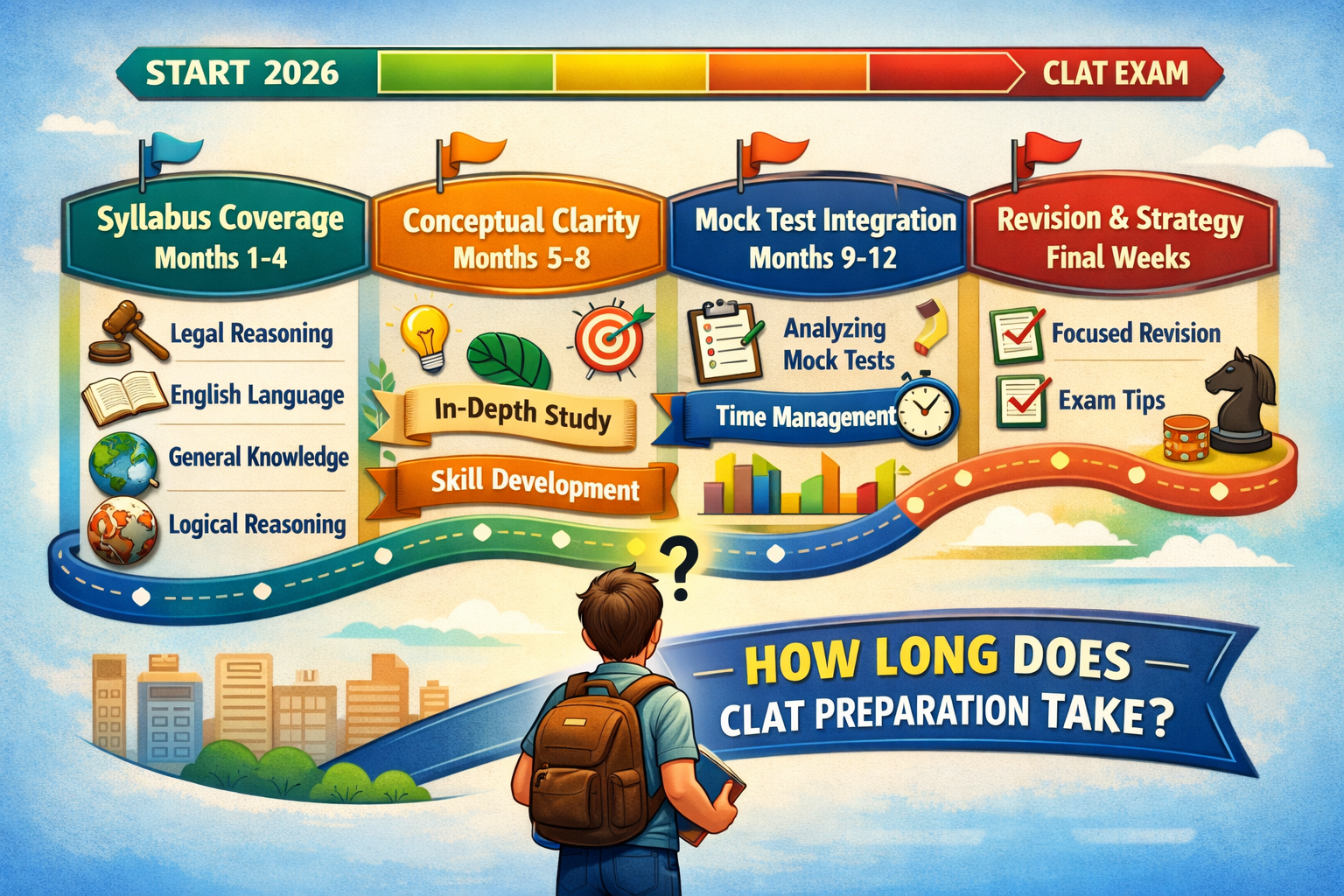
When you ask, “how long does CLAT preparation take?”, you’re really asking, “how can I maximize my chances of success?” The truth is, aspiring lawyers often find that a dedicated preparation window of 6 months to 1.5 years is most effective. This isn’t a hard-and-fast rule, but a general guideline based on the comprehensive nature of the CLAT exam and the depth of understanding required. Some highly motivated and academically strong students might crack it in less, while others benefit from a longer, more gradual approach, especially if they’re balancing school.
Think of it this way: a longer timeline allows for deeper conceptual understanding, more extensive practice, and ample time to rectify mistakes identified through mock tests. A shorter, more intense period demands extreme focus and efficient time management. What matters most is consistent effort and a smart strategy, not just the number of days. At Lawgic Coaching, we’ve seen thousands crack CLAT, and while their timelines differed, their commitment to a structured approach was a common thread.
Factors Influencing Your CLAT Prep Duration
Several elements play into how long your personal CLAT preparation journey will be:
- Your Starting Point: Are you strong in English comprehension and logical reasoning already? Or do you need to build foundational skills from scratch? Students with a robust academic background, particularly in reading and critical thinking, might find themselves on a faster track.
- Daily Study Hours: How much dedicated, focused time can you realistically commit each day? 2-3 hours consistently over 12 months can be more effective than sporadic 6-hour sessions.
- Learning Style: Some grasp concepts quickly; others need more repetition and diverse examples. Understanding your learning style helps tailor your approach.
- Resource Quality: Access to expert guidance, high-quality study materials, and realistic mock tests can significantly streamline your preparation. This is where platforms like Lawgic Coaching with our real mentors from top NLUs come in, offering proven strategies that actually work.
- Previous Exam Experience: If you’ve prepared for other competitive exams, you might have an edge in managing pressure and understanding exam dynamics.
Understanding the CLAT 2026 Exam Pattern: Your Foundation
Before diving into timelines, let’s quickly reiterate the CLAT 2026 exam pattern. It’s a 2-hour, 120-question multiple-choice test, focusing on five key areas:
- English Language: Reading comprehension, vocabulary, grammar.
- Current Affairs including General Knowledge: A broad section testing current events, static GK.
- Legal Reasoning: Principles, facts, and conclusions based on legal propositions.
- Logical Reasoning: Critical thinking, syllogisms, analogies, logical puzzles.
- Quantitative Techniques: Basic arithmetic, data interpretation.
Each section demands a distinct approach, and understanding these nuances is crucial for strategic exam preparation. You can dive deeper into the exam pattern and syllabus to focus your preparation effectively here.
Crafting Your CLAT Preparation Strategy for 2026: A Deeper Dive
Okay, we’ve established that “how long does CLAT preparation take” is flexible. Now, let’s talk about how to use that time effectively. A comprehensive CLAT study guide isn’t just about reading books; it’s about a multi-faceted approach that builds skills, tests knowledge, and strengthens your mental resolve.
Phase 1: Foundation Building & Conceptual Clarity (Months 1-4)
This initial phase is about getting your basics strong. Don’t rush this part.
- Syllabus Deep Dive: Start by understanding the entire CLAT 2026 syllabus thoroughly. Break it down into manageable chunks.
- Subject-wise Mastery:
- English Language: Focus on improving reading speed and comprehension. Start reading newspapers, editorials, and non-fiction daily. Build vocabulary, but more importantly, learn to infer meaning from context. This is vital for the passage-based format.
- Current Affairs & GK: This is a continuous process. Begin by regularly reading a quality newspaper (like The Hindu or Indian Express) and a reputable current affairs magazine. Make notes. Don’t just memorize; understand the ‘why’ behind events. For specific high-yield topics, you might find this guide on 10 high-yield GK topics very helpful.
- Legal Reasoning: This section requires a distinct mindset. Focus on understanding legal principles, drawing conclusions from given facts, and identifying logical fallacies. Start with basic legal terms and concepts.
- Logical Reasoning: Develop critical thinking skills. Practice various types of logical puzzles, syllogisms, statement-assumption, and statement-conclusion questions.
- Quantitative Techniques: Brush up on your basic math concepts from 8th-10th grade. Percentages, ratios, averages, profit & loss, time & work are crucial. Data interpretation passages will test your ability to quickly analyze information from graphs and tables. We have some great tricks and shortcuts for Quantitative Techniques here.
- Resource Accumulation: Gather the best books for CLAT preparation. But remember, it’s about quality study, not just collecting books. Our expert faculty from top NLUs can recommend precise materials.
- Time Management Basics: Start developing a consistent study schedule. Even if it’s just 2-3 hours a day, make it disciplined.
Phase 2: Application, Practice & Mock Test Integration (Months 5-9)
Once your foundation is solid, it’s time to apply that knowledge and start testing yourself under exam conditions. This is where your CLAT study schedule truly takes shape.
- Section-wise Drills: Practice questions specific to each section. Don’t shy away from your weak areas. Instead, tackle them head-on.
- Mock Test Strategy: Begin taking full-length CLAT mock tests regularly – at least once every two weeks. The frequency will increase later.
- Crucial Step: Don’t just take the mock; analyze it thoroughly. Understand where you went wrong, why, and how to improve. This is a game-changer.
- Time Allocation: Use mocks to refine your time management for CLAT. Which sections take longer? Where can you save time? For boosting your readiness, incorporating CLAT mock tests is paramount.
- Skill Development: Beyond rote learning, focus on developing critical skills:
- Speed Reading: Essential for English and Legal Reasoning passages.
- Active Recall: Test yourself frequently without looking at notes.
- Problem-Solving: Break down complex questions into smaller, manageable parts.
- Critical Analysis: Especially for Legal and Logical Reasoning, learn to critically evaluate arguments.
- Targeted Feedback: If you’re enrolled in a program, leverage your mentors for personalized feedback on your performance. This personalized attention you deserve is a hallmark of Lawgic Coaching.
Phase 3: Refinement, Revision & Psychological Preparation (Months 10-12 / Final Weeks)
The final stretch is about consolidating your knowledge, perfecting your strategy, and ensuring you’re mentally prepared.
- Intensive Mock Test Series: Increase mock test frequency to 2-3 per week. Simulating exam day conditions builds confidence and stamina.
- Revision, Revision, Revision: Go over all your notes, especially for GK and Legal principles. Use flashcards, mind maps, or self-quizzing. Look for CLAT 2026 revision tips.
- Weak Section Emergency Kit: Identify your persistently weak areas and dedicate extra time to them. Don’t ignore them, as they can cost you crucial marks. We have a great resource for a CLAT weak section emergency kit that might help.
- Psychological Preparation Techniques: This is often overlooked but incredibly important.
- Stress Management: Practice mindfulness, meditation, or light exercise. CLAT exam anxiety is real, and having strategies to cope with it can make a huge difference. Our guide on CLAT exam anxiety offers proven stress-relief strategies.
- Visualization: Imagine yourself calmly and confidently attempting the exam.
- Positive Self-Talk: Combat negative thoughts. Believe in your preparation. Building exam day confidence is crucial for mastering CLAT, and consistent practice is key.
- Sleep and Nutrition: Don’t compromise on these in the final weeks. A well-rested mind performs better. Remember to boost your CLAT prep by taking breaks.
- Digital Tools for CLAT Prep: Leverage technology to your advantage.
- Online Platforms: Use adaptive learning features, practice question banks, and video lectures. Lawgic Coaching offers flexible learning that fits your life, allowing you to study at your own pace.
- Current Affairs Apps: Stay updated with daily news quizzes and summaries.
- Vocabulary Apps: Gamified learning can make vocabulary building fun and effective.
- Mock Test Analysis Tools: Many online platforms provide detailed analytics of your performance, highlighting specific areas of improvement.
Section-Specific Skill Development: Beyond the Basics
To truly excel, you need to develop specific skill sets for each CLAT section:
- English Language:
- Inference Skills: Practice drawing logical conclusions from text, even if not explicitly stated.
- Tone Recognition: Identify the author’s tone and intent in various passages.
- Contextual Vocabulary: Learn to understand word meanings from the surrounding text.
- Current Affairs & GK:
- Interdisciplinary Connection: Link current events to static GK topics (e.g., a news item about a constitutional amendment to constitutional history).
- Retention Strategies: Use mnemonics, regular revision, and self-quizzing to retain vast amounts of information.
- Legal Reasoning:
- Principle-Fact Application: The core skill here is applying a given legal principle to a set of facts without letting your personal opinions or outside legal knowledge interfere.
- Identify Ratios: Pinpoint the essential legal reasoning in a given passage or caselet.
- Critical Analysis of Arguments: Learn to identify the strengths and weaknesses of an argument presented in a legal scenario.
- Logical Reasoning:
- Pattern Recognition: Crucial for series, analogies, and coding-decoding questions.
- Assumption Identification: Understand what assumptions underpin an argument.
- Deductive vs. Inductive Reasoning: Know the difference and apply appropriate reasoning types.
- Quantitative Techniques:
- Approximation Skills: Learn to quickly estimate answers without getting bogged down in precise calculations.
- Data Interpretation Speed: Practice quickly extracting relevant information from charts, graphs, and tables.
- Mental Math: Improve your speed for basic calculations.
Cost-Effective Preparation Strategies: Law School Dreams Without Breaking the Bank
We believe accessible education for serious aspirants is key. Your CLAT prep doesn’t have to be prohibitively expensive.
- Leverage Free Resources: Many high-quality newspapers, government websites, and educational blogs offer valuable current affairs and GK content. Check out free CLAT mocks and study material on Telegram channels.
- Smart Book Choices: Instead of buying every book recommended, invest in a few core, high-quality resources. Borrow from libraries or use e-versions. We have a detailed list of best books for CLAT preparation.
- Affordable Online Coaching: This is where Lawgic Coaching shines. We provide expert guidance without the premium price tag. Our flexible online modules mean you get top-tier education from real mentors from top NLUs without the overheads of traditional coaching centers. We are among the best online CLAT coaching for budget-conscious aspirants.
- Study Groups: Collaborate with peers for discussions, doubt-solving, and peer teaching. This is a zero-cost, high-impact strategy.
Personalized Preparation Framework: Tailoring Your Journey
There’s no cookie-cutter approach here. Your preparation needs to be as unique as you are.
- Self-Assessment: Honestly evaluate your strengths and weaknesses in each CLAT section. This initial step is critical.
- Goal Setting: Set realistic daily, weekly, and monthly study goals.
- Adaptive Learning: If you struggle with Legal Reasoning, dedicate more time and resources there. If you’re strong in English, focus on maintaining that edge and refining speed. Lawgic Coaching offers adaptive learning techniques that can help you tailor your study.
- Feedback Loop: Regularly review your progress. Are you hitting your targets? Are your strategies working? Be prepared to adjust your plan based on your performance in mock tests.
Common Challenges and Solutions
- Procrastination: Break tasks into smaller, manageable chunks. Use the “Pomodoro Technique” (25 minutes study, 5 minutes break).
- Lack of Motivation: Remind yourself of your “why” – your law school dream! Connect with mentors and peers for encouragement. Read success stories.
- Overwhelm: The syllabus can seem vast. Focus on one section at a time, and remember that consistent, small steps lead to big results.
- Burnout: Crucially, take regular breaks! Burnout is a real threat. Schedule downtime, pursue hobbies, and maintain a social life. This helps you return to studies refreshed.
Real Student Success Narratives: Inspiration from Lawgic Alumni
We’ve helped thousands crack CLAT, and their stories are a testament to what’s possible with the right guidance and effort. Take Aarav, for instance, who joined Lawgic Coaching with decent academic scores but struggled with time management. Through our personalized mentorship and rigorous mock test analysis, he not only improved his speed but also learned to strategically attempt the paper, eventually securing a seat at a top NLU in 2026. Or consider Priya, who initially felt overwhelmed by the GK section. Our expert faculty provided her with targeted resources and a unique current affairs retention strategy, transforming her weakest section into one of her strongest. These results speak louder than promises.
International Law School Perspective (Bonus Insight)
While CLAT primarily focuses on Indian NLUs, developing strong analytical, critical thinking, and communication skills through your CLAT preparation can also lay a fantastic groundwork if you ever consider pursuing legal education abroad. The foundational legal reasoning and general aptitude skills are universally valuable.
Conclusion: Your CLAT Journey Starts Now, in 2026

So, how long does CLAT preparation take? Ultimately, it takes as long as you need it to take, coupled with a smart, structured, and consistent approach. Whether you have 6 months or 18 months, the formula for success remains largely the same: deep conceptual understanding, relentless practice, thorough mock test analysis, and unwavering mental resilience.
Your success is our mission at Lawgic Coaching. We offer accessible education for serious aspirants, providing flexible learning that fits your life and expert guidance without the premium price tag. With our real mentors from top NLUs, proven strategies that actually work, and personalized attention, we’re here to help you navigate every step of your CLAT 2026 journey. Let’s build your law career together.
Ready to start? Don’t just dream of a law career; make it a reality. Explore our courses and get your personalized study plan today!
References
[1] Consortium of National Law Universities. (2026). CLAT 2026 Information Brochure.
[2] Lawgic Coaching. (2026). Internal Success Metrics and Student Testimonials.
CLAT 2026 Preparation Timeline Calculator
Wondering how long *your* CLAT preparation will take? Use this quick calculator to get a personalized estimate based on key factors. Remember, this is a guide, and dedication makes all the difference!
Based on your input, here’s an estimated CLAT 2026 preparation timeline:
Estimated Duration:
Key Focus Areas:
Remember, consistency is key! Lawgic Coaching offers personalized mentorship to guide you every step of the way. Explore our courses here.

