

Are you dreaming of a career in law but feeling overwhelmed by the multitude of entrance exams? You’re not alone. With over 60,000 students competing annually for law school admissions in India, choosing the right entrance exam can make or break your legal career aspirations.
The landscape of law entrance exams has evolved significantly, especially with recent changes like the discontinuation of LSAT-India in 2025. This comprehensive guide will help you navigate through the major law entrance exams – CLAT, AILET, SLAT, MH CET Law, and others – to determine which one aligns best with your career goals and strengths.
Why Your Choice of Law Entrance Exam Matters More Than Ever
In today’s competitive legal education landscape, strategic exam selection isn’t just about getting into any law school – it’s about maximizing your chances of admission to institutions that align with your career trajectory. Each entrance exam serves as a gateway to different sets of colleges, career opportunities, and geographical regions.
The Current State of Law Entrance Exams in India
The Indian legal education system offers multiple pathways through various entrance examinations:
- National-level exams: CLAT (most popular), AILET
- State-level exams: MH CET Law, AP LAWCET, TS LAWCET
- University-specific exams: SLAT, SET Law, BVP CET Law
- International options: LNAT (for select institutions)
Important Update: LSAT-India has been officially discontinued from 2025, making alternative exams more crucial than ever for aspiring law students.
CLAT 2025: The Gold Standard of Law Entrance Exams
The Common Law Admission Test (CLAT) remains the most prestigious and widely accepted law entrance exam in India, serving as the gateway to 22 National Law Universities (NLUs).
CLAT Exam Structure & Pattern
| Section | Questions | Marks | Time Allocation |
|---|---|---|---|
| English Language | 28-32 | 28-32 | 35-40 minutes |
| Current Affairs & GK | 35-39 | 35-39 | 40-45 minutes |
| Legal Reasoning | 28-32 | 28-32 | 35-40 minutes |
| Logical Reasoning | 28-32 | 28-32 | 35-40 minutes |
| Quantitative Techniques | 13-17 | 13-17 | 20-25 minutes |
| Total | 150 | 150 | 120 minutes |
CLAT Syllabus Deep Dive
English Language & Comprehension
- Reading comprehension passages (400-450 words each)
- Grammar, vocabulary, and verbal ability
- Focus on contemporary and legally relevant topics
Current Affairs & General Knowledge
- Static GK: History, Geography, Political Science, Economics
- Current Affairs: Last 12 months of national and international events
- Stay updated with reliable news sources like The Hindu, Indian Express
Legal Reasoning
- Legal principles and their application
- Constitutional Law basics
- Contemporary legal issues and landmark judgments
Logical Reasoning
- Analytical reasoning, critical thinking
- Syllogisms, analogies, and pattern recognition
- Data interpretation and logical puzzles
Quantitative Techniques
- Mathematics up to Class 10 level
- Percentage, ratio, proportion, averages
- Basic geometry and mensuration
CLAT 2025: Key Dates and Information
- Application Period: December 2024 – April 2025
- Exam Date: May 2025 (Second Sunday)
- Results: June 2025
- Counselling: June-July 2025
Colleges Accepting CLAT Scores: All 22 NLUs including NLSIU Bangalore, NALSAR Hyderabad, WBNUJS Kolkata, and more.
AILET 2025: The Exclusive Gateway to NLU Delhi
The All India Law Entrance Test (AILET) is conducted exclusively by National Law University, Delhi – one of India’s most prestigious law schools.
AILET vs CLAT: Key Differences
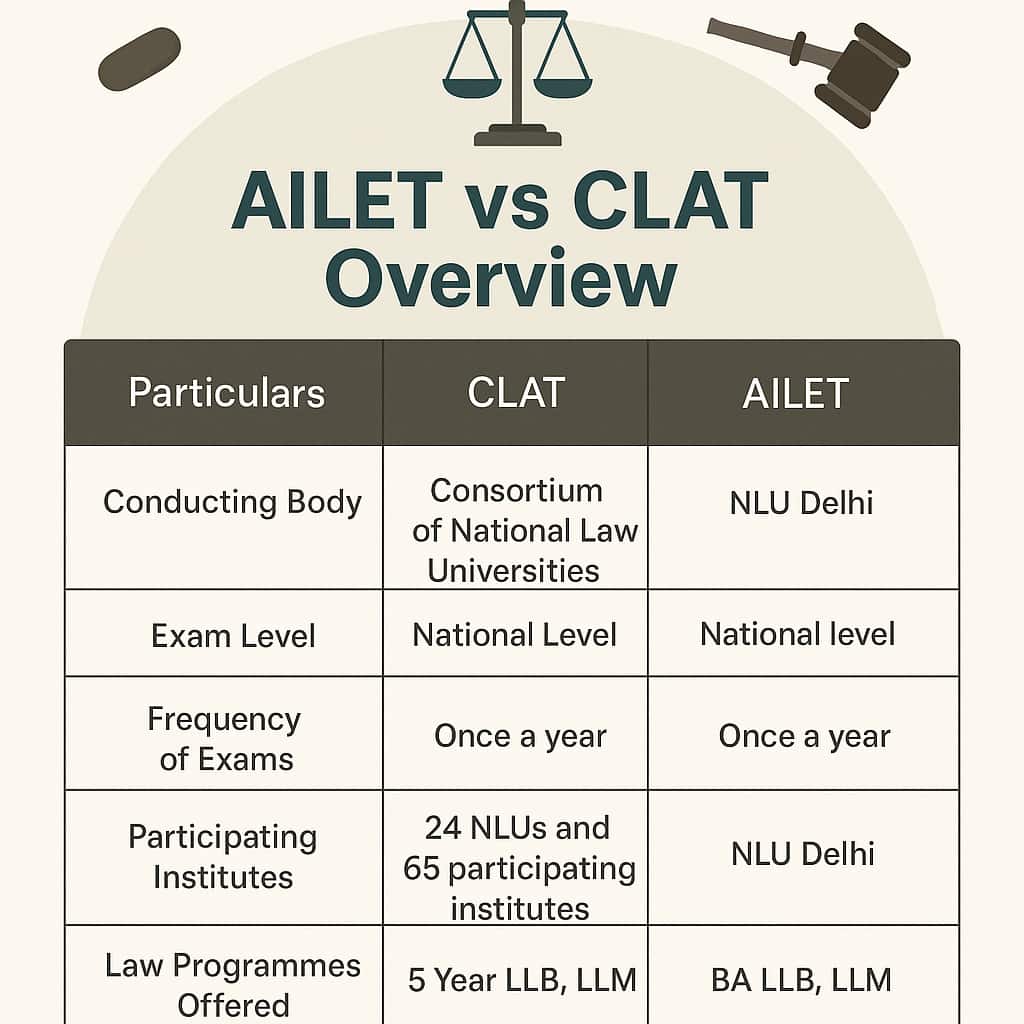
| Aspect | AILET | CLAT |
|---|---|---|
| Conducting Body | NLU Delhi | Consortium of NLUs |
| Seats Available | ~120 (5-year), ~30 (3-year) | 2,300+ across all NLUs |
| Difficulty Level | High | Moderate to High |
| Negative Marking | 0.25 per wrong answer | 0.25 per wrong answer |
| Mathematics Section | Yes (Elementary) | Yes (Quantitative Techniques) |
AILET Exam Pattern
- Total Questions: 150 MCQs
- Duration: 90 minutes
- Sections: English, General Knowledge, Legal Aptitude, Reasoning, Elementary Mathematics
- Marking: +1 for correct, -0.25 for incorrect
Why Choose AILET?
Advantages:
- Direct admission to NLU Delhi (top-ranked law school)
- Smaller batch size ensures better faculty-student ratio
- Strong alumni network in judiciary and corporate law
- Delhi location provides excellent internship opportunities
Considerations:
- Limited seats mean extremely high competition
- No backup options if you don’t clear the cutoff
- Requires dedicated preparation alongside CLAT
SLAT 2025: Gateway to Symbiosis Law Schools
The Symbiosis Law Admission Test (SLAT) provides access to four Symbiosis law schools across India.
SLAT Exam Details
Participating Institutions:
- Symbiosis Law School, Pune
- Symbiosis Law School, Noida
- Symbiosis Law School, Nagpur
- Symbiosis Law School, Hyderabad
Exam Pattern:
- Questions: 150 MCQs
- Duration: 150 minutes
- Sections: Legal Reasoning, Logical Reasoning, Analytical Reasoning, Reading Comprehension, General Knowledge
Key Dates 2025:
- Application: January – April 2025
- Exam: May 2025
- Results: May 2025
SLAT Success Strategy
Focus areas for SLAT preparation:
- Logical and Analytical Reasoning (40% weightage)
- Reading Comprehension (25% weightage)
- Legal Reasoning (20% weightage)
- General Knowledge (15% weightage)
MH CET Law 2025: Maharashtra’s Premier Law Entrance
Maharashtra Common Entrance Test for Law caters to both 3-year and 5-year LLB programs across 150+ colleges in Maharashtra.
MH CET Law Exam Structure
5-Year LLB Pattern:
- Total Questions: 150
- Duration: 90 minutes
- Sections: English, Legal Aptitude, Logical Reasoning, GK, Mathematics
3-Year LLB Pattern:
- Total Questions: 120
- Duration: 90 minutes
- Sections: English, Legal Aptitude, Logical Reasoning, GK
MH CET Law 2025 Timeline
- Application: February – March 2025
- 5-Year LLB Exam: April 28, 2025
- 3-Year LLB Exam: May 2-3, 2025
- Results: May 2025
- Counselling: June – September 2025
Top Colleges Accepting MH CET Law:
- ILS Law College, Pune
- Government Law College, Mumbai
- Bharati Vidyapeeth New Law College, Pune
- Maharashtra National Law University, Mumbai
State-Level Law Entrance Exams: Regional Opportunities
AP LAWCET & TS LAWCET
Andhra Pradesh and Telangana conduct separate law entrance tests for their respective state colleges.
Key Features:
- Separate exams for 3-year and 5-year programs
- Computer-based testing
- State quota advantages for local students
Kerala Law Entrance Examination (KLEE)
Conducted by the Commissioner for Entrance Examinations, Kerala.
Rajasthan University Law Entrance Test (RULET)
For admission to law colleges affiliated with Rajasthan University.
The Impact of LSAT-India Discontinuation: What It Means for You
The Law School Admission Council (LSAC) officially discontinued LSAT-India from 2025, citing business strategy decisions. This significant change affects thousands of law aspirants.
Colleges Previously Accepting LSAT-India Scores
Major institutions that accepted LSAT-India are now transitioning to alternative admission criteria:
- O.P. Jindal Global University: Now accepts LNAT (UK) scores
- Symbiosis Law Schools: Continue with SLAT
- Private law colleges: Moving to CLAT or institutional tests
Alternative Options for Former LSAT-India Aspirants
- CLAT: Best overall alternative with maximum college options
- AILET: For those targeting NLU Delhi specifically
- SLAT: For Symbiosis institutions
- LNAT: For international programs (O.P. Jindal)
- State-level exams: Based on preferred location
Choosing Your Exam: A Strategic Decision Framework
Factor 1: Career Goals and Specialization
For Corporate Law Careers:
- Primary Choice: CLAT (access to top NLUs)
- Secondary: AILET (NLU Delhi’s strong corporate connections)
For Judiciary and Litigation:
- Primary Choice: CLAT or SLAT
- Secondary: State-level exams for regional practice
For International Law/Global Practice:
- Primary Choice: LNAT + CLAT combination
- Secondary: AILET (Delhi’s international exposure)
Factor 2: Geographic Preferences
Northern India Focus:
- CLAT (multiple NLU options)
- AILET (Delhi-centric)
Western India Focus:
- MH CET Law (Maharashtra colleges)
- SLAT (Pune, Mumbai presence)
Southern India Focus:
- CLAT (NLSIU Bangalore, NALSAR Hyderabad)
- AP LAWCET/TS LAWCET (regional advantages)
Factor 3: Preparation Timeline and Resources
Long-term Preparation (12+ months):
- CLAT + AILET combination
- Include state-level backups
Medium-term Preparation (6-12 months):
- Focus on CLAT primarily
- One state-level exam as backup
Short-term Preparation (3-6 months):
- SLAT or MH CET Law (more specific syllabi)
- State exams with focused preparation
Subject-wise Preparation Strategies
Mastering English and Reading Comprehension
Common Across All Exams:
- Daily Reading: The Hindu editorials, legal magazines
- Vocabulary Building: 20 new words daily with legal context
- Practice Strategy: 2-3 RC passages daily with time limits
Exam-specific Tips:
- CLAT: Focus on contemporary issues and legal topics
- AILET: Emphasize critical analysis skills
- SLAT: Practice longer passages with complex reasoning
Legal Reasoning: Building Your Legal Foundation
Core Concepts to Master:
- Constitutional Law Basics
- Fundamental Rights and Duties
- Directive Principles of State Policy
- Basic Structure Doctrine
- Criminal Law Fundamentals
- IPC sections and classifications
- Cognizable vs non-cognizable offenses
- Landmark criminal law cases
- Contract Law Principles
- Essential elements of a contract
- Breach and remedies
- Specific Relief Act provisions
- Tort Law Basics
- Negligence and its elements
- Defamation laws
- Consumer protection principles
Study Resources:
- Constitutional Law by Lawgic Coaching
- Bare Acts: Constitution of India, IPC, CrPC
- Monthly legal awareness magazines
Current Affairs and General Knowledge Mastery
Monthly Study Plan:
- Week 1-2: Static GK revision (History, Geography, Polity)
- Week 3: Current month’s events compilation
- Week 4: Previous months’ revision and test-taking
Essential Topics for 2025:
- Legal Developments: New laws, amendments, landmark judgments
- Political Events: Elections, policy changes, international relations
- Economic Updates: Budget 2025, economic policies, trade relations
- Social Issues: Environmental law updates, digital rights, privacy laws
Recommended Sources:
- Newspapers: The Hindu, Indian Express, Economic Times
- Monthly Magazines: Pratiyogita Darpan, Competition Success Review
- Legal Updates: Bar Council reports, Supreme Court judgments
Logical Reasoning: Developing Analytical Skills
Core Topic Areas:
- Syllogisms and Deductive Reasoning
- Valid and invalid argument forms
- Categorical syllogisms
- Practical application in legal scenarios
- Analytical Reasoning
- Arrangement problems
- Grouping and selection
- Network diagrams and flowcharts
- Critical Thinking
- Assumption identification
- Strengthen/weaken arguments
- Inference drawing
Daily Practice Routine:
- 30 minutes of varied LR problems
- Weekly full-length sectional tests
- Error analysis and improvement tracking
Quantitative Techniques: Mathematics for Law Exams
High-Yield Topics:
- Percentage and Ratios: 25% of questions
- Profit and Loss: 20% of questions
- Time and Work: 15% of questions
- Mensuration: 15% of questions
- Data Interpretation: 25% of questions
Preparation Strategy:
- Focus on concept clarity over complex calculations
- Use approximation techniques for faster solving
- Practice mixed problems for better time management
Mock Tests and Performance Analysis
Creating Your Test-Taking Strategy
Phase 1: Foundation Building (Months 1-6)
- Subject-wise tests weekly
- Focus on accuracy over speed
- Detailed error analysis after each test
Phase 2: Integration (Months 7-9)
- Full-length mock tests bi-weekly
- Time management practice
- Cross-exam comparison (CLAT vs AILET patterns)
Phase 3: Final Preparation (Months 10-12)
- Daily mock tests in final month
- Exam-day simulation including breaks
- Strategy refinement based on performance trends
Recommended Mock Test Series
For CLAT:
- Lawgic Coaching Mock Test Series
- Career Launcher All India Mock Tests
- IMS Mock Test Package
For AILET:
- NLU Delhi Previous Years with Timer
- Specialized AILET Test Series
- Cross-practice with CLAT mocks for additional practice
Performance Benchmarks:
- CLAT: 90+ for top NLUs, 75+ for mid-tier NLUs
- AILET: 95+ for strong consideration
- SLAT: 85+ for merit list consideration
Financial Planning and Cost Analysis
Exam Fees and Related Costs
| Exam | Application Fee | Additional Costs | Total Budget |
|---|---|---|---|
| CLAT | ₹4,000 | Coaching: ₹50,000-₹1,50,000 | ₹54,000-₹1,54,000 |
| AILET | ₹3,500 | Books & Materials: ₹10,000 | ₹13,500-₹63,500 |
| SLAT | ₹2,750 | Mock Tests: ₹5,000-₹15,000 | ₹7,750-₹17,750 |
| MH CET Law | ₹800 | Travel & Accommodation: ₹5,000 | ₹5,800-₹10,800 |
Education Loan and Scholarship Options
Government Scholarships:
- National Scholarship Portal schemes
- State-specific merit scholarships
- SC/ST/OBC category benefits
Private Scholarships:
- College-specific merit scholarships
- Corporate social responsibility programs
- Law firm sponsored scholarships
Education Loans:
- Public sector banks: 9-11% interest
- Private banks: 10-13% interest
- NBFCs: 11-15% interest
Success Stories and Inspiration
From Average Student to NLU Graduate
Case Study 1: Priya Sharma – CLAT 2024 All India Rank 45
Background: Commerce student from Tier-2 city, first attempt Challenge: Limited resources, no legal background Strategy:
- Started preparation 18 months early
- Focused heavily on current affairs and legal reasoning
- Joined online coaching to supplement self-study Result: Secured admission to WBNUJS Kolkata
Key Takeaways:
- Early start compensates for resource limitations
- Consistent daily study routine is crucial
- Mock test analysis helped identify weak areas
Case Study 2: Rajesh Kumar – AILET 2024 Top 20
Background: Engineering dropout, second attempt at law Challenge: Career change decision, family pressure Strategy:
- Dedicated 14-16 hours daily for 8 months
- Specialized coaching for AILET pattern
- Extensive current affairs preparation Result: NLU Delhi admission with scholarship
Key Takeaways:
- Career change is possible with dedicated effort
- Specialized preparation for target exam pays off
- Scholarship opportunities reward excellence
Technology and Digital Preparation Tools
Essential Apps and Platforms
Study Apps:
- Unacademy: Comprehensive courses and live classes
- Byju’s Law: Structured learning modules
- Gradeup: Daily current affairs and practice questions
- Testbook: Mock tests and previous year papers
Current Affairs Apps:
- Inshorts: Quick news updates
- The Hindu App: Detailed analysis and editorials
- PIB App: Government press releases and updates
Time Management Tools:
- Forest App: Focus and productivity tracking
- Google Calendar: Study schedule management
- Toggl: Time tracking for different subjects
Online vs Offline Preparation
Online Preparation Advantages:
- Flexibility in timing and pace
- Access to recorded lectures for revision
- Cost-effective compared to classroom coaching
- Wide variety of mock tests and materials
Offline Preparation Benefits:
- Direct interaction with faculty
- Peer group motivation and competition
- Structured curriculum and timeline
- Better doubt resolution mechanism
Hybrid Approach (Recommended):
- Online courses for flexibility
- Offline library or study group for discipline
- Regular mentor consultation for guidance
- Mix of online and offline mock tests
Last-Minute Preparation and Exam Day Strategy
Final Month Preparation Checklist
Academic Preparation:
- ✅ Complete syllabus revision (2 rounds minimum)
- ✅ Solve previous 5 years’ question papers
- ✅ Daily mock tests with time limits
- ✅ Current affairs compilation review
- ✅ Legal reasoning case studies revision
Logistical Preparation:
- ✅ Admit card download and verification
- ✅ Exam center location visit
- ✅ Document preparation (ID proof, photos)
- ✅ Travel and accommodation booking
- ✅ Backup plans for technical issues
Exam Day Success Strategy
Pre-Exam Routine:
- Light breakfast with adequate nutrition
- Arrive at center 30 minutes early
- Avoid discussing topics with other candidates
- Carry all required documents in organized manner
During the Exam:
- First 5 minutes: Scan entire paper, identify easy questions
- Time allocation: Stick to predetermined time limits per section
- Attempt strategy: Easy → Moderate → Difficult
- Guessing strategy: Eliminate obviously wrong options first
- Review time: Keep 10-15 minutes for final review
Section-wise Time Management (CLAT Example):
- English: 25-28 minutes
- Current Affairs: 35-38 minutes
- Legal Reasoning: 25-28 minutes
- Logical Reasoning: 25-28 minutes
- Quantitative Techniques: 15-18 minutes
- Review: 10-12 minutes
Beyond Entrance Exams: Career Planning
Specialization Options in Law
Corporate Law Tracks:
- Mergers & Acquisitions
- Securities and Capital Markets
- Intellectual Property Rights
- International Trade Law
Litigation Specializations:
- Constitutional Law
- Criminal Law
- Family and Personal Laws
- Environmental Law
Alternative Career Paths:
- Legal Journalism and Media
- Legal Technology and Innovation
- Policy Research and Think Tanks
- International Organizations (UN, WTO)
Building Your Legal Profile
During Law School:
- Participate in national moot court competitions
- Secure internships at top law firms or courts
- Contribute to legal journals and publications
- Build network through alumni and industry events
Professional Development:
- Clear bar exams in desired states
- Pursue LLM from prestigious institutions
- Obtain international qualifications (NY Bar, Solicitor)
- Develop expertise in emerging areas (cyber law, space law)
Conclusion: Your Path to Legal Excellence Starts Here
Choosing the right law entrance exam is the first critical decision in your legal career journey. Whether you opt for CLAT’s comprehensive reach, AILET’s exclusive prestige, or specialized exams like SLAT and MH CET Law, success depends on strategic preparation, consistent effort, and adaptability to changing patterns.
Key Takeaways for 2025 Aspirants:
- Start Early: Begin preparation at least 12-18 months before target exams
- Stay Updated: Follow legal news and developments regularly
- Practice Consistently: Daily mock tests and revision are non-negotiable
- Seek Guidance: Consider coaching or mentorship for structured preparation
- Plan Alternatives: Apply to multiple exams to maximize admission chances
Remember, the legal profession offers diverse opportunities beyond traditional practice – from corporate boardrooms to international courts, from policy-making to legal technology innovation. Your entrance exam choice should align with your long-term career vision.
The path to legal excellence begins with the right preparation strategy and unwavering commitment to your goals. With proper planning, dedicated effort, and strategic exam selection, you can secure admission to your dream law school and embark on a rewarding legal career.
For personalized guidance and comprehensive preparation resources, explore our specialized programs at Lawgic Coaching, where success stories are crafted through expert mentorship and proven methodologies.
Ready to begin your law entrance exam preparation? Start with a comprehensive syllabus analysis and create your personalized study plan today. Your future in law starts with the right preparation strategy – choose wisely, prepare thoroughly, and success will follow.