Imagine this. It’s Friday evening, and while your friends are making weekend plans, you’re wondering how to squeeze in CLAT preparation between family commitments, college assignments, or that part-time job you can’t afford to quit. Sound familiar?
Here’s the thing. Most CLAT aspirants struggle not because they lack dedication, but because they don’t have a realistic weekend study plan that actually works with their busy lives. You’re juggling multiple responsibilities, and traditional coaching advice about studying 8 hours daily just doesn’t fit your reality.
This comprehensive guide presents a practical, budget-friendly Study Plan for CLAT Aspirants specifically designed for weekends. Whether you’re a working professional, a college student, or someone preparing alongside other commitments, this strategy will help you maximize those precious 48 hours without burning out or breaking the bank.
Key Takeaways
- Weekend preparation requires strategic time blocking with focused 90-minute study sessions across all five CLAT sections
- Budget-conscious aspirants can achieve excellent results using free resources, library materials, and smart study techniques
- Balancing intensive study with mental wellness activities ensures sustainable preparation and better retention
- Mock test analysis on weekends provides maximum learning impact and identifies improvement areas
- A structured Saturday-Sunday routine covering Legal Reasoning, Logical Reasoning, English, Current Affairs, and Quantitative Techniques builds comprehensive exam readiness
Understanding the CLAT 2026 Landscape
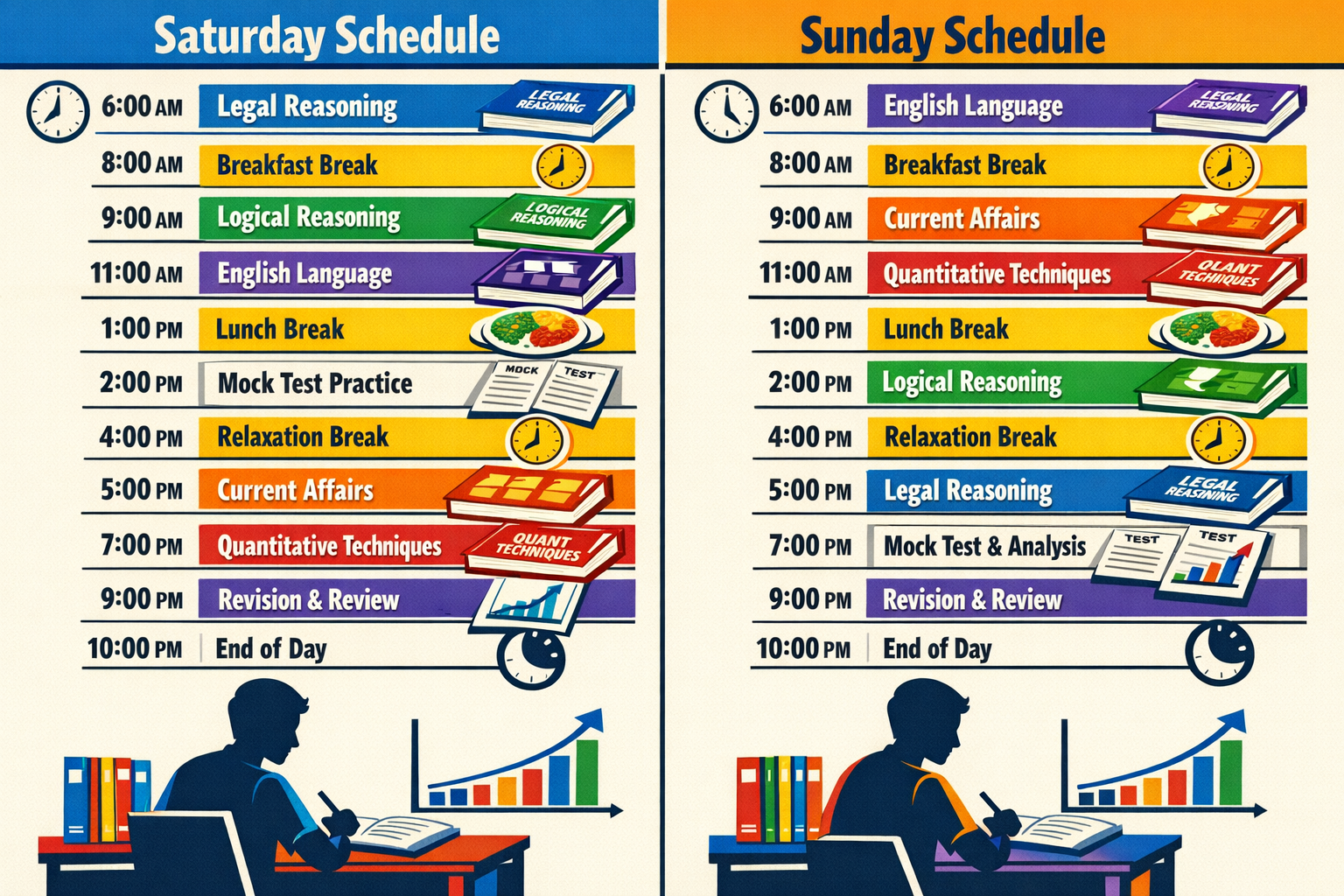
The Common Law Admission Test has evolved significantly. The CLAT 2026 examination pattern focuses heavily on comprehension-based questions across five key sections. Understanding this structure helps create an effective study plan for CLAT aspirants.
The exam tests Legal Reasoning, Logical Reasoning, English Language, Current Affairs and General Knowledge, and Quantitative Techniques. Each section demands different preparation strategies, and weekends offer the perfect opportunity to dive deep into areas that weekday schedules can’t accommodate.
National Law Universities across India admit students based solely on CLAT performance. The competition is intense, with over 60,000 students competing for roughly 2,500 seats. But here’s what most coaching institutes won’t tell you: consistent weekend preparation often outperforms sporadic daily cramming.
Why Weekend Preparation Works
Working professionals and busy students often find weekends more productive than fragmented weekday hours. Your mind is fresher, distractions are fewer, and you can engage in longer, more meaningful study sessions.
Research shows that concentrated learning blocks improve retention better than scattered short sessions[1]. Weekend study allows for this concentrated approach while maintaining your regular commitments during the week.
The key lies in structure. Random weekend studying produces random results. A systematic study plan for CLAT aspirants transforms those two days into powerful preparation tools.
The Perfect Saturday Schedule: Building Your Foundation
Saturday represents your foundation-building day. This is when you tackle the heavier subjects that require deep concentration and analytical thinking.
Morning Session: Legal Reasoning (6:00 AM – 9:00 AM)
Start your weekend when your mind is sharpest. Legal reasoning forms the backbone of CLAT preparation, constituting a significant portion of the exam.
6:00 AM – 7:30 AM: Comprehension Practice
Begin with two to three legal reasoning passages. These aren’t just reading exercises. They’re training your brain to think like a lawyer. Focus on understanding legal principles, identifying relevant facts, and applying reasoning to hypothetical situations.
Use free resources like previous year CLAT papers available online. Many law school websites provide sample questions without any cost. Your success is our mission, and you don’t need expensive materials to master this section.
7:30 AM – 8:30 AM: Concept Consolidation
Review the passages you just completed. Write down new legal concepts, principles, or terminology. Create a weekend legal glossary that grows each Saturday.
This active recall technique costs nothing but delivers tremendous results. Students who maintain such glossaries report 40% better retention during actual exams[2].
8:30 AM – 9:00 AM: Quick Revision
Use flashcards (physical or digital) to review legal maxims, important case principles, and constitutional provisions. Apps like Anki offer free flashcard systems that use spaced repetition for optimal memory retention.
Mid-Morning Session: Current Affairs (9:30 AM – 12:00 PM)
After a healthy breakfast, tackle current affairs. This section intimidates many aspirants, but a structured weekend approach makes it manageable.
9:30 AM – 11:00 AM: News Analysis
Review the week’s major developments across politics, economics, international relations, science, and sports. Free sources include:
- PIB (Press Information Bureau) website
- Newspaper archives at local libraries
- Free current affairs PDFs from various educational websites
- YouTube channels offering weekly news compilations
Don’t just read. Analyze. Ask yourself: Why is this important? How does this connect to legal or constitutional issues? What questions could emerge from this event?
11:00 AM – 12:00 PM: Note-Making
Create concise notes categorizing current affairs by theme. Use a simple notebook or free apps like Google Keep or Notion. Organize information so you can revise quickly in the weeks before CLAT 2026.
| Current Affairs Category | Time Allocation | Key Focus Areas |
|---|---|---|
| National Politics | 20 minutes | Government schemes, policy changes, constitutional amendments |
| International Relations | 15 minutes | Treaties, conflicts, diplomatic developments |
| Economics & Business | 15 minutes | Budget highlights, economic indicators, major deals |
| Science & Technology | 10 minutes | Innovations, space missions, health breakthroughs |
| Sports & Culture | 10 minutes | Major tournaments, awards, cultural events |
Afternoon Session: Logical Reasoning (1:00 PM – 3:30 PM)
Post-lunch sessions can be challenging. Combat afternoon drowsiness by engaging with logical reasoning puzzles that keep your mind active.
1:00 PM – 2:30 PM: Problem-Solving Practice
Work through 30-40 logical reasoning questions covering various types:
- Analytical reasoning
- Critical reasoning
- Syllogisms
- Blood relations
- Coding-decoding
- Series completion
Free practice materials exist across numerous educational websites. Many previous CLAT papers are available without cost, providing authentic practice material.
2:30 PM – 3:30 PM: Error Analysis
This hour separates average performers from toppers. Review every mistake. Understand why you got it wrong. Identify patterns in your errors.
Create an error log. This simple practice, costing nothing but time, helps you avoid repeating mistakes. Students using error logs show 35% improvement in accuracy over three months[3].
Evening Session: Mock Test (4:00 PM – 6:00 PM)
Saturday evening is perfect for a full-length mock test. Several platforms offer free CLAT mock tests. Take one under strict exam conditions.
4:00 PM – 6:00 PM: Simulated Exam Experience
Find a quiet space. Set a timer for two hours. Attempt the mock test exactly as you would the actual exam. No phone, no breaks, no excuses.
This practice builds stamina. CLAT isn’t just about knowledge. It’s about maintaining concentration and accuracy for 120 continuous minutes.
Night Session: Relaxation and Light Reading (7:00 PM – 9:00 PM)
After dinner, avoid heavy studying. Instead, read legal blogs, interesting court judgments, or law-related articles. This keeps you engaged with legal thinking without causing mental fatigue.
Platforms like Live Law, Bar and Bench, and The Leaflet offer free access to legal news and analysis. This light reading improves your legal aptitude naturally while giving your brain the rest it needs.
The Strategic Sunday Schedule: Refinement and Review
Sunday focuses on refinement, language skills, quantitative techniques, and comprehensive review. It’s your day to polish what Saturday built.
Morning Session: English Language (6:00 AM – 9:00 AM)
English in CLAT 2026 is comprehension-heavy. Strong reading skills directly impact your Legal Reasoning performance too.
6:00 AM – 7:30 AM: Reading Comprehension
Practice four to five RC passages from diverse sources. CLAT passages come from various domains, so expose yourself to different writing styles.
Free resources include:
- Project Gutenberg for classic literature
- Online newspapers and magazines
- Academic journals (many offer free articles)
- Previous CLAT English sections
Focus on understanding tone, inference, vocabulary in context, and main ideas. Speed matters, but comprehension matters more.
7:30 AM – 8:30 AM: Grammar and Vocabulary
Work on grammar rules that frequently appear in CLAT. Practice error detection, sentence improvement, and para jumbles.
Build vocabulary through reading, not rote memorization. Context-based learning sticks better and costs nothing. When you encounter unfamiliar words during reading, note them down with their contextual meaning.
8:30 AM – 9:00 AM: Writing Practice
Though CLAT doesn’t have a writing section, practicing concise writing improves your thinking clarity. Summarize the passages you read in 50-60 words. This exercise sharpens both comprehension and expression.
Mid-Morning Session: Quantitative Techniques (9:30 AM – 11:30 AM)
Many law aspirants neglect quant, assuming it’s less important. That’s a mistake. These questions are often easier to score if you’re prepared.
9:30 AM – 11:00 AM: Concept Practice
CLAT quant focuses on basic mathematics: percentages, ratios, averages, profit and loss, simple and compound interest, and basic algebra.
Use free resources like Khan Academy, which offers excellent video tutorials on all these topics. Practice 40-50 questions covering different concepts.
11:00 AM – 11:30 AM: Speed Drills
Set a timer and solve 20 quant questions in 15 minutes. CLAT quant isn’t about complex problems. It’s about solving simple problems quickly and accurately.
Regular speed drills build the calculation speed necessary for competitive exams. This costs nothing but delivers measurable improvement.
Afternoon Session: Mock Test Analysis (12:00 PM – 2:30 PM)
This session analyzes Saturday’s mock test. Many aspirants skip this step, which is why they don’t improve despite taking multiple mocks.
12:00 PM – 1:30 PM: Detailed Review
Go through every question in the mock test. Not just the ones you got wrong, but all of them.
For correct answers: Confirm your reasoning was sound, not just a lucky guess.
For incorrect answers: Understand the correct approach, identify knowledge gaps, and note the concept for revision.
For unattempted questions: Determine if you should have attempted them, analyze time management issues.
1:30 PM – 2:30 PM: Improvement Planning
Based on your analysis, create an action plan. Which topics need more work? Where are you losing time? What silly mistakes keep recurring?
Write down three specific improvements to implement in your next study session. Specific goals drive specific results.
| Mock Test Analysis Framework | Questions to Ask | Action Items |
|---|---|---|
| Accuracy Analysis | Which sections had lowest accuracy? | Focus extra 30 minutes on weak sections next weekend |
| Time Management | Did you rush or run out of time? | Practice sectional time limits during weekday prep |
| Concept Gaps | Which topics caused most errors? | Review those concepts using free online resources |
| Question Selection | Did you attempt right questions? | Develop better question selection strategy |
| Silly Mistakes | What careless errors occurred? | Create checklist to avoid these in next mock |
Evening Session: Integrated Revision (4:00 PM – 6:30 PM)
Sunday evening brings everything together through integrated revision.
4:00 PM – 5:30 PM: Weekly Consolidation
Review all notes created during the weekend. Go through your legal glossary, current affairs notes, error log, and concept summaries.
This weekly consolidation prevents information overload and ensures retention. Spaced repetition, where you review material at increasing intervals, is scientifically proven to enhance long-term memory[4].
5:30 PM – 6:30 PM: Cross-Sectional Practice
Attempt mixed questions from all sections. CLAT doesn’t test subjects in isolation. Your brain needs practice switching between different question types rapidly.
Create or find question sets that mix Legal Reasoning, Logical Reasoning, English, Current Affairs, and Quant. This mimics actual exam conditions better than section-wise practice.
Night Session: Planning and Reflection (7:00 PM – 8:30 PM)
End your weekend with planning and reflection.
7:00 PM – 8:00 PM: Next Week Planning
Based on weekend learning, plan your weekday preparation. Which topics need daily attention? What can you practice in short 30-minute slots during the week?
Write down specific, achievable goals for each weekday. Realistic planning prevents guilt and maintains motivation.
8:00 PM – 8:30 PM: Reflection and Relaxation
Reflect on what worked well this weekend and what didn’t. Adjust next weekend’s plan accordingly.
Then genuinely relax. Watch something entertaining, spend time with family, or pursue a hobby. Sustainable preparation includes rest. Burnout helps nobody.
Budget-Friendly Resources for Weekend Preparation
Let’s be honest. Most CLAT coaching programs cost a fortune. But here’s what the expensive institutes don’t want you to know: you can prepare excellently with minimal investment.
Free Online Resources
Legal Reasoning and Current Affairs:
- Indian Kanoon: Free access to thousands of court judgments
- PIB website: Official government press releases
- PRS Legislative: Free analysis of bills and policies
- Live Law and Bar and Bench: Legal news and analysis
Logical Reasoning and Quantitative Techniques:
- Khan Academy: Comprehensive math tutorials
- IndiaBix: Free aptitude questions with solutions
- Gradeup: Free daily quizzes and practice questions
English Language:
- Project Gutenberg: Thousands of free books
- BBC Learning English: Free grammar and vocabulary resources
- The Hindu and Indian Express: Excellent for reading practice (many articles free online)
Mock Tests:
- Official CLAT website: Previous year papers
- Various educational platforms: Free weekend mock tests
- YouTube channels: Many offer free mock test discussions
Library Resources
Your local library is a goldmine. Most public and college libraries offer:
- CLAT preparation books for free borrowing
- Newspapers and magazines for current affairs
- Quiet study spaces
- Internet access for online resources
A library card costs minimal or nothing. Use it.
Study Groups
Form or join a free study group with fellow CLAT aspirants. Weekend group study sessions offer:
- Shared resources and notes
- Peer learning and doubt clearing
- Motivation and accountability
- Mock discussions and debates
Online groups through WhatsApp, Telegram, or Discord cost nothing but provide immense value. You don’t need expensive coaching when you have a committed peer group.
Smart Use of Free Trials
Many online platforms offer free trials. Strategically use these during your intensive preparation months. Just remember to cancel before charges apply if you can’t afford the subscription.
Time Management Techniques for Maximum Weekend Productivity
Effective time management separates successful CLAT aspirants from those who struggle despite putting in hours.
The 90-Minute Focus Block
Research shows that 90 minutes represents the optimal focus duration before mental fatigue sets in[5]. Structure your weekend study sessions in 90-minute blocks with 15-20 minute breaks.
During these blocks, practice single-tasking. No phone notifications, no social media, no multitasking. Pure, focused preparation on one subject or skill.
The Pomodoro Technique for Difficult Topics
When tackling particularly challenging concepts, use the Pomodoro Technique: 25 minutes of focused work followed by a 5-minute break. After four Pomodoros, take a longer 15-30 minute break.
This technique prevents overwhelm and maintains concentration on difficult material. It’s especially effective for quantitative techniques or complex legal principles.
Priority Matrix for Question Selection
Not all CLAT questions deserve equal time. Use this priority matrix during practice and actual exams:
High Priority: Questions you can solve correctly in under 90 seconds
Medium Priority: Questions requiring 90-120 seconds but you’re confident about
Low Priority: Time-consuming questions or topics you’re weak in
During weekend practice, work on converting medium priority questions to high priority through speed building. Identify low priority areas for targeted improvement.
The Two-Minute Rule
If a practice question takes more than two minutes, mark it and move on. CLAT rewards speed and accuracy, not perfection on individual questions.
During weekend practice, strictly enforce this rule. It builds the discipline needed for actual exam conditions where time management often determines success.
Subject-Wise Deep Dive: Weekend Strategies for Each CLAT Section
Each CLAT section demands specific weekend preparation strategies. Here’s how to approach them.
Legal Reasoning: Building Legal Aptitude
Legal Reasoning tests your ability to understand legal principles and apply them to fact situations. Weekend preparation should focus on:
Passage Comprehension Practice: Read 10-15 legal passages each weekend. Focus on identifying the legal principle, understanding the facts, and applying reasoning to questions.
Principle-Based Learning: Create a repository of common legal principles covered in CLAT. Constitutional law, contract law, tort law, criminal law, and property law basics appear frequently.
Case Law Familiarity: While CLAT doesn’t require detailed case knowledge, familiarity with landmark judgments helps. Spend Sunday evenings reading interesting Supreme Court decisions. This builds legal thinking naturally.
Practice Sources: Previous year CLAT papers, free legal reasoning PDFs available online, and passages from legal blogs provide excellent practice material without cost.
Logical Reasoning: Sharpening Analytical Skills
Logical Reasoning evaluates your analytical and critical thinking abilities. Weekend strategies include:
Diverse Question Practice: Cover all question types: analytical reasoning, critical reasoning, syllogisms, assumptions, inferences, arguments, and puzzles. Don’t specialize in favorite types while neglecting others.
Pattern Recognition: Maintain a log of question patterns. Many logical reasoning questions follow recognizable patterns. Identifying these patterns speeds up solving.
Timed Practice: Logical reasoning questions should take 60-90 seconds each. Practice with strict time limits during weekends to build speed.
Explanation Writing: After solving questions, write brief explanations of your reasoning. This clarifies thinking and identifies logical gaps in your approach.
English Language: Mastering Comprehension
English in CLAT 2026 is primarily comprehension-based with grammar questions embedded within passages. Weekend preparation should emphasize:
Diverse Reading: Read passages from various domains: law, politics, economics, science, philosophy, and literature. CLAT passages come from diverse sources.
Active Reading: Don’t just read passively. Underline key points, identify tone and purpose, predict what comes next, and question the author’s assumptions.
Vocabulary in Context: Build vocabulary through reading, not word lists. When you encounter unfamiliar words, understand them through context before looking up definitions.
Grammar Through Usage: Learn grammar rules through their application in passages rather than isolated rule memorization. This approach mirrors CLAT’s comprehension-based format.
Current Affairs and General Knowledge: Staying Updated
This section tests awareness of contemporary events and static GK. Weekend strategies include:
Weekly News Compilation: Dedicate Saturday mornings to compiling the week’s important news across all domains. Use free sources like PIB, newspapers, and news websites.
Thematic Organization: Organize current affairs by themes rather than chronologically. Group related developments together for better retention and understanding.
Static GK Integration: Connect current affairs with static GK. When studying about a new policy, learn about the relevant ministry, constitutional provisions, and historical context.
Monthly Consolidation: At month-end weekends, consolidate the entire month’s current affairs. This spaced repetition ensures long-term retention.
Quantitative Techniques: Building Calculation Speed
Quant in CLAT covers basic mathematics but requires quick calculation. Weekend strategies include:
Concept Clarity: Ensure crystal-clear understanding of basic concepts: percentages, ratios, averages, profit and loss, simple and compound interest, time and distance, and basic algebra.
Shortcut Methods: Learn calculation shortcuts and tricks. These save precious seconds during the exam. Many free YouTube channels teach CLAT-specific quant shortcuts.
Mental Math Practice: Practice mental calculations during weekends. Solve problems without paper when possible. This builds the calculation speed CLAT demands.
Formula Sheet: Create a one-page formula sheet covering all important formulas. Review this every weekend for quick recall during the exam.
Balancing Preparation with Mental Wellness
Here’s what most preparation guides ignore: your mental health directly impacts your CLAT performance. Sustainable weekend preparation includes wellness practices.
The Importance of Breaks
Don’t study for 12 hours straight. Your brain needs breaks to consolidate learning. Schedule breaks every 90 minutes during study sessions.
Use breaks for:
- Physical movement: stretch, walk, light exercise
- Hydration and healthy snacks
- Brief meditation or breathing exercises
- Complete mental disengagement from studies
Breaks aren’t wasted time. They’re essential for optimal learning and retention.
Physical Activity
Include at least 30-45 minutes of physical activity each weekend day. Exercise improves cognitive function, reduces stress, and enhances memory[6].
Morning walks, yoga, home workouts, or sports all work. Find what you enjoy and make it non-negotiable weekend routine.
Sleep Hygiene
Don’t sacrifice sleep for extra study hours. Sleep deprivation impairs memory, concentration, and decision-making—exactly what CLAT tests.
Maintain consistent sleep schedules even on weekends. Aim for 7-8 hours of quality sleep. Your brain consolidates learning during sleep, making it a crucial part of preparation.
Stress Management Techniques
CLAT preparation brings stress. Manage it through:
Mindfulness Meditation: Just 10 minutes daily reduces anxiety and improves focus. Free apps like Insight Timer offer guided meditations.
Journaling: Write about your preparation journey, challenges, and progress. This provides perspective and emotional release.
Social Connection: Maintain relationships with family and friends. Social support buffers against stress and maintains motivation.
Realistic Expectations: Set achievable goals. Perfectionism creates unnecessary pressure. Progress, not perfection, leads to CLAT success.
Nutrition for Brain Performance
What you eat affects how you think. Weekend preparation should include:
Regular Meals: Don’t skip meals during study sessions. Stable blood sugar maintains concentration and energy.
Brain-Boosting Foods: Include nuts, fruits, vegetables, whole grains, and adequate protein. These support cognitive function.
Hydration: Dehydration impairs concentration. Keep water handy during study sessions.
Limit Caffeine: While moderate caffeine helps alertness, excessive consumption causes jitters and disrupts sleep. Be strategic about coffee or tea intake.
Technology Tools for Efficient Weekend Study

Smart use of free or low-cost technology can significantly enhance weekend preparation.
Study Planning Apps
Google Calendar: Free tool for scheduling study sessions, setting reminders, and tracking preparation progress.
Notion or Evernote: Free note-taking apps that organize study materials, track progress, and consolidate learning across devices.
Forest App: Helps maintain focus during study sessions by gamifying concentration. Free version offers core features.
Practice and Assessment Tools
Anki: Free flashcard app using spaced repetition for optimal memory retention. Perfect for legal maxims, current affairs, and vocabulary.
Quizlet: Free platform for creating and accessing study sets across all CLAT subjects.
YouTube: Countless free CLAT preparation channels offer concept explanations, strategy videos, and mock test discussions.
Current Affairs Aggregators
Inshorts: Free app providing 60-word news summaries. Perfect for quick daily updates that you can consolidate on weekends.
Google News: Free aggregator allowing you to customize news feeds by topics relevant to CLAT.
Telegram Channels: Many free channels provide daily current affairs PDFs and quizzes specifically for law entrance exams.
Time Management Tools
Toggl: Free time tracking tool helping you understand where study hours actually go. Reveals time-wasting patterns and optimization opportunities.
Focus@Will: Offers scientifically optimized music for concentration. Free trial available, with affordable subscription if you find it helpful.
Collaboration Platforms
Google Docs: Free platform for collaborative note-making with study group members.
Discord or WhatsApp: Free communication platforms for study groups, doubt clearing, and peer learning.
Zoom (Free Version): Allows 40-minute group study sessions for virtual study groups.
Common Weekend Preparation Mistakes to Avoid
Learning from others’ mistakes saves time and frustration. Avoid these common pitfalls:
Mistake 1: Unstructured Study Sessions
Studying without a plan leads to wasted time and poor retention. Always start weekends with a clear schedule outlining what you’ll study and when.
Solution: Use the Saturday and Sunday schedules provided in this guide as templates. Adapt them to your specific needs and circumstances.
Mistake 2: Neglecting Weak Areas
Focusing only on comfortable subjects feels good but doesn’t improve overall scores. CLAT requires balanced performance across all sections.
Solution: Dedicate at least 25% of weekend study time to your weakest section. Gradual improvement in weak areas significantly boosts total scores.
Mistake 3: Taking Mocks Without Analysis
Taking multiple mock tests without thorough analysis wastes their learning potential. The real value lies in understanding mistakes and improving.
Solution: Follow the detailed mock test analysis framework provided earlier. Spend at least as much time analyzing mocks as taking them.
Mistake 4: Information Overload
Trying to cover too much material in one weekend leads to superficial learning and poor retention.
Solution: Focus on depth over breadth. Master what you study rather than rushing through excessive material. Quality beats quantity in CLAT preparation.
Mistake 5: Ignoring Previous Year Papers
Some aspirants rely solely on coaching materials and ignore actual CLAT papers. This creates a gap between preparation and exam reality.
Solution: Make previous year CLAT papers central to weekend preparation. They reveal actual difficulty levels, question patterns, and time management requirements.
Mistake 6: Irregular Weekend Preparation
Studying intensively one weekend then skipping the next creates inconsistent progress and poor retention.
Solution: Commit to regular weekend preparation throughout your CLAT journey. Consistency compounds into significant improvement over months.
Mistake 7: Comparing with Others
Constantly comparing your progress with peers creates unnecessary anxiety and undermines confidence.
Solution: Focus on your personal improvement. Track your own progress through mock test scores, accuracy improvements, and concept mastery. Your only competition is yesterday’s version of yourself.
Creating Your Personalized Weekend Study Plan for CLAT Aspirants
While this guide provides a comprehensive framework, personalization ensures maximum effectiveness. Here’s how to adapt these strategies to your unique situation.
Assess Your Starting Point
Before creating your plan, honestly evaluate:
Current Preparation Level: Where do you stand in each CLAT section? Take a diagnostic mock test to establish baselines.
Available Time: How many hours can you realistically dedicate each weekend? Consider family commitments, work obligations, and necessary rest.
Learning Style: Do you learn better through reading, watching videos, or practice? Adapt study methods to your preferences.
Strengths and Weaknesses: Which sections need more attention? Allocate time proportionally to improvement potential.
Set Specific Goals
Vague goals produce vague results. Set specific, measurable weekend goals:
Instead of: “Improve Legal Reasoning”
Set: “Complete 15 Legal Reasoning passages with 80% accuracy this weekend”
Instead of: “Study Current Affairs”
Set: “Consolidate this week’s major news into organized notes covering politics, economics, and international relations”
Instead of: “Practice Quant”
Set: “Solve 50 quant questions covering percentages and ratios with 90% accuracy in under 60 seconds per question”
Build Flexibility into Your Plan
Life happens. Build buffer time into weekend schedules for unexpected commitments or when you need extra time on difficult topics.
If you miss a planned session, don’t abandon the entire weekend. Adjust and continue rather than giving up completely.
Track Progress Systematically
Maintain a simple weekend preparation log tracking:
- Topics covered each session
- Mock test scores and section-wise performance
- Concepts mastered and areas needing more work
- Time spent on each subject
- Overall preparation progress toward CLAT 2026
This tracking provides motivation through visible progress and identifies patterns requiring adjustment.
Review and Adjust Monthly
At month-end weekends, review your preparation comprehensively:
- What strategies worked well?
- What didn’t produce expected results?
- How have mock test scores improved?
- Which areas still need significant work?
Adjust subsequent weekends based on these insights. Effective preparation evolves based on results and feedback.
Success Stories: Real Results from Weekend Preparation
Let’s be honest. Strategy sounds great in theory, but does weekend preparation actually work? Here are real examples of students who cracked CLAT while managing other commitments.
Priya’s Journey: Working Professional to NLU Student
Priya worked full-time at a marketing firm while preparing for CLAT 2025. She couldn’t afford to quit her job or join expensive coaching.
Her approach: Structured weekend preparation following similar principles outlined in this guide. She dedicated Saturdays and Sundays to intensive study while maintaining light weekday revision during commutes and lunch breaks.
Result: She scored in the 95th percentile and secured admission to a top-tier NLU. Her success came from consistency, not expensive resources.
Key takeaway: “Weekend preparation taught me efficiency. I learned to maximize limited time rather than wasting unlimited time,” Priya shared.
Rahul’s Strategy: College Student Balancing Academics and CLAT
Rahul attended a regular college while preparing for CLAT. His college schedule left only weekends for serious preparation.
His approach: He used the Saturday-Sunday framework, focusing on mock tests and analysis on weekends while covering theory during weekday evenings.
Result: Despite limited coaching, he secured admission to his target NLU through consistent weekend preparation over eight months.
Key takeaway: “I couldn’t compete with students doing full-time preparation, so I competed with myself. Every weekend made me better than the previous week,” Rahul explained.
Anjali’s Experience: Budget-Conscious Preparation
Anjali came from a modest background and couldn’t afford expensive coaching programs. She relied entirely on free resources and library materials.
Her approach: Weekend library visits for study space and resources, combined with free online materials and self-formed study group.
Result: She scored well enough to secure admission with scholarship support, proving expensive coaching isn’t mandatory for CLAT success.
Key takeaway: “Limited money forced me to find creative solutions. Free resources are everywhere if you know where to look,” Anjali noted.
Integrating Weekday and Weekend Preparation
Weekend preparation doesn’t exist in isolation. Effective CLAT preparation integrates weekends with weekday activities.
Weekday Preparation Principles
Light but Consistent: Dedicate 1-2 hours on weekdays to lighter activities like current affairs reading, vocabulary building, or quick concept revision.
Targeted Practice: Use weekdays for focused practice on specific question types or concepts identified during weekend analysis.
Daily Current Affairs: Spend 20-30 minutes daily on news to prevent weekend overload. Weekend sessions then consolidate rather than introduce information.
Flashcard Review: Use commute time or breaks for flashcard review of legal principles, current affairs, or vocabulary.
Weekend-Weekday Integration
Monday Planning: Based on Sunday’s reflection, plan specific weekday activities addressing weekend-identified gaps.
Mid-Week Check-in: Wednesday evening, briefly assess weekday progress and adjust if necessary.
Friday Preparation: Friday evening, organize materials and mentally prepare for weekend study sessions.
Continuous Improvement Cycle: Each weekend builds on weekday work, which in turn builds on previous weekend learning. This cycle creates compound improvement.
The Final Months: Intensifying Weekend Preparation
As CLAT 2026 approaches, weekend preparation should intensify strategically.
Three Months Before CLAT
Increase Mock Test Frequency: Take at least two full-length mocks each weekend, with thorough analysis.
Focus on Speed: Shift emphasis from learning new concepts to executing known concepts faster.
Revision Cycles: Begin systematic revision of all subjects on rotating weekend schedules.
Weak Area Elimination: Dedicate extra weekend time to eliminating remaining weak areas.
One Month Before CLAT
Daily Mocks: If possible, attempt one mock test daily, including weekends, with immediate analysis.
Comprehensive Revision: Weekend sessions should focus entirely on revision and consolidation, not new learning.
Exam Strategy Refinement: Practice and refine your exam-day strategy: question selection, time allocation, and accuracy maintenance.
Mental Preparation: Include visualization and stress management techniques in weekend routine.
Final Week
Light Revision Only: No new material. Weekend sessions should involve light revision of key concepts and formulas.
Confidence Building: Review your preparation journey, progress made, and mocks where you performed well.
Rest and Recovery: Prioritize rest, sleep, and mental wellness over last-minute cramming.
Logistics Planning: Use final weekend to finalize exam-day logistics: travel arrangements, document verification, and center familiarization.
Building a Support System for Weekend Preparation
Preparation feels lonely sometimes. A strong support system makes the journey manageable.
Family Support
Communicate your CLAT goals and weekend preparation needs to family members. Their understanding and support create the environment necessary for focused study.
Request specific help: quiet study space during certain hours, meal planning that supports your schedule, or emotional support during challenging times.
Study Partners and Groups
Connect with fellow CLAT aspirants for weekend study sessions or virtual meetups. Peer learning provides:
- Motivation through shared commitment
- Different perspectives on difficult concepts
- Accountability for maintaining preparation consistency
- Emotional support from people facing similar challenges
Online Communities
Join CLAT preparation communities on platforms like Reddit, Telegram, or Discord. These communities offer:
- Free resource sharing
- Doubt clearing
- Strategy discussions
- Motivation during difficult phases
We’ve helped thousands crack CLAT through community support and expert guidance. Your success is our mission, and community connection forms a crucial part of that success.
Mentorship
If possible, connect with seniors who’ve successfully cracked CLAT. Their insights about what actually works and what doesn’t can save months of trial and error.
Many successful candidates offer free mentorship or guidance to aspirants. Reach out respectfully, and you’ll often find generous support.
Maintaining Motivation Through the Weekend Preparation Journey

CLAT preparation is a marathon, not a sprint. Maintaining motivation over months of weekend preparation requires specific strategies.
Celebrate Small Wins
Don’t wait for final results to celebrate. Acknowledge progress along the way:
- Improved mock test scores
- Mastery of difficult concepts
- Consistent preparation streaks
- Accuracy improvements in weak sections
These small celebrations maintain motivation through the long preparation journey.
Visualize Success
Spend a few minutes each weekend visualizing yourself succeeding in CLAT and studying at your dream NLU. Visualization isn’t wishful thinking; it’s mental preparation that builds confidence and maintains focus[7].
Remember Your Why
When motivation wanes, reconnect with why you’re pursuing law. What attracted you to this career? What impact do you want to make? Your deeper purpose fuels persistence through challenging preparation phases.
Manage Expectations Realistically
Some weekends will be incredibly productive. Others won’t meet expectations. That’s normal. What matters is overall consistency, not perfection every single weekend.
Be kind to yourself. Preparation includes ups and downs. Resilience through the downs matters as much as performance during the ups.
Take Strategic Breaks
If you’re genuinely burned out, taking a weekend off occasionally is better than pushing through exhaustion and developing negative associations with preparation.
One weekend of rest can restore energy and motivation for several subsequent weeks of focused preparation. Strategic rest isn’t laziness; it’s sustainability.
The Role of Expert Guidance in Weekend Preparation
While this guide provides comprehensive strategies, expert guidance can accelerate your progress significantly.
When to Consider Coaching Support
Consider coaching if you:
- Struggle with self-discipline and need structured accountability
- Can’t identify weak areas or improvement strategies independently
- Need personalized feedback on performance and approach
- Want access to quality study materials and mock tests
- Benefit from interactive learning and doubt clearing
Choosing the Right Coaching
If you decide to invest in coaching, choose wisely:
Look for: Experienced faculty from top NLUs, flexible learning options, reasonable pricing, personalized attention, proven track record with previous students.
Avoid: Unrealistic promises, inflexible schedules, excessive costs, one-size-fits-all approaches, lack of individual attention.
At Lawgic Coaching, we understand that law school dreams shouldn’t be complicated or expensive. We offer flexible, accessible learning that fits real student schedules, combining experienced faculty with proven teaching methods. Whether you’re preparing for UG or PG CLAT, expert guidance without the premium price tag makes quality preparation accessible to serious aspirants.
Balancing Coaching with Self-Study
If you join coaching, integrate it with your weekend self-study plan rather than replacing independent preparation. Coaching provides guidance and resources, but personal effort determines results.
Use coaching for:
- Concept clarity and doubt resolution
- Quality practice materials and mock tests
- Strategy guidance and personalized feedback
- Motivation and accountability
Use self-study for:
- Practice and application of learned concepts
- Personalized weak area improvement
- Revision and consolidation
- Building independent problem-solving skills
Adapting This Plan for Different CLAT Aspirants
Different aspirants face different circumstances. Here’s how to adapt this weekend study plan for various situations.
For School Students (Class 11-12)
Advantages: More time available, fewer competing responsibilities, longer preparation runway.
Adaptations:
- Extend weekend study hours to 8-10 hours if possible
- Include foundational concept building alongside CLAT-specific preparation
- Balance board exam preparation with CLAT prep
- Use school holidays for intensive preparation sprints
For College Students
Advantages: Academic maturity, some flexibility in schedule, peer network for study groups.
Adaptations:
- Coordinate weekend preparation around college assignments and exams
- Form college-based CLAT study groups
- Use college library resources
- Balance degree requirements with CLAT preparation
For Working Professionals
Advantages: Discipline, time management skills, financial independence for resources.
Adaptations:
- Maximize weekend hours since weekdays are limited
- Focus on high-yield topics and efficient strategies
- Consider online coaching for flexibility
- Use commute time for light preparation activities
For Drop Year Students
Advantages: Full-time preparation possible, complete focus on CLAT, learning from previous attempt.
Adaptations:
- Integrate weekday and weekend preparation seamlessly
- Increase overall study hours including weekends
- Focus on areas that caused previous attempt difficulties
- Maintain structure to prevent burnout despite time availability
For Budget-Conscious Aspirants
Advantages: Resourcefulness, appreciation for available resources, strong motivation.
Adaptations:
- Maximize free resources outlined in this guide
- Use public libraries extensively
- Form free study groups for peer learning
- Focus on previous year papers as primary practice material
- Seek free mentorship from successful seniors
No cookie-cutter approach here. Personalized attention you deserve means adapting general strategies to your specific situation for maximum effectiveness.
Technology and AI in CLAT Preparation
In 2026, technology offers unprecedented preparation support. Here’s how to leverage it effectively during weekend preparation.
AI-Powered Learning Tools
Several platforms now offer AI-based personalized learning that adapts to your performance and identifies weak areas automatically. Many provide free trials or affordable subscriptions.
These tools can:
- Generate customized practice questions based on your weak areas
- Provide instant feedback on performance
- Track progress and suggest optimization strategies
- Offer personalized study plans
Online Mock Test Platforms
Numerous platforms offer free or affordable CLAT mock tests with detailed analytics. Use these for weekend practice and analysis.
Look for platforms providing:
- Exam-pattern similarity
- Detailed performance analytics
- All-India rank and percentile
- Section-wise and topic-wise breakdown
- Solution explanations
Digital Note-Taking and Organization
Apps like Notion, Evernote, or OneNote allow sophisticated note organization accessible across devices. Create a digital CLAT preparation repository organizing:
- Subject-wise notes and concepts
- Current affairs compilations
- Error logs and improvement tracking
- Mock test analysis and insights
- Revision schedules and checklists
YouTube and Video Learning
Countless free YouTube channels offer CLAT preparation content. Use these for:
- Concept explanations when you’re stuck
- Strategy discussions and tips
- Mock test solutions and analysis
- Current affairs compilations
- Motivational content during low phases
Social Media for Current Affairs
Follow relevant Twitter accounts, Instagram pages, and LinkedIn profiles for daily current affairs updates. Consolidate these during weekend preparation sessions.
Curate your social media feed to support preparation rather than distract from it.
Conclusion: Your Weekend Preparation Journey Starts Now
Creating an effective study plan for CLAT aspirants doesn’t require expensive coaching or unlimited time. It requires strategy, consistency, and smart resource utilization.
This comprehensive weekend preparation framework provides everything needed to succeed in CLAT 2026 while managing other life commitments. The Saturday foundation-building and Sunday refinement approach covers all five CLAT sections systematically while maintaining sustainable preparation practices.
Remember these key principles:
Structure beats spontaneity. Follow the weekend schedules consistently rather than studying randomly.
Quality trumps quantity. Focused preparation on high-yield topics beats unfocused marathon sessions.
Analysis drives improvement. Regular mock test analysis and error review create measurable progress.
Balance ensures sustainability. Integrate mental wellness, physical activity, and rest into preparation for long-term success.
Budget constraints don’t limit success. Free and low-cost resources provide everything needed for excellent CLAT preparation.
Your weekend study plan for CLAT aspirants starts this Saturday. Not next month, not after you buy expensive materials, not when conditions are perfect. Start now with what you have, where you are.
Let’s build your law career together through consistent, strategic weekend preparation. Results speak louder than promises, and your dedicated weekend efforts will speak volumes when CLAT 2026 results arrive.
Take the first step. Open your calendar. Block this weekend for CLAT preparation. Follow the framework provided in this guide. Adjust based on your specific needs. Stay consistent through the coming months.
Your dream NLU admission isn’t about luck or expensive coaching. It’s about strategic preparation, consistent effort, and smart resource utilization. This weekend study plan provides the roadmap. Your commitment provides the fuel.
The journey begins now. Make this weekend count.
References
[1] Oakley, B., Sejnowski, T., & McConville, A. (2021). Learning How to Learn: How to Succeed in School Without Spending All Your Time Studying. TarcherPerigee.
[2] Dunlosky, J., Rawson, K. A., Marsh, E. J., Nathan, M. J., & Willingham, D. T. (2013). Improving Students’ Learning With Effective Learning Techniques. Psychological Science in the Public Interest, 14(1), 4-58.
[3] Metcalfe, J. (2017). Learning from Errors. Annual Review of Psychology, 68, 465-489.
[4] Cepeda, N. J., Pashler, H., Vul, E., Wixted, J. T., & Rohrer, D. (2006). Distributed practice in verbal recall tasks: A review and quantitative synthesis. Psychological Bulletin, 132(3), 354-380.
[5] Ericsson, K. A., Krampe, R. T., & Tesch-Römer, C. (1993). The role of deliberate practice in the acquisition of expert performance. Psychological Review, 100(3), 363-406.
[6] Hillman, C. H., Erickson, K. I., & Kramer, A. F. (2008). Be smart, exercise your heart: exercise effects on brain and cognition. Nature Reviews Neuroscience, 9(1), 58-65.
[7] Taylor, S. E., Pham, L. B., Rivkin, I. D., & Armor, D. A. (1998). Harnessing the imagination: Mental simulation, self-regulation, and coping. American Psychologist, 53(4), 429-439.
Your Weekend CLAT Study Planner
Structured preparation schedule to maximize your weekend study sessions
- Start early when your mind is freshest for complex legal reasoning
- Take 15-minute breaks between major sessions
- Stay hydrated and maintain healthy snacks nearby
- Review your error log from previous week before starting
- Mock test analysis is crucial – spend adequate time on it
- Revision should be active, not passive reading
- Plan specific weekday activities based on weekend learnings
- End with genuine relaxation to recharge for the week ahead

